Measuring Impact
Ed Baker & The Scratchpads Team
ViBRANT and eMonocot
• Projects that focus on data collection, curation
and reuse
ViBRANT and eMonocot
• Projects that focus on data collection, curation
and reuse
• Would like metrics to know how well we are
doing
ViBRANT and eMonocot
Projects based around communities
ViBRANT and eMonocot
Projects based around communities
Provide tools for communities
ViBRANT and eMonocot
Projects based around communities
Provide tools for communities
• Quantify user contribution to multi-user
projects
ViBRANT and eMonocot
Projects based around communities
Provide tools for communities
• Quantify user contribution to multi-user
projects
• Quantify how content generated by the
community is used/reused
Citizen Science
Citizen Science
• COMBER
Citizen Science
• COMBER
• anymals+plants
Citizen Science
• COMBER
• anymals+plants
• Citizen Science profile
Citizen Science
• COMBER
• anymals+plants

• Citizen Science profile
Metrics allow for more competitive activities
and for users to quantify their involvement
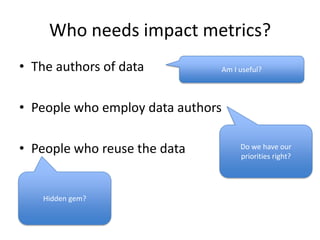
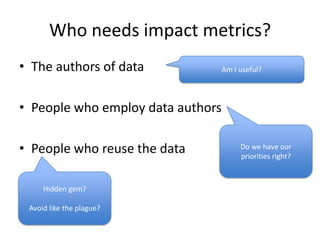
Who needs impact metrics?
• The authors of data
Who needs impact metrics?
• The authors of data
• People who employ data authors
Who needs impact metrics?
• The authors of data
• People who employ data authors
• People who reuse the data
Who needs impact metrics?
• The authors of data
• People who employ data authors
• People who reuse the data

Am I useful?
Who needs impact metrics?
• The authors of data

Am I useful?

• People who employ data authors
• People who reuse the data

Do we have our
priorities right?
Who needs impact metrics?
• The authors of data

Am I useful?

• People who employ data authors
• People who reuse the data

Do we have our
priorities right?
Who needs impact metrics?
• The authors of data

Am I useful?

• People who employ data authors
• People who reuse the data

Hidden gem?

Do we have our
priorities right?
Who needs impact metrics?
• The authors of data

Am I useful?

• People who employ data authors
• People who reuse the data
Hidden gem?
Avoid like the plague?

Do we have our
priorities right?
Our premise
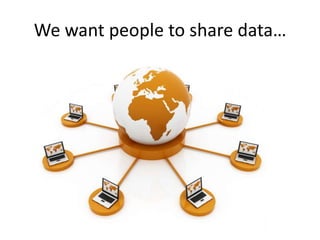
We want people to share data…
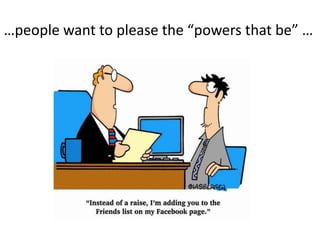
…people want to please the “powers that be” …
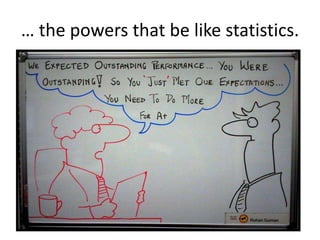
… the powers that be like statistics.
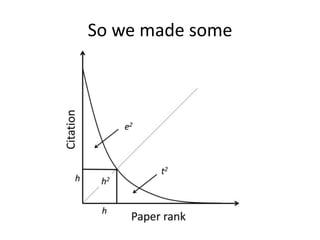
So we made some
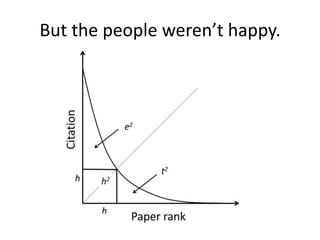
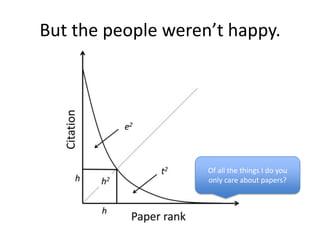
But the people weren’t happy.

Of all the things I do you
only care about papers?
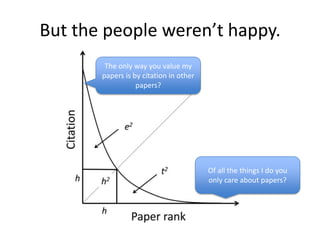
But the people weren’t happy.
The only way you value my
papers is by citation in other
papers?

Of all the things I do you
only care about papers?
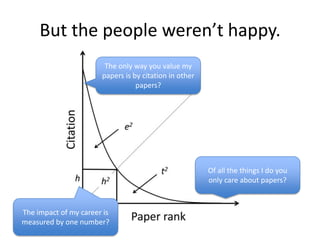
But the people weren’t happy.
The only way you value my
papers is by citation in other
papers?

Of all the things I do you
only care about papers?

The impact of my career is
measured by one number?
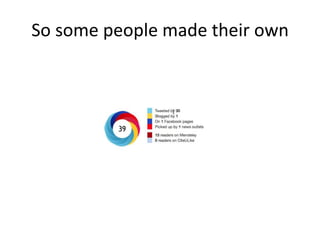
So some people made their own
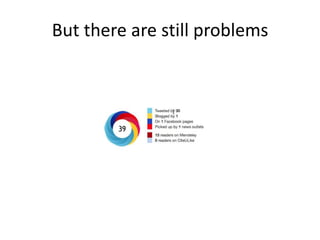
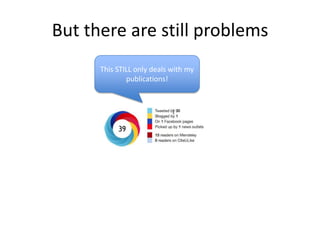
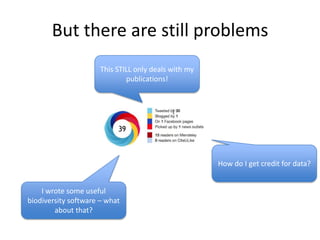
But there are still problems
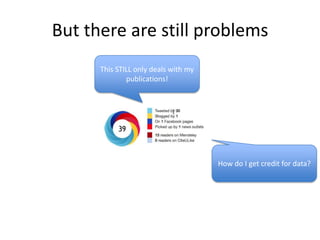
This STILL only deals with my
publications!
But there are still problems
This STILL only deals with my
publications!

How do I get credit for data?
But there are still problems
This STILL only deals with my
publications!

How do I get credit for data?
I wrote some useful
biodiversity software – what
about that?
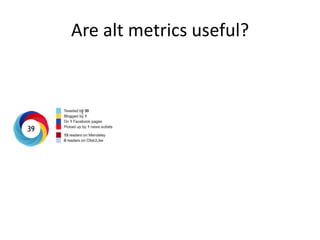
Are alt metrics useful?

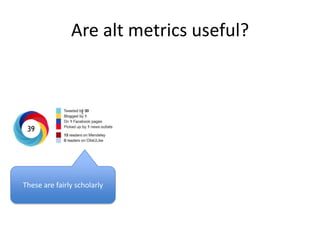
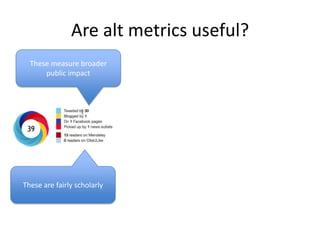
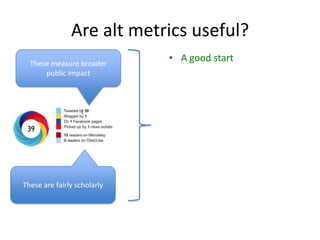
These are fairly scholarly
Are alt metrics useful?
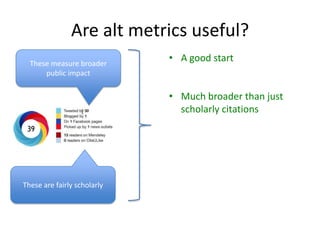
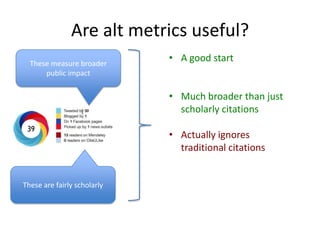
These measure broader
public impact

These are fairly scholarly
Are alt metrics useful?
These measure broader
public impact

These are fairly scholarly

• A good start
Are alt metrics useful?
These measure broader
public impact

• A good start
• Much broader than just
scholarly citations

These are fairly scholarly
Are alt metrics useful?
These measure broader
public impact

• A good start
• Much broader than just
scholarly citations

• Actually ignores
traditional citations

These are fairly scholarly
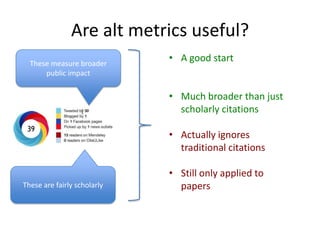
Are alt metrics useful?
These measure broader
public impact

• A good start
• Much broader than just
scholarly citations

• Actually ignores
traditional citations

These are fairly scholarly

• Still only applied to
papers
What are we doing?
What are we doing?
What are we doing?
What are we doing?
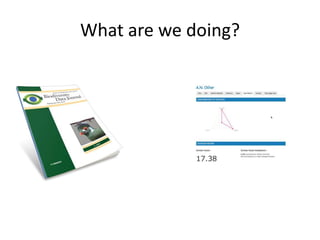
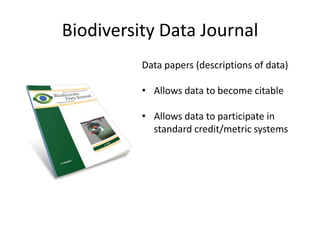
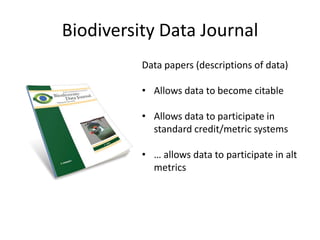
Biodiversity Data Journal
Data papers (descriptions of data)
Biodiversity Data Journal
Data papers (descriptions of data)
• Allows data to become citable
Biodiversity Data Journal
Data papers (descriptions of data)
• Allows data to become citable
• Allows data to participate in
standard credit/metric systems
Biodiversity Data Journal
Data papers (descriptions of data)
• Allows data to become citable
• Allows data to participate in
standard credit/metric systems
• … allows data to participate in alt
metrics
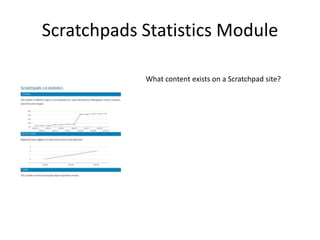
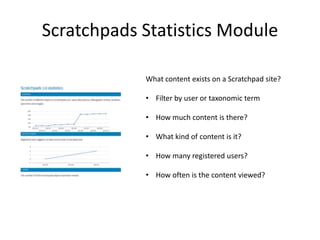
Scratchpads Statistics Module
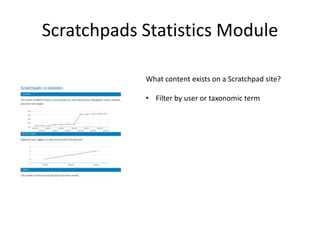
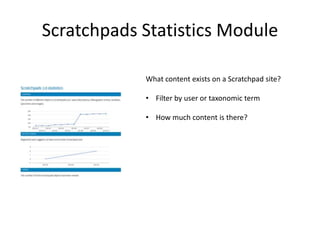
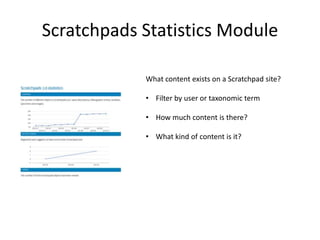
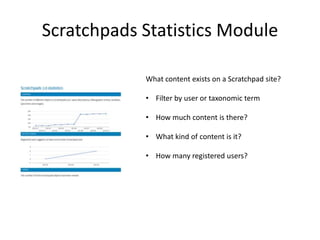
What content exists on a Scratchpad site?
Scratchpads Statistics Module
What content exists on a Scratchpad site?
• Filter by user or taxonomic term
Scratchpads Statistics Module
What content exists on a Scratchpad site?
• Filter by user or taxonomic term

• How much content is there?
Scratchpads Statistics Module
What content exists on a Scratchpad site?
• Filter by user or taxonomic term

• How much content is there?
• What kind of content is it?
Scratchpads Statistics Module
What content exists on a Scratchpad site?
• Filter by user or taxonomic term

• How much content is there?
• What kind of content is it?
• How many registered users?
Scratchpads Statistics Module
What content exists on a Scratchpad site?
• Filter by user or taxonomic term

• How much content is there?
• What kind of content is it?
• How many registered users?

• How often is the content viewed?
Scratchpads Statistics Module
Available now:
http://antkey.org/stats
[scratchpad.url]/stats
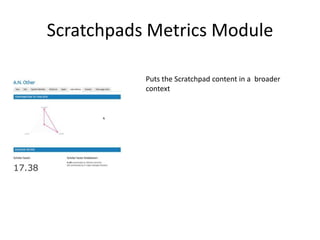
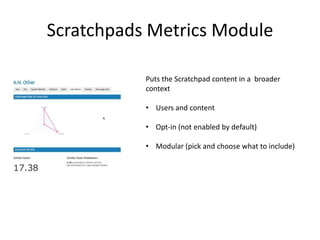
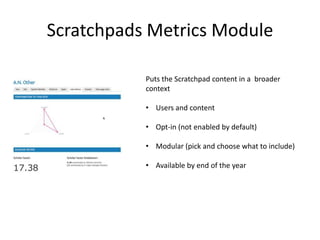
Scratchpads Metrics Module
Puts the Scratchpad content in a broader
context
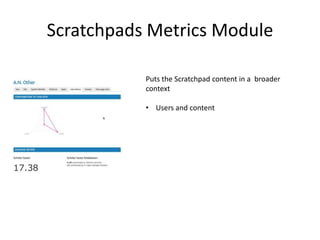
Scratchpads Metrics Module
Puts the Scratchpad content in a broader
context
• Users and content
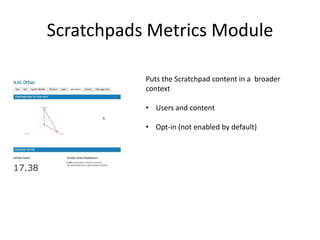
Scratchpads Metrics Module
Puts the Scratchpad content in a broader
context
• Users and content
• Opt-in (not enabled by default)
Scratchpads Metrics Module
Puts the Scratchpad content in a broader
context
• Users and content
• Opt-in (not enabled by default)
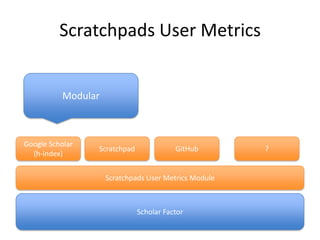
• Modular (pick and choose what to include)
Scratchpads Metrics Module
Puts the Scratchpad content in a broader
context
• Users and content
• Opt-in (not enabled by default)
• Modular (pick and choose what to include)
• Available by end of the year
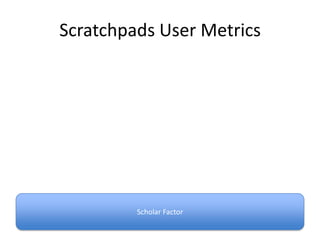
Scratchpads User Metrics
A partial implementation of the Scholar Factor
proposed by Bourne and Fink
Scratchpads User Metrics
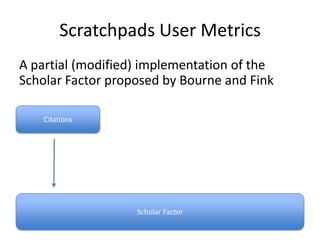
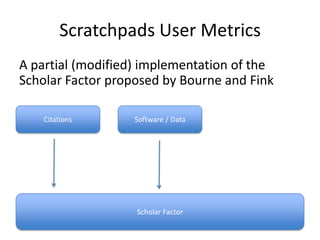
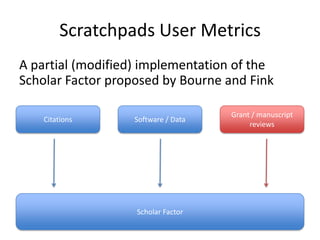
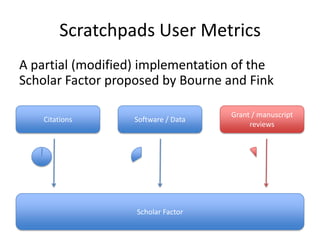
A partial (modified) implementation of the
Scholar Factor proposed by Bourne and Fink
Citations
Scratchpads User Metrics
A partial (modified) implementation of the
Scholar Factor proposed by Bourne and Fink
Citations

Scholar Factor
Scratchpads User Metrics
A partial (modified) implementation of the
Scholar Factor proposed by Bourne and Fink
Citations

Software / Data

Scholar Factor
Scratchpads User Metrics
A partial (modified) implementation of the
Scholar Factor proposed by Bourne and Fink
Citations

Software / Data

Scholar Factor

Grant / manuscript
reviews
Scratchpads User Metrics
A partial (modified) implementation of the
Scholar Factor proposed by Bourne and Fink
Citations

Software / Data

Scholar Factor

Grant / manuscript
reviews
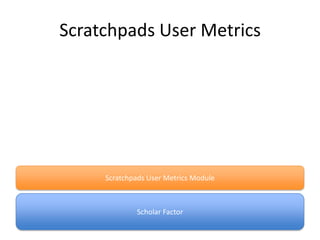
Scratchpads User Metrics

Scholar Factor
Scratchpads User Metrics

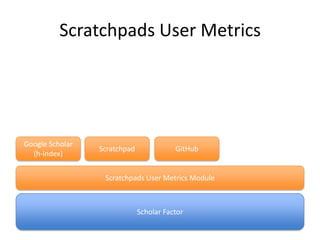
Scratchpads User Metrics Module

Scholar Factor
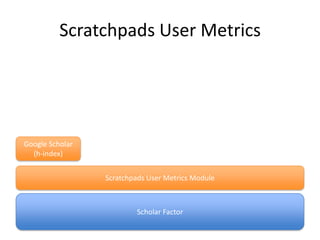
Scratchpads User Metrics

Google Scholar
(h-index)
Scratchpads User Metrics Module

Scholar Factor
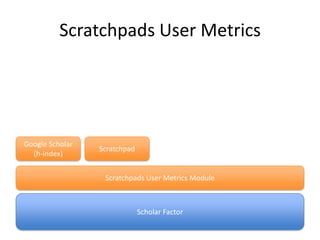
Scratchpads User Metrics

Google Scholar
(h-index)

Scratchpad

Scratchpads User Metrics Module

Scholar Factor
Scratchpads User Metrics

Google Scholar
(h-index)

Scratchpad

GitHub

Scratchpads User Metrics Module

Scholar Factor
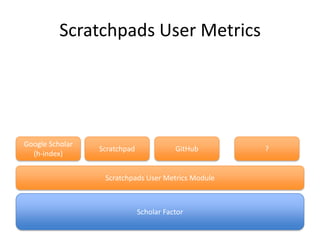
Scratchpads User Metrics

Google Scholar
(h-index)

Scratchpad

GitHub

Scratchpads User Metrics Module

Scholar Factor

?
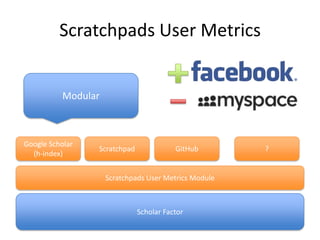
Scratchpads User Metrics

Modular

Google Scholar
(h-index)

Scratchpad

GitHub

Scratchpads User Metrics Module

Scholar Factor

?
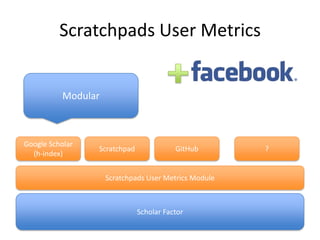
Scratchpads User Metrics

Modular

Google Scholar
(h-index)

Scratchpad

GitHub

Scratchpads User Metrics Module

Scholar Factor

?
Scratchpads User Metrics

Modular

Google Scholar
(h-index)

Scratchpad

GitHub

Scratchpads User Metrics Module

Scholar Factor

?
Same modular structure for content
• Number of web links to page
Same modular structure for content
• Number of web links to page
• Scholarly links (Google Scholar)
Same modular structure for content
• Number of web links to page
• Scholarly links (Google Scholar)
• Social links
Summary
We’re not there yet.
Summary
We’re not there yet, but we have …
Summary
We’re not there yet, but we have…
• Modular framework to add services as they
become available
Summary
We’re not there yet, but we have…
• Modular framework to add services as they
become available
• multi-dimensional – not just papers and
citations
Summary
We’re not there yet, but we have…
• Modular framework to add services as they
become available
• multi-dimensional – not just papers and
citations
• Not a one size fits all approach
Summary
We’re not there yet, but we have…
• Modular framework to add services as they
become available
• multi-dimensional – not just papers and
citations
• Not a one size fits all approach
Measuring Impact: Towards a data citation metric

Measuring Impact: Towards a data citation metric

Editor's Notes

  • #3 This work has been done under the ViBRANT and eMonocot projects. Much of this relates to Scratchpads which are in a simple terms an online content management system for biodiversity data (if you really want to know more you may want to leave and go next door as there is a summary of the project going on there).
  • #4 These projects focus on data collection and curation, and making it available for reuse. Both projects use Scratchpads for a large part of this process.
  • #5 In all large projects we like to know how well we are doing. But this is a pretty selfish use of statistics and metrics.
  • #7 Communities are the core of these projects. We build tools for communities.
  • #8 so we also need to consider how we build metrics tools for communities.
  • #9 This might be allowing people to see how much they have contributed to a project, or conversely letting people using the project see who has contributed
  • #10 We’d like a way to show people how the content they have generated is being used: who links to it, has it been shared socially, has it been traditionally cited, have people reused the data for novel purposes.
  • #11 As part of ViBRANT there are a few citizen science projects so we also need to consider how we build metrics tools for communities
  • #13 Collecting observation data via mobile phone
  • #14 We’re working on a citizen science platform for Scratchpads
  • #15 Metrics provide an added layer of incentive for citizen scientists – they could form the basis of a gamification reward system and allow people to quanify their involvement.
  • #19 People who reuse their data. All of these different people need metrics to answer specific questions.
  • #29 Perhaps the stereotypical metric – the h-index
  • #33 We’ve found a way of creating a number out of one aspect of our output, and many people use it as proxy for the rest of what scientists do.
  • #34 There has been a move towards alternative metrics, this example uses the altmetric
  • #35 But there are still some problems with this method
  • #41 Some parts of the metric, like Mendeley, can be considered to be fairly scholarly
  • #49 Scratchpads metrics module
  • #50 Scratchpads statistics module
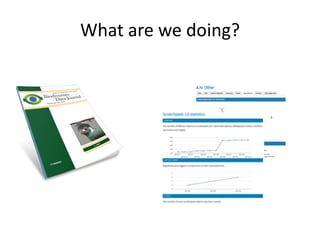
  • #51 It’s possible to publish data from a Scratchpad in the recently launched Biodiversity Data Journal, so an opportunity for some metrics activity.
  • #52 Through CrossRef DOI
  • #55 The Scratchpads statistics module provides information about the content on a given Scratchpad.
  • #56 Filtering by user or taxonomic term means it’s easy to find out how much people have contributed, and how content is available for a given taxon.
  • #58 If you’re looking for references or images you know how rich a resource this site might be.
  • #59 Might give an indication of how active a community is
  • #60 Do other people find the content useful?
  • #64 This isn’t perfect, in fact it’s pretty experimental. So it will be on an opt-in basis.
  • #65 Not every community wants the same set of criteria.
  • #68 Traditional citations still play a part.
  • #70 You also get credit for software you have written and datasets that you have created
  • #71 Also get credit for grant and manuscript reviews. This is perhaps the trickiest part – but we are working with Pensoft to include this for reviews of papers in their journals.
  • #72 Some of these things take more effort than others, so they are weighted.
  • #73 So we have seen the theoretical model, now for the implementation we have created.
  • #74 The user metrics module deals with the aggregation, weighting and display of metrics data.
  • #75 A number of helper modules are responsible for getting the required data from external sources.
  • #78 It’s easy to write a module that can supply data – maybe as little as 20 lines of code.
  • #79 Modular design allow for a mix-and-match set of functionality, that also has some degree of future proofing. As a maybe slightly extreme example…
  • #80 … we could add Facebook….
  • #81 .. And remove legacy systems
  • #83 One of the most basic web metrics available
  • #84 We have done studies on links to Scratchpad content in articles on Google Scholar – and there has been a noticeable increase in recent years.
  • #85 Also take some ideas from the altmetric community.