Open Science for sustainability and inclusiveness:
the SKA role model
Lourdes Verdes-Montenegro, Susana Sánchez
IAA Severo Ochoa Centre of Excellence (CSIC)
Open Science: a new concept?
• Too many adjectives for science:
excellent, high quality, trustable, … Open
• Too many adjectives for science:
excellent, high quality, trustable, … Open
Scientific Reproducibility is a fundamental
principle of the Scientific Method, a
process established in the 17th century that
marked the beginning of modern science
and laid the foundations for the Philosophy
of Science
• Let’s go back 383 years in time…
• Science = Scientific Method = Reproducible = Open!
Open Science: a new concept?
Open Science: but then we already follow it, right?
• We are scientists! We (want to) follow the Scientific Method!
2016
Open Science: but then we already follow it, right?
• We are scientists! We (want to) follow the Scientific Method!
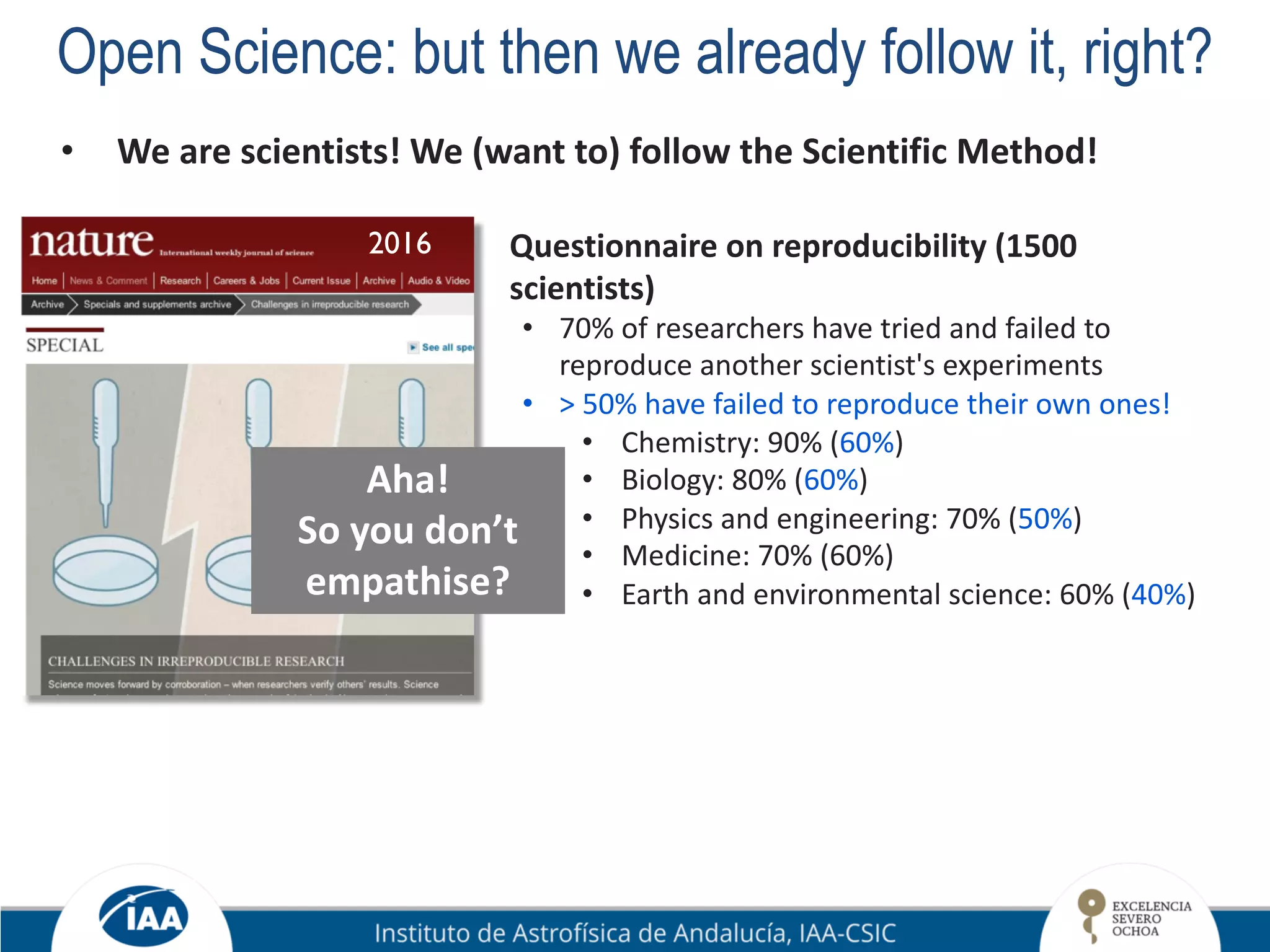
Questionnaire on reproducibility (1500
scientists)
• 70% of researchers have tried and failed to
reproduce another scientist's experiments
• > 50% have failed to reproduce their own ones!
• Chemistry: 90% (60%)
• Biology: 80% (60%)
• Physics and engineering: 70% (50%)
• Medicine: 70% (60%)
• Earth and environmental science: 60% (40%)
2016
Open Science: but then we already follow it, right?
• We are scientists! We (want to) follow the Scientific Method!
Questionnaire on reproducibility (1500
scientists)
• 70% of researchers have tried and failed to
reproduce another scientist's experiments
• > 50% have failed to reproduce their own ones!
• Chemistry: 90% (60%)
• Biology: 80% (60%)
• Physics and engineering: 70% (50%)
• Medicine: 70% (60%)
• Earth and environmental science: 60% (40%)
2016
Aha!
So you don’t
empathise?
Open Science: but then we already follow it, right?
• We are scientists! We (want to) follow the Scientific Method!
Questionnaire on reproducibility (1500
scientists)
• 70% of researchers have tried and failed to
reproduce another scientist's experiments
• > 50% have failed to reproduce their own ones!
• Chemistry: 90% (60%)
• Biology: 80% (60%)
• Physics and engineering: 70% (50%)
• Medicine: 70% (60%)
• Earth and environmental science: 60% (40%)
2016
Aha!
So you don’t
empathise?
Maybe with this?
Open Science: then what happened since 1637?
• Moving beyond the PDF
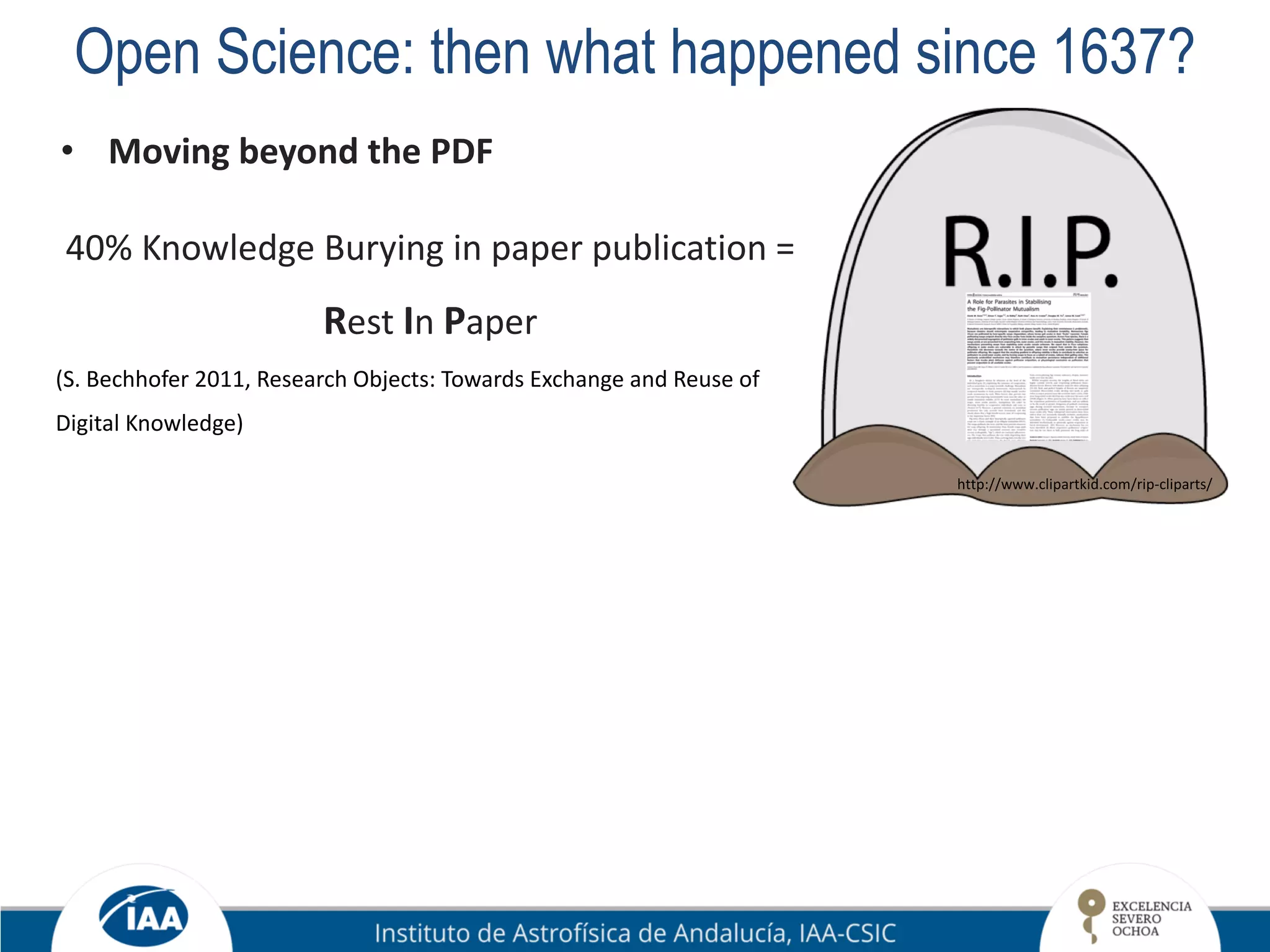
40% Knowledge Burying in paper publication =
Rest In Paper
(S. Bechhofer 2011, Research Objects: Towards Exchange and Reuse of
Digital Knowledge)
http://www.clipartkid.com/rip-cliparts/
Open Science: then what happened since 1637?
• Moving beyond the PDF
http://www.clipartkid.com/rip-cliparts/
Moving from narratives (last 300 yrs) to the
actual output of research is not so easy
40% Knowledge Burying in paper publication =
Rest In Paper
(S. Bechhofer 2011, Research Objects: Towards Exchange and Reuse of
Digital Knowledge)
In practice
Open Science represents an approach to research that is collaborative,
transparent and accessible
Open Science definition, European Commission, 2017, doi: 10.2777/75255
Open Science for sustainability and inclusiveness
Remember: Open Science started bottom-up
(DORA, Metric Tide, Leiden Manifesto, Altmetrics, etc)
Open Science embodies the need to transform, open and democratize
the entire knowledge generation to ensure that every scientific challenge
is faced and really drives and allows the achievement of the United
Nations Sustainable Development Goals
UNESCO and Open Science [1]
[1]https://en.unesco.org/news/unesco-launches-global-consultation-develop-standard-setting-instrument-open-science
Open Science for sustainability and inclusiveness
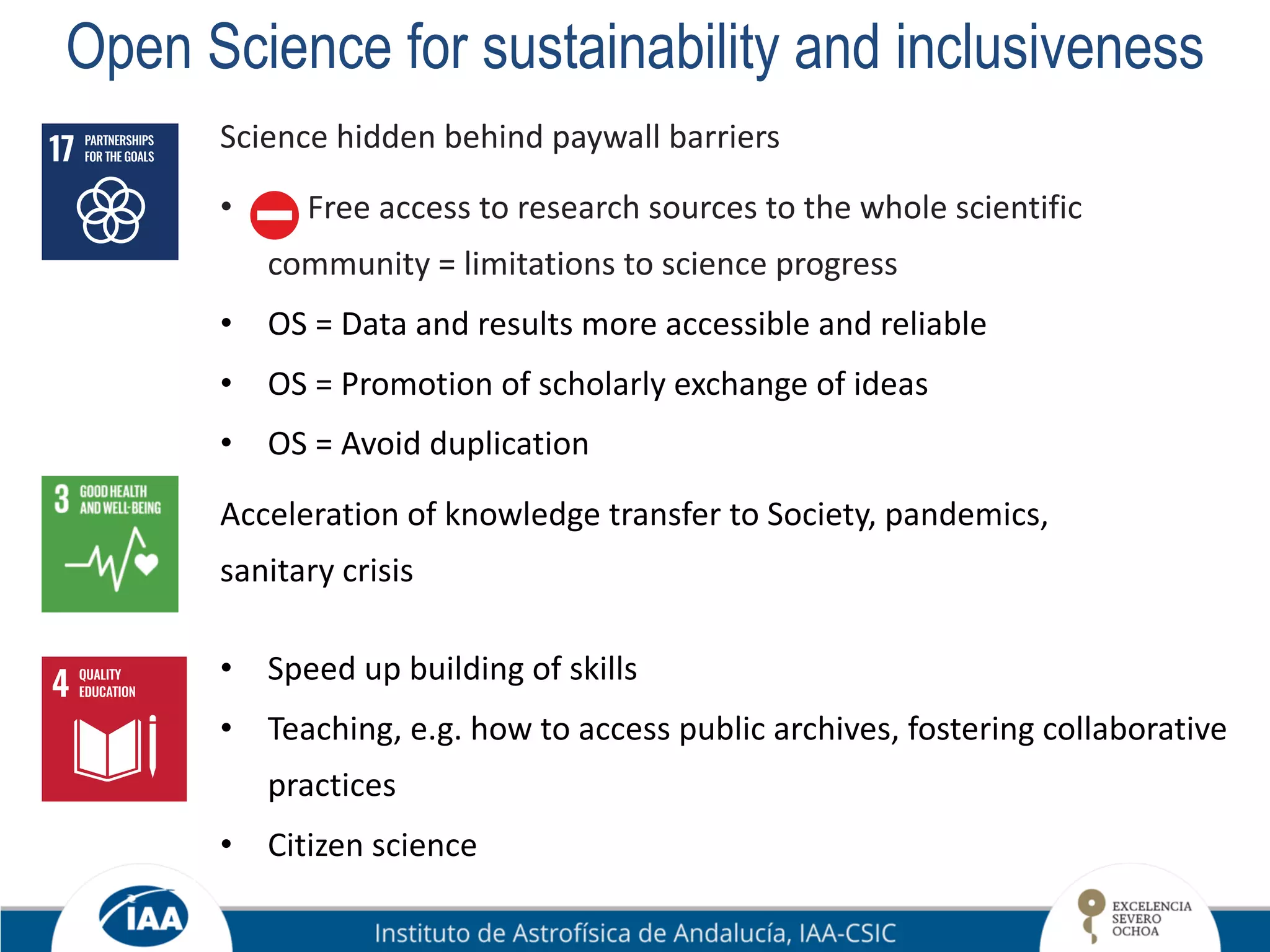
Science hidden behind paywall barriers
• Free access to research sources to the whole scientific
community = limitations to science progress
• OS = Data and results more accessible and reliable
• OS = Promotion of scholarly exchange of ideas
• OS = Avoid duplication
Acceleration of knowledge transfer to Society, pandemics,
sanitary crisis
• Speed up building of skills
• Teaching, e.g. how to access public archives, fostering collaborative
practices
• Citizen science
Open Science for sustainability and inclusiveness
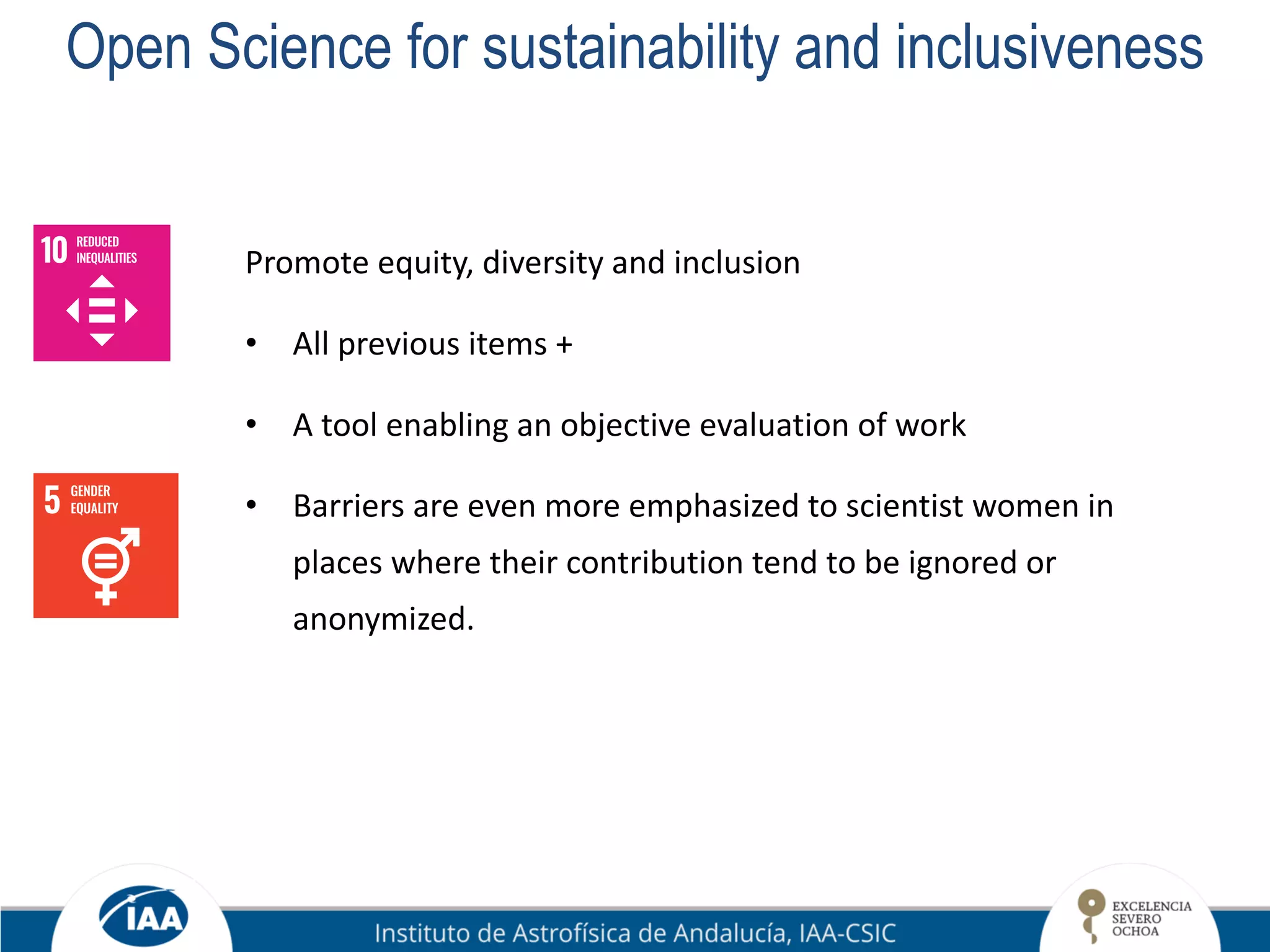
Promote equity, diversity and inclusion
• All previous items +
• A tool enabling an objective evaluation of work
• Barriers are even more emphasized to scientist women in
places where their contribution tend to be ignored or
anonymized.
Open Science
Open Science in the Big Data era
We are in a race to exploit ever larger datasets
in our quest for “efficiency” we risk forgetting about reproducibility
The era of Big Data is beginning across sciences
Today is the time to ask
What kind of research want mega-science
infrastructures to do in tomorrow’s future?
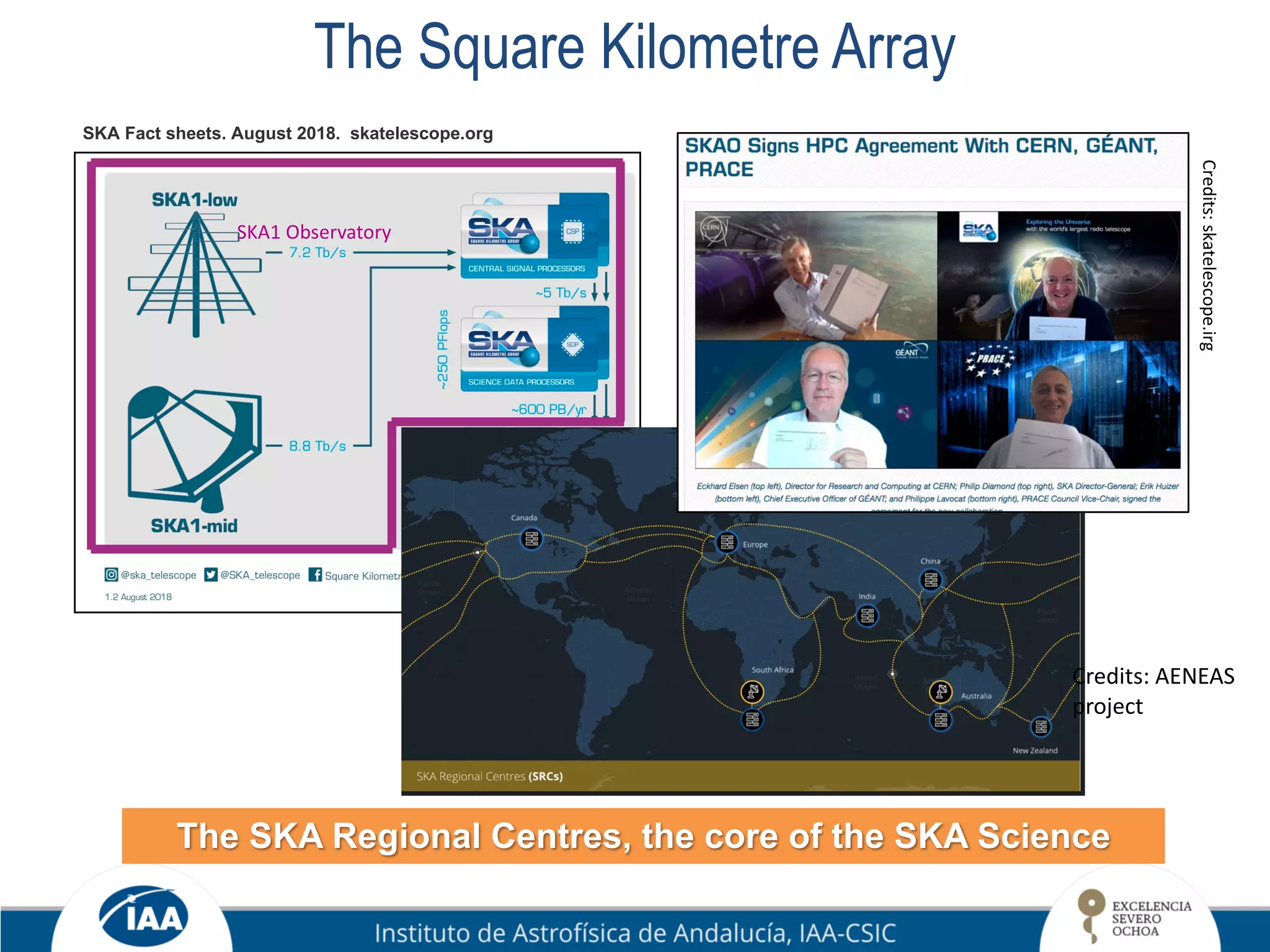
The Square Kilometre Array
SKA1 Observatory
SKA Fact sheets. August 2018. skatelescope.org
The SKA Regional Centres, the core of the SKA Science
Credits: AENEAS
project
Credits:skatelescope.irg
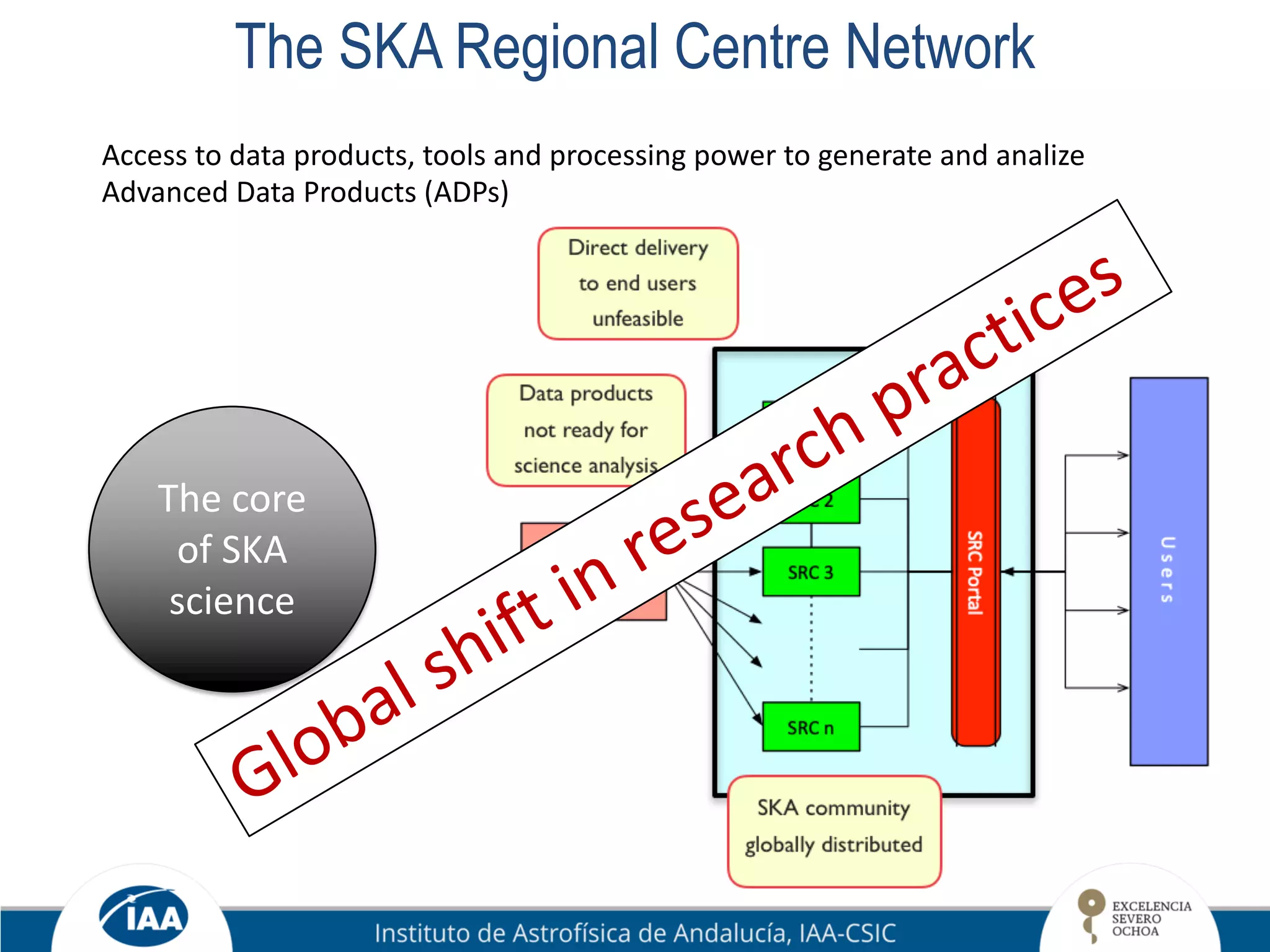
Access to data products, tools and processing power to generate and analize
Advanced Data Products (ADPs)
The SKA Regional Centre Network
The core
of SKA
science
Access to data products, tools and processing power to generate and analize
Advanced Data Products (ADPs)
The SKA Regional Centre Network
The core
of SKA
science
Global shift in research practices
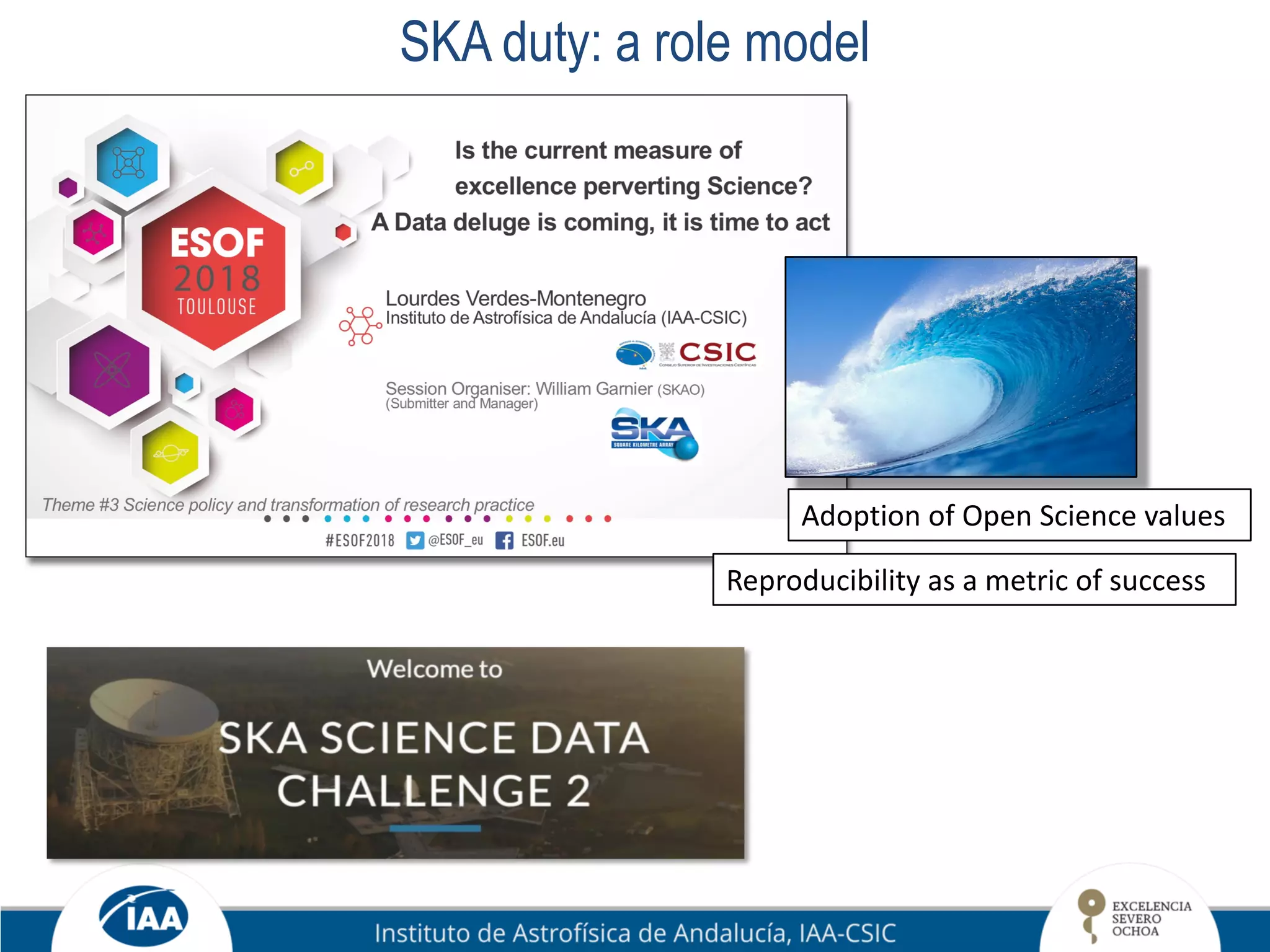
SKA duty: a role model
Reproducibility as a metric of success
Adoption of Open Science values
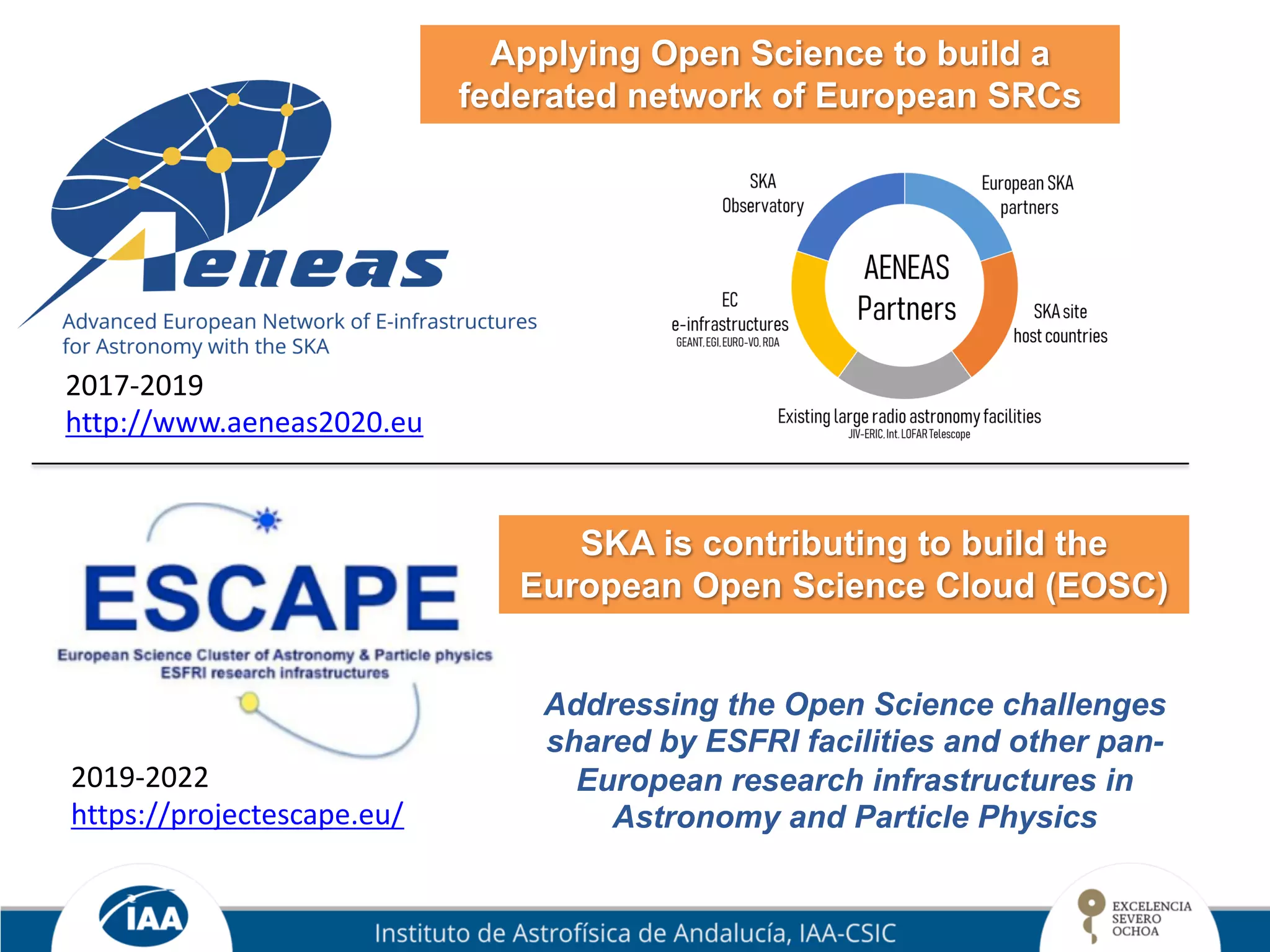
2017-2019
http://www.aeneas2020.eu
Applying Open Science to build a
federated network of European SRCs
SKA is contributing to build the
European Open Science Cloud (EOSC)
Addressing the Open Science challenges
shared by ESFRI facilities and other pan-
European research infrastructures in
Astronomy and Particle Physics
2019-2022
https://projectescape.eu/
The challenge from different perspectives
Implementation of Open, reproducible science
is challenging, even more in this new
framework:
Individual users
Large teams
Service providers
Publishers
Evaluators/Funding
agencies
new roles new perspectives
Data to the desktop: “individual scientist”
• I have the best code, which I know how to use and can do special things
• I do not trust any pipeline that you made
• partly because I know better how to do it
• partly because I read the news and there is a reproducibility crisis
• well, and I can hardly reproduce the results of my own papers some years later...
• In general I want full control of the software and of the computational
environment
About trust
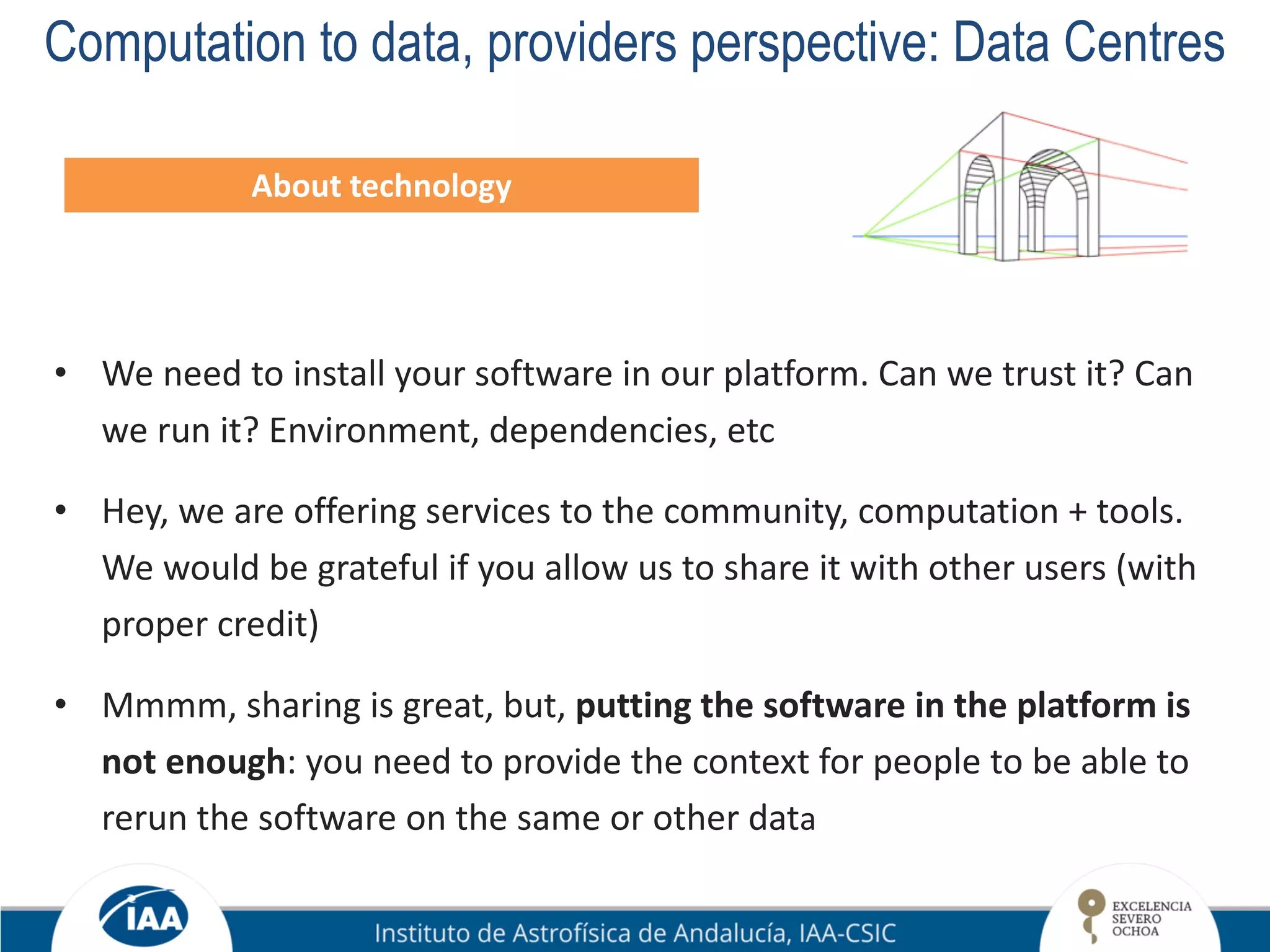
Computation to data, providers perspective: Data Centres
About technology
• We need to install your software in our platform. Can we trust it? Can
we run it? Environment, dependencies, etc
• Hey, we are offering services to the community, computation + tools.
We would be grateful if you allow us to share it with other users (with
proper credit)
• Mmmm, sharing is great, but, putting the software in the platform is
not enough: you need to provide the context for people to be able to
rerun the software on the same or other data
Large alliances of scientists
About metrics of research careers
• We have tools to generate Advanced Data Products, and we will put
them there where the storage and computation is (Data Centres)
• But... we put effort on it, what would we gain if we make the
*additional effort* to make it reusable? If we make it, then we will
pave the way to competitors
• Well, maybe we will share in 4 yrs time (PhD typical time)
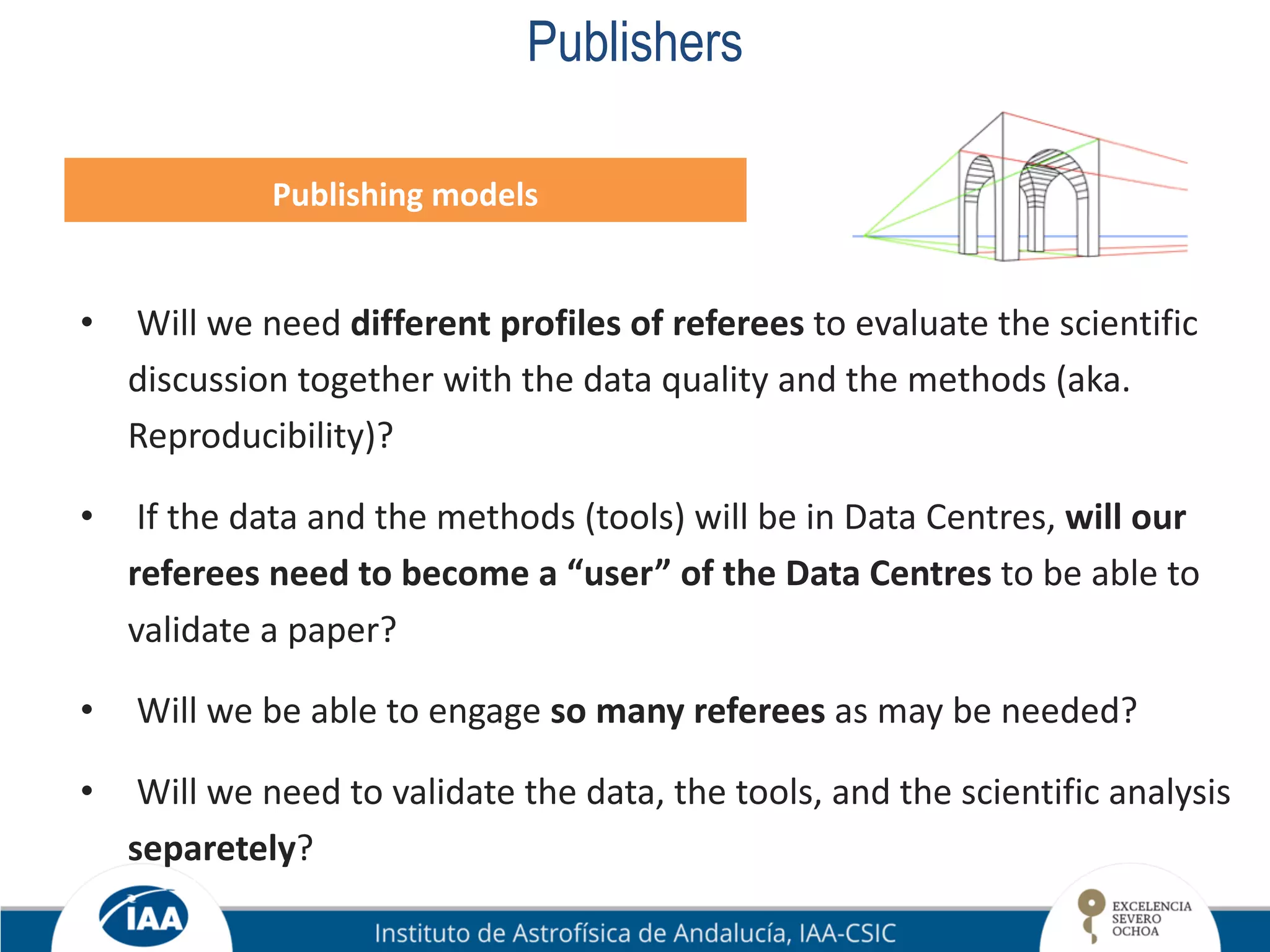
Publishers
Publishing models
• Will we need different profiles of referees to evaluate the scientific
discussion together with the data quality and the methods (aka.
Reproducibility)?
• If the data and the methods (tools) will be in Data Centres, will our
referees need to become a “user” of the Data Centres to be able to
validate a paper?
• Will we be able to engage so many referees as may be needed?
• Will we need to validate the data, the tools, and the scientific analysis
separetely?
Policy makers / funding agencies
Evaluation
• How to measure reproducibility?
• How to weight it and/or aggregate with other indicators?
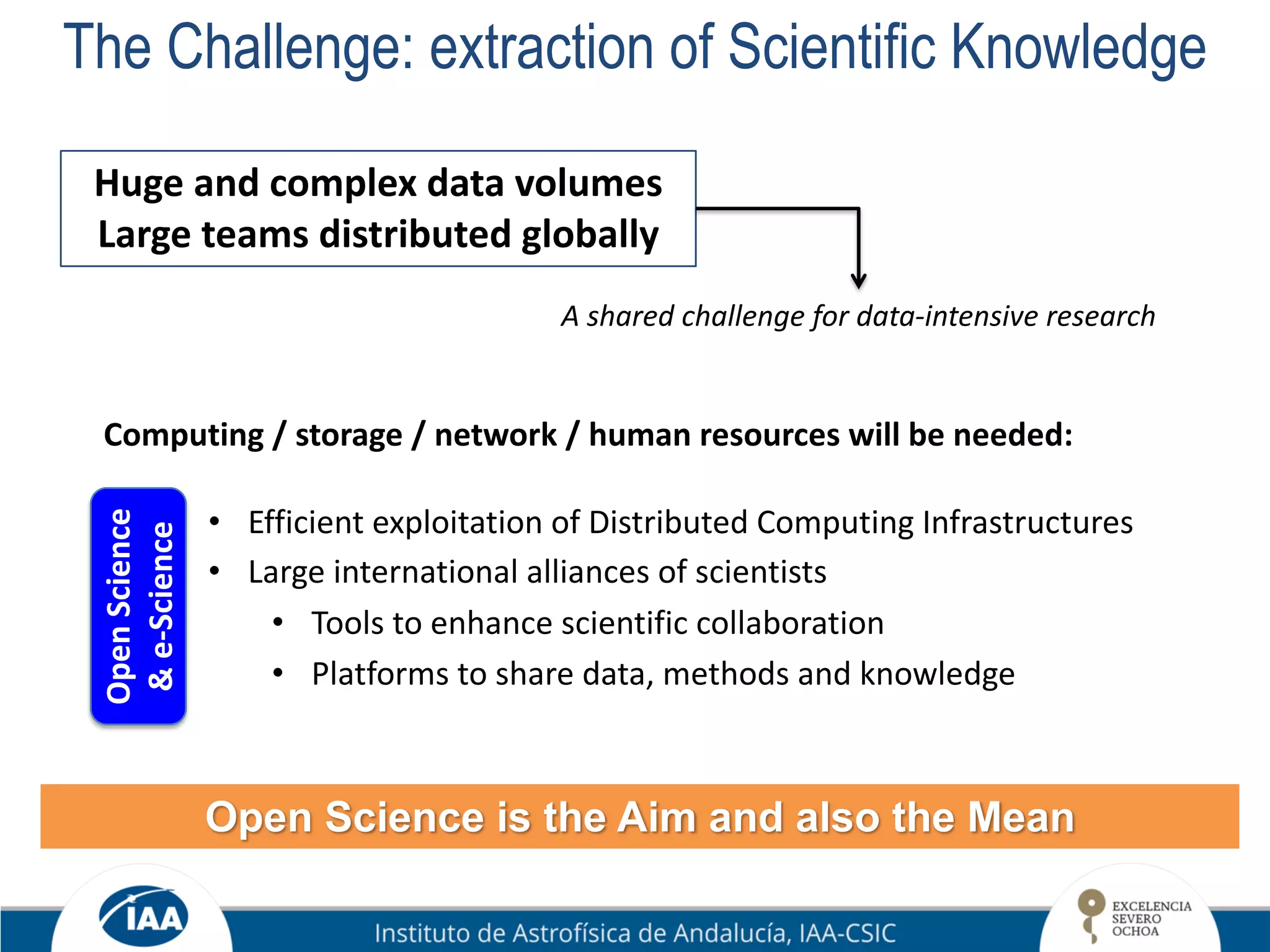
The Challenge: extraction of Scientific Knowledge
Huge and complex data volumes
Large teams distributed globally
A shared challenge for data-intensive research
Computing / storage / network / human resources will be needed:
• Efficient exploitation of Distributed Computing Infrastructures
• Large international alliances of scientists
• Tools to enhance scientific collaboration
• Platforms to share data, methods and knowledge
OpenScience
&e-Science
Open Science is the Aim and also the Mean
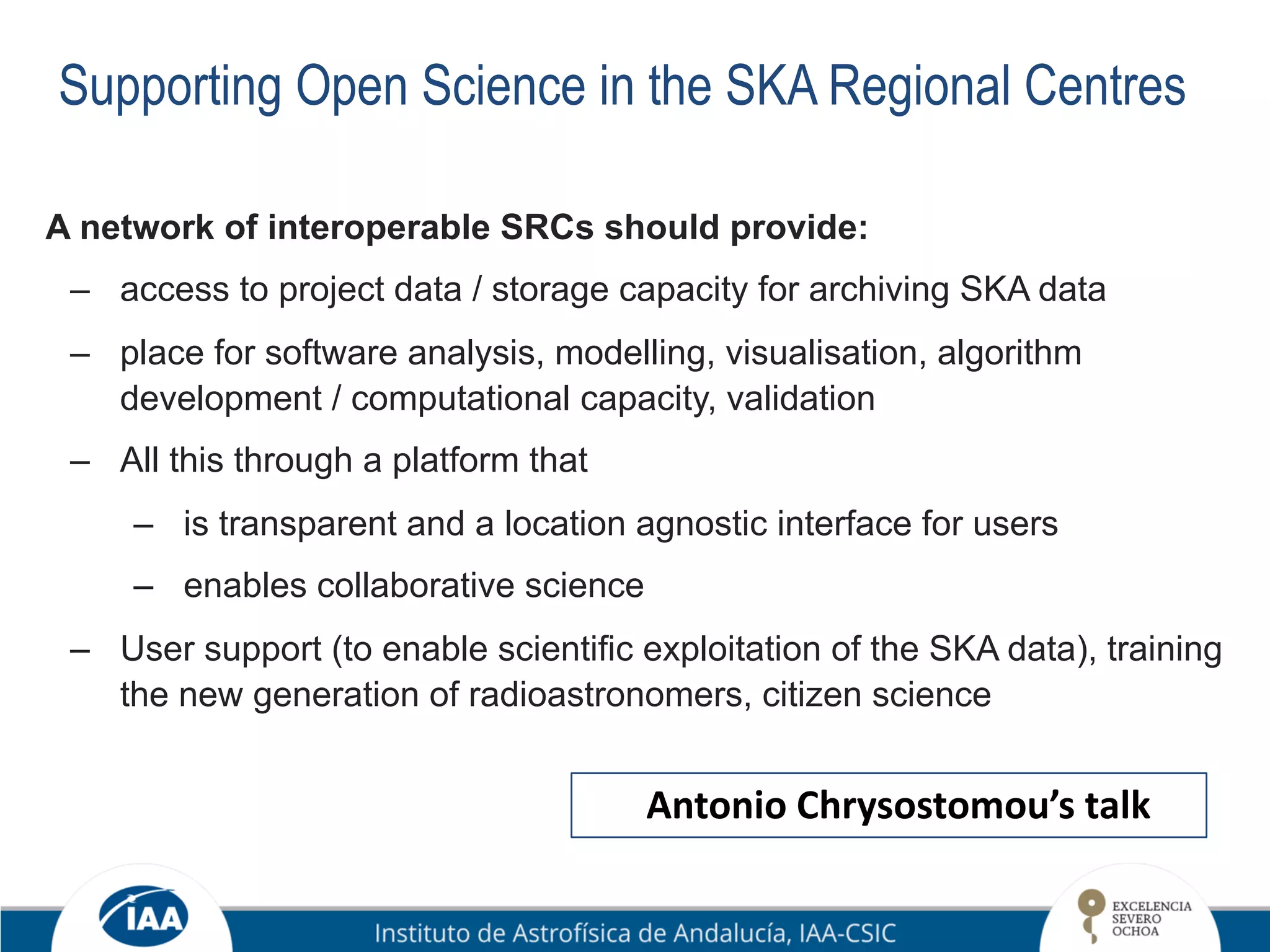
Supporting Open Science in the SKA Regional Centres
A network of interoperable SRCs should provide:
– access to project data / storage capacity for archiving SKA data
– place for software analysis, modelling, visualisation, algorithm
development / computational capacity, validation
– All this through a platform that
– is transparent and a location agnostic interface for users
– enables collaborative science
– User support (to enable scientific exploitation of the SKA data), training
the new generation of radioastronomers, citizen science
Antonio Chrysostomou’s talk
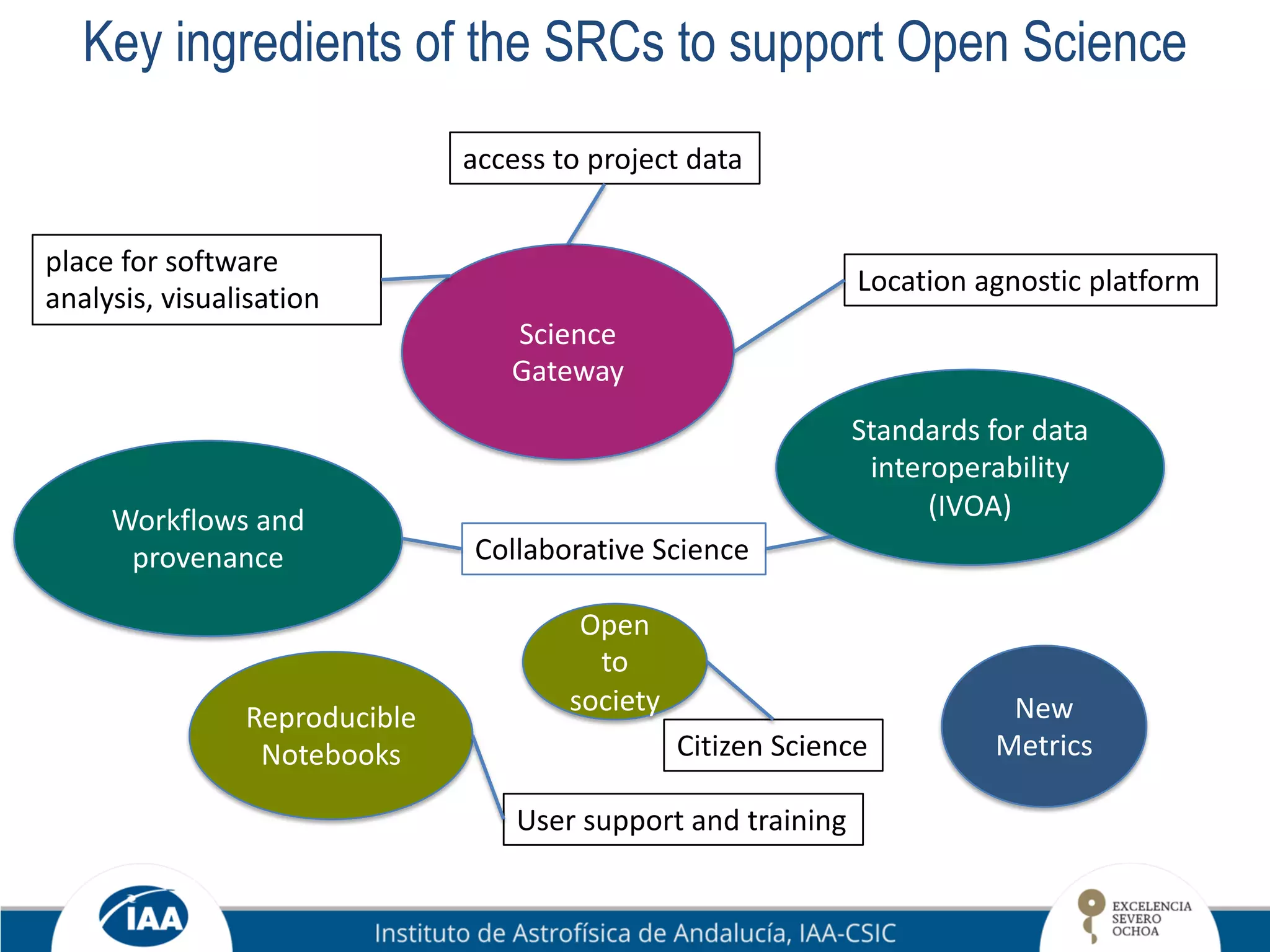
Key ingredients of the SRCs to support Open Science
Science
Gateway
New
Metrics
Workflows and
provenance
Reproducible
Notebooks
Standards for data
interoperability
(IVOA)
access to project data
place for software
analysis, visualisation
Location agnostic platform
Collaborative Science
User support and training
Open
to
society
Citizen Science
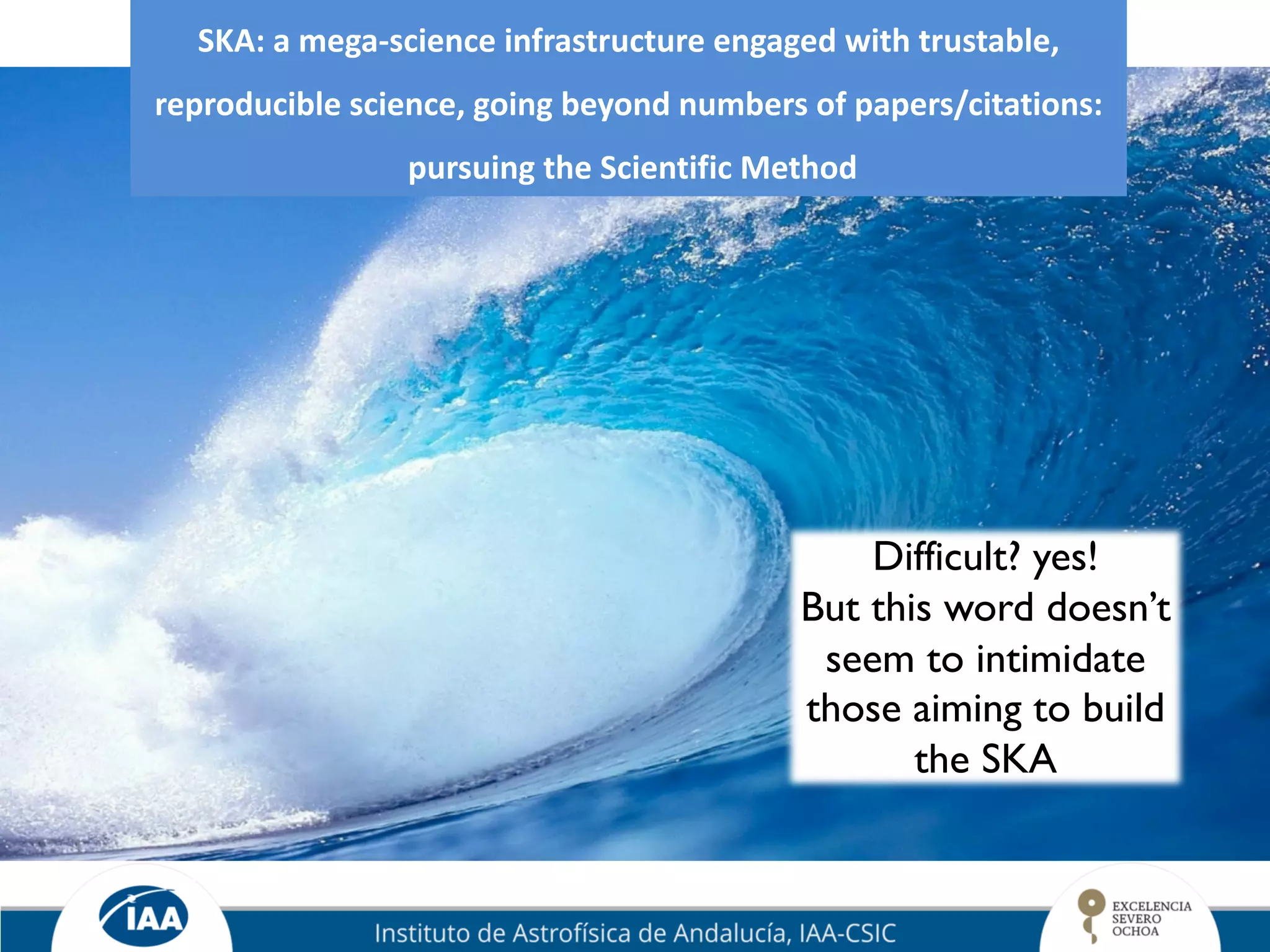
SKA: a mega-science infrastructure engaged with trustable,
reproducible science, going beyond numbers of papers/citations:
pursuing the Scientific Method
Difficult? yes!
But this word doesn’t
seem to intimidate
those aiming to build
the SKA
SKA: a mega-science infrastructure engaged with trustable,
reproducible science, going beyond numbers of papers/citations:
pursuing the Scientific Method
Difficult? yes!
But this word doesn’t
seem to intimidate
those aiming to build
the SKA
THANK YOU FOR YOUR
ATTENTION

Open Science for sustainability and inclusiveness: the SKA role model

  • 1.
    Open Science forsustainability and inclusiveness: the SKA role model Lourdes Verdes-Montenegro, Susana Sánchez IAA Severo Ochoa Centre of Excellence (CSIC)
  • 2.
    Open Science: anew concept? • Too many adjectives for science: excellent, high quality, trustable, … Open
  • 3.
    • Too manyadjectives for science: excellent, high quality, trustable, … Open Scientific Reproducibility is a fundamental principle of the Scientific Method, a process established in the 17th century that marked the beginning of modern science and laid the foundations for the Philosophy of Science • Let’s go back 383 years in time… • Science = Scientific Method = Reproducible = Open! Open Science: a new concept?
  • 4.
    Open Science: butthen we already follow it, right? • We are scientists! We (want to) follow the Scientific Method! 2016
  • 5.
    Open Science: butthen we already follow it, right? • We are scientists! We (want to) follow the Scientific Method! Questionnaire on reproducibility (1500 scientists) • 70% of researchers have tried and failed to reproduce another scientist's experiments • > 50% have failed to reproduce their own ones! • Chemistry: 90% (60%) • Biology: 80% (60%) • Physics and engineering: 70% (50%) • Medicine: 70% (60%) • Earth and environmental science: 60% (40%) 2016
  • 6.
    Open Science: butthen we already follow it, right? • We are scientists! We (want to) follow the Scientific Method! Questionnaire on reproducibility (1500 scientists) • 70% of researchers have tried and failed to reproduce another scientist's experiments • > 50% have failed to reproduce their own ones! • Chemistry: 90% (60%) • Biology: 80% (60%) • Physics and engineering: 70% (50%) • Medicine: 70% (60%) • Earth and environmental science: 60% (40%) 2016 Aha! So you don’t empathise?
  • 7.
    Open Science: butthen we already follow it, right? • We are scientists! We (want to) follow the Scientific Method! Questionnaire on reproducibility (1500 scientists) • 70% of researchers have tried and failed to reproduce another scientist's experiments • > 50% have failed to reproduce their own ones! • Chemistry: 90% (60%) • Biology: 80% (60%) • Physics and engineering: 70% (50%) • Medicine: 70% (60%) • Earth and environmental science: 60% (40%) 2016 Aha! So you don’t empathise? Maybe with this?
  • 8.
    Open Science: thenwhat happened since 1637? • Moving beyond the PDF 40% Knowledge Burying in paper publication = Rest In Paper (S. Bechhofer 2011, Research Objects: Towards Exchange and Reuse of Digital Knowledge) http://www.clipartkid.com/rip-cliparts/
  • 9.
    Open Science: thenwhat happened since 1637? • Moving beyond the PDF http://www.clipartkid.com/rip-cliparts/ Moving from narratives (last 300 yrs) to the actual output of research is not so easy 40% Knowledge Burying in paper publication = Rest In Paper (S. Bechhofer 2011, Research Objects: Towards Exchange and Reuse of Digital Knowledge) In practice
  • 10.
    Open Science representsan approach to research that is collaborative, transparent and accessible Open Science definition, European Commission, 2017, doi: 10.2777/75255 Open Science for sustainability and inclusiveness Remember: Open Science started bottom-up (DORA, Metric Tide, Leiden Manifesto, Altmetrics, etc) Open Science embodies the need to transform, open and democratize the entire knowledge generation to ensure that every scientific challenge is faced and really drives and allows the achievement of the United Nations Sustainable Development Goals UNESCO and Open Science [1] [1]https://en.unesco.org/news/unesco-launches-global-consultation-develop-standard-setting-instrument-open-science
  • 11.
    Open Science forsustainability and inclusiveness Science hidden behind paywall barriers • Free access to research sources to the whole scientific community = limitations to science progress • OS = Data and results more accessible and reliable • OS = Promotion of scholarly exchange of ideas • OS = Avoid duplication Acceleration of knowledge transfer to Society, pandemics, sanitary crisis • Speed up building of skills • Teaching, e.g. how to access public archives, fostering collaborative practices • Citizen science
  • 12.
    Open Science forsustainability and inclusiveness Promote equity, diversity and inclusion • All previous items + • A tool enabling an objective evaluation of work • Barriers are even more emphasized to scientist women in places where their contribution tend to be ignored or anonymized.
  • 13.
  • 14.
    Open Science inthe Big Data era We are in a race to exploit ever larger datasets in our quest for “efficiency” we risk forgetting about reproducibility The era of Big Data is beginning across sciences Today is the time to ask What kind of research want mega-science infrastructures to do in tomorrow’s future?
  • 15.
    The Square KilometreArray SKA1 Observatory SKA Fact sheets. August 2018. skatelescope.org The SKA Regional Centres, the core of the SKA Science Credits: AENEAS project Credits:skatelescope.irg
  • 16.
    Access to dataproducts, tools and processing power to generate and analize Advanced Data Products (ADPs) The SKA Regional Centre Network The core of SKA science
  • 17.
    Access to dataproducts, tools and processing power to generate and analize Advanced Data Products (ADPs) The SKA Regional Centre Network The core of SKA science Global shift in research practices
  • 18.
    SKA duty: arole model Reproducibility as a metric of success Adoption of Open Science values
  • 19.
    2017-2019 http://www.aeneas2020.eu Applying Open Scienceto build a federated network of European SRCs SKA is contributing to build the European Open Science Cloud (EOSC) Addressing the Open Science challenges shared by ESFRI facilities and other pan- European research infrastructures in Astronomy and Particle Physics 2019-2022 https://projectescape.eu/
  • 20.
    The challenge fromdifferent perspectives Implementation of Open, reproducible science is challenging, even more in this new framework: Individual users Large teams Service providers Publishers Evaluators/Funding agencies new roles new perspectives
  • 21.
    Data to thedesktop: “individual scientist” • I have the best code, which I know how to use and can do special things • I do not trust any pipeline that you made • partly because I know better how to do it • partly because I read the news and there is a reproducibility crisis • well, and I can hardly reproduce the results of my own papers some years later... • In general I want full control of the software and of the computational environment About trust
  • 22.
    Computation to data,providers perspective: Data Centres About technology • We need to install your software in our platform. Can we trust it? Can we run it? Environment, dependencies, etc • Hey, we are offering services to the community, computation + tools. We would be grateful if you allow us to share it with other users (with proper credit) • Mmmm, sharing is great, but, putting the software in the platform is not enough: you need to provide the context for people to be able to rerun the software on the same or other data
  • 23.
    Large alliances ofscientists About metrics of research careers • We have tools to generate Advanced Data Products, and we will put them there where the storage and computation is (Data Centres) • But... we put effort on it, what would we gain if we make the *additional effort* to make it reusable? If we make it, then we will pave the way to competitors • Well, maybe we will share in 4 yrs time (PhD typical time)
  • 24.
    Publishers Publishing models • Willwe need different profiles of referees to evaluate the scientific discussion together with the data quality and the methods (aka. Reproducibility)? • If the data and the methods (tools) will be in Data Centres, will our referees need to become a “user” of the Data Centres to be able to validate a paper? • Will we be able to engage so many referees as may be needed? • Will we need to validate the data, the tools, and the scientific analysis separetely?
  • 25.
    Policy makers /funding agencies Evaluation • How to measure reproducibility? • How to weight it and/or aggregate with other indicators?
  • 26.
    The Challenge: extractionof Scientific Knowledge Huge and complex data volumes Large teams distributed globally A shared challenge for data-intensive research Computing / storage / network / human resources will be needed: • Efficient exploitation of Distributed Computing Infrastructures • Large international alliances of scientists • Tools to enhance scientific collaboration • Platforms to share data, methods and knowledge OpenScience &e-Science Open Science is the Aim and also the Mean
  • 27.
    Supporting Open Sciencein the SKA Regional Centres A network of interoperable SRCs should provide: – access to project data / storage capacity for archiving SKA data – place for software analysis, modelling, visualisation, algorithm development / computational capacity, validation – All this through a platform that – is transparent and a location agnostic interface for users – enables collaborative science – User support (to enable scientific exploitation of the SKA data), training the new generation of radioastronomers, citizen science Antonio Chrysostomou’s talk
  • 28.
    Key ingredients ofthe SRCs to support Open Science Science Gateway New Metrics Workflows and provenance Reproducible Notebooks Standards for data interoperability (IVOA) access to project data place for software analysis, visualisation Location agnostic platform Collaborative Science User support and training Open to society Citizen Science
  • 29.
    SKA: a mega-scienceinfrastructure engaged with trustable, reproducible science, going beyond numbers of papers/citations: pursuing the Scientific Method Difficult? yes! But this word doesn’t seem to intimidate those aiming to build the SKA
  • 30.
    SKA: a mega-scienceinfrastructure engaged with trustable, reproducible science, going beyond numbers of papers/citations: pursuing the Scientific Method Difficult? yes! But this word doesn’t seem to intimidate those aiming to build the SKA THANK YOU FOR YOUR ATTENTION