Scratchpads
 Past, present & future

                                     Ed Baker
               Natural History Museum, London
                             edwab@nhm.ac.uk
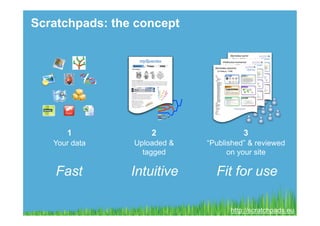
Scratchpads: the concept


      1             2                  3
   Your data    Uploaded &   “Published” & reviewed
                  tagged           on your site

    Fast        Intuitive      Fit for use

                                   http://scratchpads.eu
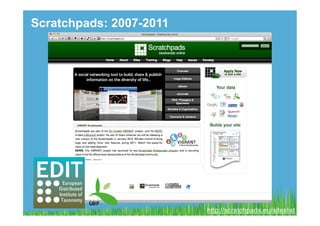
Scratchpads: 2007-2011


                         http://scratchpads.eu/siteslist
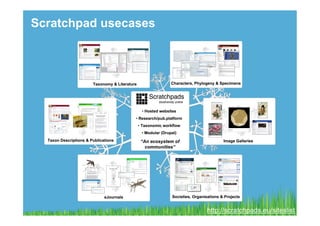
Scratchpad usecases


                      http://scratchpads.eu/siteslist
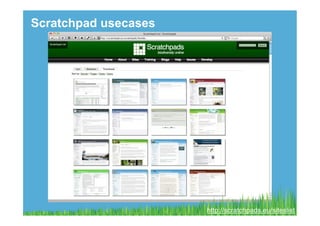
Scratchpad usecases


                      http://scratchpads.eu/siteslist
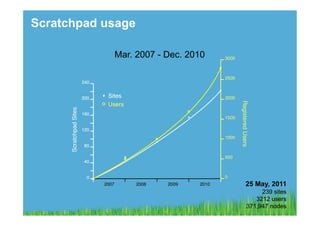
Scratchpad usage

            Mar. 2007 - Dec. 2010


                                    25 May, 2011
                                         239 sites
                                       3212 users
                                    371,947 nodes
Scratchpads: the present
Financial support until Dec. 2013


              ViBRANT
               Virtual Biodiversity
Scratchpads 2

 •  Scheduled for January 2012 (5 years after Scratchpad 1)
 •  Move from Drupal 6 to Drupal 7 (4 year upgrade cycle, UI + entities)
 •  67 Contributed modules (31 done, 14 untested, 22 to do)
 •  52 Scratchpad modules (28 done, 14 untested, 10 to do)
 •  Migrate current Scratchpads
 •  New technical enhancements (hosting env., git, services, registry…)
         - supporting sustainability
 •  New user features (theme, workflow, spp. pages, mapping, services)
         - supporting “publication”

                                   http://wiki.scratchpads.eu/w/Wp2
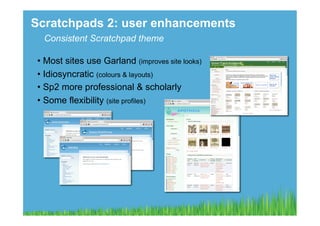
Scratchpads 2: user enhancements
  Consistent Scratchpad theme

 •  Most sites use Garland (improves site looks)
 •  Idiosyncratic (colours & layouts)
 •  Sp2 more professional & scholarly
 •  Some flexibility (site profiles)
Scratchpads 2: user enhancements
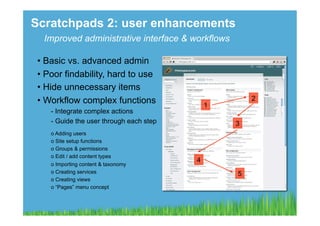
  Improved administrative interface & workflows

 •  Basic vs. advanced admin
 •  Poor findability, hard to use
 •  Hide unnecessary items
 •  Workflow complex functions                        2
                                              1
    -  Integrate complex actions
    -  Guide the user through each step           3
    o  Adding users
    o  Site setup functions
    o  Groups & permissions
    o  Edit / add content types
                                          4
    o  Importing content & taxonomy
    o  Creating services                          5
    o  Creating views
    o  “Pages” menu concept
Scratchpads 2: user enhancements
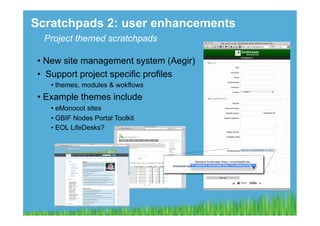
  Project themed scratchpads

 •  New site management system (Aegir)
 •  Support project specific profiles
    •  themes, modules & wokflows
 •  Example themes include
    •  eMonocot sites
    •  GBIF Nodes Portal Toolkit
    •  EOL LifeDesks?
Scratchpads 2: user enhancements
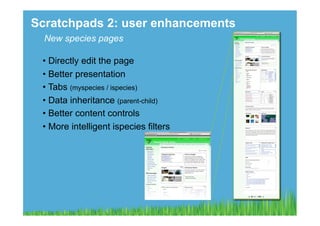
  New species pages

 •  Directly edit the page
 •  Better presentation
 •  Tabs (myspecies / ispecies)
 •  Data inheritance (parent-child)
 •  Better content controls
 •  More intelligent ispecies filters
Scratchpads 2: user enhancements
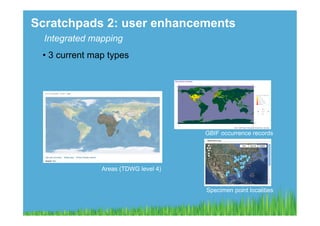
  Integrated mapping
 •  3 current map types


                                       GBIF occurrence records


                Areas (TDWG level 4)


                                       Specimen point localities
Scratchpads 2: user enhancements
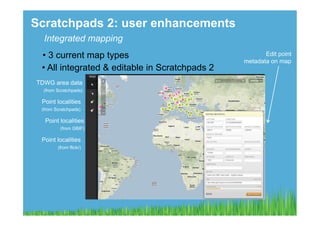
  Integrated mapping
 •  3 current map types                                 Edit point
                                                 metadata on map
 •  All integrated & editable in Scratchpads 2
TDWG area data
  (from Scratchpads)

 Point localities
 (from Scratchpads)

  Point localities
         (from GBIF)

 Point localities
        (from flickr)


                        Areas (TDWG level 4)
Scratchpads: the future
A natively digital scholarly communication system


    •  The article was (is) the unit of scholarly comm. (350yrs)
    •  Research practices have moved on
         o  Highly collaborative, data intensive & networked

    •  Scholarly communication has not adapted (e.g. the PDF)
    •  Published “knowledge” hides “dark data”
    •  Need a natively digital scholarly communication system
         o  Must support end-to-end the lifecycle of data, information & knowledge

    “the future scholarly communication system should
    closely resemble—and be intertwined with—the
    scholarly endeavor itself, rather than being
    its after-thought or annex” Sompel et al 2004. http://bit.ly/
                           Van de
                                                      a3o9UX
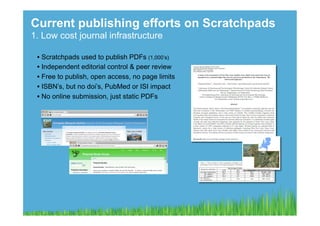
Current publishing efforts on Scratchpads
1. Low cost journal infrastructure

 •  Scratchpads used to publish PDFs (1,000’s)
 •  Independent editorial control & peer review
 •  Free to publish, open access, no page limits
 •  ISBN’s, but no doi’s, PubMed or ISI impact
 •  No online submission, just static PDFs
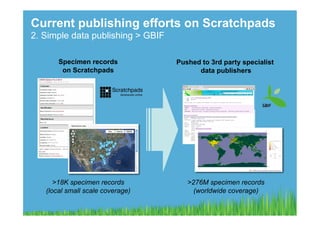
Current publishing efforts on Scratchpads
2. Simple data publishing > GBIF

       Specimen records            Pushed to 3rd party specialist
        on Scratchpads                   data publishers


      >18K specimen records           >276M specimen records
   (local small scale coverage)         (worldwide coverage)
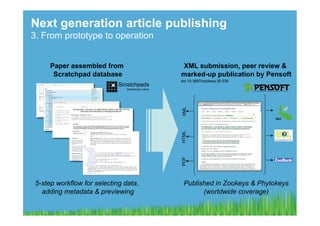
Next generation article publishing
3. From prototype to operation


      Paper assembled from             XML submission, peer review &
       Scratchpad database             marked-up publication by Pensoft
                                       doi:10.3897/zookeys.50.539


 5-step workflow for selecting data,   XML
                                       HTML
                                       PDF
                                        Published in Zookeys & Phytokeys
   adding metadata & previewing               (worldwide coverage)
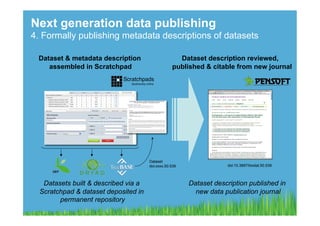
Next generation data publishing
4. Formally publishing metadata descriptions of datasets

 Dataset & metadata description                     Dataset description reviewed,
    assembled in Scratchpad                       published & citable from new journal


                                      Dataset
                                      doi:xxxx.50.539               doi:10.3897/biodat.50.539


   Datasets built & described via a                     Dataset description published in
  Scratchpad & dataset deposited in                       new data publication journal
        permanent repository
Scratchpads past,present,future

Scratchpads past,present,future

  • 1.
    Scratchpads Past, present& future Ed Baker Natural History Museum, London edwab@nhm.ac.uk
  • 2.
    Scratchpads: the concept 1 2 3 Your data Uploaded & “Published” & reviewed tagged on your site Fast Intuitive Fit for use http://scratchpads.eu
  • 3.
    Scratchpads: 2007-2011 http://scratchpads.eu/siteslist
  • 4.
    Scratchpad usecases http://scratchpads.eu/siteslist
  • 5.
    Scratchpad usecases http://scratchpads.eu/siteslist
  • 6.
    Scratchpad usage Mar. 2007 - Dec. 2010 25 May, 2011 239 sites 3212 users 371,947 nodes
  • 7.
    Scratchpads: the present Financialsupport until Dec. 2013 ViBRANT Virtual Biodiversity
  • 8.
    Scratchpads 2 • Scheduled for January 2012 (5 years after Scratchpad 1) •  Move from Drupal 6 to Drupal 7 (4 year upgrade cycle, UI + entities) •  67 Contributed modules (31 done, 14 untested, 22 to do) •  52 Scratchpad modules (28 done, 14 untested, 10 to do) •  Migrate current Scratchpads •  New technical enhancements (hosting env., git, services, registry…) - supporting sustainability •  New user features (theme, workflow, spp. pages, mapping, services) - supporting “publication” http://wiki.scratchpads.eu/w/Wp2
  • 9.
    Scratchpads 2: userenhancements Consistent Scratchpad theme •  Most sites use Garland (improves site looks) •  Idiosyncratic (colours & layouts) •  Sp2 more professional & scholarly •  Some flexibility (site profiles)
  • 10.
    Scratchpads 2: userenhancements Improved administrative interface & workflows •  Basic vs. advanced admin •  Poor findability, hard to use •  Hide unnecessary items •  Workflow complex functions 2 1 -  Integrate complex actions -  Guide the user through each step 3 o  Adding users o  Site setup functions o  Groups & permissions o  Edit / add content types 4 o  Importing content & taxonomy o  Creating services 5 o  Creating views o  “Pages” menu concept
  • 11.
    Scratchpads 2: userenhancements Project themed scratchpads •  New site management system (Aegir) •  Support project specific profiles •  themes, modules & wokflows •  Example themes include •  eMonocot sites •  GBIF Nodes Portal Toolkit •  EOL LifeDesks?
  • 12.
    Scratchpads 2: userenhancements New species pages •  Directly edit the page •  Better presentation •  Tabs (myspecies / ispecies) •  Data inheritance (parent-child) •  Better content controls •  More intelligent ispecies filters
  • 13.
    Scratchpads 2: userenhancements Integrated mapping •  3 current map types GBIF occurrence records Areas (TDWG level 4) Specimen point localities
  • 14.
    Scratchpads 2: userenhancements Integrated mapping •  3 current map types Edit point metadata on map •  All integrated & editable in Scratchpads 2 TDWG area data (from Scratchpads) Point localities (from Scratchpads) Point localities (from GBIF) Point localities (from flickr) Areas (TDWG level 4)
  • 15.
    Scratchpads: the future Anatively digital scholarly communication system •  The article was (is) the unit of scholarly comm. (350yrs) •  Research practices have moved on o  Highly collaborative, data intensive & networked •  Scholarly communication has not adapted (e.g. the PDF) •  Published “knowledge” hides “dark data” •  Need a natively digital scholarly communication system o  Must support end-to-end the lifecycle of data, information & knowledge “the future scholarly communication system should closely resemble—and be intertwined with—the scholarly endeavor itself, rather than being its after-thought or annex” Sompel et al 2004. http://bit.ly/ Van de a3o9UX
  • 16.
    Current publishing effortson Scratchpads 1. Low cost journal infrastructure •  Scratchpads used to publish PDFs (1,000’s) •  Independent editorial control & peer review •  Free to publish, open access, no page limits •  ISBN’s, but no doi’s, PubMed or ISI impact •  No online submission, just static PDFs
  • 17.
    Current publishing effortson Scratchpads 2. Simple data publishing > GBIF Specimen records Pushed to 3rd party specialist on Scratchpads data publishers >18K specimen records >276M specimen records (local small scale coverage) (worldwide coverage)
  • 18.
    Next generation articlepublishing 3. From prototype to operation Paper assembled from XML submission, peer review & Scratchpad database marked-up publication by Pensoft doi:10.3897/zookeys.50.539 5-step workflow for selecting data, XML HTML PDF Published in Zookeys & Phytokeys adding metadata & previewing (worldwide coverage)
  • 19.
    Next generation datapublishing 4. Formally publishing metadata descriptions of datasets Dataset & metadata description Dataset description reviewed, assembled in Scratchpad published & citable from new journal Dataset doi:xxxx.50.539 doi:10.3897/biodat.50.539 Datasets built & described via a Dataset description published in Scratchpad & dataset deposited in new data publication journal permanent repository