The Metadata [R]evolution: Transformative Opportunities
September 18, 2013
Some Ideas on Making Research Data
Discoverable and Usable:
“It’s the Metadata, Stupid!”
Anita de Waard, VP Research Data Collaborations,
Elsevier Research Data Services (VT)
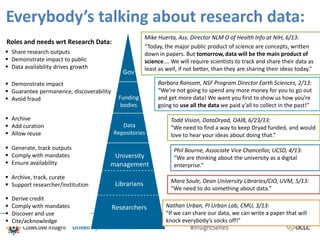
Everybody’s talking about research data:
 Share research outputs
 Demonstrate impact to public
 Data availability drives growth
 Demonstrate impact
 Guarantee permanence, discoverability
 Avoid fraud
 Generate, track outputs
 Comply with mandates
 Ensure availability
 Archive, track, curate
 Support researcher/institution
 Archive
 Add curation
 Allow reuse
Todd Vision, DataDryad, OAI8, 6/23/13:
“We need to find a way to keep Dryad funded, and would
love to hear your ideas about doing that.”
Phil Bourne, Associate Vice Chancellor, UCSD, 4/13:
“We are thinking about the university as a digital
enterprise.”
Mike Huerta, Ass. Director NLM O of Health Info at NIH, 6/13:
“Today, the major public product of science are concepts, written
down in papers. But tomorrow, data will be the main product of
science…. We will require scientists to track and share their data as
least as well, if not better, than they are sharing their ideas today.”
Mara Saule, Dean University Libraries/CIO, UVM, 5/13:
“We need to do something about data.”
 Derive credit
 Comply with mandates
 Discover and use
 Cite/acknowledge
Gov
Funding
bodies
University
management
Researchers
Librarians
Data
Repositories
Nathan Urban, PI Urban Lab, CMU, 3/13:
“If we can share our data, we can write a paper that will
knock everybody’s socks off!”
Roles and needs wrt Research Data:
Barbara Ransom, NSF Program Director Earth Sciences, 2/13:
“We’re not going to spend any more money for you to go out
and get more data! We want you first to show us how you’re
going to use all the data we paid y’all to collect in the past!”
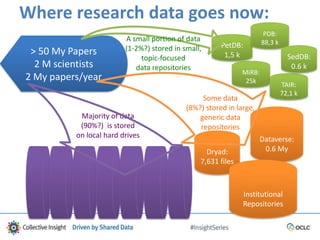
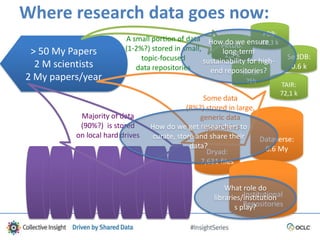
Where research data goes now:
> 50 My Papers
2 M scientists
2 My papers/year
Majority of data
(90%?) is stored
on local hard drives
Dryad:
7,631 files
Dataverse:
0.6 My
Institutional
Repositories
Some data
(8%?) stored in large,
generic data
repositories
MiRB:
25k
PetDB:
1,5 k
TAIR:
72,1 k
PDB:
88,3 k
SedDB:
0.6 k
A small portion of data
(1-2%?) stored in small,
topic-focused
data repositories
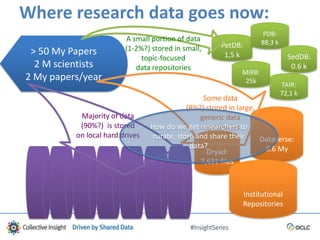
Where research data goes now:
> 50 My Papers
2 M scientists
2 My papers/year
Majority of data
(90%?) is stored
on local hard drives
Dryad:
7,631 files
Dataverse:
0.6 My
Institutional
Repositories
Some data
(8%?) stored in large,
generic data
repositories
MiRB:
25k
PetDB:
1,5 k
TAIR:
72,1 k
PDB:
88,3 k
SedDB:
0.6 k
A small portion of data
(1-2%?) stored in small,
topic-focused
data repositories
How do we get researchers to
curate, store and share their
data?
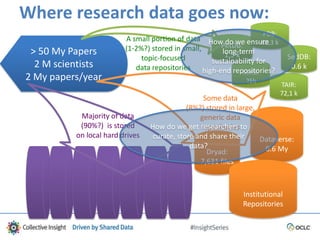
Where research data goes now:
> 50 My Papers
2 M scientists
2 My papers/year
Majority of data
(90%?) is stored
on local hard drives
Dryad:
7,631 files
Dataverse:
0.6 My
Institutional
Repositories
Some data
(8%?) stored in large,
generic data
repositories
MiRB:
25k
PetDB:
1,5 k
TAIR:
72,1 k
PDB:
88,3 k
SedDB:
0.6 k
A small portion of data
(1-2%?) stored in small,
topic-focused
data repositories
How do we get researchers to
curate, store and share their
data?
How do we ensure
long-term
sustainability for
high-end repositories?
Where research data goes now:
> 50 My Papers
2 M scientists
2 My papers/year
Majority of data
(90%?) is stored
on local hard drives
Dryad:
7,631 files
Dataverse:
0.6 My
Institutional
Repositories
Some data
(8%?) stored in large,
generic data
repositories
MiRB:
25k
PetDB:
1,5 k
TAIR:
72,1 k
PDB:
88,3 k
SedDB:
0.6 k
A small portion of data
(1-2%?) stored in small,
topic-focused
data repositories
How do we get researchers to
curate, store and share their
data?
How do we ensure
long-term
sustainability for high-
end repositories?
What role do
libraries/institution
s play?
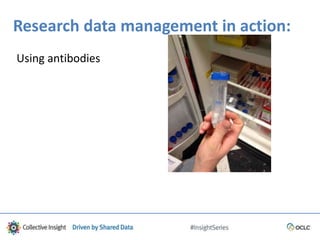
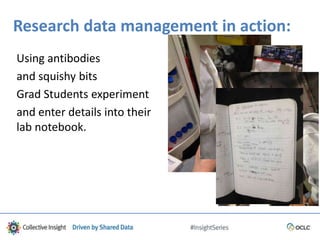
Research data management in action:
Using antibodies
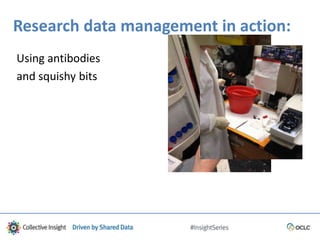
Research data management in action:
Using antibodies
and squishy bits
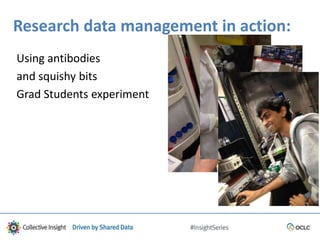
Research data management in action:
Using antibodies
and squishy bits
Grad Students experiment
Research data management in action:
Using antibodies
and squishy bits
Grad Students experiment
and enter details into their
lab notebook.
Research data management in action:
Using antibodies
and squishy bits
Grad Students experiment
and enter details into their
lab notebook.
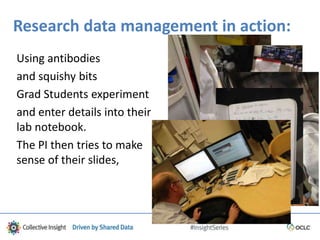
The PI then tries to make
sense of their slides,
Research data management in action:
Using antibodies
and squishy bits
Grad Students experiment
and enter details into their
lab notebook.
The PI then tries to make
sense of their slides,
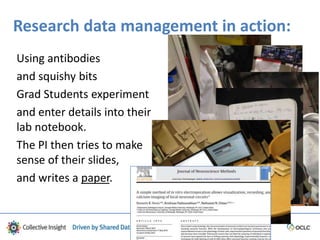
and writes a paper.
Research data management in action:
Using antibodies
and squishy bits
Grad Students experiment
and enter details into their
lab notebook.
The PI then tries to make
sense of their slides,
and writes a paper.
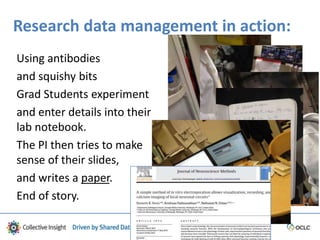
End of story.
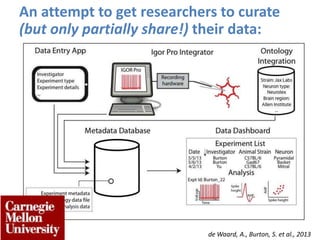
de Waard, A., Burton, S. et al., 2013
An attempt to get researchers to curate
(but only partially share!) their data:
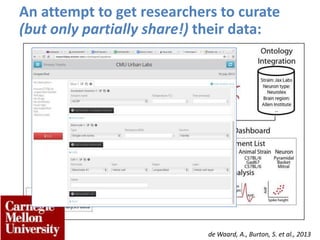
de Waard, A., Burton, S. et al., 2013
An attempt to get researchers to curate
(but only partially share!) their data:
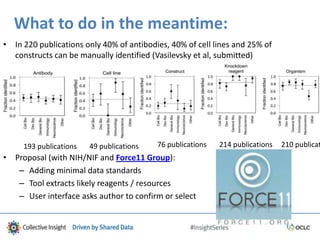
What to do in the meantime:
49 publications193 publications 76 publications 214 publications 210 publicat
• In 220 publications only 40% of antibodies, 40% of cell lines and 25% of
constructs can be manually identified (Vasilevsky et al, submitted)
• Proposal (with NIH/NIF and Force11 Group):
– Adding minimal data standards
– Tool extracts likely reagents / resources
– User interface asks author to confirm or select
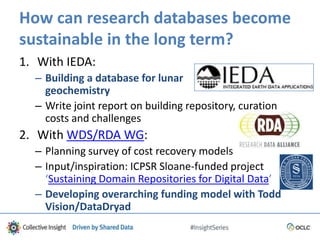
How can research databases become
sustainable in the long term?
1. With IEDA:
– Building a database for lunar
geochemistry
– Write joint report on building repository, curation
costs and challenges
2. With WDS/RDA WG:
– Planning survey of cost recovery models
– Input/inspiration: ICPSR Sloane-funded project
‘Sustaining Domain Repositories for Digital Data’
– Developing overarching funding model with Todd
Vision/DataDryad
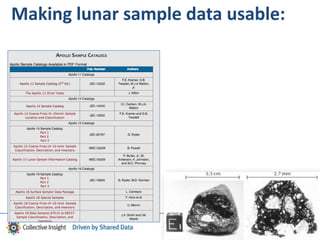
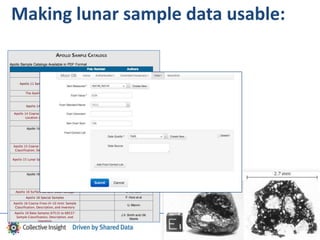
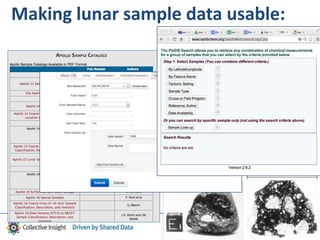
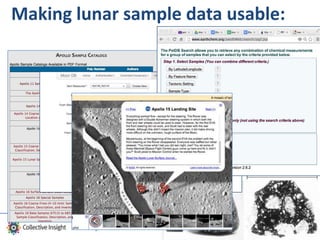
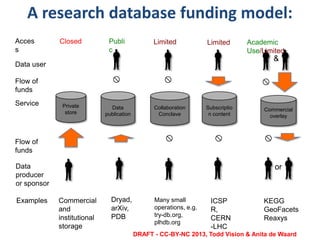
Making lunar sample data usable:
Private
store
Data
producer
or sponsor
Acces
s
Closed
Flow of
funds
Data
publication
Publi
c
Service
Collaboration
Conclave

Limited
Subscriptio
n content


Commercial
overlay

Limited Academic
Use/Limited
Data user
Flow of
funds
Examples ICSP
R,
CERN
-LHC
KEGG
GeoFacets
Reaxys
DRAFT - CC-BY-NC 2013, Todd Vision & Anita de Waard
Many small
operations, e.g.
try-db.org,
plhdb.org
Dryad,
arXiv,
PDB
Commercial
and
institutional
storage

&
or
A research database funding model:
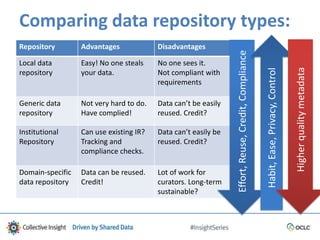
Comparing data repository types:
Repository Advantages Disadvantages
Local data
repository
Easy! No one steals
your data.
No one sees it.
Not compliant with
requirements
Generic data
repository
Not very hard to do.
Have complied!
Data can’t be easily
reused. Credit?
Institutional
Repository
Can use existing IR?
Tracking and
compliance checks.
Data can’t easily be
reused. Credit?
Domain-specific
data repository
Data can be reused.
Credit!
Lot of work for
curators. Long-term
sustainable?
Effort,Reuse,Credit,Compliance
Habit,Ease,Privacy,Control
Higherqualitymetadata
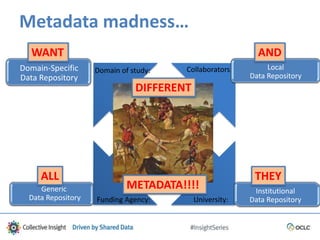
Funding Agency: University:
Collaborators:Domain of study:Domain-Specific
Data Repository
Local
Data Repository
Institutional
Data Repository
Generic
Data Repository
AND
THEYALL
WANT
DIFFERENT
METADATA!!!!
Metadata madness…
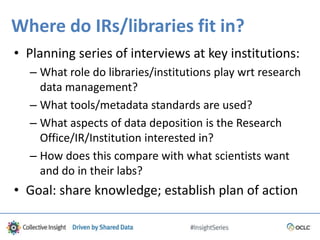
Where do IRs/libraries fit in?
• Planning series of interviews at key institutions:
– What role do libraries/institutions play wrt research
data management?
– What tools/metadata standards are used?
– What aspects of data deposition is the Research
Office/IR/Institution interested in?
– How does this compare with what scientists want
and do in their labs?
• Goal: share knowledge; establish plan of action
Principles of Elsevier RDS:
• Main goal: make research data optimally available,
discoverable and reusable.
• Collaboration is tailored to partner’s unique needs:
– Working with a few domain-specific and institutional
repositories and institutions
– Aspects where collaboration is needed are discussed
– Collaboration plan is drawn up using SLA: agree on time,
conditions, etc.
• 2013: series of pilots, studies and reports to enable
feasibility study:
– What are key needs?
– Can Elsevier play a role: skillsets, partnerships?
– Is there a (transparent) business model for this?
In summary:
If researchers start to curate and share their data…
And research databases become long-term
sustainable…
… we enable enrichment with high-quality metadata
that makes research data truly discoverable and
reusable.
Many questions remain:
? What role would the institution/library play?
? How do we ensure interoperable metadata?
? What are sustainable models, moving forward?
? Is there a place for publishers, in all this?
Thank you!
Collaborations and discussions gratefully acknowledged:
• CMU: Nathan Urban, Shreejoy Tripathy, Shawn Burton, Ed Hovy
• UCSD: Phil Bourne, Brian Shoettlander, David Minor, Declan Fleming,
Ilya Zaslavsky
• NIF: Maryann Martone, Anita Bandrowski
• MSU: Brian Bothner
• OHSU: Melissa Haendel, Nicole Vasilevsky
• California Digital Library: Carly Strasser, John Kunze, Stephen Abrams
• Columbia/IEDA: Kerstin Lehnert, Leslie Hsu
• CNI: Clifford Lynch
• Harvard: Michael Kurtz, Chris Erdmann
• MIT: Micah Altman
• UVM: Mara Saurle
Your questions?
Anita de Waard
VP Research Data Collaborations,
Elsevier Research Data Services (VT)
a.dewaard@elsevier.com
http://researchdata.elsevier.com/

Some Ideas on Making Research Data: "It's the Metadata, stupid!"

  • 1.
    The Metadata [R]evolution:Transformative Opportunities September 18, 2013 Some Ideas on Making Research Data Discoverable and Usable: “It’s the Metadata, Stupid!” Anita de Waard, VP Research Data Collaborations, Elsevier Research Data Services (VT)
  • 2.
    Everybody’s talking aboutresearch data:  Share research outputs  Demonstrate impact to public  Data availability drives growth  Demonstrate impact  Guarantee permanence, discoverability  Avoid fraud  Generate, track outputs  Comply with mandates  Ensure availability  Archive, track, curate  Support researcher/institution  Archive  Add curation  Allow reuse Todd Vision, DataDryad, OAI8, 6/23/13: “We need to find a way to keep Dryad funded, and would love to hear your ideas about doing that.” Phil Bourne, Associate Vice Chancellor, UCSD, 4/13: “We are thinking about the university as a digital enterprise.” Mike Huerta, Ass. Director NLM O of Health Info at NIH, 6/13: “Today, the major public product of science are concepts, written down in papers. But tomorrow, data will be the main product of science…. We will require scientists to track and share their data as least as well, if not better, than they are sharing their ideas today.” Mara Saule, Dean University Libraries/CIO, UVM, 5/13: “We need to do something about data.”  Derive credit  Comply with mandates  Discover and use  Cite/acknowledge Gov Funding bodies University management Researchers Librarians Data Repositories Nathan Urban, PI Urban Lab, CMU, 3/13: “If we can share our data, we can write a paper that will knock everybody’s socks off!” Roles and needs wrt Research Data: Barbara Ransom, NSF Program Director Earth Sciences, 2/13: “We’re not going to spend any more money for you to go out and get more data! We want you first to show us how you’re going to use all the data we paid y’all to collect in the past!”
  • 3.
    Where research datagoes now: > 50 My Papers 2 M scientists 2 My papers/year Majority of data (90%?) is stored on local hard drives Dryad: 7,631 files Dataverse: 0.6 My Institutional Repositories Some data (8%?) stored in large, generic data repositories MiRB: 25k PetDB: 1,5 k TAIR: 72,1 k PDB: 88,3 k SedDB: 0.6 k A small portion of data (1-2%?) stored in small, topic-focused data repositories
  • 4.
    Where research datagoes now: > 50 My Papers 2 M scientists 2 My papers/year Majority of data (90%?) is stored on local hard drives Dryad: 7,631 files Dataverse: 0.6 My Institutional Repositories Some data (8%?) stored in large, generic data repositories MiRB: 25k PetDB: 1,5 k TAIR: 72,1 k PDB: 88,3 k SedDB: 0.6 k A small portion of data (1-2%?) stored in small, topic-focused data repositories How do we get researchers to curate, store and share their data?
  • 5.
    Where research datagoes now: > 50 My Papers 2 M scientists 2 My papers/year Majority of data (90%?) is stored on local hard drives Dryad: 7,631 files Dataverse: 0.6 My Institutional Repositories Some data (8%?) stored in large, generic data repositories MiRB: 25k PetDB: 1,5 k TAIR: 72,1 k PDB: 88,3 k SedDB: 0.6 k A small portion of data (1-2%?) stored in small, topic-focused data repositories How do we get researchers to curate, store and share their data? How do we ensure long-term sustainability for high-end repositories?
  • 6.
    Where research datagoes now: > 50 My Papers 2 M scientists 2 My papers/year Majority of data (90%?) is stored on local hard drives Dryad: 7,631 files Dataverse: 0.6 My Institutional Repositories Some data (8%?) stored in large, generic data repositories MiRB: 25k PetDB: 1,5 k TAIR: 72,1 k PDB: 88,3 k SedDB: 0.6 k A small portion of data (1-2%?) stored in small, topic-focused data repositories How do we get researchers to curate, store and share their data? How do we ensure long-term sustainability for high- end repositories? What role do libraries/institution s play?
  • 7.
    Research data managementin action: Using antibodies
  • 8.
    Research data managementin action: Using antibodies and squishy bits
  • 9.
    Research data managementin action: Using antibodies and squishy bits Grad Students experiment
  • 10.
    Research data managementin action: Using antibodies and squishy bits Grad Students experiment and enter details into their lab notebook.
  • 11.
    Research data managementin action: Using antibodies and squishy bits Grad Students experiment and enter details into their lab notebook. The PI then tries to make sense of their slides,
  • 12.
    Research data managementin action: Using antibodies and squishy bits Grad Students experiment and enter details into their lab notebook. The PI then tries to make sense of their slides, and writes a paper.
  • 13.
    Research data managementin action: Using antibodies and squishy bits Grad Students experiment and enter details into their lab notebook. The PI then tries to make sense of their slides, and writes a paper. End of story.
  • 14.
    de Waard, A.,Burton, S. et al., 2013 An attempt to get researchers to curate (but only partially share!) their data:
  • 15.
    de Waard, A.,Burton, S. et al., 2013 An attempt to get researchers to curate (but only partially share!) their data:
  • 16.
    What to doin the meantime: 49 publications193 publications 76 publications 214 publications 210 publicat • In 220 publications only 40% of antibodies, 40% of cell lines and 25% of constructs can be manually identified (Vasilevsky et al, submitted) • Proposal (with NIH/NIF and Force11 Group): – Adding minimal data standards – Tool extracts likely reagents / resources – User interface asks author to confirm or select
  • 17.
    How can researchdatabases become sustainable in the long term? 1. With IEDA: – Building a database for lunar geochemistry – Write joint report on building repository, curation costs and challenges 2. With WDS/RDA WG: – Planning survey of cost recovery models – Input/inspiration: ICPSR Sloane-funded project ‘Sustaining Domain Repositories for Digital Data’ – Developing overarching funding model with Todd Vision/DataDryad
  • 18.
    Making lunar sampledata usable:
  • 19.
    Making lunar sampledata usable:
  • 20.
    Making lunar sampledata usable:
  • 21.
    Making lunar sampledata usable:
  • 22.
    Private store Data producer or sponsor Acces s Closed Flow of funds Data publication Publi c Service Collaboration Conclave  Limited Subscriptio ncontent   Commercial overlay  Limited Academic Use/Limited Data user Flow of funds Examples ICSP R, CERN -LHC KEGG GeoFacets Reaxys DRAFT - CC-BY-NC 2013, Todd Vision & Anita de Waard Many small operations, e.g. try-db.org, plhdb.org Dryad, arXiv, PDB Commercial and institutional storage  & or A research database funding model:
  • 23.
    Comparing data repositorytypes: Repository Advantages Disadvantages Local data repository Easy! No one steals your data. No one sees it. Not compliant with requirements Generic data repository Not very hard to do. Have complied! Data can’t be easily reused. Credit? Institutional Repository Can use existing IR? Tracking and compliance checks. Data can’t easily be reused. Credit? Domain-specific data repository Data can be reused. Credit! Lot of work for curators. Long-term sustainable? Effort,Reuse,Credit,Compliance Habit,Ease,Privacy,Control Higherqualitymetadata
  • 24.
    Funding Agency: University: Collaborators:Domainof study:Domain-Specific Data Repository Local Data Repository Institutional Data Repository Generic Data Repository AND THEYALL WANT DIFFERENT METADATA!!!! Metadata madness…
  • 25.
    Where do IRs/librariesfit in? • Planning series of interviews at key institutions: – What role do libraries/institutions play wrt research data management? – What tools/metadata standards are used? – What aspects of data deposition is the Research Office/IR/Institution interested in? – How does this compare with what scientists want and do in their labs? • Goal: share knowledge; establish plan of action
  • 26.
    Principles of ElsevierRDS: • Main goal: make research data optimally available, discoverable and reusable. • Collaboration is tailored to partner’s unique needs: – Working with a few domain-specific and institutional repositories and institutions – Aspects where collaboration is needed are discussed – Collaboration plan is drawn up using SLA: agree on time, conditions, etc. • 2013: series of pilots, studies and reports to enable feasibility study: – What are key needs? – Can Elsevier play a role: skillsets, partnerships? – Is there a (transparent) business model for this?
  • 27.
    In summary: If researchersstart to curate and share their data… And research databases become long-term sustainable… … we enable enrichment with high-quality metadata that makes research data truly discoverable and reusable. Many questions remain: ? What role would the institution/library play? ? How do we ensure interoperable metadata? ? What are sustainable models, moving forward? ? Is there a place for publishers, in all this?
  • 28.
    Thank you! Collaborations anddiscussions gratefully acknowledged: • CMU: Nathan Urban, Shreejoy Tripathy, Shawn Burton, Ed Hovy • UCSD: Phil Bourne, Brian Shoettlander, David Minor, Declan Fleming, Ilya Zaslavsky • NIF: Maryann Martone, Anita Bandrowski • MSU: Brian Bothner • OHSU: Melissa Haendel, Nicole Vasilevsky • California Digital Library: Carly Strasser, John Kunze, Stephen Abrams • Columbia/IEDA: Kerstin Lehnert, Leslie Hsu • CNI: Clifford Lynch • Harvard: Michael Kurtz, Chris Erdmann • MIT: Micah Altman • UVM: Mara Saurle
  • 29.
    Your questions? Anita deWaard VP Research Data Collaborations, Elsevier Research Data Services (VT) a.dewaard@elsevier.com http://researchdata.elsevier.com/