Altmetrics: New Ways to 
Evaluate for a New 
Publishing Environment 
A 
Chuck Huber, UCSB Library, University of California – Santa Barbara 27 Oct. 2014
What is/are Altmetrics? 
• From “alternative metrics” 
• “Metrics” refers to ways to quantitatively 
and objectively measure the scholarly 
significance of publications. 
• This measurement may be done at the 
level of the individual, the group, the 
department, the university or the journal.
Metrics…why? 
• Many groups (hiring, tenure/promotion, funding 
agencies, immigration agencies) have a need to 
evaluate a scholar’s performance. 
• Unless the evaluator is an expert in the field, they 
may not be able to evaluate published work directly. 
• Reading and evaluating the content of a cv can be 
very time-consuming. 
• So they want metrics to use as shorthand for the 
quality of scholarship.
Alternative…to what? 
• In the beginning…there was the impact 
factor, measuring impact of scholarly 
journals. (See Journal Citation Reports 
database, http://isiknowledge.com/jcr ) 
• Later, modified ways of measuring 
impact were developed: SNIP, 
Eigenfactor 
• For individuals, h-index.
Alternative…why? 
• Impact factors have flaws 
• Hard to compare across disciplines 
• Not useful for rating individuals directly 
• More significantly, they are ill-adapted for “Scholarship 
2.0” 
• Citation metrics don’t count blogs, tweets, other 
social media. 
• They also don’t track use of data (mostly), software, 
figures, presentations, etc. 
• They have inherent lag time (disadvantageous to 
new publishers.)
What do altmetrics measure? 
• Lots of things! There are currently no standards 
(though NISO is working on it.) 
• Example (from Plum Analytics) 
• Usage (views, clicks, downloads) 
• Captures (bookmarks, favorites, followers) 
• Mentions (social networks, blogs, tweets, news 
items, reviews) 
• Ratings (likes, recommendations, shares) 
• And, oh yes, Citations
Where do they get the numbers? 
• Pretty much anywhere the measuring organization 
can get them for free. 
• Facebook Twitter, Google Plus 
• YouTube, Vimeo, SlideShare, FigShare 
• CiteULike, Delicious, Mendeley 
• GoodReads, Amazon 
• SourceForge, Github 
• Research Blogging, Science Seeker 
• PLOS, PubMed Central 
• And commercial sources willing to share.
Who is measuring altmetrics? 
• Altmetric.com (http://www.altmetric.com/) 
• Small private company, founded 2011, used by 
Elsevier, Springer, Nature, among others. Now 
associated with Digital Science 
(http://www.digital-science.com/) 
• ImpactStory (https://impactstory.org/) 
• Not-for-profit company, founded 2011, funded 
by NSF, Sloan Foundation et al. 
• Plum Analytics (http://www.plumanalytics.com/) 
• Founded 2011, purchased by EBSCO 2014
Altmetric.com (http://www.altmetric.com/) 
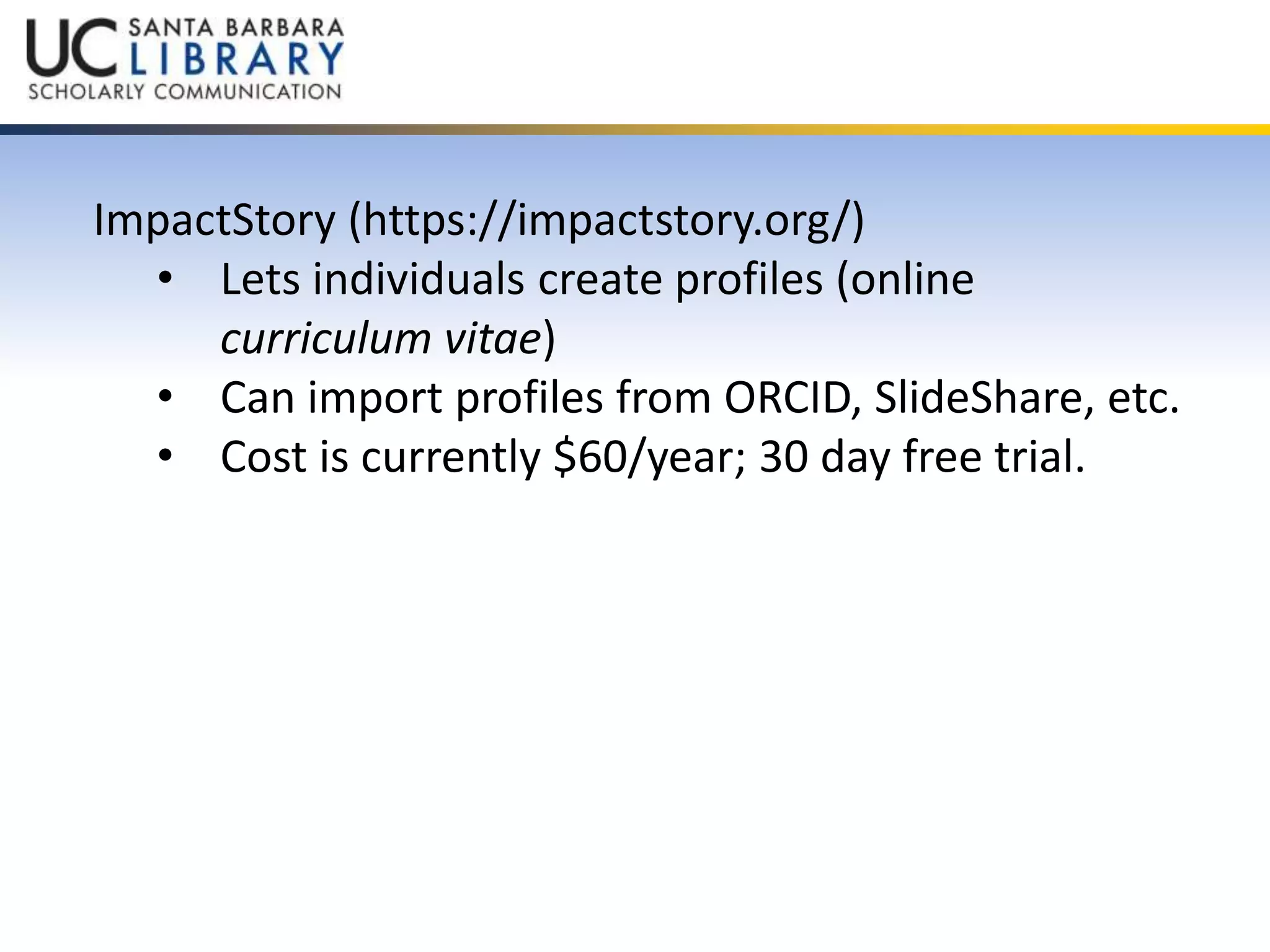
• Generates altmetric data for articles, journals, institutions, individuals (at 
institutions with a contract.) 
• Draws data from news, blogs, tweets, social media, social bookmarking, 
government policy documents. 
• Does not use non-public data from publishers, aggregators, etc. 
• Bookmarklet provides data for (most) articles. 
• API lets you insert Altmetric “badges” on webpages – basic data is free.
ImpactStory (https://impactstory.org/) 
• Lets individuals create profiles (online 
curriculum vitae) 
• Can import profiles from ORCID, SlideShare, etc. 
• Cost is currently $60/year; 30 day free trial.
Plum Analytics (http://www.plumanalytics.com/) 
• Aimed at institutional users, though individuals at 
institutions with Plum contracts can make use of it. 
• Uses data from public news, social networks, social 
bookmarks, plus data from EBSCO resources. 
• See PlumX (http://plu.mx) for example of their 
interfaces.
How can I, as a researcher, use altmetrics? 
• Get connected, so people can find your work. 
• Deposit articles in repositories (such as UC’s e-Scholarship), 
presentations in SlideShare, figures in FigShare, data in data repositories. 
• Use social networks. Comment on, review and share the works of others 
as well as promote your own. 
• Use social bookmarking (e.g. CiteULike, Connotea, Mendeley) to list both 
your own publications and those you find important in your field. 
• Contribute to Wikipedia, etc. 
• See, for example: http://www.chemconnector.com/antonywilliams_cv/ 
• Register with ORCID (http://www.orcid.org) 
• Make use of altmetrics tools (e.g. Altmetric bookmarklet, ImpactStory 
profile) to get a feel for the tools and see how you’re doing.
ORCID – the ID number for authors 
• ORCID.org (http://orcid.org/) 
• Allows authors to register, and create a profile of their 
publications. 
• ORCID number acts as a unique identifier, distinguishing 
you from authors with the same name and collating 
publications you may have made under different names. 
• Example: Charles F. Huber 0000-0003-0205-2261 
• ORCID shares information with other systems (e.g. ImpactStory, 
ResearcherID) 
• Increasing numbers of systems allow searching by ORCID (e.g. 
Web of Science)
14

Altmetrics 3 2014

  • 1.
    Altmetrics: New Waysto Evaluate for a New Publishing Environment A Chuck Huber, UCSB Library, University of California – Santa Barbara 27 Oct. 2014
  • 2.
    What is/are Altmetrics? • From “alternative metrics” • “Metrics” refers to ways to quantitatively and objectively measure the scholarly significance of publications. • This measurement may be done at the level of the individual, the group, the department, the university or the journal.
  • 3.
    Metrics…why? • Manygroups (hiring, tenure/promotion, funding agencies, immigration agencies) have a need to evaluate a scholar’s performance. • Unless the evaluator is an expert in the field, they may not be able to evaluate published work directly. • Reading and evaluating the content of a cv can be very time-consuming. • So they want metrics to use as shorthand for the quality of scholarship.
  • 4.
    Alternative…to what? •In the beginning…there was the impact factor, measuring impact of scholarly journals. (See Journal Citation Reports database, http://isiknowledge.com/jcr ) • Later, modified ways of measuring impact were developed: SNIP, Eigenfactor • For individuals, h-index.
  • 5.
    Alternative…why? • Impactfactors have flaws • Hard to compare across disciplines • Not useful for rating individuals directly • More significantly, they are ill-adapted for “Scholarship 2.0” • Citation metrics don’t count blogs, tweets, other social media. • They also don’t track use of data (mostly), software, figures, presentations, etc. • They have inherent lag time (disadvantageous to new publishers.)
  • 6.
    What do altmetricsmeasure? • Lots of things! There are currently no standards (though NISO is working on it.) • Example (from Plum Analytics) • Usage (views, clicks, downloads) • Captures (bookmarks, favorites, followers) • Mentions (social networks, blogs, tweets, news items, reviews) • Ratings (likes, recommendations, shares) • And, oh yes, Citations
  • 7.
    Where do theyget the numbers? • Pretty much anywhere the measuring organization can get them for free. • Facebook Twitter, Google Plus • YouTube, Vimeo, SlideShare, FigShare • CiteULike, Delicious, Mendeley • GoodReads, Amazon • SourceForge, Github • Research Blogging, Science Seeker • PLOS, PubMed Central • And commercial sources willing to share.
  • 8.
    Who is measuringaltmetrics? • Altmetric.com (http://www.altmetric.com/) • Small private company, founded 2011, used by Elsevier, Springer, Nature, among others. Now associated with Digital Science (http://www.digital-science.com/) • ImpactStory (https://impactstory.org/) • Not-for-profit company, founded 2011, funded by NSF, Sloan Foundation et al. • Plum Analytics (http://www.plumanalytics.com/) • Founded 2011, purchased by EBSCO 2014
  • 9.
    Altmetric.com (http://www.altmetric.com/) •Generates altmetric data for articles, journals, institutions, individuals (at institutions with a contract.) • Draws data from news, blogs, tweets, social media, social bookmarking, government policy documents. • Does not use non-public data from publishers, aggregators, etc. • Bookmarklet provides data for (most) articles. • API lets you insert Altmetric “badges” on webpages – basic data is free.
  • 10.
    ImpactStory (https://impactstory.org/) •Lets individuals create profiles (online curriculum vitae) • Can import profiles from ORCID, SlideShare, etc. • Cost is currently $60/year; 30 day free trial.
  • 11.
    Plum Analytics (http://www.plumanalytics.com/) • Aimed at institutional users, though individuals at institutions with Plum contracts can make use of it. • Uses data from public news, social networks, social bookmarks, plus data from EBSCO resources. • See PlumX (http://plu.mx) for example of their interfaces.
  • 12.
    How can I,as a researcher, use altmetrics? • Get connected, so people can find your work. • Deposit articles in repositories (such as UC’s e-Scholarship), presentations in SlideShare, figures in FigShare, data in data repositories. • Use social networks. Comment on, review and share the works of others as well as promote your own. • Use social bookmarking (e.g. CiteULike, Connotea, Mendeley) to list both your own publications and those you find important in your field. • Contribute to Wikipedia, etc. • See, for example: http://www.chemconnector.com/antonywilliams_cv/ • Register with ORCID (http://www.orcid.org) • Make use of altmetrics tools (e.g. Altmetric bookmarklet, ImpactStory profile) to get a feel for the tools and see how you’re doing.
  • 13.
    ORCID – theID number for authors • ORCID.org (http://orcid.org/) • Allows authors to register, and create a profile of their publications. • ORCID number acts as a unique identifier, distinguishing you from authors with the same name and collating publications you may have made under different names. • Example: Charles F. Huber 0000-0003-0205-2261 • ORCID shares information with other systems (e.g. ImpactStory, ResearcherID) • Increasing numbers of systems allow searching by ORCID (e.g. Web of Science)
  • 14.

Editor's Notes

  • #4 PDF versions, print and premium titles are still available through other channels The more libraries that pledge, the lower the average price per book; the Pilot goal was 200 libraries paying 15K or an average of $60 per book “Open Access Publishing in European Networks,” a library of scholarly OA books in the social sciences and humanities
  • #5 PDF versions, print and premium titles are still available through other channels The more libraries that pledge, the lower the average price per book; the Pilot goal was 200 libraries paying 15K or an average of $60 per book “Open Access Publishing in European Networks,” a library of scholarly OA books in the social sciences and humanities
  • #6 They’re working with additional libraries
  • #7 What’s not on this list that is also important: To be a part of experiments in transforming scholarly publishing, perhaps even pioneers in what may become a sustainable alternative To invest in open access initiatives in the social sciences and humanities Another answer to the question of what the library is doing to support open access