| 1
Anita de Waard 0000-0002-9034-4119
VP Research Data Collaborations, Elsevier RDM
a.dewaard@elsevier.com
Data, Data, Everywhere:
What’s A Publisher To Do?
| 2
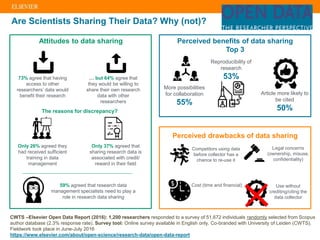
Are Scientists Sharing Their Data? Why (not)?
Attitudes to data sharing
73% agree that having
access to other
researchers’ data would
benefit their research
… but 64% agree that
they would be willing to
share their own research
data with other
researchers
The reasons for discrepancy?
Only 26% agreed they
had received sufficient
training in data
management
Only 37% agreed that
sharing research data is
associated with credit/
reward in their field
59% agreed that research data
management specialists need to play a
role in research data sharing
Perceived benefits of data sharing
Top 3
More possibilities
for collaboration
55%
Reproducibility of
research
53%
Article more likely to
be cited
50%
Perceived drawbacks of data sharing
Competitors using data
before collector has a
chance to re-use it
Use without
crediting/citing the
data collector
Cost (time and financial)
Legal concerns
(ownership, misuse,
confidentiality)
CWTS –Elsevier Open Data Report (2016): 1,200 researchers responded to a survey of 51,672 individuals randomly selected from Scopus
author database (2.3% response rate). Survey tool: Online survey available in English only. Co-branded with University of Leiden (CWTS).
Fieldwork took place in June-July 2016
https://www.elsevier.com/about/open-science/research-data/open-data-report
| 3
Publishers Getting Together: AGU FAIR Data Sharing Guidelines
1. https://www.elsevier.com/authors/author-services/research-data/data-guidelines/
2. https://cos.io/our-services/top-guidelines/
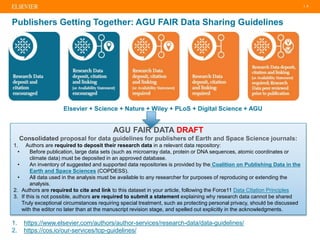
AGU FAIR DATA DRAFT
Consolidated proposal for data guidelines for publishers of Earth and Space Science journals:
1. Authors are required to deposit their research data in a relevant data repository:
• Before publication, large data sets (such as microarray data, protein or DNA sequences, atomic coordinates or
climate data) must be deposited in an approved database.
• An inventory of suggested and supported data repositories is provided by the Coalition on Publishing Data in the
Earth and Space Sciences (COPDESS).
• All data used in the analysis must be available to any researcher for purposes of reproducing or extending the
analysis.
2. Authors are required to cite and link to this dataset in your article, following the Force11 Data CItation Principles
3. If this is not possible, authors are required to submit a statement explaining why research data cannot be shared
Truly exceptional circumstances requiring special treatment, such as protecting personal privacy, should be discussed
with the editor no later than at the manuscript revision stage, and spelled out explicitly in the acknowledgments.
Elsevier + Science + Nature + Wiley + PLoS + Digital Science + AGU
| 4
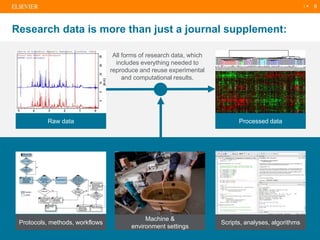
Research data is more than just a journal supplement:
9
All forms of research data, which
includes everything needed to
reproduce and reuse experimental
and computational results.
Raw data Processed data
Machine &
environment settings
Protocols, methods, workflows Scripts, analyses, algorithms
| 5
3. ‘Metrics on data’
Monitoring and reporting
on institutional data
• Benchmark • Rank Evaluate
• Manage • Preserve
Institution
Search Repository
Notebook
Manager
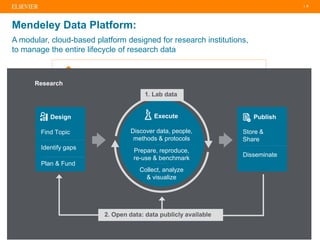
Mendeley Data Platform:
Monitor
A modular, cloud-based platform designed for research institutions,
to manage the entire lifecycle of research data
Find Topic
Design
Identify gaps
Plan & Fund
Discover data, people,
methods & protocols
Collect, analyze
& visualize
Prepare, reproduce,
re-use & benchmark
Store &
Share
Publish
Disseminate
1. Lab data
Execute
Research
2. Open data: data publicly available
| 6
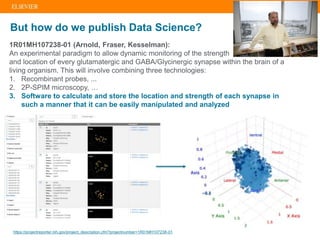
But how do we publish Data Science?
https://projectreporter.nih.gov/project_description.cfm?projectnumber=1R01MH107238-01
1R01MH107238-01 (Arnold, Fraser, Kesselman):
An experimental paradigm to allow dynamic monitoring of the strength
and location of every glutamatergic and GABA/Glycinergic synapse within the brain of a
living organism. This will involve combining three technologies:
1. Recombinant probes, ...
2. 2P-SPIM microscopy, …
3. Software to calculate and store the location and strength of each synapse in
such a manner that it can be easily manipulated and analyzed
| 7
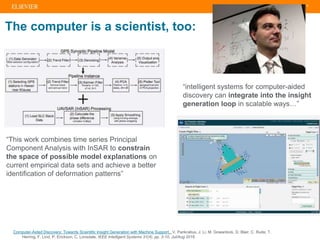
The computer is a scientist, too:
“intelligent systems for computer-aided
discovery can integrate into the insight
generation loop in scalable ways…”
Computer-Aided Discovery: Towards Scientific Insight Generation with Machine Support, V. Pankratius, J. Li, M. Gowanlock, D. Blair, C. Rude, T.
Herring, F. Lind, P. Erickson, C. Lonsdale, IEEE Intelligent Systems 31(4), pp. 3-10, Jul/Aug 2016
“This work combines time series Principal
Component Analysis with InSAR to constrain
the space of possible model explanations on
current empirical data sets and achieve a better
identification of deformation patterns”
| 8
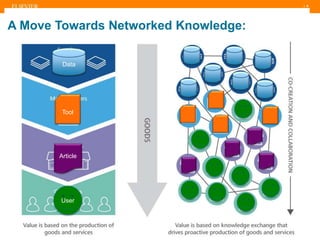
Data
Tool
Article
User
A Move Towards Networked Knowledge:
| 9
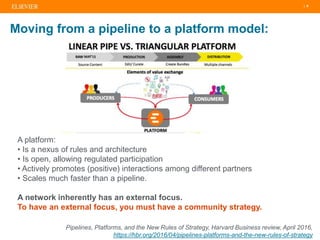
Moving from a pipeline to a platform model:
A platform:
• Is a nexus of rules and architecture
• Is open, allowing regulated participation
• Actively promotes (positive) interactions among different partners
• Scales much faster than a pipeline.
A network inherently has an external focus.
To have an external focus, you must have a community strategy.
Pipelines, Platforms, and the New Rules of Strategy, Harvard Business review, April 2016,
https://hbr.org/2016/04/pipelines-platforms-and-the-new-rules-of-strategy
| 10
existing integration
planned integration
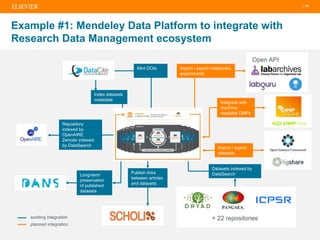
Example #1: Mendeley Data Platform to integrate with
Research Data Management ecosystem
Index datasets
metadata
Mint DOIs Import / export notebooks,
experiments
Import / export
datasets
Repository
indexed by
OpenAIRE
Zenodo indexed
by DataSearch
Publish links
between articles
and datasets
Datasets indexed by
DataSearchLong-term
preservation
of published
datasets
+ 22 repositories
Integrate with
machine
readable DMPs
Open API
| 11
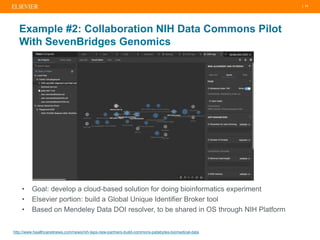
• Goal: develop a cloud-based solution for doing bioinformatics experiment
• Elsevier portion: build a Global Unique Identifier Broker tool
• Based on Mendeley Data DOI resolver, to be shared in OS through NIH Platform
Example #2: Collaboration NIH Data Commons Pilot
With SevenBridges Genomics
http://www.healthcareitnews.com/news/nih-taps-new-partners-build-commons-petabytes-biomedical-data
| 12
In Summary:
• Publishers are getting together to help store and share data:
- Open Data Report
- AGU Fair Data Group
- Mendeley Data Platform
• But: all science is becoming data science:
- Scientists are building the tools that other scientists work with
- We are moving ‘beyond download science’, where computers join in
• Publishers need to change:
- We need to enable network effects
- This means moving from a pipeline to a platform model
• Some things we are doing at Elsevier RDM:
- Mendeley Data Platform
- Participating in the NIH Data Commons Pilot
| 13
Many Questions Remain…
• How do we best publish Data Science?
• (How) do we connect this to the article/journal model that we all know
and love?
• How does scientific software become sustainable, used, connected?
• What role do all the parties play: funding agencies, tool builders
(commercial and academic), HPCCs, cloud providers, libraries,
standards bodies, publishers?
• How do all of us become connected into a viable network?
• How do we collectively transition from the old models into the new?
| 14
Extra Slides
| 15
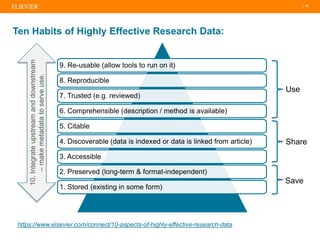
https://www.elsevier.com/connect/10-aspects-of-highly-effective-research-data
10.Integrateupstreamanddownstream
–makemetadatatoserveuse.
Save
Share
Use
9. Re-usable (allow tools to run on it)
8. Reproducible
7. Trusted (e.g. reviewed)
6. Comprehensible (description / method is available)
5. Citable
4. Discoverable (data is indexed or data is linked from article)
3. Accessible
1. Stored (existing in some form)
2. Preserved (long-term & format-independent)
Ten Habits of Highly Effective Research Data:
| 16
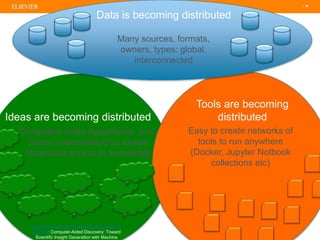
Ideas are becoming distributed
Tools are becoming
distributed
Easy to create networks of
tools to run anywhere
(Docker, Jupyter Notbook
collections etc)
Many sources, formats,
owners, types: global,
interconnected
Computers make hypotheses, too*;
citizen science/MOOCs enable
ubiquitous access to knowledge
*
http://ieeexplore.ieee.org/abstract/document/7
515118/: Computer-Aided Discovery: Toward
Scientific Insight Generation with Machine
Data is becoming distributed
| 17
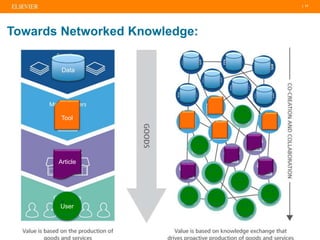
Data
Tool
Article
User
Towards Networked Knowledge:
| 18
Thank you!
Links to RDM Work:
• https://www.elsevier.com/connect/10-aspects-of-highly-effective-research-data
• https://www.elsevier.com/about/open-science/research-data
• https://www.hivebench.com
• https://data.mendeley.com/
• https://datasearch.elsevier.com/
• https://www.elsevier.com/books-and-journals/content-innovation/data-base-linking
• http://www.journals.elsevier.com/softwarex/
• https://rd-alliance.org/groups/rdawds-publishing-data-services-wg.html
• https://www.force11.org/
• http://www.nationaldataservice.org/
• https://rd-alliance.org/
Anita de Waard, a.dewaard@elsevier.com

Data, Data Everywhere: What's A Publisher to Do?

  • 1.
    | 1 Anita deWaard 0000-0002-9034-4119 VP Research Data Collaborations, Elsevier RDM a.dewaard@elsevier.com Data, Data, Everywhere: What’s A Publisher To Do?
  • 2.
    | 2 Are ScientistsSharing Their Data? Why (not)? Attitudes to data sharing 73% agree that having access to other researchers’ data would benefit their research … but 64% agree that they would be willing to share their own research data with other researchers The reasons for discrepancy? Only 26% agreed they had received sufficient training in data management Only 37% agreed that sharing research data is associated with credit/ reward in their field 59% agreed that research data management specialists need to play a role in research data sharing Perceived benefits of data sharing Top 3 More possibilities for collaboration 55% Reproducibility of research 53% Article more likely to be cited 50% Perceived drawbacks of data sharing Competitors using data before collector has a chance to re-use it Use without crediting/citing the data collector Cost (time and financial) Legal concerns (ownership, misuse, confidentiality) CWTS –Elsevier Open Data Report (2016): 1,200 researchers responded to a survey of 51,672 individuals randomly selected from Scopus author database (2.3% response rate). Survey tool: Online survey available in English only. Co-branded with University of Leiden (CWTS). Fieldwork took place in June-July 2016 https://www.elsevier.com/about/open-science/research-data/open-data-report
  • 3.
    | 3 Publishers GettingTogether: AGU FAIR Data Sharing Guidelines 1. https://www.elsevier.com/authors/author-services/research-data/data-guidelines/ 2. https://cos.io/our-services/top-guidelines/ AGU FAIR DATA DRAFT Consolidated proposal for data guidelines for publishers of Earth and Space Science journals: 1. Authors are required to deposit their research data in a relevant data repository: • Before publication, large data sets (such as microarray data, protein or DNA sequences, atomic coordinates or climate data) must be deposited in an approved database. • An inventory of suggested and supported data repositories is provided by the Coalition on Publishing Data in the Earth and Space Sciences (COPDESS). • All data used in the analysis must be available to any researcher for purposes of reproducing or extending the analysis. 2. Authors are required to cite and link to this dataset in your article, following the Force11 Data CItation Principles 3. If this is not possible, authors are required to submit a statement explaining why research data cannot be shared Truly exceptional circumstances requiring special treatment, such as protecting personal privacy, should be discussed with the editor no later than at the manuscript revision stage, and spelled out explicitly in the acknowledgments. Elsevier + Science + Nature + Wiley + PLoS + Digital Science + AGU
  • 4.
    | 4 Research datais more than just a journal supplement: 9 All forms of research data, which includes everything needed to reproduce and reuse experimental and computational results. Raw data Processed data Machine & environment settings Protocols, methods, workflows Scripts, analyses, algorithms
  • 5.
    | 5 3. ‘Metricson data’ Monitoring and reporting on institutional data • Benchmark • Rank Evaluate • Manage • Preserve Institution Search Repository Notebook Manager Mendeley Data Platform: Monitor A modular, cloud-based platform designed for research institutions, to manage the entire lifecycle of research data Find Topic Design Identify gaps Plan & Fund Discover data, people, methods & protocols Collect, analyze & visualize Prepare, reproduce, re-use & benchmark Store & Share Publish Disseminate 1. Lab data Execute Research 2. Open data: data publicly available
  • 6.
    | 6 But howdo we publish Data Science? https://projectreporter.nih.gov/project_description.cfm?projectnumber=1R01MH107238-01 1R01MH107238-01 (Arnold, Fraser, Kesselman): An experimental paradigm to allow dynamic monitoring of the strength and location of every glutamatergic and GABA/Glycinergic synapse within the brain of a living organism. This will involve combining three technologies: 1. Recombinant probes, ... 2. 2P-SPIM microscopy, … 3. Software to calculate and store the location and strength of each synapse in such a manner that it can be easily manipulated and analyzed
  • 7.
    | 7 The computeris a scientist, too: “intelligent systems for computer-aided discovery can integrate into the insight generation loop in scalable ways…” Computer-Aided Discovery: Towards Scientific Insight Generation with Machine Support, V. Pankratius, J. Li, M. Gowanlock, D. Blair, C. Rude, T. Herring, F. Lind, P. Erickson, C. Lonsdale, IEEE Intelligent Systems 31(4), pp. 3-10, Jul/Aug 2016 “This work combines time series Principal Component Analysis with InSAR to constrain the space of possible model explanations on current empirical data sets and achieve a better identification of deformation patterns”
  • 8.
    | 8 Data Tool Article User A MoveTowards Networked Knowledge:
  • 9.
    | 9 Moving froma pipeline to a platform model: A platform: • Is a nexus of rules and architecture • Is open, allowing regulated participation • Actively promotes (positive) interactions among different partners • Scales much faster than a pipeline. A network inherently has an external focus. To have an external focus, you must have a community strategy. Pipelines, Platforms, and the New Rules of Strategy, Harvard Business review, April 2016, https://hbr.org/2016/04/pipelines-platforms-and-the-new-rules-of-strategy
  • 10.
    | 10 existing integration plannedintegration Example #1: Mendeley Data Platform to integrate with Research Data Management ecosystem Index datasets metadata Mint DOIs Import / export notebooks, experiments Import / export datasets Repository indexed by OpenAIRE Zenodo indexed by DataSearch Publish links between articles and datasets Datasets indexed by DataSearchLong-term preservation of published datasets + 22 repositories Integrate with machine readable DMPs Open API
  • 11.
    | 11 • Goal:develop a cloud-based solution for doing bioinformatics experiment • Elsevier portion: build a Global Unique Identifier Broker tool • Based on Mendeley Data DOI resolver, to be shared in OS through NIH Platform Example #2: Collaboration NIH Data Commons Pilot With SevenBridges Genomics http://www.healthcareitnews.com/news/nih-taps-new-partners-build-commons-petabytes-biomedical-data
  • 12.
    | 12 In Summary: •Publishers are getting together to help store and share data: - Open Data Report - AGU Fair Data Group - Mendeley Data Platform • But: all science is becoming data science: - Scientists are building the tools that other scientists work with - We are moving ‘beyond download science’, where computers join in • Publishers need to change: - We need to enable network effects - This means moving from a pipeline to a platform model • Some things we are doing at Elsevier RDM: - Mendeley Data Platform - Participating in the NIH Data Commons Pilot
  • 13.
    | 13 Many QuestionsRemain… • How do we best publish Data Science? • (How) do we connect this to the article/journal model that we all know and love? • How does scientific software become sustainable, used, connected? • What role do all the parties play: funding agencies, tool builders (commercial and academic), HPCCs, cloud providers, libraries, standards bodies, publishers? • How do all of us become connected into a viable network? • How do we collectively transition from the old models into the new?
  • 14.
  • 15.
    | 15 https://www.elsevier.com/connect/10-aspects-of-highly-effective-research-data 10.Integrateupstreamanddownstream –makemetadatatoserveuse. Save Share Use 9. Re-usable(allow tools to run on it) 8. Reproducible 7. Trusted (e.g. reviewed) 6. Comprehensible (description / method is available) 5. Citable 4. Discoverable (data is indexed or data is linked from article) 3. Accessible 1. Stored (existing in some form) 2. Preserved (long-term & format-independent) Ten Habits of Highly Effective Research Data:
  • 16.
    | 16 Ideas arebecoming distributed Tools are becoming distributed Easy to create networks of tools to run anywhere (Docker, Jupyter Notbook collections etc) Many sources, formats, owners, types: global, interconnected Computers make hypotheses, too*; citizen science/MOOCs enable ubiquitous access to knowledge * http://ieeexplore.ieee.org/abstract/document/7 515118/: Computer-Aided Discovery: Toward Scientific Insight Generation with Machine Data is becoming distributed
  • 17.
  • 18.
    | 18 Thank you! Linksto RDM Work: • https://www.elsevier.com/connect/10-aspects-of-highly-effective-research-data • https://www.elsevier.com/about/open-science/research-data • https://www.hivebench.com • https://data.mendeley.com/ • https://datasearch.elsevier.com/ • https://www.elsevier.com/books-and-journals/content-innovation/data-base-linking • http://www.journals.elsevier.com/softwarex/ • https://rd-alliance.org/groups/rdawds-publishing-data-services-wg.html • https://www.force11.org/ • http://www.nationaldataservice.org/ • https://rd-alliance.org/ Anita de Waard, a.dewaard@elsevier.com

Editor's Notes

  • #2 Outline: Some Trends Some Questions What Elsevier is interested in, and doing
  • #5 When we talk about data, we are meaning all forms of research data, which includes everything you need to reproduce and reuse.