POSTMODERN FILM
HISTORY OF POSTMODERN FILM 
• 80s - early examples of postmodern films include Blade Runner 
(1982). It is a science fiction film with futuristic sets and action but 
it combines 1940’s costumes, punk hairstyles and offices. It plays 
with time, culture and genre by fusing them all together. 
• Another example is Blue Velvet (1986) which features a lot of 
intertextuality. 
• In the 90s, Pulp Fiction (1994) is another good example of 
postmodern film. This film consists of a lot of intertextuality and 
uses non-linear narration as it breaks down chronological time. 
The film is very much fragmented as it tells three interlocking 
stories of gangsters, robbers and a boxer. 
• 2000s - newer examples of postmodern film include: Scary Movie, 
Scream and Inception. There has been quite a few examples of 
postmodern films which are turning horror films into comedies. On 
the other hand there has been an increase in sci-fi films which 
focuses on a different aspect of postmodernism and plays with 
time e.g. Inception, Source Code.
FEATURES OF POSTMODERN FILM 
• Pastiche – an artistic work in a style that 
imitates that of another work, artist or period. 
Self-referential, tongue-in-cheek, rehashes of 
classic pop culture. 
• Flattening of affect – describes a person’s 
detachment and lack of emotional reactivity. 
This involves technology, drugs, violence and 
the media which lead to detached, emotionless 
and unauthentic lives. 
• Hyperreality – the inability of consciousness to 
distinguish reality from a simulation of reality. 
Technology creates realities which are original 
or more desirable than in the real world. 
• Time bending – used to connote importance of 
time travel as it shows how time travel provides 
another way to shape reality. 
• Altered states – involves mental illness, drugs 
and technology which provide a dark gateway 
to internal realities. 
• More human than human – artificial 
intelligence, robotics and cybernetics seek to 
enhance or replace humanity. 
Postmodern films goes 
against the generic film 
conventions in terms of 
the narrative and roles 
for example. 
They may consist of 
self-reflexivity which is 
where the character 
from the film stops and 
looks directly at the 
camera and talks to the 
audience.
FAMOUS EXAMPLES OF POSTMODERN FILM 
• Blade Runner 
• Pulp Fiction 
• Blue Velvet 
• The Matrix 
• Scream 
• Scary Movie 
• Inception 
Films like Scream and Scary Movie take horror film 
conventions and reverse them. For example, the 
lighting is bright which is opposite to the 
conventional dark lighting in horror movies. Also 
the setting is in a house which is an ordinary 
location and perhaps contrasts with the typical 
location such as a graveyard.
AUDIENCE AND POSTMODERN FILM 
• Where films make references to other media texts, it is 
sometimes portrayed in a humorous way which entertains the 
audience. 
• On the other hand, hyperreality may lead the audience to get too 
into the film and as a result create disappointment when the film 
comes to an end as they return to the real world where things are 
perhaps less exciting and entertaining as what they saw in the 
film. 
Anne Friedberg has argued that because we now have much control of how we 
watch a film (through video/dvd), and we increasingly watch film in personal 
spaces (the home) rather than exclusively in public places, ‘cinema and televison 
become readable as symptoms of a “postmodern condition”, but as contributing 
causes.’ In other words, we don’t just have films that are about postmodernism or 
reflect postmodern thinking. Films have helped contribute to the postmodern 
quality of life by manipulating and playing around with our conventional 
understanding of time and space. ‘One can literally rent another space and time 
when one borrows a videotape to watch on a VCR….the VCR allows man to 
organize a time which is not his own…a time which is somewhere else – and to 
capture it.’
CRITICISMS OF POSTMODERN FILM 
• Norman Denzin describes postmodern film as a regressive 
“masculinized culture … [in which] the oppressive structures of 
racism and sexism are still firmly in place” 
• Jane Shattuc criticises the sexual violence of ‘Blue Velvet’ and 
argues postmodern film as a “patriarchal form” hostile to the 
“conventions of affect, romance, melodrama and romantic 
symbolism, all forms associated with women”.
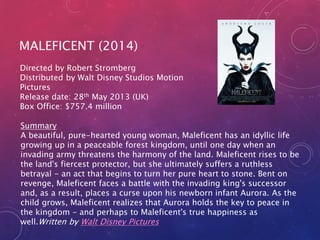
MALEFICENT (2014) 
Directed by Robert Stromberg 
Distributed by Walt Disney Studios Motion 
Pictures 
Release date: 28th May 2013 (UK) 
Box Office: $757.4 million 
Summary 
A beautiful, pure-hearted young woman, Maleficent has an idyllic life 
growing up in a peaceable forest kingdom, until one day when an 
invading army threatens the harmony of the land. Maleficent rises to be 
the land's fiercest protector, but she ultimately suffers a ruthless 
betrayal - an act that begins to turn her pure heart to stone. Bent on 
revenge, Maleficent faces a battle with the invading king's successor 
and, as a result, places a curse upon his newborn infant Aurora. As the 
child grows, Maleficent realizes that Aurora holds the key to peace in 
the kingdom - and perhaps to Maleficent's true happiness as 
well.Written by Walt Disney Pictures
MALEFICENT (2014) 
The build up of the film is based on the story of Sleeping Beauty. 
Maleficent places a curse on the kind’s daughter Aurora so that before the 
sun sets on her sixteenth birthday, the girl will "prick her finger on a 
spindle of a spinning wheel and die!" which she then weakens the curse so 
that Aurora will fall into a deep sleep instead, with only a kiss from her 
true love needed to awaken her. 
This is re-telling the story of Sleeping Beauty in the villain’s perspective 
where the main character is a fairy turned into a villain. 
Intent on saving her, Maleficent abducts Phillip and goes to Stefan's 
castle to have him kiss Aurora and break the curse. However, Phillip's 
romantic kiss has no effect, as the two are not yet truly in love. Maleficent 
apologizes to Aurora and swears no harm will come to her, kissing her 
forehead. This breaks the curse and Aurora awakens as Maleficent's 
motherly concern for Aurora constitutes "true love.“ 
Rather than the Philip awakening Aurora like in Sleeping Beauty, Maleficent 
is the one who breaks the curse.

Postmodern film

  • 1.
  • 2.
    HISTORY OF POSTMODERNFILM • 80s - early examples of postmodern films include Blade Runner (1982). It is a science fiction film with futuristic sets and action but it combines 1940’s costumes, punk hairstyles and offices. It plays with time, culture and genre by fusing them all together. • Another example is Blue Velvet (1986) which features a lot of intertextuality. • In the 90s, Pulp Fiction (1994) is another good example of postmodern film. This film consists of a lot of intertextuality and uses non-linear narration as it breaks down chronological time. The film is very much fragmented as it tells three interlocking stories of gangsters, robbers and a boxer. • 2000s - newer examples of postmodern film include: Scary Movie, Scream and Inception. There has been quite a few examples of postmodern films which are turning horror films into comedies. On the other hand there has been an increase in sci-fi films which focuses on a different aspect of postmodernism and plays with time e.g. Inception, Source Code.
  • 3.
    FEATURES OF POSTMODERNFILM • Pastiche – an artistic work in a style that imitates that of another work, artist or period. Self-referential, tongue-in-cheek, rehashes of classic pop culture. • Flattening of affect – describes a person’s detachment and lack of emotional reactivity. This involves technology, drugs, violence and the media which lead to detached, emotionless and unauthentic lives. • Hyperreality – the inability of consciousness to distinguish reality from a simulation of reality. Technology creates realities which are original or more desirable than in the real world. • Time bending – used to connote importance of time travel as it shows how time travel provides another way to shape reality. • Altered states – involves mental illness, drugs and technology which provide a dark gateway to internal realities. • More human than human – artificial intelligence, robotics and cybernetics seek to enhance or replace humanity. Postmodern films goes against the generic film conventions in terms of the narrative and roles for example. They may consist of self-reflexivity which is where the character from the film stops and looks directly at the camera and talks to the audience.
  • 4.
    FAMOUS EXAMPLES OFPOSTMODERN FILM • Blade Runner • Pulp Fiction • Blue Velvet • The Matrix • Scream • Scary Movie • Inception Films like Scream and Scary Movie take horror film conventions and reverse them. For example, the lighting is bright which is opposite to the conventional dark lighting in horror movies. Also the setting is in a house which is an ordinary location and perhaps contrasts with the typical location such as a graveyard.
  • 5.
    AUDIENCE AND POSTMODERNFILM • Where films make references to other media texts, it is sometimes portrayed in a humorous way which entertains the audience. • On the other hand, hyperreality may lead the audience to get too into the film and as a result create disappointment when the film comes to an end as they return to the real world where things are perhaps less exciting and entertaining as what they saw in the film. Anne Friedberg has argued that because we now have much control of how we watch a film (through video/dvd), and we increasingly watch film in personal spaces (the home) rather than exclusively in public places, ‘cinema and televison become readable as symptoms of a “postmodern condition”, but as contributing causes.’ In other words, we don’t just have films that are about postmodernism or reflect postmodern thinking. Films have helped contribute to the postmodern quality of life by manipulating and playing around with our conventional understanding of time and space. ‘One can literally rent another space and time when one borrows a videotape to watch on a VCR….the VCR allows man to organize a time which is not his own…a time which is somewhere else – and to capture it.’
  • 6.
    CRITICISMS OF POSTMODERNFILM • Norman Denzin describes postmodern film as a regressive “masculinized culture … [in which] the oppressive structures of racism and sexism are still firmly in place” • Jane Shattuc criticises the sexual violence of ‘Blue Velvet’ and argues postmodern film as a “patriarchal form” hostile to the “conventions of affect, romance, melodrama and romantic symbolism, all forms associated with women”.
  • 7.
    MALEFICENT (2014) Directedby Robert Stromberg Distributed by Walt Disney Studios Motion Pictures Release date: 28th May 2013 (UK) Box Office: $757.4 million Summary A beautiful, pure-hearted young woman, Maleficent has an idyllic life growing up in a peaceable forest kingdom, until one day when an invading army threatens the harmony of the land. Maleficent rises to be the land's fiercest protector, but she ultimately suffers a ruthless betrayal - an act that begins to turn her pure heart to stone. Bent on revenge, Maleficent faces a battle with the invading king's successor and, as a result, places a curse upon his newborn infant Aurora. As the child grows, Maleficent realizes that Aurora holds the key to peace in the kingdom - and perhaps to Maleficent's true happiness as well.Written by Walt Disney Pictures
  • 8.
    MALEFICENT (2014) Thebuild up of the film is based on the story of Sleeping Beauty. Maleficent places a curse on the kind’s daughter Aurora so that before the sun sets on her sixteenth birthday, the girl will "prick her finger on a spindle of a spinning wheel and die!" which she then weakens the curse so that Aurora will fall into a deep sleep instead, with only a kiss from her true love needed to awaken her. This is re-telling the story of Sleeping Beauty in the villain’s perspective where the main character is a fairy turned into a villain. Intent on saving her, Maleficent abducts Phillip and goes to Stefan's castle to have him kiss Aurora and break the curse. However, Phillip's romantic kiss has no effect, as the two are not yet truly in love. Maleficent apologizes to Aurora and swears no harm will come to her, kissing her forehead. This breaks the curse and Aurora awakens as Maleficent's motherly concern for Aurora constitutes "true love.“ Rather than the Philip awakening Aurora like in Sleeping Beauty, Maleficent is the one who breaks the curse.