Q3. What have you learned
from your audience feedback?
Target audience:
• Young
• Mainly female
• Social grade E
• Likely to still be in education
Method
 Feedback is an important process that allows you to get an idea of what people think about your product so that
you can make relevant improvements to it. The way in which you gain feedback is also important as different
types can be informative in different ways. For example, using surveys is one of the best ways to get a range of
quantitative and qualitative data. Furthermore, the respondent’s answers are anonymous meaning that they are
more likely to be truthful which can produce more useful feedback for me to act on.
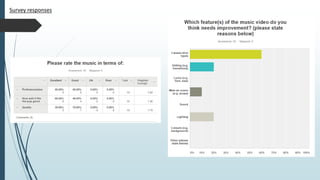
 I received feedback for my music video through the survey I created on SurveyMonkey. In this survey I included a
range of questions which were quantitative as well as qualitative to ensure that I had a variety of answers to look
at. Some of the quantitative questions required the respondents to rate certain aspects of the music video. For
the qualitative questions, the respondents commented on the strengths, weaknesses and more specifically what
improvements I should make to my music video. This allowed me to get a detailed response of my music video
which would help to make useful improvements to it.
Qualitative questions
Quantitative questions
Survey responses
Survey responses
Survey responses
Feedback and improvements
 I gathered from my audience feedback that the use of props is a strength of my music
video as it is appealing. In reaction to this I created more props which were used in the
second video shoot. I also found that the positioning of the artist being in the centre
throughout the music video was uninteresting. Therefore, to improve this I positioned the
artist so that they were on the left or right side occasionally. Another issue brought up by
my target audience is the use of transitions. Some of the transitions I used in the first draft
seemed to vary too much which made it look slightly unorganised. As a result, I decided to
use the key frames to change between the scenes with the artist appearing on and off the
screen. To add variety to this I made the artist appear form different directions –from the
left, right, bottom.
 I made use of the comment feature on Blogger to obtain feedback for my digipak and
magazine advert. This allowed people to comment freely on what they thought of my
products which is an easy method of getting qualitative data. From the feedback I
received, I found that the first draft of my digipak was relatively simple and lacked some
information which makes it look less like real world products. After acknowledging this I
made a few additions to the digipak whilst keeping the original layout as this was liked by
my audience. For example, I added a special edition label on the front cover, a ‘Thanks to’
page and details on the CD. As for my magazine advert, I learnt from my feedback that I
should add more reviews to make it look more similar to real products.

Evaluation Q3

  • 1.
    Q3. What haveyou learned from your audience feedback? Target audience: • Young • Mainly female • Social grade E • Likely to still be in education
  • 2.
    Method  Feedback isan important process that allows you to get an idea of what people think about your product so that you can make relevant improvements to it. The way in which you gain feedback is also important as different types can be informative in different ways. For example, using surveys is one of the best ways to get a range of quantitative and qualitative data. Furthermore, the respondent’s answers are anonymous meaning that they are more likely to be truthful which can produce more useful feedback for me to act on.  I received feedback for my music video through the survey I created on SurveyMonkey. In this survey I included a range of questions which were quantitative as well as qualitative to ensure that I had a variety of answers to look at. Some of the quantitative questions required the respondents to rate certain aspects of the music video. For the qualitative questions, the respondents commented on the strengths, weaknesses and more specifically what improvements I should make to my music video. This allowed me to get a detailed response of my music video which would help to make useful improvements to it. Qualitative questions Quantitative questions
  • 3.
  • 4.
  • 5.
  • 6.
    Feedback and improvements I gathered from my audience feedback that the use of props is a strength of my music video as it is appealing. In reaction to this I created more props which were used in the second video shoot. I also found that the positioning of the artist being in the centre throughout the music video was uninteresting. Therefore, to improve this I positioned the artist so that they were on the left or right side occasionally. Another issue brought up by my target audience is the use of transitions. Some of the transitions I used in the first draft seemed to vary too much which made it look slightly unorganised. As a result, I decided to use the key frames to change between the scenes with the artist appearing on and off the screen. To add variety to this I made the artist appear form different directions –from the left, right, bottom.  I made use of the comment feature on Blogger to obtain feedback for my digipak and magazine advert. This allowed people to comment freely on what they thought of my products which is an easy method of getting qualitative data. From the feedback I received, I found that the first draft of my digipak was relatively simple and lacked some information which makes it look less like real world products. After acknowledging this I made a few additions to the digipak whilst keeping the original layout as this was liked by my audience. For example, I added a special edition label on the front cover, a ‘Thanks to’ page and details on the CD. As for my magazine advert, I learnt from my feedback that I should add more reviews to make it look more similar to real products.