LYMPHATIC SYSTEM
AND LYMPH
Dr. JILSHA
OBJECTIVES
To get a better understanding of :
 Lymphatic system
 Lymph nodes and their functions
 Formation, Composition and functions of lymph.
LYMPHATIC SYSTEM
 It is a closed system of lymph channels or lymph
vessels through which lymph flows.
 One way system – allows lymph flow from tissue
spaces towards the blood.
 Almost all tissues of the body have lymphatics –
except skin, brain and bones.
LYMPHATIC SYSTEM
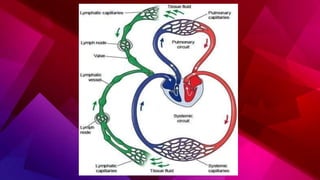
 Lymphatic system arises from tissue spaces as a
meshwork of delicate vessels – lymph capillaries.
 Large lymph vessels ultimately form the right
lymphatic duct and thoracic duct.
 R lymphatic duct – R subclavian vein.
 Thoracic duct – L subclavian vein.
LYMPH NODES
 Small glandular structures located in the course of
lymph vessels.
 Each lymph node constitutes masses of lymphatic
tissue covered by a dense connective tissue capsule.
 Three layers – cortex, paracortex and medulla.
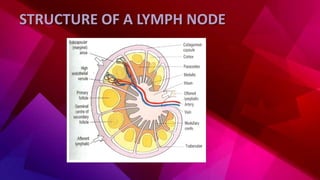
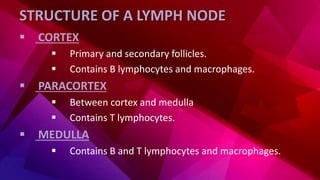
STRUCTURE OF A LYMPH NODE
 CORTEX
 Primary and secondary follicles.
 Contains B lymphocytes and macrophages.
 PARACORTEX
 Between cortex and medulla
 Contains T lymphocytes.
 MEDULLA
 Contains B and T lymphocytes and macrophages.
LYMPH NODES
 LYMPHATIC VESSELS
 Lymph enters lymph node via Afferent vessels.
 Lymph leaves lymph node via Efferent vessels.
 DISTRIBUTION OF LYMPH NODES
 Along the course of lymphatic vessels in elbow, axilla,
groin, knee.
 Also in neck, thorax and abdomen where many lymph
vessels join.
FUNCTIONS OF LYMPH NODES
 Filters lymph – water & electrolytes are
removed, proteins & lipids are retained.
 Bacteria and other toxic substances are
destroyed by macrophages.
 Also called defense barriers.
APPLIED PHYSIOLOGY
 During infection, lymph node activity increase –
swelling of lymph nodes.
 Tonsillitis, Throat Ca – neck lymph node (cervical
nodes) swelling.
 Breast Ca – armpit - axillary nodes.
 Lung Ca – chest.
 Genital infections – groin - Inguinal nodes.
LYMPH
 Lymph is an alkaline clear fluid that is derived
from interstitial fluid and flowing to blood
stream through lymphatic vessels.
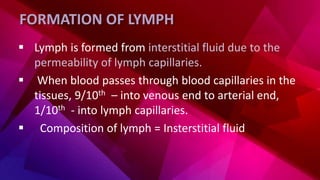
FORMATION OF LYMPH
 Lymph is formed from interstitial fluid due to the
permeability of lymph capillaries.
 When blood passes through blood capillaries in the
tissues, 9/10th – into venous end to arterial end,
1/10th - into lymph capillaries.
 Composition of lymph = Insterstitial fluid
RATE OF LYMPH
 About 120 ML of lymph flows into blood per
hour.
 About 100 ML – thoracic duct.
 20 ML – right lymphatic duct.
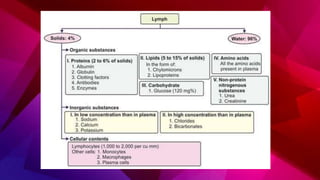
COMPOSITION OF LYMPH
 Lymph is a clear and colorless fluid.
 96% water and 4% solids.
 Some blood cells are also present.
FUNCTIONS OF LYMPH
 Important function – return proteins from tissue
spaces into blood.
 Redistribution of fluid in the body.
 Bacteria, toxins and other foreign bodies are
removed.
 Maintenance of structural & functional integrity of
tissue.
 Intestinal fat absorption.
 Immunity – transport of lymphocytes.
SUMMARY
 Lymphatic system is a closed one way system.
 Lymph node is made of cortex, para cortex and medulla,
afferent & efferent vessels.
 Lymph nodes are present in various regions.
 Infection leads to swelling of lymph node.
 Lymph is a clear fluid.
 Lymph flows into the blood at a rate of 120 mL/hr.
 Foreign bodies are removed in lymph.
Lymphatic system and lymph

Lymphatic system and lymph

  • 1.
  • 2.
    OBJECTIVES To get abetter understanding of :  Lymphatic system  Lymph nodes and their functions  Formation, Composition and functions of lymph.
  • 3.
    LYMPHATIC SYSTEM  Itis a closed system of lymph channels or lymph vessels through which lymph flows.  One way system – allows lymph flow from tissue spaces towards the blood.  Almost all tissues of the body have lymphatics – except skin, brain and bones.
  • 4.
    LYMPHATIC SYSTEM  Lymphaticsystem arises from tissue spaces as a meshwork of delicate vessels – lymph capillaries.  Large lymph vessels ultimately form the right lymphatic duct and thoracic duct.  R lymphatic duct – R subclavian vein.  Thoracic duct – L subclavian vein.
  • 5.
    LYMPH NODES  Smallglandular structures located in the course of lymph vessels.  Each lymph node constitutes masses of lymphatic tissue covered by a dense connective tissue capsule.  Three layers – cortex, paracortex and medulla.
  • 6.
    STRUCTURE OF ALYMPH NODE
  • 7.
    STRUCTURE OF ALYMPH NODE  CORTEX  Primary and secondary follicles.  Contains B lymphocytes and macrophages.  PARACORTEX  Between cortex and medulla  Contains T lymphocytes.  MEDULLA  Contains B and T lymphocytes and macrophages.
  • 8.
    LYMPH NODES  LYMPHATICVESSELS  Lymph enters lymph node via Afferent vessels.  Lymph leaves lymph node via Efferent vessels.  DISTRIBUTION OF LYMPH NODES  Along the course of lymphatic vessels in elbow, axilla, groin, knee.  Also in neck, thorax and abdomen where many lymph vessels join.
  • 10.
    FUNCTIONS OF LYMPHNODES  Filters lymph – water & electrolytes are removed, proteins & lipids are retained.  Bacteria and other toxic substances are destroyed by macrophages.  Also called defense barriers.
  • 12.
    APPLIED PHYSIOLOGY  Duringinfection, lymph node activity increase – swelling of lymph nodes.  Tonsillitis, Throat Ca – neck lymph node (cervical nodes) swelling.  Breast Ca – armpit - axillary nodes.  Lung Ca – chest.  Genital infections – groin - Inguinal nodes.
  • 14.
    LYMPH  Lymph isan alkaline clear fluid that is derived from interstitial fluid and flowing to blood stream through lymphatic vessels.
  • 15.
    FORMATION OF LYMPH Lymph is formed from interstitial fluid due to the permeability of lymph capillaries.  When blood passes through blood capillaries in the tissues, 9/10th – into venous end to arterial end, 1/10th - into lymph capillaries.  Composition of lymph = Insterstitial fluid
  • 17.
    RATE OF LYMPH About 120 ML of lymph flows into blood per hour.  About 100 ML – thoracic duct.  20 ML – right lymphatic duct.
  • 18.
    COMPOSITION OF LYMPH Lymph is a clear and colorless fluid.  96% water and 4% solids.  Some blood cells are also present.
  • 20.
    FUNCTIONS OF LYMPH Important function – return proteins from tissue spaces into blood.  Redistribution of fluid in the body.  Bacteria, toxins and other foreign bodies are removed.  Maintenance of structural & functional integrity of tissue.  Intestinal fat absorption.  Immunity – transport of lymphocytes.
  • 21.
    SUMMARY  Lymphatic systemis a closed one way system.  Lymph node is made of cortex, para cortex and medulla, afferent & efferent vessels.  Lymph nodes are present in various regions.  Infection leads to swelling of lymph node.  Lymph is a clear fluid.  Lymph flows into the blood at a rate of 120 mL/hr.  Foreign bodies are removed in lymph.