BY-
ROMENA BEGUM
FINAL YEAR MSC (N)
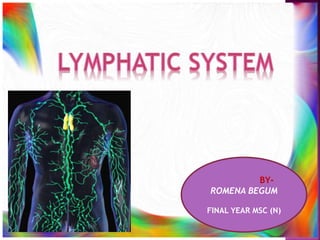
The lymphatic system consists of a fluid
called lymph.This fluid is flowing through
the lymphatic vessels.Lymph passes
through the vessels and lymph nodes.
The entire system consists of
Lymph
Lymph capillaries
Lymph vessels
Lymph node
Lymph ducts
Lymph organs
Lymphatic tissue
Bone marrow
Tissue drainage
Absorption and transportation of fat from the
small intestine.
Protect from infection
Produce lymphocyte
Produce antibody and antitoxin
Transporting nutrients to tissue
Keep body cell moist
•Lymph is a colourless interstitial fluid
closely resemble blood plasma in
composition.
•Lymph is isotonic.
•Normal lymph flow is 2-4 L/day(80-
150ml/hour) for entire body.
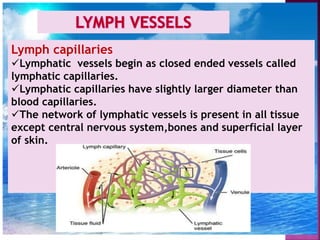
Lymph capillaries
Lymphatic vessels begin as closed ended vessels called
lymphatic capillaries.
Lymphatic capillaries have slightly larger diameter than
blood capillaries.
The network of lymphatic vessels is present in all tissue
except central nervous system,bones and superficial layer
of skin.
The lymphatic vessels of left side
unite to form a thoracic duct and right
side unite to form right lymphatic
duct.
Lymph nodes are small,oval or bean like
bodies placed in the lymphatic vessels and
joint together by them.
The main groups
present in
•Neck
•Axilla
•Thorax
•Abdomen
•Groin.
Each node is covered by a capsule of dense
connective tissue.
The capsular extensions are called trabeculae.
The paranchyma of a lymph node is specialized
into two region,cortex and medulla .
1.Cervical nodes
2.Axillary nodes
3.Inguinal nodes
4.Pelvic nodes
Filtering and
phagocytosis
Hematopoiesis
Proliferation
of lymphocytes
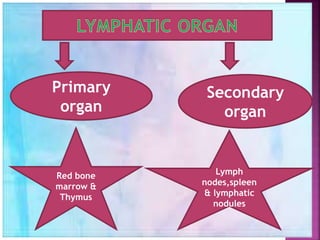
Primary
organ
Secondary
organ
Red bone
marrow &
Thymus
Lymph
nodes,spleen
& lymphatic
nodules
•Thymus is a bilobed lymphatic organ.
•It is located in the mediastinum.
•Weight -10-15gm at birth.
• Its consist of 2 lobes.
•Each lobe has 2 lobules.
•Each lobules consists of outer cotex n central medulla part
Thymosin hormone stimulates the maturation of
thymus & lymphoid tissue.
Thymus develop into activated T- Lymphocytes.
The oval spleen is the largest single mass of
lymphatic tissue in the body.
The anterior surface is covered with
peritoneum.
It measures about 12 cm long.
Its weights about 200mg.
Phagocytosis
Storage of blood
Immune response
Erythropoiesis
The main groups of mucosa-
associated lymphoid tissue are
the tonsils & peyers patches.
Lymphatic nodules are oval shaped concentrations of
lymphatic tissue.
The main group of mucosa-associated lymphoid tissue
are the tonsils & peyers patches.
•Tonsils form a ring at the
junction of the oral cavity &
oropharynx.
•They destroy the swallowed &
inhaled antigens.
These are located in the small intestine &
intercept swallowed antigens.
Lymphatic capillaries(lymph)
Subclavian veins (blood plasma)
Lymphatic ducts
Lymphatic vessels
Interstitial spaces(interstitial fluid)
Blood capillaries
Arteries(blood plasma)
Lymphatic system

Lymphatic system