LYMPHODENOPATHY
Abu-alhassn haedar
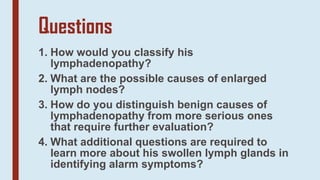
Questions
1. How would you classify his
lymphadenopathy?
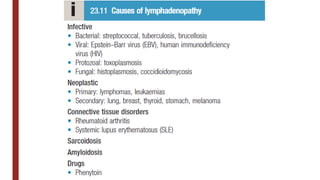
2. What are the possible causes of enlarged
lymph nodes?
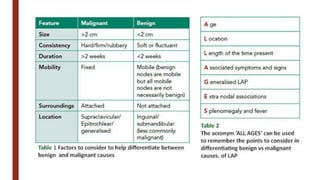
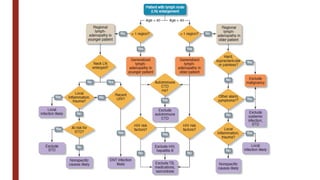
3. How do you distinguish benign causes of
lymphadenopathy from more serious ones
that require further evaluation?
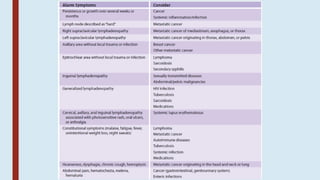
4. What additional questions are required to
learn more about his swollen lymph glands in
identifying alarm symptoms?
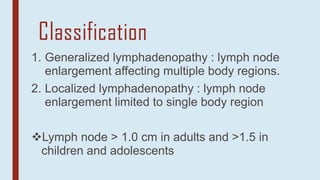
Classification
1. Generalized lymphadenopathy : lymph node
enlargement affecting multiple body regions.
2. Localized lymphadenopathy : lymph node
enlargement limited to single body region
❖Lymph node > 1.0 cm in adults and >1.5 in
children and adolescents
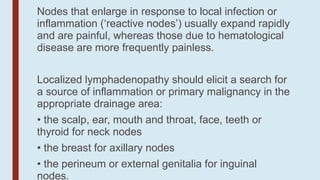
Nodes that enlarge in response to local infection or
inflammation (‘reactive nodes’) usually expand rapidly
and are painful, whereas those due to hematological
disease are more frequently painless.
Localized lymphadenopathy should elicit a search for
a source of inflammation or primary malignancy in the
appropriate drainage area:
• the scalp, ear, mouth and throat, face, teeth or
thyroid for neck nodes
• the breast for axillary nodes
• the perineum or external genitalia for inguinal
nodes.
Generalized lymphadenopathy may be secondary
to infection, often viral, connective tissue disease
or extensive skin disease but is more likely to
signify underlying hematological malignancy.
Weight loss and drenching night sweats that may
require a change of nightclothes are associated
Lymphadenopathy
Lymphadenopathy
Lymphadenopathy
Lymphadenopathy
Lymphadenopathy
Lymphadenopathy
Lymphadenopathy

Lymphadenopathy

  • 1.
  • 3.
    Questions 1. How wouldyou classify his lymphadenopathy? 2. What are the possible causes of enlarged lymph nodes? 3. How do you distinguish benign causes of lymphadenopathy from more serious ones that require further evaluation? 4. What additional questions are required to learn more about his swollen lymph glands in identifying alarm symptoms?
  • 5.
    Classification 1. Generalized lymphadenopathy: lymph node enlargement affecting multiple body regions. 2. Localized lymphadenopathy : lymph node enlargement limited to single body region ❖Lymph node > 1.0 cm in adults and >1.5 in children and adolescents
  • 7.
    Nodes that enlargein response to local infection or inflammation (‘reactive nodes’) usually expand rapidly and are painful, whereas those due to hematological disease are more frequently painless. Localized lymphadenopathy should elicit a search for a source of inflammation or primary malignancy in the appropriate drainage area: • the scalp, ear, mouth and throat, face, teeth or thyroid for neck nodes • the breast for axillary nodes • the perineum or external genitalia for inguinal nodes.
  • 8.
    Generalized lymphadenopathy maybe secondary to infection, often viral, connective tissue disease or extensive skin disease but is more likely to signify underlying hematological malignancy. Weight loss and drenching night sweats that may require a change of nightclothes are associated