Approach to
Approach to
Lymphadenopathy
Lymphadenopathy
Dr. FARYAL AZHAR
Dr. FARYAL AZHAR
Case 1
Case 1
 25 year old female
25 year old female
 3 month history of B-symptoms, progressive
3 month history of B-symptoms, progressive
anemia (normocytic), new adenopathy – not
painful but progressive over weeks, weight loss
 Physical exam – diffuse adenopathy 2-3 cm in
Physical exam – diffuse adenopathy 2-3 cm in
size, oral ulceration - ?HSV, no organomegaly
 Laboratory Investigations – Hemoglobin 60,
Laboratory Investigations – Hemoglobin 60,
MCV of 80, low WBC, normal platelet count,
normal biochemistry – high LDH
Case 2
Case 2
 83 yo Female
83 yo Female
 Otherwise healthy
Otherwise healthy
 5 years ago presented with painful right submandicular
5 years ago presented with painful right submandicular
node – 3X3 cm – given ABx and followed for a few
months – slight decrease
 FNA done – reactive
FNA done – reactive
 Node persisted over months – excisional biopsy –
Node persisted over months – excisional biopsy –
reactive adenopathy
reactive adenopathy
 6 months ago – recurrent right submandicular node –
6 months ago – recurrent right submandicular node –
matted, slowly increased in size – now 3X3cm
Objectives
Objectives
 Approach to Adenopathy
Approach to Adenopathy
 Who to investigate
Who to investigate
 When to investigate
When to investigate
 How to define risk for underlying malignancy
How to define risk for underlying malignancy
Lymph Nodes
Lymph Nodes
 Anatomy
Anatomy
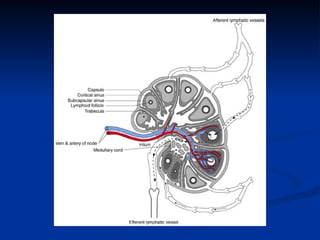
 Collection of lymphoid cells attached to both vascular and
Collection of lymphoid cells attached to both vascular and
lymphatic systems
lymphatic systems
 Over 600 lymph nodes in the body
Over 600 lymph nodes in the body
 Function
Function
 To provide optimal sites for the concentration of free or cell-
To provide optimal sites for the concentration of free or cell-
associated antigens and recirculating lymphocytes –
“sensitization of the immune response”
 To allow contact between B-cells, T-cells and macrophages
To allow contact between B-cells, T-cells and macrophages
 Lymphadenopathy - node greater than 1cm in size
Lymphadenopathy - node greater than 1cm in size
Why do lymph nodes enlarge?
 Increase in the number of benign lymphocytes
Increase in the number of benign lymphocytes
and macrophages in response to antigens
 Infiltration of inflammatory cells in infection
Infiltration of inflammatory cells in infection
(lymphadenitis)
(lymphadenitis)
 In situ proliferation of malignant lymphocytes or
In situ proliferation of malignant lymphocytes or
macrophages
macrophages
 Infiltration by metastatic malignant cells
Infiltration by metastatic malignant cells
 Infiltration of lymph nodes by metabolite laden
Infiltration of lymph nodes by metabolite laden
macrophages (lipid storage diseases)
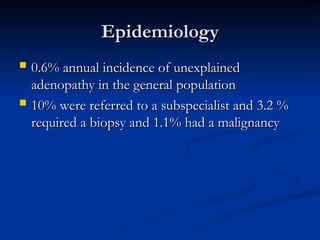
Epidemiology
Epidemiology
 0.6% annual incidence of unexplained
0.6% annual incidence of unexplained
adenopathy in the general population
 10% were referred to a subspecialist and 3.2 %
10% were referred to a subspecialist and 3.2 %
required a biopsy and 1.1% had a malignancy
When to worry?
When to worry?
 Age
Age
 Characteristics of the node
Characteristics of the node
 Location of the node
Location of the node
 Clinical setting associated with
Clinical setting associated with
lymphadenopathy
lymphadenopathy
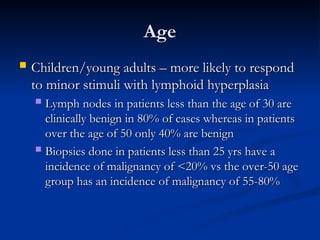
Age
Age
 Children/young adults – more likely to respond
Children/young adults – more likely to respond
to minor stimuli with lymphoid hyperplasia
 Lymph nodes in patients less than the age of 30 are
Lymph nodes in patients less than the age of 30 are
clinically benign in 80% of cases whereas in patients
over the age of 50 only 40% are benign
 Biopsies done in patients less than 25 yrs have a
Biopsies done in patients less than 25 yrs have a
incidence of malignancy of <20% vs the over-50 age
group has an incidence of malignancy of 55-80%
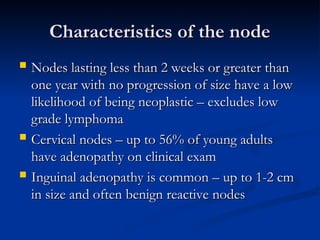
Characteristics of the node
 Nodes lasting less than 2 weeks or greater than
Nodes lasting less than 2 weeks or greater than
one year with no progression of size have a low
likelihood of being neoplastic – excludes low
grade lymphoma
grade lymphoma
 Cervical nodes – up to 56% of young adults
Cervical nodes – up to 56% of young adults
have adenopathy on clinical exam
 Inguinal adenopathy is common – up to 1-2 cm
Inguinal adenopathy is common – up to 1-2 cm
in size and often benign reactive nodes
Characteristics of the node
 Consistency – Hard/Firm vs Soft/Shotty; Fluctuant
Consistency – Hard/Firm vs Soft/Shotty; Fluctuant
 Mobile vs Fixed/Matted
Mobile vs Fixed/Matted
 Tender vs Painless
Tender vs Painless
 Clearly demarcated
Clearly demarcated
 Size
Size
 When to worry – 1.5-2cm in size
When to worry – 1.5-2cm in size
 Epitroclear nodes over 0.5cm; Inguinal over 1.5cm
Epitroclear nodes over 0.5cm; Inguinal over 1.5cm
 Duration and Rate of Growth
Duration and Rate of Growth
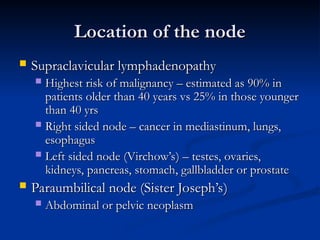
Location of the node
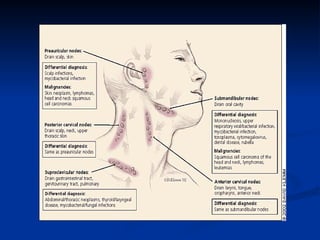
 Supraclavicular lymphadenopathy
Supraclavicular lymphadenopathy
 Highest risk of malignancy – estimated as 90% in
Highest risk of malignancy – estimated as 90% in
patients older than 40 years vs 25% in those younger
than 40 yrs
than 40 yrs
 Right sided node – cancer in mediastinum, lungs,
Right sided node – cancer in mediastinum, lungs,
esophagus
esophagus
 Left sided node (Virchow’s) – testes, ovaries,
Left sided node (Virchow’s) – testes, ovaries,
kidneys, pancreas, stomach, gallbladder or prostate
 Paraumbilical node (Sister Joseph’s)
Paraumbilical node (Sister Joseph’s)
 Abdominal or pelvic neoplasm
Abdominal or pelvic neoplasm
Location of the node
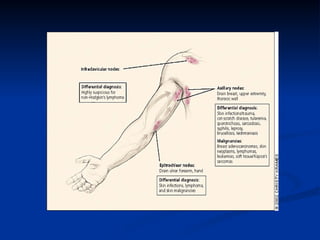
 Epitroclear nodes
Epitroclear nodes
 Unlikely to be reactive
Unlikely to be reactive
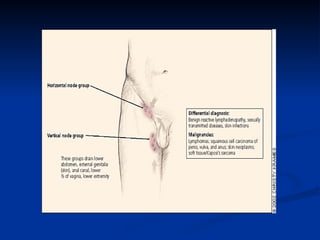
 Isolated inguinal adenopathy
Isolated inguinal adenopathy
 Less likely to be associated with malignancy
Less likely to be associated with malignancy
Clinical Setting
Clinical Setting
 B symptoms – fever, night sweats, weight loss
B symptoms – fever, night sweats, weight loss
 Fatigue
Fatigue
 Pruritis
Pruritis
 Evidence of other medical conditions –
Evidence of other medical conditions –
connective tissue disease
 Young patient – mononucleosis type of
Young patient – mononucleosis type of
syndrome
syndrome
History
History
 Identifiable cause for the lymphadenopathy?
Identifiable cause for the lymphadenopathy?
 Localizing symptoms or signs to suggest
Localizing symptoms or signs to suggest
infection/neoplasm/trauma at a particular site
 URTI, pharyngitis, periodontal disease, conjunctivitis, insect bites,
URTI, pharyngitis, periodontal disease, conjunctivitis, insect bites,
recent immunization etc
 Constitutional symptoms
Constitutional symptoms
 Epidemiological clues
Epidemiological clues
 Occupational exposures, recent travel, high-risk behaviour
Occupational exposures, recent travel, high-risk behaviour
 Medications – serum-sickness syndrome
Medications – serum-sickness syndrome
Physical Exam
Physical Exam
 Full nodal examination – nodal characteristics
Full nodal examination – nodal characteristics
 Organomegaly
Organomegaly
 Localized – examine area drained by the nodes
Localized – examine area drained by the nodes
for evidence of infection, skin lesions or
tumours
tumours
Approach to Lymphadenopathy
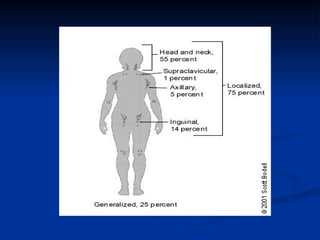
 Localized – one area involved
Localized – one area involved
 Generalized – two or more non-contiguous
Generalized – two or more non-contiguous
areas
areas
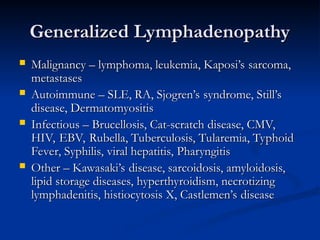
Generalized Lymphadenopathy
 Malignancy – lymphoma, leukemia, Kaposi’s sarcoma,
Malignancy – lymphoma, leukemia, Kaposi’s sarcoma,
metastases
metastases
 Autoimmune – SLE, RA, Sjogren’s syndrome, Still’s
Autoimmune – SLE, RA, Sjogren’s syndrome, Still’s
disease, Dermatomyositis
 Infectious – Brucellosis, Cat-scratch disease, CMV,
Infectious – Brucellosis, Cat-scratch disease, CMV,
HIV, EBV, Rubella, Tuberculosis, Tularemia, Typhoid
Fever, Syphilis, viral hepatitis, Pharyngitis
 Other – Kawasaki’s disease, sarcoidosis, amyloidosis,
Other – Kawasaki’s disease, sarcoidosis, amyloidosis,
lipid storage diseases, hyperthyroidism, necrotizing
lymphadenitis, histiocytosis X, Castlemen’s disease
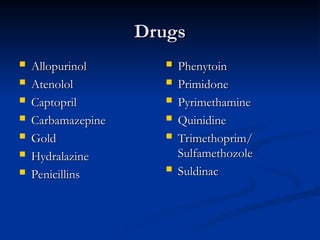
Drugs
Drugs
 Allopurinol
Allopurinol
 Atenolol
Atenolol
 Captopril
Captopril
 Carbamazepine
Carbamazepine
 Gold
Gold
 Hydralazine
Hydralazine
 Penicillins
Penicillins
 Phenytoin
Phenytoin
 Primidone
Primidone
 Pyrimethamine
Pyrimethamine
 Quinidine
Quinidine
 Trimethoprim/
Trimethoprim/
Sulfamethozole
Sulfamethozole
 Suldinac
Suldinac
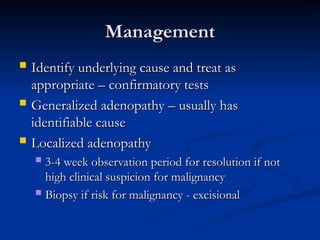
Management
Management
 Identify underlying cause and treat as
Identify underlying cause and treat as
appropriate – confirmatory tests
 Generalized adenopathy – usually has
Generalized adenopathy – usually has
identifiable cause
identifiable cause
 Localized adenopathy
Localized adenopathy
 3-4 week observation period for resolution if not
3-4 week observation period for resolution if not
high clinical suspicion for malignancy
 Biopsy if risk for malignancy - excisional
Biopsy if risk for malignancy - excisional
Fine Needle Aspirate
 Convenient, less invasive, quicker turn-around
Convenient, less invasive, quicker turn-around
time
time
 Most patients with a benign diagnosis on FNA
Most patients with a benign diagnosis on FNA
biopsy do not undergo a surgical biopsy
Conclusions
Conclusions
 Lymphadenopathy – initial presenting symptom
Lymphadenopathy – initial presenting symptom
 Reactive vs Malignant
Reactive vs Malignant
 Probability
Probability
 History
History
 Physical Exam
Physical Exam
 Biopsy if not resolved in 3-4 weeks for low risk
Biopsy if not resolved in 3-4 weeks for low risk
patients
patients
 Biopsy all high risk patients – excisional biopsy
Biopsy all high risk patients – excisional biopsy

Approach-to-Lymphadenopathyyyyyyyyyy.ppt

  • 1.
  • 2.
    Case 1 Case 1 25 year old female 25 year old female  3 month history of B-symptoms, progressive 3 month history of B-symptoms, progressive anemia (normocytic), new adenopathy – not anemia (normocytic), new adenopathy – not painful but progressive over weeks, weight loss painful but progressive over weeks, weight loss  Physical exam – diffuse adenopathy 2-3 cm in Physical exam – diffuse adenopathy 2-3 cm in size, oral ulceration - ?HSV, no organomegaly size, oral ulceration - ?HSV, no organomegaly  Laboratory Investigations – Hemoglobin 60, Laboratory Investigations – Hemoglobin 60, MCV of 80, low WBC, normal platelet count, MCV of 80, low WBC, normal platelet count, normal biochemistry – high LDH normal biochemistry – high LDH
  • 3.
    Case 2 Case 2 83 yo Female 83 yo Female  Otherwise healthy Otherwise healthy  5 years ago presented with painful right submandicular 5 years ago presented with painful right submandicular node – 3X3 cm – given ABx and followed for a few node – 3X3 cm – given ABx and followed for a few months – slight decrease months – slight decrease  FNA done – reactive FNA done – reactive  Node persisted over months – excisional biopsy – Node persisted over months – excisional biopsy – reactive adenopathy reactive adenopathy  6 months ago – recurrent right submandicular node – 6 months ago – recurrent right submandicular node – matted, slowly increased in size – now 3X3cm matted, slowly increased in size – now 3X3cm
  • 4.
    Objectives Objectives  Approach toAdenopathy Approach to Adenopathy  Who to investigate Who to investigate  When to investigate When to investigate  How to define risk for underlying malignancy How to define risk for underlying malignancy
  • 6.
    Lymph Nodes Lymph Nodes Anatomy Anatomy  Collection of lymphoid cells attached to both vascular and Collection of lymphoid cells attached to both vascular and lymphatic systems lymphatic systems  Over 600 lymph nodes in the body Over 600 lymph nodes in the body  Function Function  To provide optimal sites for the concentration of free or cell- To provide optimal sites for the concentration of free or cell- associated antigens and recirculating lymphocytes – associated antigens and recirculating lymphocytes – “sensitization of the immune response” “sensitization of the immune response”  To allow contact between B-cells, T-cells and macrophages To allow contact between B-cells, T-cells and macrophages  Lymphadenopathy - node greater than 1cm in size Lymphadenopathy - node greater than 1cm in size
  • 7.
    Why do lymphnodes enlarge? Why do lymph nodes enlarge?  Increase in the number of benign lymphocytes Increase in the number of benign lymphocytes and macrophages in response to antigens and macrophages in response to antigens  Infiltration of inflammatory cells in infection Infiltration of inflammatory cells in infection (lymphadenitis) (lymphadenitis)  In situ proliferation of malignant lymphocytes or In situ proliferation of malignant lymphocytes or macrophages macrophages  Infiltration by metastatic malignant cells Infiltration by metastatic malignant cells  Infiltration of lymph nodes by metabolite laden Infiltration of lymph nodes by metabolite laden macrophages (lipid storage diseases) macrophages (lipid storage diseases)
  • 8.
    Epidemiology Epidemiology  0.6% annualincidence of unexplained 0.6% annual incidence of unexplained adenopathy in the general population adenopathy in the general population  10% were referred to a subspecialist and 3.2 % 10% were referred to a subspecialist and 3.2 % required a biopsy and 1.1% had a malignancy required a biopsy and 1.1% had a malignancy
  • 9.
    When to worry? Whento worry?  Age Age  Characteristics of the node Characteristics of the node  Location of the node Location of the node  Clinical setting associated with Clinical setting associated with lymphadenopathy lymphadenopathy
  • 10.
    Age Age  Children/young adults– more likely to respond Children/young adults – more likely to respond to minor stimuli with lymphoid hyperplasia to minor stimuli with lymphoid hyperplasia  Lymph nodes in patients less than the age of 30 are Lymph nodes in patients less than the age of 30 are clinically benign in 80% of cases whereas in patients clinically benign in 80% of cases whereas in patients over the age of 50 only 40% are benign over the age of 50 only 40% are benign  Biopsies done in patients less than 25 yrs have a Biopsies done in patients less than 25 yrs have a incidence of malignancy of <20% vs the over-50 age incidence of malignancy of <20% vs the over-50 age group has an incidence of malignancy of 55-80% group has an incidence of malignancy of 55-80%
  • 11.
    Characteristics of thenode Characteristics of the node  Nodes lasting less than 2 weeks or greater than Nodes lasting less than 2 weeks or greater than one year with no progression of size have a low one year with no progression of size have a low likelihood of being neoplastic – excludes low likelihood of being neoplastic – excludes low grade lymphoma grade lymphoma  Cervical nodes – up to 56% of young adults Cervical nodes – up to 56% of young adults have adenopathy on clinical exam have adenopathy on clinical exam  Inguinal adenopathy is common – up to 1-2 cm Inguinal adenopathy is common – up to 1-2 cm in size and often benign reactive nodes in size and often benign reactive nodes
  • 12.
    Characteristics of thenode Characteristics of the node  Consistency – Hard/Firm vs Soft/Shotty; Fluctuant Consistency – Hard/Firm vs Soft/Shotty; Fluctuant  Mobile vs Fixed/Matted Mobile vs Fixed/Matted  Tender vs Painless Tender vs Painless  Clearly demarcated Clearly demarcated  Size Size  When to worry – 1.5-2cm in size When to worry – 1.5-2cm in size  Epitroclear nodes over 0.5cm; Inguinal over 1.5cm Epitroclear nodes over 0.5cm; Inguinal over 1.5cm  Duration and Rate of Growth Duration and Rate of Growth
  • 13.
    Location of thenode Location of the node  Supraclavicular lymphadenopathy Supraclavicular lymphadenopathy  Highest risk of malignancy – estimated as 90% in Highest risk of malignancy – estimated as 90% in patients older than 40 years vs 25% in those younger patients older than 40 years vs 25% in those younger than 40 yrs than 40 yrs  Right sided node – cancer in mediastinum, lungs, Right sided node – cancer in mediastinum, lungs, esophagus esophagus  Left sided node (Virchow’s) – testes, ovaries, Left sided node (Virchow’s) – testes, ovaries, kidneys, pancreas, stomach, gallbladder or prostate kidneys, pancreas, stomach, gallbladder or prostate  Paraumbilical node (Sister Joseph’s) Paraumbilical node (Sister Joseph’s)  Abdominal or pelvic neoplasm Abdominal or pelvic neoplasm
  • 14.
    Location of thenode Location of the node  Epitroclear nodes Epitroclear nodes  Unlikely to be reactive Unlikely to be reactive  Isolated inguinal adenopathy Isolated inguinal adenopathy  Less likely to be associated with malignancy Less likely to be associated with malignancy
  • 15.
    Clinical Setting Clinical Setting B symptoms – fever, night sweats, weight loss B symptoms – fever, night sweats, weight loss  Fatigue Fatigue  Pruritis Pruritis  Evidence of other medical conditions – Evidence of other medical conditions – connective tissue disease connective tissue disease  Young patient – mononucleosis type of Young patient – mononucleosis type of syndrome syndrome
  • 16.
    History History  Identifiable causefor the lymphadenopathy? Identifiable cause for the lymphadenopathy?  Localizing symptoms or signs to suggest Localizing symptoms or signs to suggest infection/neoplasm/trauma at a particular site infection/neoplasm/trauma at a particular site  URTI, pharyngitis, periodontal disease, conjunctivitis, insect bites, URTI, pharyngitis, periodontal disease, conjunctivitis, insect bites, recent immunization etc recent immunization etc  Constitutional symptoms Constitutional symptoms  Epidemiological clues Epidemiological clues  Occupational exposures, recent travel, high-risk behaviour Occupational exposures, recent travel, high-risk behaviour  Medications – serum-sickness syndrome Medications – serum-sickness syndrome
  • 17.
    Physical Exam Physical Exam Full nodal examination – nodal characteristics Full nodal examination – nodal characteristics  Organomegaly Organomegaly  Localized – examine area drained by the nodes Localized – examine area drained by the nodes for evidence of infection, skin lesions or for evidence of infection, skin lesions or tumours tumours
  • 18.
    Approach to Lymphadenopathy Approachto Lymphadenopathy  Localized – one area involved Localized – one area involved  Generalized – two or more non-contiguous Generalized – two or more non-contiguous areas areas
  • 23.
    Generalized Lymphadenopathy Generalized Lymphadenopathy Malignancy – lymphoma, leukemia, Kaposi’s sarcoma, Malignancy – lymphoma, leukemia, Kaposi’s sarcoma, metastases metastases  Autoimmune – SLE, RA, Sjogren’s syndrome, Still’s Autoimmune – SLE, RA, Sjogren’s syndrome, Still’s disease, Dermatomyositis disease, Dermatomyositis  Infectious – Brucellosis, Cat-scratch disease, CMV, Infectious – Brucellosis, Cat-scratch disease, CMV, HIV, EBV, Rubella, Tuberculosis, Tularemia, Typhoid HIV, EBV, Rubella, Tuberculosis, Tularemia, Typhoid Fever, Syphilis, viral hepatitis, Pharyngitis Fever, Syphilis, viral hepatitis, Pharyngitis  Other – Kawasaki’s disease, sarcoidosis, amyloidosis, Other – Kawasaki’s disease, sarcoidosis, amyloidosis, lipid storage diseases, hyperthyroidism, necrotizing lipid storage diseases, hyperthyroidism, necrotizing lymphadenitis, histiocytosis X, Castlemen’s disease lymphadenitis, histiocytosis X, Castlemen’s disease
  • 24.
    Drugs Drugs  Allopurinol Allopurinol  Atenolol Atenolol Captopril Captopril  Carbamazepine Carbamazepine  Gold Gold  Hydralazine Hydralazine  Penicillins Penicillins  Phenytoin Phenytoin  Primidone Primidone  Pyrimethamine Pyrimethamine  Quinidine Quinidine  Trimethoprim/ Trimethoprim/ Sulfamethozole Sulfamethozole  Suldinac Suldinac
  • 25.
    Management Management  Identify underlyingcause and treat as Identify underlying cause and treat as appropriate – confirmatory tests appropriate – confirmatory tests  Generalized adenopathy – usually has Generalized adenopathy – usually has identifiable cause identifiable cause  Localized adenopathy Localized adenopathy  3-4 week observation period for resolution if not 3-4 week observation period for resolution if not high clinical suspicion for malignancy high clinical suspicion for malignancy  Biopsy if risk for malignancy - excisional Biopsy if risk for malignancy - excisional
  • 26.
    Fine Needle Aspirate FineNeedle Aspirate  Convenient, less invasive, quicker turn-around Convenient, less invasive, quicker turn-around time time  Most patients with a benign diagnosis on FNA Most patients with a benign diagnosis on FNA biopsy do not undergo a surgical biopsy biopsy do not undergo a surgical biopsy
  • 27.
    Conclusions Conclusions  Lymphadenopathy –initial presenting symptom Lymphadenopathy – initial presenting symptom  Reactive vs Malignant Reactive vs Malignant  Probability Probability  History History  Physical Exam Physical Exam  Biopsy if not resolved in 3-4 weeks for low risk Biopsy if not resolved in 3-4 weeks for low risk patients patients  Biopsy all high risk patients – excisional biopsy Biopsy all high risk patients – excisional biopsy