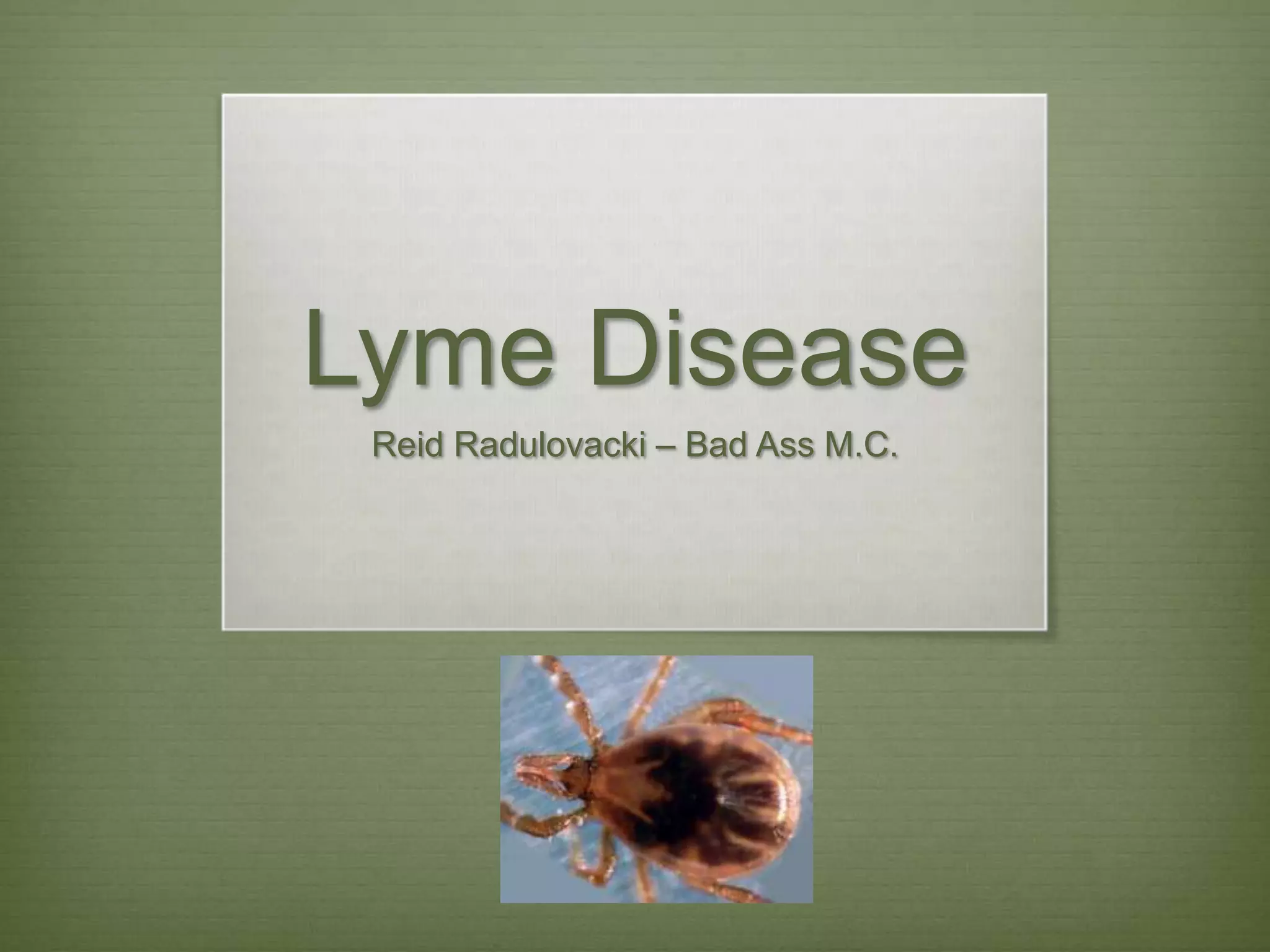
Lyme Disease
 Reid Radulovacki – Bad Ass M.C.
What Is Lyme Disease?
   Lyme Disease is a spreading, infectious disease that is caused
    by three types of bacteria including the Borrelia afzelii and
    Borrelia garinii.

   It is the most common tick-born disease in the Northern
    Hemisphere

   The bacteria, Borrelia is transmitted by the bite of infected
    ticks that belong to the Ixodes. (Infected species)

   The disease comes from the bite of a Deer Tick that happens
    to be carrying the bacteria. Ticks feed on blood, so when it bite
    you it won‟t let go until they have multiplied in size so that it
    can‟t store anymore blood. It bites you by jamming its claw-like
    head into your skin, and slowly directs the bacteria into your
    blood stream. Ticks are smaller than a grain of rice. The tick
    nymphs are the size of a poppy seed.
Bacteria Cycle
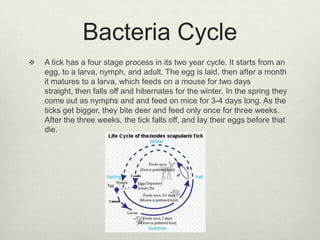
   A tick has a four stage process in its two year cycle. It starts from an
    egg, to a larva, nymph, and adult. The egg is laid, then after a month
    it matures to a larva, which feeds on a mouse for two days
    straight, then falls off and hibernates for the winter. In the spring they
    come out as nymphs and and feed on mice for 3-4 days long. As the
    ticks get bigger, they bite deer and feed only once for three weeks.
    After the three weeks, the tick falls off, and lay their eggs before that
    die.
Symptoms
 Early symptoms may include
   depression, fever, headache and fatigue, similar to flu
   symptoms

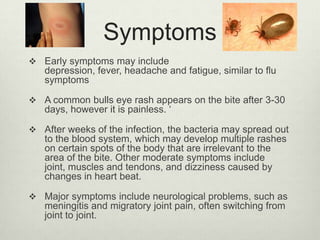
 A common bulls eye rash appears on the bite after 3-30
   days, however it is painless. „

 After weeks of the infection, the bacteria may spread out
   to the blood system, which may develop multiple rashes
   on certain spots of the body that are irrelevant to the
   area of the bite. Other moderate symptoms include
   joint, muscles and tendons, and dizziness caused by
   changes in heart beat.

 Major symptoms include neurological problems, such as
   meningitis and migratory joint pain, often switching from
   joint to joint.
Cure/Treatment
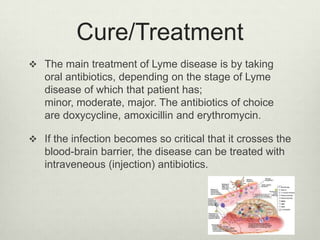
 The main treatment of Lyme disease is by taking
   oral antibiotics, depending on the stage of Lyme
   disease of which that patient has;
   minor, moderate, major. The antibiotics of choice
   are doxycycline, amoxicillin and erythromycin.

 If the infection becomes so critical that it crosses the
   blood-brain barrier, the disease can be treated with
   intraveneous (injection) antibiotics.
How to Prevent Infection
   If you feel or see a tick bite you, remove the tick from your
    body as fast as possible with tweezers. Grab the part of the
    tick that is closest to you skin because it is the head of the tick
    that is inside of you and is “feeding” the infection. If the tick is
    left inside of the skin, you are still susceptible to infection.
    Wash the bitten area thoroughly with water and soap.

   A way to prevent being bitten by a tick is to wear clothing that
    covers your legs and arms when walking in dense
    vegetation, such as tall, leafy plants in forests, and wearing
    bug-spray as a precaution.

   If you remove the tick quick enough, the bacteria may not have
    reached your blood stream in time. Unless the bacteria comes
    into contact with your blood stream you will not be infected.
Untreatable effects
 A small percentage of patients that get Lyme
   disease can develop incurable disorders/diseases
   such as chronic Lyme arthritis.

 It can damage heart tissues and cause cardiac
   arrhythmia.

 In fatal cause, heart failure can occur.
Works Consulted
 Mayo Clinic , Staff. (2011). Lyme disease. Mayo
    Foundation for Medical Education and Research
    (MFMER). Retrieved from
    http://www.mayoclinic.com/health/lyme-
    disease/DS00116

 A.D.A.M., Inc. (2012). Lyme disease. 8600 Rockville
    Pike, Bethesda MD: A.D.A.M., Inc. Retrieved from
    http://www.ncbi.nlm.nih.gov/pubmedhealth/PMH000
    2296/

    Paul, K. (2011). Lyme disease. Wales: Net Doctor.
    Retrieved from
    http://www.netdoctor.co.uk/diseases/facts/lymedisea
    se.htm
Thanks for watching!

Lyme disease232424232

  • 1.
    Lyme Disease ReidRadulovacki – Bad Ass M.C.
  • 2.
    What Is LymeDisease?  Lyme Disease is a spreading, infectious disease that is caused by three types of bacteria including the Borrelia afzelii and Borrelia garinii.  It is the most common tick-born disease in the Northern Hemisphere  The bacteria, Borrelia is transmitted by the bite of infected ticks that belong to the Ixodes. (Infected species)  The disease comes from the bite of a Deer Tick that happens to be carrying the bacteria. Ticks feed on blood, so when it bite you it won‟t let go until they have multiplied in size so that it can‟t store anymore blood. It bites you by jamming its claw-like head into your skin, and slowly directs the bacteria into your blood stream. Ticks are smaller than a grain of rice. The tick nymphs are the size of a poppy seed.
  • 3.
    Bacteria Cycle  A tick has a four stage process in its two year cycle. It starts from an egg, to a larva, nymph, and adult. The egg is laid, then after a month it matures to a larva, which feeds on a mouse for two days straight, then falls off and hibernates for the winter. In the spring they come out as nymphs and and feed on mice for 3-4 days long. As the ticks get bigger, they bite deer and feed only once for three weeks. After the three weeks, the tick falls off, and lay their eggs before that die.
  • 4.
    Symptoms  Early symptomsmay include depression, fever, headache and fatigue, similar to flu symptoms  A common bulls eye rash appears on the bite after 3-30 days, however it is painless. „  After weeks of the infection, the bacteria may spread out to the blood system, which may develop multiple rashes on certain spots of the body that are irrelevant to the area of the bite. Other moderate symptoms include joint, muscles and tendons, and dizziness caused by changes in heart beat.  Major symptoms include neurological problems, such as meningitis and migratory joint pain, often switching from joint to joint.
  • 5.
    Cure/Treatment  The maintreatment of Lyme disease is by taking oral antibiotics, depending on the stage of Lyme disease of which that patient has; minor, moderate, major. The antibiotics of choice are doxycycline, amoxicillin and erythromycin.  If the infection becomes so critical that it crosses the blood-brain barrier, the disease can be treated with intraveneous (injection) antibiotics.
  • 6.
    How to PreventInfection  If you feel or see a tick bite you, remove the tick from your body as fast as possible with tweezers. Grab the part of the tick that is closest to you skin because it is the head of the tick that is inside of you and is “feeding” the infection. If the tick is left inside of the skin, you are still susceptible to infection. Wash the bitten area thoroughly with water and soap.  A way to prevent being bitten by a tick is to wear clothing that covers your legs and arms when walking in dense vegetation, such as tall, leafy plants in forests, and wearing bug-spray as a precaution.  If you remove the tick quick enough, the bacteria may not have reached your blood stream in time. Unless the bacteria comes into contact with your blood stream you will not be infected.
  • 7.
    Untreatable effects  Asmall percentage of patients that get Lyme disease can develop incurable disorders/diseases such as chronic Lyme arthritis.  It can damage heart tissues and cause cardiac arrhythmia.  In fatal cause, heart failure can occur.
  • 8.
    Works Consulted  MayoClinic , Staff. (2011). Lyme disease. Mayo Foundation for Medical Education and Research (MFMER). Retrieved from http://www.mayoclinic.com/health/lyme- disease/DS00116  A.D.A.M., Inc. (2012). Lyme disease. 8600 Rockville Pike, Bethesda MD: A.D.A.M., Inc. Retrieved from http://www.ncbi.nlm.nih.gov/pubmedhealth/PMH000 2296/  Paul, K. (2011). Lyme disease. Wales: Net Doctor. Retrieved from http://www.netdoctor.co.uk/diseases/facts/lymedisea se.htm
  • 9.