IBM Power Systems


    Mainline Functional Verification of IBM’s
    POWER7 Processor Core
                         John Ludden
                         Senior Technical Staff Member
                         Hardware Verification
                         IBM Systems & Technology Group

                         E-mail: ludden@us.ibm.com


© 2010 IBM Corporation
IBM System p
          Mainline Functional Verification of IBM’s POWER7 Processor Core


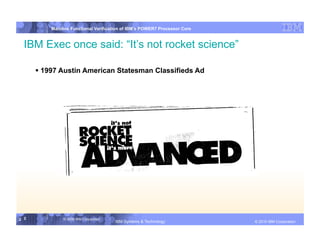
  IBM Exec once said: “It’s not rocket science”

       1997 Austin American Statesman Classifieds Ad


2 2            © 2006 IBM Corporation
                                        IBM Systems & Technology   DRAFT: IBM Confidential          IBM Systems
                                                                                             © 2010 IBM Corporation
IBM System p
          Mainline Functional Verification of IBM’s POWER7 Processor Core


  Overview

      1. Background: POWER Processor History / Roadmap


      2. Verification Methodology


      3. Verification Execution


      4. Verification Advances


      5. Summary


3 3            © 2006 IBM Corporation
                                        IBM Systems & Technology   DRAFT: IBM Confidential          IBM Systems
                                                                                             © 2010 IBM Corporation
IBM System p
                  Mainline Functional Verification of IBM’s POWER7 Processor Core
                                                                                                                                                                  45nm

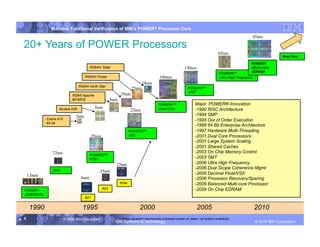
  20+ Years of POWER Processors
                                                                                                                                          65nm
                                                                                                                                                                                 Next Gen.

                                                                                                                                                              POWER7
                                            RS64IV Sstar                                                         130nm
                                       -Multi-core
                                                                                                                                          POWER6TM            -EDRAM
                                         RS64III Pulsar                                         180nm
                                    -Ultra High Frequency
                                                                              .18um
                                     RS64II North Star
                                                                         .25um
                                     POWER5TM
                                                                                                                    -SMT
                                 RS64I Apache                       .35um
                                 BiCMOS                     .5um
                                                                                              POWER4TM                   Major POWER® Innovation
                      Muskie A35               .5um
                                          -Dual Core                 -1990 RISC Architecture
                                                                           .22um
                                   .5um
                                                                                 -1994 SMP
               -Cobra A10                                                                                                -1995 Out of Order Execution
               -64 bit
                                                                                                                         -1996 64 Bit Enterprise Architecture
                                                                           POWER3TM                                      -1997 Hardware Multi-Threading
                                            .35um
                         -630                                          -2001 Dual Core Processors
                                                                                                                         -2001 Large System Scaling
                                                                                                                         -2001 Shared Caches
                  .72um
                                                                                                 -2003 On Chip Memory Control
                                           POWER2TM
                                           P2SC                                                                          -2003 SMT
                                                               .25um
                                                    -2006 Ultra High Frequency
                                                                                                                         -2006 Dual Scope Coherence Mgmt
                   RSC                           .35um
      1.0um
                                                                                                             -2006 Decimal Float/VSX
                                     .6um
                                                                               -2006 Processor Recovery/Sparing
                                                                    604e                                                 -2009 Balanced Multi-core Processor
                                                     -603                                                                -2009 On Chip EDRAM
  POWER1
  -AMERICA’s
                                        -601


       1990                            1995                                      2000                                     2005                                    2010
4 4                         © 2006 IBM Corporation                                                          DRAFT: IBM Confidential
                                                                     Dates represent approximate processor power-on dates, not system availability
                                                               IBM Systems & Technology                                                                                     IBM Systems
                                                                                                                                                                   © 2010 IBM Corporation
IBM System p
                  Mainline Functional Verification of IBM’s POWER7 Processor Core


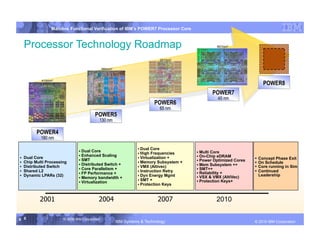
     Processor Technology Roadmap                                                                      567mm2


                                                                               341mm2

                                                 389mm2


             415mm2
                                                                                                                            POWER8
                                                                                                     POWER7
                                                                                                        45 nm
                                                                            POWER6
                                                                               65 nm
                                          POWER5
                                             130 nm

           POWER4
             180 nm

                                                                     Dual Core
                                  Dual Core                                                   Multi Core
                                                                     High Frequencies
                                  Enhanced Scaling                                            On-Chip eDRAM
    Dual Core                                                       Virtualization +                                   Concept Phase Exit
                                  SMT                                                         Power Optimized Cores
    Chip Multi Processing                                           Memory Subsystem    +                              On Schedule
                                  Distributed Switch +                                        Mem Subsystem ++
    Distributed Switch                                              VMX (Altivec)                                      Core running in Sim
                                  Core Parallelism +                                          SMT++
    Shared L2                                                       Instruction Retry
                                                                                               Reliability +
                                                                                                                         Continued
                                  FP Performance +
    Dynamic LPARs (32)                                              Dyn Energy Mgmt          VSX & VMX (AltiVec)
                                                                                                                          Leadership
                                  Memory bandwidth +
                                                                     SMT +                    Protection Keys+
                                  Virtualization
                                                                     Protection Keys


            2001                             2004                             2007                     2010

5 5                     © 2006 IBM Corporation
                                                          IBM Systems & Technology      DRAFT: IBM Confidential                IBM Systems
                                                                                                                        © 2010 IBM Corporation
IBM System p
            Mainline Functional Verification of IBM’s POWER7 Processor Core


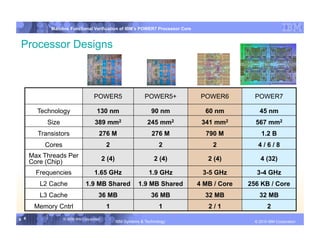
Processor Designs


                                    POWER5                       POWER5+              POWER6              POWER7

        Technology                   130 nm                         90 nm              60 nm                45 nm
           Size                     389 mm2                       245 mm2             341 mm2             567 mm2
        Transistors                    276 M                        276 M              790 M                 1.2 B
          Cores                             2                          2                  2                4/6/8
      Max Threads Per                      2 (4)                     2 (4)              2 (4)                4 (32)
      Core (Chip)
        Frequencies                 1.65 GHz                       1.9 GHz            3-5 GHz              3-4 GHz
         L2 Cache              1.9 MB Shared                  1.9 MB Shared         4 MB / Core         256 KB / Core
         L3 Cache                     36 MB                         36 MB              32 MB                32 MB
       Memory Cntrl                         1                          1                2/1                     2
6 6               © 2006 IBM Corporation
                                                   IBM Systems & Technology   DRAFT: IBM Confidential            IBM Systems
                                                                                                          © 2010 IBM Corporation
IBM System p
            Mainline Functional Verification of IBM’s POWER7 Processor Core

      The highest performing 4-socket system on the planet


         POWER7 continues to break the rules
              with more performance                                                Power 750
                             SPECint_rate


                                                                                  4 POWER7 Chip Interconnect
         Itanium         SPARC                x86             POWER7
        HP rx6600       Sun T5440           HP DL585         Power 750
                                                            with PowerVM

7 7              © 2006 IBM Corporation
                                            IBM Systems & Technology   DRAFT: IBM Confidential          IBM Systems
                                                                                                 © 2010 IBM Corporation
IBM System p
                   Mainline Functional Verification of IBM’s POWER7 Processor Core


  POWER7 Processor Chip Overview
                                                                          ores : 8 ( 4 / 6 core options )
                                                                         C
                               Local SMP Links
                                                                          67mm2 Technology:
                                                                         5
        POWER7
                     F
                           POWER7         POWER7       POWER7            – 45nm lithography, Cu, SOI, eDRAM
         CORE               CORE           CORE         CORE
                     A

        L2 Cache
                     S
                     T     L2 Cache       L2 Cache     L2 Cache
                                                                          ransistors: 1.2 B
                                                                         T
                         L3 REGION                                       – Equivalent function of 2.7B
  MC0                                                             MC1
                               L3 Cache and
                              Chip Interconnect
                                                                         – eDRAM efficiency
        L2 Cache           L2 Cache       L2 Cache     L2 Cache           ight processor cores
                                                                         E
        POWER7             POWER7         POWER7       POWER7            – 12 execution units per core
         CORE               CORE           CORE         CORE
                                                                         – 4 Way SMT per core – up to 4 threads per core
                           Remote SMP & I/O Links                        – 32 Threads per chip
                                                                         – L1: 32 KB I Cache / 32 KB D Cache
                                                                         – L2: 256 KB per core
      Binary Compatibility with POWER6                                   – L3: Shared 32MB on chip eDRAM

                                                                          ual DDR3 Memory Controllers
                                                                         D
                                                                         – 100 GB/s Memory bandwidth per chip

                                                                          calability up to 32 Sockets
                                                                         S
8 8                       © 2006 IBM Corporation
                                                     IBM Systems & Technology   DRAFT: IBM Confidential             IBM Systems
                                                                                                             © 2010 IBM Corporation
                                                                         – 360 GB/s SMP bandwidth/chip
                                                                         – 20,000 coherent operations in flight
IBM System p
             Mainline Functional Verification of IBM’s POWER7 Processor Core

                                                            64-bit Power ISA Architecture v2.06
  POWER7 Core Details                                       Out of Order Execution (POWER5-like)
                                                            Up to 4 threads per core
                             DFU                            12 Execution Units
                                                            – 2 Fixed Point Units
             ISU
                                           VSX              – 2 Load Store Units also do Simple FX ops

                            FXU            FPU
            Add
                                                            – 4 Double Precision Floating Point Pipes

                            Boxes                           – 1 Branch
                                                            – 1 Condition Register
        IFU                                                 – 1 Vector Unit
      CRU/BRU                       LSU                     – 1 Decimal Floating Point Unit
                                                            – 6 Wide Dispatch (2 branches per group)
                                                            – 8 Wide issue

                     256KB L2                               – Units include distributed Recovery Function


        OWER7 continues to support VMX / Extends SIMD support with VSX
       P
       – 2 VSX units that can each handle
                • 2 Double-Precision FP calculations
                • 4 Single-Precision FP calculations
       – 64 architected registers
9 9               © 2006 IBM Corporation
                                            IBM Systems & Technology   DRAFT: IBM Confidential                 IBM Systems
                                                                                                        © 2010 IBM Corporation
IBM System p
                  Mainline Functional Verification of IBM’s POWER7 Processor Core

    POWER7 Core Block Diagram
                                                                                 6 instructions
               Global                                                                                                  8 instructions
                                         Instruction               Instruction               Instruction Fetch                                      Instruction
             Completion
                                          Dispatch                   Decode                        Buffer                                             Cache
               Table
                                                                                                                           Branch History                                 Predecode
                                                                                                                               Table               32KB, 4-way
                                                                                  Branch Information
                                                                                       Queue                                    Return
                                                                                                                                 stack               Instruction
                                                                                                                                Count                Translation
                                                                                                                                Cache                                   Eight
                                                                                                                                                                     instructions
                                                                                                                           Branch Prediction
                      Condition
         Branch
                       Register               VSX / FP / DFP / VMX / FX / LSU
          Issue
                        Issue                       Unified Issue Queue                                                                         32-entry      512-entry
         Queue                                                                                      Load          Store        Store
                        Queue                                                                                                                  Segment       Translation
                                                                                                   Reorder       Reorder        Data           Lookaside     Lookaside
                                                                                                   Queue          Queue        Queue             Buffer        Buffer

                                   Dual FP          Dual FP       FX              LS / FX                                                       (SLB)             (TLB)
         Branch         CR
        Execution    Execution      VSX              VSX       Execution         Execution
                                  Execution        Execution                                                     Data
          Unit         Unit                                      Unit              Unit                       Translation                       Second level translation
                                    Unit             Unit                                          16B
                                                                                                             Data Cache           16B store data
                                    VMX              VMX                                                                                                          Translation
                                                                                  LS / FX
                                  Compute           Permute       FX                               16B       32KB, 8-way          32B cache sector                   Data
                                                                                 Execution
                                                   Execution   Execution
                                  Execution                                        Unit
                                                     Unit        Unit
                                    Unit
                                                                                                                     Advanced
                                                                                                                    Data Prefetch                          256KB, 8-way
                                                     DFU                                                               Engine
                                                    Decimal                                                                                                 L2 Cache
                                                   Execution                                          Load Miss                                         (outside the core)
                                                     Unit                                              Queue

                                                                                                                      Memory subsystem


10 10                  © 2006 IBM Corporation
                                                       IBM Systems & Technology               DRAFT: IBM Confidential                                             IBM Systems
                                                                                                                                                      © 2010 IBM Corporation
IBM System p
            Mainline Functional Verification of IBM’s POWER7 Processor Core


   Overview

        1. Background: POWER Processor History / Roadmap


        2. Verification Methodology


        3. Verification Execution


        4. Verification Advances


        5. Summary


11 11            © 2006 IBM Corporation
                                          IBM Systems & Technology   DRAFT: IBM Confidential          IBM Systems
                                                                                               © 2010 IBM Corporation
IBM System p
                Mainline Functional Verification of IBM’s POWER7 Processor Core


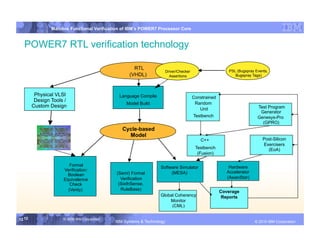
  POWER7 RTL verification technology

                                                      RTL                                               PSL (Bugspray Events,
                                                                     Driver/Checker
                                                    (VHDL)             Assertions                          Bugspray Tags)


         Physical VLSI                          Language Compile                      Constrained
         Design Tools /
                                                   Model Build                         Random
        Custom Design                                                                                                  Test Program
                                                                                         Unit
                                                                                                                        Generator
                                                                                      Testbench                        Genesys-Pro
                                                                                                                         (GPRO)
                                                 Cycle-based
                                                   Model
                                                                                          C++                             Post-Silicon
                                                                                                                          Exercisers
                                                                                       Testbench                            (EoA)
                                                                                        (Fusion)

                        Formal                                     Software Simulator                   Hardware
                     Verification:                                                                     Accelerator
                       Boolean                (Semi) Formal             (MESA)
                     Equivalence                Verification                                           (AwanStar)
                        Check                  (SixthSense,
                       (Verity)                 RuleBase)
                                                                                                    Coverage
                                                                   Global Coherency                  Reports
                                                                       Monitor
                                                                        (CML)


12 12                © 2006 IBM Corporation
                                              IBM Systems & Technology     DRAFT: IBM Confidential                              IBM Systems
                                                                                                                      © 2010 IBM Corporation
IBM System p
            Mainline Functional Verification of IBM’s POWER7 Processor Core


  POWER7 Unit Simulation

         Two Types:

           – Instruction Level Test case Driven: (Inherited from POWER5)
                 • Employs “Core-Common Code” to drive “unit under test”
                      – Instruction level Architecture Verification Programs (AVPs) created by
                        Genesys-Pro (GPRO) pseudo-random test generator
                      – Instruction-By-Instruction (IBI) checking against AVP results
                 • Low level microarchitecture checkers written in FUSION
                 • Employed by: IFU, LSU, ISU, FXU, VSU(FPU)


           – Constrained Random Command Driven Environments (Modeled after POWER6)
                 • C++ FUSION Drivers and Checkers
                 • “On-the-fly” test generation and result checking
                 • Employed by: IFU, LSU, ISU


13 13            © 2006 IBM Corporation
                                          IBM Systems & Technology   DRAFT: IBM Confidential          IBM Systems
                                                                                               © 2010 IBM Corporation
IBM System p
            Mainline Functional Verification of IBM’s POWER7 Processor Core


  POWER7 Full Core Software Simulation Model

        Instruction Level Architecture Verification Program (AVP) Based
            – Default test generation via GPRO pseudo-random generator
                 • IBI checking against AVP results for up to four independent instruction
                   threads contained within single test
                 • Low level microarchitecture FUSION checkers promoted from unit sim
                   environments
                 • Global Coherency Checker (CML) looks for architectural storage rule
                   violations

            – SMT: True-sharing scenarios, lock testing and storage access
              (“weak”) ordering checked
                 • GPRO employed but….
                      – IBI checking of these accesses is limited or not possible:
                            › Non-unique or non-deterministic results
                            › CML employed to detect the “right answer” as a post-simulation
                              rule check


14 14            © 2006 IBM Corporation
                                          IBM Systems & Technology   DRAFT: IBM Confidential          IBM Systems
                                                                                               © 2010 IBM Corporation
IBM System p
            Mainline Functional Verification of IBM’s POWER7 Processor Core


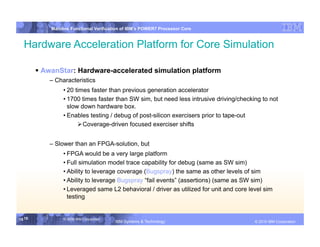
  Hardware Acceleration Platform for Core Simulation

         AwanStar: Hardware-accelerated simulation platform
            – Characteristics
                 • 20 times faster than previous generation accelerator
                 • 1700 times faster than SW sim, but need less intrusive driving/checking to not
                   slow down hardware box.
                 • Enables testing / debug of post-silicon exercisers prior to tape-out
                        Coverage-driven focused exerciser shifts


            – Slower than an FPGA-solution, but
                 • FPGA would be a very large platform
                 • Full simulation model trace capability for debug (same as SW sim)
                 • Ability to leverage coverage (Bugspray) the same as other levels of sim
                 • Ability to leverage Bugspray “fail events” (assertions) (same as SW sim)
                 • Leveraged same L2 behavioral / driver as utilized for unit and core level sim
                   testing


15 15            © 2006 IBM Corporation
                                          IBM Systems & Technology   DRAFT: IBM Confidential          IBM Systems
                                                                                               © 2010 IBM Corporation
IBM System p
            Mainline Functional Verification of IBM’s POWER7 Processor Core


  Synthesizable L2 Cache Behavioral

         POWER4 thru POWER7 have:
           – “write-through” L1 Data Cache
                 • No modified data
           – independent L1 Instruction Cache
                 • No modified data
           – L2 cache:
                 • “inclusive” of L1 caches
                 •  contains modified data

         POWER4 and POWER5 used C++ developed behavioral
           – Not portable to accelerator platforms

         POWER6 and POWER7 developed synthesizable VHDL L2 behavorial
           – Key component enabling re-use across all levels of P7 Core Simulation (including
             Accelerator platform)


16 16            © 2006 IBM Corporation
                                          IBM Systems & Technology   DRAFT: IBM Confidential          IBM Systems
                                                                                               © 2010 IBM Corporation
IBM System p
           Mainline Functional Verification of IBM’s POWER7 Processor Core


   Formal Verification

        Formal methods are a vital complement to simulation
          –  Largest ever application of formal on any IBM project
          –  Synergistic application as a “mainstream” verification discipline
          –  POWER7 deep dives early to identify areas ripe for FV
          –  Reuse of FV assertions by cycle simulation environments
          –  Sequential Equivalence Checking for late design changes
          –  Leveraged extensively for lab bring-up bug re-creation
              •  Often faster reproduction than simulation based approaches
              •  Aids in root cause analysis
              •  High-coverage / proof of side-effect-free fixes


17 17           © 2006 IBM Corporation
                                         IBM Systems & Technology   DRAFT: IBM Confidential          IBM Systems
                                                                                              © 2010 IBM Corporation
IBM System p
            Mainline Functional Verification of IBM’s POWER7 Processor Core


   Overview

        1. Background: POWER Processor History / Roadmap


        2. Verification Methodology


        3. Verification Execution


        4. Verification Advances


        5. Summary


18 18            © 2006 IBM Corporation
                                          IBM Systems & Technology   DRAFT: IBM Confidential          IBM Systems
                                                                                               © 2010 IBM Corporation
IBM System p
            Mainline Functional Verification of IBM’s POWER7 Processor Core


  POWER7: “We need to change our way of thinking”

         Four threads per core instead of two

         POWER7 Compressed Schedule
            – Approximately 1 year less than for POWER6 to meet “time to market” objectives
            – “Shift left”: term used to describe pulling the schedule in

         POWER6 Lessons Learned
            – Need to find a better way to interlock verification plan and coverage

         Need to increase exploitation of Simulation Acceleration Platform
            – Ability to run same exercisers in pre-silicon that will eventually run on silicon
                 • EoA: Exercisers on Accelerators
            – Fast platform, but what about coverage?


19 19            © 2006 IBM Corporation
                                          IBM Systems & Technology   DRAFT: IBM Confidential          IBM Systems
                                                                                               © 2010 IBM Corporation
IBM System p
        Mainline Functional Verification of IBM’s POWER7 Processor Core


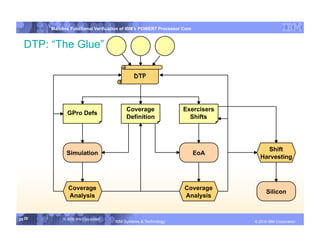
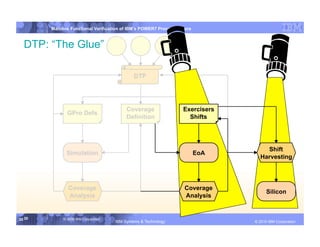
  DTP: “The Glue”

                                              DTP


                                           Coverage                Exercisers
               GPro Defs
                                           Definition                Shifts


                                                                                               Shift
              Simulation                                                  EoA
                                                                                             Harvesting


               Coverage                                             Coverage
                                                                                                 Silicon
               Analysis                                             Analysis


20 20        © 2006 IBM Corporation
                                      IBM Systems & Technology   DRAFT: IBM Confidential          IBM Systems
                                                                                           © 2010 IBM Corporation
IBM System p
        Mainline Functional Verification of IBM’s POWER7 Processor Core


  DTP: “The Glue”

                                              DTP


                                           Coverage                Exercisers
               GPro Defs
                                           Definition                Shifts


                                                                                               Shift
              Simulation                                                  EoA
                                                                                             Harvesting


               Coverage                                             Coverage
                                                                                                 Silicon
               Analysis                                             Analysis


21 21        © 2006 IBM Corporation
                                      IBM Systems & Technology   DRAFT: IBM Confidential          IBM Systems
                                                                                           © 2010 IBM Corporation
IBM System p
             Mainline Functional Verification of IBM’s POWER7 Processor Core


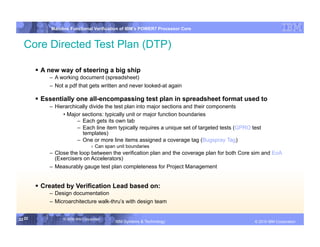
  Core Directed Test Plan (DTP)

         A new way of steering a big ship
            –  A working document (spreadsheet)
            –  Not a pdf that gets written and never looked-at again

         Essentially one all-encompassing test plan in spreadsheet format used to
            –  Hierarchically divide the test plan into major sections and their components
                  • Major sections: typically unit or major function boundaries
                        –  Each gets its own tab
                        –  Each line item typically requires a unique set of targeted tests (GPRO test
                           templates)
                        –  One or more line items assigned a coverage tag (Bugspray Tag)
                                  ›  Can span unit boundaries
            –  Close the loop between the verification plan and the coverage plan for both Core sim and EoA
               (Exercisers on Accelerators)
            –  Measurably gauge test plan completeness for Project Management


         Created by Verification Lead based on:
            –  Design documentation
            –  Microarchitecture walk-thru’s with design team


22 22             © 2006 IBM Corporation
                                             IBM Systems & Technology   DRAFT: IBM Confidential           IBM Systems
                                                                                                   © 2010 IBM Corporation
IBM System p
            Mainline Functional Verification of IBM’s POWER7 Processor Core


  What is a Bugspray Tag?

         Bugspray Events:
           – Discrete coverage points we want to see hit in the design which are coded by the
             designers in VHDL.
           – 3 Types:
                 • Count: Most commonly used
                 • Harvest: Usage is waning
                 • Fail: Causes simulation failure if event occurs….even on Accelerator platform

         Bugspray Tags:
           – Groups of Count Events that are related to covering a particular function in the
             hardware.
           – These events could exist within a single unit or spans multiple units.
           – Typically corresponds to one or more line items in DTP


23 23            © 2006 IBM Corporation
                                          IBM Systems & Technology   DRAFT: IBM Confidential          IBM Systems
                                                                                               © 2010 IBM Corporation
IBM System p
             Mainline Functional Verification of IBM’s POWER7 Processor Core


  Example of Bugspray Tag

         Example:
            – If there is “flush” related logic in both ISU and LSU, those events should get the
              same tag: “flush". These tags will become line items in the core Directed Test Plan
              (DTP).

         What if tag applies to multiple line items in DTP?
            – Not a problem
            – This just shows the items are related
            – Counts against you multiple times when coverage is poor. But, coverage improves
              quickly when you get the correct stimulus on line.


         Litmus test:
            – Q: Do I need a tag for something?
            – A: Rule of thumb: If I need to write a unique set of tests (drivers/stimuli) to target it,
              then give it a new tag.


24 24             © 2006 IBM Corporation
                                           IBM Systems & Technology   DRAFT: IBM Confidential          IBM Systems
                                                                                                © 2010 IBM Corporation
IBM System p
        Mainline Functional Verification of IBM’s POWER7 Processor Core


  DTP: ”The Glue”

                                              DTP


                                           Coverage                Exercisers
               GPro Defs
                                           Definition                Shifts


                                                                                               Shift
              Simulation                                                  EoA
                                                                                             Harvesting


               Coverage                                             Coverage
                                                                                                 Silicon
               Analysis                                             Analysis


25 25        © 2006 IBM Corporation
                                      IBM Systems & Technology   DRAFT: IBM Confidential          IBM Systems
                                                                                           © 2010 IBM Corporation
IBM System p
            Mainline Functional Verification of IBM’s POWER7 Processor Core


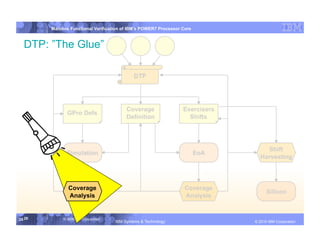
  Coverage Analysis

         The Bugspray Tags allowed a “big picture” view
            – Can see the “forest through the trees”

         Coverage Reports presented data in terms of
            – Major sections of the DTP
            – Bugspray tags
            – Side-by-side comparisons of coverage by platform (unit, core, EoA, system)
                 • Allowed quick analysis of unreachable events if un-hit on all platforms
                       – Bugspray coding errors
                       – Microarchitecture Restrictions Prevent Occurrance
                 • Identified platform dependent tool / driver deficiencies
                 • Enabled priority calls to be made when schedule was tight
                       – Event or Tag has good coverage on multiple platforms vs. poor coverage
                          on all platforms
                                 › Risk mitigation


26 26            © 2006 IBM Corporation
                                           IBM Systems & Technology   DRAFT: IBM Confidential          IBM Systems
                                                                                                © 2010 IBM Corporation
IBM System p
        Mainline Functional Verification of IBM’s POWER7 Processor Core


  Category Report


27 27        © 2006 IBM Corporation
                                      IBM Systems & Technology   DRAFT: IBM Confidential          IBM Systems
                                                                                           © 2010 IBM Corporation
IBM System p
        Mainline Functional Verification of IBM’s POWER7 Processor Core


  Bigger Category Report


28 28        © 2006 IBM Corporation
                                      IBM Systems & Technology   DRAFT: IBM Confidential          IBM Systems
                                                                                           © 2010 IBM Corporation
IBM System p
                  Mainline Functional Verification of IBM’s POWER7 Processor Core


  Tag Report                                                                                         Tags                   Events
                                                                                                 No events
        dcache                                                                                   defined
                                                                                                 > 10% no hit             Aged out
                          Total            No hit        Light hit             Hit               events
        Unit Sim               110                22               21                67          Some no hit              Not hit
                                                                                                 events
        Core Sim               110                12               14                84          All events               Hit less than
          EoA                  110                18                2                90          Hit once                 100 times
                                                                                                 All events               Hit at least
          Total                110                10                4                96
                                                                                                 Hit 100 times            100 times
          Unit            Entity            Class            Var         LSU Sim          Core Sim          EoA          Total
    lsu              ls                 ls_load         e1                      64850         1373                0         66223
    lsu              ls                 ls_load         e2                            0          0                0               0
    lsu              ls                 ls_load         e3                       4127        18991      45207320       45230438
    lsu              ls                 ls_load         e4                            0          0                0               0
    lsu              ls                 ls_load         e5                           35        124                0            159
    lsu              ls                 ls_load         e6                           15         46                0              61
    lsu              ls                 ls_load         e7                       2587       Waived      22906016       22928167
    lsu              ls                 ls_load         e8                            4        141            N/A             1111
    lsu              ls                 ls_load         e9                      11485          973                0          12458
29 29                  © 2006 IBM Corporation
                                                    IBM Systems & Technology         DRAFT: IBM Confidential                  IBM Systems
                                                                                                                      © 2010 IBM Corporation
IBM System p
        Mainline Functional Verification of IBM’s POWER7 Processor Core


  DTP: “The Glue”

                                              DTP


                                           Coverage                Exercisers
               GPro Defs
                                           Definition                Shifts


                                                                                               Shift
              Simulation                                                  EoA
                                                                                             Harvesting


               Coverage                                             Coverage
                                                                                                 Silicon
               Analysis                                             Analysis


30 30        © 2006 IBM Corporation
                                      IBM Systems & Technology   DRAFT: IBM Confidential          IBM Systems
                                                                                           © 2010 IBM Corporation
IBM System p
           Mainline Functional Verification of IBM’s POWER7 Processor Core


  Exerciser Shift Development Workflow
                  Verification           BU Lab Team


                   Core DTP              BU Testplans


                            Exerciser Writers


                            Exerciser Images


                           EoA Shift Creation

        EoA                                             Run on
                               Shifts Library                          Bugspray
                                                        AWAN


        Bringup                    Run on
                                    HW


31 31           © 2006 IBM Corporation
                                          IBM Systems & Technology   DRAFT: IBM Confidential          IBM Systems
                                                                                               © 2010 IBM Corporation
IBM System p
         Mainline Functional Verification of IBM’s POWER7 Processor Core


  How did EoA use coverage reports?
        •    Measurement & Feedback
               –      Indication of what is not being hit
               –      Coverage visibility to the exerciser writers
               –      Drives exerciser improvement

        •    Proof of the exercisers to verification & design
               –      Previously, only make statements about what the exercisers were testing
               –      Now, well conceived coverage events provide proof

        •    Tagging and Organization of Coverage Events Essential
               –      Gives exerciser writers direction
               –      Eliminates first pass interaction with designers as to which events are important.

        •    Allowed Development of High Quality Exerciser Shifts for Post-
             Silicon Validation Effort
               –      Coverage proven directed exerciser shifts
               –      Ready to quickly exploit high throughput post-silicon offers


32 32         © 2006 IBM Corporation
                                        IBM Systems & Technology     DRAFT: IBM Confidential                      IBM Systems
                                                                                                           © 2010 IBM Corporation
IBM System p
            Mainline Functional Verification of IBM’s POWER7 Processor Core


   Overview

        1. Background: POWER Processor History / Roadmap


        2. Verification Methodology


        3. Verification Execution


        4. Verification Advances


        5. Summary


33 33            © 2006 IBM Corporation
                                          IBM Systems & Technology   DRAFT: IBM Confidential          IBM Systems
                                                                                               © 2010 IBM Corporation
IBM System p
           Mainline Functional Verification of IBM’s POWER7 Processor Core


  Traditional Approach to SMT Verification

        The Traditional Approach:
           –  “symmetric” instruction streams on each thread
                •  A particular resource targeted (e.g., GPR rename registers)
                        – 100 random load/store instructions on each thread


           –  Hindsight: This methodology had weaknesses….
                •  No guarantee instructions streams from all threads run same number
                   of cycles
                •  Not the best way to achieve desired cross thread interaction
                •  Not effective at targeting live-locks, hangs and “worst case scenarios”
                   such as thread starvation


34 34           © 2006 IBM Corporation
                                         IBM Systems & Technology   DRAFT: IBM Confidential          IBM Systems
                                                                                              © 2010 IBM Corporation
IBM System p
        Mainline Functional Verification of IBM’s POWER7 Processor Core


   Traditional approach to SMT verification

                  SMP.def
               traditional.def                               Test
                                                             Test
              (test template)
              (test template)                             Generation
                                                          Generation

                                                                   Output test case


                                                                     SMT.tst
                                Core Level Registers common to both threads
                                 Core Level Registers common to both threads

                                      t0 Registers                        t1 Registers


                                      “t0 random                         “t1 random
                                         finite                             finite
                                      Random t0                          Random t1
                                      instruction                        instruction
                                        Stream”                            Stream”


                           Real memory is common to both threads with test generator
                                      managing some potential overlap

35 35        © 2006 IBM Corporation
                                        IBM Systems & Technology    DRAFT: IBM Confidential          IBM Systems
                                                                                              © 2010 IBM Corporation
IBM System p
           Mainline Functional Verification of IBM’s POWER7 Processor Core


  Irritator thread example for two-threaded core (e.g. POWER6)


            SMT_Irritator.def                            Test
             (test template)                           Generation

                                                                    Output test case


                                                                       SMT_Irritator.tst
             Core Level Registers common to both threads

                     t0 Registers                          t1 Registers                 Irritator thread restrictions
                                                                                          •  Cannot cause unexpected
                                                          “t1 infinite                       exceptions
                  “t0 random                                                              •  Cannot modify memory read
                                                              loop
                     finite                                                                  by random thread
                                                            irritator
                  instruction                                                             •  Cannot modify registers
                                                          instruction                        shared with other threads
                    stream”
                                                            stream”                       •  Architected results may be
                                                                                             undefined


          Real memory with test generator managing some potential overlap


36 36           © 2006 IBM Corporation
                                         IBM Systems & Technology      DRAFT: IBM Confidential             IBM Systems
                                                                                                   © 2010 IBM Corporation
IBM System p
        Mainline Functional Verification of IBM’s POWER7 Processor Core


  Guaranteed Worst-Case Cross-Thread Resource
  Contention and SMT Balanced Test Length
                                                               Irritator Thread Test Generation
                                                                  – Description:
                                                                          • Random generation on Primary Thread
                                                                          • Tight infinite loop on one or more “irritator”
                                                                          threads
                                                                          • Primary Thread kills Irritator Thread(s) by
                                                                          terminating infinite loop
                                                                  – Balanced Test Length Among All Threads
                                                                  – Targets worst case (tight infinite loop) cross
                                                                  thread interaction
                                                                         • Impossible to miss:
                                                                                – live-locks
                                                                                – hangs
                                                                                – thread starvation
                                                                  – Efficient Test Generation:
                                                                          • Only generate 1 pass of irr thread loop
                                                                          • Net effect is test generation time
                                                                          governed by Primary Thread
                                                                                 – 2x perf improvement for 2 threads
                                                                                 – 4x perf improvement for 4 threads


37 37        © 2006 IBM Corporation
                                      IBM Systems & Technology   DRAFT: IBM Confidential                         IBM Systems
                                                                                                          © 2010 IBM Corporation
IBM System p
        Mainline Functional Verification of IBM’s POWER7 Processor Core


  Guaranteed Cross-Thread Interaction


                                                               Extremely effective cross-thread
                                                                interaction when compared to
                                                                traditional approach


38 38        © 2006 IBM Corporation
                                      IBM Systems & Technology   DRAFT: IBM Confidential           IBM Systems
                                                                                            © 2010 IBM Corporation
IBM System p
                  Mainline Functional Verification of IBM’s POWER7 Processor Core


                       P7 SMT4 “Irritator Thread”                                                 I


                                                              GPRO
               SMT4_irritator.def
                                                             Generation


                                                                             SMT4_irritator.tst
               Core Level Registers Common to all threads
        t0 Registers     t1 Registers                 t2 Registers          t3 Registers        Irritator Thread Restrictions
                                                                                                   Ÿ  annot cause unexpected
                                                                                                     C
                                                                                                   exceptions
     “t0 finite                                                            “t3 infinite            Ÿ  annot modify memory
                                                                                                     C
                        “t1 infinite                “t2 infinite
      random                                                                   loop
                                                                                                   read by Random threads
                            loop                        loop                                       Ÿ  annot modify registers
                                                                                                     C
    instruction                                     irritator B”           irritator C”            shared with other threads
                        irritator A”                                                               Ÿ  rchitected results may
                                                                                                     A
      Stream”                                                                                      be undefined


                 Real Memory with GPRO managing some potential overlap


39 39                  © 2006 IBM Corporation
                                                IBM Systems & Technology       DRAFT: IBM Confidential             IBM Systems
                                                                                                            © 2010 IBM Corporation
IBM System p
              Mainline Functional Verification of IBM’s POWER7 Processor Core


           P7 SMT4 “Irritator Thread” Example

Long Random Thread                    Irritator Thread A               Irritator Thread B               Irritator Thread C
  SEQUENCE
                                         LB0: SEQUENCE                      LB1: SEQUENCE                SEQUENCE
        REPEAT 100
                                                fdiv                                slbie                C: b2self
          SELECT
                                                add                         B:      b to LB1
             Group_All
                                                ld
        stw nop, A
        stw nop, B                       A:     b to LB0
        stw nop, C


  Generated Instr: 103                  Generated Instr: 4                  Generated Instr: 2           Generated Instr: 1
  Simulated Instr: 103                  Simulated Instr: Infinite           Simulated Instr: Infinite    Simulated Instr: Infinite


40 40                © 2006 IBM Corporation
                                                 IBM Systems & Technology        DRAFT: IBM Confidential                IBM Systems
                                                                                                                 © 2010 IBM Corporation
IBM System p
            Mainline Functional Verification of IBM’s POWER7 Processor Core


  POWER7 Irritator Thread Bug Summary

          With irritator threads, removed 23 “high quality” bugs
           traditionally seen only in post-silicon:

            –  Flush Related: 6
            –  Hang: 5
            –  Thread Starvation: 5
            –  Live-lock: 4
            –  Cache Write Transition: 2
            –  Branch to wrong target EA: 1

          Patent pending


41 41            © 2006 IBM Corporation
                                          IBM Systems & Technology   DRAFT: IBM Confidential          IBM Systems
                                                                                               © 2010 IBM Corporation
IBM System p
              Mainline Functional Verification of IBM’s POWER7 Processor Core


  Additional Advancements over POWER6 Verification


          Software simulation on core model
             –  2x number of simulation cycles
             –  Very methodical effort driven by Core Directed Test Plan
             –  2.5x number of test cases simulated
             –  Most effective use of coverage ever by POWER processor team
                     45K discreet (Bugspray) coverage events

          Hardware-accelerated simulation
             –  7x number of accelerator cycles
             –  10x number of targeted exerciser shifts based on Core Directed Test Plan
                     overage-driven focused exerciser shifts vs. running random
                    C


          Formal Verification
             –  Broad application of the technology across all areas of the chip
             –  Extensive leverage from assertion-based verification <-> designer-level verification
             –  Deep dive FV reviews conducted early in the project to identify key areas


42 42              © 2006 IBM Corporation
                                            IBM Systems & Technology      DRAFT: IBM Confidential             IBM Systems
                                                                                                       © 2010 IBM Corporation
IBM System p
            Mainline Functional Verification of IBM’s POWER7 Processor Core


  Additional Improvements: Design for Verification

         “POWER Architecture for Verification”
            – Tight interlock between POWER Architecture Specification Team and Verification
              Team
            – Verification team actually maintained the official POWER Architecture Change list

         Extensive “chicken switches” for back-off modes
            – Any area considered risky from verification team
            – Degraded performance, but does not gate forward progress

         “Hardware Irritators”
            – Special modes built into silicon to enable stressing of otherwise rarely occurring
              microarchitecture events
            – “Opposite of a chicken switch”
            – Verification-only usage
                 •  Used for either pre-silicon (including EoA) or post-silicon testing
            – Patent pending

43 43            © 2006 IBM Corporation
                                          IBM Systems & Technology   DRAFT: IBM Confidential          IBM Systems
                                                                                               © 2010 IBM Corporation
IBM System p
            Mainline Functional Verification of IBM’s POWER7 Processor Core


   Overview

        1. Background: POWER Processor History / Roadmap


        2. Verification Methodology


        3. Verification Execution


        4. Verification Advances


        5. Summary


44 44            © 2006 IBM Corporation
                                          IBM Systems & Technology   DRAFT: IBM Confidential          IBM Systems
                                                                                               © 2010 IBM Corporation
IBM System p
            Mainline Functional Verification of IBM’s POWER7 Processor Core


  Summary

        1.  POWER7 verification effort is the new “gold standard” in IBM
              Release 1.0 hardware shipped to select customers (e.g. Rice University)

        2.  Effective Utilization of Coverage Across All Simulation Levels
              Direct comparison of coverage from one platform to the next

        3.  Irritator Threads for SMT Verification
              Found 23 “tough” bugs on POWER7

        4.  Exercisers on Accelerator (EoA) Exploitation
              Allowed Development of High-Quality Exerciser Shifts later utilized for Post-Silicon
               Validation Effort

        5.  Constant planning for Post-Silicon Validation
              Hardware Irritators and Back-off Mode Testing


45 45            © 2006 IBM Corporation
                                          IBM Systems & Technology   DRAFT: IBM Confidential          IBM Systems
                                                                                               © 2010 IBM Corporation
IBM System p
             Mainline Functional Verification of IBM’s POWER7 Processor Core


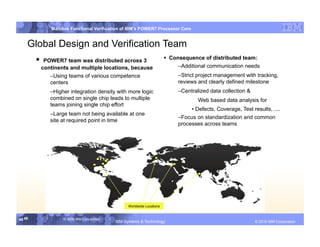
    Global Design and Verification Team
          POWER7 team was distributed across 3                          Consequence of distributed team:
         continents and multiple locations, because                          –  dditional communication needs
                                                                              A
            –  sing teams of various competence
             U                                                              –  trict project management with tracking,
                                                                             S
            centers                                                         reviews and clearly defined milestone
             –  igher integration density with more logic
               H                                                            –  entralized data collection &
                                                                             C
             combined on single chip leads to multiple                              Web based data analysis for
             teams joining single chip effort
                                                                                 • Defects, Coverage, Test results, ....
             –  arge team not being available at one
              L
                                                                            –  ocus on standardization and common
                                                                             F
             site at required point in time
                                                                            processes across teams


                                                 Worldwide Locations


46 46             © 2006 IBM Corporation
                                           IBM Systems & Technology         DRAFT: IBM Confidential                  IBM Systems
                                                                                                              © 2010 IBM Corporation
IBM System p
            Mainline Functional Verification of IBM’s POWER7 Processor Core


  Thank You’s to IBM team members

         Borrowed charts / content input:
                 • Ron Kalla
                 • Avi Ziv
                 • Michal Rimon
                 • Bryan Hickerson
                 • John Schumann
                 • Wolfgang Roesner
                 • Viresh Paruthi
                 • Mike Behm
                 • Klaus-Dieter Schubert
                 • Charles Meissner

         Reviewers
                 • Wolfgang Roesner
                 • Mendy Furmanek
                 • Klaus-Dieter Schubert
                 • Keith Sharp

47 47            © 2006 IBM Corporation
                                          IBM Systems & Technology   DRAFT: IBM Confidential          IBM Systems
                                                                                               © 2010 IBM Corporation
IBM System p
        Mainline Functional Verification of IBM’s POWER7 Processor Core


                                REFERENCE MATERIAL


48 48        © 2006 IBM Corporation
                                      IBM Systems & Technology   DRAFT: IBM Confidential          IBM Systems
                                                                                           © 2010 IBM Corporation
IBM System p
          Mainline Functional Verification of IBM’s POWER7 Processor Core


  The IBM Power™ 750 Express is the highest performing 4-socket system
  on the planet. In addition it outperforms all other non-IBM 8 and 16-socket
  systems
                                                                                                  Cores/     Threads/
             System Name                                                       Cores     Chips                              Peak*
                                                                                                   Chip        Core
             IBM Power 750                                                         32         4         8           4        1060
             HP ProLiant DL585 G6 (2.8 GHz AMD Opteron 8439 SE)                    24         4         6           1         416
             HP Integrity rx6600 (1.6 GHz/24MB Dual-core Intel Itanium 2)           8         4         2           1         102
             HP ProLiant DL580 G5 (2.66 GHz, Intel Xeon X7460)                     24         4         6           1         291
             Sun SPARC Enterprise T5440                                            32         4         8           8         360
             Sun SPARC Enterprise M4000                                            16         4         4           2         152
             HP ProLiant DL 785 G6 (2.8 GHz AMD Opteron 8439 SE)                   48         8         6           1         800
             Unisys ES7000 Model 7600R, Intel Xeon X7460, 2.66 GHz                 48         8         6           1         527
             Sun SPARC Enterprise M5000                                            32         8         4           2         296
             HP Integrity rx8640 (1.6 GHz/24MB Dual-core Intel Itanium 2)          16         8         2           1         209
             Unisys ES7000 Model 7600R, Intel Xeon X7460, 2.66 GHz                 96        16         6           1        1049
             Sun SPARCPeak = SPECint_rate2006 (Peak)
                     * Enterprise M8000                                            64        16         4           2         753
                   Substantiation:
                     Competitive benchmark results reflect results published as of February 3, 2010. The results are the
                      best results for four-socket single (non-clustered) systems using POWER™, Intel® x86, AMD
                      Opteron™ x86, SPARC and Intel Itanium® processors. IBM Power 750 result submitted on February
                      8, 2010.
                     SPEC® and the benchmark names SPECrate®, SPECint®, and SPECjbb® are registered trademarks
                      of the Standard Performance Evaluation Corporation. For the latest SPEC benchmark results, visit
                      http://www.spec.org


49 49
   49          © 2006 IBM Corporation
                                               IBM Systems & Technology      DRAFT: IBM Confidential                                IBM Systems
                                                                                                                        © 2010 IBM Corporation
IBM System p
                 Mainline Functional Verification of IBM’s POWER7 Processor Core


  The IBM Power 750 Express is the most energy
  efficient 4-socket system on the planet.
                                                                                                                                Peak
                                                                                            Core
                                                                            Core    Chip            Thread    Peak                /
                       System Name                                                           s/                       WATTs
                                                                             s       s              s/Core      *               WAT
                                                                                            Chip
                                                                                                                                 T
                       IBM Power 750                                          32       4       8         4    1060      1950     0.54
                       HP ProLiant DL585 G6 (2.8 GHz AMD Opteron 8439         24       4       6         1     416      1548     0.26
                       SE)
                       HP Integrity rx6600 (1.6 GHz/24MB Dual-core Intel       8       4       2         1     102      1600     0.06
                       Itanium 2)
                       HP ProLiant DL580 G5 (2.66 GHz, Intel Xeon X7460)      24       4       6         1     291      1412     0.20
                         Sun    * Peak = SPECint_rate2006 (Peak)
          Substantiation: SPARC Enterprise T5440                              32       4       8          8     360     2700     0.13
          Competitive benchmark results reflect results published as of February 3, 2010. The results are the best results for four-socket single
           (non-clustered) SPARC Enterprise M4000 Intel x86, Opteron x86, SPARC and Itanium processors. IBM 152
                         Sun systems using POWER,                              16       4       4          2     Power 750 result 0.07
                                                                                                                         2016      submitted on
           February 8, 2010.
          SPEC and the benchmark names SPECrate, SPECint, and SPECjbb are registered trademarks of the Standard Performance Evaluation
           Corporation. For the latest SPEC benchmark results, visit http://www.spec.org
          Performance/WATT is calculated by dividing the performance from the tables below by the recommended maximum power usage for
           site planning. This defines the requirement for the power infrastructure. Actual power used by the systems will be less than this value
           for all of the systems. For Power Systems™ servers, this information is available in the site planning guides available through
           www.ibm.com. For HP systems, this information is contained in the QuickSpecs for each system available through www.hp.com.
          For Sun systems, this information is available through the Site Planning Guides available through www.sun.com.


50 50
   50                  © 2006 IBM Corporation
                                                       IBM Systems & Technology        DRAFT: IBM Confidential                             IBM Systems
                                                                                                                                   © 2010 IBM Corporation
IBM System p
                Mainline Functional Verification of IBM’s POWER7 Processor Core


  The IBM Power 750 Express has more SAP performance than any 8-socket
  system in the industry – and is even comparable to a 128-core, 32-socket
  Sun M9000.
        Substantiation:
        All results are 2-tier, SAP EHP 4 for SAP ERP 6.0 (Unicode). IBM results valid as of 2/8/2010. Competitive results valid as of
            2/3/2010.
          IBM Power 750 Express certification number not available at press time and can be found at www.sap.com/
            benchmarks.
              IBM Power 750 Express: 4p / 32–c / 128 – t, POWER7™, 3.55 GHz, 256 GB memory, 15,600 SD users, dialog resp.:
            0.98s, line items/hour: 1,704,330, Dialog steps/hour: 5,113,000, SAPS: 85,220, DB time (dialog/ update):0.015s /
            0.028s, CPU utilization: 99%, AIX® 6.1, DB2® 9.7
          Sun SPARC Enterprise T5540: 4p / 32-c / 256 –t, UltraSPARC T2 plus OC, 1.6 GHz, 256 GB memory, 4720 SD users,
            dialog resp: 0.97s, line items/hour: 516,670, dialog steps/hour: 1,550,000, SAPS: 25,830, Solaris 10, Oracle 10g ,
            cert# 2009026-1
          HP DL585 G6: 4p / 24-c / 24-t, AMD Opteron 8439 SE, 2.8 GHz, 64 GB memory, 4665 SD users, dialog resp: 0.96s, line
            items/hour: 510,670, dialog steps/hour: 1,532,000, SAPS: 25,530, Windows Server 2008 EE, , SQL Server 2008,
            cert#: 2009025
          HP DL785 G6: 8p / 48-c / 48-t, AMD Opteron 8439 SE, 2.8 GHz, 128 GB memory, 8280 SD users, dialog resp: 0.96s,
            line items/hour: 907,000, dialog steps/hour: 2,721,000, SAPS: 45,350, Windows Server 2008 EE, , SQL Server 2008,
            cert#: 2009035
          Sun Fire x4640: 8p / 48-c / 48–t, Six-core AMD Opteron 8435, 2.6 GHz, 256 GB memory, 10,000 SD users, dialog resp:
            0.9s, line items/hour: 1,101,330, dialog steps/hour: 3,304,000, SAPS: 55,070, Solaris 10, Oracle 10g, cert# 2009049
          HP DL380 G6: 2p / 8-c / 16-t, Intel Xeon® X5570, 2.93 GHz, 48 GB memory, 3171 SD users, dialog resp: 0.94s, line
            items/hour: 347,670, dialog steps/hour: 1,043,000, SAPS: 17,380, SUSE Linux® Enterprise Server 10, MaxDB 7.8,
            cert#: 2009006
          Sun SPARC Enterprise M9000: 32p / 128-c / 256–t, Six-core AMD Opteron 8435, 2.6 GHz, 1 TB memory, 17,430 SD
            users, dialog resp: 0.95s, line items/hour: 1,909,670, dialog steps/hour: 5,729,000, SAPS: 95,480, Solaris 10, Oracle
            10g, cert# 2009038


51 51
   51                 © 2006 IBM Corporation
                                                IBM Systems & Technology       DRAFT: IBM Confidential                        IBM Systems
                                                                                                                      © 2010 IBM Corporation
IBM System p
                      Mainline Functional Verification of IBM’s POWER7 Processor Core


  Consolidation onto POWER7 can deliver significant savings.
  Ninety-two Sun SPARC Enterprise T2000 servers can be consolidated into
  a single IBM Power 750 Express system, saving 95% of the cores for
  software licensing, 97% on floorspace, and 95% on energy.
             Calculation Summary: the Power 750 has 30.93 better SPECjbb2005 performance than the Sun T2000. Assuming a 3x virtualization factor
                                                       JVM                       Processor
             for greater consolidation - then 92 Sun Fire T2000 servers could be consolidated onto HW Threading Express bops (30.93 * 3bops/JVM
                                                                                                   one Power 750        server         = 92.8
                       HW System Name                               Cores
             servers rounded to 92 T2000 servers) Instances                          chips
                  IBM Power 750 Express                            32           32                     4           Yes                   2,478,929                 77,467

                  Sun File T2000                                      4          8                     1           Yes                       74,365                18,591


                                                                                                                                                                          Total
                                                              Max          Rack                                                             Total          Total
               System Name              SPECjbb2005                                       Cores         Systems          Total Perf                                       Rack
                                                              Watts        space                                                            Cores          Watts
                                                                                                                                                                          Space

             IBM Power 750
                                              2,478,929         1950                 4           32                1       1,380,000              32           1950               4
             Express
             Sun File T2000                       74,365         450                 2            8              92        1,368,150             736         41,400            184
            Savings with
            Power 750                                                                                                                         95.6%          95.2%          97.8%
            Express
        Substantiation
        1. SPEC and the benchmark names SPECrate, SPECint, and SPECjbb are registered trademarks of the Standard Performance Evaluation Corporation. Competitive benchmark results
        stated reflect results published on www.spec.org as of February 08, 2010. The comparison presented below is based on a consolidation of a legacy 8-core Sun SPARC Enterprise
        T2000 UltraSPARC T1 servers into a 32 core IBM Power 750. For the latest SPEC benchmark results, visit http://www.spec.org.
        2. SPECjbb2005 results are:
         POWER7: IBM Power 750 Express with 4 chips, and 32 cores and four threads per core with a result of 2,300,000 bops and 71,875 bops/jvm submitted to SPEC on
        February 8, 2010.
          SPARC: Sun Microsystems Sun SPARC Enterprise T2000 with 1 chip, 8 cores and 4 threads per core with a result of 74,356 bops and 18,591 bops/jvm
        *The virtualized system count and energy savings were derived from several factors:
          - A performance ratio factor of 30.93X was applied to the virtualization scenario. The performance factor is the SPECjbb2005 result of the Power 750 Express divided by the result of
        the competitive Sun SPARC Enterprise T2000 server.
          - A virtualization factor of 3X was applied to the virtualization scenario using utilization assumptions derived from an Alinean white paper on server consolidation. The tool assumes
        19% utilization of existing servers and 60% utilization of new servers. Source - www.ibm.com/services/us/cio/optimize/opt_wp_ibm_systemp.pdf.
        Space calculation: The Sun T2000 is 2U in height and 21 can fit into a 42U rack. The 750 is 4U in height.
        Power consumption figures of 1950W for the IBM Power 750 and 450W for the Sun T2000 were based on the maximum rates published by IBM and Sun Microsystems, respectively.
        This information for the Power 750 is in "Model 8233-E8B server specifications" available at
        http://www-01.ibm.com/common/ssi/index.wss - search for Power 750. Sun T2000 Maximum AC power consumption of 450 WATTs was sourced from Sun SPAC Enterprise T2000
        Servers site planning guide at http://docs.sun.com/app/docs/doc/819-2545-11 as of 2/9/2010.

52 52
   52                          © 2006 IBM Corporation
                                                                      IBM Systems & Technology                    DRAFT: IBM Confidential                                             IBM Systems
                                                                                                                                                                            © 2010 IBM Corporation
IBM System p
         Mainline Functional Verification of IBM’s POWER7 Processor Core


  345 million kilowatt-hours are used yearly by the 91,920* Sun SPARC
  Enterprise T2000 servers shipped since 2005 above what would be used
  yearly if consolidated into 1,000 IBM Power 750 Express servers at the
  rate of 92 to 1.
  That’s enough electricity to supply 34,500 homes for a year.**
           Substantiation
           - Maximum power for 1 IBM Power 750 Express server = 1950 watts
           - Maximum power for 92 Sun Fire T2000 servers = 92 x 450 = 41,400 watts
           - Excess power per consolidation instance (92 Sun T2000’s into one Power 750) = 39,450
              watts
           - Number of consolidations required = 1,000 (91,320 / 92)
           - Total excess kilowatt-hours per year =
              39,450 watts x 24 hrs/day x 365 days/yr x 1,000 = 345 million kilowatt-hours per year

           * Source: 3Q09 IDC Server Tracker
           ** Source: Wikipedia estimate of average annual household energy use of 10,000 kilowatt-
              hours


53 53
   53         © 2006 IBM Corporation
                                       IBM Systems & Technology   DRAFT: IBM Confidential                    IBM Systems
                                                                                                      © 2010 IBM Corporation
IBM System p
               Mainline Functional Verification of IBM’s POWER7 Processor Core


  The IBM Power 750 Express has 28% more performance than a 64-core
  HP Integrity Superdome and requires only 83% as much power to run – at
  a fraction of the price.
        Substantiation:
        Notes:
        1. SPEC and the benchmark names SPECrate, SPECint, and SPECjbb are registered trademarks of the Standard
           Performance Evaluation Corporation. HP Integrity Superdome benchmark results stated reflect results published
           on www.spec.org as of February 08, 2010. For the latest SPEC benchmark results, visit http://www.spec.org.
        2. SPECint_rate2006 Peak results are:
        POWER7: IBM Power 750 Express with 4 chips, and 32 cores and four threads per core with a result of 1060 submitted
           to SPEC on February 8, 2010.
        Itanium: Hewlett-Packard Integrity Superdome with 32 chips, 64 cores, and one thread per core with a result of 824.
        3. The HP Integrity Superdome is a rack cabinet. The 750 is 4U in height.
        Power consumption is derived from the recommended maximum power for site planning. Actual power used by the
          systems will be less than this value for all of the systems.
          This information for the Power 750 Express is available at http://www-01.ibm.com/common/ssi/index.wss -
          search for Power 750. The maximum power requirement for the Power 750 is 1,950 Watts.
          The information for the Integrity Superdome is in "QuickSpecs HP Integrity rx6600 Server" available at http://
          h18000.www1.hp.com/products/quickspecs/11717_div/11717_div.HTML, which shows the maximum power
          requirement for the Integrity Superdome of 12,196 VA. Using the Power Factor of 0.95 shown at http://
          www.spectra.com/pdfs/superdome.pdf, the maximum input power is 11,586 Watts.
        Price comparison based on IBM analysis:
           HP Superdome price estimated at $2,117,000 for the configuration described in the SPECint_rate2006 benchmark
           IBM Power 750 Express U.S. list price = $275,420


54 54
   54               © 2006 IBM Corporation
                                             IBM Systems & Technology     DRAFT: IBM Confidential                      IBM Systems
                                                                                                                © 2010 IBM Corporation
IBM System p
                         Mainline Functional Verification of IBM’s POWER7 Processor Core


  The IBM Power 780 delivers leadership performance and consolidation
  capability vs. HP and Sun high-end servers. For example, eight HP
  Integrity Superdome 64‑core systems utilized at 30% can be consolidated
  into a single IBM Power 780 server utilized at 80%, thus saving 87% of the
  cores for software licensing, reducing floorspace from 80 square feet to
    Substantiation:
  7.6 square feet, and reducing energy costs by 92%.


        Performance per watt is calculated by dividing the performance in the table above by the recommended maximum power for site planning. Actual power used by the systems will be less than this value for
            all of the systems. The maximum power requirement for the Power 780 is 6,400 Watts and is available at http://www-01.ibm.com/common/ssi/index.wss - search for Power 780.
        Power consumption figures of 6400 W for the IBM Power 780, 12,196 W / 24,392 W for the HP Superdome and 44,800 W for the Sun SPARC Enterprise M9000 were based on the maximum rates published by
            IBM, HP and Sun Microsystems, respectively. The information for the HP Integrity Superdome is in “QuickSpecs HP Integrity Superdome Servers 16- processor, 32-processor, and 64- processor
            Systems” available at www.hp.com. The information for the Sun SPARC Enterprise M9000 is in the "Sun SPARC Enterprise M9000 Servers Site Planning Guide" available at www.sun.com
        .
        The virtualized system count and energy savings were derived from several factors:
        A performance ratio factor was applied to the virtualization scenario based on SPECint_rate2006. The performance factor is simply the SPECint_rate2006 result per core of the Power 780 divided by the per
            core result of the HP or Sun system.

        Power 780 (64-core, 8 chips, 8 cores per chip, 3.8 GHz) SPECint_rate2006 2,530 peak as of 2/8/2010. HP Superdome (64-core, 32 chips, 2 cores per chip) 1.6 GHz, SPECint_rate2006 824 peak published
           October 2006. Data valid as of 2/3/2010.

        Sun SPARC Enterprise M9000 (256-core, 64 chips, 4 cores per chip) 2.88 GHz, SPECint_rate2006 2,586 peak published October 2009. Data valid as of 2/3/2010. SPEC® results available at: www.spec.org.
        A virtualization factor of 3.157X was applied to the virtualization scenario using utilization assumptions derived from an Alinean white paper on server consolidation. The tool assumes 19% utilization of
             existing servers and 60% utilization of new servers. Source - www.ibm.com/services/us/cio/optimize/opt_wp_ibm_systemp.pdf.
        Air conditioning power requirement estimated at 50% of system power requirement.

        Energy cost of $.1031 per kWh is based on 2009 YTD US Average Retail price to commercial customers per US DOE at http://www.eia.doe.gov/cneaf/electricity/epm/table5_6_b.html as of 1/27/2010.
        The reduction in floor space, power, cooling and software costs depends on the specific customer, environment, application requirements, and the consolidation potential. Actual numbers of virtualized
            systems supported will depend on workload levels for each replaced system.
        System data for HP from the HP Superdome Datasheet and HP Integrity Superdome Server — specifications both available at www.hp.com. System data for Sun from the Sun SPARC Enterprise M9000 Tech
            Specs available at www.sun.com. Data is current as of January 27, 2010.


55 55
   55                              © 2006 IBM Corporation
                                                                           IBM Systems & Technology                        DRAFT: IBM Confidential                                                 IBM Systems
                                                                                                                                                                                        © 2010 IBM Corporation
IBM System p
              Mainline Functional Verification of IBM’s POWER7 Processor Core


                  The modular enterprise class POWER systems have continued
                  to deliver significant improvements year over year. With the
                  Power 770 server, clients can consolidate four POWER5™
                  processor-based Power 570 systems onto one Power 770. In
                  fact, it only takes two nodes and moving to the Power 770 still
        Substantiation: an effective capacity increase of 50%.
                  has

                                                                                    Effective
                                                                      Utilizatio
                     System Name            Cores   Nodes    rPerf                 Performan    WATTs    Maintenance
                                                                           n
                                                                                       ce

                     IBM Power 770           24       2      261.19       60%        156.7      3200

                     IBM System p®
                                             64       16     309.8        30%         92.9      20,800
                     570 (x4)

                                                                                                 84%
                                                     87%
                     Advantage /                                                    > 50%       Less
                                                    Less
                     Savings                                                       Capacity     Energ
                                                    Space
                                                                                                  y


56 56
   56              © 2006 IBM Corporation
                                               IBM Systems & Technology         DRAFT: IBM Confidential                       IBM Systems
                                                                                                                       © 2010 IBM Corporation
IBM System p
               Mainline Functional Verification of IBM’s POWER7 Processor Core


                 POWER7 systems deliver up to three or four times the energy
                 efficiency of POWER6™ based systems.
        Substantiation:
          SPEC and the benchmark names SPECrate, SPECint, and SPECjbb are registered trademarks of the
           Standard Performance Evaluation Corporation. Benchmark results stated reflect results published on
           www.spec.org as of
           February 8, 2010. The comparison used in the claim is based on a consolidation of the best high-end
           POWER6 result (Power 595) to the Power 780, the best mid-range POWER6 result (Power 570) to the Power
           770, and the best four-socket and above POWER6 Express results with the Power 750 Express. For the
           latest SPEC benchmark results, visit http://www.spec.org.
          Performance/WATT is calculated by dividing the performance from the tables below by the recommended
           maximum power usage for site planning. This defines the requirement for the power infrastructure. Actual
           power used by the systems will be less than this value for all of the systems. This information is available
           in the site planning guides available through www.ibm.com.
                                                        SPECint_rate2006 results as of January 7, 2010

                                                 Core                  Cores/   Thread                           Peak /
                             System Name                   Chips                          Peak      WATTs
                                                  s                     chip    s/ Core                          WATT

                             IBM Power 780         64              8        8        4     2530           6400     0.39
                             IBM Power 595         64           32          2        2     2160          28300     0.07
                             IBM Power 770         64              8        8        4     2013           6400     0.31
                             IBM Power 570         16              8        2        2      542           5600     0.09
                             IBM Power 750
                                                   32              4        8        4     1060           1950     0.54
                             Express

                             IBM Power 560
                                                   16              8        2        2      363           2400     0.15
                             Express

                             IBM Power 550
                                                    8              4        2        2      263           1400     0.18
                             Express


57 57
   57               © 2006 IBM Corporation
                                             IBM Systems & Technology           DRAFT: IBM Confidential                          IBM Systems
                                                                                                                          © 2010 IBM Corporation
IBM System p
                    Mainline Functional Verification of IBM’s POWER7 Processor Core


                        POWER7 systems deliver up to three or four times the
                        performance with less energy than POWER6 based
        Substantiation: systems.
        rPerf (Relative Performance) is an IBM estimate of commercial processing performance relative to other IBM UNIX® systems.
        The comparison used in the claim is based on these comparisons:
               4-node Power 570 (POWER6+™) to a 1-node Power 780 (POWER7)
               4-node Power 570 (POWER6+) to a 3‑node Power 780 (POWER7)
               4-node Power 570 (POWER6+) to a 3-node Power 770 (POWER7)
               2-node Power 560 Express (POWER6+) to Power 750 Express (POWER7)
        Performance/WATT is calculated by dividing the performance (rPerf) from the tables below by the recommended maximum power usage for site
           planning. This defines the requirement for the power infrastructure. Actual power used by the systems will be less than this value for all of the
                                                                   Processor                     Energy
           systems. This information is available in the site planning guides available through www.ibm.com.             Factor*
                          System Name              Nodes                          Proc. Freq.               rPerf
                                                                  Technology                     (Watts)              (P7 over P6)

                           IBM Power 780                    1       POWER7              3.8 GHz          1600        195             1.38
                           IBM Power 570                    4      POWER6+              5.0 GHz          5600        141         -


                           IBM Power 780                    3       POWER7              3.8 GHz          4800        523              3.7
                           IBM Power 570                    4      POWER6+              5.0 GHz          5600        141         -


                           IBM Power 770                    3       POWER7              3.1 GHz          4800        443              3.1
                           IBM Power 570                    4      POWER6+              5.0 GHz          5600        141         -


                           IBM Power 750
                                                            1       POWER7             3.55 GHz          1950        331              3.3
                           Express

                           IBM Power 560
                                                            2      POWER6+               3.6 Ghz         2400        100         -
                           Express
                                    * Factor = Performance increase factor of POWER7 system over POWER6 system for less energy

58 58
   58                      © 2006 IBM Corporation
                                                          IBM Systems & Technology             DRAFT: IBM Confidential                             IBM Systems
                                                                                                                                            © 2010 IBM Corporation
IBM System p
                      Mainline Functional Verification of IBM’s POWER7 Processor Core


  Special notices
        This document was developed for IBM offerings in the United States as of the date of publication. IBM may not make these offerings available in other
        countries, and the information is subject to change without notice. Consult your local IBM business contact for information on the IBM offerings available in
        your area.
        Information in this document concerning non-IBM products was obtained from the suppliers of these products or other public sources. Questions on the
        capabilities of non-IBM products should be addressed to the suppliers of those products.
        IBM may have patents or pending patent applications covering subject matter in this document. The furnishing of this document does not give you any
        license to these patents. Send license inquires, in writing, to IBM Director of Licensing, IBM Corporation, New Castle Drive, Armonk, NY 10504-1785
        USA.
        All statements regarding IBM future direction and intent are subject to change or withdrawal without notice, and represent goals and objectives only.
        The information contained in this document has not been submitted to any formal IBM test and is provided "AS IS" with no warranties or guarantees either
        expressed or implied.
        All examples cited or described in this document are presented as illustrations of the manner in which some IBM products can be used and the results
        that may be achieved. Actual environmental costs and performance characteristics will vary depending on individual client configurations and conditions.
        IBM Global Financing offerings are provided through IBM Credit Corporation in the United States and other IBM subsidiaries and divisions worldwide to
        qualified commercial and government clients. Rates are based on a client's credit rating, financing terms, offering type, equipment type and options, and
        may vary by country. Other restrictions may apply. Rates and offerings are subject to change, extension or withdrawal without notice.
        IBM is not responsible for printing errors in this document that result in pricing or information inaccuracies.
        All prices shown are IBM's United States suggested list prices and are subject to change without notice; reseller prices may vary.
        IBM hardware products are manufactured from new parts, or new and serviceable used parts. Regardless, our warranty terms apply.
        Any performance data contained in this document was determined in a controlled environment. Actual results may vary significantly and are dependent
        on many factors including system hardware configuration and software design and configuration. Some measurements quoted in this document may
        have been made on development-level systems. There is no guarantee these measurements will be the same on generally-available systems. Some
        measurements quoted in this document may have been estimated through extrapolation. Users of this document should verify the applicable data for
        their specific environment.


                                                                                                                                          Revised September 26, 2006


59 59
   59                        © 2006 IBM Corporation
                                                             IBM Systems & Technology              DRAFT: IBM Confidential                                 IBM Systems
                                                                                                                                                   © 2010 IBM Corporation
IBM System p
                    Mainline Functional Verification of IBM’s POWER7 Processor Core


  Special notices (cont.)
  IBM, the IBM logo, ibm.com AIX, AIX (logo), AIX 6 (logo), AS/400, Active Memory, BladeCenter, Blue Gene, CacheFlow, ClusterProven, DB2, ESCON, i5/OS, i5/OS (logo), IBM
  Business Partner (logo), IntelliStation, LoadLeveler, Lotus, Lotus Notes, Notes, Operating System/400, OS/400, PartnerLink, PartnerWorld, PowerPC, pSeries, Rational, RISC
  System/6000, RS/6000, THINK, Tivoli, Tivoli (logo), Tivoli Management Environment, WebSphere, xSeries, z/OS, zSeries, AIX 5L, Chiphopper, Chipkill, Cloudscape, DB2 Universal
  Database, DS4000, DS6000, DS8000, EnergyScale, Enterprise Workload Manager, General Purpose File System, , GPFS, HACMP, HACMP/6000, HASM, IBM Systems Director
  Active Energy Manager, iSeries, Micro-Partitioning, POWER, PowerExecutive, PowerVM, PowerVM (logo), PowerHA, Power Architecture, Power Everywhere, Power Family,
  POWER Hypervisor, Power Systems, Power Systems (logo), Power Systems Software, Power Systems Software (logo), POWER2, POWER3, POWER4, POWER4+, POWER5,
  POWER5+, POWER6, POWER7, pureScale, System i, System p, System p5, System Storage, System z, Tivoli Enterprise, TME 10, TurboCore, Workload Partitions Manager and
  X-Architecture are trademarks or registered trademarks of International Business Machines Corporation in the United States, other countries, or both. If these and other IBM
  trademarked terms are marked on their first occurrence in this information with a trademark symbol (® or ™), these symbols indicate U.S. registered or common law trademarks
  owned by IBM at the time this information was published. Such trademarks may also be registered or common law trademarks in other countries. A current list of IBM trademarks is
  available on the Web at "Copyright and trademark information" at www.ibm.com/legal/copytrade.shtml

  The Power Architecture and Power.org wordmarks and the Power and Power.org logos and related marks are trademarks and service marks licensed by Power.org.
  UNIX is a registered trademark of The Open Group in the United States, other countries or both.
  Linux is a registered trademark of Linus Torvalds in the United States, other countries or both.
  Microsoft, Windows and the Windows logo are registered trademarks of Microsoft Corporation in the United States, other countries or both.
  Intel, Itanium, Pentium are registered trademarks and Xeon is a trademark of Intel Corporation or its subsidiaries in the United States, other countries or both.
  AMD Opteron is a trademark of Advanced Micro Devices, Inc.
  Java and all Java-based trademarks and logos are trademarks of Sun Microsystems, Inc. in the United States, other countries or both.
  TPC-C and TPC-H are trademarks of the Transaction Performance Processing Council (TPPC).
  SPECint, SPECfp, SPECjbb, SPECweb, SPECjAppServer, SPEC OMP, SPECviewperf, SPECapc, SPEChpc, SPECjvm, SPECmail, SPECimap and SPECsfs are trademarks of
  the Standard Performance Evaluation Corp (SPEC).
  NetBench is a registered trademark of Ziff Davis Media in the United States, other countries or both.
  AltiVec is a trademark of Freescale Semiconductor, Inc.
  Cell Broadband Engine is a trademark of Sony Computer Entertainment Inc.
  InfiniBand, InfiniBand Trade Association and the InfiniBand design marks are trademarks and/or service marks of the InfiniBand Trade Association.
  Other company, product and service names may be trademarks or service marks of others.


                                                                                                                                               Revised February 9, 2010


60 60
   60                       © 2006 IBM Corporation
                                                             IBM Systems & Technology                DRAFT: IBM Confidential                                     IBM Systems
                                                                                                                                                        © 2010 IBM Corporation
IBM System p
                     Mainline Functional Verification of IBM’s POWER7 Processor Core


  Notes on benchmarks and values
  The IBM benchmarks results shown herein were derived using particular, well configured, development-level and generally-available computer systems. Buyers should consult other
  sources of information to evaluate the performance of systems they are considering buying and should consider conducting application oriented testing. For additional information
  about the benchmarks, values and systems tested, contact your local IBM office or IBM authorized reseller or access the Web site of the benchmark consortium or benchmark
  vendor.

  IBM benchmark results can be found in the IBM Power Systems Performance Report at http://www.ibm.com/systems/p/hardware/system_perf.html .

  All performance measurements were made with AIX or AIX 5L operating systems unless otherwise indicated to have used Linux. For new and upgraded systems, AIX Version 4.3,
  AIX 5L or AIX 6 were used. All other systems used previous versions of AIX. The SPEC CPU2006, SPEC2000, LINPACK, and Technical Computing benchmarks were compiled
  using IBM's high performance C, C++, and FORTRAN compilers for AIX 5L and Linux. For new and upgraded systems, the latest versions of these compilers were used: XL C
  Enterprise Edition V7.0 for AIX, XL C/C++ Enterprise Edition V7.0 for AIX, XL FORTRAN Enterprise Edition V9.1 for AIX, XL C/C++ Advanced Edition V7.0 for Linux, and XL
  FORTRAN Advanced Edition V9.1 for Linux. The SPEC CPU95 (retired in 2000) tests used preprocessors, KAP 3.2 for FORTRAN and KAP/C 1.4.2 from Kuck & Associates and
  VAST-2 v4.01X8 from Pacific-Sierra Research. The preprocessors were purchased separately from these vendors. Other software packages like IBM ESSL for AIX, MASS for AIX
  and Kazushige Goto’s BLAS Library for Linux were also used in some benchmarks.

  For a definition/explanation of each benchmark and the full list of detailed results, visit the Web site of the benchmark consortium or benchmark vendor.

  TPC                              http://www.tpc.org
  SPEC                             http://www.spec.org
  LINPACK                          http://www.netlib.org/benchmark/performance.pdf
  Pro/E                            http://www.proe.com
  GPC                              http://www.spec.org/gpc
  VolanoMark                       http://www.volano.com
  STREAM                           http://www.cs.virginia.edu/stream/
  SAP                              http://www.sap.com/benchmark/
  Oracle Applications              http://www.oracle.com/apps_benchmark/
  PeopleSoft - To get information on PeopleSoft benchmarks, contact PeopleSoft directly
  Siebel                           http://www.siebel.com/crm/performance_benchmark/index.shtm
  Baan                             http://www.ssaglobal.com
  Fluent                           http://www.fluent.com/software/fluent/index.htm
  TOP500 Supercomputers            http://www.top500.org/
  Ideas International              http://www.ideasinternational.com/benchmark/bench.html
  Storage Performance Council http://www.storageperformance.org/results


                                                                                                                                                    Revised March 12, 2009


61 61
   61                        © 2006 IBM Corporation
                                                                IBM Systems & Technology                 DRAFT: IBM Confidential                                     IBM Systems
                                                                                                                                                              © 2010 IBM Corporation
IBM System p
                    Mainline Functional Verification of IBM’s POWER7 Processor Core


  Notes on HPC benchmarks and values
  The IBM benchmarks results shown herein were derived using particular, well configured, development-level and generally-available computer systems. Buyers should consult other
  sources of information to evaluate the performance of systems they are considering buying and should consider conducting application oriented testing. For additional information
  about the benchmarks, values and systems tested, contact your local IBM office or IBM authorized reseller or access the Web site of the benchmark consortium or benchmark
  vendor.

  IBM benchmark results can be found in the IBM Power Systems Performance Report at http://www.ibm.com/systems/p/hardware/system_perf.html .

  All performance measurements were made with AIX or AIX 5L operating systems unless otherwise indicated to have used Linux. For new and upgraded systems, AIX Version 4.3 or
  AIX 5L were used. All other systems used previous versions of AIX. The SPEC CPU2000, LINPACK, and Technical Computing benchmarks were compiled using IBM's high
  performance C, C++, and FORTRAN compilers for AIX 5L and Linux. For new and upgraded systems, the latest versions of these compilers were used: XL C Enterprise Edition V7.0
  for AIX, XL C/C++ Enterprise Edition V7.0 for AIX, XL FORTRAN Enterprise Edition V9.1 for AIX, XL C/C++ Advanced Edition V7.0 for Linux, and XL FORTRAN Advanced Edition
  V9.1 for Linux. The SPEC CPU95 (retired in 2000) tests used preprocessors, KAP 3.2 for FORTRAN and KAP/C 1.4.2 from Kuck & Associates and VAST-2 v4.01X8 from Pacific-
  Sierra Research. The preprocessors were purchased separately from these vendors. Other software packages like IBM ESSL for AIX, MASS for AIX and Kazushige Goto’s BLAS
  Library for Linux were also used in some benchmarks.

  For a definition/explanation of each benchmark and the full list of detailed results, visit the Web site of the benchmark consortium or benchmark vendor.
  SPEC                              http://www.spec.org
  LINPACK                           http://www.netlib.org/benchmark/performance.pdf
  Pro/E                             http://www.proe.com
  GPC                               http://www.spec.org/gpc
  STREAM                            http://www.cs.virginia.edu/stream/
  Fluent                            http://www.fluent.com/software/fluent/index.htm
  TOP500 Supercomputers             http://www.top500.org/
  AMBER                             http://amber.scripps.edu/
  FLUENT                            http://www.fluent.com/software/fluent/fl5bench/index.htm
  GAMESS                            http://www.msg.chem.iastate.edu/gamess
  GAUSSIAN                          http://www.gaussian.com
  ANSYS                             http://www.ansys.com/services/hardware-support-db.htm
                                    Click on the "Benchmarks" icon on the left hand side frame to expand. Click on "Benchmark Results in a Table" icon for benchmark results.
  ABAQUS                            http://www.simulia.com/support/v68/v68_performance.php
  ECLIPSE                           http://www.sis.slb.com/content/software/simulation/index.asp?seg=geoquest&
  MM5                               http://www.mmm.ucar.edu/mm5/
  MSC.NASTRAN                       http://www.mscsoftware.com/support/prod%5Fsupport/nastran/performance/v04_sngl.cfm
  STAR-CD                           www.cd-adapco.com/products/STAR-CD/performance/320/index/html
  NAMD                              http://www.ks.uiuc.edu/Research/namd
  HMMER                             http://hmmer.janelia.org/                                                                                       Revised March 12, 2009
                                    http://powerdev.osuosl.org/project/hmmerAltivecGen2mod


62 62
   62                       © 2006 IBM Corporation
                                                              IBM Systems & Technology                 DRAFT: IBM Confidential                                      IBM Systems
                                                                                                                                                          © 2010 IBM Corporation
IBM System p
                Mainline Functional Verification of IBM’s POWER7 Processor Core


  Notes on performance estimates
        rPerf for AIX
        rPerf (Relative Performance) is an estimate of commercial processing performance relative to other IBM UNIX
          systems. It is derived from an IBM analytical model which uses characteristics from IBM internal workloads, TPC
          and SPEC benchmarks. The rPerf model is not intended to represent any specific public benchmark results and
          should not be reasonably used in that way. The model simulates some of the system operations such as CPU,
          cache and memory. However, the model does not simulate disk or network I/O operations.
          rPerf estimates are calculated based on systems with the latest levels of AIX and other pertinent software at the
           time of system announcement. Actual performance will vary based on application and configuration specifics. The
           IBM eServer pSeries 640 is the baseline reference system and has a value of 1.0. Although rPerf may be used to
           approximate relative IBM UNIX commercial processing performance, actual system performance may vary and is
           dependent upon many factors including system hardware configuration and software design and configuration.
           Note that the rPerf methodology used for the POWER6 systems is identical to that used for the POWER5 systems.
           Variations in incremental system performance may be observed in commercial workloads due to changes in the
           underlying system architecture.
        All performance estimates are provided "AS IS" and no warranties or guarantees are expressed or implied by IBM.
          Buyers should consult other sources of information, including system benchmarks, and application sizing guides
          to evaluate the performance of a system they are considering buying. For additional information about rPerf,
          contact your local IBM office or IBM authorized reseller.
        ========================================================================
        CPW for IBM i
        Commercial Processing Workload (CPW) is a relative measure of performance of processors running the IBM i
          operating system. Performance in customer environments may vary. The value is based on maximum
          configurations. More performance information is available in the Performance Capabilities Reference at:
          www.ibm.com/systems/i/solutions/perfmgmt/resource.html


                                                                                                       Revised April 2, 2007


63 63
   63                   © 2006 IBM Corporation
                                                 IBM Systems & Technology   DRAFT: IBM Confidential                    IBM Systems
                                                                                                               © 2010 IBM Corporation

Ludden power7 verification

  • 1.
    IBM Power Systems Mainline Functional Verification of IBM’s POWER7 Processor Core John Ludden Senior Technical Staff Member Hardware Verification IBM Systems & Technology Group E-mail: ludden@us.ibm.com © 2010 IBM Corporation
  • 2.
    IBM System p Mainline Functional Verification of IBM’s POWER7 Processor Core IBM Exec once said: “It’s not rocket science”  1997 Austin American Statesman Classifieds Ad 2 2 © 2006 IBM Corporation IBM Systems & Technology DRAFT: IBM Confidential IBM Systems © 2010 IBM Corporation
  • 3.
    IBM System p Mainline Functional Verification of IBM’s POWER7 Processor Core Overview 1. Background: POWER Processor History / Roadmap 2. Verification Methodology 3. Verification Execution 4. Verification Advances 5. Summary 3 3 © 2006 IBM Corporation IBM Systems & Technology DRAFT: IBM Confidential IBM Systems © 2010 IBM Corporation
  • 4.
    IBM System p Mainline Functional Verification of IBM’s POWER7 Processor Core 45nm 20+ Years of POWER Processors 65nm Next Gen. POWER7 RS64IV Sstar 130nm -Multi-core POWER6TM -EDRAM RS64III Pulsar 180nm -Ultra High Frequency .18um RS64II North Star .25um POWER5TM -SMT RS64I Apache .35um BiCMOS .5um POWER4TM Major POWER® Innovation Muskie A35 .5um -Dual Core -1990 RISC Architecture .22um .5um -1994 SMP -Cobra A10 -1995 Out of Order Execution -64 bit -1996 64 Bit Enterprise Architecture POWER3TM -1997 Hardware Multi-Threading .35um -630 -2001 Dual Core Processors -2001 Large System Scaling -2001 Shared Caches .72um -2003 On Chip Memory Control POWER2TM P2SC -2003 SMT .25um -2006 Ultra High Frequency -2006 Dual Scope Coherence Mgmt RSC .35um 1.0um -2006 Decimal Float/VSX .6um -2006 Processor Recovery/Sparing 604e -2009 Balanced Multi-core Processor -603 -2009 On Chip EDRAM POWER1 -AMERICA’s -601 1990 1995 2000 2005 2010 4 4 © 2006 IBM Corporation DRAFT: IBM Confidential Dates represent approximate processor power-on dates, not system availability IBM Systems & Technology IBM Systems © 2010 IBM Corporation
  • 5.
    IBM System p Mainline Functional Verification of IBM’s POWER7 Processor Core Processor Technology Roadmap 567mm2 341mm2 389mm2 415mm2 POWER8 POWER7 45 nm POWER6 65 nm POWER5 130 nm POWER4 180 nm  Dual Core  Dual Core  Multi Core  High Frequencies  Enhanced Scaling  On-Chip eDRAM   Dual Core  Virtualization +  Concept Phase Exit  SMT  Power Optimized Cores   Chip Multi Processing  Memory Subsystem +  On Schedule  Distributed Switch +  Mem Subsystem ++   Distributed Switch  VMX (Altivec)  Core running in Sim  Core Parallelism +  SMT++   Shared L2  Instruction Retry  Reliability +  Continued  FP Performance +   Dynamic LPARs (32)  Dyn Energy Mgmt  VSX & VMX (AltiVec) Leadership  Memory bandwidth +  SMT +  Protection Keys+  Virtualization  Protection Keys 2001 2004 2007 2010 5 5 © 2006 IBM Corporation IBM Systems & Technology DRAFT: IBM Confidential IBM Systems © 2010 IBM Corporation
  • 6.
    IBM System p Mainline Functional Verification of IBM’s POWER7 Processor Core Processor Designs POWER5 POWER5+ POWER6 POWER7 Technology 130 nm 90 nm 60 nm 45 nm Size 389 mm2 245 mm2 341 mm2 567 mm2 Transistors 276 M 276 M 790 M 1.2 B Cores 2 2 2 4/6/8 Max Threads Per 2 (4) 2 (4) 2 (4) 4 (32) Core (Chip) Frequencies 1.65 GHz 1.9 GHz 3-5 GHz 3-4 GHz L2 Cache 1.9 MB Shared 1.9 MB Shared 4 MB / Core 256 KB / Core L3 Cache 36 MB 36 MB 32 MB 32 MB Memory Cntrl 1 1 2/1 2 6 6 © 2006 IBM Corporation IBM Systems & Technology DRAFT: IBM Confidential IBM Systems © 2010 IBM Corporation
  • 7.
    IBM System p Mainline Functional Verification of IBM’s POWER7 Processor Core The highest performing 4-socket system on the planet POWER7 continues to break the rules with more performance Power 750 SPECint_rate 4 POWER7 Chip Interconnect Itanium SPARC x86 POWER7 HP rx6600 Sun T5440 HP DL585 Power 750 with PowerVM 7 7 © 2006 IBM Corporation IBM Systems & Technology DRAFT: IBM Confidential IBM Systems © 2010 IBM Corporation
  • 8.
    IBM System p Mainline Functional Verification of IBM’s POWER7 Processor Core POWER7 Processor Chip Overview   ores : 8 ( 4 / 6 core options ) C Local SMP Links   67mm2 Technology: 5 POWER7 F POWER7 POWER7 POWER7 – 45nm lithography, Cu, SOI, eDRAM CORE CORE CORE CORE A L2 Cache S T L2 Cache L2 Cache L2 Cache   ransistors: 1.2 B T L3 REGION – Equivalent function of 2.7B MC0 MC1 L3 Cache and Chip Interconnect – eDRAM efficiency L2 Cache L2 Cache L2 Cache L2 Cache   ight processor cores E POWER7 POWER7 POWER7 POWER7 – 12 execution units per core CORE CORE CORE CORE – 4 Way SMT per core – up to 4 threads per core Remote SMP & I/O Links – 32 Threads per chip – L1: 32 KB I Cache / 32 KB D Cache – L2: 256 KB per core Binary Compatibility with POWER6 – L3: Shared 32MB on chip eDRAM   ual DDR3 Memory Controllers D – 100 GB/s Memory bandwidth per chip   calability up to 32 Sockets S 8 8 © 2006 IBM Corporation IBM Systems & Technology DRAFT: IBM Confidential IBM Systems © 2010 IBM Corporation – 360 GB/s SMP bandwidth/chip – 20,000 coherent operations in flight
  • 9.
    IBM System p Mainline Functional Verification of IBM’s POWER7 Processor Core  64-bit Power ISA Architecture v2.06 POWER7 Core Details  Out of Order Execution (POWER5-like)  Up to 4 threads per core DFU  12 Execution Units – 2 Fixed Point Units ISU VSX – 2 Load Store Units also do Simple FX ops FXU FPU Add – 4 Double Precision Floating Point Pipes Boxes – 1 Branch – 1 Condition Register IFU – 1 Vector Unit CRU/BRU LSU – 1 Decimal Floating Point Unit – 6 Wide Dispatch (2 branches per group) – 8 Wide issue 256KB L2 – Units include distributed Recovery Function   OWER7 continues to support VMX / Extends SIMD support with VSX P – 2 VSX units that can each handle • 2 Double-Precision FP calculations • 4 Single-Precision FP calculations – 64 architected registers 9 9 © 2006 IBM Corporation IBM Systems & Technology DRAFT: IBM Confidential IBM Systems © 2010 IBM Corporation
  • 10.
    IBM System p Mainline Functional Verification of IBM’s POWER7 Processor Core POWER7 Core Block Diagram 6 instructions Global 8 instructions Instruction Instruction Instruction Fetch Instruction Completion Dispatch Decode Buffer Cache Table Branch History Predecode Table 32KB, 4-way Branch Information Queue Return stack Instruction Count Translation Cache Eight instructions Branch Prediction Condition Branch Register VSX / FP / DFP / VMX / FX / LSU Issue Issue Unified Issue Queue 32-entry 512-entry Queue Load Store Store Queue Segment Translation Reorder Reorder Data Lookaside Lookaside Queue Queue Queue Buffer Buffer Dual FP Dual FP FX LS / FX (SLB) (TLB) Branch CR Execution Execution VSX VSX Execution Execution Execution Execution Data Unit Unit Unit Unit Translation Second level translation Unit Unit 16B Data Cache 16B store data VMX VMX Translation LS / FX Compute Permute FX 16B 32KB, 8-way 32B cache sector Data Execution Execution Execution Execution Unit Unit Unit Unit Advanced Data Prefetch 256KB, 8-way DFU Engine Decimal L2 Cache Execution Load Miss (outside the core) Unit Queue Memory subsystem 10 10 © 2006 IBM Corporation IBM Systems & Technology DRAFT: IBM Confidential IBM Systems © 2010 IBM Corporation
  • 11.
    IBM System p Mainline Functional Verification of IBM’s POWER7 Processor Core Overview 1. Background: POWER Processor History / Roadmap 2. Verification Methodology 3. Verification Execution 4. Verification Advances 5. Summary 11 11 © 2006 IBM Corporation IBM Systems & Technology DRAFT: IBM Confidential IBM Systems © 2010 IBM Corporation
  • 12.
    IBM System p Mainline Functional Verification of IBM’s POWER7 Processor Core POWER7 RTL verification technology RTL PSL (Bugspray Events, Driver/Checker (VHDL) Assertions Bugspray Tags) Physical VLSI Language Compile Constrained Design Tools / Model Build Random Custom Design Test Program Unit Generator Testbench Genesys-Pro (GPRO) Cycle-based Model C++ Post-Silicon Exercisers Testbench (EoA) (Fusion) Formal Software Simulator Hardware Verification: Accelerator Boolean (Semi) Formal (MESA) Equivalence Verification (AwanStar) Check (SixthSense, (Verity) RuleBase) Coverage Global Coherency Reports Monitor (CML) 12 12 © 2006 IBM Corporation IBM Systems & Technology DRAFT: IBM Confidential IBM Systems © 2010 IBM Corporation
  • 13.
    IBM System p Mainline Functional Verification of IBM’s POWER7 Processor Core POWER7 Unit Simulation  Two Types: – Instruction Level Test case Driven: (Inherited from POWER5) • Employs “Core-Common Code” to drive “unit under test” – Instruction level Architecture Verification Programs (AVPs) created by Genesys-Pro (GPRO) pseudo-random test generator – Instruction-By-Instruction (IBI) checking against AVP results • Low level microarchitecture checkers written in FUSION • Employed by: IFU, LSU, ISU, FXU, VSU(FPU) – Constrained Random Command Driven Environments (Modeled after POWER6) • C++ FUSION Drivers and Checkers • “On-the-fly” test generation and result checking • Employed by: IFU, LSU, ISU 13 13 © 2006 IBM Corporation IBM Systems & Technology DRAFT: IBM Confidential IBM Systems © 2010 IBM Corporation
  • 14.
    IBM System p Mainline Functional Verification of IBM’s POWER7 Processor Core POWER7 Full Core Software Simulation Model Instruction Level Architecture Verification Program (AVP) Based – Default test generation via GPRO pseudo-random generator • IBI checking against AVP results for up to four independent instruction threads contained within single test • Low level microarchitecture FUSION checkers promoted from unit sim environments • Global Coherency Checker (CML) looks for architectural storage rule violations – SMT: True-sharing scenarios, lock testing and storage access (“weak”) ordering checked • GPRO employed but…. – IBI checking of these accesses is limited or not possible: › Non-unique or non-deterministic results › CML employed to detect the “right answer” as a post-simulation rule check 14 14 © 2006 IBM Corporation IBM Systems & Technology DRAFT: IBM Confidential IBM Systems © 2010 IBM Corporation
  • 15.
    IBM System p Mainline Functional Verification of IBM’s POWER7 Processor Core Hardware Acceleration Platform for Core Simulation  AwanStar: Hardware-accelerated simulation platform – Characteristics • 20 times faster than previous generation accelerator • 1700 times faster than SW sim, but need less intrusive driving/checking to not slow down hardware box. • Enables testing / debug of post-silicon exercisers prior to tape-out  Coverage-driven focused exerciser shifts – Slower than an FPGA-solution, but • FPGA would be a very large platform • Full simulation model trace capability for debug (same as SW sim) • Ability to leverage coverage (Bugspray) the same as other levels of sim • Ability to leverage Bugspray “fail events” (assertions) (same as SW sim) • Leveraged same L2 behavioral / driver as utilized for unit and core level sim testing 15 15 © 2006 IBM Corporation IBM Systems & Technology DRAFT: IBM Confidential IBM Systems © 2010 IBM Corporation
  • 16.
    IBM System p Mainline Functional Verification of IBM’s POWER7 Processor Core Synthesizable L2 Cache Behavioral  POWER4 thru POWER7 have: – “write-through” L1 Data Cache • No modified data – independent L1 Instruction Cache • No modified data – L2 cache: • “inclusive” of L1 caches •  contains modified data  POWER4 and POWER5 used C++ developed behavioral – Not portable to accelerator platforms  POWER6 and POWER7 developed synthesizable VHDL L2 behavorial – Key component enabling re-use across all levels of P7 Core Simulation (including Accelerator platform) 16 16 © 2006 IBM Corporation IBM Systems & Technology DRAFT: IBM Confidential IBM Systems © 2010 IBM Corporation
  • 17.
    IBM System p Mainline Functional Verification of IBM’s POWER7 Processor Core Formal Verification Formal methods are a vital complement to simulation –  Largest ever application of formal on any IBM project –  Synergistic application as a “mainstream” verification discipline –  POWER7 deep dives early to identify areas ripe for FV –  Reuse of FV assertions by cycle simulation environments –  Sequential Equivalence Checking for late design changes –  Leveraged extensively for lab bring-up bug re-creation •  Often faster reproduction than simulation based approaches •  Aids in root cause analysis •  High-coverage / proof of side-effect-free fixes 17 17 © 2006 IBM Corporation IBM Systems & Technology DRAFT: IBM Confidential IBM Systems © 2010 IBM Corporation
  • 18.
    IBM System p Mainline Functional Verification of IBM’s POWER7 Processor Core Overview 1. Background: POWER Processor History / Roadmap 2. Verification Methodology 3. Verification Execution 4. Verification Advances 5. Summary 18 18 © 2006 IBM Corporation IBM Systems & Technology DRAFT: IBM Confidential IBM Systems © 2010 IBM Corporation
  • 19.
    IBM System p Mainline Functional Verification of IBM’s POWER7 Processor Core POWER7: “We need to change our way of thinking”  Four threads per core instead of two  POWER7 Compressed Schedule – Approximately 1 year less than for POWER6 to meet “time to market” objectives – “Shift left”: term used to describe pulling the schedule in  POWER6 Lessons Learned – Need to find a better way to interlock verification plan and coverage  Need to increase exploitation of Simulation Acceleration Platform – Ability to run same exercisers in pre-silicon that will eventually run on silicon • EoA: Exercisers on Accelerators – Fast platform, but what about coverage? 19 19 © 2006 IBM Corporation IBM Systems & Technology DRAFT: IBM Confidential IBM Systems © 2010 IBM Corporation
  • 20.
    IBM System p Mainline Functional Verification of IBM’s POWER7 Processor Core DTP: “The Glue” DTP Coverage Exercisers GPro Defs Definition Shifts Shift Simulation EoA Harvesting Coverage Coverage Silicon Analysis Analysis 20 20 © 2006 IBM Corporation IBM Systems & Technology DRAFT: IBM Confidential IBM Systems © 2010 IBM Corporation
  • 21.
    IBM System p Mainline Functional Verification of IBM’s POWER7 Processor Core DTP: “The Glue” DTP Coverage Exercisers GPro Defs Definition Shifts Shift Simulation EoA Harvesting Coverage Coverage Silicon Analysis Analysis 21 21 © 2006 IBM Corporation IBM Systems & Technology DRAFT: IBM Confidential IBM Systems © 2010 IBM Corporation
  • 22.
    IBM System p Mainline Functional Verification of IBM’s POWER7 Processor Core Core Directed Test Plan (DTP)  A new way of steering a big ship –  A working document (spreadsheet) –  Not a pdf that gets written and never looked-at again  Essentially one all-encompassing test plan in spreadsheet format used to –  Hierarchically divide the test plan into major sections and their components • Major sections: typically unit or major function boundaries –  Each gets its own tab –  Each line item typically requires a unique set of targeted tests (GPRO test templates) –  One or more line items assigned a coverage tag (Bugspray Tag) ›  Can span unit boundaries –  Close the loop between the verification plan and the coverage plan for both Core sim and EoA (Exercisers on Accelerators) –  Measurably gauge test plan completeness for Project Management  Created by Verification Lead based on: –  Design documentation –  Microarchitecture walk-thru’s with design team 22 22 © 2006 IBM Corporation IBM Systems & Technology DRAFT: IBM Confidential IBM Systems © 2010 IBM Corporation
  • 23.
    IBM System p Mainline Functional Verification of IBM’s POWER7 Processor Core What is a Bugspray Tag?  Bugspray Events: – Discrete coverage points we want to see hit in the design which are coded by the designers in VHDL. – 3 Types: • Count: Most commonly used • Harvest: Usage is waning • Fail: Causes simulation failure if event occurs….even on Accelerator platform  Bugspray Tags: – Groups of Count Events that are related to covering a particular function in the hardware. – These events could exist within a single unit or spans multiple units. – Typically corresponds to one or more line items in DTP 23 23 © 2006 IBM Corporation IBM Systems & Technology DRAFT: IBM Confidential IBM Systems © 2010 IBM Corporation
  • 24.
    IBM System p Mainline Functional Verification of IBM’s POWER7 Processor Core Example of Bugspray Tag  Example: – If there is “flush” related logic in both ISU and LSU, those events should get the same tag: “flush". These tags will become line items in the core Directed Test Plan (DTP).  What if tag applies to multiple line items in DTP? – Not a problem – This just shows the items are related – Counts against you multiple times when coverage is poor. But, coverage improves quickly when you get the correct stimulus on line.  Litmus test: – Q: Do I need a tag for something? – A: Rule of thumb: If I need to write a unique set of tests (drivers/stimuli) to target it, then give it a new tag. 24 24 © 2006 IBM Corporation IBM Systems & Technology DRAFT: IBM Confidential IBM Systems © 2010 IBM Corporation
  • 25.
    IBM System p Mainline Functional Verification of IBM’s POWER7 Processor Core DTP: ”The Glue” DTP Coverage Exercisers GPro Defs Definition Shifts Shift Simulation EoA Harvesting Coverage Coverage Silicon Analysis Analysis 25 25 © 2006 IBM Corporation IBM Systems & Technology DRAFT: IBM Confidential IBM Systems © 2010 IBM Corporation
  • 26.
    IBM System p Mainline Functional Verification of IBM’s POWER7 Processor Core Coverage Analysis  The Bugspray Tags allowed a “big picture” view – Can see the “forest through the trees”  Coverage Reports presented data in terms of – Major sections of the DTP – Bugspray tags – Side-by-side comparisons of coverage by platform (unit, core, EoA, system) • Allowed quick analysis of unreachable events if un-hit on all platforms – Bugspray coding errors – Microarchitecture Restrictions Prevent Occurrance • Identified platform dependent tool / driver deficiencies • Enabled priority calls to be made when schedule was tight – Event or Tag has good coverage on multiple platforms vs. poor coverage on all platforms › Risk mitigation 26 26 © 2006 IBM Corporation IBM Systems & Technology DRAFT: IBM Confidential IBM Systems © 2010 IBM Corporation
  • 27.
    IBM System p Mainline Functional Verification of IBM’s POWER7 Processor Core Category Report 27 27 © 2006 IBM Corporation IBM Systems & Technology DRAFT: IBM Confidential IBM Systems © 2010 IBM Corporation
  • 28.
    IBM System p Mainline Functional Verification of IBM’s POWER7 Processor Core Bigger Category Report 28 28 © 2006 IBM Corporation IBM Systems & Technology DRAFT: IBM Confidential IBM Systems © 2010 IBM Corporation
  • 29.
    IBM System p Mainline Functional Verification of IBM’s POWER7 Processor Core Tag Report Tags Events No events dcache defined > 10% no hit Aged out Total No hit Light hit Hit events Unit Sim 110 22 21 67 Some no hit Not hit events Core Sim 110 12 14 84 All events Hit less than EoA 110 18 2 90 Hit once 100 times All events Hit at least Total 110 10 4 96 Hit 100 times 100 times Unit Entity Class Var LSU Sim Core Sim EoA Total lsu ls ls_load e1 64850 1373 0 66223 lsu ls ls_load e2 0 0 0 0 lsu ls ls_load e3 4127 18991 45207320 45230438 lsu ls ls_load e4 0 0 0 0 lsu ls ls_load e5 35 124 0 159 lsu ls ls_load e6 15 46 0 61 lsu ls ls_load e7 2587 Waived 22906016 22928167 lsu ls ls_load e8 4 141 N/A 1111 lsu ls ls_load e9 11485 973 0 12458 29 29 © 2006 IBM Corporation IBM Systems & Technology DRAFT: IBM Confidential IBM Systems © 2010 IBM Corporation
  • 30.
    IBM System p Mainline Functional Verification of IBM’s POWER7 Processor Core DTP: “The Glue” DTP Coverage Exercisers GPro Defs Definition Shifts Shift Simulation EoA Harvesting Coverage Coverage Silicon Analysis Analysis 30 30 © 2006 IBM Corporation IBM Systems & Technology DRAFT: IBM Confidential IBM Systems © 2010 IBM Corporation
  • 31.
    IBM System p Mainline Functional Verification of IBM’s POWER7 Processor Core Exerciser Shift Development Workflow Verification BU Lab Team Core DTP BU Testplans Exerciser Writers Exerciser Images EoA Shift Creation EoA Run on Shifts Library Bugspray AWAN Bringup Run on HW 31 31 © 2006 IBM Corporation IBM Systems & Technology DRAFT: IBM Confidential IBM Systems © 2010 IBM Corporation
  • 32.
    IBM System p Mainline Functional Verification of IBM’s POWER7 Processor Core How did EoA use coverage reports? •  Measurement & Feedback –  Indication of what is not being hit –  Coverage visibility to the exerciser writers –  Drives exerciser improvement •  Proof of the exercisers to verification & design –  Previously, only make statements about what the exercisers were testing –  Now, well conceived coverage events provide proof •  Tagging and Organization of Coverage Events Essential –  Gives exerciser writers direction –  Eliminates first pass interaction with designers as to which events are important. •  Allowed Development of High Quality Exerciser Shifts for Post- Silicon Validation Effort –  Coverage proven directed exerciser shifts –  Ready to quickly exploit high throughput post-silicon offers 32 32 © 2006 IBM Corporation IBM Systems & Technology DRAFT: IBM Confidential IBM Systems © 2010 IBM Corporation
  • 33.
    IBM System p Mainline Functional Verification of IBM’s POWER7 Processor Core Overview 1. Background: POWER Processor History / Roadmap 2. Verification Methodology 3. Verification Execution 4. Verification Advances 5. Summary 33 33 © 2006 IBM Corporation IBM Systems & Technology DRAFT: IBM Confidential IBM Systems © 2010 IBM Corporation
  • 34.
    IBM System p Mainline Functional Verification of IBM’s POWER7 Processor Core Traditional Approach to SMT Verification The Traditional Approach: –  “symmetric” instruction streams on each thread •  A particular resource targeted (e.g., GPR rename registers) – 100 random load/store instructions on each thread –  Hindsight: This methodology had weaknesses…. •  No guarantee instructions streams from all threads run same number of cycles •  Not the best way to achieve desired cross thread interaction •  Not effective at targeting live-locks, hangs and “worst case scenarios” such as thread starvation 34 34 © 2006 IBM Corporation IBM Systems & Technology DRAFT: IBM Confidential IBM Systems © 2010 IBM Corporation
  • 35.
    IBM System p Mainline Functional Verification of IBM’s POWER7 Processor Core Traditional approach to SMT verification SMP.def traditional.def Test Test (test template) (test template) Generation Generation Output test case SMT.tst Core Level Registers common to both threads Core Level Registers common to both threads t0 Registers t1 Registers “t0 random “t1 random finite finite Random t0 Random t1 instruction instruction Stream” Stream” Real memory is common to both threads with test generator managing some potential overlap 35 35 © 2006 IBM Corporation IBM Systems & Technology DRAFT: IBM Confidential IBM Systems © 2010 IBM Corporation
  • 36.
    IBM System p Mainline Functional Verification of IBM’s POWER7 Processor Core Irritator thread example for two-threaded core (e.g. POWER6) SMT_Irritator.def Test (test template) Generation Output test case SMT_Irritator.tst Core Level Registers common to both threads t0 Registers t1 Registers Irritator thread restrictions •  Cannot cause unexpected “t1 infinite exceptions “t0 random •  Cannot modify memory read loop finite by random thread irritator instruction •  Cannot modify registers instruction shared with other threads stream” stream” •  Architected results may be undefined Real memory with test generator managing some potential overlap 36 36 © 2006 IBM Corporation IBM Systems & Technology DRAFT: IBM Confidential IBM Systems © 2010 IBM Corporation
  • 37.
    IBM System p Mainline Functional Verification of IBM’s POWER7 Processor Core Guaranteed Worst-Case Cross-Thread Resource Contention and SMT Balanced Test Length   Irritator Thread Test Generation – Description: • Random generation on Primary Thread • Tight infinite loop on one or more “irritator” threads • Primary Thread kills Irritator Thread(s) by terminating infinite loop – Balanced Test Length Among All Threads – Targets worst case (tight infinite loop) cross thread interaction • Impossible to miss: – live-locks – hangs – thread starvation – Efficient Test Generation: • Only generate 1 pass of irr thread loop • Net effect is test generation time governed by Primary Thread – 2x perf improvement for 2 threads – 4x perf improvement for 4 threads 37 37 © 2006 IBM Corporation IBM Systems & Technology DRAFT: IBM Confidential IBM Systems © 2010 IBM Corporation
  • 38.
    IBM System p Mainline Functional Verification of IBM’s POWER7 Processor Core Guaranteed Cross-Thread Interaction   Extremely effective cross-thread interaction when compared to traditional approach 38 38 © 2006 IBM Corporation IBM Systems & Technology DRAFT: IBM Confidential IBM Systems © 2010 IBM Corporation
  • 39.
    IBM System p Mainline Functional Verification of IBM’s POWER7 Processor Core P7 SMT4 “Irritator Thread” I GPRO SMT4_irritator.def Generation SMT4_irritator.tst Core Level Registers Common to all threads t0 Registers t1 Registers t2 Registers t3 Registers Irritator Thread Restrictions Ÿ  annot cause unexpected C exceptions “t0 finite “t3 infinite Ÿ  annot modify memory C “t1 infinite “t2 infinite random loop read by Random threads loop loop Ÿ  annot modify registers C instruction irritator B” irritator C” shared with other threads irritator A” Ÿ  rchitected results may A Stream” be undefined Real Memory with GPRO managing some potential overlap 39 39 © 2006 IBM Corporation IBM Systems & Technology DRAFT: IBM Confidential IBM Systems © 2010 IBM Corporation
  • 40.
    IBM System p Mainline Functional Verification of IBM’s POWER7 Processor Core P7 SMT4 “Irritator Thread” Example Long Random Thread Irritator Thread A Irritator Thread B Irritator Thread C SEQUENCE LB0: SEQUENCE LB1: SEQUENCE SEQUENCE REPEAT 100 fdiv slbie C: b2self SELECT add B: b to LB1 Group_All ld stw nop, A stw nop, B A: b to LB0 stw nop, C Generated Instr: 103 Generated Instr: 4 Generated Instr: 2 Generated Instr: 1 Simulated Instr: 103 Simulated Instr: Infinite Simulated Instr: Infinite Simulated Instr: Infinite 40 40 © 2006 IBM Corporation IBM Systems & Technology DRAFT: IBM Confidential IBM Systems © 2010 IBM Corporation
  • 41.
    IBM System p Mainline Functional Verification of IBM’s POWER7 Processor Core POWER7 Irritator Thread Bug Summary   With irritator threads, removed 23 “high quality” bugs traditionally seen only in post-silicon: –  Flush Related: 6 –  Hang: 5 –  Thread Starvation: 5 –  Live-lock: 4 –  Cache Write Transition: 2 –  Branch to wrong target EA: 1   Patent pending 41 41 © 2006 IBM Corporation IBM Systems & Technology DRAFT: IBM Confidential IBM Systems © 2010 IBM Corporation
  • 42.
    IBM System p Mainline Functional Verification of IBM’s POWER7 Processor Core Additional Advancements over POWER6 Verification   Software simulation on core model –  2x number of simulation cycles –  Very methodical effort driven by Core Directed Test Plan –  2.5x number of test cases simulated –  Most effective use of coverage ever by POWER processor team  45K discreet (Bugspray) coverage events   Hardware-accelerated simulation –  7x number of accelerator cycles –  10x number of targeted exerciser shifts based on Core Directed Test Plan   overage-driven focused exerciser shifts vs. running random C   Formal Verification –  Broad application of the technology across all areas of the chip –  Extensive leverage from assertion-based verification <-> designer-level verification –  Deep dive FV reviews conducted early in the project to identify key areas 42 42 © 2006 IBM Corporation IBM Systems & Technology DRAFT: IBM Confidential IBM Systems © 2010 IBM Corporation
  • 43.
    IBM System p Mainline Functional Verification of IBM’s POWER7 Processor Core Additional Improvements: Design for Verification  “POWER Architecture for Verification” – Tight interlock between POWER Architecture Specification Team and Verification Team – Verification team actually maintained the official POWER Architecture Change list  Extensive “chicken switches” for back-off modes – Any area considered risky from verification team – Degraded performance, but does not gate forward progress  “Hardware Irritators” – Special modes built into silicon to enable stressing of otherwise rarely occurring microarchitecture events – “Opposite of a chicken switch” – Verification-only usage •  Used for either pre-silicon (including EoA) or post-silicon testing – Patent pending 43 43 © 2006 IBM Corporation IBM Systems & Technology DRAFT: IBM Confidential IBM Systems © 2010 IBM Corporation
  • 44.
    IBM System p Mainline Functional Verification of IBM’s POWER7 Processor Core Overview 1. Background: POWER Processor History / Roadmap 2. Verification Methodology 3. Verification Execution 4. Verification Advances 5. Summary 44 44 © 2006 IBM Corporation IBM Systems & Technology DRAFT: IBM Confidential IBM Systems © 2010 IBM Corporation
  • 45.
    IBM System p Mainline Functional Verification of IBM’s POWER7 Processor Core Summary 1.  POWER7 verification effort is the new “gold standard” in IBM   Release 1.0 hardware shipped to select customers (e.g. Rice University) 2.  Effective Utilization of Coverage Across All Simulation Levels   Direct comparison of coverage from one platform to the next 3.  Irritator Threads for SMT Verification   Found 23 “tough” bugs on POWER7 4.  Exercisers on Accelerator (EoA) Exploitation   Allowed Development of High-Quality Exerciser Shifts later utilized for Post-Silicon Validation Effort 5.  Constant planning for Post-Silicon Validation   Hardware Irritators and Back-off Mode Testing 45 45 © 2006 IBM Corporation IBM Systems & Technology DRAFT: IBM Confidential IBM Systems © 2010 IBM Corporation
  • 46.
    IBM System p Mainline Functional Verification of IBM’s POWER7 Processor Core Global Design and Verification Team   POWER7 team was distributed across 3   Consequence of distributed team: continents and multiple locations, because –  dditional communication needs A –  sing teams of various competence U –  trict project management with tracking, S centers reviews and clearly defined milestone –  igher integration density with more logic H –  entralized data collection & C combined on single chip leads to multiple Web based data analysis for teams joining single chip effort • Defects, Coverage, Test results, .... –  arge team not being available at one L –  ocus on standardization and common F site at required point in time processes across teams Worldwide Locations 46 46 © 2006 IBM Corporation IBM Systems & Technology DRAFT: IBM Confidential IBM Systems © 2010 IBM Corporation
  • 47.
    IBM System p Mainline Functional Verification of IBM’s POWER7 Processor Core Thank You’s to IBM team members  Borrowed charts / content input: • Ron Kalla • Avi Ziv • Michal Rimon • Bryan Hickerson • John Schumann • Wolfgang Roesner • Viresh Paruthi • Mike Behm • Klaus-Dieter Schubert • Charles Meissner  Reviewers • Wolfgang Roesner • Mendy Furmanek • Klaus-Dieter Schubert • Keith Sharp 47 47 © 2006 IBM Corporation IBM Systems & Technology DRAFT: IBM Confidential IBM Systems © 2010 IBM Corporation
  • 48.
    IBM System p Mainline Functional Verification of IBM’s POWER7 Processor Core REFERENCE MATERIAL 48 48 © 2006 IBM Corporation IBM Systems & Technology DRAFT: IBM Confidential IBM Systems © 2010 IBM Corporation
  • 49.
    IBM System p Mainline Functional Verification of IBM’s POWER7 Processor Core The IBM Power™ 750 Express is the highest performing 4-socket system on the planet. In addition it outperforms all other non-IBM 8 and 16-socket systems Cores/ Threads/ System Name Cores Chips Peak* Chip Core IBM Power 750 32 4 8 4 1060 HP ProLiant DL585 G6 (2.8 GHz AMD Opteron 8439 SE) 24 4 6 1 416 HP Integrity rx6600 (1.6 GHz/24MB Dual-core Intel Itanium 2) 8 4 2 1 102 HP ProLiant DL580 G5 (2.66 GHz, Intel Xeon X7460) 24 4 6 1 291 Sun SPARC Enterprise T5440 32 4 8 8 360 Sun SPARC Enterprise M4000 16 4 4 2 152 HP ProLiant DL 785 G6 (2.8 GHz AMD Opteron 8439 SE) 48 8 6 1 800 Unisys ES7000 Model 7600R, Intel Xeon X7460, 2.66 GHz 48 8 6 1 527 Sun SPARC Enterprise M5000 32 8 4 2 296 HP Integrity rx8640 (1.6 GHz/24MB Dual-core Intel Itanium 2) 16 8 2 1 209 Unisys ES7000 Model 7600R, Intel Xeon X7460, 2.66 GHz 96 16 6 1 1049 Sun SPARCPeak = SPECint_rate2006 (Peak) * Enterprise M8000 64 16 4 2 753 Substantiation:   Competitive benchmark results reflect results published as of February 3, 2010. The results are the best results for four-socket single (non-clustered) systems using POWER™, Intel® x86, AMD Opteron™ x86, SPARC and Intel Itanium® processors. IBM Power 750 result submitted on February 8, 2010.   SPEC® and the benchmark names SPECrate®, SPECint®, and SPECjbb® are registered trademarks of the Standard Performance Evaluation Corporation. For the latest SPEC benchmark results, visit http://www.spec.org 49 49 49 © 2006 IBM Corporation IBM Systems & Technology DRAFT: IBM Confidential IBM Systems © 2010 IBM Corporation
  • 50.
    IBM System p Mainline Functional Verification of IBM’s POWER7 Processor Core The IBM Power 750 Express is the most energy efficient 4-socket system on the planet. Peak Core Core Chip Thread Peak / System Name s/ WATTs s s s/Core * WAT Chip T IBM Power 750 32 4 8 4 1060 1950 0.54 HP ProLiant DL585 G6 (2.8 GHz AMD Opteron 8439 24 4 6 1 416 1548 0.26 SE) HP Integrity rx6600 (1.6 GHz/24MB Dual-core Intel 8 4 2 1 102 1600 0.06 Itanium 2) HP ProLiant DL580 G5 (2.66 GHz, Intel Xeon X7460) 24 4 6 1 291 1412 0.20 Sun * Peak = SPECint_rate2006 (Peak)   Substantiation: SPARC Enterprise T5440 32 4 8 8 360 2700 0.13   Competitive benchmark results reflect results published as of February 3, 2010. The results are the best results for four-socket single (non-clustered) SPARC Enterprise M4000 Intel x86, Opteron x86, SPARC and Itanium processors. IBM 152 Sun systems using POWER, 16 4 4 2 Power 750 result 0.07 2016 submitted on February 8, 2010.   SPEC and the benchmark names SPECrate, SPECint, and SPECjbb are registered trademarks of the Standard Performance Evaluation Corporation. For the latest SPEC benchmark results, visit http://www.spec.org   Performance/WATT is calculated by dividing the performance from the tables below by the recommended maximum power usage for site planning. This defines the requirement for the power infrastructure. Actual power used by the systems will be less than this value for all of the systems. For Power Systems™ servers, this information is available in the site planning guides available through www.ibm.com. For HP systems, this information is contained in the QuickSpecs for each system available through www.hp.com.   For Sun systems, this information is available through the Site Planning Guides available through www.sun.com. 50 50 50 © 2006 IBM Corporation IBM Systems & Technology DRAFT: IBM Confidential IBM Systems © 2010 IBM Corporation
  • 51.
    IBM System p Mainline Functional Verification of IBM’s POWER7 Processor Core The IBM Power 750 Express has more SAP performance than any 8-socket system in the industry – and is even comparable to a 128-core, 32-socket Sun M9000. Substantiation: All results are 2-tier, SAP EHP 4 for SAP ERP 6.0 (Unicode). IBM results valid as of 2/8/2010. Competitive results valid as of 2/3/2010.   IBM Power 750 Express certification number not available at press time and can be found at www.sap.com/ benchmarks. IBM Power 750 Express: 4p / 32–c / 128 – t, POWER7™, 3.55 GHz, 256 GB memory, 15,600 SD users, dialog resp.: 0.98s, line items/hour: 1,704,330, Dialog steps/hour: 5,113,000, SAPS: 85,220, DB time (dialog/ update):0.015s / 0.028s, CPU utilization: 99%, AIX® 6.1, DB2® 9.7   Sun SPARC Enterprise T5540: 4p / 32-c / 256 –t, UltraSPARC T2 plus OC, 1.6 GHz, 256 GB memory, 4720 SD users, dialog resp: 0.97s, line items/hour: 516,670, dialog steps/hour: 1,550,000, SAPS: 25,830, Solaris 10, Oracle 10g , cert# 2009026-1   HP DL585 G6: 4p / 24-c / 24-t, AMD Opteron 8439 SE, 2.8 GHz, 64 GB memory, 4665 SD users, dialog resp: 0.96s, line items/hour: 510,670, dialog steps/hour: 1,532,000, SAPS: 25,530, Windows Server 2008 EE, , SQL Server 2008, cert#: 2009025   HP DL785 G6: 8p / 48-c / 48-t, AMD Opteron 8439 SE, 2.8 GHz, 128 GB memory, 8280 SD users, dialog resp: 0.96s, line items/hour: 907,000, dialog steps/hour: 2,721,000, SAPS: 45,350, Windows Server 2008 EE, , SQL Server 2008, cert#: 2009035   Sun Fire x4640: 8p / 48-c / 48–t, Six-core AMD Opteron 8435, 2.6 GHz, 256 GB memory, 10,000 SD users, dialog resp: 0.9s, line items/hour: 1,101,330, dialog steps/hour: 3,304,000, SAPS: 55,070, Solaris 10, Oracle 10g, cert# 2009049   HP DL380 G6: 2p / 8-c / 16-t, Intel Xeon® X5570, 2.93 GHz, 48 GB memory, 3171 SD users, dialog resp: 0.94s, line items/hour: 347,670, dialog steps/hour: 1,043,000, SAPS: 17,380, SUSE Linux® Enterprise Server 10, MaxDB 7.8, cert#: 2009006   Sun SPARC Enterprise M9000: 32p / 128-c / 256–t, Six-core AMD Opteron 8435, 2.6 GHz, 1 TB memory, 17,430 SD users, dialog resp: 0.95s, line items/hour: 1,909,670, dialog steps/hour: 5,729,000, SAPS: 95,480, Solaris 10, Oracle 10g, cert# 2009038 51 51 51 © 2006 IBM Corporation IBM Systems & Technology DRAFT: IBM Confidential IBM Systems © 2010 IBM Corporation
  • 52.
    IBM System p Mainline Functional Verification of IBM’s POWER7 Processor Core Consolidation onto POWER7 can deliver significant savings. Ninety-two Sun SPARC Enterprise T2000 servers can be consolidated into a single IBM Power 750 Express system, saving 95% of the cores for software licensing, 97% on floorspace, and 95% on energy. Calculation Summary: the Power 750 has 30.93 better SPECjbb2005 performance than the Sun T2000. Assuming a 3x virtualization factor JVM Processor for greater consolidation - then 92 Sun Fire T2000 servers could be consolidated onto HW Threading Express bops (30.93 * 3bops/JVM one Power 750 server = 92.8 HW System Name Cores servers rounded to 92 T2000 servers) Instances chips IBM Power 750 Express 32 32 4 Yes 2,478,929 77,467 Sun File T2000 4 8 1 Yes 74,365 18,591 Total Max Rack Total Total System Name SPECjbb2005 Cores Systems Total Perf Rack Watts space Cores Watts Space IBM Power 750 2,478,929 1950 4 32 1 1,380,000 32 1950 4 Express Sun File T2000 74,365 450 2 8 92 1,368,150 736 41,400 184 Savings with Power 750 95.6% 95.2% 97.8% Express Substantiation 1. SPEC and the benchmark names SPECrate, SPECint, and SPECjbb are registered trademarks of the Standard Performance Evaluation Corporation. Competitive benchmark results stated reflect results published on www.spec.org as of February 08, 2010. The comparison presented below is based on a consolidation of a legacy 8-core Sun SPARC Enterprise T2000 UltraSPARC T1 servers into a 32 core IBM Power 750. For the latest SPEC benchmark results, visit http://www.spec.org. 2. SPECjbb2005 results are: POWER7: IBM Power 750 Express with 4 chips, and 32 cores and four threads per core with a result of 2,300,000 bops and 71,875 bops/jvm submitted to SPEC on February 8, 2010. SPARC: Sun Microsystems Sun SPARC Enterprise T2000 with 1 chip, 8 cores and 4 threads per core with a result of 74,356 bops and 18,591 bops/jvm *The virtualized system count and energy savings were derived from several factors: - A performance ratio factor of 30.93X was applied to the virtualization scenario. The performance factor is the SPECjbb2005 result of the Power 750 Express divided by the result of the competitive Sun SPARC Enterprise T2000 server. - A virtualization factor of 3X was applied to the virtualization scenario using utilization assumptions derived from an Alinean white paper on server consolidation. The tool assumes 19% utilization of existing servers and 60% utilization of new servers. Source - www.ibm.com/services/us/cio/optimize/opt_wp_ibm_systemp.pdf. Space calculation: The Sun T2000 is 2U in height and 21 can fit into a 42U rack. The 750 is 4U in height. Power consumption figures of 1950W for the IBM Power 750 and 450W for the Sun T2000 were based on the maximum rates published by IBM and Sun Microsystems, respectively. This information for the Power 750 is in "Model 8233-E8B server specifications" available at http://www-01.ibm.com/common/ssi/index.wss - search for Power 750. Sun T2000 Maximum AC power consumption of 450 WATTs was sourced from Sun SPAC Enterprise T2000 Servers site planning guide at http://docs.sun.com/app/docs/doc/819-2545-11 as of 2/9/2010. 52 52 52 © 2006 IBM Corporation IBM Systems & Technology DRAFT: IBM Confidential IBM Systems © 2010 IBM Corporation
  • 53.
    IBM System p Mainline Functional Verification of IBM’s POWER7 Processor Core 345 million kilowatt-hours are used yearly by the 91,920* Sun SPARC Enterprise T2000 servers shipped since 2005 above what would be used yearly if consolidated into 1,000 IBM Power 750 Express servers at the rate of 92 to 1. That’s enough electricity to supply 34,500 homes for a year.** Substantiation - Maximum power for 1 IBM Power 750 Express server = 1950 watts - Maximum power for 92 Sun Fire T2000 servers = 92 x 450 = 41,400 watts - Excess power per consolidation instance (92 Sun T2000’s into one Power 750) = 39,450 watts - Number of consolidations required = 1,000 (91,320 / 92) - Total excess kilowatt-hours per year = 39,450 watts x 24 hrs/day x 365 days/yr x 1,000 = 345 million kilowatt-hours per year * Source: 3Q09 IDC Server Tracker ** Source: Wikipedia estimate of average annual household energy use of 10,000 kilowatt- hours 53 53 53 © 2006 IBM Corporation IBM Systems & Technology DRAFT: IBM Confidential IBM Systems © 2010 IBM Corporation
  • 54.
    IBM System p Mainline Functional Verification of IBM’s POWER7 Processor Core The IBM Power 750 Express has 28% more performance than a 64-core HP Integrity Superdome and requires only 83% as much power to run – at a fraction of the price. Substantiation: Notes: 1. SPEC and the benchmark names SPECrate, SPECint, and SPECjbb are registered trademarks of the Standard Performance Evaluation Corporation. HP Integrity Superdome benchmark results stated reflect results published on www.spec.org as of February 08, 2010. For the latest SPEC benchmark results, visit http://www.spec.org. 2. SPECint_rate2006 Peak results are: POWER7: IBM Power 750 Express with 4 chips, and 32 cores and four threads per core with a result of 1060 submitted to SPEC on February 8, 2010. Itanium: Hewlett-Packard Integrity Superdome with 32 chips, 64 cores, and one thread per core with a result of 824. 3. The HP Integrity Superdome is a rack cabinet. The 750 is 4U in height. Power consumption is derived from the recommended maximum power for site planning. Actual power used by the systems will be less than this value for all of the systems. This information for the Power 750 Express is available at http://www-01.ibm.com/common/ssi/index.wss - search for Power 750. The maximum power requirement for the Power 750 is 1,950 Watts. The information for the Integrity Superdome is in "QuickSpecs HP Integrity rx6600 Server" available at http:// h18000.www1.hp.com/products/quickspecs/11717_div/11717_div.HTML, which shows the maximum power requirement for the Integrity Superdome of 12,196 VA. Using the Power Factor of 0.95 shown at http:// www.spectra.com/pdfs/superdome.pdf, the maximum input power is 11,586 Watts. Price comparison based on IBM analysis: HP Superdome price estimated at $2,117,000 for the configuration described in the SPECint_rate2006 benchmark IBM Power 750 Express U.S. list price = $275,420 54 54 54 © 2006 IBM Corporation IBM Systems & Technology DRAFT: IBM Confidential IBM Systems © 2010 IBM Corporation
  • 55.
    IBM System p Mainline Functional Verification of IBM’s POWER7 Processor Core The IBM Power 780 delivers leadership performance and consolidation capability vs. HP and Sun high-end servers. For example, eight HP Integrity Superdome 64‑core systems utilized at 30% can be consolidated into a single IBM Power 780 server utilized at 80%, thus saving 87% of the cores for software licensing, reducing floorspace from 80 square feet to Substantiation: 7.6 square feet, and reducing energy costs by 92%. Performance per watt is calculated by dividing the performance in the table above by the recommended maximum power for site planning. Actual power used by the systems will be less than this value for all of the systems. The maximum power requirement for the Power 780 is 6,400 Watts and is available at http://www-01.ibm.com/common/ssi/index.wss - search for Power 780. Power consumption figures of 6400 W for the IBM Power 780, 12,196 W / 24,392 W for the HP Superdome and 44,800 W for the Sun SPARC Enterprise M9000 were based on the maximum rates published by IBM, HP and Sun Microsystems, respectively. The information for the HP Integrity Superdome is in “QuickSpecs HP Integrity Superdome Servers 16- processor, 32-processor, and 64- processor Systems” available at www.hp.com. The information for the Sun SPARC Enterprise M9000 is in the "Sun SPARC Enterprise M9000 Servers Site Planning Guide" available at www.sun.com . The virtualized system count and energy savings were derived from several factors: A performance ratio factor was applied to the virtualization scenario based on SPECint_rate2006. The performance factor is simply the SPECint_rate2006 result per core of the Power 780 divided by the per core result of the HP or Sun system. Power 780 (64-core, 8 chips, 8 cores per chip, 3.8 GHz) SPECint_rate2006 2,530 peak as of 2/8/2010. HP Superdome (64-core, 32 chips, 2 cores per chip) 1.6 GHz, SPECint_rate2006 824 peak published October 2006. Data valid as of 2/3/2010. Sun SPARC Enterprise M9000 (256-core, 64 chips, 4 cores per chip) 2.88 GHz, SPECint_rate2006 2,586 peak published October 2009. Data valid as of 2/3/2010. SPEC® results available at: www.spec.org. A virtualization factor of 3.157X was applied to the virtualization scenario using utilization assumptions derived from an Alinean white paper on server consolidation. The tool assumes 19% utilization of existing servers and 60% utilization of new servers. Source - www.ibm.com/services/us/cio/optimize/opt_wp_ibm_systemp.pdf. Air conditioning power requirement estimated at 50% of system power requirement. Energy cost of $.1031 per kWh is based on 2009 YTD US Average Retail price to commercial customers per US DOE at http://www.eia.doe.gov/cneaf/electricity/epm/table5_6_b.html as of 1/27/2010. The reduction in floor space, power, cooling and software costs depends on the specific customer, environment, application requirements, and the consolidation potential. Actual numbers of virtualized systems supported will depend on workload levels for each replaced system. System data for HP from the HP Superdome Datasheet and HP Integrity Superdome Server — specifications both available at www.hp.com. System data for Sun from the Sun SPARC Enterprise M9000 Tech Specs available at www.sun.com. Data is current as of January 27, 2010. 55 55 55 © 2006 IBM Corporation IBM Systems & Technology DRAFT: IBM Confidential IBM Systems © 2010 IBM Corporation
  • 56.
    IBM System p Mainline Functional Verification of IBM’s POWER7 Processor Core The modular enterprise class POWER systems have continued to deliver significant improvements year over year. With the Power 770 server, clients can consolidate four POWER5™ processor-based Power 570 systems onto one Power 770. In fact, it only takes two nodes and moving to the Power 770 still Substantiation: an effective capacity increase of 50%. has Effective Utilizatio System Name Cores Nodes rPerf Performan WATTs Maintenance n ce IBM Power 770 24 2 261.19 60% 156.7 3200 IBM System p® 64 16 309.8 30% 92.9 20,800 570 (x4) 84% 87% Advantage / > 50% Less Less Savings Capacity Energ Space y 56 56 56 © 2006 IBM Corporation IBM Systems & Technology DRAFT: IBM Confidential IBM Systems © 2010 IBM Corporation
  • 57.
    IBM System p Mainline Functional Verification of IBM’s POWER7 Processor Core POWER7 systems deliver up to three or four times the energy efficiency of POWER6™ based systems. Substantiation:   SPEC and the benchmark names SPECrate, SPECint, and SPECjbb are registered trademarks of the Standard Performance Evaluation Corporation. Benchmark results stated reflect results published on www.spec.org as of February 8, 2010. The comparison used in the claim is based on a consolidation of the best high-end POWER6 result (Power 595) to the Power 780, the best mid-range POWER6 result (Power 570) to the Power 770, and the best four-socket and above POWER6 Express results with the Power 750 Express. For the latest SPEC benchmark results, visit http://www.spec.org.   Performance/WATT is calculated by dividing the performance from the tables below by the recommended maximum power usage for site planning. This defines the requirement for the power infrastructure. Actual power used by the systems will be less than this value for all of the systems. This information is available in the site planning guides available through www.ibm.com. SPECint_rate2006 results as of January 7, 2010 Core Cores/ Thread Peak / System Name Chips Peak WATTs s chip s/ Core WATT IBM Power 780 64 8 8 4 2530 6400 0.39 IBM Power 595 64 32 2 2 2160 28300 0.07 IBM Power 770 64 8 8 4 2013 6400 0.31 IBM Power 570 16 8 2 2 542 5600 0.09 IBM Power 750 32 4 8 4 1060 1950 0.54 Express IBM Power 560 16 8 2 2 363 2400 0.15 Express IBM Power 550 8 4 2 2 263 1400 0.18 Express 57 57 57 © 2006 IBM Corporation IBM Systems & Technology DRAFT: IBM Confidential IBM Systems © 2010 IBM Corporation
  • 58.
    IBM System p Mainline Functional Verification of IBM’s POWER7 Processor Core POWER7 systems deliver up to three or four times the performance with less energy than POWER6 based Substantiation: systems. rPerf (Relative Performance) is an IBM estimate of commercial processing performance relative to other IBM UNIX® systems. The comparison used in the claim is based on these comparisons: 4-node Power 570 (POWER6+™) to a 1-node Power 780 (POWER7) 4-node Power 570 (POWER6+) to a 3‑node Power 780 (POWER7) 4-node Power 570 (POWER6+) to a 3-node Power 770 (POWER7) 2-node Power 560 Express (POWER6+) to Power 750 Express (POWER7) Performance/WATT is calculated by dividing the performance (rPerf) from the tables below by the recommended maximum power usage for site planning. This defines the requirement for the power infrastructure. Actual power used by the systems will be less than this value for all of the Processor Energy systems. This information is available in the site planning guides available through www.ibm.com. Factor* System Name Nodes Proc. Freq. rPerf Technology (Watts) (P7 over P6) IBM Power 780 1 POWER7 3.8 GHz 1600 195 1.38 IBM Power 570 4 POWER6+ 5.0 GHz 5600 141 - IBM Power 780 3 POWER7 3.8 GHz 4800 523 3.7 IBM Power 570 4 POWER6+ 5.0 GHz 5600 141 - IBM Power 770 3 POWER7 3.1 GHz 4800 443 3.1 IBM Power 570 4 POWER6+ 5.0 GHz 5600 141 - IBM Power 750 1 POWER7 3.55 GHz 1950 331 3.3 Express IBM Power 560 2 POWER6+ 3.6 Ghz 2400 100 - Express * Factor = Performance increase factor of POWER7 system over POWER6 system for less energy 58 58 58 © 2006 IBM Corporation IBM Systems & Technology DRAFT: IBM Confidential IBM Systems © 2010 IBM Corporation
  • 59.
    IBM System p Mainline Functional Verification of IBM’s POWER7 Processor Core Special notices This document was developed for IBM offerings in the United States as of the date of publication. IBM may not make these offerings available in other countries, and the information is subject to change without notice. Consult your local IBM business contact for information on the IBM offerings available in your area. Information in this document concerning non-IBM products was obtained from the suppliers of these products or other public sources. Questions on the capabilities of non-IBM products should be addressed to the suppliers of those products. IBM may have patents or pending patent applications covering subject matter in this document. The furnishing of this document does not give you any license to these patents. Send license inquires, in writing, to IBM Director of Licensing, IBM Corporation, New Castle Drive, Armonk, NY 10504-1785 USA. All statements regarding IBM future direction and intent are subject to change or withdrawal without notice, and represent goals and objectives only. The information contained in this document has not been submitted to any formal IBM test and is provided "AS IS" with no warranties or guarantees either expressed or implied. All examples cited or described in this document are presented as illustrations of the manner in which some IBM products can be used and the results that may be achieved. Actual environmental costs and performance characteristics will vary depending on individual client configurations and conditions. IBM Global Financing offerings are provided through IBM Credit Corporation in the United States and other IBM subsidiaries and divisions worldwide to qualified commercial and government clients. Rates are based on a client's credit rating, financing terms, offering type, equipment type and options, and may vary by country. Other restrictions may apply. Rates and offerings are subject to change, extension or withdrawal without notice. IBM is not responsible for printing errors in this document that result in pricing or information inaccuracies. All prices shown are IBM's United States suggested list prices and are subject to change without notice; reseller prices may vary. IBM hardware products are manufactured from new parts, or new and serviceable used parts. Regardless, our warranty terms apply. Any performance data contained in this document was determined in a controlled environment. Actual results may vary significantly and are dependent on many factors including system hardware configuration and software design and configuration. Some measurements quoted in this document may have been made on development-level systems. There is no guarantee these measurements will be the same on generally-available systems. Some measurements quoted in this document may have been estimated through extrapolation. Users of this document should verify the applicable data for their specific environment. Revised September 26, 2006 59 59 59 © 2006 IBM Corporation IBM Systems & Technology DRAFT: IBM Confidential IBM Systems © 2010 IBM Corporation
  • 60.
    IBM System p Mainline Functional Verification of IBM’s POWER7 Processor Core Special notices (cont.) IBM, the IBM logo, ibm.com AIX, AIX (logo), AIX 6 (logo), AS/400, Active Memory, BladeCenter, Blue Gene, CacheFlow, ClusterProven, DB2, ESCON, i5/OS, i5/OS (logo), IBM Business Partner (logo), IntelliStation, LoadLeveler, Lotus, Lotus Notes, Notes, Operating System/400, OS/400, PartnerLink, PartnerWorld, PowerPC, pSeries, Rational, RISC System/6000, RS/6000, THINK, Tivoli, Tivoli (logo), Tivoli Management Environment, WebSphere, xSeries, z/OS, zSeries, AIX 5L, Chiphopper, Chipkill, Cloudscape, DB2 Universal Database, DS4000, DS6000, DS8000, EnergyScale, Enterprise Workload Manager, General Purpose File System, , GPFS, HACMP, HACMP/6000, HASM, IBM Systems Director Active Energy Manager, iSeries, Micro-Partitioning, POWER, PowerExecutive, PowerVM, PowerVM (logo), PowerHA, Power Architecture, Power Everywhere, Power Family, POWER Hypervisor, Power Systems, Power Systems (logo), Power Systems Software, Power Systems Software (logo), POWER2, POWER3, POWER4, POWER4+, POWER5, POWER5+, POWER6, POWER7, pureScale, System i, System p, System p5, System Storage, System z, Tivoli Enterprise, TME 10, TurboCore, Workload Partitions Manager and X-Architecture are trademarks or registered trademarks of International Business Machines Corporation in the United States, other countries, or both. If these and other IBM trademarked terms are marked on their first occurrence in this information with a trademark symbol (® or ™), these symbols indicate U.S. registered or common law trademarks owned by IBM at the time this information was published. Such trademarks may also be registered or common law trademarks in other countries. A current list of IBM trademarks is available on the Web at "Copyright and trademark information" at www.ibm.com/legal/copytrade.shtml The Power Architecture and Power.org wordmarks and the Power and Power.org logos and related marks are trademarks and service marks licensed by Power.org. UNIX is a registered trademark of The Open Group in the United States, other countries or both. Linux is a registered trademark of Linus Torvalds in the United States, other countries or both. Microsoft, Windows and the Windows logo are registered trademarks of Microsoft Corporation in the United States, other countries or both. Intel, Itanium, Pentium are registered trademarks and Xeon is a trademark of Intel Corporation or its subsidiaries in the United States, other countries or both. AMD Opteron is a trademark of Advanced Micro Devices, Inc. Java and all Java-based trademarks and logos are trademarks of Sun Microsystems, Inc. in the United States, other countries or both. TPC-C and TPC-H are trademarks of the Transaction Performance Processing Council (TPPC). SPECint, SPECfp, SPECjbb, SPECweb, SPECjAppServer, SPEC OMP, SPECviewperf, SPECapc, SPEChpc, SPECjvm, SPECmail, SPECimap and SPECsfs are trademarks of the Standard Performance Evaluation Corp (SPEC). NetBench is a registered trademark of Ziff Davis Media in the United States, other countries or both. AltiVec is a trademark of Freescale Semiconductor, Inc. Cell Broadband Engine is a trademark of Sony Computer Entertainment Inc. InfiniBand, InfiniBand Trade Association and the InfiniBand design marks are trademarks and/or service marks of the InfiniBand Trade Association. Other company, product and service names may be trademarks or service marks of others. Revised February 9, 2010 60 60 60 © 2006 IBM Corporation IBM Systems & Technology DRAFT: IBM Confidential IBM Systems © 2010 IBM Corporation
  • 61.
    IBM System p Mainline Functional Verification of IBM’s POWER7 Processor Core Notes on benchmarks and values The IBM benchmarks results shown herein were derived using particular, well configured, development-level and generally-available computer systems. Buyers should consult other sources of information to evaluate the performance of systems they are considering buying and should consider conducting application oriented testing. For additional information about the benchmarks, values and systems tested, contact your local IBM office or IBM authorized reseller or access the Web site of the benchmark consortium or benchmark vendor. IBM benchmark results can be found in the IBM Power Systems Performance Report at http://www.ibm.com/systems/p/hardware/system_perf.html . All performance measurements were made with AIX or AIX 5L operating systems unless otherwise indicated to have used Linux. For new and upgraded systems, AIX Version 4.3, AIX 5L or AIX 6 were used. All other systems used previous versions of AIX. The SPEC CPU2006, SPEC2000, LINPACK, and Technical Computing benchmarks were compiled using IBM's high performance C, C++, and FORTRAN compilers for AIX 5L and Linux. For new and upgraded systems, the latest versions of these compilers were used: XL C Enterprise Edition V7.0 for AIX, XL C/C++ Enterprise Edition V7.0 for AIX, XL FORTRAN Enterprise Edition V9.1 for AIX, XL C/C++ Advanced Edition V7.0 for Linux, and XL FORTRAN Advanced Edition V9.1 for Linux. The SPEC CPU95 (retired in 2000) tests used preprocessors, KAP 3.2 for FORTRAN and KAP/C 1.4.2 from Kuck & Associates and VAST-2 v4.01X8 from Pacific-Sierra Research. The preprocessors were purchased separately from these vendors. Other software packages like IBM ESSL for AIX, MASS for AIX and Kazushige Goto’s BLAS Library for Linux were also used in some benchmarks. For a definition/explanation of each benchmark and the full list of detailed results, visit the Web site of the benchmark consortium or benchmark vendor. TPC http://www.tpc.org SPEC http://www.spec.org LINPACK http://www.netlib.org/benchmark/performance.pdf Pro/E http://www.proe.com GPC http://www.spec.org/gpc VolanoMark http://www.volano.com STREAM http://www.cs.virginia.edu/stream/ SAP http://www.sap.com/benchmark/ Oracle Applications http://www.oracle.com/apps_benchmark/ PeopleSoft - To get information on PeopleSoft benchmarks, contact PeopleSoft directly Siebel http://www.siebel.com/crm/performance_benchmark/index.shtm Baan http://www.ssaglobal.com Fluent http://www.fluent.com/software/fluent/index.htm TOP500 Supercomputers http://www.top500.org/ Ideas International http://www.ideasinternational.com/benchmark/bench.html Storage Performance Council http://www.storageperformance.org/results Revised March 12, 2009 61 61 61 © 2006 IBM Corporation IBM Systems & Technology DRAFT: IBM Confidential IBM Systems © 2010 IBM Corporation
  • 62.
    IBM System p Mainline Functional Verification of IBM’s POWER7 Processor Core Notes on HPC benchmarks and values The IBM benchmarks results shown herein were derived using particular, well configured, development-level and generally-available computer systems. Buyers should consult other sources of information to evaluate the performance of systems they are considering buying and should consider conducting application oriented testing. For additional information about the benchmarks, values and systems tested, contact your local IBM office or IBM authorized reseller or access the Web site of the benchmark consortium or benchmark vendor. IBM benchmark results can be found in the IBM Power Systems Performance Report at http://www.ibm.com/systems/p/hardware/system_perf.html . All performance measurements were made with AIX or AIX 5L operating systems unless otherwise indicated to have used Linux. For new and upgraded systems, AIX Version 4.3 or AIX 5L were used. All other systems used previous versions of AIX. The SPEC CPU2000, LINPACK, and Technical Computing benchmarks were compiled using IBM's high performance C, C++, and FORTRAN compilers for AIX 5L and Linux. For new and upgraded systems, the latest versions of these compilers were used: XL C Enterprise Edition V7.0 for AIX, XL C/C++ Enterprise Edition V7.0 for AIX, XL FORTRAN Enterprise Edition V9.1 for AIX, XL C/C++ Advanced Edition V7.0 for Linux, and XL FORTRAN Advanced Edition V9.1 for Linux. The SPEC CPU95 (retired in 2000) tests used preprocessors, KAP 3.2 for FORTRAN and KAP/C 1.4.2 from Kuck & Associates and VAST-2 v4.01X8 from Pacific- Sierra Research. The preprocessors were purchased separately from these vendors. Other software packages like IBM ESSL for AIX, MASS for AIX and Kazushige Goto’s BLAS Library for Linux were also used in some benchmarks. For a definition/explanation of each benchmark and the full list of detailed results, visit the Web site of the benchmark consortium or benchmark vendor. SPEC http://www.spec.org LINPACK http://www.netlib.org/benchmark/performance.pdf Pro/E http://www.proe.com GPC http://www.spec.org/gpc STREAM http://www.cs.virginia.edu/stream/ Fluent http://www.fluent.com/software/fluent/index.htm TOP500 Supercomputers http://www.top500.org/ AMBER http://amber.scripps.edu/ FLUENT http://www.fluent.com/software/fluent/fl5bench/index.htm GAMESS http://www.msg.chem.iastate.edu/gamess GAUSSIAN http://www.gaussian.com ANSYS http://www.ansys.com/services/hardware-support-db.htm Click on the "Benchmarks" icon on the left hand side frame to expand. Click on "Benchmark Results in a Table" icon for benchmark results. ABAQUS http://www.simulia.com/support/v68/v68_performance.php ECLIPSE http://www.sis.slb.com/content/software/simulation/index.asp?seg=geoquest& MM5 http://www.mmm.ucar.edu/mm5/ MSC.NASTRAN http://www.mscsoftware.com/support/prod%5Fsupport/nastran/performance/v04_sngl.cfm STAR-CD www.cd-adapco.com/products/STAR-CD/performance/320/index/html NAMD http://www.ks.uiuc.edu/Research/namd HMMER http://hmmer.janelia.org/ Revised March 12, 2009 http://powerdev.osuosl.org/project/hmmerAltivecGen2mod 62 62 62 © 2006 IBM Corporation IBM Systems & Technology DRAFT: IBM Confidential IBM Systems © 2010 IBM Corporation
  • 63.
    IBM System p Mainline Functional Verification of IBM’s POWER7 Processor Core Notes on performance estimates rPerf for AIX rPerf (Relative Performance) is an estimate of commercial processing performance relative to other IBM UNIX systems. It is derived from an IBM analytical model which uses characteristics from IBM internal workloads, TPC and SPEC benchmarks. The rPerf model is not intended to represent any specific public benchmark results and should not be reasonably used in that way. The model simulates some of the system operations such as CPU, cache and memory. However, the model does not simulate disk or network I/O operations.   rPerf estimates are calculated based on systems with the latest levels of AIX and other pertinent software at the time of system announcement. Actual performance will vary based on application and configuration specifics. The IBM eServer pSeries 640 is the baseline reference system and has a value of 1.0. Although rPerf may be used to approximate relative IBM UNIX commercial processing performance, actual system performance may vary and is dependent upon many factors including system hardware configuration and software design and configuration. Note that the rPerf methodology used for the POWER6 systems is identical to that used for the POWER5 systems. Variations in incremental system performance may be observed in commercial workloads due to changes in the underlying system architecture. All performance estimates are provided "AS IS" and no warranties or guarantees are expressed or implied by IBM. Buyers should consult other sources of information, including system benchmarks, and application sizing guides to evaluate the performance of a system they are considering buying. For additional information about rPerf, contact your local IBM office or IBM authorized reseller. ======================================================================== CPW for IBM i Commercial Processing Workload (CPW) is a relative measure of performance of processors running the IBM i operating system. Performance in customer environments may vary. The value is based on maximum configurations. More performance information is available in the Performance Capabilities Reference at: www.ibm.com/systems/i/solutions/perfmgmt/resource.html Revised April 2, 2007 63 63 63 © 2006 IBM Corporation IBM Systems & Technology DRAFT: IBM Confidential IBM Systems © 2010 IBM Corporation