EE103 (Spring 2004-05)


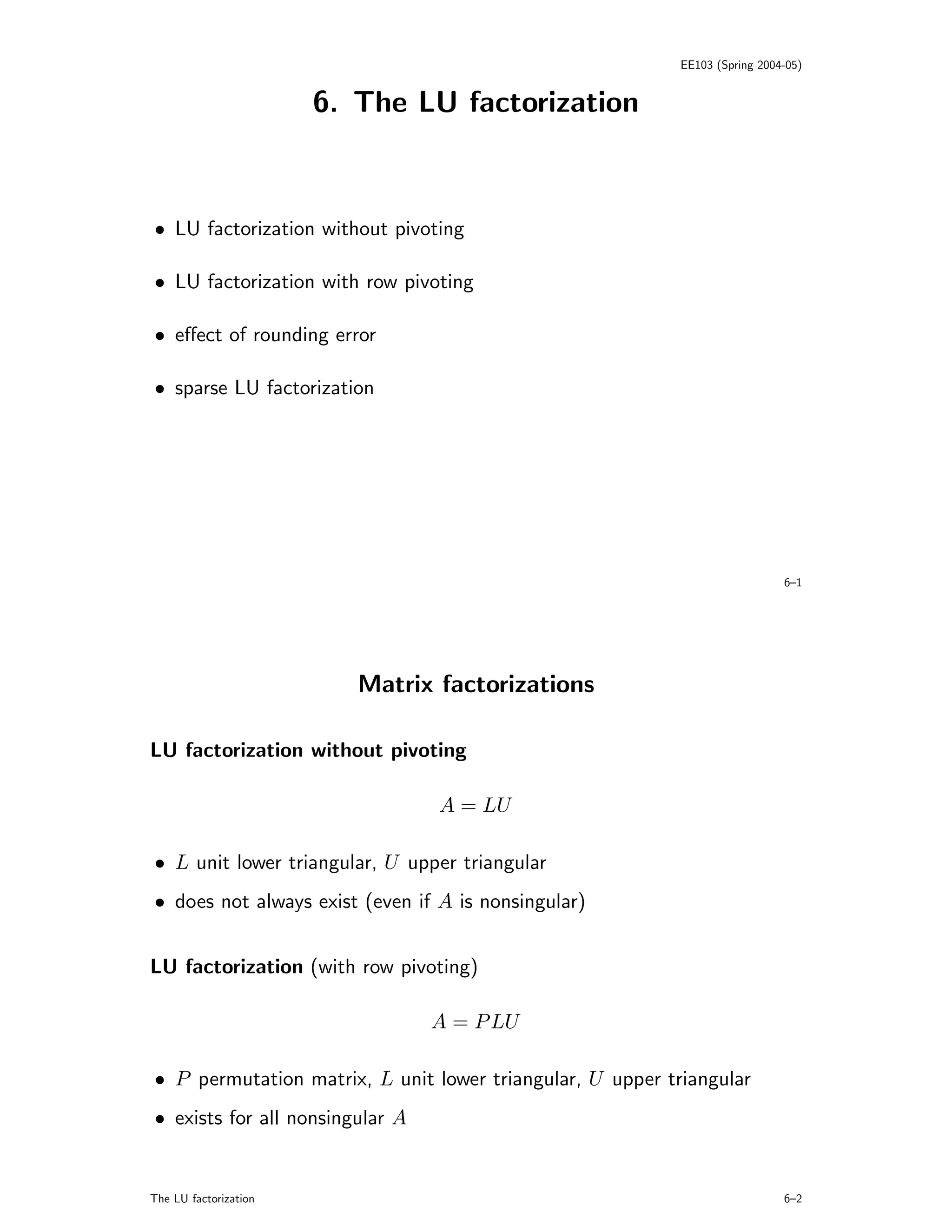
                       6. The LU factorization


• LU factorization without pivoting

• LU factorization with row pivoting

• effect of rounding error

• sparse LU factorization


                                                                             6–1


                          Matrix factorizations

LU factorization without pivoting

                                 A = LU

• L unit lower triangular, U upper triangular
• does not always exist (even if A is nonsingular)


LU factorization (with row pivoting)

                                 A = P LU

• P permutation matrix, L unit lower triangular, U upper triangular
• exists for all nonsingular A


The LU factorization                                                         6–2
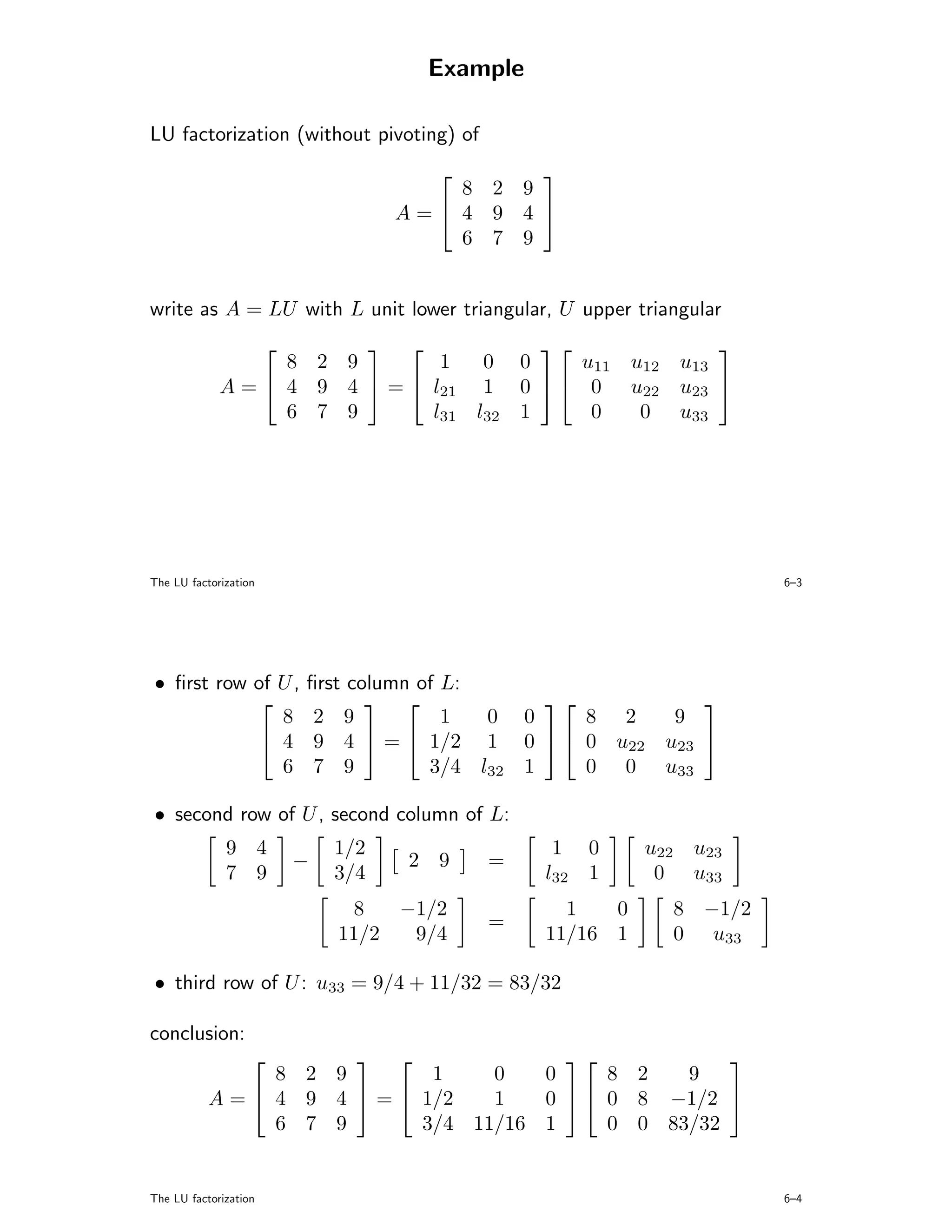
Example

LU factorization (without pivoting) of
                                              
                                         8 2 9
                                     A= 4 9 4 
                                         6 7 9


write as A = LU with L unit lower triangular, U upper triangular
                                                   
                   8 2 9        1   0 0     u11 u12 u13
             A =  4 9 4  =  l21 1 0   0 u22 u23 
                   6 7 9       l31 l32 1     0   0 u33


The LU factorization                                                  6–3


• first row of U ,          first column of L:
                                                        
              8             2 9           1  0 0     8 2  9
             4             9 4  =  1/2 1 0   0 u22 u23 
              6             7 9         3/4 l32 1    0 0 u33

• second row of U , second column of L:
              9 4              1/2               1     0   u22 u23
                           −         2 9   =
              7 9              3/4               l32   1    0 u33
                                 8  −1/2           1   0     8 −1/2
                                           =
                               11/2  9/4         11/16 1     0 u33

• third row of U : u33 = 9/4 + 11/32 = 83/32

conclusion:
                                                  
                 8 2 9        1    0   0     8 2   9
           A =  4 9 4  =  1/2   1   0   0 8 −1/2 
                 6 7 9       3/4 11/16 1     0 0 83/32


The LU factorization                                                  6–4
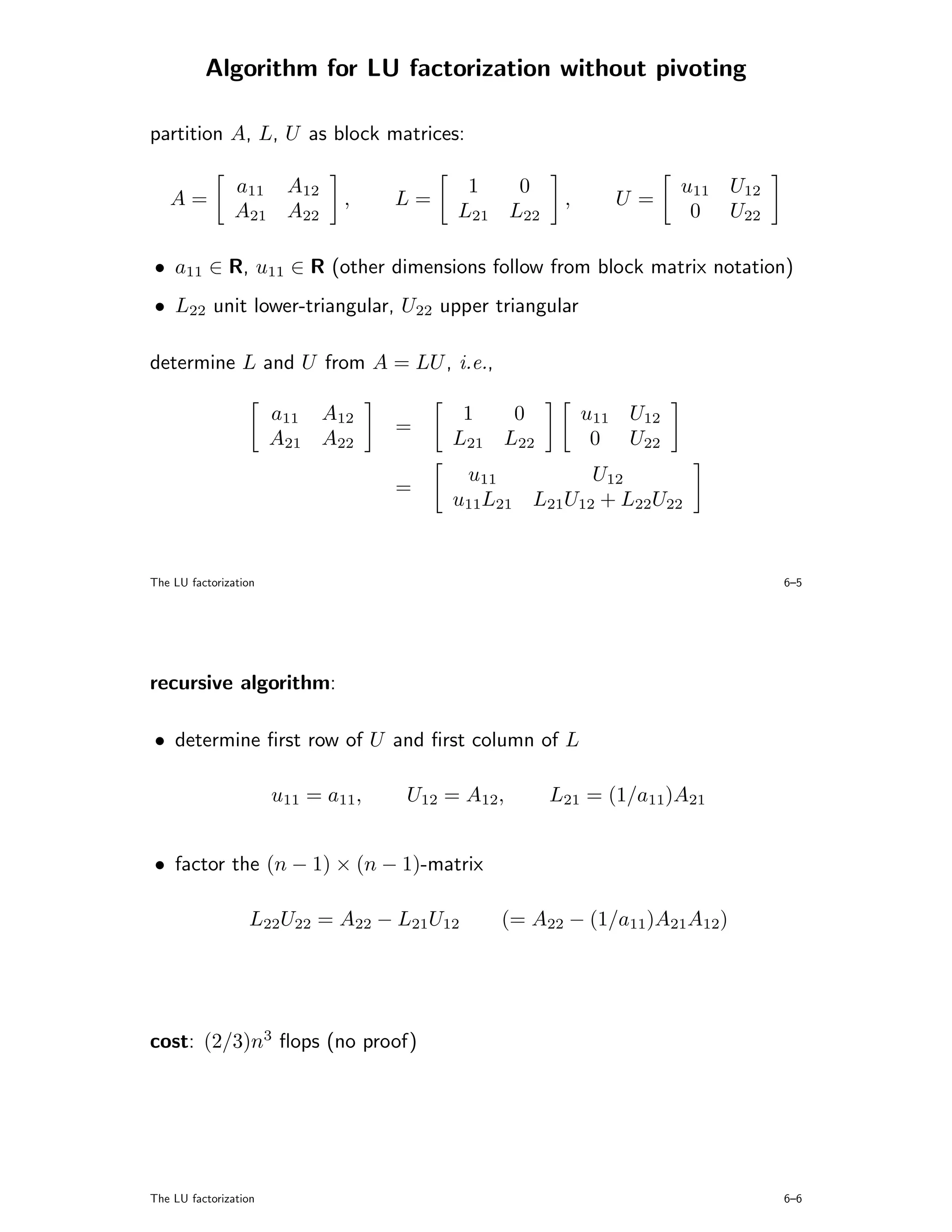
Algorithm for LU factorization without pivoting

partition A, L, U as block matrices:

                a11 A12                   1   0                   u11 U12
   A=                          ,    L=              ,      U=
                A21 A22                  L21 L22                   0 U22

• a11 ∈ R, u11 ∈ R (other dimensions follow from block matrix notation)
• L22 unit lower-triangular, U22 upper triangular

determine L and U from A = LU , i.e.,

                       a11 A12            1   0         u11 U12
                                    =
                       A21 A22           L21 L22         0 U22
                                          u11         U12
                                    =
                                         u11L21 L21U12 + L22U22


The LU factorization                                                        6–5


recursive algorithm:

• determine first row of U and first column of L

                       u11 = a11,   U12 = A12,     L21 = (1/a11)A21


• factor the (n − 1) × (n − 1)-matrix

                  L22U22 = A22 − L21U12      (= A22 − (1/a11)A21A12)


cost: (2/3)n3 flops (no proof)


The LU factorization                                                        6–6
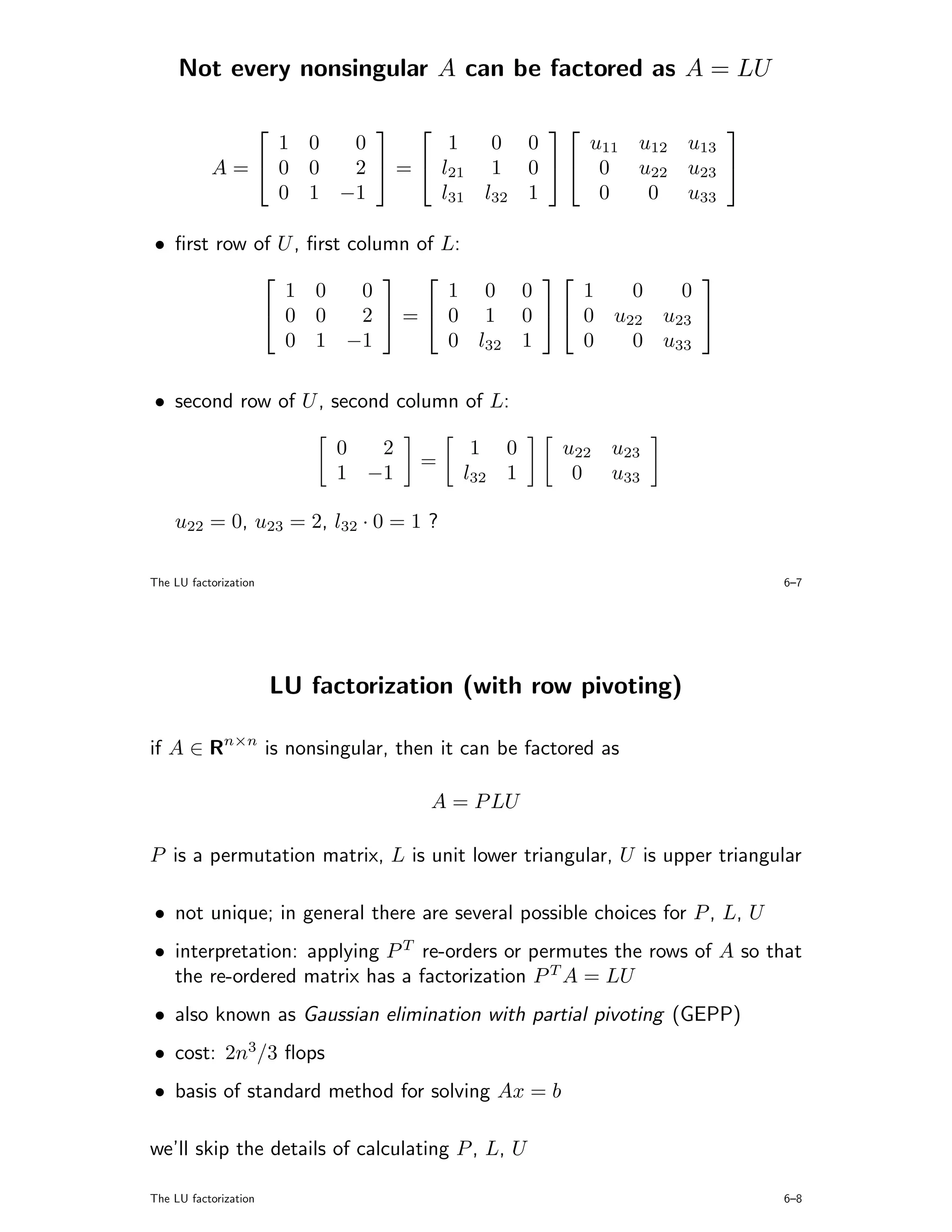
Not every nonsingular A can be factored as A = LU

                       
                                                  
               1 0  0        1   0 0     u11 u12 u13
           A= 0 0  2  =  l21 1 0   0 u22 u23 
               0 1 −1       l31 l32 1     0   0 u33

• first row of U ,             first column of L:
                                                            
               1               0     0        1 0 0      1 0   0
             0                0     2  =  0 1 0   0 u22 u23 
               0               1 −1           0 l32 1    0 0 u33

• second row of U , second column of L:

                                0  2        1     0   u22 u23
                                        =
                                1 −1        l32   1    0 u33

    u22 = 0, u23 = 2, l32 · 0 = 1 ?

The LU factorization                                                       6–7


                           LU factorization (with row pivoting)

if A ∈ Rn×n is nonsingular, then it can be factored as

                                         A = P LU

P is a permutation matrix, L is unit lower triangular, U is upper triangular

• not unique; in general there are several possible choices for P , L, U
• interpretation: applying P T re-orders or permutes the rows of A so that
  the re-ordered matrix has a factorization P T A = LU
• also known as Gaussian elimination with partial pivoting (GEPP)
• cost: 2n3/3 flops
• basis of standard method for solving Ax = b

we’ll skip the details of calculating P , L, U

The LU factorization                                                       6–8
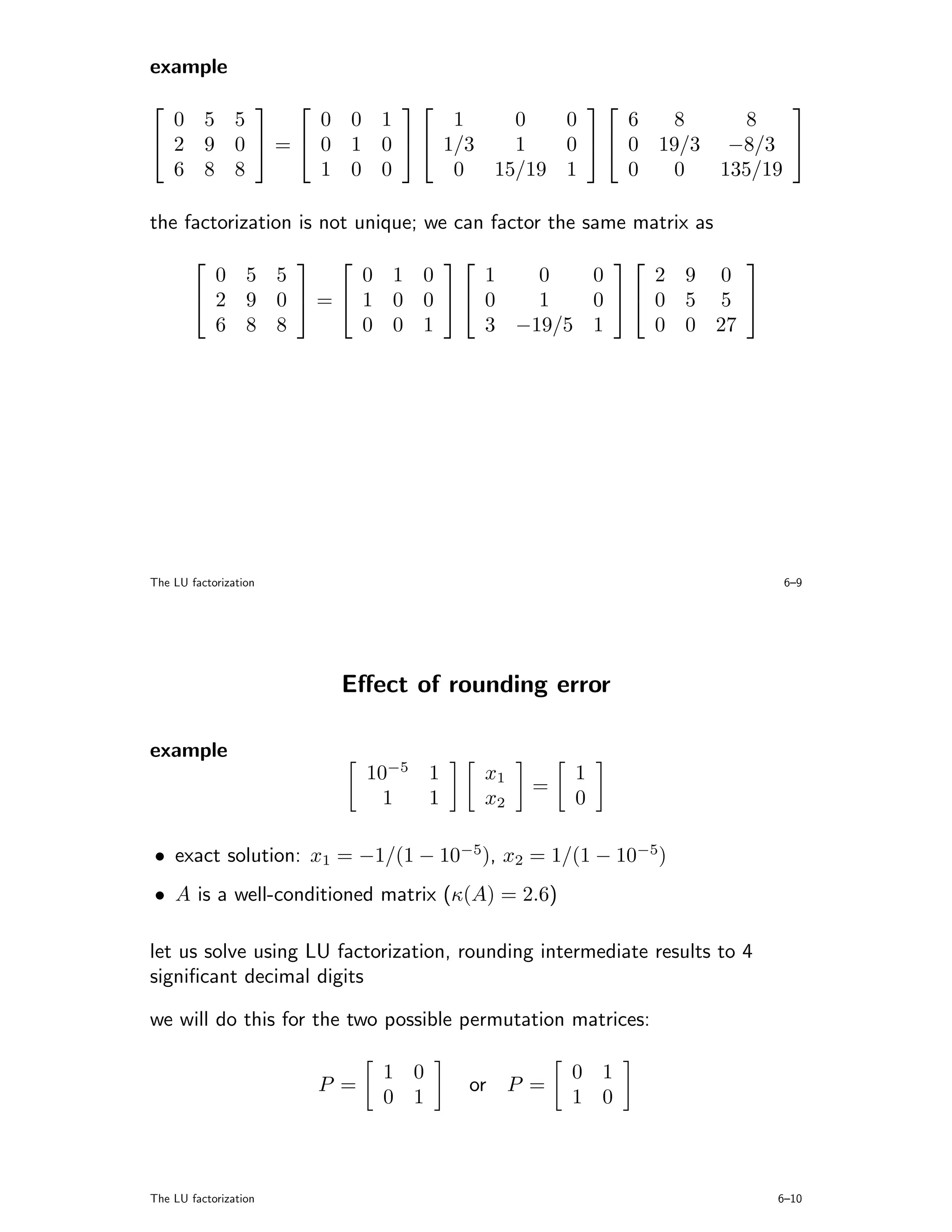
example
                                              
  0 5 5       0 0 1      1   0   0     6   8     8
 2 9 0  =  0 1 0   1/3  1   0   0 19/3 −8/3 
  6 8 8       1 0 0      0 15/19 1     0   0  135/19

the factorization is not unique; we can factor the same matrix as
                                           
         0 5 5       0 1 0    1   0   0    2 9 0
        2 9 0  =  1 0 0  0   1   0  0 5 5 
         6 8 8       0 0 1    3 −19/5 1    0 0 27


The LU factorization                                                       6–9


                        Effect of rounding error

example
                             10−5 1    x1         1
                                             =
                               1  1    x2         0

• exact solution: x1 = −1/(1 − 10−5), x2 = 1/(1 − 10−5)
• A is a well-conditioned matrix (κ(A) = 2.6)

let us solve using LU factorization, rounding intermediate results to 4
significant decimal digits

we will do this for the two possible permutation matrices:

                              1 0                 0 1
                       P =            or    P =
                              0 1                 1 0


The LU factorization                                                      6–10
first choice of P : P = I (no pivoting)

                         10−5 1                  1 0              10−5    1
                                        =
                           1  1                 105 1               0  1 − 105

L, U rounded to 4 decimal significant digits

                                  1 0                             10−5  1
                         L=                     ,           U=
                                 105 1                              0  −105

forward substitution
                   1 0            z1                1
                                            =                =⇒       z1 = 1, z2 = −105
                  105 1           z2                0

backward substitution
             10−5  1                   x1                1
                                                =                     =⇒   x1 = 0, x2 = 1
               0  −105                 x2               −105

error in x1 is 100%

The LU factorization                                                                        6–11


second choice of P : interchange rows

                            1   1                     1   0        1     1
                                         =
                          10 −5
                                1                   10 −5
                                                          1        0 1 − 10−5

L, U rounded to 4 decimal significant digits

                                         1   0                          1 1
                             L=                         ,        U=
                                       10 −5
                                             1                          0 1

forward substitution
                         1   0         z1               0
                                                =                =⇒     z1 = 0, z2 = 1
                       10 −5
                             1         z2               1

backward substitution
                       1 1        x1                0
                                            =               =⇒        x1 = −1, x2 = 1
                       0 1        x2                1

error in x1, x2 is about 10−5

The LU factorization                                                                        6–12
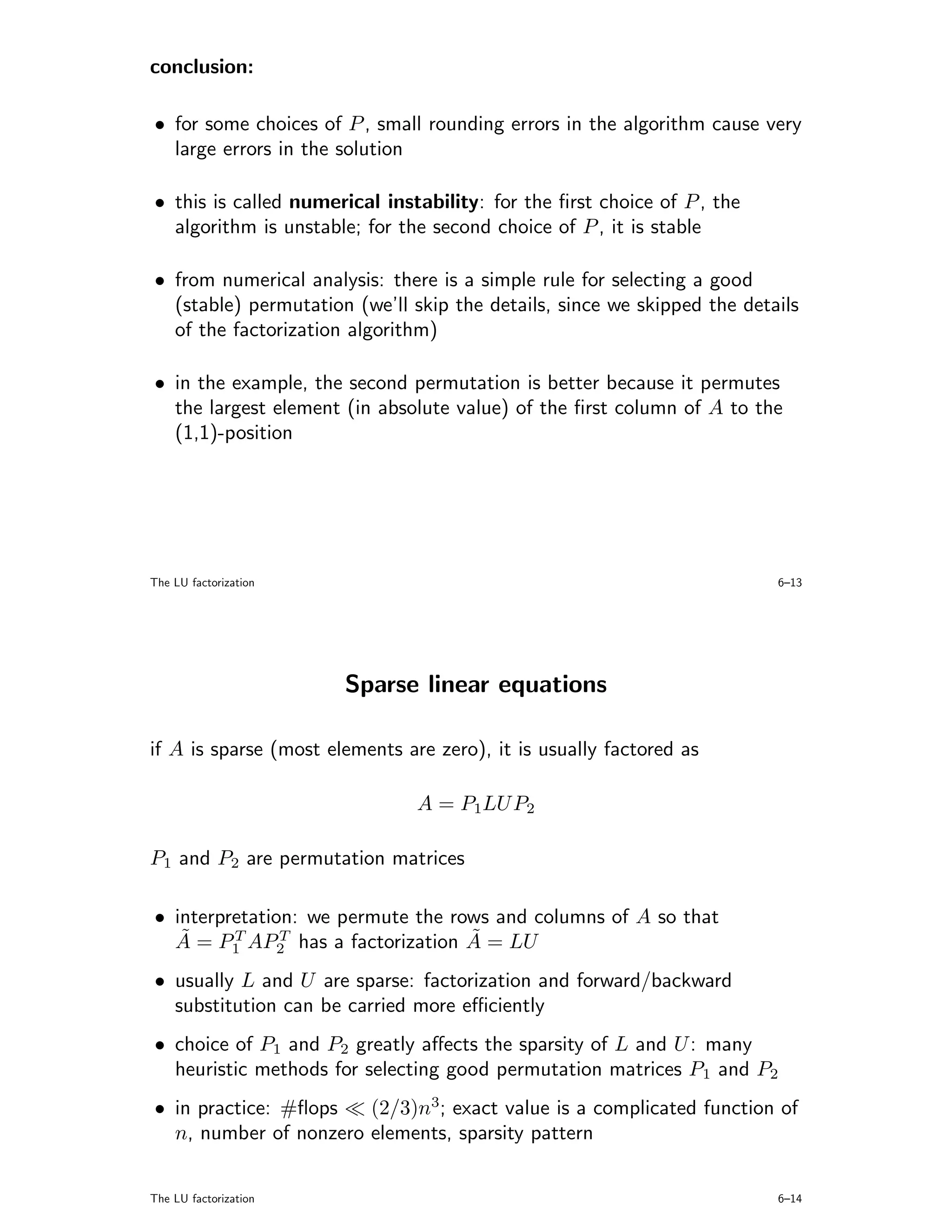
conclusion:

• for some choices of P , small rounding errors in the algorithm cause very
  large errors in the solution

• this is called numerical instability: for the first choice of P , the
  algorithm is unstable; for the second choice of P , it is stable

• from numerical analysis: there is a simple rule for selecting a good
  (stable) permutation (we’ll skip the details, since we skipped the details
  of the factorization algorithm)

• in the example, the second permutation is better because it permutes
  the largest element (in absolute value) of the first column of A to the
  (1,1)-position


The LU factorization                                                     6–13


                       Sparse linear equations

if A is sparse (most elements are zero), it is usually factored as

                                A = P1LU P2

P1 and P2 are permutation matrices

• interpretation: we permute the rows and columns of A so that
   ˜     T     T                   ˜
  A = P1 AP2 has a factorization A = LU
• usually L and U are sparse: factorization and forward/backward
  substitution can be carried more efficiently
• choice of P1 and P2 greatly affects the sparsity of L and U : many
  heuristic methods for selecting good permutation matrices P1 and P2
• in practice: #flops   (2/3)n3; exact value is a complicated function of
  n, number of nonzero elements, sparsity pattern


The LU factorization                                                     6–14
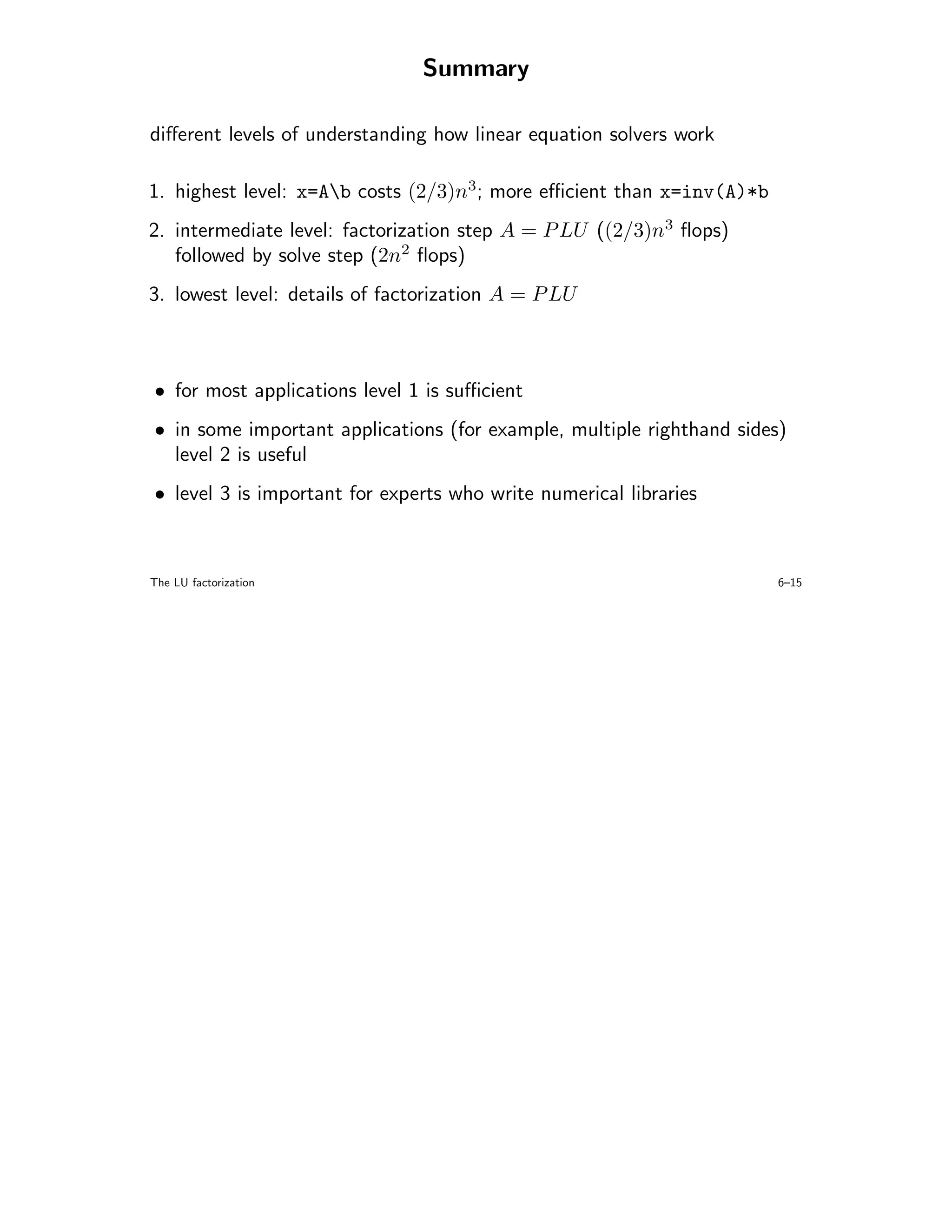
Summary

different levels of understanding how linear equation solvers work

1. highest level: x=Ab costs (2/3)n3; more efficient than x=inv(A)*b
2. intermediate level: factorization step A = P LU ((2/3)n3 flops)
   followed by solve step (2n2 flops)
3. lowest level: details of factorization A = P LU


• for most applications level 1 is sufficient
• in some important applications (for example, multiple righthand sides)
  level 2 is useful
• level 3 is important for experts who write numerical libraries


The LU factorization                                                   6–15

Lu

  • 1.
    EE103 (Spring 2004-05) 6. The LU factorization • LU factorization without pivoting • LU factorization with row pivoting • effect of rounding error • sparse LU factorization 6–1 Matrix factorizations LU factorization without pivoting A = LU • L unit lower triangular, U upper triangular • does not always exist (even if A is nonsingular) LU factorization (with row pivoting) A = P LU • P permutation matrix, L unit lower triangular, U upper triangular • exists for all nonsingular A The LU factorization 6–2
  • 2.
    Example LU factorization (withoutpivoting) of   8 2 9 A= 4 9 4  6 7 9 write as A = LU with L unit lower triangular, U upper triangular      8 2 9 1 0 0 u11 u12 u13 A =  4 9 4  =  l21 1 0   0 u22 u23  6 7 9 l31 l32 1 0 0 u33 The LU factorization 6–3 • first row of U , first column of L:      8 2 9 1 0 0 8 2 9  4 9 4  =  1/2 1 0   0 u22 u23  6 7 9 3/4 l32 1 0 0 u33 • second row of U , second column of L: 9 4 1/2 1 0 u22 u23 − 2 9 = 7 9 3/4 l32 1 0 u33 8 −1/2 1 0 8 −1/2 = 11/2 9/4 11/16 1 0 u33 • third row of U : u33 = 9/4 + 11/32 = 83/32 conclusion:      8 2 9 1 0 0 8 2 9 A =  4 9 4  =  1/2 1 0   0 8 −1/2  6 7 9 3/4 11/16 1 0 0 83/32 The LU factorization 6–4
  • 3.
    Algorithm for LUfactorization without pivoting partition A, L, U as block matrices: a11 A12 1 0 u11 U12 A= , L= , U= A21 A22 L21 L22 0 U22 • a11 ∈ R, u11 ∈ R (other dimensions follow from block matrix notation) • L22 unit lower-triangular, U22 upper triangular determine L and U from A = LU , i.e., a11 A12 1 0 u11 U12 = A21 A22 L21 L22 0 U22 u11 U12 = u11L21 L21U12 + L22U22 The LU factorization 6–5 recursive algorithm: • determine first row of U and first column of L u11 = a11, U12 = A12, L21 = (1/a11)A21 • factor the (n − 1) × (n − 1)-matrix L22U22 = A22 − L21U12 (= A22 − (1/a11)A21A12) cost: (2/3)n3 flops (no proof) The LU factorization 6–6
  • 4.
    Not every nonsingularA can be factored as A = LU      1 0 0 1 0 0 u11 u12 u13 A= 0 0 2  =  l21 1 0   0 u22 u23  0 1 −1 l31 l32 1 0 0 u33 • first row of U , first column of L:      1 0 0 1 0 0 1 0 0  0 0 2  =  0 1 0   0 u22 u23  0 1 −1 0 l32 1 0 0 u33 • second row of U , second column of L: 0 2 1 0 u22 u23 = 1 −1 l32 1 0 u33 u22 = 0, u23 = 2, l32 · 0 = 1 ? The LU factorization 6–7 LU factorization (with row pivoting) if A ∈ Rn×n is nonsingular, then it can be factored as A = P LU P is a permutation matrix, L is unit lower triangular, U is upper triangular • not unique; in general there are several possible choices for P , L, U • interpretation: applying P T re-orders or permutes the rows of A so that the re-ordered matrix has a factorization P T A = LU • also known as Gaussian elimination with partial pivoting (GEPP) • cost: 2n3/3 flops • basis of standard method for solving Ax = b we’ll skip the details of calculating P , L, U The LU factorization 6–8
  • 5.
    example       0 5 5 0 0 1 1 0 0 6 8 8  2 9 0  =  0 1 0   1/3 1 0   0 19/3 −8/3  6 8 8 1 0 0 0 15/19 1 0 0 135/19 the factorization is not unique; we can factor the same matrix as       0 5 5 0 1 0 1 0 0 2 9 0  2 9 0  =  1 0 0  0 1 0  0 5 5  6 8 8 0 0 1 3 −19/5 1 0 0 27 The LU factorization 6–9 Effect of rounding error example 10−5 1 x1 1 = 1 1 x2 0 • exact solution: x1 = −1/(1 − 10−5), x2 = 1/(1 − 10−5) • A is a well-conditioned matrix (κ(A) = 2.6) let us solve using LU factorization, rounding intermediate results to 4 significant decimal digits we will do this for the two possible permutation matrices: 1 0 0 1 P = or P = 0 1 1 0 The LU factorization 6–10
  • 6.
    first choice ofP : P = I (no pivoting) 10−5 1 1 0 10−5 1 = 1 1 105 1 0 1 − 105 L, U rounded to 4 decimal significant digits 1 0 10−5 1 L= , U= 105 1 0 −105 forward substitution 1 0 z1 1 = =⇒ z1 = 1, z2 = −105 105 1 z2 0 backward substitution 10−5 1 x1 1 = =⇒ x1 = 0, x2 = 1 0 −105 x2 −105 error in x1 is 100% The LU factorization 6–11 second choice of P : interchange rows 1 1 1 0 1 1 = 10 −5 1 10 −5 1 0 1 − 10−5 L, U rounded to 4 decimal significant digits 1 0 1 1 L= , U= 10 −5 1 0 1 forward substitution 1 0 z1 0 = =⇒ z1 = 0, z2 = 1 10 −5 1 z2 1 backward substitution 1 1 x1 0 = =⇒ x1 = −1, x2 = 1 0 1 x2 1 error in x1, x2 is about 10−5 The LU factorization 6–12
  • 7.
    conclusion: • for somechoices of P , small rounding errors in the algorithm cause very large errors in the solution • this is called numerical instability: for the first choice of P , the algorithm is unstable; for the second choice of P , it is stable • from numerical analysis: there is a simple rule for selecting a good (stable) permutation (we’ll skip the details, since we skipped the details of the factorization algorithm) • in the example, the second permutation is better because it permutes the largest element (in absolute value) of the first column of A to the (1,1)-position The LU factorization 6–13 Sparse linear equations if A is sparse (most elements are zero), it is usually factored as A = P1LU P2 P1 and P2 are permutation matrices • interpretation: we permute the rows and columns of A so that ˜ T T ˜ A = P1 AP2 has a factorization A = LU • usually L and U are sparse: factorization and forward/backward substitution can be carried more efficiently • choice of P1 and P2 greatly affects the sparsity of L and U : many heuristic methods for selecting good permutation matrices P1 and P2 • in practice: #flops (2/3)n3; exact value is a complicated function of n, number of nonzero elements, sparsity pattern The LU factorization 6–14
  • 8.
    Summary different levels ofunderstanding how linear equation solvers work 1. highest level: x=Ab costs (2/3)n3; more efficient than x=inv(A)*b 2. intermediate level: factorization step A = P LU ((2/3)n3 flops) followed by solve step (2n2 flops) 3. lowest level: details of factorization A = P LU • for most applications level 1 is sufficient • in some important applications (for example, multiple righthand sides) level 2 is useful • level 3 is important for experts who write numerical libraries The LU factorization 6–15