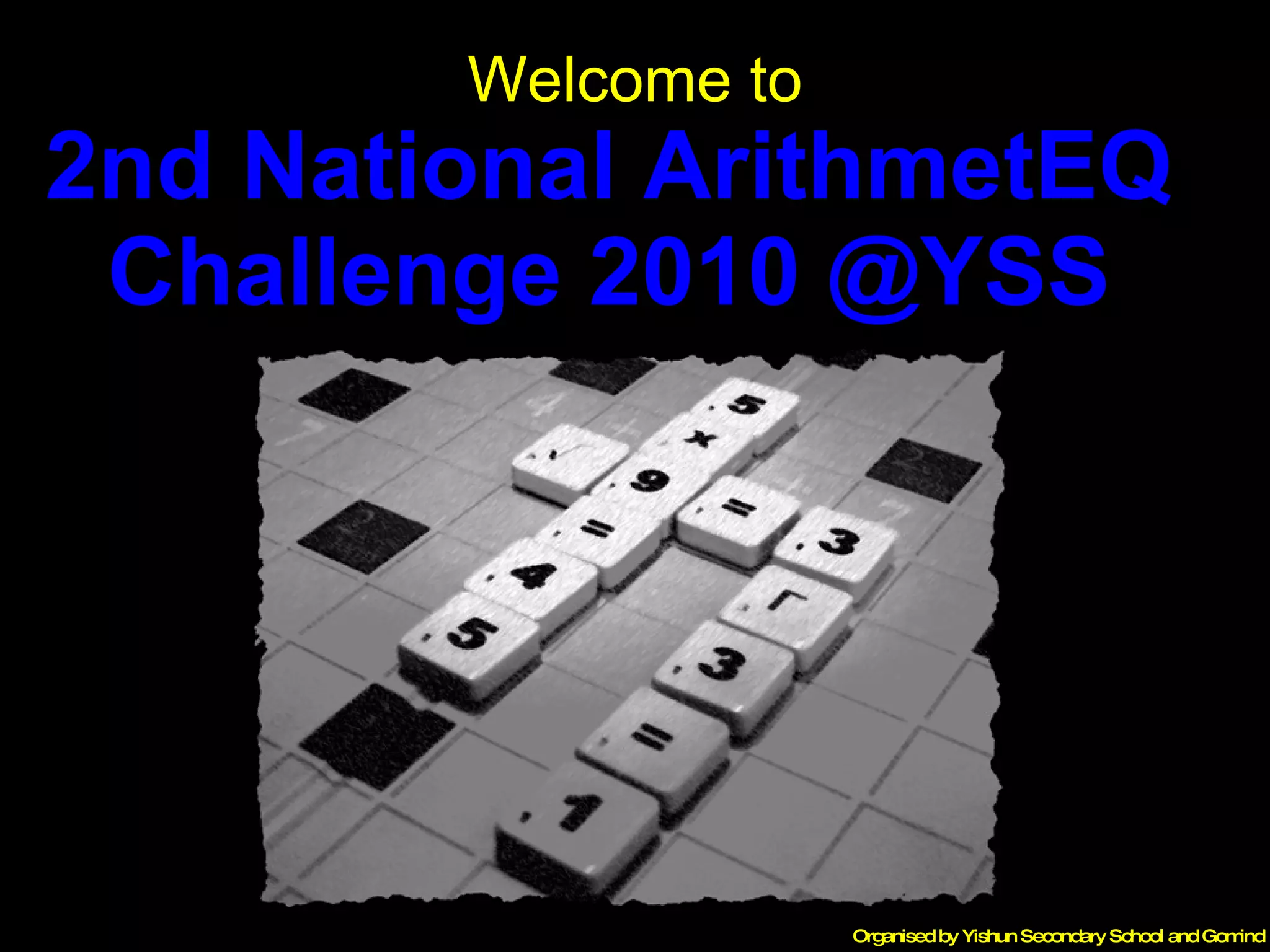
Welcome to 2nd National ArithmetEQ Challenge 2010 @YSS
Do Take Note… All participants, please note  You are required to register at the registration counter. Sit according to the table assigned. Each player will pick a number card from the helper which will determine who starts the game and the sequence of the other players. Sit in such a way that the game will be played in a clockwise manner. Lastly, do remember to switch off or put all handphone on silence mode before the start of the competition.
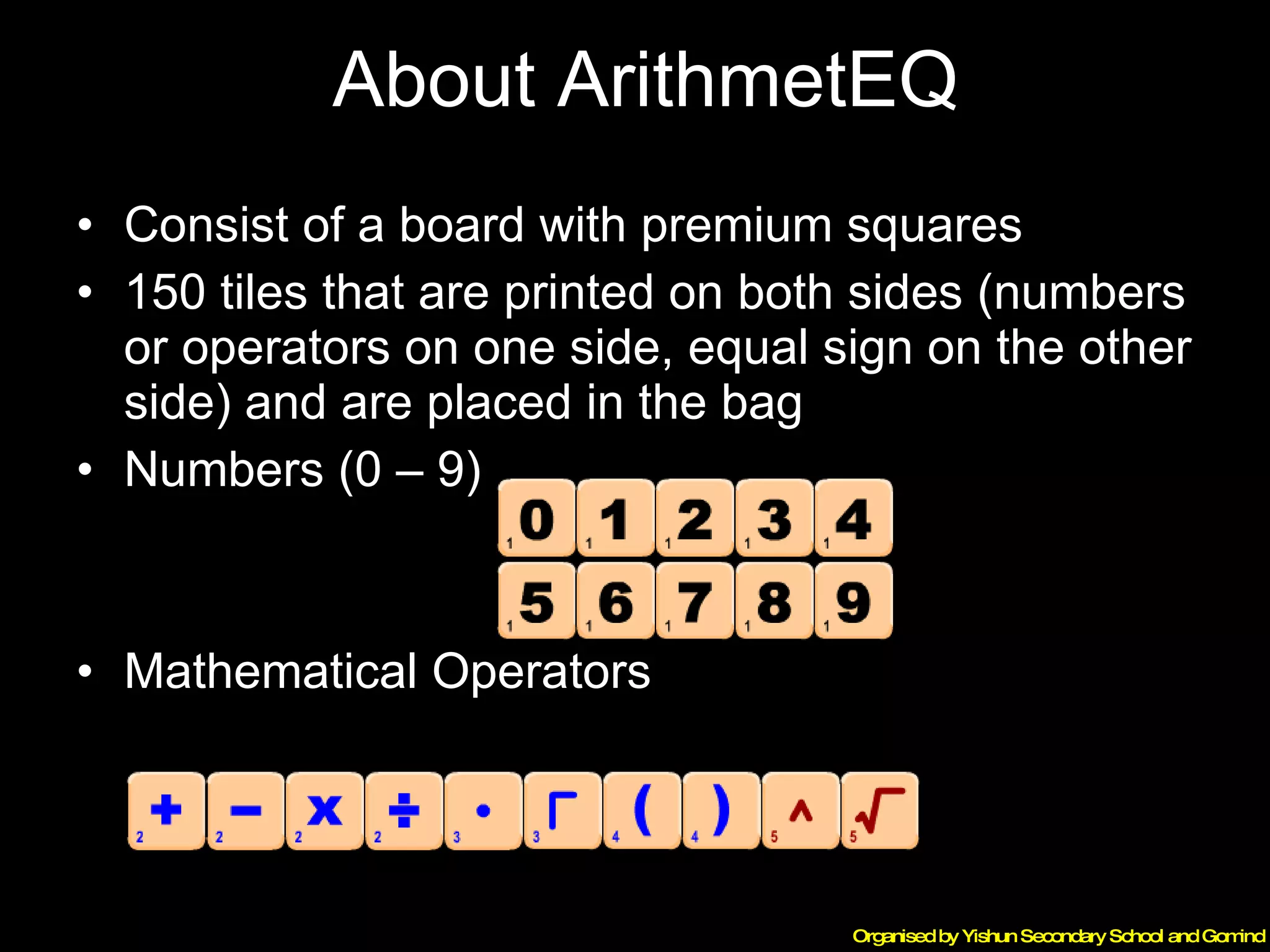
About ArithmetEQ Consist of a board with premium squares 150 tiles that are printed on both sides (numbers or operators on one side, equal sign on the other side) and are placed in the bag Numbers (0 – 9) Mathematical Operators
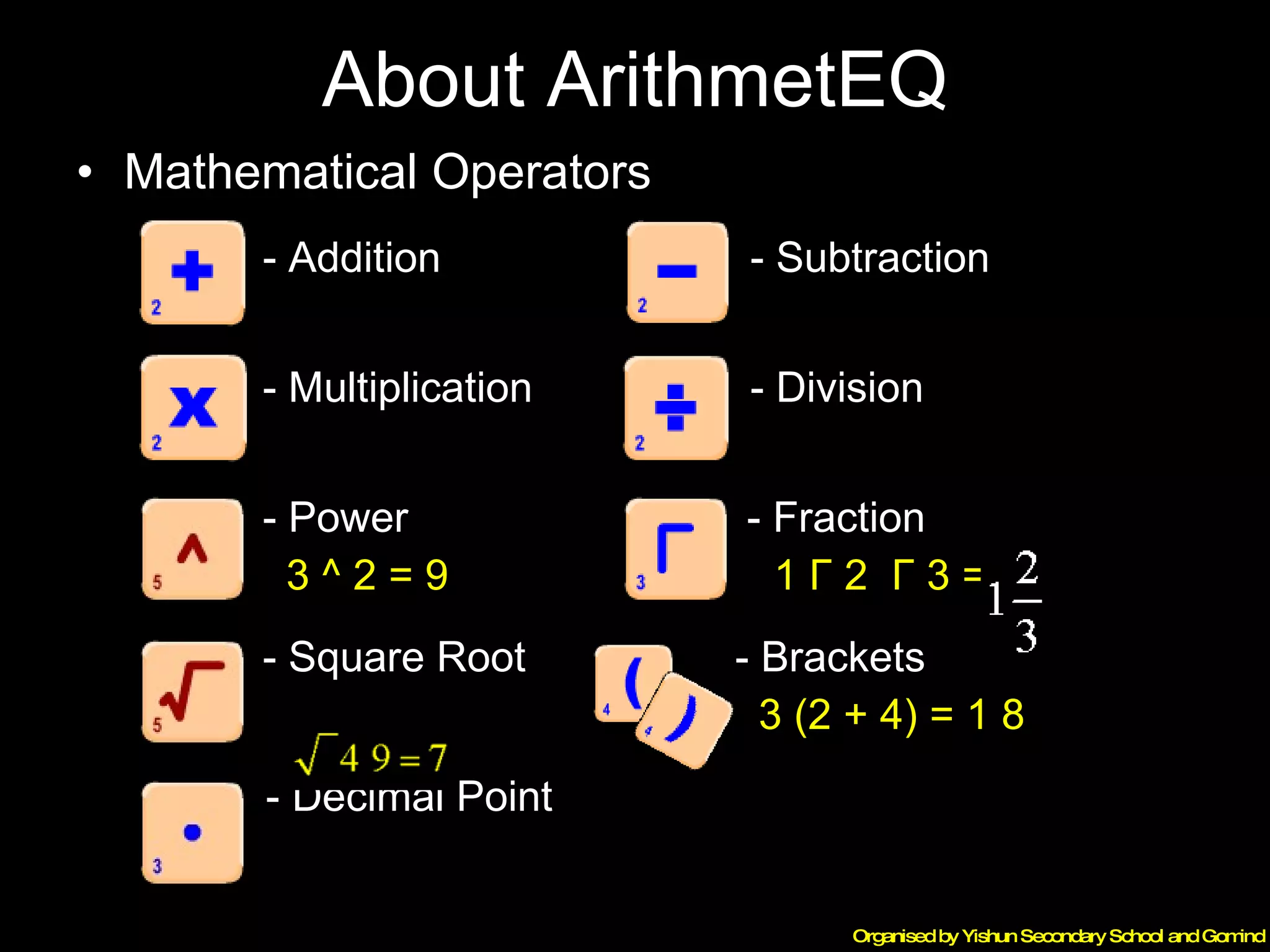
About ArithmetEQ Mathematical Operators   - Addition   - Subtraction   - Multiplication   - Division   - Power       - Fraction   3 ^ 2 = 9   1  Γ  2  Γ  3 =   - Square Root   - Brackets   3 (2 + 4) = 1 8 - Decimal Point
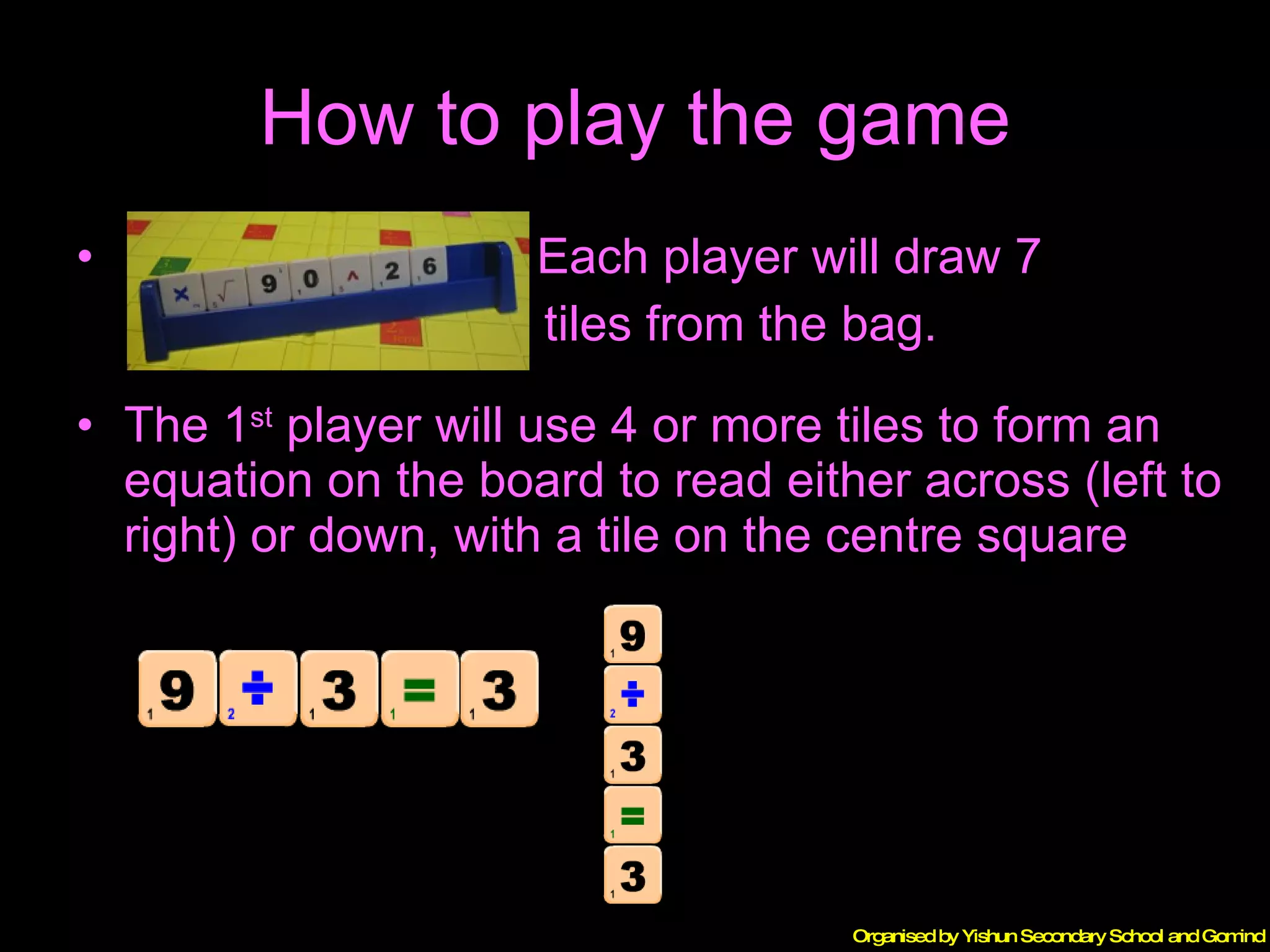
How to play the game Each player will draw 7  tiles from the bag. The 1 st  player will use 4 or more tiles to form an equation on the board to read either across (left to right) or down, with a tile on the centre square
How to play the game (cont..) After an equation is placed on the board, the player will replace the number of tiles that are used from the bag and place them back on his rack. Play in sequence and on each turn, the players have a choice of exchanging the tiles, passing or placing an equation on the board. All tiles played in any one turn must be placed in each row across or one column down the board.
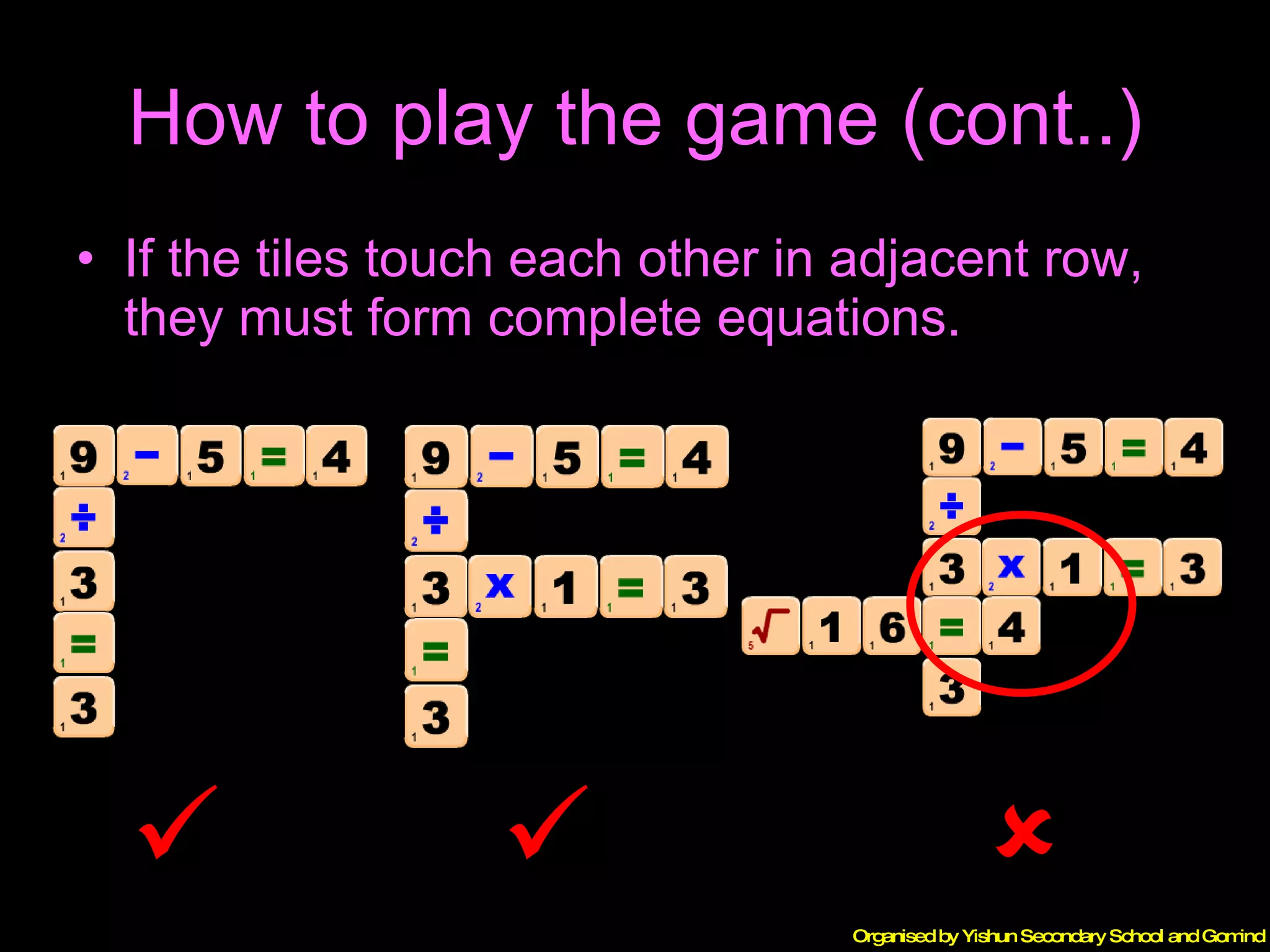
How to play the game (cont..) If the tiles touch each other in adjacent row, they must form complete equations.   
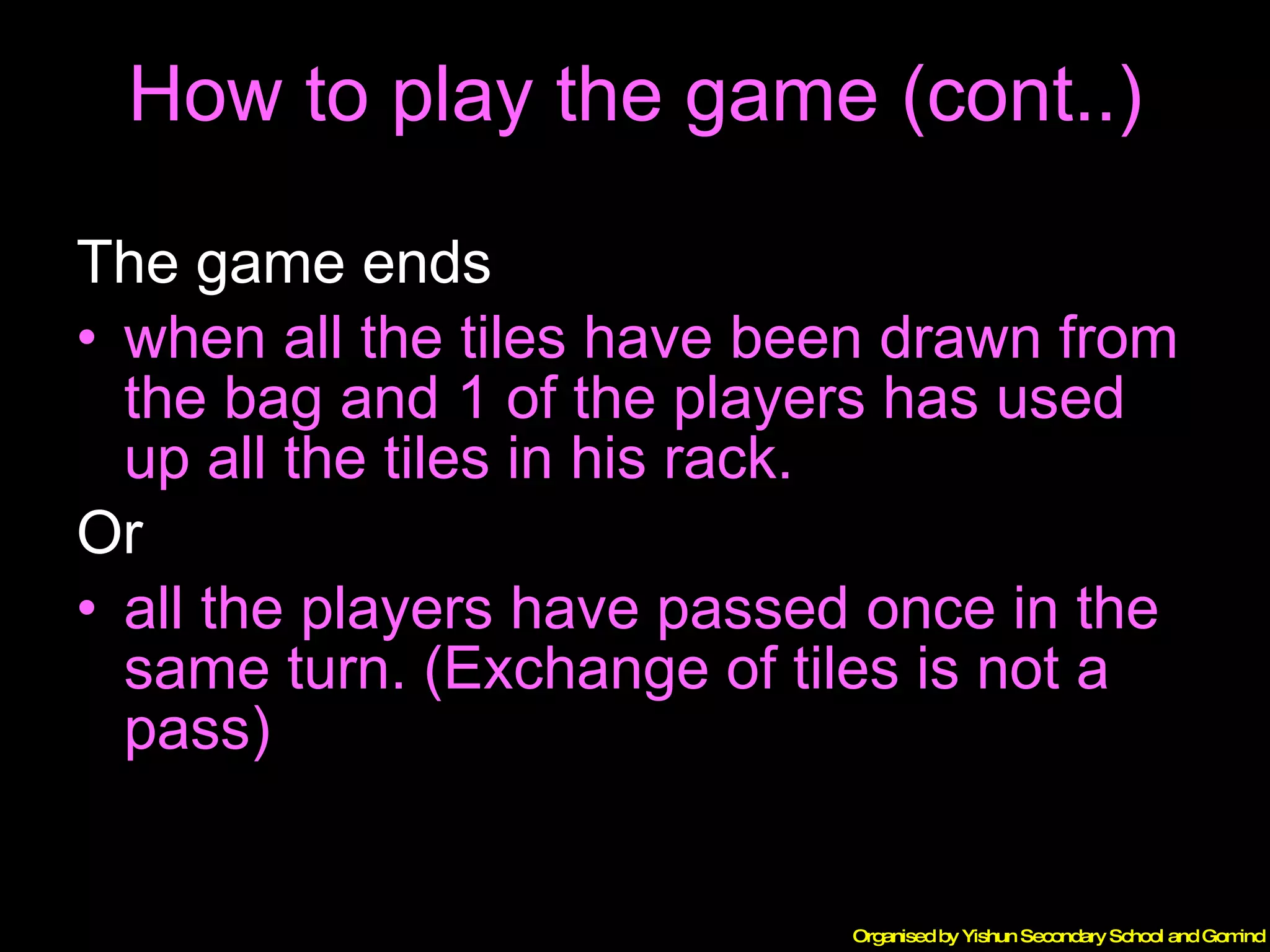
How to play the game (cont..) The game ends  when all the tiles have been drawn from the bag and 1 of the players has used up all the tiles in his rack. Or all the players have passed once in the same turn. (Exchange of tiles is not a pass)
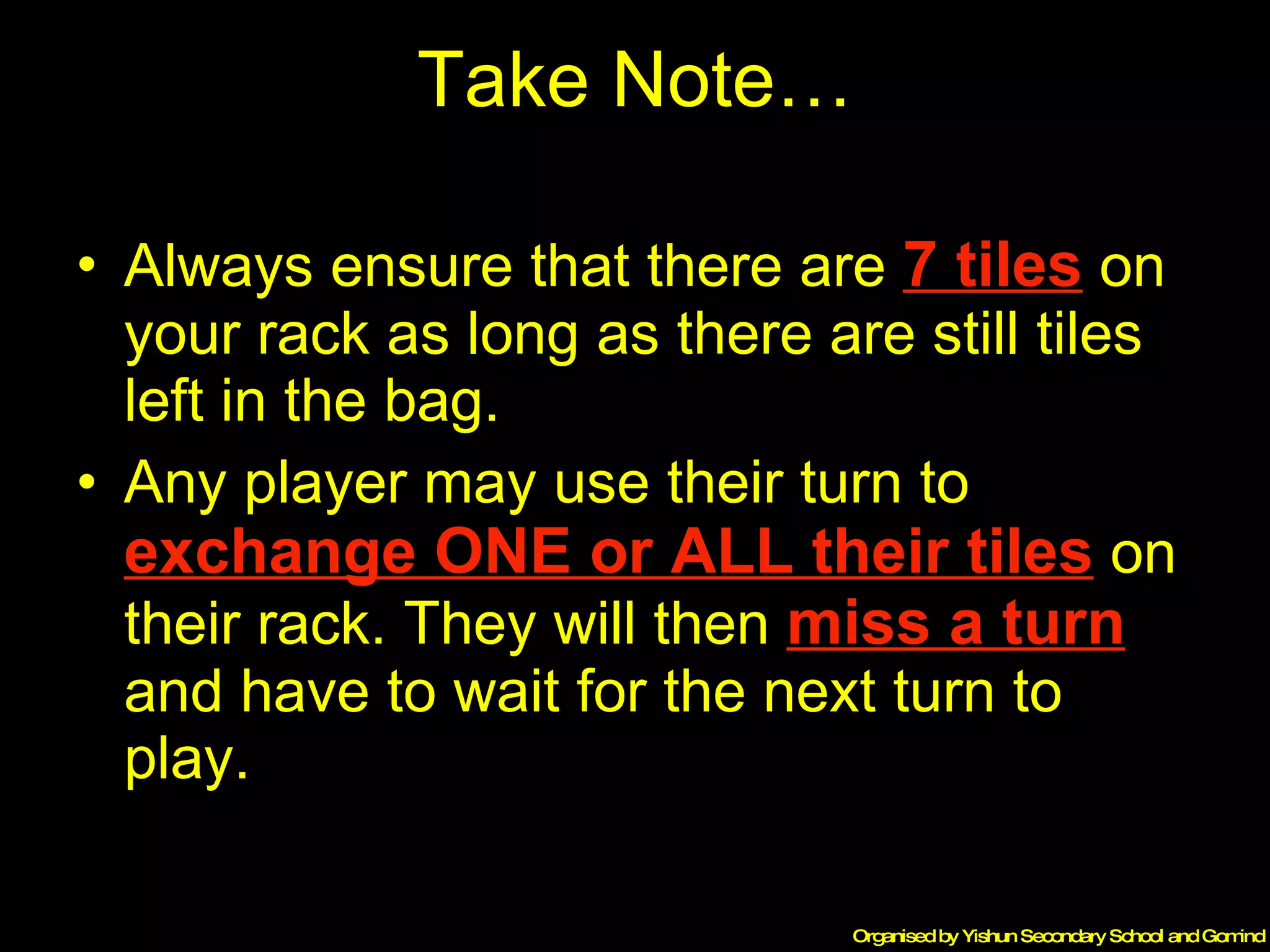
Take Note… Always ensure that there are  7 tiles  on your rack as long as there are still tiles left in the bag. Any player may use their turn to  exchange ONE or ALL their tiles  on their rack. They will then  miss a turn  and have to wait for the next turn to play.
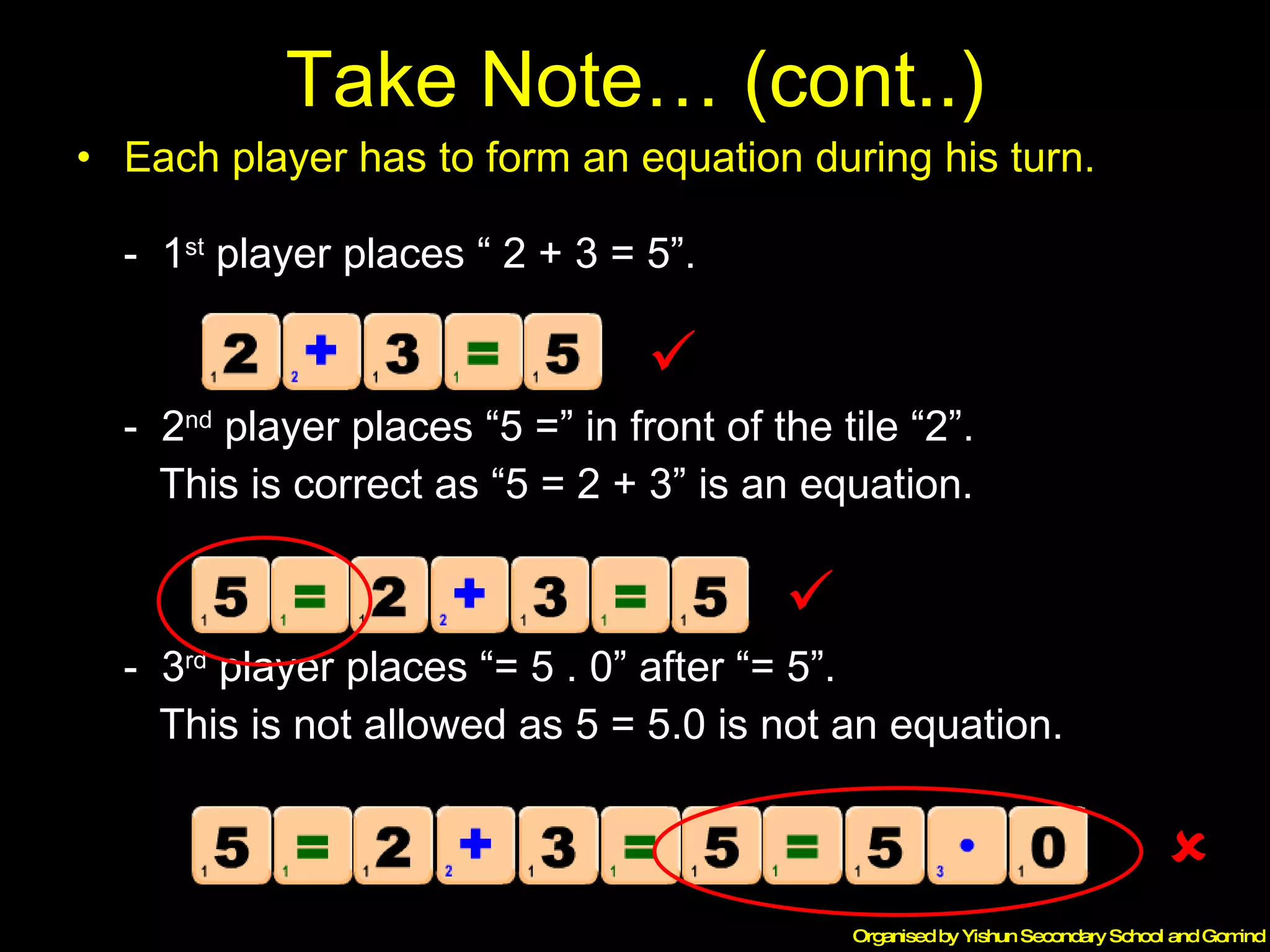
Take Note… (cont..) Each player has to form an equation during his turn. -  1 st  player places “ 2 + 3 = 5”. -  2 nd  player places “5 =” in front of the tile “2”. This is correct as “5 = 2 + 3” is an equation. -  3 rd  player places “= 5 . 0” after “= 5”. This is not allowed as 5 = 5.0 is not an equation.   
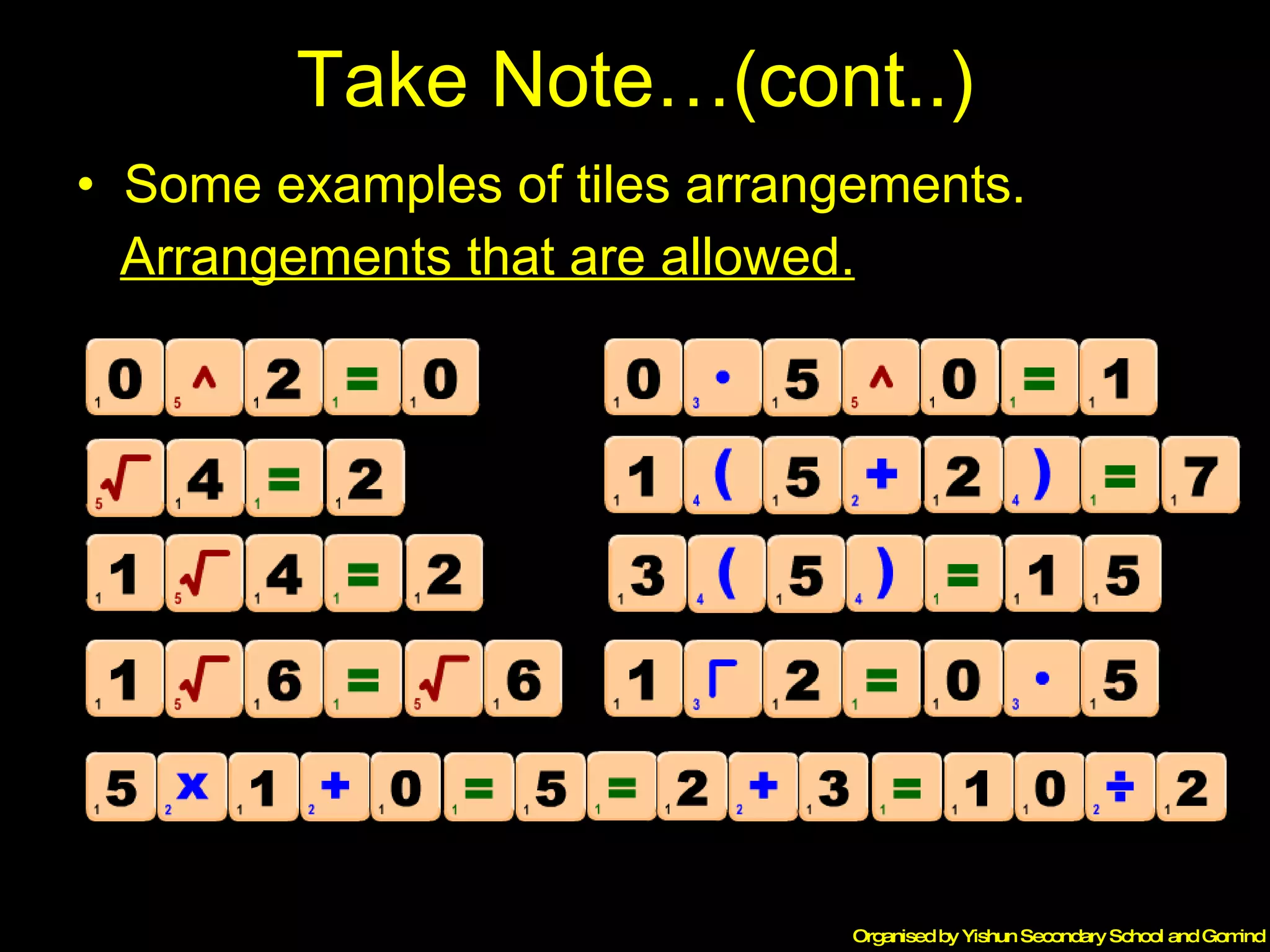
Take Note…(cont..) Some examples of tiles arrangements. Arrangements that are allowed.
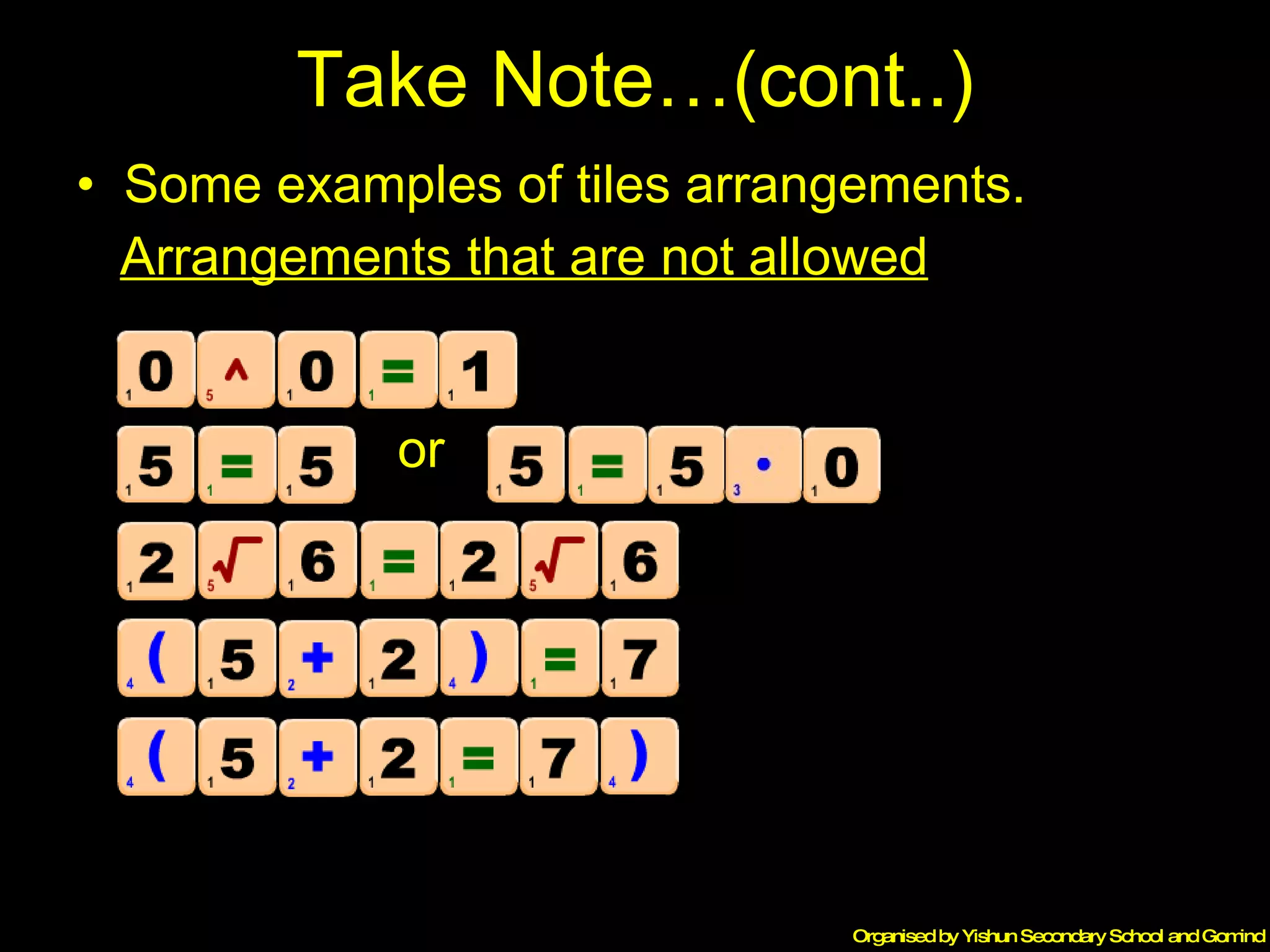
Take Note…(cont..) Some examples of tiles arrangements. Arrangements that are not allowed or
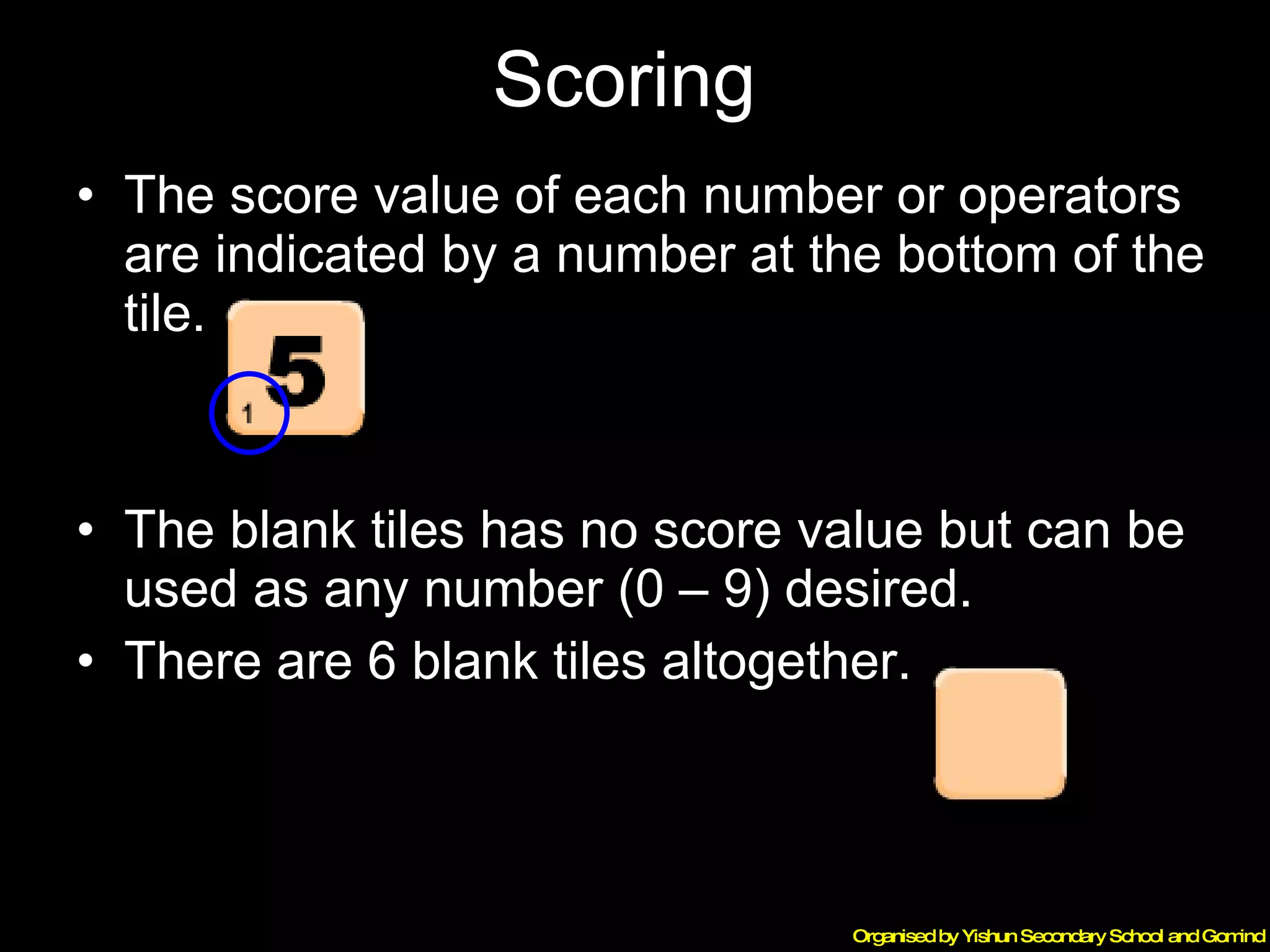
Scoring  The score value of each number or operators are indicated by a number at the bottom of the tile. The blank tiles has no score value but can be used as any number (0 – 9) desired.  There are 6 blank tiles altogether.
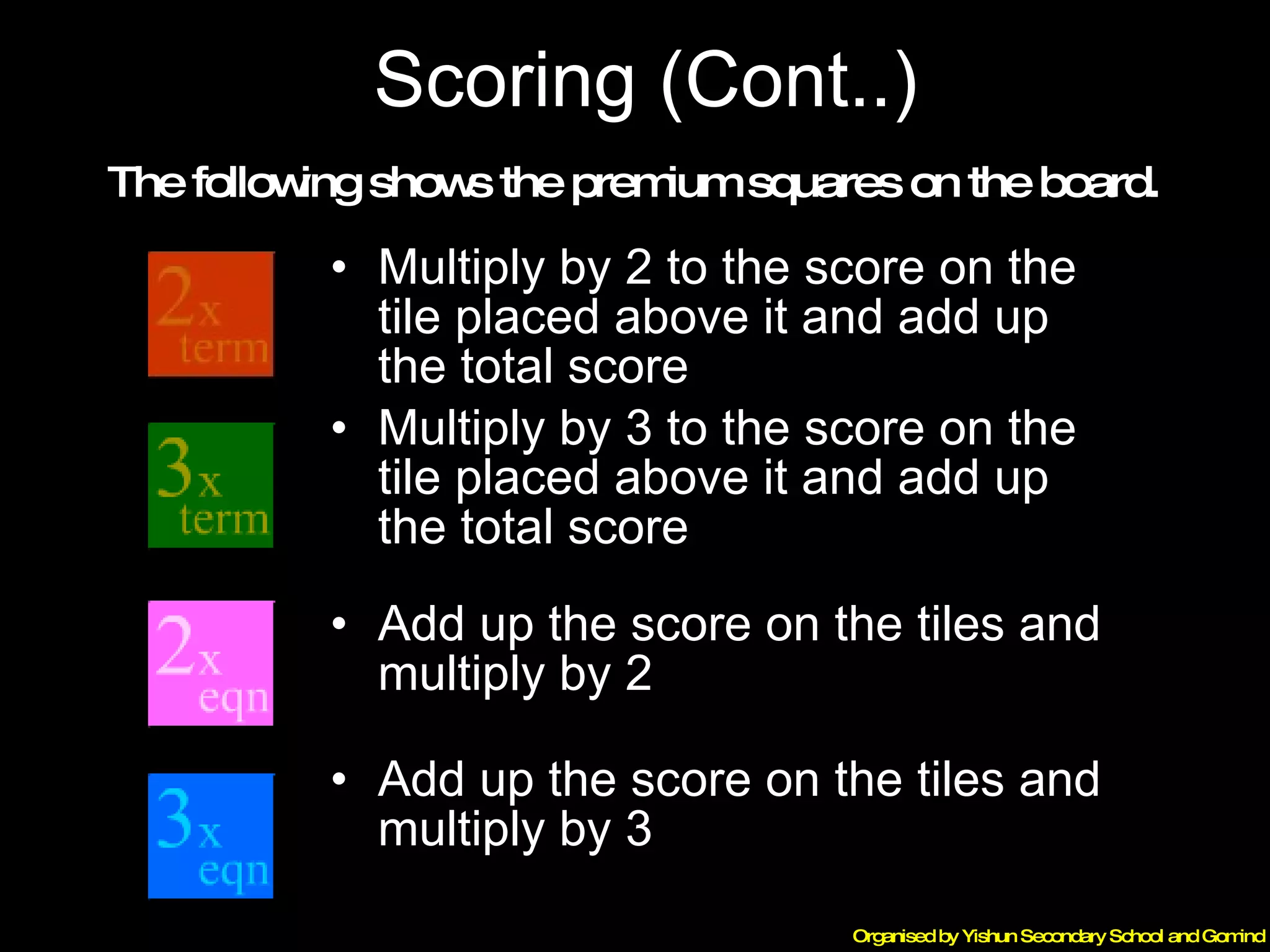
Scoring (Cont..) Multiply by 2 to the score on the tile placed above it and add up the total score Multiply by 3 to the score on the tile placed above it and add up the total score Add up the score on the tiles and multiply by 2 Add up the score on the tiles and multiply by 3 The following shows the premium squares on the board.
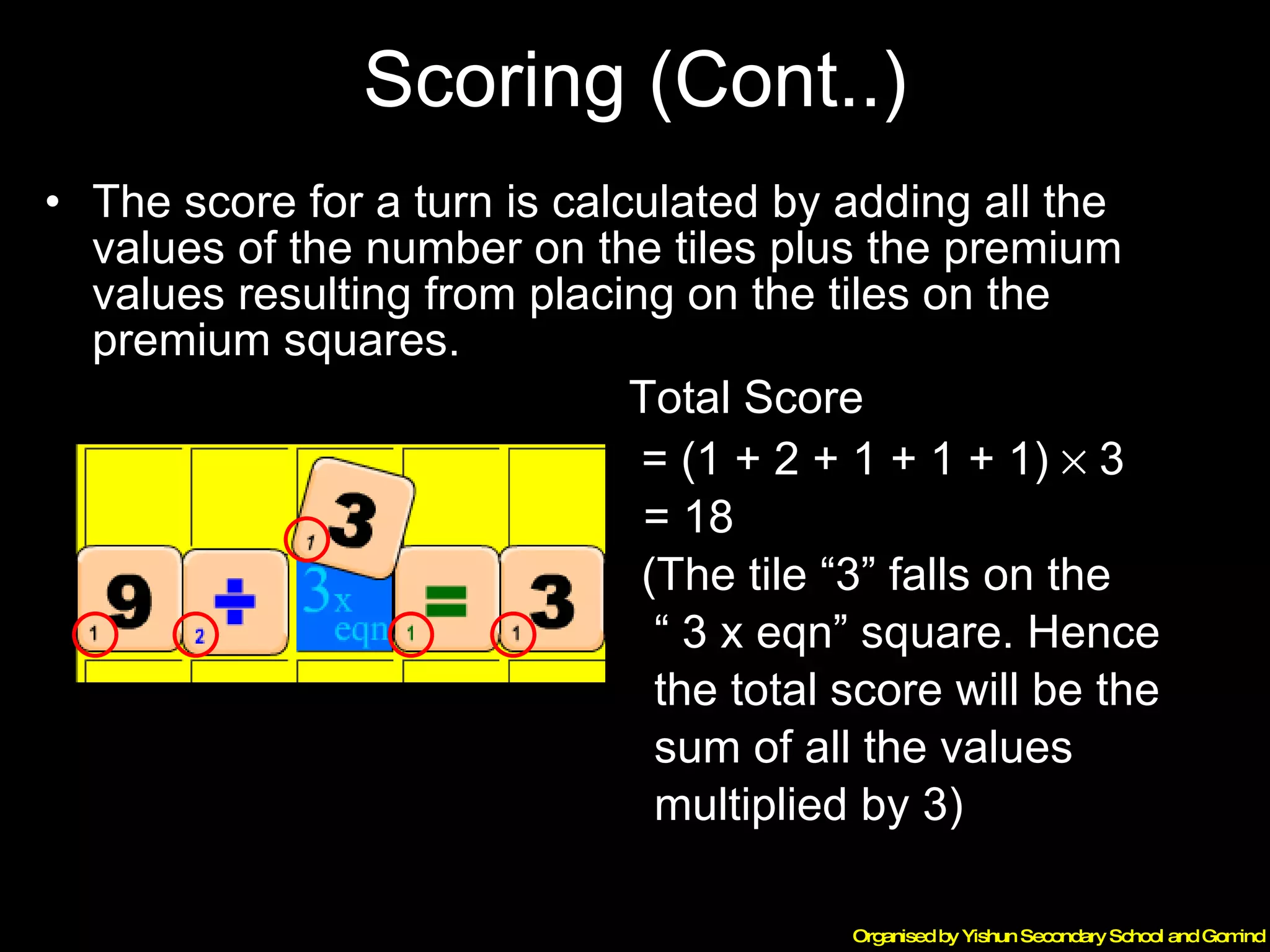
Scoring (Cont..) The score for a turn is calculated by adding all the values of the number on the tiles plus the premium values resulting from placing on the tiles on the premium squares.   Total Score    = (1 + 2 + 1 + 1 + 1)    3   = 18 (The tile “3” falls on the  “  3 x eqn” square. Hence  the total score will be the  sum of all the values  multiplied by 3)
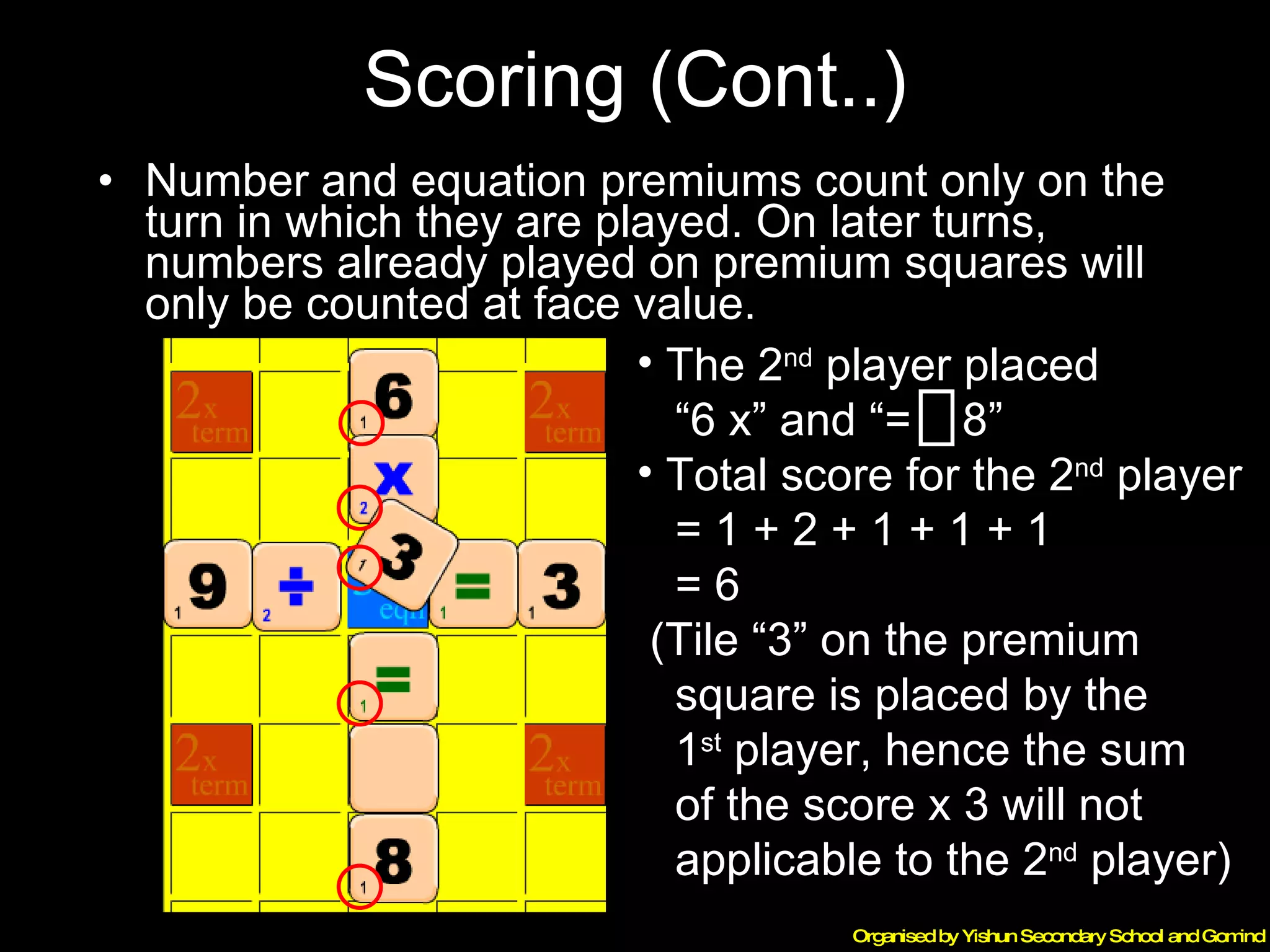
Scoring (Cont..) Number and equation premiums count only on the turn in which they are played. On later turns, numbers already played on premium squares will only be counted at face value. The 2 nd  player placed  “ 6 x” and “=  8” Total score for the 2 nd  player  = 1 + 2 + 1 + 1 + 1  = 6 (Tile “3” on the premium  square is placed by the  1 st  player, hence the sum  of the score x 3 will not  applicable to the 2 nd  player)
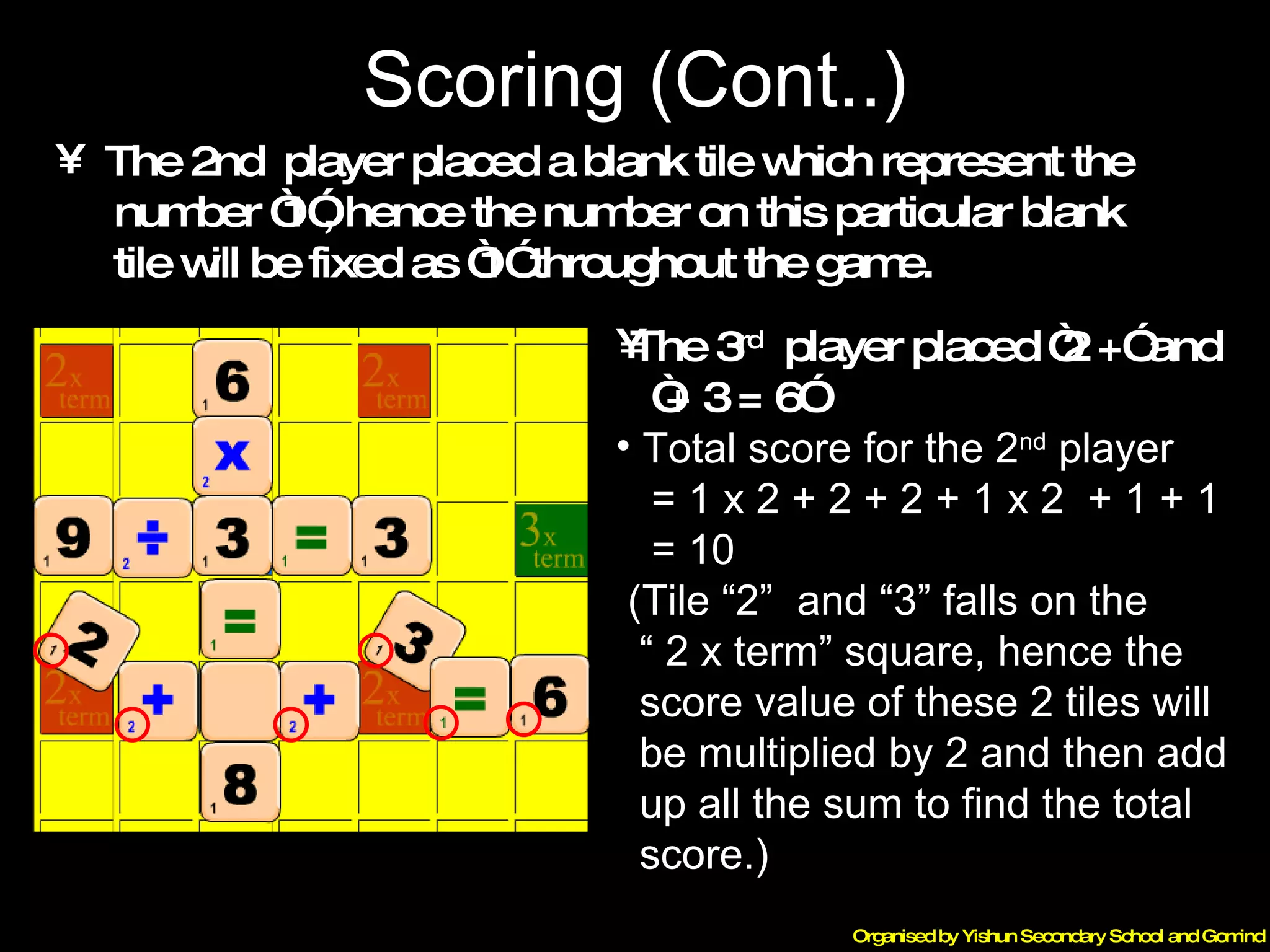
Scoring (Cont..) The 3 rd   player placed “2 +” and  “ + 3 = 6” Total score for the 2 nd  player  = 1 x 2 + 2 + 2 + 1 x 2  + 1 + 1 = 10 (Tile “2”  and “3” falls on the  “  2 x term” square, hence the  score value of these 2 tiles will  be multiplied by 2 and then add  up all the sum to find the total  score.) The 2nd  player placed a blank tile which represent the  number “1”, hence the number on this particular blank  tile will be fixed as “1” throughout the game.
Scoring (Cont..) Bonus Score:  If the player uses  ALL  the tiles on his rack in a single turn, in addition to the regular score for his turn, he scores an extra  50 points
Scoring (Cont..) Unplayed tiles:   When the game ends, the final score of each player is  reduced  by the sum of all his unplayed tiles. If one player has used up all his tiles, his score is  increased  by the sum of all the unplayed tiles of all other players.
Scoring (Cont..) The player with the highest final score wins the game. In case of a tie, the player with the highest score before adding or deducting unplayed tiles wins. Decision of the judges is final.
Latest Update! Disallowed arrangements (those not found in earlier slides) 1. 6-4=2/0/2   Allowed arrangements (those not found in earlier slides) 1. [2] [sqrt][3][=][2] [X] [sqrt 3] 2. [7][/][1][=][7] becomes [7][7]/[1][=][7][7] 3. [0][divide][1][2][3][4][5][=][0] 4. [0][/][1][2][3][4][5][=][0]
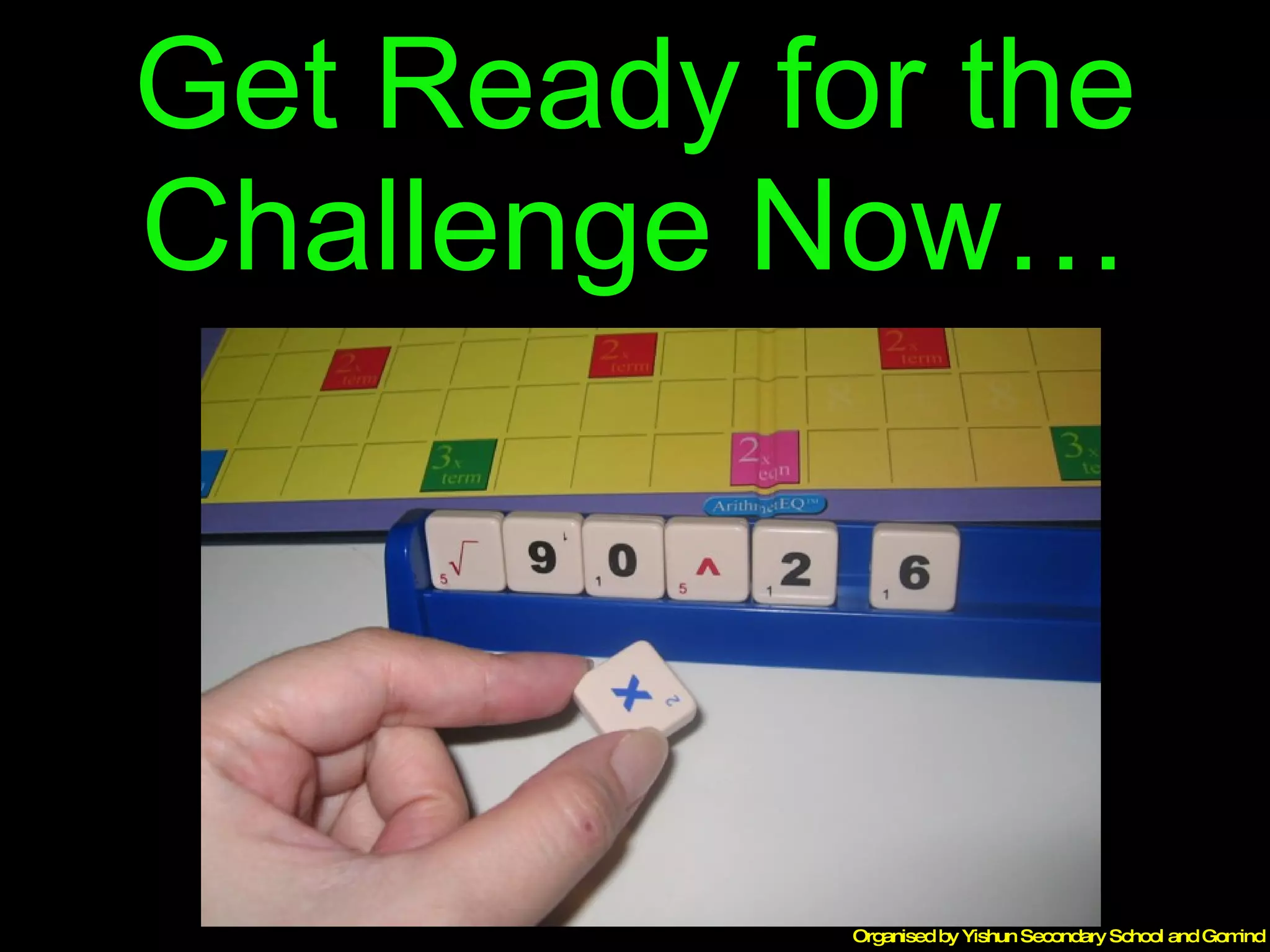
Get Ready for the Challenge Now…

National ArithmetEQ Challenge Rules 2010

  • 1.
  • 2.
    Welcome to 2ndNational ArithmetEQ Challenge 2010 @YSS
  • 3.
    Do Take Note…All participants, please note You are required to register at the registration counter. Sit according to the table assigned. Each player will pick a number card from the helper which will determine who starts the game and the sequence of the other players. Sit in such a way that the game will be played in a clockwise manner. Lastly, do remember to switch off or put all handphone on silence mode before the start of the competition.
  • 4.
    About ArithmetEQ Consistof a board with premium squares 150 tiles that are printed on both sides (numbers or operators on one side, equal sign on the other side) and are placed in the bag Numbers (0 – 9) Mathematical Operators
  • 5.
    About ArithmetEQ MathematicalOperators - Addition - Subtraction - Multiplication - Division - Power - Fraction 3 ^ 2 = 9 1 Γ 2 Γ 3 = - Square Root - Brackets 3 (2 + 4) = 1 8 - Decimal Point
  • 6.
    How to playthe game Each player will draw 7 tiles from the bag. The 1 st player will use 4 or more tiles to form an equation on the board to read either across (left to right) or down, with a tile on the centre square
  • 7.
    How to playthe game (cont..) After an equation is placed on the board, the player will replace the number of tiles that are used from the bag and place them back on his rack. Play in sequence and on each turn, the players have a choice of exchanging the tiles, passing or placing an equation on the board. All tiles played in any one turn must be placed in each row across or one column down the board.
  • 8.
    How to playthe game (cont..) If the tiles touch each other in adjacent row, they must form complete equations.   
  • 9.
    How to playthe game (cont..) The game ends when all the tiles have been drawn from the bag and 1 of the players has used up all the tiles in his rack. Or all the players have passed once in the same turn. (Exchange of tiles is not a pass)
  • 10.
    Take Note… Alwaysensure that there are 7 tiles on your rack as long as there are still tiles left in the bag. Any player may use their turn to exchange ONE or ALL their tiles on their rack. They will then miss a turn and have to wait for the next turn to play.
  • 11.
    Take Note… (cont..)Each player has to form an equation during his turn. - 1 st player places “ 2 + 3 = 5”. - 2 nd player places “5 =” in front of the tile “2”. This is correct as “5 = 2 + 3” is an equation. - 3 rd player places “= 5 . 0” after “= 5”. This is not allowed as 5 = 5.0 is not an equation.   
  • 12.
    Take Note…(cont..) Someexamples of tiles arrangements. Arrangements that are allowed.
  • 13.
    Take Note…(cont..) Someexamples of tiles arrangements. Arrangements that are not allowed or
  • 14.
    Scoring Thescore value of each number or operators are indicated by a number at the bottom of the tile. The blank tiles has no score value but can be used as any number (0 – 9) desired. There are 6 blank tiles altogether.
  • 15.
    Scoring (Cont..) Multiplyby 2 to the score on the tile placed above it and add up the total score Multiply by 3 to the score on the tile placed above it and add up the total score Add up the score on the tiles and multiply by 2 Add up the score on the tiles and multiply by 3 The following shows the premium squares on the board.
  • 16.
    Scoring (Cont..) Thescore for a turn is calculated by adding all the values of the number on the tiles plus the premium values resulting from placing on the tiles on the premium squares. Total Score = (1 + 2 + 1 + 1 + 1)  3 = 18 (The tile “3” falls on the “ 3 x eqn” square. Hence the total score will be the sum of all the values multiplied by 3)
  • 17.
    Scoring (Cont..) Numberand equation premiums count only on the turn in which they are played. On later turns, numbers already played on premium squares will only be counted at face value. The 2 nd player placed “ 6 x” and “= 8” Total score for the 2 nd player = 1 + 2 + 1 + 1 + 1 = 6 (Tile “3” on the premium square is placed by the 1 st player, hence the sum of the score x 3 will not applicable to the 2 nd player)
  • 18.
    Scoring (Cont..) The3 rd player placed “2 +” and “ + 3 = 6” Total score for the 2 nd player = 1 x 2 + 2 + 2 + 1 x 2 + 1 + 1 = 10 (Tile “2” and “3” falls on the “ 2 x term” square, hence the score value of these 2 tiles will be multiplied by 2 and then add up all the sum to find the total score.) The 2nd player placed a blank tile which represent the number “1”, hence the number on this particular blank tile will be fixed as “1” throughout the game.
  • 19.
    Scoring (Cont..) BonusScore: If the player uses ALL the tiles on his rack in a single turn, in addition to the regular score for his turn, he scores an extra 50 points
  • 20.
    Scoring (Cont..) Unplayedtiles: When the game ends, the final score of each player is reduced by the sum of all his unplayed tiles. If one player has used up all his tiles, his score is increased by the sum of all the unplayed tiles of all other players.
  • 21.
    Scoring (Cont..) Theplayer with the highest final score wins the game. In case of a tie, the player with the highest score before adding or deducting unplayed tiles wins. Decision of the judges is final.
  • 22.
    Latest Update! Disallowedarrangements (those not found in earlier slides) 1. 6-4=2/0/2  Allowed arrangements (those not found in earlier slides) 1. [2] [sqrt][3][=][2] [X] [sqrt 3] 2. [7][/][1][=][7] becomes [7][7]/[1][=][7][7] 3. [0][divide][1][2][3][4][5][=][0] 4. [0][/][1][2][3][4][5][=][0]
  • 23.
    Get Ready forthe Challenge Now…