RA41201EN20GLA0
LTE – EPC Overview
1
1 © Nokia Siemens Networks RA41201EN20GLA0
LTE RPESS
LTE – EPC Overview
RA41201EN20GLA0
LTE – EPC Overview
2
2 © Nokia Siemens Networks RA41201EN20GLA0
Nokia Siemens Networks Academy
Legal notice
Intellectual Property Rights
All copyrights and intellectual property rights for Nokia Siemens Networks training
documentation, product documentation and slide presentation material, all of which are forthwith
known as Nokia Siemens Networks training material, are the exclusive property of Nokia
Siemens Networks. Nokia Siemens Networks owns the rights to copying, modification,
translation, adaptation or derivatives including any improvements or developments. Nokia
Siemens Networks has the sole right to copy, distribute, amend, modify, develop, license,
sublicense, sell, transfer and assign the Nokia Siemens Networks training material. Individuals
can use the Nokia Siemens Networks training material for their own personal self-development
only, those same individuals cannot subsequently pass on that same Intellectual Property to
others without the prior written agreement of Nokia Siemens Networks. The Nokia Siemens
Networks training material cannot be used outside of an agreed Nokia Siemens Networks
training session for development of groups without the prior written agreement of Nokia
Siemens Networks.
RA41201EN20GLA0
LTE – EPC Overview
3
3 © Nokia Siemens Networks RA41201EN20GLA0
Module Objectives
After completing this module, the participant should be able to:
• List the LTE/SAE main requirements
• Underline the LTE/SAE key features
• Review the 3GPP specification work concerning LTE/SAE.
• Describe the LTE Network Architecture
• List the key functionalities of the evolved NB
• Understand the protocol stack implemented on EUTRAN
interfaces
RA41201EN20GLA0
LTE – EPC Overview
4
4 © Nokia Siemens Networks RA41201EN20GLA0
Module Contents
• LTE Requirements
• LTE Key Features
• LTE Standardization
• LTE Architecture
• Evolved NB functionalities
• EUTRAN Interfaces
• LTE Summary
RA41201EN20GLA0
LTE – EPC Overview
5
5 © Nokia Siemens Networks RA41201EN20GLA0
Module Contents
• LTE Requirements
• LTE Key Features
• LTE Standardization
• LTE Architecture
• Evolved NB functionalities
• EUTRAN Interfaces
• LTE Summary
RA41201EN20GLA0
LTE – EPC Overview
6
6 © Nokia Siemens Networks RA41201EN20GLA0
The way to the Long-Term Evolution (LTE): a 3GPP driven
initiative
• LTE is 3GPP system for the years 2010 to 2020 & beyond.
• It shall especially compete with WiMAX 802.16e/m
• It must keep the support for high & highest mobility users
like in GSM/UMTS networks
• The architectural changes are big compared to UMTS
• LTE commercial launch has started early 2010.
RA41201EN20GLA0
LTE – EPC Overview
7
7 © Nokia Siemens Networks RA41201EN20GLA0
What are the LTE challenges?
• Best price, transparent flat rate
• Full Internet
• Click-bang responsiveness
• reduce cost per bit
• provide high data rate
• provide low latency
The Users’ expectation… ..leads to the operator’s challenges
Price per Mbyte has to be reduced
to remain profitable
User experience will have an
impact on ARPU
LTE: lower cost per bit and improved end user experience
UMTS HSPA I-HSPA LTE
Cost per MByte
HSPA LTE HSPA LTE
Throughput Latency
Factor10
Factor2-3
RA41201EN20GLA0
LTE – EPC Overview
8
8 © Nokia Siemens Networks RA41201EN20GLA0
LTE = Long Term Evolution
• Peak data rates of 303
Mbps / 75 Mbps
• Low latency 10-20 ms
Enhanced consumer experience
• Scalable bandwidth of
1.4 – 20 MHz
Easy to introduce on any
frequency band
• OFDM technology
• Flat, scalable IP based
architecture
Decreased cost / GB
• Next step for
GSM/WCDMA/HSPA
and CDMA
A true global roaming technology
RA41201EN20GLA0
LTE – EPC Overview
9
9 © Nokia Siemens Networks RA41201EN20GLA0
Schedule for 3GPP releases
• Next step for
GSM/WCDMA/HSPA
and cdma2000
A true global roaming technology
year
3GPP Rel. 99/43GPP Rel. 99/4 Rel. 5Rel. 5 Rel. 6Rel. 6 Rel. 7Rel. 7
2007200520032000 2008
HSDPA
IMS
HSUPA
MBMS
WLAN IW
HSPA+
LTE Studies
Specification:
2009
• LTE have been developed by the same standardization organization. The target has been
simple multimode implementation and backwards compatibility.
• HSPA and LTE have in common:
– Sampling rate using the same clocking frequency
– Same kind of Turbo coding
• The harmonization of these parameters is important as sampling and Turbo decoding are
typically done on hardware due to high processing requirements.
• WiMAX and LTE do not have such harmonization.
Rel. 8Rel. 8
LTE & EPC
Rel. 9Rel. 9
LTE-A
studies
LTE-A: LTE-Advanced
Rel. 10Rel. 10
LTE-A
UMTS/
WCDMA
2011
RA41201EN20GLA0
LTE – EPC Overview
10
10 © Nokia Siemens Networks RA41201EN20GLA0
Comparison of Throughput and Latency (1/2)
HSPA R6
Max. peak data rate
Mbps
Evolved HSPA
(Rel. 7/8, 2x2
MIMO)
LTE 2x20 MHz
(2x2 MIMO)
LTE 2x20
MHz (4x4
MIMO)
Downlink
Uplink
350
300
250
200
150
100
50
0
HSPAevo
(Rel8)
LTE
* Server near RAN
Latency (Rountrip delay)*
DSL (~20-50 ms, depending on operator)
0 20 40 60 80 100 120 140 160 180 200
GSM/
EDGE
HSPA
Rel6
min max
ms
Enhanced consumer experience:
- drives subscriber uptake
- allow for new applications
- provide additional revenue streams
• Peak data rates of
303 Mbps / 75 Mbps
• Low latency 10-20 ms
RA41201EN20GLA0
LTE – EPC Overview
11
11 © Nokia Siemens Networks RA41201EN20GLA0
Scalable bandwidth
• Scalable bandwidth
of 1.4 – 20 MHz
Easy to introduce on any
frequency band: Frequency
Refarming
(Cost efficient deployment on lower
frequency bands supported)
Scalable Bandwidth
Urban
2006 2008 2010 2012 2014 2016 2018 2020
Rural
2006 2008 2010 2012 2014 2016 2018 2020
or
2.6 GHz
2.1 GHz
2.6 GHz
2.1 GHz
LTE
UMTS
UMTS
LTE
900 MHz
900 MHz GSM
or
GSM UMTS
LTE
LTE
LTE
RA41201EN20GLA0
LTE – EPC Overview
12
12 © Nokia Siemens Networks RA41201EN20GLA0
0.0
0.2
0.4
0.6
0.8
1.0
1.2
1.4
1.6
1.8
2.0
HSPA R6 HSPA R6 +
UE
equalizer
HSPA R7 WiMAX LTE R8
bps/Hz/cell
Downlink
Uplink
Increased Spectral Efficiency
• All cases assume 2-antenna terminal reception
• HSPA R7, WiMAX and LTE assume 2-antenna BTS transmission (2x2 MIMO)
ITU contribution from
WiMAX Forum shows
DL 1.3 & UL 0.8 bps/Hz/cell
Reference:
- HSPA R6 and LTE R8 from 3GPP R1-071960
- HSPA R6 equalizer from 3GPP R1-063335
- HSPA R7 and WiMAX from NSN/Nokia
simulations
• OFDMA technology
increases Spectral
efficiency
LTE efficiency is 3 x HSPA R6 in
downlink
HSPA R7 and WiMAX have Similar
Spectral Efficiency
RA41201EN20GLA0
LTE – EPC Overview
13
13 © Nokia Siemens Networks RA41201EN20GLA0
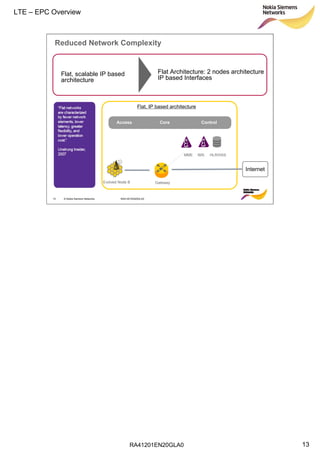
Reduced Network Complexity
• Flat, scalable IP based
architecture
Flat Architecture: 2 nodes architecture
IP based Interfaces
Access Core Control
Evolved Node B Gateway
IMS HLR/HSS
Flat, IP based architecture
Internet
MME
RA41201EN20GLA0
LTE – EPC Overview
14
14 © Nokia Siemens Networks RA41201EN20GLA0
LTE/SAE Requirements Summary
1. Simplify the RAN:
- Reduce the number of different types of RAN nodes, and their complexity.
- Minimize the number of RAN interface types.
2. Increase throughput: Peak data rates of UL/DL 50/100 Mbps
3. Reduce latency (prerequisite for CS replacement).
4. Improve spectrum efficiency: Capacity 2-4 x higher than with Release 6 HSPA
5. Frequency flexibility & bandwidth scalability: Frequency Refarming
6. Migrate to a PS only domain in the core network: CSFB for initial phase
7. Provide efficient support for a variety of different services. Traditional CS services
will be supported via VoIP, etc: EPS bearers for IMS based Voice
8. Minimise the presence of single points of failure in the network above the eNBs S1-
Flex interface
9. Support for inter-working with existing 3G system & non-3GPP specified systems.
10. Operation in FDD & TDD modes
11. Improved terminal power efficiency
A more detailed list of the requirements and objectives for LTE can be found in TR 25.913.
RA41201EN20GLA0
LTE – EPC Overview
15
15 © Nokia Siemens Networks RA41201EN20GLA0
Module Contents
• LTE Requirements
• LTE Key Features
• LTE Standardization
• LTE Architecture
• Evolved NB functionalities
• EUTRAN Interfaces
• LTE Summary
RA41201EN20GLA0
LTE – EPC Overview
16
16 © Nokia Siemens Networks RA41201EN20GLA0
LTE/SAE Key Features
EPS ( Evolved Packet System ) /
SAE ( System Architecture Evolution ) /
LTE ( Long Term Evolution )
EPC ( Evolved Packet Core )EPC ( Evolved Packet Core )EUTRAN
( Evolved UTRAN )
EUTRAN
( Evolved UTRAN )
IP NetworkIP Network
OFDMA/SC-FDMA
MIMO ( beam-forming/
spatial multiplexing)
HARQ
Scalable bandwidth
(1.4, 3, 5, 10, .. 20 MHz)
Evolved Node B /
No RNC
UL/DL resource
scheduling
IP Transport Layer
QoS Aware
Self Configuration
PS Domain only,
No CS Domain
IP Transport Layer
QoS Aware
3GPP (GTP) or
IETF (MIPv6)
Prepared for
Non-3GPP Access
RA41201EN20GLA0
LTE – EPC Overview
17
17 © Nokia Siemens Networks RA41201EN20GLA0
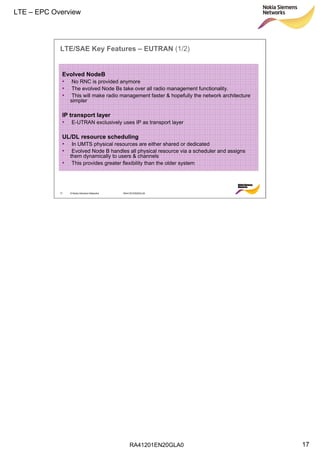
LTE/SAE Key Features – EUTRAN (1/2)
Evolved NodeB
• No RNC is provided anymore
• The evolved Node Bs take over all radio management functionality.
• This will make radio management faster & hopefully the network architecture
simpler
IP transport layer
• E-UTRAN exclusively uses IP as transport layer
UL/DL resource scheduling
• In UMTS physical resources are either shared or dedicated
• Evolved Node B handles all physical resource via a scheduler and assigns
them dynamically to users & channels
• This provides greater flexibility than the older system
RA41201EN20GLA0
LTE – EPC Overview
18
18 © Nokia Siemens Networks RA41201EN20GLA0
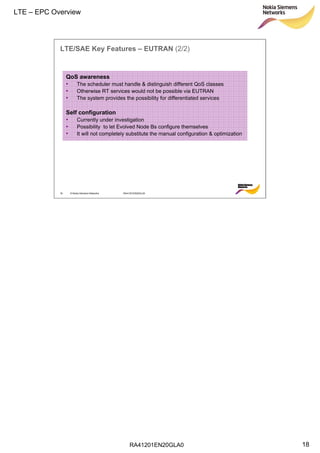
LTE/SAE Key Features – EUTRAN (2/2)
QoS awareness
• The scheduler must handle & distinguish different QoS classes
• Otherwise RT services would not be possible via EUTRAN
• The system provides the possibility for differentiated services
Self configuration
• Currently under investigation
• Possibility to let Evolved Node Bs configure themselves
• It will not completely substitute the manual configuration & optimization
RA41201EN20GLA0
LTE – EPC Overview
19
19 © Nokia Siemens Networks RA41201EN20GLA0
LTE/SAE Key Features – EPC (Evolved Packet Core)
Packet Switched Domain only
• no CS domain is provided
• if CS applications are required, they must be implemented via IP
• only one mobility management for the UE in LTE.
3GPP (GTP) or IETF (MIPv6) option
• The EPC can be based either on 3GPP GTP protocols (similar to PS domain in
UMTS/GPRS) or on IETF Mobile IPv6 (MIPv6)
Non-3GPP access
• The EPC will be prepared also to be used by non-3GPP access networks (e.g.
LAN, WLAN, WiMAX, etc.)
• This will provide true convergence of different packet radio access system
RA41201EN20GLA0
LTE – EPC Overview
20
20 © Nokia Siemens Networks RA41201EN20GLA0
Module Contents
• LTE Requirements
• LTE Key Features
• LTE Standardization
• LTE Architecture
• Evolved NB functionalities
• EUTRAN Interfaces
• LTE Summary
RA41201EN20GLA0
LTE – EPC Overview
21
21 © Nokia Siemens Networks RA41201EN20GLA0
Standardisation around LTE
Next Generation Mobile Networks. Is a group of mobile
operators, to provide a coherent vision for technology
evolution beyond 3G for the competitive delivery of
broadband wireless services.
More in www.ngmn.org
Collaboration agreement established in December
1998. The collaboration agreement brings together a
number of telecommunications standards bodies: ARIB,
CCSA, ETSI, ATIS, TTA, and TTC.
More in www.3gpp.org
LTE/SAE Trial Initiative. Is was founded in may 2007 by a
group of leading telecommunications companies.
Its aim is to prove the potential and benefits that the LTE
technology can offer.
More in http://www.lstiforum.com/
LSTI
RA41201EN20GLA0
LTE – EPC Overview
22
22 © Nokia Siemens Networks RA41201EN20GLA0
From 3GPP Specs into Commercial Launch
• Historically, 1.25-1.5 years from the specs approval until backwards compatibility
(ASN.1) with HSDPA and HSUPA
• Historically, 1.25-1.5 years from the backwards compatibility until commercial
launch with HSDPA & HSUPA
• LTE backwards compatibility: 03/2009. First commercial launch: 12/2009
2003 2004 2005 2006 2007
1 2 3
1 2 3
1.5 years 1.5 years
1.25 years 1.25 years
1 = Specs approved
2 = Backwards compatibility
3 = 1st commercial launch
HSDPA
HSUPA
2008 2009 2010
1 2 3
1.25 years 0.75 years
LTE
RA41201EN20GLA0
LTE – EPC Overview
23
23 © Nokia Siemens Networks RA41201EN20GLA0
3GPP LTE Background (1/2)
Milestones
• End 2004 3GPP workshop on UTRAN Long Term Evolution
• March 2005 Study item started
• December 2005 Multiple access selected
• March 2006 Functionality split between radio and core agreed
• September 2006 Study item closed & approval of the work items
• December 2007 1st version of all radio specs approved
• March 2008 3GPP Release 8 Stage 1 specifications were frozen
• December 2008 3GPP Release 8
2005 2006 2007 2008
Feasibility
study started
Multiple
access
selected
Feasibility
study closed
Work item
started
Work plan
approved
Stage 2
approved
Stage 3
approved
Radio Specs
approved
RA41201EN20GLA0
LTE – EPC Overview
24
24 © Nokia Siemens Networks RA41201EN20GLA0
3GPP LTE Background (2/2)
Schedule
• 2009 2100 & 2100/1700 MHz frequency bands selected; Release 9
• 2010 Additional frequency bands added (700, 800 & 2600 MHz). Inter-RAT
Mobility. LTE capable devices
• 2011 Network Sharing. Self-optimized networks. Part of 3GPP Release 9.
Release 10 (LTE-Advanced)
2008 2009 2010 2011
Demonstrate
LTE Air
Interface
Performance
Operator
Trials. Friendly-
use networks
LTE Networks
Launch:
commercial
solution
available
Large Scale LTE
Networks.
VoIP service
optimized.
RA41201EN20GLA0
LTE – EPC Overview
25
25 © Nokia Siemens Networks RA41201EN20GLA0
Module Contents
• LTE Requirements
• LTE Key Features
• LTE Standardization
• LTE Architecture
• Evolved NB functionalities
• EUTRAN Interfaces
• LTE Summary
RA41201EN20GLA0
LTE – EPC Overview
26
26 © Nokia Siemens Networks RA41201EN20GLA0
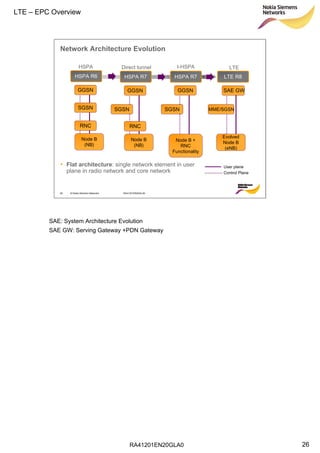
Network Architecture Evolution
SAE GWGGSN
SGSN
RNC
Node B
(NB)
Direct tunnel
GGSN
SGSN
I-HSPA
MME/SGSN
HSPA R7 HSPA R7 LTE R8
Node B +
RNC
Functionality
Evolved
Node B
(eNB)
GGSN
SGSN
RNC
Node B
(NB)
HSPA
HSPA R6
LTE
User plane
Control Plane
• Flat architecture: single network element in user
plane in radio network and core network
SAE: System Architecture Evolution
SAE GW: Serving Gateway +PDN Gateway
RA41201EN20GLA0
LTE – EPC Overview
27
27 © Nokia Siemens Networks RA41201EN20GLA0
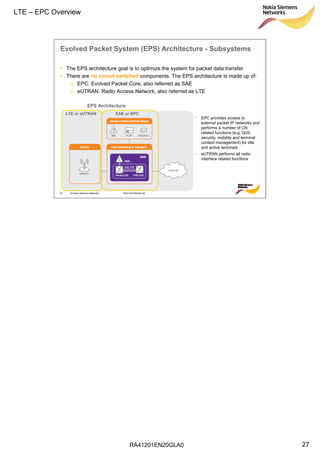
Evolved Packet System (EPS) Architecture - Subsystems
• The EPS architecture goal is to optimize the system for packet data transfer.
• There are no circuit switched components. The EPS architecture is made up of:
– EPC: Evolved Packet Core, also referred as SAE
– eUTRAN: Radio Access Network, also referred as LTE
LTE or eUTRAN SAE or EPC
EPS Architecture
• EPC provides access to
external packet IP networks and
performs a number of CN
related functions (e.g. QoS,
security, mobility and terminal
context management) for idle
and active terminals
• eUTRAN performs all radio
interface related functions
RA41201EN20GLA0
LTE – EPC Overview
28
28 © Nokia Siemens Networks RA41201EN20GLA0
LTE/SAE Network Elements
Main references to architecture in 3GPP specs.: TS23.401,TS23.402,TS36.300
LTE-UE
Evolved UTRAN (E-UTRAN)
MME S10
S6a
Serving
Gateway
S1-U
S11
PDN
Gateway
PDN
Evolved Packet Core (EPC)
S1-MME
PCRF
S7 Rx+
SGiS5/S8
Evolved Node B
(eNB)
X2
LTE-Uu
HSS
Mobility
Management
Entity Policy &
Charging Rule
Function
SAE
Gateway
eNB
RA41201EN20GLA0
LTE – EPC Overview
29
29 © Nokia Siemens Networks RA41201EN20GLA0
Module Contents
• LTE Requirements
• LTE Key Features
• LTE Standardization
• LTE Architecture
• Evolved NB functionalities
• EUTRAN Interfaces
• LTE Summary
RA41201EN20GLA0
LTE – EPC Overview
30
30 © Nokia Siemens Networks RA41201EN20GLA0
Inter-cell RRM: HO, load balancing between cells
Radio Bearer Control: setup , modifications and
release of Radio Resources
Connection Mgt. Control: UE State Management,
MME-UE Connection
Radio Admission Control
eNode B Meas. collection and evaluation
Dynamic Resource Allocation (Scheduler)
eNB Functions
IP Header Compression/ de-compression
Access Layer Security: ciphering and integrity
protection on the radio interface
MME Selection at Attach of the UE
User Data Routing to the SAE GW
Transmission of Paging Msg coming from MME
Transmission of Broadcast Info (e.g. System info,
MBMS)
• Only network element defined as
part of eUTRAN.
• Replaces the old Node B / RNC
combination from 3G.
• Terminates the complete radio
interface including physical layer.
• Provides all radio management
functions
• To enable efficient inter-cell radio
management for cells not attached to
the same eNB, there is a inter-eNB
interface X2 specified. It will allow to
coordinate inter-eNB handovers
without direct involvement of EPC
during this process.
Evolved Node B (eNB)
RA41201EN20GLA0
LTE – EPC Overview
31
31 © Nokia Siemens Networks RA41201EN20GLA0
Module Contents
• LTE Requirements
• LTE Key Features
• LTE Standardization
• LTE Architecture
• Evolved NB functionalities
• EUTRAN Interfaces
• LTE Summary
RA41201EN20GLA0
LTE – EPC Overview
32
32 © Nokia Siemens Networks RA41201EN20GLA0
LTE Radio Interface & the X2 Interface
LTE-Uu interface
• Air interface of LTE
• Based on OFDMA in DL & SC-FDMA in UL
• FDD & TDD duplex methods
• Scalable bandwidth: 1.4MHz - 20 MHz
X2 interface
• Inter eNB interface
• X2AP: special signalling protocol
(Application Part)
• Functionalities:
– In inter- eNB HO to facilitate Handover
and provide data forwarding.
– In RRM to provide e.g. load
information to neighbouring eNBs to
facilitate interference management.
– Logical interface: doesn’t need direct
site-to-site connection, i.e. can be
routed via CN as well
(E)-RRC(E)-RRC User PDUsUser PDUs User PDUsUser PDUs
PDCPPDCP
..
RLCRLC
MACMAC
LTE-L1 (FDD/TDD-OFDMA/SC-FDMA)LTE-L1 (FDD/TDD-OFDMA/SC-FDMA)
TS 36.300
eNB
LTE-Uu
eNB
X2
User PDUsUser PDUs
GTP-UGTP-U
UDPUDP
IPIP
L1/L2L1/L2
TS 36.424
X2-UP
(User Plane)X2-CP
(Control Plane)
X2-APX2-AP
SCTPSCTP
IPIP
L1/L2L1/L2TS 36.421
TS 36.422
TS 36.423
TS 36.421
TS 36.420
UDP: User Datagram Protocol ( L4 Transport Layer)
RA41201EN20GLA0
LTE – EPC Overview
33
33 © Nokia Siemens Networks RA41201EN20GLA0
S1-MME & S1-U Interfaces
MME
Serving
Gateway
S1-MME
(Control Plane)
S1-U
(User Plane)
NAS ProtocolsNAS Protocols
S1-APS1-AP
SCTPSCTP
IPIP
L1/L2L1/L2
User PDUsUser PDUs
GTP-UGTP-U
UDPUDP
IPIP
L1/L2L1/L2
TS 36.411
TS 36.411
TS 36.412
TS 36.413
TS 36.414
TS 36.410
eNB
S1 interface is divided into two parts:
S1-MME interface
• Control Plane interface between eNB &
MME
• S1AP:S1 Application Protocol
• MME & UE will exchange NAS signaling
via eNB through this interface ( i.e.
authentication, tracking area updates)
• S1 Flex: an eNB is allowed to connect to a
maximum of 16 MME. (LTE2, RL20)
S1-U interface
• User plane interface between eNB & Serving
Gateway.
• Pure user data interface (U=User plane)
LTE4: Multi-Operator Core Network (MO-CN): An eNB can be connected
simultaneously to the different Evolved Packet Cores (EPCs) of different operators,
and shared by them.
RA41201EN20GLA0
LTE – EPC Overview
34
34 © Nokia Siemens Networks RA41201EN20GLA0
Module Contents
• LTE Requirements
• LTE Key Features
• LTE Standardization
• LTE Architecture
• Evolved NB functionalities
• EUTRAN Interfaces
• LTE Summary
RA41201EN20GLA0
LTE – EPC Overview
35
35 © Nokia Siemens Networks RA41201EN20GLA0
LTE: What is new?
• new radio transmission schemes:
– OFDMA in DL
– SC-FDMA in UL
– MIMO Multiple Antenna Technology
• New radio protocol architecture:
– Complexity reduction
– Focus on shared channel operation,
no dedicated channels anymore
• new network architecture:
– More functionality in the base
station (eNodeB)
– Focus on PS domain
– Flat architecture (2-nodes)
– All-IP
• Important for Radio Planning
– Frequency Reuse 1
▪ No need for Frequency Planning
– No need to define neighbour lists
in LTE
OFDMA: Orthogonal Frequency Division Multiple Access
SC-FDMA: Single Carrier Frequency Division Multiple Access
PS: Packet Switched

244079168 lte-overview

  • 1.
    RA41201EN20GLA0 LTE – EPCOverview 1 1 © Nokia Siemens Networks RA41201EN20GLA0 LTE RPESS LTE – EPC Overview
  • 2.
    RA41201EN20GLA0 LTE – EPCOverview 2 2 © Nokia Siemens Networks RA41201EN20GLA0 Nokia Siemens Networks Academy Legal notice Intellectual Property Rights All copyrights and intellectual property rights for Nokia Siemens Networks training documentation, product documentation and slide presentation material, all of which are forthwith known as Nokia Siemens Networks training material, are the exclusive property of Nokia Siemens Networks. Nokia Siemens Networks owns the rights to copying, modification, translation, adaptation or derivatives including any improvements or developments. Nokia Siemens Networks has the sole right to copy, distribute, amend, modify, develop, license, sublicense, sell, transfer and assign the Nokia Siemens Networks training material. Individuals can use the Nokia Siemens Networks training material for their own personal self-development only, those same individuals cannot subsequently pass on that same Intellectual Property to others without the prior written agreement of Nokia Siemens Networks. The Nokia Siemens Networks training material cannot be used outside of an agreed Nokia Siemens Networks training session for development of groups without the prior written agreement of Nokia Siemens Networks.
  • 3.
    RA41201EN20GLA0 LTE – EPCOverview 3 3 © Nokia Siemens Networks RA41201EN20GLA0 Module Objectives After completing this module, the participant should be able to: • List the LTE/SAE main requirements • Underline the LTE/SAE key features • Review the 3GPP specification work concerning LTE/SAE. • Describe the LTE Network Architecture • List the key functionalities of the evolved NB • Understand the protocol stack implemented on EUTRAN interfaces
  • 4.
    RA41201EN20GLA0 LTE – EPCOverview 4 4 © Nokia Siemens Networks RA41201EN20GLA0 Module Contents • LTE Requirements • LTE Key Features • LTE Standardization • LTE Architecture • Evolved NB functionalities • EUTRAN Interfaces • LTE Summary
  • 5.
    RA41201EN20GLA0 LTE – EPCOverview 5 5 © Nokia Siemens Networks RA41201EN20GLA0 Module Contents • LTE Requirements • LTE Key Features • LTE Standardization • LTE Architecture • Evolved NB functionalities • EUTRAN Interfaces • LTE Summary
  • 6.
    RA41201EN20GLA0 LTE – EPCOverview 6 6 © Nokia Siemens Networks RA41201EN20GLA0 The way to the Long-Term Evolution (LTE): a 3GPP driven initiative • LTE is 3GPP system for the years 2010 to 2020 & beyond. • It shall especially compete with WiMAX 802.16e/m • It must keep the support for high & highest mobility users like in GSM/UMTS networks • The architectural changes are big compared to UMTS • LTE commercial launch has started early 2010.
  • 7.
    RA41201EN20GLA0 LTE – EPCOverview 7 7 © Nokia Siemens Networks RA41201EN20GLA0 What are the LTE challenges? • Best price, transparent flat rate • Full Internet • Click-bang responsiveness • reduce cost per bit • provide high data rate • provide low latency The Users’ expectation… ..leads to the operator’s challenges Price per Mbyte has to be reduced to remain profitable User experience will have an impact on ARPU LTE: lower cost per bit and improved end user experience UMTS HSPA I-HSPA LTE Cost per MByte HSPA LTE HSPA LTE Throughput Latency Factor10 Factor2-3
  • 8.
    RA41201EN20GLA0 LTE – EPCOverview 8 8 © Nokia Siemens Networks RA41201EN20GLA0 LTE = Long Term Evolution • Peak data rates of 303 Mbps / 75 Mbps • Low latency 10-20 ms Enhanced consumer experience • Scalable bandwidth of 1.4 – 20 MHz Easy to introduce on any frequency band • OFDM technology • Flat, scalable IP based architecture Decreased cost / GB • Next step for GSM/WCDMA/HSPA and CDMA A true global roaming technology
  • 9.
    RA41201EN20GLA0 LTE – EPCOverview 9 9 © Nokia Siemens Networks RA41201EN20GLA0 Schedule for 3GPP releases • Next step for GSM/WCDMA/HSPA and cdma2000 A true global roaming technology year 3GPP Rel. 99/43GPP Rel. 99/4 Rel. 5Rel. 5 Rel. 6Rel. 6 Rel. 7Rel. 7 2007200520032000 2008 HSDPA IMS HSUPA MBMS WLAN IW HSPA+ LTE Studies Specification: 2009 • LTE have been developed by the same standardization organization. The target has been simple multimode implementation and backwards compatibility. • HSPA and LTE have in common: – Sampling rate using the same clocking frequency – Same kind of Turbo coding • The harmonization of these parameters is important as sampling and Turbo decoding are typically done on hardware due to high processing requirements. • WiMAX and LTE do not have such harmonization. Rel. 8Rel. 8 LTE & EPC Rel. 9Rel. 9 LTE-A studies LTE-A: LTE-Advanced Rel. 10Rel. 10 LTE-A UMTS/ WCDMA 2011
  • 10.
    RA41201EN20GLA0 LTE – EPCOverview 10 10 © Nokia Siemens Networks RA41201EN20GLA0 Comparison of Throughput and Latency (1/2) HSPA R6 Max. peak data rate Mbps Evolved HSPA (Rel. 7/8, 2x2 MIMO) LTE 2x20 MHz (2x2 MIMO) LTE 2x20 MHz (4x4 MIMO) Downlink Uplink 350 300 250 200 150 100 50 0 HSPAevo (Rel8) LTE * Server near RAN Latency (Rountrip delay)* DSL (~20-50 ms, depending on operator) 0 20 40 60 80 100 120 140 160 180 200 GSM/ EDGE HSPA Rel6 min max ms Enhanced consumer experience: - drives subscriber uptake - allow for new applications - provide additional revenue streams • Peak data rates of 303 Mbps / 75 Mbps • Low latency 10-20 ms
  • 11.
    RA41201EN20GLA0 LTE – EPCOverview 11 11 © Nokia Siemens Networks RA41201EN20GLA0 Scalable bandwidth • Scalable bandwidth of 1.4 – 20 MHz Easy to introduce on any frequency band: Frequency Refarming (Cost efficient deployment on lower frequency bands supported) Scalable Bandwidth Urban 2006 2008 2010 2012 2014 2016 2018 2020 Rural 2006 2008 2010 2012 2014 2016 2018 2020 or 2.6 GHz 2.1 GHz 2.6 GHz 2.1 GHz LTE UMTS UMTS LTE 900 MHz 900 MHz GSM or GSM UMTS LTE LTE LTE
  • 12.
    RA41201EN20GLA0 LTE – EPCOverview 12 12 © Nokia Siemens Networks RA41201EN20GLA0 0.0 0.2 0.4 0.6 0.8 1.0 1.2 1.4 1.6 1.8 2.0 HSPA R6 HSPA R6 + UE equalizer HSPA R7 WiMAX LTE R8 bps/Hz/cell Downlink Uplink Increased Spectral Efficiency • All cases assume 2-antenna terminal reception • HSPA R7, WiMAX and LTE assume 2-antenna BTS transmission (2x2 MIMO) ITU contribution from WiMAX Forum shows DL 1.3 & UL 0.8 bps/Hz/cell Reference: - HSPA R6 and LTE R8 from 3GPP R1-071960 - HSPA R6 equalizer from 3GPP R1-063335 - HSPA R7 and WiMAX from NSN/Nokia simulations • OFDMA technology increases Spectral efficiency LTE efficiency is 3 x HSPA R6 in downlink HSPA R7 and WiMAX have Similar Spectral Efficiency
  • 13.
    RA41201EN20GLA0 LTE – EPCOverview 13 13 © Nokia Siemens Networks RA41201EN20GLA0 Reduced Network Complexity • Flat, scalable IP based architecture Flat Architecture: 2 nodes architecture IP based Interfaces Access Core Control Evolved Node B Gateway IMS HLR/HSS Flat, IP based architecture Internet MME
  • 14.
    RA41201EN20GLA0 LTE – EPCOverview 14 14 © Nokia Siemens Networks RA41201EN20GLA0 LTE/SAE Requirements Summary 1. Simplify the RAN: - Reduce the number of different types of RAN nodes, and their complexity. - Minimize the number of RAN interface types. 2. Increase throughput: Peak data rates of UL/DL 50/100 Mbps 3. Reduce latency (prerequisite for CS replacement). 4. Improve spectrum efficiency: Capacity 2-4 x higher than with Release 6 HSPA 5. Frequency flexibility & bandwidth scalability: Frequency Refarming 6. Migrate to a PS only domain in the core network: CSFB for initial phase 7. Provide efficient support for a variety of different services. Traditional CS services will be supported via VoIP, etc: EPS bearers for IMS based Voice 8. Minimise the presence of single points of failure in the network above the eNBs S1- Flex interface 9. Support for inter-working with existing 3G system & non-3GPP specified systems. 10. Operation in FDD & TDD modes 11. Improved terminal power efficiency A more detailed list of the requirements and objectives for LTE can be found in TR 25.913.
  • 15.
    RA41201EN20GLA0 LTE – EPCOverview 15 15 © Nokia Siemens Networks RA41201EN20GLA0 Module Contents • LTE Requirements • LTE Key Features • LTE Standardization • LTE Architecture • Evolved NB functionalities • EUTRAN Interfaces • LTE Summary
  • 16.
    RA41201EN20GLA0 LTE – EPCOverview 16 16 © Nokia Siemens Networks RA41201EN20GLA0 LTE/SAE Key Features EPS ( Evolved Packet System ) / SAE ( System Architecture Evolution ) / LTE ( Long Term Evolution ) EPC ( Evolved Packet Core )EPC ( Evolved Packet Core )EUTRAN ( Evolved UTRAN ) EUTRAN ( Evolved UTRAN ) IP NetworkIP Network IP NetworkIP Network IP NetworkIP Network OFDMA/SC-FDMA MIMO ( beam-forming/ spatial multiplexing) HARQ Scalable bandwidth (1.4, 3, 5, 10, .. 20 MHz) Evolved Node B / No RNC UL/DL resource scheduling IP Transport Layer QoS Aware Self Configuration PS Domain only, No CS Domain IP Transport Layer QoS Aware 3GPP (GTP) or IETF (MIPv6) Prepared for Non-3GPP Access
  • 17.
    RA41201EN20GLA0 LTE – EPCOverview 17 17 © Nokia Siemens Networks RA41201EN20GLA0 LTE/SAE Key Features – EUTRAN (1/2) Evolved NodeB • No RNC is provided anymore • The evolved Node Bs take over all radio management functionality. • This will make radio management faster & hopefully the network architecture simpler IP transport layer • E-UTRAN exclusively uses IP as transport layer UL/DL resource scheduling • In UMTS physical resources are either shared or dedicated • Evolved Node B handles all physical resource via a scheduler and assigns them dynamically to users & channels • This provides greater flexibility than the older system
  • 18.
    RA41201EN20GLA0 LTE – EPCOverview 18 18 © Nokia Siemens Networks RA41201EN20GLA0 LTE/SAE Key Features – EUTRAN (2/2) QoS awareness • The scheduler must handle & distinguish different QoS classes • Otherwise RT services would not be possible via EUTRAN • The system provides the possibility for differentiated services Self configuration • Currently under investigation • Possibility to let Evolved Node Bs configure themselves • It will not completely substitute the manual configuration & optimization
  • 19.
    RA41201EN20GLA0 LTE – EPCOverview 19 19 © Nokia Siemens Networks RA41201EN20GLA0 LTE/SAE Key Features – EPC (Evolved Packet Core) Packet Switched Domain only • no CS domain is provided • if CS applications are required, they must be implemented via IP • only one mobility management for the UE in LTE. 3GPP (GTP) or IETF (MIPv6) option • The EPC can be based either on 3GPP GTP protocols (similar to PS domain in UMTS/GPRS) or on IETF Mobile IPv6 (MIPv6) Non-3GPP access • The EPC will be prepared also to be used by non-3GPP access networks (e.g. LAN, WLAN, WiMAX, etc.) • This will provide true convergence of different packet radio access system
  • 20.
    RA41201EN20GLA0 LTE – EPCOverview 20 20 © Nokia Siemens Networks RA41201EN20GLA0 Module Contents • LTE Requirements • LTE Key Features • LTE Standardization • LTE Architecture • Evolved NB functionalities • EUTRAN Interfaces • LTE Summary
  • 21.
    RA41201EN20GLA0 LTE – EPCOverview 21 21 © Nokia Siemens Networks RA41201EN20GLA0 Standardisation around LTE Next Generation Mobile Networks. Is a group of mobile operators, to provide a coherent vision for technology evolution beyond 3G for the competitive delivery of broadband wireless services. More in www.ngmn.org Collaboration agreement established in December 1998. The collaboration agreement brings together a number of telecommunications standards bodies: ARIB, CCSA, ETSI, ATIS, TTA, and TTC. More in www.3gpp.org LTE/SAE Trial Initiative. Is was founded in may 2007 by a group of leading telecommunications companies. Its aim is to prove the potential and benefits that the LTE technology can offer. More in http://www.lstiforum.com/ LSTI
  • 22.
    RA41201EN20GLA0 LTE – EPCOverview 22 22 © Nokia Siemens Networks RA41201EN20GLA0 From 3GPP Specs into Commercial Launch • Historically, 1.25-1.5 years from the specs approval until backwards compatibility (ASN.1) with HSDPA and HSUPA • Historically, 1.25-1.5 years from the backwards compatibility until commercial launch with HSDPA & HSUPA • LTE backwards compatibility: 03/2009. First commercial launch: 12/2009 2003 2004 2005 2006 2007 1 2 3 1 2 3 1.5 years 1.5 years 1.25 years 1.25 years 1 = Specs approved 2 = Backwards compatibility 3 = 1st commercial launch HSDPA HSUPA 2008 2009 2010 1 2 3 1.25 years 0.75 years LTE
  • 23.
    RA41201EN20GLA0 LTE – EPCOverview 23 23 © Nokia Siemens Networks RA41201EN20GLA0 3GPP LTE Background (1/2) Milestones • End 2004 3GPP workshop on UTRAN Long Term Evolution • March 2005 Study item started • December 2005 Multiple access selected • March 2006 Functionality split between radio and core agreed • September 2006 Study item closed & approval of the work items • December 2007 1st version of all radio specs approved • March 2008 3GPP Release 8 Stage 1 specifications were frozen • December 2008 3GPP Release 8 2005 2006 2007 2008 Feasibility study started Multiple access selected Feasibility study closed Work item started Work plan approved Stage 2 approved Stage 3 approved Radio Specs approved
  • 24.
    RA41201EN20GLA0 LTE – EPCOverview 24 24 © Nokia Siemens Networks RA41201EN20GLA0 3GPP LTE Background (2/2) Schedule • 2009 2100 & 2100/1700 MHz frequency bands selected; Release 9 • 2010 Additional frequency bands added (700, 800 & 2600 MHz). Inter-RAT Mobility. LTE capable devices • 2011 Network Sharing. Self-optimized networks. Part of 3GPP Release 9. Release 10 (LTE-Advanced) 2008 2009 2010 2011 Demonstrate LTE Air Interface Performance Operator Trials. Friendly- use networks LTE Networks Launch: commercial solution available Large Scale LTE Networks. VoIP service optimized.
  • 25.
    RA41201EN20GLA0 LTE – EPCOverview 25 25 © Nokia Siemens Networks RA41201EN20GLA0 Module Contents • LTE Requirements • LTE Key Features • LTE Standardization • LTE Architecture • Evolved NB functionalities • EUTRAN Interfaces • LTE Summary
  • 26.
    RA41201EN20GLA0 LTE – EPCOverview 26 26 © Nokia Siemens Networks RA41201EN20GLA0 Network Architecture Evolution SAE GWGGSN SGSN RNC Node B (NB) Direct tunnel GGSN SGSN I-HSPA MME/SGSN HSPA R7 HSPA R7 LTE R8 Node B + RNC Functionality Evolved Node B (eNB) GGSN SGSN RNC Node B (NB) HSPA HSPA R6 LTE User plane Control Plane • Flat architecture: single network element in user plane in radio network and core network SAE: System Architecture Evolution SAE GW: Serving Gateway +PDN Gateway
  • 27.
    RA41201EN20GLA0 LTE – EPCOverview 27 27 © Nokia Siemens Networks RA41201EN20GLA0 Evolved Packet System (EPS) Architecture - Subsystems • The EPS architecture goal is to optimize the system for packet data transfer. • There are no circuit switched components. The EPS architecture is made up of: – EPC: Evolved Packet Core, also referred as SAE – eUTRAN: Radio Access Network, also referred as LTE LTE or eUTRAN SAE or EPC EPS Architecture • EPC provides access to external packet IP networks and performs a number of CN related functions (e.g. QoS, security, mobility and terminal context management) for idle and active terminals • eUTRAN performs all radio interface related functions
  • 28.
    RA41201EN20GLA0 LTE – EPCOverview 28 28 © Nokia Siemens Networks RA41201EN20GLA0 LTE/SAE Network Elements Main references to architecture in 3GPP specs.: TS23.401,TS23.402,TS36.300 LTE-UE Evolved UTRAN (E-UTRAN) MME S10 S6a Serving Gateway S1-U S11 PDN Gateway PDN Evolved Packet Core (EPC) S1-MME PCRF S7 Rx+ SGiS5/S8 Evolved Node B (eNB) X2 LTE-Uu HSS Mobility Management Entity Policy & Charging Rule Function SAE Gateway eNB
  • 29.
    RA41201EN20GLA0 LTE – EPCOverview 29 29 © Nokia Siemens Networks RA41201EN20GLA0 Module Contents • LTE Requirements • LTE Key Features • LTE Standardization • LTE Architecture • Evolved NB functionalities • EUTRAN Interfaces • LTE Summary
  • 30.
    RA41201EN20GLA0 LTE – EPCOverview 30 30 © Nokia Siemens Networks RA41201EN20GLA0 Inter-cell RRM: HO, load balancing between cells Radio Bearer Control: setup , modifications and release of Radio Resources Connection Mgt. Control: UE State Management, MME-UE Connection Radio Admission Control eNode B Meas. collection and evaluation Dynamic Resource Allocation (Scheduler) eNB Functions IP Header Compression/ de-compression Access Layer Security: ciphering and integrity protection on the radio interface MME Selection at Attach of the UE User Data Routing to the SAE GW Transmission of Paging Msg coming from MME Transmission of Broadcast Info (e.g. System info, MBMS) • Only network element defined as part of eUTRAN. • Replaces the old Node B / RNC combination from 3G. • Terminates the complete radio interface including physical layer. • Provides all radio management functions • To enable efficient inter-cell radio management for cells not attached to the same eNB, there is a inter-eNB interface X2 specified. It will allow to coordinate inter-eNB handovers without direct involvement of EPC during this process. Evolved Node B (eNB)
  • 31.
    RA41201EN20GLA0 LTE – EPCOverview 31 31 © Nokia Siemens Networks RA41201EN20GLA0 Module Contents • LTE Requirements • LTE Key Features • LTE Standardization • LTE Architecture • Evolved NB functionalities • EUTRAN Interfaces • LTE Summary
  • 32.
    RA41201EN20GLA0 LTE – EPCOverview 32 32 © Nokia Siemens Networks RA41201EN20GLA0 LTE Radio Interface & the X2 Interface LTE-Uu interface • Air interface of LTE • Based on OFDMA in DL & SC-FDMA in UL • FDD & TDD duplex methods • Scalable bandwidth: 1.4MHz - 20 MHz X2 interface • Inter eNB interface • X2AP: special signalling protocol (Application Part) • Functionalities: – In inter- eNB HO to facilitate Handover and provide data forwarding. – In RRM to provide e.g. load information to neighbouring eNBs to facilitate interference management. – Logical interface: doesn’t need direct site-to-site connection, i.e. can be routed via CN as well (E)-RRC(E)-RRC User PDUsUser PDUs User PDUsUser PDUs PDCPPDCP .. RLCRLC MACMAC LTE-L1 (FDD/TDD-OFDMA/SC-FDMA)LTE-L1 (FDD/TDD-OFDMA/SC-FDMA) TS 36.300 eNB LTE-Uu eNB X2 User PDUsUser PDUs GTP-UGTP-U UDPUDP IPIP L1/L2L1/L2 TS 36.424 X2-UP (User Plane)X2-CP (Control Plane) X2-APX2-AP SCTPSCTP IPIP L1/L2L1/L2TS 36.421 TS 36.422 TS 36.423 TS 36.421 TS 36.420 UDP: User Datagram Protocol ( L4 Transport Layer)
  • 33.
    RA41201EN20GLA0 LTE – EPCOverview 33 33 © Nokia Siemens Networks RA41201EN20GLA0 S1-MME & S1-U Interfaces MME Serving Gateway S1-MME (Control Plane) S1-U (User Plane) NAS ProtocolsNAS Protocols S1-APS1-AP SCTPSCTP IPIP L1/L2L1/L2 User PDUsUser PDUs GTP-UGTP-U UDPUDP IPIP L1/L2L1/L2 TS 36.411 TS 36.411 TS 36.412 TS 36.413 TS 36.414 TS 36.410 eNB S1 interface is divided into two parts: S1-MME interface • Control Plane interface between eNB & MME • S1AP:S1 Application Protocol • MME & UE will exchange NAS signaling via eNB through this interface ( i.e. authentication, tracking area updates) • S1 Flex: an eNB is allowed to connect to a maximum of 16 MME. (LTE2, RL20) S1-U interface • User plane interface between eNB & Serving Gateway. • Pure user data interface (U=User plane) LTE4: Multi-Operator Core Network (MO-CN): An eNB can be connected simultaneously to the different Evolved Packet Cores (EPCs) of different operators, and shared by them.
  • 34.
    RA41201EN20GLA0 LTE – EPCOverview 34 34 © Nokia Siemens Networks RA41201EN20GLA0 Module Contents • LTE Requirements • LTE Key Features • LTE Standardization • LTE Architecture • Evolved NB functionalities • EUTRAN Interfaces • LTE Summary
  • 35.
    RA41201EN20GLA0 LTE – EPCOverview 35 35 © Nokia Siemens Networks RA41201EN20GLA0 LTE: What is new? • new radio transmission schemes: – OFDMA in DL – SC-FDMA in UL – MIMO Multiple Antenna Technology • New radio protocol architecture: – Complexity reduction – Focus on shared channel operation, no dedicated channels anymore • new network architecture: – More functionality in the base station (eNodeB) – Focus on PS domain – Flat architecture (2-nodes) – All-IP • Important for Radio Planning – Frequency Reuse 1 ▪ No need for Frequency Planning – No need to define neighbour lists in LTE OFDMA: Orthogonal Frequency Division Multiple Access SC-FDMA: Single Carrier Frequency Division Multiple Access PS: Packet Switched