https://www.youtube.com
/watch?v=WsqP1O7388g
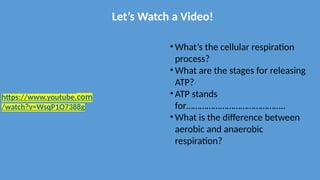
Let’s Watch aVideo!
• What’s the cellular respiration
process?
• What are the stages for releasing
ATP?
• ATP stands
for……………………………………..
• What is the difference between
aerobic and anaerobic
respiration?
7.
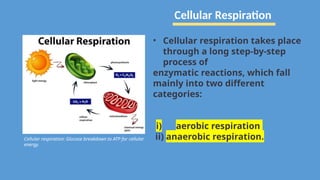
Cellular respiration: Glucosebreakdown to ATP for cellular
energy.
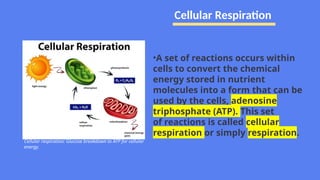
•A set of reactions occurs within
cells to convert the chemical
energy stored in nutrient
molecules into a form that can be
used by the cells, adenosine
triphosphate (ATP). This set
of reactions is called cellular
respiration or simply respiration.
Cellular Respiration
8.
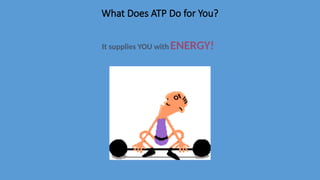
What Does ATPDo for You?
It supplies YOU with ENERGY!
9.
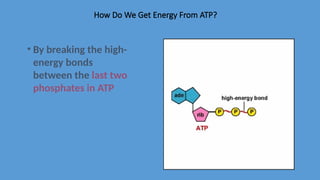
How Do WeGet Energy From ATP?
• By breaking the high-
energy bonds
between the last two
phosphates in ATP
Cellular respiration: Glucosebreakdown to ATP for cellular
energy.
• Cellular respiration takes place
through a long step-by-step
process of
enzymatic reactions, which fall
mainly into two different
categories:
i) aerobic respiration
ii) anaerobic respiration.
Cellular Respiration
12.
ATP: The EnergyCurrency
Adenosine triphosphate (ATP) is the common energy
currency used by cells. All living cells need ATP to perform
the needed activities to sustain life. The more active a cell is,
the more ATP it needs. However, cells do not store large amounts of ready-to-
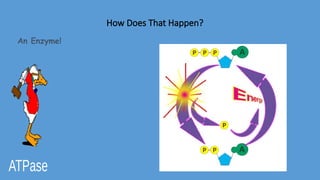
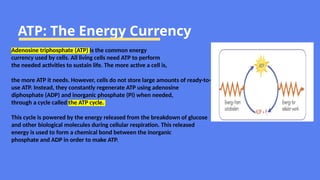
use ATP. Instead, they constantly regenerate ATP using adenosine
diphosphate (ADP) and inorganic phosphate (Pi) when needed,
through a cycle called the ATP cycle.
This cycle is powered by the energy released from the breakdown of glucose
and other biological molecules during cellular respiration. This released
energy is used to form a chemical bond between the inorganic
phosphate and ADP in order to make ATP.
13.
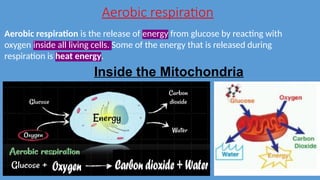
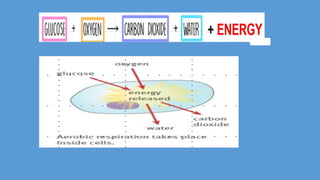
Aerobic respiration
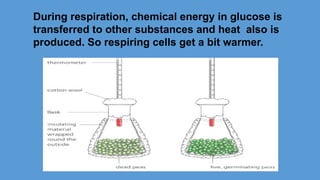
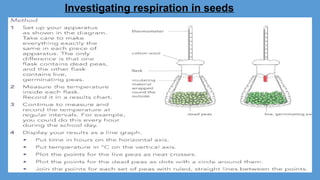
Aerobic respirationis the release of energy from glucose by reacting with
oxygen inside all living cells. Some of the energy that is released during
respiration is heat energy.
Inside the Mitochondria
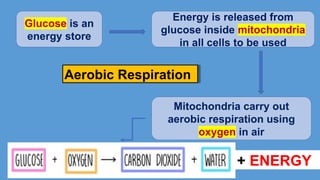
14.
Glucose is an
energystore
Mitochondria carry out
aerobic respiration using
oxygen in air
+ ENERGY
Aerobic Respiration
Energy is released from
glucose inside mitochondria
in all cells to be used
16.
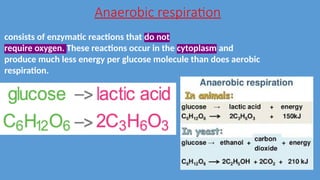
Anaerobic respiration
consists ofenzymatic reactions that do not
require oxygen. These reactions occur in the cytoplasm and
produce much less energy per glucose molecule than does aerobic
respiration.
17.
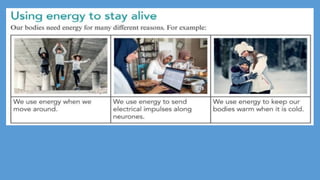
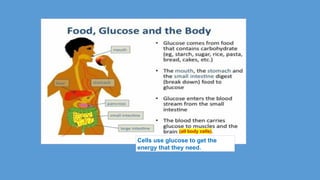
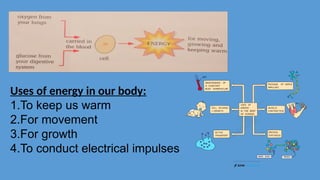
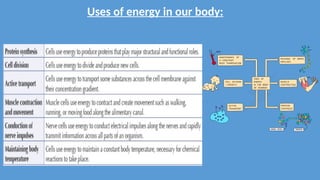
Uses of energyin our body:
1.To keep us warm
2.For movement
3.For growth
4.To conduct electrical impulses
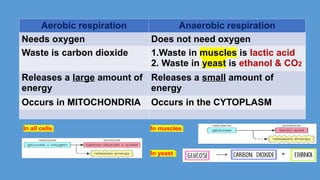
Aerobic respiration Anaerobicrespiration
Needs oxygen Does not need oxygen
Waste is carbon dioxide 1.Waste in muscles is lactic acid
2. Waste in yeast is ethanol & CO2
Releases a large amount of
energy
Releases a small amount of
energy
Occurs in MITOCHONDRIA Occurs in the CYTOPLASM
In muscles:
In yeast :
In all cells:




![Respiration_and_Aerobic_Respiration_Grade8 [Autosaved].pptx](https://cdn.slidesharecdn.com/ss_thumbnails/respirationandaerobicrespirationgrade8autosaved-260111053345-527fa963-thumbnail.jpg?width=640&height=640&fit=bounds)
![Respiration_and_Aerobic_Respiration_Grade8 [Autosaved].pptx](https://cdn.slidesharecdn.com/ss_thumbnails/respirationandaerobicrespirationgrade8autosaved-251229082428-28ccd008-thumbnail.jpg?width=640&height=640&fit=bounds)


![7[1].1 the respiratory process in energy production](https://cdn.slidesharecdn.com/ss_thumbnails/71-1-therespiratoryprocessinenergyproduction-120601182218-phpapp02-thumbnail.jpg?width=640&height=640&fit=bounds)
![7[1].1 the respiratory process in energy production](https://cdn.slidesharecdn.com/ss_thumbnails/71-1-therespiratoryprocessinenergyproduction-120601180320-phpapp02-thumbnail.jpg?width=640&height=640&fit=bounds)


