AT on a shoestring


  Low cost AAC & AT
Firstly..
• Assistive Technology encompasses lots!

• Lowtech hardware for better ergonomic usage (e.g. A grip on a
  tool, a piece of mounting equipment). This tech requires
  manual hacking to adapt it.

• Technology specifically designed for a need to make
  something better e.g. Electronic aids from battery devices to
  mains and bigger battery devices (Lion) to aid communication.
  This tech often allows for adaption through software or
  soldering ... Or not!

• If you can get what you need off a shelf and only a small
  amount of adaption then do..
.. A word of caution...
• Free is rarely best. Neither is paid for. Custom
  generally is.

• Remember your role and those involved - how
  hard is it for them to use the equipment? What
  needs to be done to make it failsafe? Don’t
  think of the technology then the person. Think
  of the problem or the need first then find the
  best technology. Define what you mean by
  best
a quick comment on today..
Plan: Communication, Access, DIY Software
adaptions, Environmental Control. PLAY!
•Our ideas! Maybe not everybody elses! The aim
is to give some current tidbits and a flavour of the
kinds of things you can do..
•If you can learn how to do it.. All the better!
•The good thing about lowcost methods is that
you aren‘t the only one.. Others need the same
solution and get stuck too! Get online :)
Sourcing Solutions
•   Newsgroups/Lists: SENIT, CM, Access
    group, Assistech

•   OATSoft: But note only strictly opensource!

•   AbilityNet Database but can be out of date

•   And AT Search

•   ...For real customised solutions: MERU or
    Remap

•   Realisepotential.org
Communication

• Some reminders:
 – Multi-modal methods of
   communication are best. Don’t
   rely on one thing.
 – Remember low-tech options
   should be tried first - and often
   continued along higher-tech
   methods
 – Communication is complex.
   Ask for advice!
Low-tech

• Many forms of presentation
• Books, charts, flash cards,
  Talking Mats, Keyrings,
  etc..
• Either use photos or
  symbols..
• But photos can be tricky to
  print..
Printing Photos
                       Remember Polaroid?


Prints: 5cm x 7.5cm with sticky    Printer: £20-40, wireless
     back, pack of 70: £10                Camera: ?
Laminating
• Self-laminating sheets cost around
  £30 for a pack of 100. But do look
  out if they are matt or gloss
• Inclusive sell poly-paper, 100
  sheets for £29. If you want to buy
  quite a bit more than one pack and
  want a discount - try Inclusive.
  Also called Zecom paper and
  called “Ruff n Tuff” paper in the
  states but not a lot cheaper
Symbols

• Printing symbols..

• You may be “fixed” to a symbol •    PCS (Boardmaker)
  system either due to a cost
  investment already made or a •      Widgit (WLS) (Aware of
  whole school approach (e.g.         Symbolworld?)
  timetabling)
                                  •   Makaton
• Important to individualise each
  students personal language      •   Symbolstix
SymbolStix

• Developed by
  News2You
• Either available
  regular - with
  your software
  or online $99/yr
• Can request a
  symbol
Open symbol systems
Open = Open source.
                            •   Picto; 4769 symbols. VI friendly. Multiple choices.
“Denoting software for          http://www.sclera.be/index.php?taal=ENG
which the original source
code is made freely         •   Mulberry http://straight-street.com/
available and may be
redistributed with or       •   ARASAAC http://www.catedu.es/arasaac/
without modification.”
                            •   Augmentativa http://www.aumentativa.net/
Different licences but
essentially free!           •   Ask for one! http://talksense.weebly.com/symbols.html
Making Charts
•   Do you do any of the dynamic stuff with Boardmaker? Do you or your parents need all the dynamic stuff?!

•   Is it for just printing out charts and the odd symbol?

•   Consider Matrix Maker: £49 for home use, £129 otherwise

•   EdWord (& EdWeb)

•   AEGIS Concept Coding Framework - in Open Office
Grid communication

         • In-TIC (In-ICT) is one of
           numerous open source
           projects developed by Orange
           Foundation, iMedia group &
           University of Corona

         • Can be hard to translate(!) but
           worth a play

         • Recently available on Android

         • 2 Options - with ARASAAC
           and one with ARASAAC &
           Augmentativa
Grid Communication
             • Maavis
             • Designed originally
               as a starting
               application for those
               wanting simple
               computer access
             • Can do many things
               other than just linking
               to applications. E.g.
               Run Skype, Picture
               galleries etc
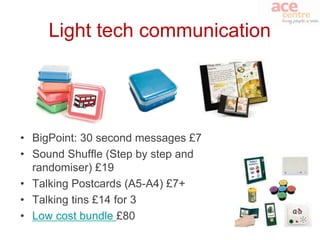
Light tech communication


• BigPoint: 30 second messages £7
• Sound Shuffle (Step by step and
  randomiser) £19
• Talking Postcards (A5-A4) £7+
• Talking tins £14 for 3
• Low cost bundle £80
High-tech Communication

• Apple’s iDevices (iPod touch, iPad & iPhone) allow the cost of a
  handheld AAC aid to be purchased for around £200-£450 (compared
  with approx £2k). 133 AAC apps. Some things are locked down
  though: for example keyboard layout. Apps are rigorously tested and
  relatively bug free.
• Lots of free-£0.59 apps for cause & effect type activities
• Android devices are easier/free to develop on. As such a number of
  keyboard designs are available with prediction. With a TTS system =
  An AAC aid. Easier right now to add in external hardware - for
  example switches and keyboards with Tekla. Apps aren‘t tested and
  are (often) a bit more hit or miss.
• Speechbubble & Appsforaac
High-tech Communication

• Windows Platform devices
• Powerbox 7 = A Sahara Tablet PC (£999), a Backbox
  (£139-550 with GEWA) and a customised
  shell/housing (???) = £5000
• If you don’t need the housing, extra battery or
  speakers consider buying the tablet - but do think
  about its usage. You also get support remember! (and
  v1 tablet PC’s do have a tendency to break!)
Before we continue..
•   Linux!

•   Not really
    covering
    today but it
    is certainly
    low-cost

•   Ubuntu is
    the most
    popular and
    easiest to
    use distro

•   Read the
    accessibility
    guide,
BREAK! But feel free to play
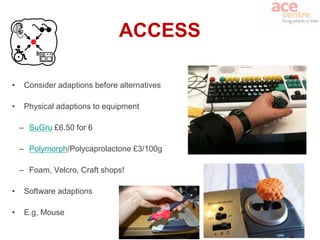
ACCESS

•    Consider adaptions before alternatives

•    Physical adaptions to equipment

    – SuGru £6.50 for 6

    – Polymorph/Polycaprolactone £3/100g

    – Foam, Velcro, Craft shops!

•    Software adaptions

•    E.g, Mouse
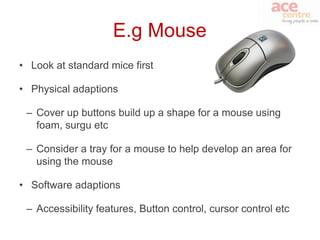
E.g Mouse
• Look at standard mice first

• Physical adaptions

 – Cover up buttons build up a shape for a mouse using
   foam, surgu etc

 – Consider a tray for a mouse to help develop an area for
   using the mouse

• Software adaptions

 – Accessibility features, Button control, cursor control etc
Pointer control Adaptions
• Accessibility options
• Change of cursors (ACE Centre Cursors,
  Enormouse)
• TouchFreeze
• SteadyMouse
Alternatives to a mouse
•   Joysticks, Traxys Roller Plus £285, Traxys roller
    Joystick £179, Pointit, EasiTrax £127, Optima £169.
    Pointit!


• Standard SEN focused devices have functions
  e.g. Scroll button, drag lock buttons. Do
  students require these?
Mouse button
  Control
• A drag lock feature
  you may be paying
  £300 for.
• Mouser, Plus switch
  latching box for drag
  lock
• Point n click
• Autohotkey
Regular Joysticks
• Can use a range of regular joysticks
  (although not many available!).
  Joy2mouse software available to convert
  it to a mouse. Available from keytools £70
  or download a free clone (or make one!
  Using autohotkey)
Developing Access Skills
•   Cheap ways to develop your skills
•   Failsafe activities
•   E.g. Pointer control Mouseskills £12
•   HelpKizLearn, TuxPaint, Cbeebies, Flash
    Games
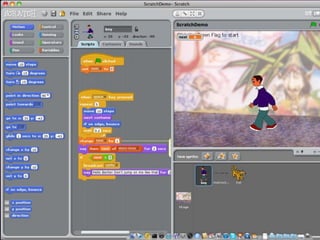
Scratch

• Want the more dynamic boardmaker type
  things?
• Scratch is a visual programming language
  designed to help teach programming to
  young children
• Developed and supported by MIT lifelong
  learning lab
Scratch Demo
• Demos/Scratch/1. Monkey
  Dress up

• Click the green flag

• Click on each of the clothes

• Change the monkey to a
  person

• Add some clothes

• Take a look at my (poor)
  attempts at a switch story
Keyboard
•   Regular keyboards are aplenty

•   Look carefully at the features of the keys that are needed (size,
    separation, travel, feedback)

•   Adapt as necessary

•   Hardware: Stickers, Keyguards, Wedge,

•   Software: Accessibility options, Onscreen keyboards (Click-N-Type)

•   Developing skills: Keyboard Shortcuts, Word & Abbreviation
    Expansion, Mouseless browsing, Launchy

•   LetMeType for Word Prediction (but look for some dictionaries)
Switches
• Ablenet (Specs- £27) vs Inclusive
  (Smoothie - £25) switches
• Hard to find cheap options!
• Do consider the switch features needed
• Maxess wedges = foam, perspex..
• Use velcro directly to tray table or use
  dycem (gorilla grip from £1 shops!)
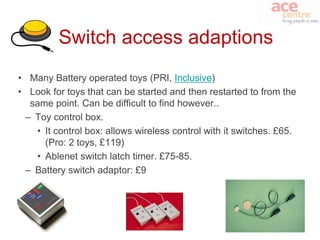
Switch access adaptions
• Many Battery operated toys (PRI, Inclusive)
• Look for toys that can be started and then restarted to from the
  same point. Can be difficult to find however..
 – Toy control box.
   • It control box: allows wireless control with it switches. £65.
     (Pro: 2 toys, £119)
   • Ablenet switch latch timer. £75-85.
 – Battery switch adaptor: £9
Adapting Toys

• See the ACE Centre website for
  Soldering approach

• Look for toys with a variety of rewards -
  you can build an activity around e.g. A
  toy washing machine etc,

• See LetsPlay! From Buffalo University
  for lots of ideas around toys and
  choosing toys
Switch & Computer

•    Switch boxes are aplenty

•    Inclusive Space & Enter box: £35. Crick:
     £99, Inclusive Multiswitch: £95, JoyCable:
     £49

•    Developing switch skills

    – Inclusive - Developing Switch Skills (with
      scanning)

    – Powerpoint/Adobe Reader slide-show

    – SENSwitcher

    – Games: oneswitch e.g Run Rabbit Run
Switches to control the
              computer
•   The Grid and Computer control
•   In-TIC
•   SAW. Switch Access to Windows.
•   E.g. On-Screen Keyboard, IE, Access
    Maths
Eyegaze

• Consider Facial
  recognition software
  e.g. Enable e-
  viacam, Facemouse,
  Camera Mouse
• Open source eye-
  tracking solutions
  aren‘t great at
  tracking head
  movement too
Eyegaze
    •   Opengazer, Cambridge
        Inference Group. No
        binary available.

    •   ITU tracker. Technically
        very accurate with a fine
        resolution. Need IR
        camera

    •   Eyewriter

    •   TrackEye

    •   myEye

    •   OpenEyes
Eyegaze software adaptions
•   Free games using flash - but not
    fullscreen

•   1. MouseTrap

•   2. Run flash standalone - then
    fullscreen…

•   To do this use the flash projector
    converter (but games need to be
    self-contained - not accessing the
    web)

•   1. Jacksonpollock.org

•   2. Find .swf link and load that. Save
    as..

•   3. Open in standalone and “Create
    projector”

•   4. Run exe and ctrl+f for full-screen
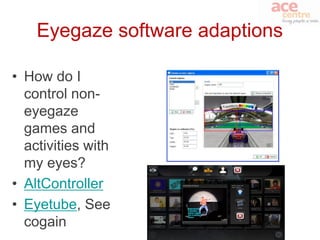
Eyegaze software adaptions

• How do I
  control non-
  eyegaze
  games and
  activities with
  my eyes?
• AltController
• Eyetube, See
  cogain
LUNCH
DIY software adaptions
• What do you need to do?
• “Tweaks” to operating system settings
  and many software settings can be done
  in the registry
• Demo registry editing
• See
  http://support.microsoft.com/kb/136393 -
  in short backup first!
RegEdit
• Need: “Turn
  on and off
  filter keys and
  change
  bounce time
  to less than
  0.5 seconds”
• 1. Look for
  options
  standard way
RegEdit

•   2. Search registry
    3. Edit registry.
    Did it work?!
    4. Export a .reg
    file. Edit in a text
    editor if
    necessary.
    5. Run on
    computer!
Autohotkey
      The software equivalent of velcro
• Input method tweaks = Autohotkey
• http://www.autohotkey.com/
• Great for keyboard mapping (or mouse
  mapping.. Or joystick mapping..)
Example
• “Disable the mouse buttons so a child can
  use a switch for the left and right click
  instead”
LButton::B

(Press the Left Mouse button - and it sends a
capital B to the screen)

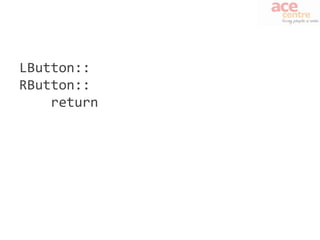
LButton::
return

(Press the left button and just “return” i.e. Do
nothing)
LButton::
RButton::
    return
LButton::
RButton::
    Return
; cntrl+s
^s::Suspend
Have a go!
• Ideas
 – Map the Q key to an A etc.. - to make a ABC
   keyboard..
 – Make a switch box piece of software (hint a
   switch box is secretly a joystick and the 1 button
   is Joy1 and Joy2 etc..
Creating your own software -
            Options
• RegEdit
• AutoHotkey
• Flash - although note not supported
  widely on new tablet PCs
• Processing.org (Example: CircleArt)
BREAK! But feel free to Play
     with software
Environmental Control
• i.e controlling toys, physical devices,
  equipment away from the computer
A brief (and scant) history of
         connecting tech
• Infrared (IR)
   – Possum range
   – Home Entertainment systems (Phillips, etc)
   – Cheap toys
• Radio
   – Home easy
   – Zigbee
   – Proprietary
• Bluetooth
• Wifi
   – TCP/IP
   – Web servers
“I want to control my TV with
     my Communication Aid”
• What is the aid? Is it easier to buy the
  licence to enable the IR device that may
  be already in the machine (e.g. Tobii..)
• Does the retailer offer a solution?
• What software are you already using?
IR Controllers

•   GEWA Prog, BigJack (£541)
•   TIRA £50-80
•   USBUIRT £50-80
•   IR-3SP £350
•   (Airlink)
•   Advocate+ £395 (but also look
    at freeway etc..)

• DIY (Arduino etc)
IR Devices
• Possum (& the Powerlink 3)
• Home entertainment equipment (TVs, DVDs, Hifi,
  Computers..)
• Toys
   – Simple e.g. Tesco’s £2.99 toys but random usage
   – Complex e.g. robosapiens but IR commands can
     be be hard to capture
• Lowcost Home Automation / Energy saving devices
  e.g. plug sockets
To control your TV
• Train the device with the code
• Plug in switch
• Press the switch

• So simple right?
To control your TV
• Train the device with the code
• Stuck
• Not all infrared toys are equal


• Demo with BigJack and UIRT
Play a video / song with a
              switch
• Playing music could be done with a iPod
  switcher (£305).
• You could try switch timing with a toy
  controller
• But if you have a computer you could just
  use iTunes or any other media player
  (Space = Play/Pause. Most switch boxes
  = Space).
• Latching – but for timed..
Control software
• WDPS IRCommand
• EventGhost

• Walkthrough of how its done 
What about this?
• Press a switch (either directly linked to a
  computer or via a infrared sending device)
• Turn a light off
• Activate a slideshow/movie for a set
  period of time
• Turn a light on

• Demo
Conclude
• What is best?
• Consider man hours, reliability and
  appearance
• Is cheap always better?
• Cost shouldn’t be the driver. The right
  solution should be

Low Cost Assistive Technology Solutions

  • 1.
    AT on ashoestring Low cost AAC & AT
  • 2.
    Firstly.. • Assistive Technologyencompasses lots! • Lowtech hardware for better ergonomic usage (e.g. A grip on a tool, a piece of mounting equipment). This tech requires manual hacking to adapt it. • Technology specifically designed for a need to make something better e.g. Electronic aids from battery devices to mains and bigger battery devices (Lion) to aid communication. This tech often allows for adaption through software or soldering ... Or not! • If you can get what you need off a shelf and only a small amount of adaption then do..
  • 3.
    .. A wordof caution... • Free is rarely best. Neither is paid for. Custom generally is. • Remember your role and those involved - how hard is it for them to use the equipment? What needs to be done to make it failsafe? Don’t think of the technology then the person. Think of the problem or the need first then find the best technology. Define what you mean by best
  • 4.
    a quick commenton today.. Plan: Communication, Access, DIY Software adaptions, Environmental Control. PLAY! •Our ideas! Maybe not everybody elses! The aim is to give some current tidbits and a flavour of the kinds of things you can do.. •If you can learn how to do it.. All the better! •The good thing about lowcost methods is that you aren‘t the only one.. Others need the same solution and get stuck too! Get online :)
  • 5.
    Sourcing Solutions • Newsgroups/Lists: SENIT, CM, Access group, Assistech • OATSoft: But note only strictly opensource! • AbilityNet Database but can be out of date • And AT Search • ...For real customised solutions: MERU or Remap • Realisepotential.org
  • 6.
    Communication • Some reminders: – Multi-modal methods of communication are best. Don’t rely on one thing. – Remember low-tech options should be tried first - and often continued along higher-tech methods – Communication is complex. Ask for advice!
  • 7.
    Low-tech • Many formsof presentation • Books, charts, flash cards, Talking Mats, Keyrings, etc.. • Either use photos or symbols.. • But photos can be tricky to print..
  • 8.
    Printing Photos Remember Polaroid? Prints: 5cm x 7.5cm with sticky Printer: £20-40, wireless back, pack of 70: £10 Camera: ?
  • 9.
    Laminating • Self-laminating sheetscost around £30 for a pack of 100. But do look out if they are matt or gloss • Inclusive sell poly-paper, 100 sheets for £29. If you want to buy quite a bit more than one pack and want a discount - try Inclusive. Also called Zecom paper and called “Ruff n Tuff” paper in the states but not a lot cheaper
  • 10.
    Symbols • Printing symbols.. •You may be “fixed” to a symbol • PCS (Boardmaker) system either due to a cost investment already made or a • Widgit (WLS) (Aware of whole school approach (e.g. Symbolworld?) timetabling) • Makaton • Important to individualise each students personal language • Symbolstix
  • 11.
    SymbolStix • Developed by News2You • Either available regular - with your software or online $99/yr • Can request a symbol
  • 12.
    Open symbol systems Open= Open source. • Picto; 4769 symbols. VI friendly. Multiple choices. “Denoting software for http://www.sclera.be/index.php?taal=ENG which the original source code is made freely • Mulberry http://straight-street.com/ available and may be redistributed with or • ARASAAC http://www.catedu.es/arasaac/ without modification.” • Augmentativa http://www.aumentativa.net/ Different licences but essentially free! • Ask for one! http://talksense.weebly.com/symbols.html
  • 13.
    Making Charts • Do you do any of the dynamic stuff with Boardmaker? Do you or your parents need all the dynamic stuff?! • Is it for just printing out charts and the odd symbol? • Consider Matrix Maker: £49 for home use, £129 otherwise • EdWord (& EdWeb) • AEGIS Concept Coding Framework - in Open Office
  • 14.
    Grid communication • In-TIC (In-ICT) is one of numerous open source projects developed by Orange Foundation, iMedia group & University of Corona • Can be hard to translate(!) but worth a play • Recently available on Android • 2 Options - with ARASAAC and one with ARASAAC & Augmentativa
  • 15.
    Grid Communication • Maavis • Designed originally as a starting application for those wanting simple computer access • Can do many things other than just linking to applications. E.g. Run Skype, Picture galleries etc
  • 16.
    Light tech communication •BigPoint: 30 second messages £7 • Sound Shuffle (Step by step and randomiser) £19 • Talking Postcards (A5-A4) £7+ • Talking tins £14 for 3 • Low cost bundle £80
  • 17.
    High-tech Communication • Apple’siDevices (iPod touch, iPad & iPhone) allow the cost of a handheld AAC aid to be purchased for around £200-£450 (compared with approx £2k). 133 AAC apps. Some things are locked down though: for example keyboard layout. Apps are rigorously tested and relatively bug free. • Lots of free-£0.59 apps for cause & effect type activities • Android devices are easier/free to develop on. As such a number of keyboard designs are available with prediction. With a TTS system = An AAC aid. Easier right now to add in external hardware - for example switches and keyboards with Tekla. Apps aren‘t tested and are (often) a bit more hit or miss. • Speechbubble & Appsforaac
  • 18.
    High-tech Communication • WindowsPlatform devices • Powerbox 7 = A Sahara Tablet PC (£999), a Backbox (£139-550 with GEWA) and a customised shell/housing (???) = £5000 • If you don’t need the housing, extra battery or speakers consider buying the tablet - but do think about its usage. You also get support remember! (and v1 tablet PC’s do have a tendency to break!)
  • 19.
    Before we continue.. • Linux! • Not really covering today but it is certainly low-cost • Ubuntu is the most popular and easiest to use distro • Read the accessibility guide,
  • 20.
    BREAK! But feelfree to play
  • 21.
    ACCESS • Consider adaptions before alternatives • Physical adaptions to equipment – SuGru £6.50 for 6 – Polymorph/Polycaprolactone £3/100g – Foam, Velcro, Craft shops! • Software adaptions • E.g, Mouse
  • 22.
    E.g Mouse • Lookat standard mice first • Physical adaptions – Cover up buttons build up a shape for a mouse using foam, surgu etc – Consider a tray for a mouse to help develop an area for using the mouse • Software adaptions – Accessibility features, Button control, cursor control etc
  • 23.
    Pointer control Adaptions •Accessibility options • Change of cursors (ACE Centre Cursors, Enormouse) • TouchFreeze • SteadyMouse
  • 24.
    Alternatives to amouse • Joysticks, Traxys Roller Plus £285, Traxys roller Joystick £179, Pointit, EasiTrax £127, Optima £169. Pointit! • Standard SEN focused devices have functions e.g. Scroll button, drag lock buttons. Do students require these?
  • 25.
    Mouse button Control • A drag lock feature you may be paying £300 for. • Mouser, Plus switch latching box for drag lock • Point n click • Autohotkey
  • 26.
    Regular Joysticks • Canuse a range of regular joysticks (although not many available!). Joy2mouse software available to convert it to a mouse. Available from keytools £70 or download a free clone (or make one! Using autohotkey)
  • 27.
    Developing Access Skills • Cheap ways to develop your skills • Failsafe activities • E.g. Pointer control Mouseskills £12 • HelpKizLearn, TuxPaint, Cbeebies, Flash Games
  • 28.
    Scratch • Want themore dynamic boardmaker type things? • Scratch is a visual programming language designed to help teach programming to young children • Developed and supported by MIT lifelong learning lab
  • 30.
    Scratch Demo • Demos/Scratch/1.Monkey Dress up • Click the green flag • Click on each of the clothes • Change the monkey to a person • Add some clothes • Take a look at my (poor) attempts at a switch story
  • 31.
    Keyboard • Regular keyboards are aplenty • Look carefully at the features of the keys that are needed (size, separation, travel, feedback) • Adapt as necessary • Hardware: Stickers, Keyguards, Wedge, • Software: Accessibility options, Onscreen keyboards (Click-N-Type) • Developing skills: Keyboard Shortcuts, Word & Abbreviation Expansion, Mouseless browsing, Launchy • LetMeType for Word Prediction (but look for some dictionaries)
  • 32.
    Switches • Ablenet (Specs-£27) vs Inclusive (Smoothie - £25) switches • Hard to find cheap options! • Do consider the switch features needed • Maxess wedges = foam, perspex.. • Use velcro directly to tray table or use dycem (gorilla grip from £1 shops!)
  • 33.
    Switch access adaptions •Many Battery operated toys (PRI, Inclusive) • Look for toys that can be started and then restarted to from the same point. Can be difficult to find however.. – Toy control box. • It control box: allows wireless control with it switches. £65. (Pro: 2 toys, £119) • Ablenet switch latch timer. £75-85. – Battery switch adaptor: £9
  • 34.
    Adapting Toys • Seethe ACE Centre website for Soldering approach • Look for toys with a variety of rewards - you can build an activity around e.g. A toy washing machine etc, • See LetsPlay! From Buffalo University for lots of ideas around toys and choosing toys
  • 35.
    Switch & Computer • Switch boxes are aplenty • Inclusive Space & Enter box: £35. Crick: £99, Inclusive Multiswitch: £95, JoyCable: £49 • Developing switch skills – Inclusive - Developing Switch Skills (with scanning) – Powerpoint/Adobe Reader slide-show – SENSwitcher – Games: oneswitch e.g Run Rabbit Run
  • 36.
    Switches to controlthe computer • The Grid and Computer control • In-TIC • SAW. Switch Access to Windows. • E.g. On-Screen Keyboard, IE, Access Maths
  • 37.
    Eyegaze • Consider Facial recognition software e.g. Enable e- viacam, Facemouse, Camera Mouse • Open source eye- tracking solutions aren‘t great at tracking head movement too
  • 38.
    Eyegaze • Opengazer, Cambridge Inference Group. No binary available. • ITU tracker. Technically very accurate with a fine resolution. Need IR camera • Eyewriter • TrackEye • myEye • OpenEyes
  • 39.
    Eyegaze software adaptions • Free games using flash - but not fullscreen • 1. MouseTrap • 2. Run flash standalone - then fullscreen… • To do this use the flash projector converter (but games need to be self-contained - not accessing the web) • 1. Jacksonpollock.org • 2. Find .swf link and load that. Save as.. • 3. Open in standalone and “Create projector” • 4. Run exe and ctrl+f for full-screen
  • 40.
    Eyegaze software adaptions •How do I control non- eyegaze games and activities with my eyes? • AltController • Eyetube, See cogain
  • 41.
  • 42.
    DIY software adaptions •What do you need to do? • “Tweaks” to operating system settings and many software settings can be done in the registry • Demo registry editing • See http://support.microsoft.com/kb/136393 - in short backup first!
  • 43.
    RegEdit • Need: “Turn on and off filter keys and change bounce time to less than 0.5 seconds” • 1. Look for options standard way
  • 44.
    RegEdit • 2. Search registry 3. Edit registry. Did it work?! 4. Export a .reg file. Edit in a text editor if necessary. 5. Run on computer!
  • 45.
    Autohotkey The software equivalent of velcro • Input method tweaks = Autohotkey • http://www.autohotkey.com/ • Great for keyboard mapping (or mouse mapping.. Or joystick mapping..)
  • 46.
    Example • “Disable themouse buttons so a child can use a switch for the left and right click instead”
  • 47.
    LButton::B (Press the LeftMouse button - and it sends a capital B to the screen) LButton:: return (Press the left button and just “return” i.e. Do nothing)
  • 48.
  • 49.
    LButton:: RButton:: Return ; cntrl+s ^s::Suspend
  • 50.
    Have a go! •Ideas – Map the Q key to an A etc.. - to make a ABC keyboard.. – Make a switch box piece of software (hint a switch box is secretly a joystick and the 1 button is Joy1 and Joy2 etc..
  • 51.
    Creating your ownsoftware - Options • RegEdit • AutoHotkey • Flash - although note not supported widely on new tablet PCs • Processing.org (Example: CircleArt)
  • 52.
    BREAK! But feelfree to Play with software
  • 53.
    Environmental Control • i.econtrolling toys, physical devices, equipment away from the computer
  • 54.
    A brief (andscant) history of connecting tech • Infrared (IR) – Possum range – Home Entertainment systems (Phillips, etc) – Cheap toys • Radio – Home easy – Zigbee – Proprietary • Bluetooth • Wifi – TCP/IP – Web servers
  • 55.
    “I want tocontrol my TV with my Communication Aid” • What is the aid? Is it easier to buy the licence to enable the IR device that may be already in the machine (e.g. Tobii..) • Does the retailer offer a solution? • What software are you already using?
  • 56.
    IR Controllers • GEWA Prog, BigJack (£541) • TIRA £50-80 • USBUIRT £50-80 • IR-3SP £350 • (Airlink) • Advocate+ £395 (but also look at freeway etc..) • DIY (Arduino etc)
  • 57.
    IR Devices • Possum(& the Powerlink 3) • Home entertainment equipment (TVs, DVDs, Hifi, Computers..) • Toys – Simple e.g. Tesco’s £2.99 toys but random usage – Complex e.g. robosapiens but IR commands can be be hard to capture • Lowcost Home Automation / Energy saving devices e.g. plug sockets
  • 58.
    To control yourTV • Train the device with the code • Plug in switch • Press the switch • So simple right?
  • 59.
    To control yourTV • Train the device with the code • Stuck • Not all infrared toys are equal • Demo with BigJack and UIRT
  • 60.
    Play a video/ song with a switch • Playing music could be done with a iPod switcher (£305). • You could try switch timing with a toy controller • But if you have a computer you could just use iTunes or any other media player (Space = Play/Pause. Most switch boxes = Space). • Latching – but for timed..
  • 61.
    Control software • WDPSIRCommand • EventGhost • Walkthrough of how its done 
  • 62.
    What about this? •Press a switch (either directly linked to a computer or via a infrared sending device) • Turn a light off • Activate a slideshow/movie for a set period of time • Turn a light on • Demo
  • 63.
    Conclude • What isbest? • Consider man hours, reliability and appearance • Is cheap always better? • Cost shouldn’t be the driver. The right solution should be