ASSISTIVE TECHNOLOGY
IN THE WORKPLACE
Technology Access Center
WHAT IS ASSISTIVE TECHNOLOGY?
ASSISTIVE TECHNOLOGY (AT)
DECISION MAKING
• There are many tools and devices that are readily available. Where do I start? Be
sure that at considerations are student centered, not device centered.
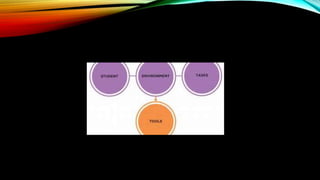
Before considering AT devices ask the following questions:
• What can the student do right now?
• What environments will the individual need the AT?
• What Tasks need to be performed? What is the desired outcome?
• What Tools have been tried previously, successful or not?
AT DECISION MAKING
Questions we will answer today:
• What makes a device a good choice?
• How do I know what will work best for an individual?
• How do I know if the AT device is effective?
ASSISTIVE TECHNOLOGY FOR
COMPUTER ACCESS
• Care must be taken to ensure that the proper tools are chosen to provide computer
access based on an individuals needs.
• Some examples of common questions to ask are:
• Does the individual know how to use a computer?
• If so, is there a particular operating system or platform that has been mastered?
• Can they touch type?
• What assistive technology is currently being used or has been used?
• What is the end result that is desired for using the computer?
• What environments will the assistive technology be used?
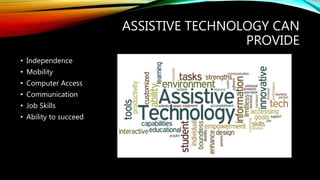
ASSISTIVE TECHNOLOGY CAN
PROVIDE
• Independence
• Mobility
• Computer Access
• Communication
• Job Skills
• Ability to succeed
COMPUTER ACCESSIBILITY
• For Visual Impairments/Blindness
• For Hard of Hearing/Deaf
• For Physical Impairments or Limitation
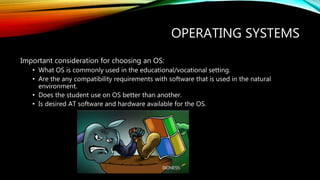
OPERATING SYSTEMS
Important consideration for choosing an OS:
• What OS is commonly used in the educational/vocational setting.
• Are the any compatibility requirements with software that is used in the natural
environment.
• Does the student use on OS better than another.
• Is desired AT software and hardware available for the OS.
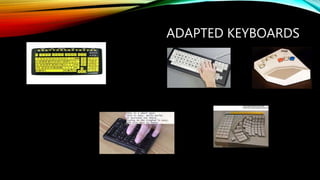
ADAPTED KEYBOARDS
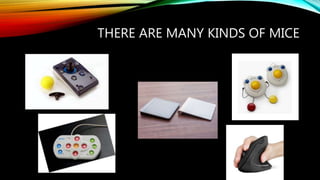
THERE ARE MANY KINDS OF MICE
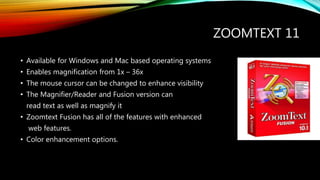
ZOOMTEXT 11
• Available for Windows and Mac based operating systems
• Enables magnification from 1x – 36x
• The mouse cursor can be changed to enhance visibility
• The Magnifier/Reader and Fusion version can
read text as well as magnify it
• Zoomtext Fusion has all of the features with enhanced
web features.
• Color enhancement options.
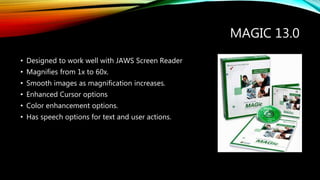
MAGIC 13.0
• Designed to work well with JAWS Screen Reader
• Magnifies from 1x to 60x.
• Smooth images as magnification increases.
• Enhanced Cursor options
• Color enhancement options.
• Has speech options for text and user actions.
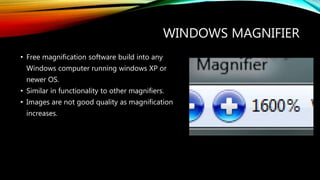
WINDOWS MAGNIFIER
• Free magnification software build into any
Windows computer running windows XP or
newer OS.
• Similar in functionality to other magnifiers.
• Images are not good quality as magnification
increases.
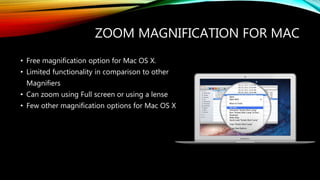
ZOOM MAGNIFICATION FOR MAC
• Free magnification option for Mac OS X.
• Limited functionality in comparison to other
Magnifiers
• Can zoom using Full screen or using a lense
• Few other magnification options for Mac OS X
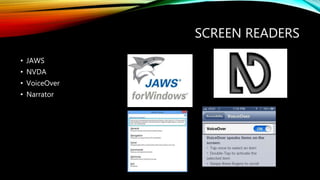
SCREEN READERS
• JAWS
• NVDA
• VoiceOver
• Narrator
J-SAY
• Enables voice accessibility to the blind and visually impaired.
• Requires
• Dragon
• JAWS
• J-Say
• Updates and upgrades must be completed in a certain order
• If not software must be removed and reinstalled.
• Training is time intensive because the user must know how to use JAWS and Dragon.
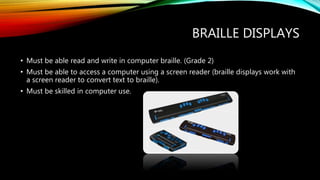
BRAILLE DISPLAYS
• Must be able read and write in computer braille. (Grade 2)
• Must be able to access a computer using a screen reader (braille displays work with
a screen reader to convert text to braille).
• Must be skilled in computer use.
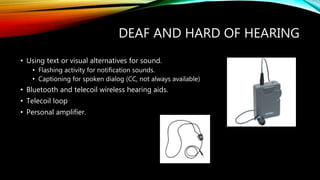
DEAF AND HARD OF HEARING
• Using text or visual alternatives for sound.
• Flashing activity for notification sounds.
• Captioning for spoken dialog (CC, not always available)
• Bluetooth and telecoil wireless hearing aids.
• Telecoil loop
• Personal amplifier.
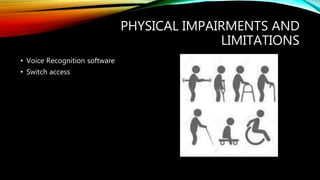
PHYSICAL IMPAIRMENTS AND
LIMITATIONS
• Voice Recognition software
• Switch access
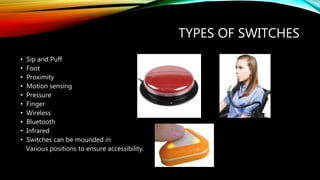
TYPES OF SWITCHES
• Sip and Puff
• Foot
• Proximity
• Motion sensing
• Pressure
• Finger
• Wireless
• Bluetooth
• Infrared
• Switches can be mounded in
Various positions to ensure accessibility.
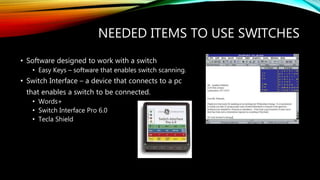
NEEDED ITEMS TO USE SWITCHES
• Software designed to work with a switch
• Easy Keys – software that enables switch scanning.
• Switch Interface – a device that connects to a pc
that enables a switch to be connected.
• Words+
• Switch Interface Pro 6.0
• Tecla Shield
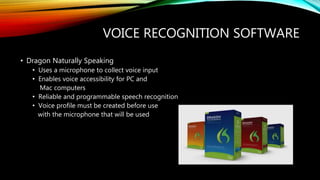
VOICE RECOGNITION SOFTWARE
• Dragon Naturally Speaking
• Uses a microphone to collect voice input
• Enables voice accessibility for PC and
Mac computers
• Reliable and programmable speech recognition
• Voice profile must be created before use
with the microphone that will be used
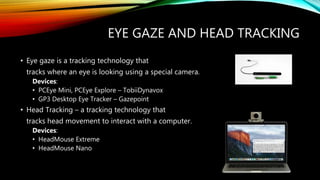
EYE GAZE AND HEAD TRACKING
• Eye gaze is a tracking technology that
tracks where an eye is looking using a special camera.
Devices:
• PCEye Mini, PCEye Explore – TobiiDynavox
• GP3 Desktop Eye Tracker – Gazepoint
• Head Tracking – a tracking technology that
tracks head movement to interact with a computer.
Devices:
• HeadMouse Extreme
• HeadMouse Nano
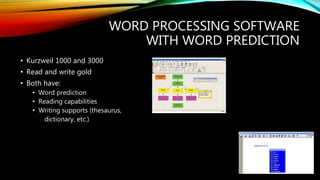
WORD PROCESSING SOFTWARE
WITH WORD PREDICTION
• Kurzweil 1000 and 3000
• Read and write gold
• Both have:
• Word prediction
• Reading capabilities
• Writing supports (thesaurus,
dictionary, etc.)
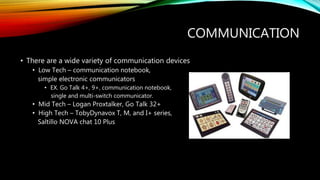
COMMUNICATION
• There are a wide variety of communication devices
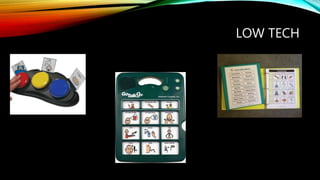
• Low Tech – communication notebook,
simple electronic communicators
• EX. Go Talk 4+, 9+, communication notebook,
single and multi-switch communicator.
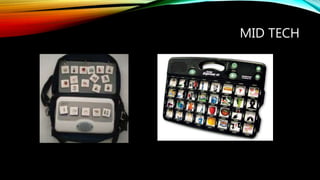
• Mid Tech – Logan Proxtalker, Go Talk 32+
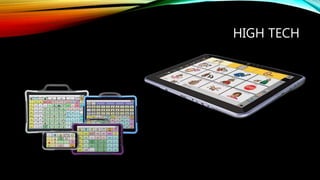
• High Tech – TobyDynavox T, M, and I+ series,
Saltillo NOVA chat 10 Plus
LOW TECH
MID TECH
HIGH TECH
CCTVS
• Student must be able to:
• Use controls
• Demonstrate early literacy skills and text awareness skills or be able to read
• Identify an appropriate magnification level
• Adjust contrast settings as needed.
Various electronic magnifiers are available:
• Stationary
• Portable
• Handheld
• Phone Applications (Android and IOS)
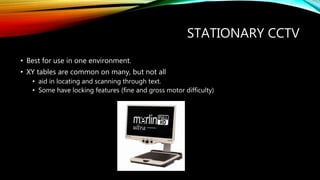
STATIONARY CCTV
• Best for use in one environment.
• XY tables are common on many, but not all
• aid in locating and scanning through text.
• Some have locking features (fine and gross motor difficulty)
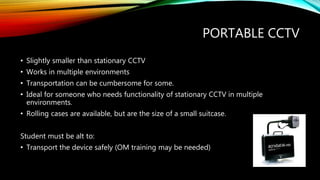
PORTABLE CCTV
• Slightly smaller than stationary CCTV
• Works in multiple environments
• Transportation can be cumbersome for some.
• Ideal for someone who needs functionality of stationary CCTV in multiple
environments.
• Rolling cases are available, but are the size of a small suitcase.
Student must be alt to:
• Transport the device safely (OM training may be needed)
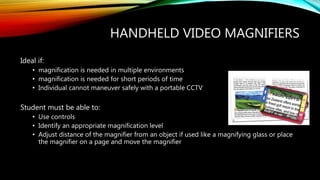
HANDHELD VIDEO MAGNIFIERS
Ideal if:
• magnification is needed in multiple environments
• magnification is needed for short periods of time
• Individual cannot maneuver safely with a portable CCTV
Student must be able to:
• Use controls
• Identify an appropriate magnification level
• Adjust distance of the magnifier from an object if used like a magnifying glass or place
the magnifier on a page and move the magnifier
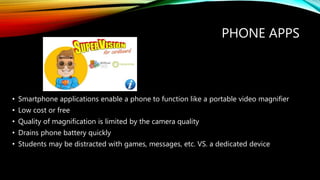
PHONE APPS
• Smartphone applications enable a phone to function like a portable video magnifier
• Low cost or free
• Quality of magnification is limited by the camera quality
• Drains phone battery quickly
• Students may be distracted with games, messages, etc. VS. a dedicated device
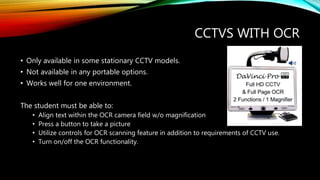
CCTVS WITH OCR
• Only available in some stationary CCTV models.
• Not available in any portable options.
• Works well for one environment.
The student must be able to:
• Align text within the OCR camera field w/o magnification
• Press a button to take a picture
• Utilize controls for OCR scanning feature in addition to requirements of CCTV use.
• Turn on/off the OCR functionality.
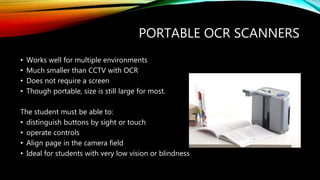
PORTABLE OCR SCANNERS
• Works well for multiple environments
• Much smaller than CCTV with OCR
• Does not require a screen
• Though portable, size is still large for most.
The student must be able to:
• distinguish buttons by sight or touch
• operate controls
• Align page in the camera field
• Ideal for students with very low vision or blindness
OCR PHONE APPLICATIONS
• Require a mobile device (Android or IOS)
• Commonly paired with mobile screen reader gestures (not required)
• Less expensive than dedicated device
• Student may become distracted with other functions of a mobile device
• Very portable
The student must be able to:
• Operate and navigate a smart phone to open application.
• Use controls with the touch screen
• Align document within the camera field (difficult for individuals with no vision)
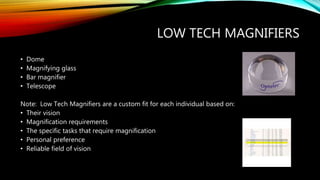
LOW TECH MAGNIFIERS
• Dome
• Magnifying glass
• Bar magnifier
• Telescope
Note: Low Tech Magnifiers are a custom fit for each individual based on:
• Their vision
• Magnification requirements
• The specific tasks that require magnification
• Personal preference
• Reliable field of vision
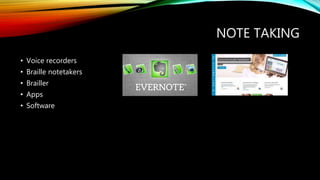
NOTE TAKING
• Voice recorders
• Braille notetakers
• Brailler
• Apps
• Software
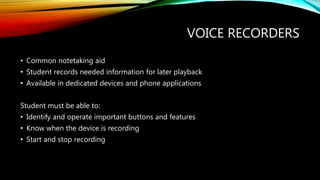
VOICE RECORDERS
• Common notetaking aid
• Student records needed information for later playback
• Available in dedicated devices and phone applications
Student must be able to:
• Identify and operate important buttons and features
• Know when the device is recording
• Start and stop recording
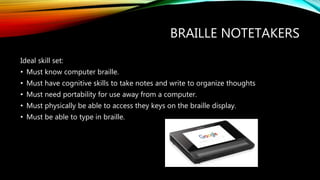
BRAILLE NOTETAKERS
Ideal skill set:
• Must know computer braille.
• Must have cognitive skills to take notes and write to organize thoughts
• Must need portability for use away from a computer.
• Must physically be able to access they keys on the braille display.
• Must be able to type in braille.
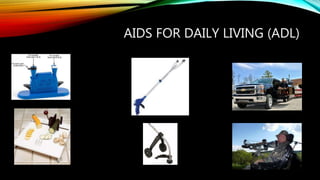
AIDS FOR DAILY LIVING (ADL)
ADL CONTINUED
• There are many more ADL tools that are available for different jobs and needs.
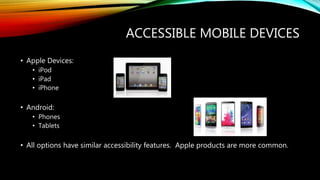
ACCESSIBLE MOBILE DEVICES
• Apple Devices:
• iPod
• iPad
• iPhone
• Android:
• Phones
• Tablets
• All options have similar accessibility features. Apple products are more common.
MOBILE DEVICES CONTINUED
• Accessibility on mobile devices:
• Can be easier to learn how to use for some individuals
• Is a good option if someone has a job that requires travel
• Cannot perform all tasks as well as a computer at the present time
HOW TO DETERMINE
EFFECTIVENESS
• Clear goals and expectations must be established.
• Services should align with the students goals and expectations that are outlined in
their IEP.
• Data must be collected to determine if a student is making progress or has achieved
their goals.
GOALS
• Must be clearly written.
• Must be measurable (must be able to track progress)
• Must be testable (anyone would get the same result if collecting data on the goal)
• Must be specific in the expected behavior or outcome.
Ex. Given a CCTV, Jennifer will use an XY table to read left to right and top to bottom
independently, with 80% accuracy for 10 school days.
DATA COLLECTION METHODS
• Frequency – records the number of times the students uses AT.
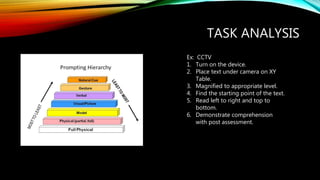
• Task analysis – task is broken up into sequential steps. Data reflects any challenging
steps areas. Data is collected using a prompt hierarchy.
• Duration – record how long the AT is used.
• Repeated opportunity – records the environment, time, and conditions where the AT
was used.
• Compare instructional data with AT to data without AT.
TASK ANALYSIS
Ex: CCTV
1. Turn on the device.
2. Place text under camera on XY
Table.
3. Magnified to appropriate level.
4. Find the starting point of the text.
5. Read left to right and top to
bottom.
6. Demonstrate comprehension
with post assessment.

Assistive Technology Selection for Employment

  • 1.
    ASSISTIVE TECHNOLOGY IN THEWORKPLACE Technology Access Center
  • 2.
    WHAT IS ASSISTIVETECHNOLOGY?
  • 3.
    ASSISTIVE TECHNOLOGY (AT) DECISIONMAKING • There are many tools and devices that are readily available. Where do I start? Be sure that at considerations are student centered, not device centered. Before considering AT devices ask the following questions: • What can the student do right now? • What environments will the individual need the AT? • What Tasks need to be performed? What is the desired outcome? • What Tools have been tried previously, successful or not?
  • 5.
    AT DECISION MAKING Questionswe will answer today: • What makes a device a good choice? • How do I know what will work best for an individual? • How do I know if the AT device is effective?
  • 6.
    ASSISTIVE TECHNOLOGY FOR COMPUTERACCESS • Care must be taken to ensure that the proper tools are chosen to provide computer access based on an individuals needs. • Some examples of common questions to ask are: • Does the individual know how to use a computer? • If so, is there a particular operating system or platform that has been mastered? • Can they touch type? • What assistive technology is currently being used or has been used? • What is the end result that is desired for using the computer? • What environments will the assistive technology be used?
  • 7.
    ASSISTIVE TECHNOLOGY CAN PROVIDE •Independence • Mobility • Computer Access • Communication • Job Skills • Ability to succeed
  • 8.
    COMPUTER ACCESSIBILITY • ForVisual Impairments/Blindness • For Hard of Hearing/Deaf • For Physical Impairments or Limitation
  • 9.
    OPERATING SYSTEMS Important considerationfor choosing an OS: • What OS is commonly used in the educational/vocational setting. • Are the any compatibility requirements with software that is used in the natural environment. • Does the student use on OS better than another. • Is desired AT software and hardware available for the OS.
  • 10.
  • 11.
    THERE ARE MANYKINDS OF MICE
  • 12.
    ZOOMTEXT 11 • Availablefor Windows and Mac based operating systems • Enables magnification from 1x – 36x • The mouse cursor can be changed to enhance visibility • The Magnifier/Reader and Fusion version can read text as well as magnify it • Zoomtext Fusion has all of the features with enhanced web features. • Color enhancement options.
  • 13.
    MAGIC 13.0 • Designedto work well with JAWS Screen Reader • Magnifies from 1x to 60x. • Smooth images as magnification increases. • Enhanced Cursor options • Color enhancement options. • Has speech options for text and user actions.
  • 14.
    WINDOWS MAGNIFIER • Freemagnification software build into any Windows computer running windows XP or newer OS. • Similar in functionality to other magnifiers. • Images are not good quality as magnification increases.
  • 15.
    ZOOM MAGNIFICATION FORMAC • Free magnification option for Mac OS X. • Limited functionality in comparison to other Magnifiers • Can zoom using Full screen or using a lense • Few other magnification options for Mac OS X
  • 16.
    SCREEN READERS • JAWS •NVDA • VoiceOver • Narrator
  • 17.
    J-SAY • Enables voiceaccessibility to the blind and visually impaired. • Requires • Dragon • JAWS • J-Say • Updates and upgrades must be completed in a certain order • If not software must be removed and reinstalled. • Training is time intensive because the user must know how to use JAWS and Dragon.
  • 18.
    BRAILLE DISPLAYS • Mustbe able read and write in computer braille. (Grade 2) • Must be able to access a computer using a screen reader (braille displays work with a screen reader to convert text to braille). • Must be skilled in computer use.
  • 19.
    DEAF AND HARDOF HEARING • Using text or visual alternatives for sound. • Flashing activity for notification sounds. • Captioning for spoken dialog (CC, not always available) • Bluetooth and telecoil wireless hearing aids. • Telecoil loop • Personal amplifier.
  • 20.
    PHYSICAL IMPAIRMENTS AND LIMITATIONS •Voice Recognition software • Switch access
  • 21.
    TYPES OF SWITCHES •Sip and Puff • Foot • Proximity • Motion sensing • Pressure • Finger • Wireless • Bluetooth • Infrared • Switches can be mounded in Various positions to ensure accessibility.
  • 22.
    NEEDED ITEMS TOUSE SWITCHES • Software designed to work with a switch • Easy Keys – software that enables switch scanning. • Switch Interface – a device that connects to a pc that enables a switch to be connected. • Words+ • Switch Interface Pro 6.0 • Tecla Shield
  • 23.
    VOICE RECOGNITION SOFTWARE •Dragon Naturally Speaking • Uses a microphone to collect voice input • Enables voice accessibility for PC and Mac computers • Reliable and programmable speech recognition • Voice profile must be created before use with the microphone that will be used
  • 24.
    EYE GAZE ANDHEAD TRACKING • Eye gaze is a tracking technology that tracks where an eye is looking using a special camera. Devices: • PCEye Mini, PCEye Explore – TobiiDynavox • GP3 Desktop Eye Tracker – Gazepoint • Head Tracking – a tracking technology that tracks head movement to interact with a computer. Devices: • HeadMouse Extreme • HeadMouse Nano
  • 25.
    WORD PROCESSING SOFTWARE WITHWORD PREDICTION • Kurzweil 1000 and 3000 • Read and write gold • Both have: • Word prediction • Reading capabilities • Writing supports (thesaurus, dictionary, etc.)
  • 26.
    COMMUNICATION • There area wide variety of communication devices • Low Tech – communication notebook, simple electronic communicators • EX. Go Talk 4+, 9+, communication notebook, single and multi-switch communicator. • Mid Tech – Logan Proxtalker, Go Talk 32+ • High Tech – TobyDynavox T, M, and I+ series, Saltillo NOVA chat 10 Plus
  • 27.
  • 28.
  • 29.
  • 30.
    CCTVS • Student mustbe able to: • Use controls • Demonstrate early literacy skills and text awareness skills or be able to read • Identify an appropriate magnification level • Adjust contrast settings as needed. Various electronic magnifiers are available: • Stationary • Portable • Handheld • Phone Applications (Android and IOS)
  • 31.
    STATIONARY CCTV • Bestfor use in one environment. • XY tables are common on many, but not all • aid in locating and scanning through text. • Some have locking features (fine and gross motor difficulty)
  • 32.
    PORTABLE CCTV • Slightlysmaller than stationary CCTV • Works in multiple environments • Transportation can be cumbersome for some. • Ideal for someone who needs functionality of stationary CCTV in multiple environments. • Rolling cases are available, but are the size of a small suitcase. Student must be alt to: • Transport the device safely (OM training may be needed)
  • 33.
    HANDHELD VIDEO MAGNIFIERS Idealif: • magnification is needed in multiple environments • magnification is needed for short periods of time • Individual cannot maneuver safely with a portable CCTV Student must be able to: • Use controls • Identify an appropriate magnification level • Adjust distance of the magnifier from an object if used like a magnifying glass or place the magnifier on a page and move the magnifier
  • 34.
    PHONE APPS • Smartphoneapplications enable a phone to function like a portable video magnifier • Low cost or free • Quality of magnification is limited by the camera quality • Drains phone battery quickly • Students may be distracted with games, messages, etc. VS. a dedicated device
  • 35.
    CCTVS WITH OCR •Only available in some stationary CCTV models. • Not available in any portable options. • Works well for one environment. The student must be able to: • Align text within the OCR camera field w/o magnification • Press a button to take a picture • Utilize controls for OCR scanning feature in addition to requirements of CCTV use. • Turn on/off the OCR functionality.
  • 36.
    PORTABLE OCR SCANNERS •Works well for multiple environments • Much smaller than CCTV with OCR • Does not require a screen • Though portable, size is still large for most. The student must be able to: • distinguish buttons by sight or touch • operate controls • Align page in the camera field • Ideal for students with very low vision or blindness
  • 37.
    OCR PHONE APPLICATIONS •Require a mobile device (Android or IOS) • Commonly paired with mobile screen reader gestures (not required) • Less expensive than dedicated device • Student may become distracted with other functions of a mobile device • Very portable The student must be able to: • Operate and navigate a smart phone to open application. • Use controls with the touch screen • Align document within the camera field (difficult for individuals with no vision)
  • 38.
    LOW TECH MAGNIFIERS •Dome • Magnifying glass • Bar magnifier • Telescope Note: Low Tech Magnifiers are a custom fit for each individual based on: • Their vision • Magnification requirements • The specific tasks that require magnification • Personal preference • Reliable field of vision
  • 39.
    NOTE TAKING • Voicerecorders • Braille notetakers • Brailler • Apps • Software
  • 40.
    VOICE RECORDERS • Commonnotetaking aid • Student records needed information for later playback • Available in dedicated devices and phone applications Student must be able to: • Identify and operate important buttons and features • Know when the device is recording • Start and stop recording
  • 41.
    BRAILLE NOTETAKERS Ideal skillset: • Must know computer braille. • Must have cognitive skills to take notes and write to organize thoughts • Must need portability for use away from a computer. • Must physically be able to access they keys on the braille display. • Must be able to type in braille.
  • 42.
    AIDS FOR DAILYLIVING (ADL)
  • 43.
    ADL CONTINUED • Thereare many more ADL tools that are available for different jobs and needs.
  • 44.
    ACCESSIBLE MOBILE DEVICES •Apple Devices: • iPod • iPad • iPhone • Android: • Phones • Tablets • All options have similar accessibility features. Apple products are more common.
  • 45.
    MOBILE DEVICES CONTINUED •Accessibility on mobile devices: • Can be easier to learn how to use for some individuals • Is a good option if someone has a job that requires travel • Cannot perform all tasks as well as a computer at the present time
  • 46.
    HOW TO DETERMINE EFFECTIVENESS •Clear goals and expectations must be established. • Services should align with the students goals and expectations that are outlined in their IEP. • Data must be collected to determine if a student is making progress or has achieved their goals.
  • 47.
    GOALS • Must beclearly written. • Must be measurable (must be able to track progress) • Must be testable (anyone would get the same result if collecting data on the goal) • Must be specific in the expected behavior or outcome. Ex. Given a CCTV, Jennifer will use an XY table to read left to right and top to bottom independently, with 80% accuracy for 10 school days.
  • 48.
    DATA COLLECTION METHODS •Frequency – records the number of times the students uses AT. • Task analysis – task is broken up into sequential steps. Data reflects any challenging steps areas. Data is collected using a prompt hierarchy. • Duration – record how long the AT is used. • Repeated opportunity – records the environment, time, and conditions where the AT was used. • Compare instructional data with AT to data without AT.
  • 49.
    TASK ANALYSIS Ex: CCTV 1.Turn on the device. 2. Place text under camera on XY Table. 3. Magnified to appropriate level. 4. Find the starting point of the text. 5. Read left to right and top to bottom. 6. Demonstrate comprehension with post assessment.