The aim: to examine the development of Cockney
 dialect through ages and its influence on the
 English that can really be heard in England
 nowadays.

Objectives:
 to examine the quintessence of the Cockney
  dialect;
 to analyze typical features of the Cockney
  dialect;
 to research the popularity of the Cockney dialect
  in modern society.
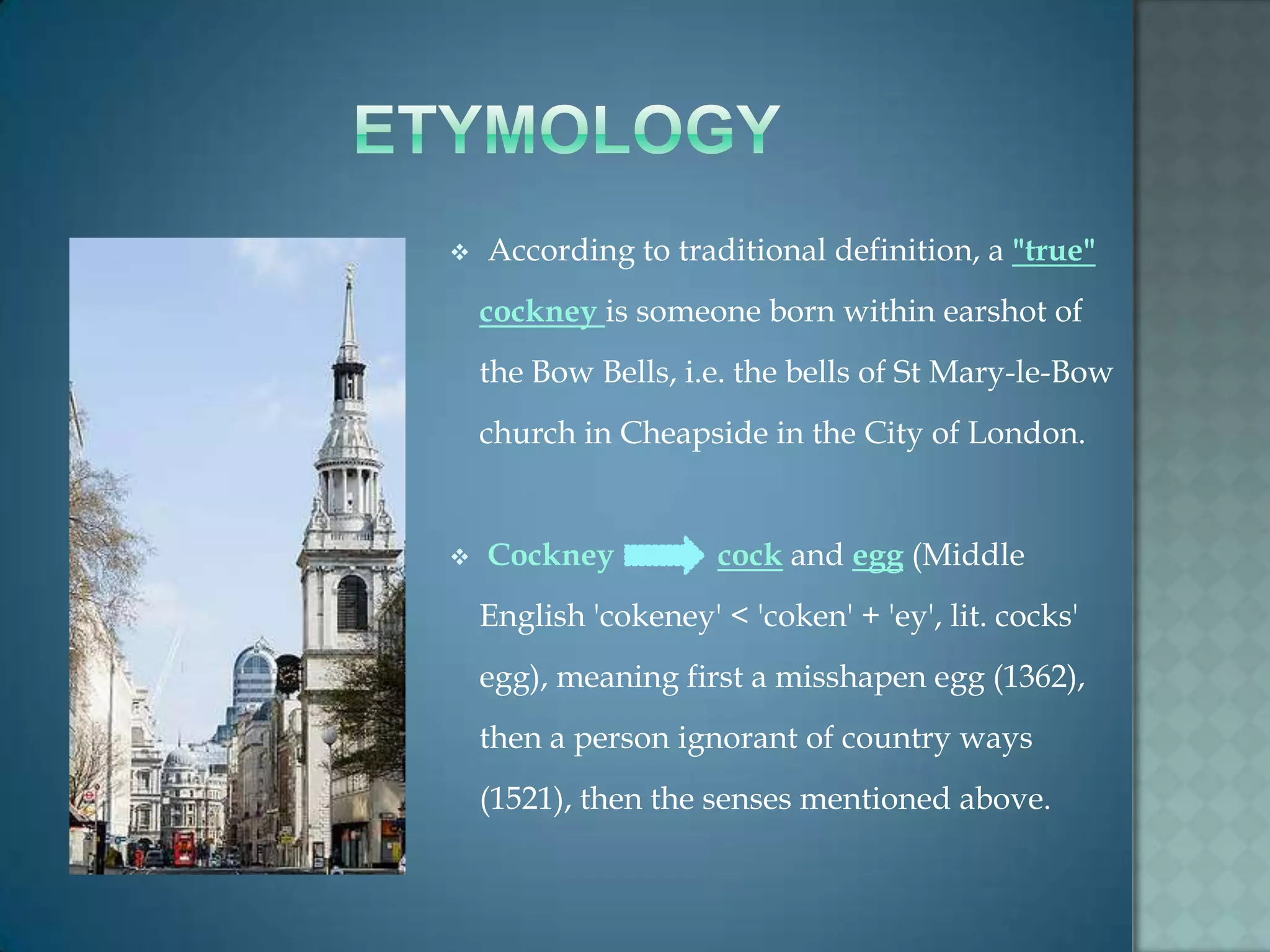
   According to traditional definition, a "true"
    cockney is someone born within earshot of
    the Bow Bells, i.e. the bells of St Mary-le-Bow
    church in Cheapside in the City of London.


   Cockney           cock and egg (Middle
    English 'cokeney' < 'coken' + 'ey', lit. cocks'
    egg), meaning first a misshapen egg (1362),
    then a person ignorant of country ways
    (1521), then the senses mentioned above.
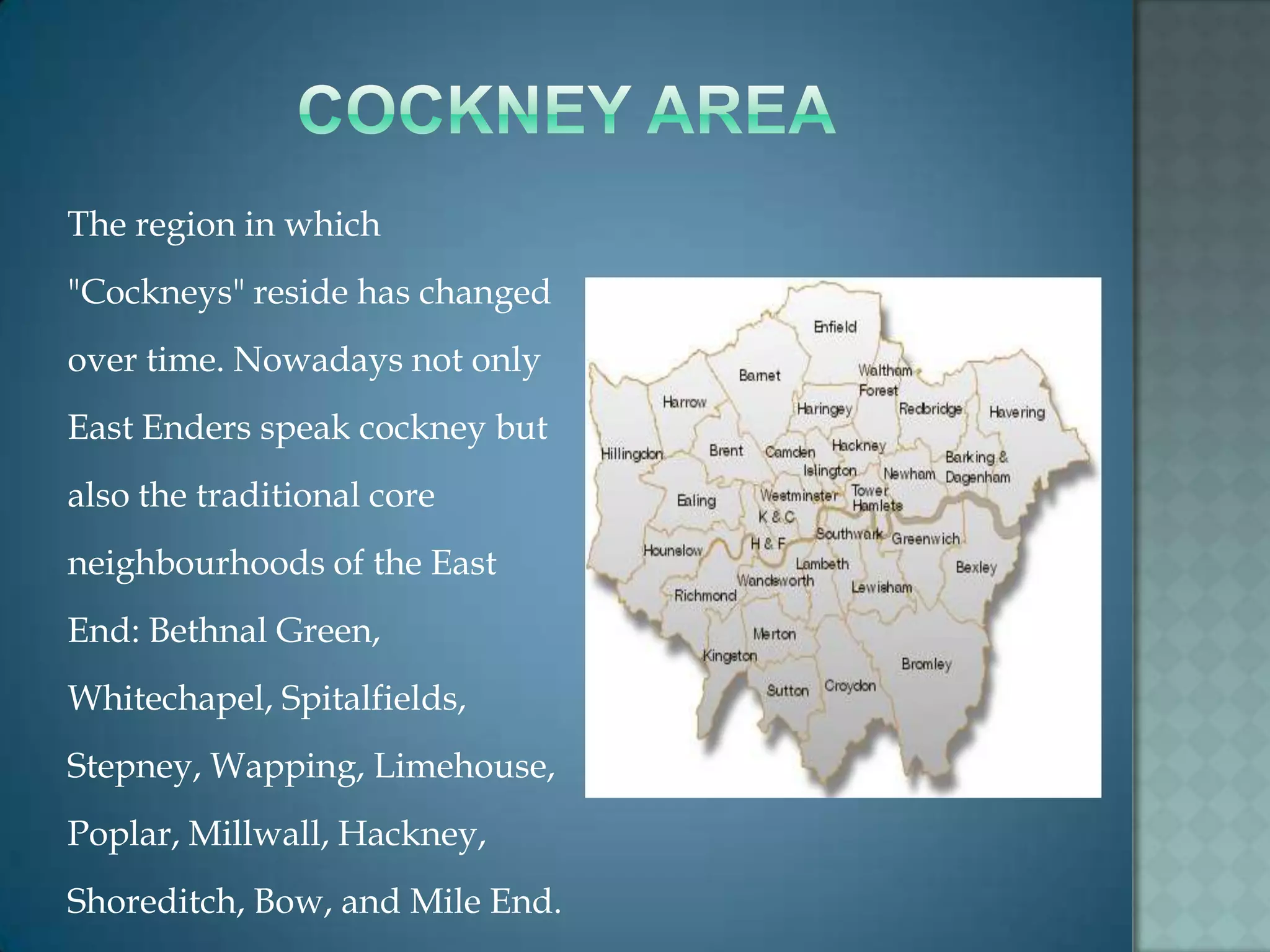
The region in which
"Cockneys" reside has changed
over time. Nowadays not only
East Enders speak cockney but
also the traditional core
neighbourhoods of the East
End: Bethnal Green,
Whitechapel, Spitalfields,
Stepney, Wapping, Limehouse,
Poplar, Millwall, Hackney,
Shoreditch, Bow, and Mile End.
PHONETICS
1.       H-dropping (house – „ouse; hammer – „ammer)
2.       Broad /a:/ (bath, path, demand)
3.       T-glottalisation (as in bottled water)
4.       Loss of dental fricatives: /ө / /f/ (maths)
         /ð /      /v/or /d/ ([bɒvə] "bother," [dæɪ]
         "they" )
5.       Diphthong alterations:
        /eɪ/ → [æɪ]: [bæɪʔ] "bait"
        /əʊ/ → [æʉ]: [kʰæʉʔ] "coat"
        /aɪ/ → [ɑɪ]: [bɑɪʔ] "bite"
        /aʊ/ may be [æə]: [tʰæən] "town"
1.  Me instead of my
2. Ain’t instead of isn‟t, am not, aren‟t
3. Double negatives: I didn‟t see nothing.
4. “That” indicates a strong degree
 (He is that pig-headed.)
   “Pretty” – a weaker one.
 (He is pretty pig-headed.)
   Sam Weller from Charles
    Dickens's novel The Pickwick
    Papers
   Bert in the movie Mary Poppins
   Eliza Doolittle in George Bernard
    Shaw's Pygmalion
   EastEnders soap opera
   Stan Shunpike in Harry Potter and
    the Prisoner of Azkaban
   Mordor Orcs in Peter Jackson's
    film trilogy The Lord of the
    Rings
   The Artful Dodger from the
    Charles Dickens novel Oliver
    Twist
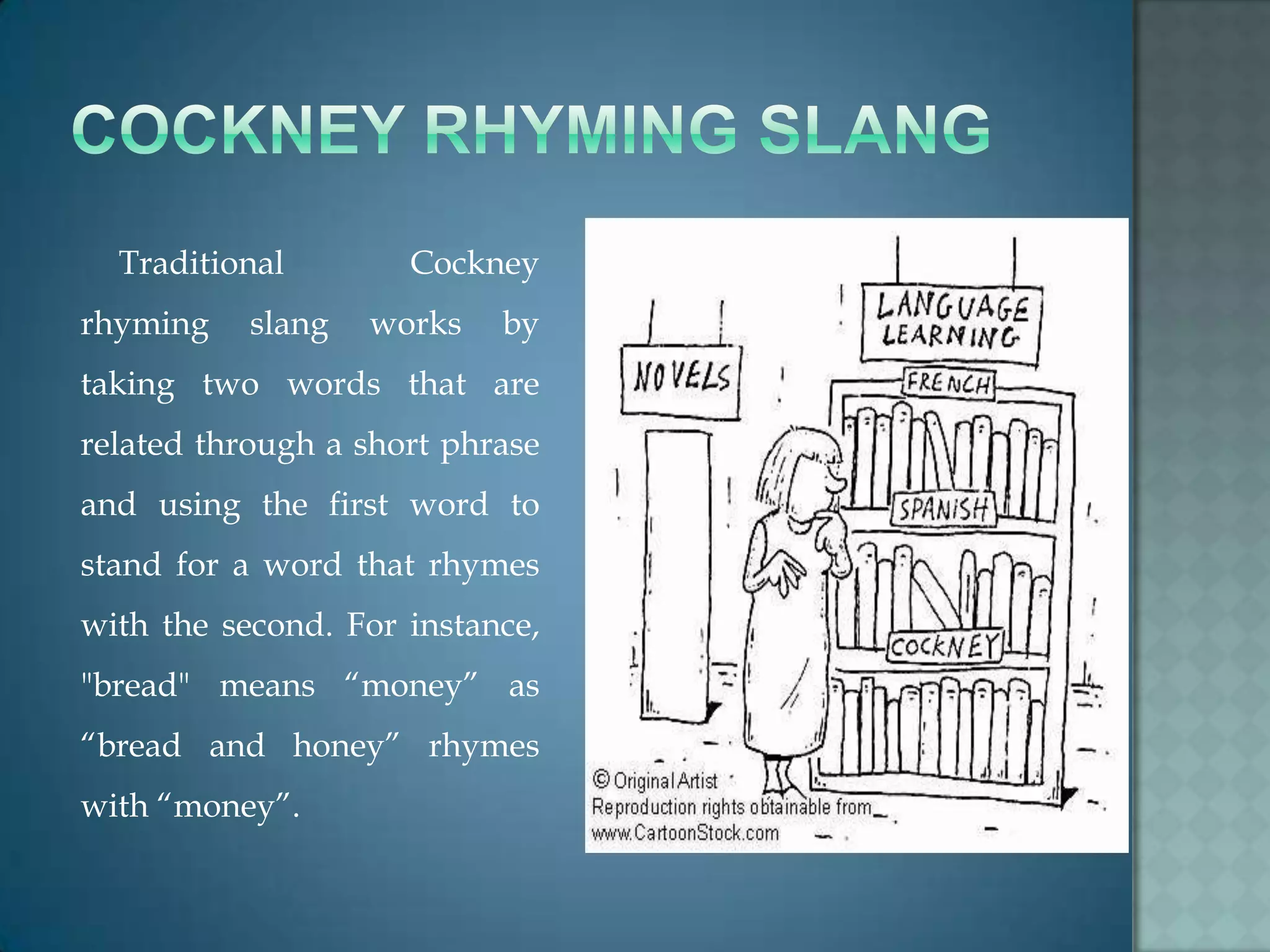
Traditional        Cockney
rhyming    slang   works   by
taking two words that are
related through a short phrase
and using the first word to
stand for a word that rhymes
with the second. For instance,
"bread" means “money” as
“bread and honey” rhymes
with “money”.
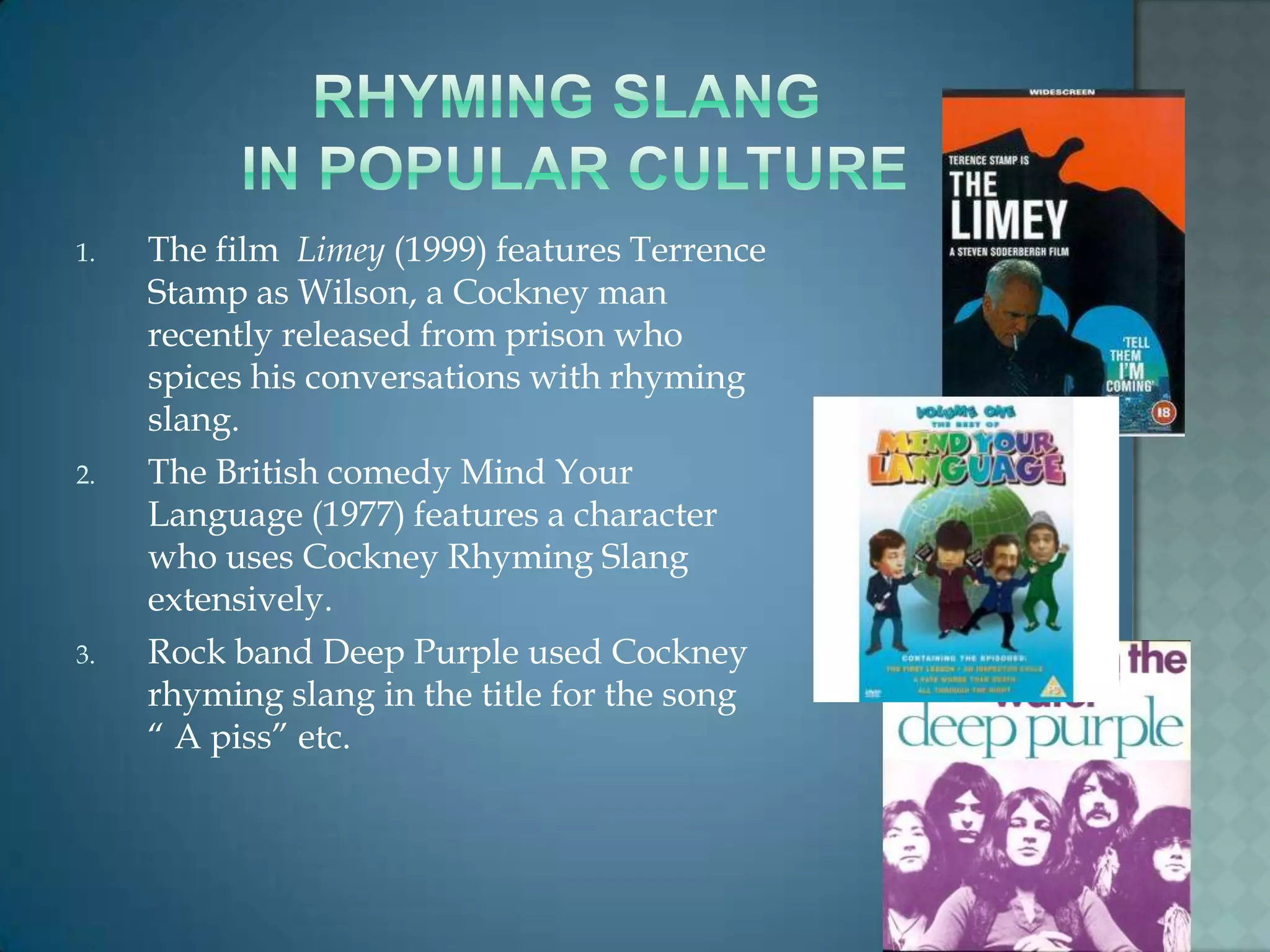
1.   The film Limey (1999) features Terrence
     Stamp as Wilson, a Cockney man
     recently released from prison who
     spices his conversations with rhyming
     slang.
2.   The British comedy Mind Your
     Language (1977) features a character
     who uses Cockney Rhyming Slang
     extensively.
3.   Rock band Deep Purple used Cockney
     rhyming slang in the title for the song
     “ A piss” etc.
1.   The traditional cockney is not so much dying out
     but new kinds of mixed accents are developing.
     (Prof. David Crystal, BBC Voices consultant)
2.   The cockney dialect is not disappearing
     altogether, but shifting to outlying towns and
     boroughs. (Laura Wright, senior lecturer in
     English Language at the University of Cambridge)
3.   A new type of speech, influenced by a number of
     foreign languages and pronunciations such as
     Bengali, Bangladeshi, rap music and popular TV
     programmes have altered traditional cockney.
   The cockney dialect is an English dialect spoken in the East
    End of London, although the area in which it is spoken has
    changed considerably.
   The term cockney comes from a Middle English word cokenei
    which means “city dweller”.
   The primary characteristics of cockney dialect include h-
    dropping, the use of double negatives, contractions and
    vowel shifts.
   One of the more unique aspects of cockney speech is
    cockney rhyming slang, where a word is replaced with a
    phrase, usually containing a word which rhymes with the
    original word.
   Some linguists have become concerned that the cockney
    dialect may fall out of spoken English, due to the influence
    of multicultural immigrants in London who have added
    their own regional slang to the dialect.

London english dialect cockney1

  • 2.
    The aim: toexamine the development of Cockney dialect through ages and its influence on the English that can really be heard in England nowadays. Objectives:  to examine the quintessence of the Cockney dialect;  to analyze typical features of the Cockney dialect;  to research the popularity of the Cockney dialect in modern society.
  • 3.
    According to traditional definition, a "true" cockney is someone born within earshot of the Bow Bells, i.e. the bells of St Mary-le-Bow church in Cheapside in the City of London.  Cockney cock and egg (Middle English 'cokeney' < 'coken' + 'ey', lit. cocks' egg), meaning first a misshapen egg (1362), then a person ignorant of country ways (1521), then the senses mentioned above.
  • 4.
    The region inwhich "Cockneys" reside has changed over time. Nowadays not only East Enders speak cockney but also the traditional core neighbourhoods of the East End: Bethnal Green, Whitechapel, Spitalfields, Stepney, Wapping, Limehouse, Poplar, Millwall, Hackney, Shoreditch, Bow, and Mile End.
  • 5.
    PHONETICS 1. H-dropping (house – „ouse; hammer – „ammer) 2. Broad /a:/ (bath, path, demand) 3. T-glottalisation (as in bottled water) 4. Loss of dental fricatives: /ө / /f/ (maths) /ð / /v/or /d/ ([bɒvə] "bother," [dæɪ] "they" ) 5. Diphthong alterations:  /eɪ/ → [æɪ]: [bæɪʔ] "bait"  /əʊ/ → [æʉ]: [kʰæʉʔ] "coat"  /aɪ/ → [ɑɪ]: [bɑɪʔ] "bite"  /aʊ/ may be [æə]: [tʰæən] "town"
  • 6.
    1. Meinstead of my 2. Ain’t instead of isn‟t, am not, aren‟t 3. Double negatives: I didn‟t see nothing. 4. “That” indicates a strong degree (He is that pig-headed.) “Pretty” – a weaker one. (He is pretty pig-headed.)
  • 7.
    Sam Weller from Charles Dickens's novel The Pickwick Papers  Bert in the movie Mary Poppins  Eliza Doolittle in George Bernard Shaw's Pygmalion  EastEnders soap opera  Stan Shunpike in Harry Potter and the Prisoner of Azkaban  Mordor Orcs in Peter Jackson's film trilogy The Lord of the Rings  The Artful Dodger from the Charles Dickens novel Oliver Twist
  • 8.
    Traditional Cockney rhyming slang works by taking two words that are related through a short phrase and using the first word to stand for a word that rhymes with the second. For instance, "bread" means “money” as “bread and honey” rhymes with “money”.
  • 9.
    1. The film Limey (1999) features Terrence Stamp as Wilson, a Cockney man recently released from prison who spices his conversations with rhyming slang. 2. The British comedy Mind Your Language (1977) features a character who uses Cockney Rhyming Slang extensively. 3. Rock band Deep Purple used Cockney rhyming slang in the title for the song “ A piss” etc.
  • 10.
    1. The traditional cockney is not so much dying out but new kinds of mixed accents are developing. (Prof. David Crystal, BBC Voices consultant) 2. The cockney dialect is not disappearing altogether, but shifting to outlying towns and boroughs. (Laura Wright, senior lecturer in English Language at the University of Cambridge) 3. A new type of speech, influenced by a number of foreign languages and pronunciations such as Bengali, Bangladeshi, rap music and popular TV programmes have altered traditional cockney.
  • 11.
    The cockney dialect is an English dialect spoken in the East End of London, although the area in which it is spoken has changed considerably.  The term cockney comes from a Middle English word cokenei which means “city dweller”.  The primary characteristics of cockney dialect include h- dropping, the use of double negatives, contractions and vowel shifts.  One of the more unique aspects of cockney speech is cockney rhyming slang, where a word is replaced with a phrase, usually containing a word which rhymes with the original word.  Some linguists have become concerned that the cockney dialect may fall out of spoken English, due to the influence of multicultural immigrants in London who have added their own regional slang to the dialect.