TECHNOLOGY ROBOTICS SOCIETY Indian Institute of Technology, Kharagpur
A TUTORIAL ON ROBOTICS Part I : Locomotion Systems and Actuators
Basic Parts Of Our Mobile Robot Locomotion system Power supply system Actuators Sensory devices for feedback Sensor Data processing unit Control system Copyright © Robotix Team, IIT Kharagpur
Locomotion System As the name suggests a mobile robot must have a system to make it move This system gives our machine the ability to move forward, backward and take turns It may also provide for climbing up and down Copyright © Robotix Team, IIT Kharagpur
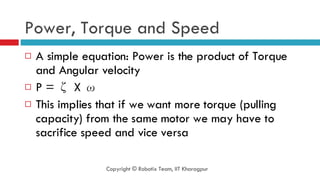
Power, Torque and Speed A simple equation: Power is the product of Torque and Angular velocity P =  ζ X ω This implies that if we want more torque (pulling capacity) from the same motor we may have to sacrifice speed and vice versa Copyright © Robotix Team, IIT Kharagpur
Wheeled Locomotion Systems Differential drive Car type drive Skid steer drive Articulated drive Synchronous drive Pivot drive Dual differential drive Copyright © Robotix Team, IIT Kharagpur
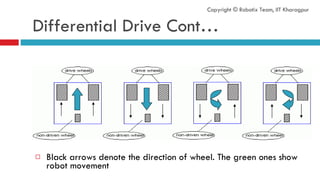
Differential Drive Most commonly used  Simplest and easiest to implement It has a free moving wheel in the front accompanied with a left and right wheel.The two wheels are separately powered When the wheels move in the same direction the machine moves in that direction. Turning is achieved by making the wheels oppose each other’s motion, thus generating a couple Copyright © Robotix Team, IIT Kharagpur
Differential Drive Cont… Black arrows denote the direction of wheel. The green ones show robot movement Copyright © Robotix Team, IIT Kharagpur
Differential Drive Cont… In-place (zero turning radius) rotation is done by turning the drive wheels at the same rate in the opposite direction Arbitrary motion paths can be implemented by dynamically modifying the angular velocity and/or direction of the drive wheels Total of two motors are required, both of them are responsible for translation and rotational motion Copyright © Robotix Team, IIT Kharagpur
Differential Drive An Analysis Simplicity and ease of use makes it the most preferred system by beginners Independent drives makes it difficult for straight line motion. The differences in motors and frictional profile of the two wheels cause them to move with slight turning effect The above drawback must be countered with appropriate feedback system. Suitable for human controlled remote robots Copyright © Robotix Team, IIT Kharagpur
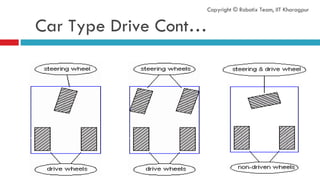
Car Type Drive This is the car type drive and the most common in real world but not in robot world It is characterized by a pair of driving wheels and a separate pair of steering wheels The translation and rotation are independent of each other. But translation and rotation are interlinked hence this system faces severe path planning problem Copyright © Robotix Team, IIT Kharagpur
Car Type Drive Cont… Copyright © Robotix Team, IIT Kharagpur
Disadvantages Of Car Type Drive The turning mechanism must be accurately controlled. A slight inaccuracy may cause large odometry errors The system is Non – Holonomic hence path planning is extremely difficult as well as inaccurate There are no direct directional actuators Copyright © Robotix Team, IIT Kharagpur
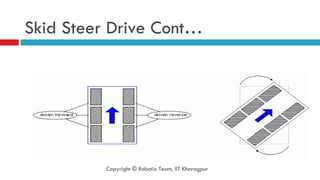
Skid Steer Drive A close relative of the differential drive system It is mostly used in tracked machines e.g. tanks. Also finds application in some four / six wheeled robots The left and right wheels are driven independently Steering is accomplished by actuating each side at a different rate or in a different direction, causing the wheels or tracks to slip, or skid, on the ground Copyright © Robotix Team, IIT Kharagpur
Skid Steer Drive Cont… Copyright © Robotix Team, IIT Kharagpur
Differences With Differential Drive Multiple drive wheels on each side give increased traction. The effect is even greater for tracked machines Skidding causes the wheels to loose contact with the surface beneath and position tracking becomes difficult Rest of it’s properties are more or less like the differential drive system Copyright © Robotix Team, IIT Kharagpur
End Actuators They convert the electrical energy into meaningful mechanical work Mechanical output can be rotational or linear (straight line) Motors provide rotational motion Electromagnets provide linear motion Copyright © Robotix Team, IIT Kharagpur
Motors are of various kinds AC Motors : Not used much in robotics Stepper Motors : For controlled rotation DC Motors : Finds extensive general use Servo Motors : DC motor with in built feedback & error compensation Copyright © Robotix Team, IIT Kharagpur
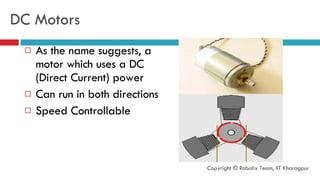
DC Motors As the name suggests, a motor which uses a DC (Direct Current) power Can run in both directions Speed Controllable Copyright © Robotix Team, IIT Kharagpur
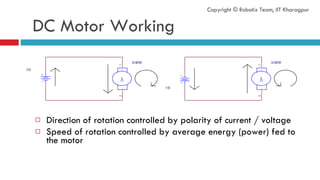
DC Motor Working  Direction of rotation controlled by polarity of current / voltage Speed of rotation controlled by average energy (power) fed to the motor Copyright © Robotix Team, IIT Kharagpur
DC Motor Specifications Operating Voltage : Recommended voltage for powering the motor Operating Current : Current drawn at a certain load on the shaft Stall Current : Maximum current drawn, when motor not allowed to rotate Stall Torque : Rotation force needed to hold the motor in stall condition Copyright © Robotix Team, IIT Kharagpur
DC Motor Characteristics Free running torque & current are ideally zero Increased load implies, increased torque, current drawn & power consumption Power supplied by a motor is the product of output shaft’s rotational velocity & torque Copyright © Robotix Team, IIT Kharagpur
DC Motor Characteristics Cont... DC Motors are high–speed, low-torque devices Using gears, the high speed of the motor is traded off into torque Copyright © Robotix Team, IIT Kharagpur
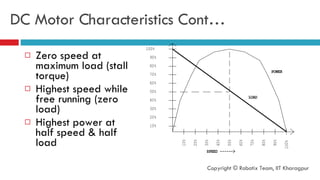
DC Motor Characteristics Cont… Zero speed at maximum load (stall torque) Highest speed while free running (zero load) Highest power at half speed & half load Copyright © Robotix Team, IIT Kharagpur
Thank You In Part II : Control System & Sensors, we will discuss various analog sensors, various aspects of feedback control Proportional Control will be discussed in depth We will take up the example of a line follower robot Copyright © Robotix Team, IIT Kharagpur

Locomotion Systems

  • 1.
    TECHNOLOGY ROBOTICS SOCIETYIndian Institute of Technology, Kharagpur
  • 2.
    A TUTORIAL ONROBOTICS Part I : Locomotion Systems and Actuators
  • 3.
    Basic Parts OfOur Mobile Robot Locomotion system Power supply system Actuators Sensory devices for feedback Sensor Data processing unit Control system Copyright © Robotix Team, IIT Kharagpur
  • 4.
    Locomotion System Asthe name suggests a mobile robot must have a system to make it move This system gives our machine the ability to move forward, backward and take turns It may also provide for climbing up and down Copyright © Robotix Team, IIT Kharagpur
  • 5.
    Power, Torque andSpeed A simple equation: Power is the product of Torque and Angular velocity P = ζ X ω This implies that if we want more torque (pulling capacity) from the same motor we may have to sacrifice speed and vice versa Copyright © Robotix Team, IIT Kharagpur
  • 6.
    Wheeled Locomotion SystemsDifferential drive Car type drive Skid steer drive Articulated drive Synchronous drive Pivot drive Dual differential drive Copyright © Robotix Team, IIT Kharagpur
  • 7.
    Differential Drive Mostcommonly used Simplest and easiest to implement It has a free moving wheel in the front accompanied with a left and right wheel.The two wheels are separately powered When the wheels move in the same direction the machine moves in that direction. Turning is achieved by making the wheels oppose each other’s motion, thus generating a couple Copyright © Robotix Team, IIT Kharagpur
  • 8.
    Differential Drive Cont…Black arrows denote the direction of wheel. The green ones show robot movement Copyright © Robotix Team, IIT Kharagpur
  • 9.
    Differential Drive Cont…In-place (zero turning radius) rotation is done by turning the drive wheels at the same rate in the opposite direction Arbitrary motion paths can be implemented by dynamically modifying the angular velocity and/or direction of the drive wheels Total of two motors are required, both of them are responsible for translation and rotational motion Copyright © Robotix Team, IIT Kharagpur
  • 10.
    Differential Drive AnAnalysis Simplicity and ease of use makes it the most preferred system by beginners Independent drives makes it difficult for straight line motion. The differences in motors and frictional profile of the two wheels cause them to move with slight turning effect The above drawback must be countered with appropriate feedback system. Suitable for human controlled remote robots Copyright © Robotix Team, IIT Kharagpur
  • 11.
    Car Type DriveThis is the car type drive and the most common in real world but not in robot world It is characterized by a pair of driving wheels and a separate pair of steering wheels The translation and rotation are independent of each other. But translation and rotation are interlinked hence this system faces severe path planning problem Copyright © Robotix Team, IIT Kharagpur
  • 12.
    Car Type DriveCont… Copyright © Robotix Team, IIT Kharagpur
  • 13.
    Disadvantages Of CarType Drive The turning mechanism must be accurately controlled. A slight inaccuracy may cause large odometry errors The system is Non – Holonomic hence path planning is extremely difficult as well as inaccurate There are no direct directional actuators Copyright © Robotix Team, IIT Kharagpur
  • 14.
    Skid Steer DriveA close relative of the differential drive system It is mostly used in tracked machines e.g. tanks. Also finds application in some four / six wheeled robots The left and right wheels are driven independently Steering is accomplished by actuating each side at a different rate or in a different direction, causing the wheels or tracks to slip, or skid, on the ground Copyright © Robotix Team, IIT Kharagpur
  • 15.
    Skid Steer DriveCont… Copyright © Robotix Team, IIT Kharagpur
  • 16.
    Differences With DifferentialDrive Multiple drive wheels on each side give increased traction. The effect is even greater for tracked machines Skidding causes the wheels to loose contact with the surface beneath and position tracking becomes difficult Rest of it’s properties are more or less like the differential drive system Copyright © Robotix Team, IIT Kharagpur
  • 17.
    End Actuators Theyconvert the electrical energy into meaningful mechanical work Mechanical output can be rotational or linear (straight line) Motors provide rotational motion Electromagnets provide linear motion Copyright © Robotix Team, IIT Kharagpur
  • 18.
    Motors are ofvarious kinds AC Motors : Not used much in robotics Stepper Motors : For controlled rotation DC Motors : Finds extensive general use Servo Motors : DC motor with in built feedback & error compensation Copyright © Robotix Team, IIT Kharagpur
  • 19.
    DC Motors Asthe name suggests, a motor which uses a DC (Direct Current) power Can run in both directions Speed Controllable Copyright © Robotix Team, IIT Kharagpur
  • 20.
    DC Motor Working Direction of rotation controlled by polarity of current / voltage Speed of rotation controlled by average energy (power) fed to the motor Copyright © Robotix Team, IIT Kharagpur
  • 21.
    DC Motor SpecificationsOperating Voltage : Recommended voltage for powering the motor Operating Current : Current drawn at a certain load on the shaft Stall Current : Maximum current drawn, when motor not allowed to rotate Stall Torque : Rotation force needed to hold the motor in stall condition Copyright © Robotix Team, IIT Kharagpur
  • 22.
    DC Motor CharacteristicsFree running torque & current are ideally zero Increased load implies, increased torque, current drawn & power consumption Power supplied by a motor is the product of output shaft’s rotational velocity & torque Copyright © Robotix Team, IIT Kharagpur
  • 23.
    DC Motor CharacteristicsCont... DC Motors are high–speed, low-torque devices Using gears, the high speed of the motor is traded off into torque Copyright © Robotix Team, IIT Kharagpur
  • 24.
    DC Motor CharacteristicsCont… Zero speed at maximum load (stall torque) Highest speed while free running (zero load) Highest power at half speed & half load Copyright © Robotix Team, IIT Kharagpur
  • 25.
    Thank You InPart II : Control System & Sensors, we will discuss various analog sensors, various aspects of feedback control Proportional Control will be discussed in depth We will take up the example of a line follower robot Copyright © Robotix Team, IIT Kharagpur