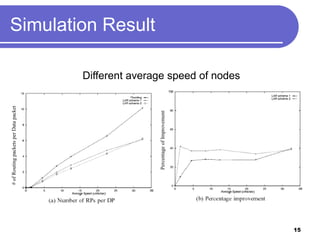
LAR uses location information to reduce routing overhead in mobile ad hoc networks. It minimizes the search zone for route discovery by using the expected zone based on the destination's last known location and speed. The route request is restricted to this request zone to limit flooding. Variations include alternative definitions of the request zone and allowing intermediate nodes to update the zone based on more recent location data or initiate local repair if a route breaks. Simulation results show LAR performs better than flooding in networks with varying node speeds, transmission ranges, densities, and location errors.