Child Rights and SDGs
Concepts and action points
By
R. Vidya Sagar,
Consultant & Former Child Protection Specialist,
Unicef
What is the SDG Agenda 2030?
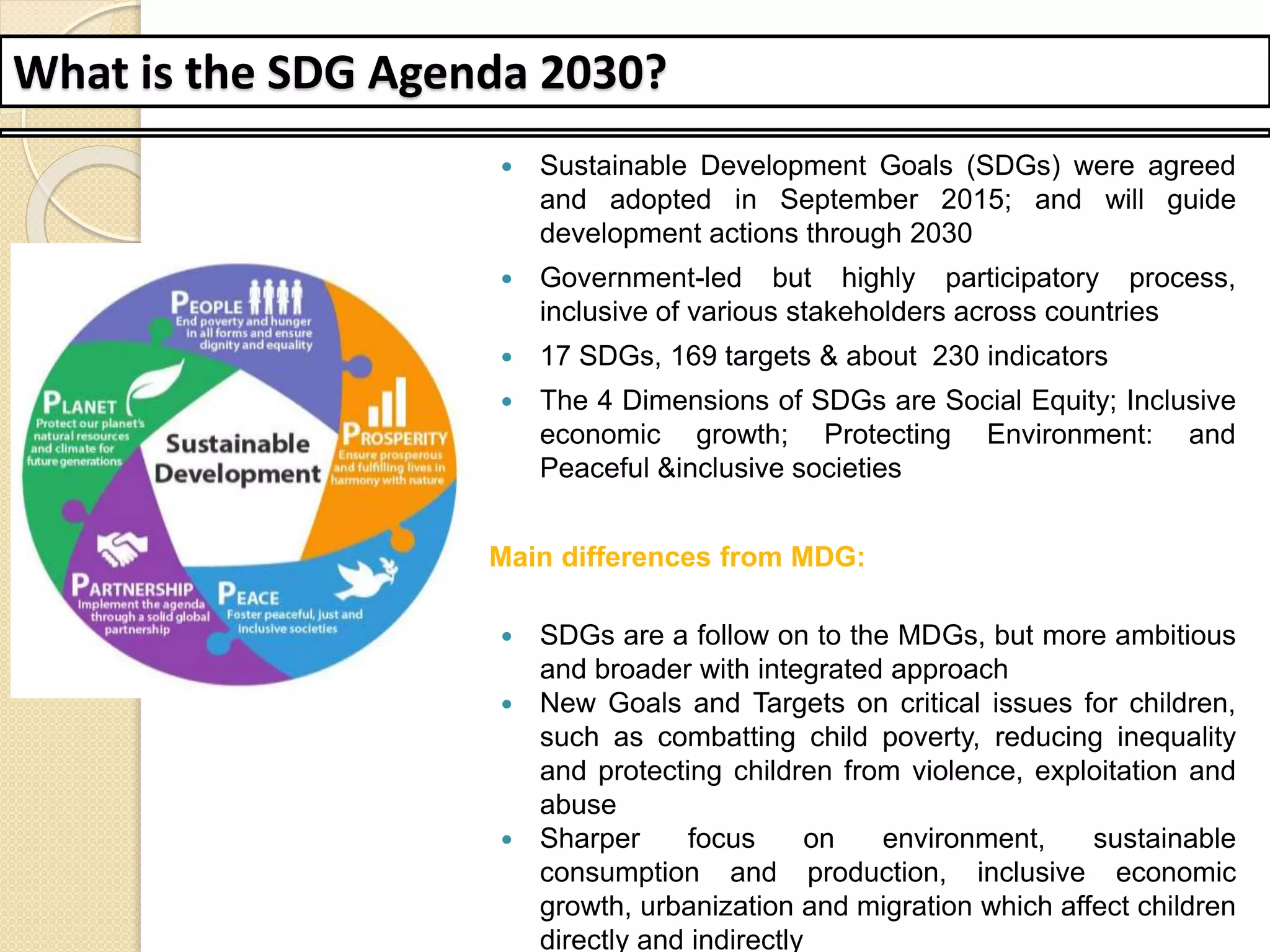
 Sustainable Development Goals (SDGs) were agreed
and adopted in September 2015; and will guide
development actions through 2030
 Government-led but highly participatory process,
inclusive of various stakeholders across countries
 17 SDGs, 169 targets & about 230 indicators
 The 4 Dimensions of SDGs are Social Equity; Inclusive
economic growth; Protecting Environment: and
Peaceful &inclusive societies
Main differences from MDG:
 SDGs are a follow on to the MDGs, but more ambitious
and broader with integrated approach
 New Goals and Targets on critical issues for children,
such as combatting child poverty, reducing inequality
and protecting children from violence, exploitation and
abuse
 Sharper focus on environment, sustainable
consumption and production, inclusive economic
growth, urbanization and migration which affect children
directly and indirectly
Highlights of SDGs from Child
Perspective
I. Preamble and Declaration
Calls to “invest in children”
Children as positive “agents of
change”
Strong mention of human rights
and inequalities in various
paragraphs
II. Goals and Targets
All goals and targets touch on
the lives of children in some
manner
A focus on addressing
inequalities, child poverty and
child protection (Not in the
MDGs)
III. Means of Implementation
Focus on national strategies &
"enabling international
economic environment”,
ensuring `No One Left Behind’
IV. Follow-up and Review
Global level, with national and
regional review mechanisms
Positive references to:
Inclusion and participation - `
For Children Everywhere’
Disaggregated data by age,
sex, wealth quintile, disability
status and other potential
dimensions of inequality as
appropriate for given contexts.
Opportunities for Children in the SDGs
 Child rights
 Equity: “leave no one behind”
 Investing in children
 Children as change agents
 Child protection issues
 Participation and inclusion
 Use and disaggregation of data
 Universally applicable to all children,
everywhere
Priority targets in the SDGs
What is most relevant to children
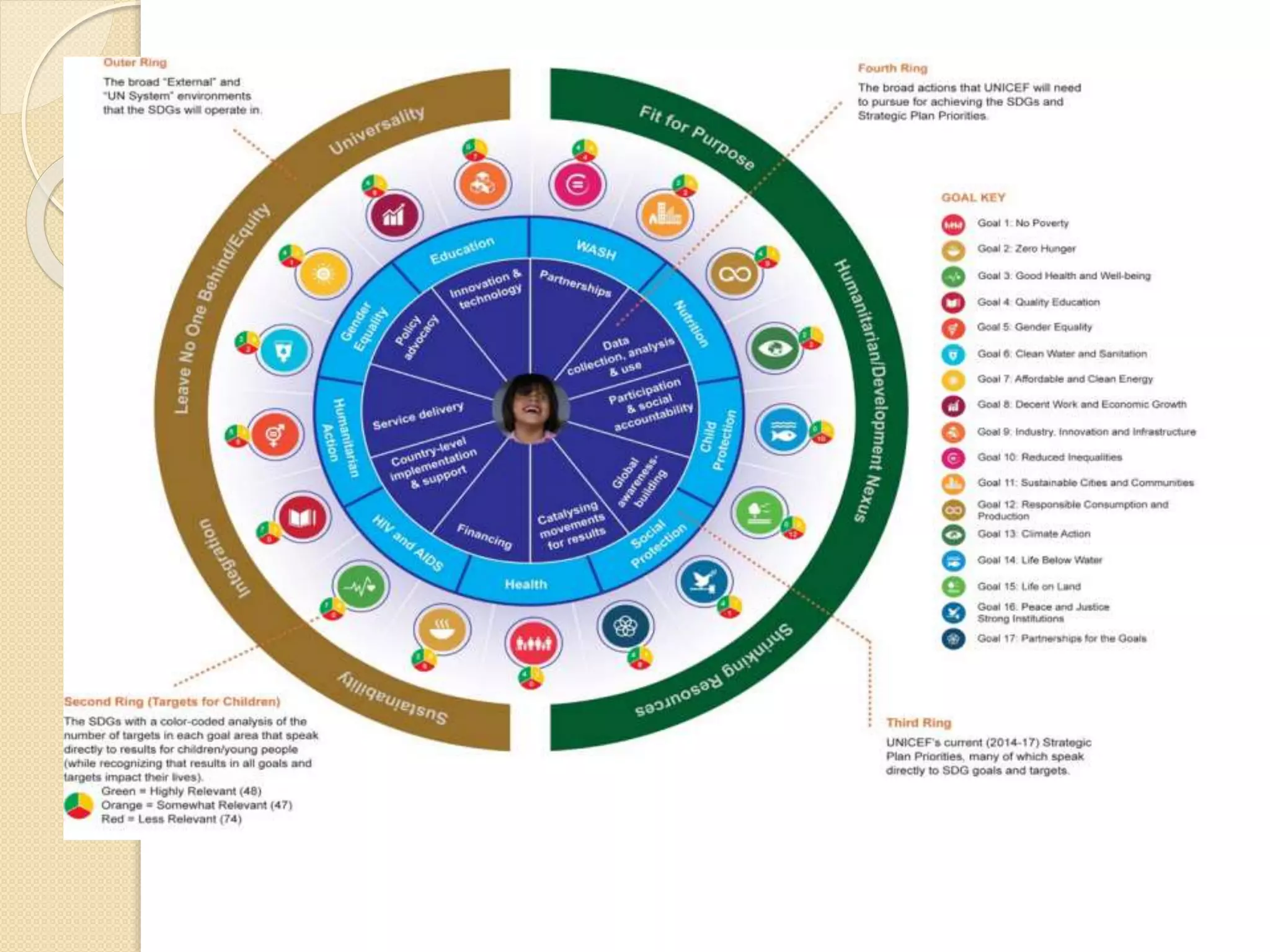
 In a preliminarily analysis, a subset of the 169
targets have been identified as particularly
relevant for children (while recognizing that
all goals and targets impact children’s and
adolescents lives).
 48 targets are deemed to be highly relevant
to children
 In particular Goals 1, 2, 3, 4, 5, 6, 8, 10 and
16
 but beyond also, energy (7); cities (11);
sustainable consumption (12); climate (13);
and means of implementation (17)
 47 are flagged as somewhat relevant to
children
 74 are considered as less relevant
Mapping of priority indicators
 SDG indicators have been classified into
 Tier I – ie There is established methodology for
data collection and data is regularly produced
 Tier II – ie There is established methodology for
data collection BUT data is not regularly
produced
 Tier III – ie Neither methodology and hence nor
data exists
 Of the 230 SDG indicators, UNICEF has
identified 33 (under 9 Goals) as Priority
Indicators for children
 Of these 33 priority indicators, 14 are in Tier I
and 13 in Tier II and 9 in Tier III
Data sources and Challenges
 DATA SOURES:
 Census; Survey based data system ( SRS, NFHS, NSS, occasional surveys
like AHS, RSOC, OOSC survey); Service based statistics
 (MIS): CRVS, HMIS, UDISE, SBM MIS, ICDS MIS etc.; Adhoc data sets,
projects based information; State and local level information
 CHALLENGES:
 Survey based information is not regular and coverage is limited both in
terms of sectors as also geography
 Most information from MIS suffer from lack of coverage, disaggregation,
incomplete, quality and not being used for planning purpose
 Many gaps ( no information on DRR, climate, environment, deprivation,
ECD, etc. violence against children, child labour)
 Little disaggregation (mortality, NE, district and block level etc.)
Way Forward
 Advocacy, Awareness, and Accountability, for
matters that affect children and youth
 Public & Private Partnerships and Financing
for investments in children
 Support to country/state level implementation
with planning and budgeting on issues of
service delivery, etc.
 Support to Innovation and Technology for
delivering results for children in the most
timely, efficient and effective way
 Monitoring progress through data collection,
analysis and use of disaggregated data for
informed policies, programmes and budgets
Action points
 Don’t wait for top down instructions
 Possibilities of bottom up action.
 Try to shape the understanding,
planning,
 implementation and monitoring of
SDG
 related action at the grassroots levels.
 Focus on goals beyond targets.
SDGs Vs laws on rights
 Map SDGs on to rights-based
developmental laws
 Right to Information.
 Right to Work.
 Forest Rights.
 Right to Education.
 Right to Food.
Localizing Understanding of
SDG Concepts
For understanding, analysis, reflection,
local action
 Poverty
dimensions.
at all ages.
strategies to combat.
 Malnutrition.
 Climate change – Resilience.
 Sustainable food production.
 Genetic diversity.
 Traditional knowledge
Localizing understanding of
SDG Concepts [Contd…]
 Non Communicable Diseases.
 Equitable, quality education.
 Gender.
 Social evils.
 Natural Resource Management.
 Inclusive growth.
 Decent work.
 Labour Rights.
 Financial inclusion.
 Peace/nonviolence.
 Lifestyle in harmony with nature.
SPECIFIC ROLES
Goal 1 – Poverty
 access to basic services.
 SHG partnership.
Goal 2 – Hunger/Food
Security/Nutrition/Sustainable
 agriculture
 ICDS/Midday Meal.
 MGNREGS.
Goal 3 – Healthy Lives
 enabling access to social determinants of health.
 extension.
 communicable/non-communicable diseases.
 substance abuse.
SPECIFIC ROLES [Contd…]
Goal 4 – Education
 access.
 performance watch.
Goal 5 – Gender equality
 EWR..
 Capacity of EWR.
 SHG partnership and engendering
planning.
Goad 6 – WATSAN
 Most critical.
 universal role.
SPECIFIC ROLES [Contd…]
Goal 8 – Growth/Employment/Decent work
 MGNREGS , skill development,
secondary education, higher education
Goal 10 – Reduce inequality
 inclusion.
 Civic/Political capital.
Goal 16 Peaceful and inclusive Society
 Grama Sabha.
 SHGs.
 Social Capital
SPECIFIC ROLES [Contd…]
 Develop a kind of PRA for SDG.
 Develop local level indicators -
qualitative and quantitative

Child Rights and SDGs - Concepts and action points

  • 1.
    Child Rights andSDGs Concepts and action points By R. Vidya Sagar, Consultant & Former Child Protection Specialist, Unicef
  • 2.
    What is theSDG Agenda 2030?  Sustainable Development Goals (SDGs) were agreed and adopted in September 2015; and will guide development actions through 2030  Government-led but highly participatory process, inclusive of various stakeholders across countries  17 SDGs, 169 targets & about 230 indicators  The 4 Dimensions of SDGs are Social Equity; Inclusive economic growth; Protecting Environment: and Peaceful &inclusive societies Main differences from MDG:  SDGs are a follow on to the MDGs, but more ambitious and broader with integrated approach  New Goals and Targets on critical issues for children, such as combatting child poverty, reducing inequality and protecting children from violence, exploitation and abuse  Sharper focus on environment, sustainable consumption and production, inclusive economic growth, urbanization and migration which affect children directly and indirectly
  • 3.
    Highlights of SDGsfrom Child Perspective I. Preamble and Declaration Calls to “invest in children” Children as positive “agents of change” Strong mention of human rights and inequalities in various paragraphs II. Goals and Targets All goals and targets touch on the lives of children in some manner A focus on addressing inequalities, child poverty and child protection (Not in the MDGs) III. Means of Implementation Focus on national strategies & "enabling international economic environment”, ensuring `No One Left Behind’ IV. Follow-up and Review Global level, with national and regional review mechanisms Positive references to: Inclusion and participation - ` For Children Everywhere’ Disaggregated data by age, sex, wealth quintile, disability status and other potential dimensions of inequality as appropriate for given contexts.
  • 4.
    Opportunities for Childrenin the SDGs  Child rights  Equity: “leave no one behind”  Investing in children  Children as change agents  Child protection issues  Participation and inclusion  Use and disaggregation of data  Universally applicable to all children, everywhere
  • 5.
    Priority targets inthe SDGs What is most relevant to children  In a preliminarily analysis, a subset of the 169 targets have been identified as particularly relevant for children (while recognizing that all goals and targets impact children’s and adolescents lives).  48 targets are deemed to be highly relevant to children  In particular Goals 1, 2, 3, 4, 5, 6, 8, 10 and 16  but beyond also, energy (7); cities (11); sustainable consumption (12); climate (13); and means of implementation (17)  47 are flagged as somewhat relevant to children  74 are considered as less relevant
  • 6.
    Mapping of priorityindicators  SDG indicators have been classified into  Tier I – ie There is established methodology for data collection and data is regularly produced  Tier II – ie There is established methodology for data collection BUT data is not regularly produced  Tier III – ie Neither methodology and hence nor data exists  Of the 230 SDG indicators, UNICEF has identified 33 (under 9 Goals) as Priority Indicators for children  Of these 33 priority indicators, 14 are in Tier I and 13 in Tier II and 9 in Tier III
  • 7.
    Data sources andChallenges  DATA SOURES:  Census; Survey based data system ( SRS, NFHS, NSS, occasional surveys like AHS, RSOC, OOSC survey); Service based statistics  (MIS): CRVS, HMIS, UDISE, SBM MIS, ICDS MIS etc.; Adhoc data sets, projects based information; State and local level information  CHALLENGES:  Survey based information is not regular and coverage is limited both in terms of sectors as also geography  Most information from MIS suffer from lack of coverage, disaggregation, incomplete, quality and not being used for planning purpose  Many gaps ( no information on DRR, climate, environment, deprivation, ECD, etc. violence against children, child labour)  Little disaggregation (mortality, NE, district and block level etc.)
  • 8.
    Way Forward  Advocacy,Awareness, and Accountability, for matters that affect children and youth  Public & Private Partnerships and Financing for investments in children  Support to country/state level implementation with planning and budgeting on issues of service delivery, etc.  Support to Innovation and Technology for delivering results for children in the most timely, efficient and effective way  Monitoring progress through data collection, analysis and use of disaggregated data for informed policies, programmes and budgets
  • 10.
    Action points  Don’twait for top down instructions  Possibilities of bottom up action.  Try to shape the understanding, planning,  implementation and monitoring of SDG  related action at the grassroots levels.  Focus on goals beyond targets.
  • 11.
    SDGs Vs lawson rights  Map SDGs on to rights-based developmental laws  Right to Information.  Right to Work.  Forest Rights.  Right to Education.  Right to Food.
  • 12.
    Localizing Understanding of SDGConcepts For understanding, analysis, reflection, local action  Poverty dimensions. at all ages. strategies to combat.  Malnutrition.  Climate change – Resilience.  Sustainable food production.  Genetic diversity.  Traditional knowledge
  • 13.
    Localizing understanding of SDGConcepts [Contd…]  Non Communicable Diseases.  Equitable, quality education.  Gender.  Social evils.  Natural Resource Management.  Inclusive growth.  Decent work.  Labour Rights.  Financial inclusion.  Peace/nonviolence.  Lifestyle in harmony with nature.
  • 14.
    SPECIFIC ROLES Goal 1– Poverty  access to basic services.  SHG partnership. Goal 2 – Hunger/Food Security/Nutrition/Sustainable  agriculture  ICDS/Midday Meal.  MGNREGS. Goal 3 – Healthy Lives  enabling access to social determinants of health.  extension.  communicable/non-communicable diseases.  substance abuse.
  • 15.
    SPECIFIC ROLES [Contd…] Goal4 – Education  access.  performance watch. Goal 5 – Gender equality  EWR..  Capacity of EWR.  SHG partnership and engendering planning. Goad 6 – WATSAN  Most critical.  universal role.
  • 16.
    SPECIFIC ROLES [Contd…] Goal8 – Growth/Employment/Decent work  MGNREGS , skill development, secondary education, higher education Goal 10 – Reduce inequality  inclusion.  Civic/Political capital. Goal 16 Peaceful and inclusive Society  Grama Sabha.  SHGs.  Social Capital
  • 17.
    SPECIFIC ROLES [Contd…] Develop a kind of PRA for SDG.  Develop local level indicators - qualitative and quantitative

Editor's Notes

  • #3 The start of 2016 marks the end of the time horizon for the Millennium Development Goals, set by world leaders at the start of the new millennium, and introduces a new era for sustainable development. For the last three and a half years, various development actors and stakeholders discussed and debated what the next era of global development -- POST 2015 – would look like. This culimated in the adoption of the Agenda 2030 for Sustainable Development at the opening of the UN General Assembly in September 2015. The Sustainable Development Goals – or SDGs -- are a follow on to the MDGs, but they aim to build on and improve those goals by being much more ambitious and broader in terms of covering all aspects of sustainable development – the social, the economic and the environmental. This includes for example: An aim to specifically address the issue of inequalities -- a major omission and lesson learned from the MDG era. To increase economic growth but in a way that is sustainable and inclusive of more people. To tackle major threats to the physical environments we inhabit -- including the issues of climate change, loss of biodiversity and the huge problem of unsustainable consumption and production patterns. And finally, to recognize that peaceful societies and rule of law are essential for making and sustaining development progress, and that any new development agenda must take on the issue of human security and protection in a bold and concrete way. The SDGs are universal – for all countries, developing and developed alike.