FOLLOW UP AND REVIEW FOR
THE 2030 AGENDA FOR
SUSTAINABLE DEVELOPMENT
Dr. Stefanos Fotiou
UNESCAP
Presentation outline
1) Overview of the 2030 Agenda for
Sustainable Development
2) Follow up and review: Mandate, functions,
and challenges
3) ESCAP’s mandate on the 2030 Agenda
4) ESCAP support to member States in
implementing the 2030 Agenda
• Mandate
• Functions
• Challenges
Overview of the 2030 Agenda
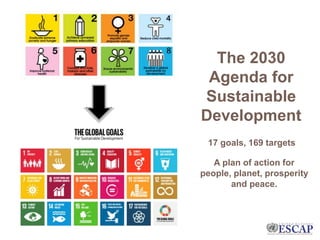
The 2030
Agenda for
Sustainable
Development
17 goals, 169 targets
A plan of action for
people, planet, prosperity
and peace.
• Mandate
• Functions
• The High-level Political Forum
• Challenges
Follow up and review
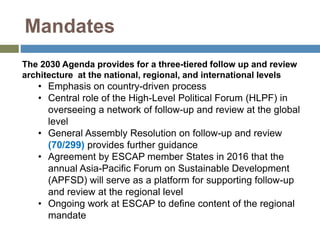
Mandates
The 2030 Agenda provides for a three-tiered follow up and review
architecture at the national, regional, and international levels
• Emphasis on country-driven process
• Central role of the High-Level Political Forum (HLPF) in
overseeing a network of follow-up and review at the global
level
• General Assembly Resolution on follow-up and review
(70/299) provides further guidance
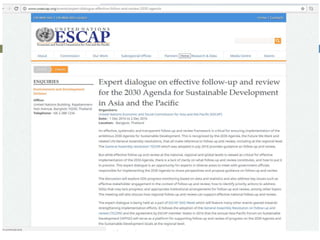
• Agreement by ESCAP member States in 2016 that the
annual Asia-Pacific Forum on Sustainable Development
(APFSD) will serve as a platform for supporting follow-up
and review at the regional level
• Ongoing work at ESCAP to define content of the regional
mandate
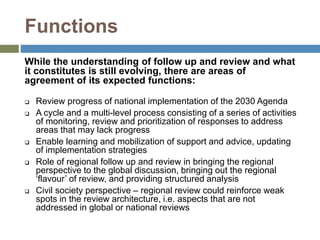
Functions
While the understanding of follow up and review and what
it constitutes is still evolving, there are areas of
agreement of its expected functions:
 Review progress of national implementation of the 2030 Agenda
 A cycle and a multi-level process consisting of a series of activities
of monitoring, review and prioritization of responses to address
areas that may lack progress
 Enable learning and mobilization of support and advice, updating
of implementation strategies
 Role of regional follow up and review in bringing the regional
perspective to the global discussion, bringing out the regional
‘flavour’ of review, and providing structured analysis
 Civil society perspective – regional review could reinforce weak
spots in the review architecture, i.e. aspects that are not
addressed in global or national reviews
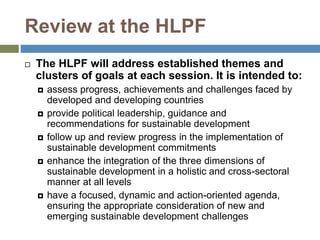
Review at the HLPF
 The HLPF will address established themes and
clusters of goals at each session. It is intended to:
 assess progress, achievements and challenges faced by
developed and developing countries
 provide political leadership, guidance and
recommendations for sustainable development
 follow up and review progress in the implementation of
sustainable development commitments
 enhance the integration of the three dimensions of
sustainable development in a holistic and cross-sectoral
manner at all levels
 have a focused, dynamic and action-oriented agenda,
ensuring the appropriate consideration of new and
emerging sustainable development challenges
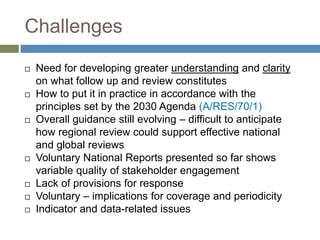
Challenges
 Need for developing greater understanding and clarity
on what follow up and review constitutes
 How to put it in practice in accordance with the
principles set by the 2030 Agenda (A/RES/70/1)
 Overall guidance still evolving – difficult to anticipate
how regional review could support effective national
and global reviews
 Voluntary National Reports presented so far shows
variable quality of stakeholder engagement
 Lack of provisions for response
 Voluntary – implications for coverage and periodicity
 Indicator and data-related issues
ESCAP’s mandate on the 2030
Agenda

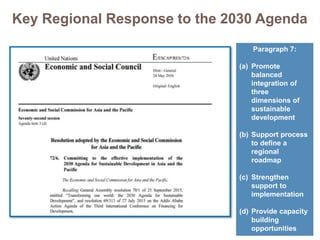
Paragraph 7:
(a) Promote
balanced
integration of
three
dimensions of
sustainable
development
(b) Support process
to define a
regional
roadmap
(c) Strengthen
support to
implementation
(d) Provide capacity
building
opportunities
Key Regional Response to the 2030 Agenda
ESCAP support to member States
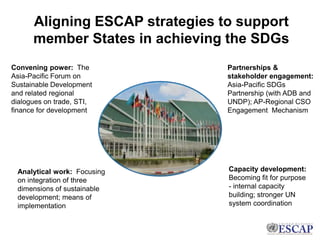
Convening power: The
Asia-Pacific Forum on
Sustainable Development
and related regional
dialogues on trade, STI,
finance for development
Analytical work: Focusing
on integration of three
dimensions of sustainable
development; means of
implementation
Partnerships &
stakeholder engagement:
Asia-Pacific SDGs
Partnership (with ADB and
UNDP); AP-Regional CSO
Engagement Mechanism
Capacity development:
Becoming fit for purpose
- internal capacity
building; stronger UN
system coordination
Aligning ESCAP strategies to support
member States in achieving the SDGs
 A week dedicated to enhancing and deepening the
understanding of the key challenges for effective
implementation of the SDGs
 With 14 events slated over the week, it will:
 facilitate dialogue among experts, public servants, researchers
and other stakeholders on challenges involved in effective
implementation of the sustainable development agenda
 strengthen peer learning and capacity development to make
progress on the 2030 Agenda
 identify gaps and opportunities for strengthening support,
including through partnerships, peer learning and capacity
development
Dr. Stefanos Fotiou
Director, Environment and Development
Email: fotiou@un.org
www.unescap.org
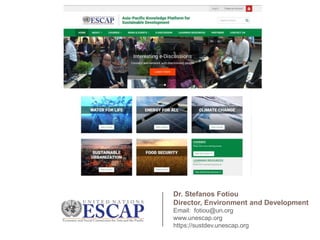
https://sustdev.unescap.org