Skeletal Muscle
Relaxants
Skeletal Muscle Relaxants
Drugs that act peripherally at neuromuscular
junction/muscle fibre or centrally in the
cerebrospinal axis to reduce muscle tone or cause
paralysis.
These drugs are used:
• To reduce painful muscle spasms.
• To reduce spastic neurological conditions.
• Together with anaesthetics to provide muscle
relaxation for surgery.
Classification:
Peripherally acting muscle relaxants
1. Neuromuscular Blockers
A. Non-depolarizing blockers:
• Long acting: d-tubocurarine, pancuronium
• Intermediate acting: Vecuronium, Atracurium
• Short acting: Mivacurium
B. Depolarizing blockers:
Succinylcholine (Sch, Suxamethonium), Decamethonium
2. Directly acting agents: Dantrolene Sodium,Quinine
Centrally acting muscle relaxants
• Mephenesin congeners: Mephenesin, Chlorzoxazone
• Benzodiazepines: Diazepam
• GABA mimetics: Baclofen
• Central α2 agonist: Tizanidine
Peripherally acting muscle relaxants
Non-depolarizing neuromuscular blockers
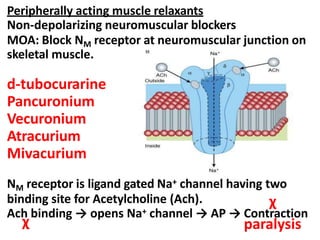
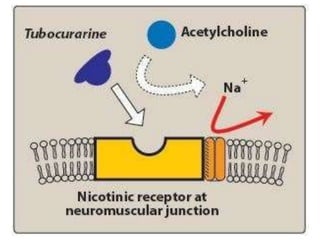
MOA: Block NM receptor at neuromuscular junction on
skeletal muscle.
d-tubocurarine
Pancuronium
Vecuronium
Atracurium
Mivacurium
NM receptor is ligand gated Na+ channel having two
binding site for Acetylcholine (Ach).
Ach binding → opens Na+ channel → AP → Contraction
χ paralysis
χ
Curare: Tubocurarine, Toxiferin; arrow poison
Tubocurarine
It is a toxic alkaloid obtained from the bark of the South
American plant Chondrodendron tomentosum historically
known for its use as an arrow poison.
d-tubocurarine
MOA: Competitively binds with the nicotinic receptors NM to
prevent the binding
depolarization of the
of Acetylcholine and
muscle cell membrane and
prevent
inhibit
muscular contraction.
• Because these agents compete with ACh at the receptor
without stimulating it, they are called competitive blockers.
• Antagonism is surmountable so neostigmine, pyridostigmine
can reverse the effect.
• Injected 0.1 to 0.3 mg/kg slow IV
• Long duration of action but more side effect so NOT used
now!
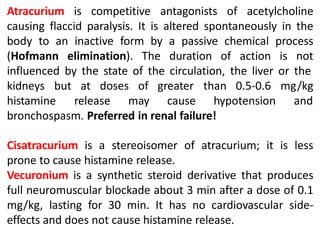
Atracurium is competitive antagonists of acetylcholine
causing flaccid paralysis. It is altered spontaneously in the
body to an inactive form by a passive chemical process
(Hofmann elimination). The duration of action is not
influenced by the state of the circulation, the liver or the
kidneys but at doses of
histamine release may
greater than 0.5-0.6 mg/kg
cause hypotension and
bronchospasm. Preferred in renal failure!
Cisatracurium is a stereoisomer of atracurium; it is less
prone to cause histamine release.
Vecuronium is a synthetic steroid derivative that produces
full neuromuscular blockade about 3 min after a dose of 0.1
mg/kg, lasting for 30 min. It has no cardiovascular side-
effects and does not cause histamine release.
Pancuronium was the first steroid-derived neuromuscular
blocker in clinical use. It is longer acting than vecuronium

and causes a slight tachycardia. It is about 5 times more
potent & provide good cardiovascular stability than d-
TC. It is used in patient in ventilator.
Mivacurium belongs to the same chemical family as
atracurium and is the only non-depolarising
neuromuscular blocker
plasma cholinesterase.
that is metabolised by
It is comparatively
short acting (10-15 min), depending on the initial
dose. Mivacurium can cause some hypotension
because of histamine release.
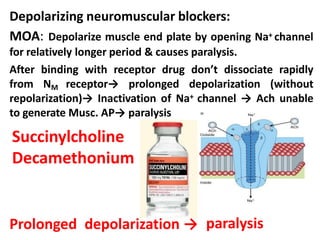
Prolonged depolarization → paralysis
Depolarizing neuromuscular blockers:
MOA: Depolarize muscle end plate by opening Na+ channel
for relatively longer period & causes paralysis.
After binding with receptor drug don’t dissociate rapidly
from NM receptor→ prolonged depolarization (without
repolarization)→ Inactivation of Na+ channel → Ach unable
to generate Musc. AP→ paralysis
Succinylcholine
Decamethonium
Succinylcholine (Suxamethonium)
MOA: Succinylcholine binds to the nicotinic receptor NM and
acts like Acetylcholine to depolarize the skeletal muscle.
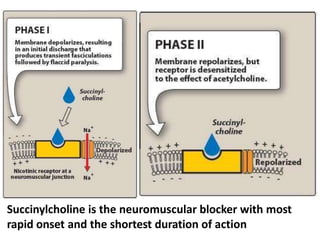
It attaches to the receptor for a relatively longer time and
provides constant stimulation of the receptor. It first(Phase I)
causes the opening of the sodium channel in nicotinic
receptors, which results in depolarization of the receptor but
continuous binding (Phase II) makes the receptor incapable
of transmitting further impulses and the sodium channel is
blocked causing paralysis.
• Agonist of NM receptor (NOT a blocker); similar to Ach
• Most commonly used for intubation (tracheal)- because
rapid, complete & predictable paralysis with spontaneous
recovery in ~ 5 min
• Infant require higher dose so precaution
Succinylcholine is the neuromuscular blocker with most
rapid onset and the shortest duration of action
Indication
• Endotracheal intubation, laryngoscopy, bronchocopy
• Used as a muscle relaxant in general anaesthesia
• Continuous i.v. infusion for producing controlled muscle
relaxation of longer duration
Contraindication and Precaution
• Contraindicated in patients with genetic disorders of
plasma pseudocholinesterase, severe burns,
hypersensitivity, malignant hyperthermia, massive trauma
• Precaution should be taken by patients with bone fracture,
neuromuscular disease, raised intraocular pressure.
Adverse Effects
• Bradycardia, Hyperkalaemia, Malignant hyperthermia,
Raised intraocular pressure, Arrhythmia
Dose:
• Adult: 0.3-1.1 mg/kg IV, 3-4 mg/kg IM
• Child: 1-2 mg/kg IV, when necessary
Peripherally acting muscle relaxants
Indication:
• Adjuvant to General anaesthesia
• Assisted Ventilation in ICU
• Endotracheal intubation, laryngoscopy, bronchocopy
(brief procedure)- Sch preferred
• Convulsions & trauma are avoided during ECT
• Severe cases of tetanus & status epilepticus – NOT
controlled by diazepam
Adverse effects:
• Respiratory paralysis & prolonged apnoea
• Fall in BP & cardiovascular collapse→ in hypovolemic
patient when d-TC used
• Cardiac arrhythmias
• Malignant hyperthermia- Sch
Drug Interactions
a. Thiopentone sodium & Sch (chemical rxn)
b. GAs potentiate action
c. Anticholinesterase (reverse action)
Neostigmine 0.5- 2mg iv + Atropine
d. Antibiotics: e.g. Aminoglycosides
e. Calcium channel blockers,Diuretics &
Antibiotics (potentiate action)
Directly acting skeletal muscle relaxants
Dantrolene Sodium: Dantrolene acts on the RyR1 (Ryanodine
Receptor) calcium channels in the sarcoplasmic reticulum of
Ca2+ Ca2+
skeletal muscles and prevents induced release
through these channels.
Intracellular release of Ca2+ needed for excitation-contraction
coupling is interfered and causes muscle relaxation.
Since Ca2+ channels in the sarcoplasmic reticulum of cardiac
and smooth muscles are of a different subtype (RyR2), these
muscles are affected little by dantrolene.
• Used orally dantrolene (25–100 mg QID)
• Drug of choice for malignant hyperthermia
• Reduces spasticity in upper motor neurone disorders
Quinine: Quinine increases refractory period and decreases
excitability of motor end plates. Thus, responses to repetitive
nerve stimulation are reduced. It is also used in malaria.
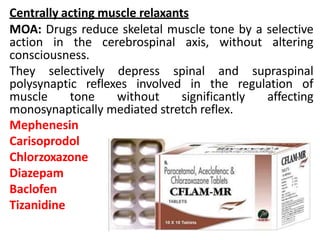
Centrally acting muscle relaxants
MOA: Drugs reduce skeletal muscle tone by a selective
action in the cerebrospinal axis, without altering
consciousness.
They selectively depress spinal and supraspinal
polysynaptic reflexes involved in the regulation of
muscle tone without significantly affecting
monosynaptically mediated stretch reflex.
Mephenesin
Carisoprodol
Chlorzoxazone
Diazepam
Baclofen
Tizanidine
Mephenesin was the first drug found to cause
muscle relaxation in animals without producing
unconsciousness. It blocks the action of the spinal
internuncial neurone which modulates reflexes
maintaining muscle tone.
It is not used clinically because orally it causes
marked gastric irritation, and injected i.v., it causes
thrombophlebitis, haemolysis and fall in BP.
Chlorzoxazone is a centrally acting muscle relaxant
used to treat muscle spasm and the resulting pain
or discomfort. It acts on the spinal cord by
depressing reflexes. It has longer duration of action
and better tolerability. Dose: 250-750 mg TDS
Diazepam is a benzodiazepine (BZD) which act in the
brain on specific receptors enhancing GABAergic
transmission and muscle tone is reduced through
supraspinal action.
Baclofen is a selective GABAB receptor agonist
structurally related to γ-aminobutyric acid (GABA), an
inhibitory central nervous system (CNS) transmitter. It
inhibits reflex activity mainly in the spinal cord. Baclofen
reduces spasticity and spasms.
Adverse effects:
drowsiness, mental confusion, weakness, ataxia, raised
serum transaminases. Sudden withdrawal after chronic
use may cause hallucinations, tachycardia and seizures.
Dose: 10 mg BD to 25 mg TDS.
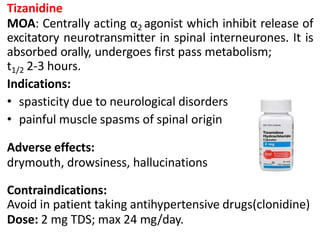
Tizanidine
MOA: Centrally acting α2 agonist which inhibit release of
excitatory neurotransmitter in spinal interneurones. It is
absorbed orally, undergoes first pass metabolism;
t1/2 2-3 hours.
Indications:
• spasticity due to neurological disorders
• painful muscle spasms of spinal origin
Adverse effects:
drymouth, drowsiness, hallucinations
Contraindications:
Avoid in patient taking antihypertensive drugs(clonidine)
Dose: 2 mg TDS; max 24 mg/day.
Centrally acting muscle relaxants
Indications:
• Acute muscle spasms
• Spastic neurological diseases
• Torticollis, lumbago, backache, neuralgias
• Tetanus
• Electroconvulsive therapy
• Orthopedic manipulations
THANK YOU !
THANK YOU !

Skeletal Muscle R ,,oa averse effects uses

  • 1.
  • 2.
    Skeletal Muscle Relaxants Drugsthat act peripherally at neuromuscular junction/muscle fibre or centrally in the cerebrospinal axis to reduce muscle tone or cause paralysis. These drugs are used: • To reduce painful muscle spasms. • To reduce spastic neurological conditions. • Together with anaesthetics to provide muscle relaxation for surgery.
  • 3.
    Classification: Peripherally acting musclerelaxants 1. Neuromuscular Blockers A. Non-depolarizing blockers: • Long acting: d-tubocurarine, pancuronium • Intermediate acting: Vecuronium, Atracurium • Short acting: Mivacurium B. Depolarizing blockers: Succinylcholine (Sch, Suxamethonium), Decamethonium 2. Directly acting agents: Dantrolene Sodium,Quinine Centrally acting muscle relaxants • Mephenesin congeners: Mephenesin, Chlorzoxazone • Benzodiazepines: Diazepam • GABA mimetics: Baclofen • Central α2 agonist: Tizanidine
  • 4.
    Peripherally acting musclerelaxants Non-depolarizing neuromuscular blockers MOA: Block NM receptor at neuromuscular junction on skeletal muscle. d-tubocurarine Pancuronium Vecuronium Atracurium Mivacurium NM receptor is ligand gated Na+ channel having two binding site for Acetylcholine (Ach). Ach binding → opens Na+ channel → AP → Contraction χ paralysis χ
  • 5.
  • 6.
    Tubocurarine It is atoxic alkaloid obtained from the bark of the South American plant Chondrodendron tomentosum historically known for its use as an arrow poison. d-tubocurarine MOA: Competitively binds with the nicotinic receptors NM to prevent the binding depolarization of the of Acetylcholine and muscle cell membrane and prevent inhibit muscular contraction. • Because these agents compete with ACh at the receptor without stimulating it, they are called competitive blockers. • Antagonism is surmountable so neostigmine, pyridostigmine can reverse the effect. • Injected 0.1 to 0.3 mg/kg slow IV • Long duration of action but more side effect so NOT used now!
  • 8.
    Atracurium is competitiveantagonists of acetylcholine causing flaccid paralysis. It is altered spontaneously in the body to an inactive form by a passive chemical process (Hofmann elimination). The duration of action is not influenced by the state of the circulation, the liver or the kidneys but at doses of histamine release may greater than 0.5-0.6 mg/kg cause hypotension and bronchospasm. Preferred in renal failure! Cisatracurium is a stereoisomer of atracurium; it is less prone to cause histamine release. Vecuronium is a synthetic steroid derivative that produces full neuromuscular blockade about 3 min after a dose of 0.1 mg/kg, lasting for 30 min. It has no cardiovascular side- effects and does not cause histamine release.
  • 9.
    Pancuronium was thefirst steroid-derived neuromuscular blocker in clinical use. It is longer acting than vecuronium and causes a slight tachycardia. It is about 5 times more potent & provide good cardiovascular stability than d- TC. It is used in patient in ventilator. Mivacurium belongs to the same chemical family as atracurium and is the only non-depolarising neuromuscular blocker plasma cholinesterase. that is metabolised by It is comparatively short acting (10-15 min), depending on the initial dose. Mivacurium can cause some hypotension because of histamine release.
  • 10.
    Prolonged depolarization →paralysis Depolarizing neuromuscular blockers: MOA: Depolarize muscle end plate by opening Na+ channel for relatively longer period & causes paralysis. After binding with receptor drug don’t dissociate rapidly from NM receptor→ prolonged depolarization (without repolarization)→ Inactivation of Na+ channel → Ach unable to generate Musc. AP→ paralysis Succinylcholine Decamethonium
  • 11.
    Succinylcholine (Suxamethonium) MOA: Succinylcholinebinds to the nicotinic receptor NM and acts like Acetylcholine to depolarize the skeletal muscle. It attaches to the receptor for a relatively longer time and provides constant stimulation of the receptor. It first(Phase I) causes the opening of the sodium channel in nicotinic receptors, which results in depolarization of the receptor but continuous binding (Phase II) makes the receptor incapable of transmitting further impulses and the sodium channel is blocked causing paralysis. • Agonist of NM receptor (NOT a blocker); similar to Ach • Most commonly used for intubation (tracheal)- because rapid, complete & predictable paralysis with spontaneous recovery in ~ 5 min • Infant require higher dose so precaution
  • 12.
    Succinylcholine is theneuromuscular blocker with most rapid onset and the shortest duration of action
  • 13.
    Indication • Endotracheal intubation,laryngoscopy, bronchocopy • Used as a muscle relaxant in general anaesthesia • Continuous i.v. infusion for producing controlled muscle relaxation of longer duration Contraindication and Precaution • Contraindicated in patients with genetic disorders of plasma pseudocholinesterase, severe burns, hypersensitivity, malignant hyperthermia, massive trauma • Precaution should be taken by patients with bone fracture, neuromuscular disease, raised intraocular pressure. Adverse Effects • Bradycardia, Hyperkalaemia, Malignant hyperthermia, Raised intraocular pressure, Arrhythmia Dose: • Adult: 0.3-1.1 mg/kg IV, 3-4 mg/kg IM • Child: 1-2 mg/kg IV, when necessary
  • 14.
    Peripherally acting musclerelaxants Indication: • Adjuvant to General anaesthesia • Assisted Ventilation in ICU • Endotracheal intubation, laryngoscopy, bronchocopy (brief procedure)- Sch preferred • Convulsions & trauma are avoided during ECT • Severe cases of tetanus & status epilepticus – NOT controlled by diazepam Adverse effects: • Respiratory paralysis & prolonged apnoea • Fall in BP & cardiovascular collapse→ in hypovolemic patient when d-TC used • Cardiac arrhythmias • Malignant hyperthermia- Sch
  • 15.
    Drug Interactions a. Thiopentonesodium & Sch (chemical rxn) b. GAs potentiate action c. Anticholinesterase (reverse action) Neostigmine 0.5- 2mg iv + Atropine d. Antibiotics: e.g. Aminoglycosides e. Calcium channel blockers,Diuretics & Antibiotics (potentiate action)
  • 16.
    Directly acting skeletalmuscle relaxants Dantrolene Sodium: Dantrolene acts on the RyR1 (Ryanodine Receptor) calcium channels in the sarcoplasmic reticulum of Ca2+ Ca2+ skeletal muscles and prevents induced release through these channels. Intracellular release of Ca2+ needed for excitation-contraction coupling is interfered and causes muscle relaxation. Since Ca2+ channels in the sarcoplasmic reticulum of cardiac and smooth muscles are of a different subtype (RyR2), these muscles are affected little by dantrolene. • Used orally dantrolene (25–100 mg QID) • Drug of choice for malignant hyperthermia • Reduces spasticity in upper motor neurone disorders Quinine: Quinine increases refractory period and decreases excitability of motor end plates. Thus, responses to repetitive nerve stimulation are reduced. It is also used in malaria.
  • 17.
    Centrally acting musclerelaxants MOA: Drugs reduce skeletal muscle tone by a selective action in the cerebrospinal axis, without altering consciousness. They selectively depress spinal and supraspinal polysynaptic reflexes involved in the regulation of muscle tone without significantly affecting monosynaptically mediated stretch reflex. Mephenesin Carisoprodol Chlorzoxazone Diazepam Baclofen Tizanidine
  • 18.
    Mephenesin was thefirst drug found to cause muscle relaxation in animals without producing unconsciousness. It blocks the action of the spinal internuncial neurone which modulates reflexes maintaining muscle tone. It is not used clinically because orally it causes marked gastric irritation, and injected i.v., it causes thrombophlebitis, haemolysis and fall in BP. Chlorzoxazone is a centrally acting muscle relaxant used to treat muscle spasm and the resulting pain or discomfort. It acts on the spinal cord by depressing reflexes. It has longer duration of action and better tolerability. Dose: 250-750 mg TDS
  • 19.
    Diazepam is abenzodiazepine (BZD) which act in the brain on specific receptors enhancing GABAergic transmission and muscle tone is reduced through supraspinal action. Baclofen is a selective GABAB receptor agonist structurally related to γ-aminobutyric acid (GABA), an inhibitory central nervous system (CNS) transmitter. It inhibits reflex activity mainly in the spinal cord. Baclofen reduces spasticity and spasms. Adverse effects: drowsiness, mental confusion, weakness, ataxia, raised serum transaminases. Sudden withdrawal after chronic use may cause hallucinations, tachycardia and seizures. Dose: 10 mg BD to 25 mg TDS.
  • 20.
    Tizanidine MOA: Centrally actingα2 agonist which inhibit release of excitatory neurotransmitter in spinal interneurones. It is absorbed orally, undergoes first pass metabolism; t1/2 2-3 hours. Indications: • spasticity due to neurological disorders • painful muscle spasms of spinal origin Adverse effects: drymouth, drowsiness, hallucinations Contraindications: Avoid in patient taking antihypertensive drugs(clonidine) Dose: 2 mg TDS; max 24 mg/day.
  • 21.
    Centrally acting musclerelaxants Indications: • Acute muscle spasms • Spastic neurological diseases • Torticollis, lumbago, backache, neuralgias • Tetanus • Electroconvulsive therapy • Orthopedic manipulations THANK YOU !
  • 22.