SYSTEMIC EFFECTS
OF
LOCAL
ANAESTHETICS
DR. SWATI SAHU
MDS FELLOW
ORAL & MAXILLOFACIAL SURGERY
CNS
• In one word : DEPRESSION
• At high levels, LA will produce tonic-clonic convulsions
• Procaine, Lidocaine etc produce ANTICONVULSANT properties.
• This drugs are used for management of grand mal & petit mal seizures
• The depressant action of LA raise the seizure threshold by decreasing the
excitability of cortical neurons in epileptic patients
PRECONVULSIVE SIGNS &
SYMPTOMS
• Numbness of the tongue & circumoral regions
• If excitation or sedation occurs in the first 5 or 10 minutes after administration of
LA, it should consider as a warning that convulsive activity could be possible.
• Shivering, slurred speech, muscular twitching, visual/auditory disturbances,
dizziness, drowsiness, disorientation & tremor.
CONVULSIVE PHASE
• Duration of seizures is related to blood level of LA & inversely related to
arterial pCO2 levels.
• Seizures last less than or equal to one minute.
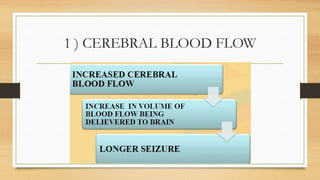
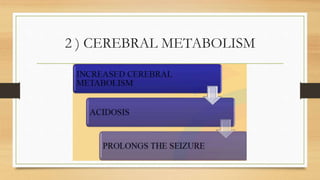
• In seizure,
1) cerebral blood flow &
2) cerebral metabolism increase
1 ) CEREBRAL BLOOD FLOW
2 ) CEREBRAL METABOLISM
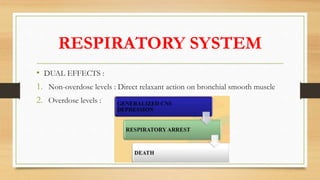
RESPIRATORY SYSTEM
• DUAL EFFECTS :
1. Non-overdose levels : Direct relaxant action on bronchial smooth muscle
2. Overdose levels :
CVS
• Direct action on myocardium & peripheral vasculature.
• Increased LA blood levels result in decreased myocardial depolarization
• Decrease in myocardial excitation, decrease in conduction rate & decrease in
the force of contraction
• Produces hypotension ( direct relaxation effect on vascular smooth muscle )
LOCAL TISSUE TOXICITY
• Skeletal muscle will heal within 2 weeks of being injected with local
anaesthetic.
• Longer acting LA produces more damage to skeletal muscle than shorter
acting LA.
TOXICITY OF LOCAL ANAESTHESIA
1- Causes
2- Factors reducing toxicity.
CAUSES
• Accidental rapid intravenous injection.
• Rapid absorption, such as from a very vascular site i.e mucous membranes.
• Overdose
FACTORS REDUCING TOXICITY
• Decide on the concentration of the local anaesthetic that is required for the block to
be performed. Calculation of the total volume of drug should be done.
• Use the least toxic drug available.
• Use lower doses in frail patients or at the extremes of ages.
• Always inject the drug slowly (around 1ml /minute) and aspirate regularly looking
for blood to indicate an accidental intravenous injection
• If Injection of a test dose of 2-3ml of local anaesthetic containing adrenaline is accidentally
given intravenously it will often (but not always) cause significant tachycardia.
• Add adrenaline (epinephrine) to reduce the speed of absorption. The addition of adrenaline
will reduce the maximum blood concentration by about 50%. Usually adrenaline is added in
a concentration of 1:200,000, with a maximum dose of 200 micrograms.
• Make sure that the patient is monitored closely by the anaesthetist or a trained nurse during
the administration of the local anaesthetic and following the surgery.
ADVANTAGES OF LOCAL
ANAESTHESIA
• During local anesthesia the patient remains conscious
• Maintains his own airway.
• Excellent muscle relaxant effect.
• Requires less skilled nursing care as compared to other anesthesia like general
anesthesia.
• Non inflammable.
• Less pulmonary complications
• Aspiration of gastric contents unlikely.
• Less nausea and vomiting.
• Contracted bowel so helpful in abdominal and pelvic surgery.
• Postoperative analgesia.
• There is reduction surgical stress.
• Earlier discharge for outpatients.
• Suitable for patients who recently ingested food or fluids.
• Local anesthesia is useful for ambulatory patients having minor procedures.
• Ideal for procedures in which it is desirable to have the patient awake and
cooperative.
• Less bleeding.
• Expenses are less.
DISADVANTAGES OF LOCAL
ANAESTHESIA
• There are individual variations in response to local anesthetic drugs.
• Rapid absorption of the drug into the bloodstream can cause severe,
potentially fatal reactions.
• Apprehension may be increased by the patient's ability to see and hear.
• Some patients prefer to be unconscious and unaware.
• Direct damage of nerve.
• Post-dural headache from CSF leak.
• Hypotension and bradycardia through blockade of the sympathetic nervous
system.
• Not suitable for extremes of ages.
• Multiple needle pricks may be needed.

Systemic effects of LOCAL ANESTHESIA

  • 1.
    SYSTEMIC EFFECTS OF LOCAL ANAESTHETICS DR. SWATISAHU MDS FELLOW ORAL & MAXILLOFACIAL SURGERY
  • 2.
    CNS • In oneword : DEPRESSION • At high levels, LA will produce tonic-clonic convulsions • Procaine, Lidocaine etc produce ANTICONVULSANT properties.
  • 3.
    • This drugsare used for management of grand mal & petit mal seizures • The depressant action of LA raise the seizure threshold by decreasing the excitability of cortical neurons in epileptic patients
  • 4.
    PRECONVULSIVE SIGNS & SYMPTOMS •Numbness of the tongue & circumoral regions • If excitation or sedation occurs in the first 5 or 10 minutes after administration of LA, it should consider as a warning that convulsive activity could be possible. • Shivering, slurred speech, muscular twitching, visual/auditory disturbances, dizziness, drowsiness, disorientation & tremor.
  • 5.
    CONVULSIVE PHASE • Durationof seizures is related to blood level of LA & inversely related to arterial pCO2 levels. • Seizures last less than or equal to one minute. • In seizure, 1) cerebral blood flow & 2) cerebral metabolism increase
  • 6.
    1 ) CEREBRALBLOOD FLOW
  • 7.
    2 ) CEREBRALMETABOLISM
  • 8.
    RESPIRATORY SYSTEM • DUALEFFECTS : 1. Non-overdose levels : Direct relaxant action on bronchial smooth muscle 2. Overdose levels :
  • 9.
    CVS • Direct actionon myocardium & peripheral vasculature. • Increased LA blood levels result in decreased myocardial depolarization • Decrease in myocardial excitation, decrease in conduction rate & decrease in the force of contraction • Produces hypotension ( direct relaxation effect on vascular smooth muscle )
  • 10.
    LOCAL TISSUE TOXICITY •Skeletal muscle will heal within 2 weeks of being injected with local anaesthetic. • Longer acting LA produces more damage to skeletal muscle than shorter acting LA.
  • 11.
    TOXICITY OF LOCALANAESTHESIA 1- Causes 2- Factors reducing toxicity.
  • 12.
    CAUSES • Accidental rapidintravenous injection. • Rapid absorption, such as from a very vascular site i.e mucous membranes. • Overdose
  • 13.
    FACTORS REDUCING TOXICITY •Decide on the concentration of the local anaesthetic that is required for the block to be performed. Calculation of the total volume of drug should be done. • Use the least toxic drug available. • Use lower doses in frail patients or at the extremes of ages. • Always inject the drug slowly (around 1ml /minute) and aspirate regularly looking for blood to indicate an accidental intravenous injection
  • 14.
    • If Injectionof a test dose of 2-3ml of local anaesthetic containing adrenaline is accidentally given intravenously it will often (but not always) cause significant tachycardia. • Add adrenaline (epinephrine) to reduce the speed of absorption. The addition of adrenaline will reduce the maximum blood concentration by about 50%. Usually adrenaline is added in a concentration of 1:200,000, with a maximum dose of 200 micrograms. • Make sure that the patient is monitored closely by the anaesthetist or a trained nurse during the administration of the local anaesthetic and following the surgery.
  • 15.
    ADVANTAGES OF LOCAL ANAESTHESIA •During local anesthesia the patient remains conscious • Maintains his own airway. • Excellent muscle relaxant effect. • Requires less skilled nursing care as compared to other anesthesia like general anesthesia. • Non inflammable.
  • 16.
    • Less pulmonarycomplications • Aspiration of gastric contents unlikely. • Less nausea and vomiting. • Contracted bowel so helpful in abdominal and pelvic surgery. • Postoperative analgesia. • There is reduction surgical stress. • Earlier discharge for outpatients.
  • 17.
    • Suitable forpatients who recently ingested food or fluids. • Local anesthesia is useful for ambulatory patients having minor procedures. • Ideal for procedures in which it is desirable to have the patient awake and cooperative. • Less bleeding. • Expenses are less.
  • 18.
    DISADVANTAGES OF LOCAL ANAESTHESIA •There are individual variations in response to local anesthetic drugs. • Rapid absorption of the drug into the bloodstream can cause severe, potentially fatal reactions. • Apprehension may be increased by the patient's ability to see and hear. • Some patients prefer to be unconscious and unaware.
  • 19.
    • Direct damageof nerve. • Post-dural headache from CSF leak. • Hypotension and bradycardia through blockade of the sympathetic nervous system. • Not suitable for extremes of ages. • Multiple needle pricks may be needed.