LOBAR COLLAPSE OF
LUNGS
- Dr. Pradeep Patil
Dr. D. Y. Patil Medical College Hospital, Kolhapur
Dept. of Radiodiagnosis
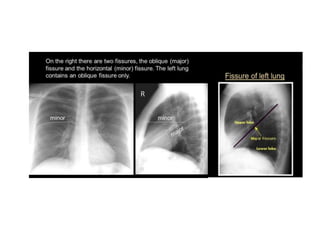
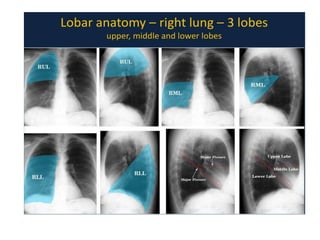
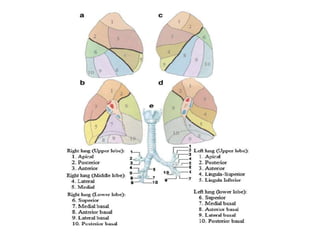
Lobes of Lungs
R
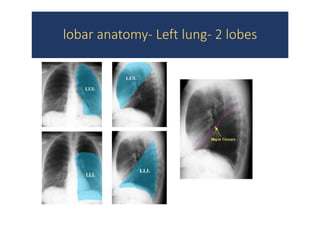
lobar anatomy- Left lung- 2 lobes
LOBAR COLLAPSE
LOBAR COLLAPSE
• Lobar collapse refers to collapse of an entire lobe of the lung.
• it is a sub type of atelectasis.
• Individual lobes of the lung may collapse due to obstruction of the
supplying bronchus.
Causes of lobar collapse
extrinsic
• compression by adjacent mass
luminal
• aspirated foreign material
• mucous plugging
• endobronchial mass
• misplaced endotracheal tube
mural
• bronchogenic carcinoma
Signs of Lobar Collapse
• Lobar
• Shift of fissure
• Crowding of pulmonary vessels
(increased opacity)
• Extra lobar
• I/L Hemi diaphragm elevation
• Mediastinal shift
towards side of collapse
• Hilar displacement towards
the collapse
• Compensatory hyperinflation of
normal lobes
• Rib approximation
(crowding of ipsilateral ribs)
• Shift of other structures
Right upper lobe collapse
RUL collapse
Horizontal fissure displaced upward
Hilum is elevated
Tracheal deviation to right
Compensatory hyperinflation of
right middle and lower lobes may be seen
Right upper lobe collapse
• On the lateral projection it is harder to identify as the soft tissues of the shoulders usually
obscure the upper zones, and the collapse is mostly medial.
• Elevation of the horizontal fissure and upper part of the oblique fissure may be visible
• Both fissures concave superiorly
Right upper lobe collapse
Golden’s S sign
The sign refers to the S shape ( or more accurately , reverse S on the right)
of the fissure due to the combination of collapse and mass centrally resulting
in a focal convexity with a concave outline.
Golden’s
S sign
Juxtaphrenic peak sign
• The juxtaphrenic peak sign,
which occurs in upper lobe
atelectasis, describes the
triangular opacity projecting
superiorly at the medial half of
the diaphragm.
D/D
• The differential diagnosis of collapse of the right upper lobe
includes:
1. consolidation of the right upper lobe
2. a mass in the medial aspect of the right upper lobe
3. a mass in on the right side of the superior mediastinum
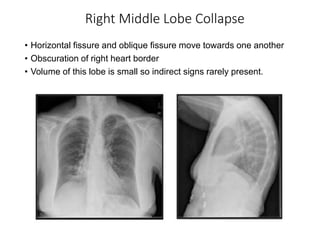
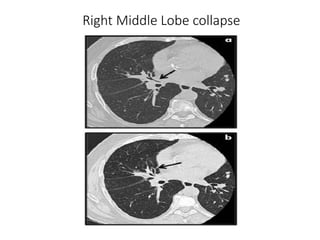
Right Middle Lobe Collapse
• Horizontal fissure and oblique fissure move towards one another
• Obscuration of right heart border
• Volume of this lobe is small so indirect signs rarely present.
Right Middle Lobe collapse
Silhouette Sign
• If two soft tissue densities lie in apposition, then they will not be
visible separately
• If they are separated by air, the boundaries of both will be seen
 Uses of Silhouette
1. Localisation without a lateral view
2. Loss of clarity of a structure suggests there is
adjacent soft tissue shadowing even when the
abnormality itself is not clearly visualised. This is
particularly valuable in some cases of lobar
collapse.
Right Middle lobe Collapse
1: Right horizontal and oblique fissure move towards each other often
subtle
2: Blur the normally sharp right-heart border (silhouette sign)
Posteroanterior (PA) (left) and lateral chest (right) radiographs.
A right middle lobe collapse obliterates the right heart border
on the PA image and projects as a wedge-shaped opacity on
the lateral view.
D/D
1. Frontal projection
On frontal (PA or AP) projection, right middle lobe collapse should be distinguished
from:
•consolidation of the right middle lobe
•pectus excavatum: downward sloping ribs and shift of the heart away from the right
are clues. Lateral projections makes the distinction easy.
2. Lateral projection
On the lateral projection, right middle lobe collapse should be distinguished from:
•fluid within the oblique fissure (pseudotumour): horizontal fissure should be visible
as separate to the opacity 2
•fat within the oblique fissure
•consolidation of the right middle lobe
Right Lower lobe collapse
• Depression of horizontal fissure
• Increase opacity of collapse lower lobe
• In case of complete collapse of lower lobe it may be so small that it merges with mediastinum
and produce a thin wedge shape shadow.
• Mediastinal parts and adjacent diaphragm obscured
• Hila depressed
• Diaphragm elevation is not usual
Right Lower lobe collapse
Posterior and medial collapse
Obliteration of the right hemi diaphragm
Heart border clearly seen
Transverse fissure pulled inferiorly
The lateral view is usually definitive-
there will be postero-inferior movement
of the oblique fissure whilst
maintaining the same slope
The lower lobes collapse downward
medially toward the spine and
posteriorly
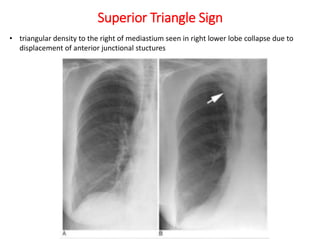
Superior Triangle Sign
• triangular density to the right of mediastium seen in right lower lobe collapse due to
displacement of anterior junctional stuctures
right lower lobe collapse that results in volume loss,
obliteration of the right side of the diaphragm, and a
posterior opacity.
D/D
The characteristic shape associated with volume loss usually does not
allow for any significant differential diagnosis. As always one should
consider:
• consolidation (of the medial basal segment of the right lower lobe)
• a pulmonary or posterior mediastinal mass
• The location is also a favourite for pulmonary sequestration.
Left Upper Lobe Collapse
• veil like opacity
• aortic knuckle, left hilum, and left-heart border initially ill
defined but may progress to become sharp
• almost vertical oblique fissure
• Loss of volume on left side
• I/L shift of trachea and
mediastinum
• Compensatory hyperinflation
of left lung
• Raised left hemidiaphragm
( compare with right with
tenting)
• Haziness over the aortic
knuckle
( silhouette sign)
• Oblique fissure
displaced anteriorly
• Opacification anterior to
the oblique fissure
• Anterior displacement
of entire oblique fissure
• Aortic knuckle obscured
LEFT UPPER LOBE COLLAPSE
LATERAL VIEW
• With increasing collapse upper
lobe retracts posteriorly and
loses contact with anterior chest
wall.
• The space between the
collapsed lung and sternum is
occupied by either hyperinflated
left lower lobe or herniated
right upper lobe.
• When complete collapse occurs
LUL lose contact with chest wall
and diaphragm and retract
medially against the
mediastinum
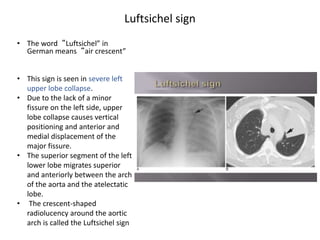
Luftsichel sign
• The word“Luftsichel” in
German means“air crescent”
• This sign is seen in severe left
upper lobe collapse.
• Due to the lack of a minor
fissure on the left side, upper
lobe collapse causes vertical
positioning and anterior and
medial displacement of the
major fissure.
• The superior segment of the left
lower lobe migrates superior
and anteriorly between the arch
of the aorta and the atelectatic
lobe.
• The crescent-shaped
radiolucency around the aortic
arch is called the Luftsichel sign
Left Upper Lobe Collapse
‘Luftsichel’
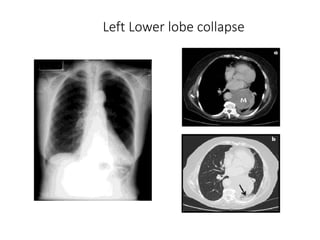
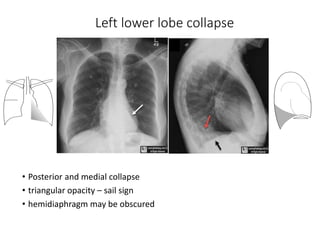
Left lower lobe collapse
• Posterior and medial collapse
• triangular opacity – sail sign
• hemidiaphragm may be obscured
• The PA view will show a triangular
area of increased opacity behind
the left heart shadow.
• There may be loss of visualisation
of the left hemi-diaphragm
behind the heart
• The lower lobes collapse
• downward
• medially toward the spine and
• posteriorly
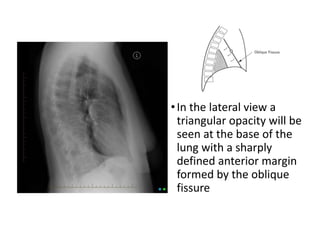
•In the lateral view a
triangular opacity will be
seen at the base of the
lung with a sharply
defined anterior margin
formed by the oblique
fissure
Left Lower lobe collapse
D/D
• The characteristic shape associated with volume loss usually does not
allow for any significant differential diagnosis. As always one should
consider:
1. consolidation (of the medial basal segment of the right lower lobe)
2. a pulmonary or posterior mediastinal mass
Summary Right
•Right Upper lobe
•Right middle lobe
•Right Lower Lobe
Summary Left
•Left upper lobe
•Left lower lobe
Thank You

lobar collapse xray.pptx

  • 1.
    LOBAR COLLAPSE OF LUNGS -Dr. Pradeep Patil Dr. D. Y. Patil Medical College Hospital, Kolhapur Dept. of Radiodiagnosis
  • 2.
  • 3.
  • 5.
    lobar anatomy- Leftlung- 2 lobes
  • 7.
  • 8.
    LOBAR COLLAPSE • Lobarcollapse refers to collapse of an entire lobe of the lung. • it is a sub type of atelectasis. • Individual lobes of the lung may collapse due to obstruction of the supplying bronchus.
  • 9.
    Causes of lobarcollapse extrinsic • compression by adjacent mass luminal • aspirated foreign material • mucous plugging • endobronchial mass • misplaced endotracheal tube mural • bronchogenic carcinoma
  • 10.
    Signs of LobarCollapse • Lobar • Shift of fissure • Crowding of pulmonary vessels (increased opacity) • Extra lobar • I/L Hemi diaphragm elevation • Mediastinal shift towards side of collapse • Hilar displacement towards the collapse • Compensatory hyperinflation of normal lobes • Rib approximation (crowding of ipsilateral ribs) • Shift of other structures
  • 11.
    Right upper lobecollapse RUL collapse Horizontal fissure displaced upward Hilum is elevated Tracheal deviation to right Compensatory hyperinflation of right middle and lower lobes may be seen
  • 12.
    Right upper lobecollapse • On the lateral projection it is harder to identify as the soft tissues of the shoulders usually obscure the upper zones, and the collapse is mostly medial. • Elevation of the horizontal fissure and upper part of the oblique fissure may be visible • Both fissures concave superiorly
  • 13.
  • 14.
    Golden’s S sign Thesign refers to the S shape ( or more accurately , reverse S on the right) of the fissure due to the combination of collapse and mass centrally resulting in a focal convexity with a concave outline.
  • 15.
  • 16.
    Juxtaphrenic peak sign •The juxtaphrenic peak sign, which occurs in upper lobe atelectasis, describes the triangular opacity projecting superiorly at the medial half of the diaphragm.
  • 17.
    D/D • The differentialdiagnosis of collapse of the right upper lobe includes: 1. consolidation of the right upper lobe 2. a mass in the medial aspect of the right upper lobe 3. a mass in on the right side of the superior mediastinum
  • 18.
    Right Middle LobeCollapse • Horizontal fissure and oblique fissure move towards one another • Obscuration of right heart border • Volume of this lobe is small so indirect signs rarely present.
  • 19.
  • 20.
    Silhouette Sign • Iftwo soft tissue densities lie in apposition, then they will not be visible separately • If they are separated by air, the boundaries of both will be seen
  • 21.
     Uses ofSilhouette 1. Localisation without a lateral view 2. Loss of clarity of a structure suggests there is adjacent soft tissue shadowing even when the abnormality itself is not clearly visualised. This is particularly valuable in some cases of lobar collapse.
  • 22.
    Right Middle lobeCollapse 1: Right horizontal and oblique fissure move towards each other often subtle 2: Blur the normally sharp right-heart border (silhouette sign)
  • 23.
    Posteroanterior (PA) (left)and lateral chest (right) radiographs. A right middle lobe collapse obliterates the right heart border on the PA image and projects as a wedge-shaped opacity on the lateral view.
  • 24.
    D/D 1. Frontal projection Onfrontal (PA or AP) projection, right middle lobe collapse should be distinguished from: •consolidation of the right middle lobe •pectus excavatum: downward sloping ribs and shift of the heart away from the right are clues. Lateral projections makes the distinction easy. 2. Lateral projection On the lateral projection, right middle lobe collapse should be distinguished from: •fluid within the oblique fissure (pseudotumour): horizontal fissure should be visible as separate to the opacity 2 •fat within the oblique fissure •consolidation of the right middle lobe
  • 25.
    Right Lower lobecollapse • Depression of horizontal fissure • Increase opacity of collapse lower lobe • In case of complete collapse of lower lobe it may be so small that it merges with mediastinum and produce a thin wedge shape shadow. • Mediastinal parts and adjacent diaphragm obscured • Hila depressed • Diaphragm elevation is not usual
  • 26.
    Right Lower lobecollapse Posterior and medial collapse Obliteration of the right hemi diaphragm Heart border clearly seen Transverse fissure pulled inferiorly
  • 27.
    The lateral viewis usually definitive- there will be postero-inferior movement of the oblique fissure whilst maintaining the same slope The lower lobes collapse downward medially toward the spine and posteriorly
  • 28.
    Superior Triangle Sign •triangular density to the right of mediastium seen in right lower lobe collapse due to displacement of anterior junctional stuctures
  • 29.
    right lower lobecollapse that results in volume loss, obliteration of the right side of the diaphragm, and a posterior opacity.
  • 30.
    D/D The characteristic shapeassociated with volume loss usually does not allow for any significant differential diagnosis. As always one should consider: • consolidation (of the medial basal segment of the right lower lobe) • a pulmonary or posterior mediastinal mass • The location is also a favourite for pulmonary sequestration.
  • 31.
    Left Upper LobeCollapse • veil like opacity • aortic knuckle, left hilum, and left-heart border initially ill defined but may progress to become sharp • almost vertical oblique fissure
  • 32.
    • Loss ofvolume on left side • I/L shift of trachea and mediastinum • Compensatory hyperinflation of left lung • Raised left hemidiaphragm ( compare with right with tenting) • Haziness over the aortic knuckle ( silhouette sign)
  • 33.
    • Oblique fissure displacedanteriorly • Opacification anterior to the oblique fissure • Anterior displacement of entire oblique fissure • Aortic knuckle obscured LEFT UPPER LOBE COLLAPSE LATERAL VIEW
  • 34.
    • With increasingcollapse upper lobe retracts posteriorly and loses contact with anterior chest wall. • The space between the collapsed lung and sternum is occupied by either hyperinflated left lower lobe or herniated right upper lobe. • When complete collapse occurs LUL lose contact with chest wall and diaphragm and retract medially against the mediastinum
  • 36.
    Luftsichel sign • Theword“Luftsichel” in German means“air crescent” • This sign is seen in severe left upper lobe collapse. • Due to the lack of a minor fissure on the left side, upper lobe collapse causes vertical positioning and anterior and medial displacement of the major fissure. • The superior segment of the left lower lobe migrates superior and anteriorly between the arch of the aorta and the atelectatic lobe. • The crescent-shaped radiolucency around the aortic arch is called the Luftsichel sign
  • 37.
    Left Upper LobeCollapse ‘Luftsichel’
  • 38.
    Left lower lobecollapse • Posterior and medial collapse • triangular opacity – sail sign • hemidiaphragm may be obscured
  • 39.
    • The PAview will show a triangular area of increased opacity behind the left heart shadow. • There may be loss of visualisation of the left hemi-diaphragm behind the heart • The lower lobes collapse • downward • medially toward the spine and • posteriorly
  • 40.
    •In the lateralview a triangular opacity will be seen at the base of the lung with a sharply defined anterior margin formed by the oblique fissure
  • 41.
  • 42.
    D/D • The characteristicshape associated with volume loss usually does not allow for any significant differential diagnosis. As always one should consider: 1. consolidation (of the medial basal segment of the right lower lobe) 2. a pulmonary or posterior mediastinal mass
  • 43.
    Summary Right •Right Upperlobe •Right middle lobe •Right Lower Lobe
  • 44.
    Summary Left •Left upperlobe •Left lower lobe
  • 45.

Editor's Notes

  • #9 here we can see right upper lobar collapse
  • #10 Proximal stenosing bronchogenic carcinoma. Middle aged or elderly, almost always smokers. Asthma due to mucous plugging Young adult or older child ,responds to physiotherapy. Inhaled foreign body Infants , such as a peanut. Retention of secretions Any age, frequent cause of post operative collapse.
  • #15 due to underlying bronchogenic carcinoma
  • #17  It is most commonly related to the presence of an inferior accessory fissure. The mechanism is not known with certainty according to one theory, the negative pressure of upper lobe atelectasis causes upward retraction of the visceral pleura, and protrusion of extrapleural fat into the recess of the fissure is responsible. The juxtaphrenic sign can also be seen in combined right upper and middle lobe volume loss or even with middle lobe collapse only.
  • #29 figure- an initial image shows normal x ray to left (note lower lobe artey is cleary visible) the subsequent image to right shows right lower lobe collapse