Copyright © 2004 South-Western
26
Saving, Investment,
and the Financial
System
Copyright © 2004 South-Western
The Financial System
• The financial system consists of the group of
institutions in the economy that help to match
one person’s saving with another person’s
investment.
• It moves the economy’s scarce resources from
savers to borrowers.
Copyright © 2004 South-Western
FINANCIAL INSTITUTIONS IN THE
U.S. ECONOMY
• The financial system is made up of financial
institutions that coordinate the actions of savers
and borrowers.
• Financial institutions can be grouped into two
different categories: financial markets and
financial intermediaries.
Copyright © 2004 South-Western
FINANCIAL INSTITUTIONS IN THE
U.S. ECONOMY
• Financial Markets
• Stock Market
• Bond Market
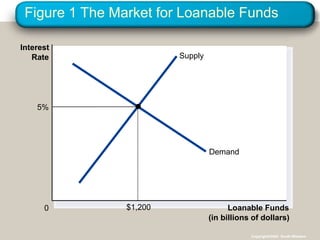
• Financial Intermediaries
• Banks
• Mutual Funds
Copyright © 2004 South-Western
FINANCIAL INSTITUTIONS IN THE
U.S. ECONOMY
• Financial markets are the institutions through
which savers can directly provide funds to
borrowers.
• Financial intermediaries are financial
institutions through which savers can indirectly
provide funds to borrowers.
Copyright © 2004 South-Western
Financial Markets
• The Bond Market
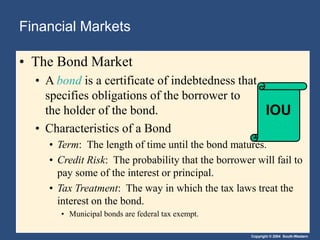
• A bond is a certificate of indebtedness that
specifies obligations of the borrower to
the holder of the bond.
• Characteristics of a Bond
• Term: The length of time until the bond matures.
• Credit Risk: The probability that the borrower will fail to
pay some of the interest or principal.
• Tax Treatment: The way in which the tax laws treat the
interest on the bond.
• Municipal bonds are federal tax exempt.
IOU
Copyright © 2004 South-Western
Financial Markets
• The Stock Market
• Stock represents a claim to partial ownership in a
firm and is therefore, a claim to the profits that the
firm makes.
• The sale of stock to raise money is called equity
financing.
• Compared to bonds, stocks offer both higher risk and
potentially higher returns.
• The most important stock exchanges in the United
States are the New York Stock Exchange, the
American Stock Exchange, and NASDAQ.
Copyright © 2004 South-Western
Financial Markets
• The Stock Market
• Most newspaper stock tables provide the following
information:
• Price (of a share)
• Volume (number of shares sold)
• Dividend (profits paid to stockholders)
• Price-earnings ratio
Copyright © 2004 South-Western
Financial Intermediaries
• Financial intermediaries are financial
institutions through which savers can indirectly
provide funds to borrowers.
Copyright © 2004 South-Western
Financial Intermediaries
• Banks
• take deposits from people who want to save and use
the deposits to make loans to people who want to
borrow.
• pay depositors interest on their deposits and charge
borrowers slightly higher interest on their loans.
Copyright © 2004 South-Western
Financial Intermediaries
• Banks
• Banks help create a medium of exchange by
allowing people to write checks against their
deposits.
• A medium of exchanges is an item that people can easily
use to engage in transactions.
• This facilitates the purchases of goods and services.
Copyright © 2004 South-Western
Financial Intermediaries
• Mutual Funds
• A mutual fund is an institution that sells shares to
the public and uses the proceeds to buy a portfolio,
of various types of stocks, bonds, or both.
• They allow people with small amounts of money to
easily diversify.
Copyright © 2004 South-Western
Financial Intermediaries
• Other Financial Institutions
• Credit unions
• Pension funds
• Insurance companies
• Loan sharks
Copyright © 2004 South-Western
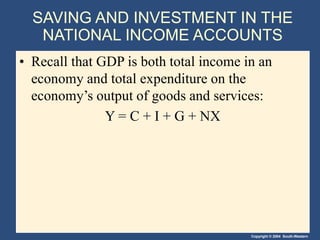
SAVING AND INVESTMENT IN THE
NATIONAL INCOME ACCOUNTS
• Recall that GDP is both total income in an
economy and total expenditure on the
economy’s output of goods and services:
Y = C + I + G + NX
Copyright © 2004 South-Western
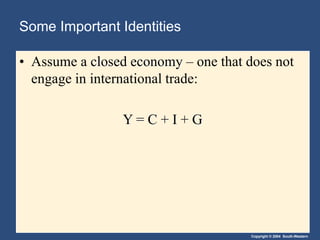
Some Important Identities
• Assume a closed economy – one that does not
engage in international trade:
Y = C + I + G
Copyright © 2004 South-Western
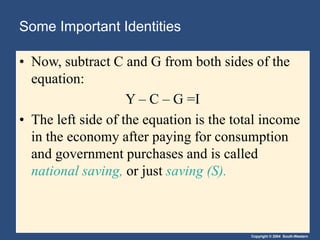
Some Important Identities
• Now, subtract C and G from both sides of the
equation:
Y – C – G =I
• The left side of the equation is the total income
in the economy after paying for consumption
and government purchases and is called
national saving, or just saving (S).
Copyright © 2004 South-Western
Some Important Identities
• Substituting S for Y - C - G, the equation can be
written as:
S = I
Copyright © 2004 South-Western
Some Important Identities
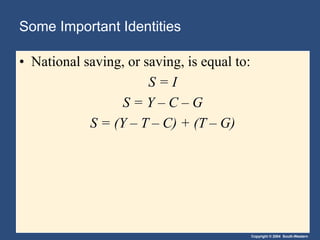
• National saving, or saving, is equal to:
S = I
S = Y – C – G
S = (Y – T – C) + (T – G)
Copyright © 2004 South-Western
The Meaning of Saving and Investment
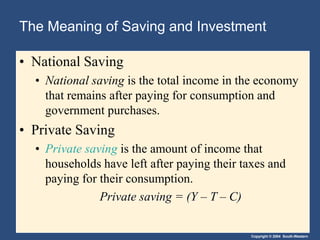
• National Saving
• National saving is the total income in the economy
that remains after paying for consumption and
government purchases.
• Private Saving
• Private saving is the amount of income that
households have left after paying their taxes and
paying for their consumption.
Private saving = (Y – T – C)
Copyright © 2004 South-Western
The Meaning of Saving and Investment
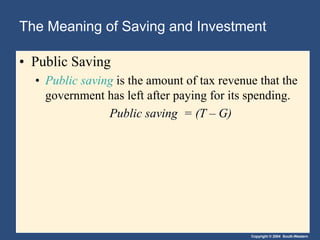
• Public Saving
• Public saving is the amount of tax revenue that the
government has left after paying for its spending.
Public saving = (T – G)
Copyright © 2004 South-Western
The Meaning of Saving and Investment
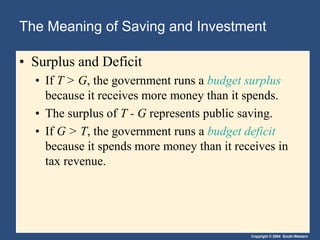
• Surplus and Deficit
• If T > G, the government runs a budget surplus
because it receives more money than it spends.
• The surplus of T - G represents public saving.
• If G > T, the government runs a budget deficit
because it spends more money than it receives in
tax revenue.
Copyright © 2004 South-Western
The Meaning of Saving and Investment
• For the economy as a whole, saving must be
equal to investment.
S = I
Copyright © 2004 South-Western
THE MARKET FOR LOANABLE
FUNDS
• Financial markets coordinate the economy’s
saving and investment in the market for
loanable funds.
Copyright © 2004 South-Western
THE MARKET FOR LOANABLE
FUNDS
• The market for loanable funds is the market in
which those who want to save supply funds and
those who want to borrow to invest demand
funds.
Copyright © 2004 South-Western
THE MARKET FOR LOANABLE
FUNDS
• Loanable funds refers to all income that people
have chosen to save and lend out, rather than
use for their own consumption.
Copyright © 2004 South-Western
Supply and Demand for Loanable Funds
• The supply of loanable funds comes from
people who have extra income they want to
save and lend out.
• The demand for loanable funds comes from
households and firms that wish to borrow to
make investments.
Copyright © 2004 South-Western
Supply and Demand for Loanable Funds
• The interest rate is the price of the loan.
• It represents the amount that borrowers pay for
loans and the amount that lenders receive on
their saving.
• The interest rate in the market for loanable
funds is the real interest rate.
Copyright © 2004 South-Western
Supply and Demand for Loanable Funds
• Financial markets work much like other
markets in the economy.
• The equilibrium of the supply and demand for
loanable funds determines the real interest rate.
Figure 1 The Market for Loanable Funds
Loanable Funds
(in billions of dollars)
0
Interest
Rate Supply
Demand
5%
$1,200
Copyright©2004 South-Western
Copyright © 2004 South-Western
Supply and Demand for Loanable Funds
• Government Policies That Affect Saving and
Investment
• Taxes and saving
• Taxes and investment
• Government budget deficits
Copyright © 2004 South-Western
Policy 1: Saving Incentives
• Taxes on interest income substantially reduce
the future payoff from current saving and, as a
result, reduce the incentive to save.
Copyright © 2004 South-Western
Policy 1: Saving Incentives
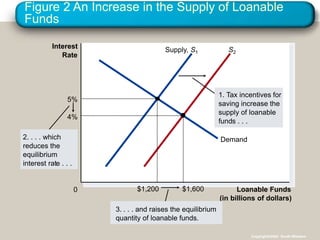
• A tax decrease increases the incentive for
households to save at any given interest rate.
• The supply of loanable funds curve shifts to the
right.
• The equilibrium interest rate decreases.
• The quantity demanded for loanable funds
increases.
Figure 2 An Increase in the Supply of Loanable
Funds
Loanable Funds
(in billions of dollars)
0
Interest
Rate
Supply, S1 S2
2. . . . which
reduces the
equilibrium
interest rate . . .
3. . . . and raises the equilibrium
quantity of loanable funds.
Demand
1. Tax incentives for
saving increase the
supply of loanable
funds . . .
5%
$1,200
4%
$1,600
Copyright©2004 South-Western
Copyright © 2004 South-Western
Policy 1: Saving Incentives
• If a change in tax law encourages greater
saving, the result will be lower interest rates
and greater investment.
Copyright © 2004 South-Western
Policy 2: Investment Incentives
• An investment tax credit increases the incentive
to borrow.
• Increases the demand for loanable funds.
• Shifts the demand curve to the right.
• Results in a higher interest rate and a greater
quantity saved.
Copyright © 2004 South-Western
Policy 2: Investment Incentives
• If a change in tax laws encourages greater
investment, the result will be higher interest
rates and greater saving.
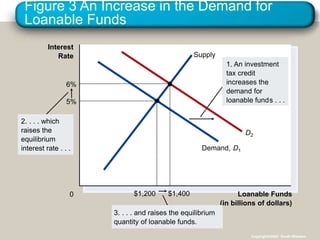
Figure 3 An Increase in the Demand for
Loanable Funds
Loanable Funds
(in billions of dollars)
0
Interest
Rate
1. An investment
tax credit
increases the
demand for
loanable funds . . .
2. . . . which
raises the
equilibrium
interest rate . . .
3. . . . and raises the equilibrium
quantity of loanable funds.
Supply
Demand, D1
D2
5%
$1,200
6%
$1,400
Copyright©2004 South-Western
Copyright © 2004 South-Western
Policy 3: Government Budget Deficits and
Surpluses
• When the government spends more than it
receives in tax revenues, the short fall is called
the budget deficit.
• The accumulation of past budget deficits is
called the government debt.
Copyright © 2004 South-Western
Policy 3: Government Budget Deficits and
Surpluses
• Government borrowing to finance its budget
deficit reduces the supply of loanable funds
available to finance investment by households
and firms.
• This fall in investment is referred to as
crowding out.
• The deficit borrowing crowds out private borrowers
who are trying to finance investments.
Copyright © 2004 South-Western
Policy 3: Government Budget Deficits and
Surpluses
• A budget deficit decreases the supply of
loanable funds.
• Shifts the supply curve to the left.
• Increases the equilibrium interest rate.
• Reduces the equilibrium quantity of loanable funds.
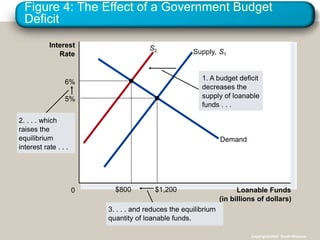
Figure 4: The Effect of a Government Budget
Deficit
Loanable Funds
(in billions of dollars)
0
Interest
Rate
3. . . . and reduces the equilibrium
quantity of loanable funds.
S2
2. . . . which
raises the
equilibrium
interest rate . . .
Supply, S1
Demand
$1,200
5%
$800
6%
1. A budget deficit
decreases the
supply of loanable
funds . . .
Copyright©2004 South-Western
Copyright © 2004 South-Western
Policy 3: Government Budget Deficits and
Surpluses
• When government reduces national saving by
running a deficit, the interest rate rises and
investment falls.
Copyright © 2004 South-Western
Policy 3: Government Budget Deficits and
Surpluses
• A budget surplus increases the supply of
loanable funds, reduces the interest rate, and
stimulates investment.
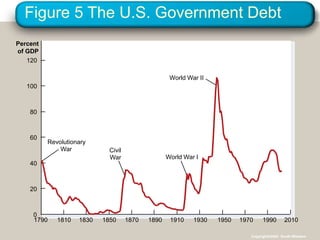
Figure 5 The U.S. Government Debt
Percent
of GDP
1790 1810 1830 1850 1870 1890 1910 1930 1950 1970 1990
Revolutionary
War
2010
Civil
War World War I
World War II
0
20
40
60
80
100
120
Copyright©2004 South-Western
Copyright © 2004 South-Western
Summary
• The U.S. financial system is made up of
financial institutions such as the bond market,
the stock market, banks, and mutual funds.
• All these institutions act to direct the resources
of households who want to save some of their
income into the hands of households and firms
who want to borrow.
Copyright © 2004 South-Western
Summary
• National income accounting identities reveal
some important relationships among
macroeconomic variables.
• In particular, in a closed economy, national
saving must equal investment.
• Financial institutions attempt to match one
person’s saving with another person’s
investment.
Copyright © 2004 South-Western
Summary
• The interest rate is determined by the supply
and demand for loanable funds.
• The supply of loanable funds comes from
households who want to save some of their
income.
• The demand for loanable funds comes from
households and firms who want to borrow for
investment.
Copyright © 2004 South-Western
Summary
• National saving equals private saving plus
public saving.
• A government budget deficit represents
negative public saving and, therefore, reduces
national saving and the supply of loanable
funds.
• When a government budget deficit crowds out
investment, it reduces the growth of
productivity and GDP.

26.ppt

  • 1.
    Copyright © 2004South-Western 26 Saving, Investment, and the Financial System
  • 2.
    Copyright © 2004South-Western The Financial System • The financial system consists of the group of institutions in the economy that help to match one person’s saving with another person’s investment. • It moves the economy’s scarce resources from savers to borrowers.
  • 3.
    Copyright © 2004South-Western FINANCIAL INSTITUTIONS IN THE U.S. ECONOMY • The financial system is made up of financial institutions that coordinate the actions of savers and borrowers. • Financial institutions can be grouped into two different categories: financial markets and financial intermediaries.
  • 4.
    Copyright © 2004South-Western FINANCIAL INSTITUTIONS IN THE U.S. ECONOMY • Financial Markets • Stock Market • Bond Market • Financial Intermediaries • Banks • Mutual Funds
  • 5.
    Copyright © 2004South-Western FINANCIAL INSTITUTIONS IN THE U.S. ECONOMY • Financial markets are the institutions through which savers can directly provide funds to borrowers. • Financial intermediaries are financial institutions through which savers can indirectly provide funds to borrowers.
  • 6.
    Copyright © 2004South-Western Financial Markets • The Bond Market • A bond is a certificate of indebtedness that specifies obligations of the borrower to the holder of the bond. • Characteristics of a Bond • Term: The length of time until the bond matures. • Credit Risk: The probability that the borrower will fail to pay some of the interest or principal. • Tax Treatment: The way in which the tax laws treat the interest on the bond. • Municipal bonds are federal tax exempt. IOU
  • 7.
    Copyright © 2004South-Western Financial Markets • The Stock Market • Stock represents a claim to partial ownership in a firm and is therefore, a claim to the profits that the firm makes. • The sale of stock to raise money is called equity financing. • Compared to bonds, stocks offer both higher risk and potentially higher returns. • The most important stock exchanges in the United States are the New York Stock Exchange, the American Stock Exchange, and NASDAQ.
  • 8.
    Copyright © 2004South-Western Financial Markets • The Stock Market • Most newspaper stock tables provide the following information: • Price (of a share) • Volume (number of shares sold) • Dividend (profits paid to stockholders) • Price-earnings ratio
  • 9.
    Copyright © 2004South-Western Financial Intermediaries • Financial intermediaries are financial institutions through which savers can indirectly provide funds to borrowers.
  • 10.
    Copyright © 2004South-Western Financial Intermediaries • Banks • take deposits from people who want to save and use the deposits to make loans to people who want to borrow. • pay depositors interest on their deposits and charge borrowers slightly higher interest on their loans.
  • 11.
    Copyright © 2004South-Western Financial Intermediaries • Banks • Banks help create a medium of exchange by allowing people to write checks against their deposits. • A medium of exchanges is an item that people can easily use to engage in transactions. • This facilitates the purchases of goods and services.
  • 12.
    Copyright © 2004South-Western Financial Intermediaries • Mutual Funds • A mutual fund is an institution that sells shares to the public and uses the proceeds to buy a portfolio, of various types of stocks, bonds, or both. • They allow people with small amounts of money to easily diversify.
  • 13.
    Copyright © 2004South-Western Financial Intermediaries • Other Financial Institutions • Credit unions • Pension funds • Insurance companies • Loan sharks
  • 14.
    Copyright © 2004South-Western SAVING AND INVESTMENT IN THE NATIONAL INCOME ACCOUNTS • Recall that GDP is both total income in an economy and total expenditure on the economy’s output of goods and services: Y = C + I + G + NX
  • 15.
    Copyright © 2004South-Western Some Important Identities • Assume a closed economy – one that does not engage in international trade: Y = C + I + G
  • 16.
    Copyright © 2004South-Western Some Important Identities • Now, subtract C and G from both sides of the equation: Y – C – G =I • The left side of the equation is the total income in the economy after paying for consumption and government purchases and is called national saving, or just saving (S).
  • 17.
    Copyright © 2004South-Western Some Important Identities • Substituting S for Y - C - G, the equation can be written as: S = I
  • 18.
    Copyright © 2004South-Western Some Important Identities • National saving, or saving, is equal to: S = I S = Y – C – G S = (Y – T – C) + (T – G)
  • 19.
    Copyright © 2004South-Western The Meaning of Saving and Investment • National Saving • National saving is the total income in the economy that remains after paying for consumption and government purchases. • Private Saving • Private saving is the amount of income that households have left after paying their taxes and paying for their consumption. Private saving = (Y – T – C)
  • 20.
    Copyright © 2004South-Western The Meaning of Saving and Investment • Public Saving • Public saving is the amount of tax revenue that the government has left after paying for its spending. Public saving = (T – G)
  • 21.
    Copyright © 2004South-Western The Meaning of Saving and Investment • Surplus and Deficit • If T > G, the government runs a budget surplus because it receives more money than it spends. • The surplus of T - G represents public saving. • If G > T, the government runs a budget deficit because it spends more money than it receives in tax revenue.
  • 22.
    Copyright © 2004South-Western The Meaning of Saving and Investment • For the economy as a whole, saving must be equal to investment. S = I
  • 23.
    Copyright © 2004South-Western THE MARKET FOR LOANABLE FUNDS • Financial markets coordinate the economy’s saving and investment in the market for loanable funds.
  • 24.
    Copyright © 2004South-Western THE MARKET FOR LOANABLE FUNDS • The market for loanable funds is the market in which those who want to save supply funds and those who want to borrow to invest demand funds.
  • 25.
    Copyright © 2004South-Western THE MARKET FOR LOANABLE FUNDS • Loanable funds refers to all income that people have chosen to save and lend out, rather than use for their own consumption.
  • 26.
    Copyright © 2004South-Western Supply and Demand for Loanable Funds • The supply of loanable funds comes from people who have extra income they want to save and lend out. • The demand for loanable funds comes from households and firms that wish to borrow to make investments.
  • 27.
    Copyright © 2004South-Western Supply and Demand for Loanable Funds • The interest rate is the price of the loan. • It represents the amount that borrowers pay for loans and the amount that lenders receive on their saving. • The interest rate in the market for loanable funds is the real interest rate.
  • 28.
    Copyright © 2004South-Western Supply and Demand for Loanable Funds • Financial markets work much like other markets in the economy. • The equilibrium of the supply and demand for loanable funds determines the real interest rate.
  • 29.
    Figure 1 TheMarket for Loanable Funds Loanable Funds (in billions of dollars) 0 Interest Rate Supply Demand 5% $1,200 Copyright©2004 South-Western
  • 30.
    Copyright © 2004South-Western Supply and Demand for Loanable Funds • Government Policies That Affect Saving and Investment • Taxes and saving • Taxes and investment • Government budget deficits
  • 31.
    Copyright © 2004South-Western Policy 1: Saving Incentives • Taxes on interest income substantially reduce the future payoff from current saving and, as a result, reduce the incentive to save.
  • 32.
    Copyright © 2004South-Western Policy 1: Saving Incentives • A tax decrease increases the incentive for households to save at any given interest rate. • The supply of loanable funds curve shifts to the right. • The equilibrium interest rate decreases. • The quantity demanded for loanable funds increases.
  • 33.
    Figure 2 AnIncrease in the Supply of Loanable Funds Loanable Funds (in billions of dollars) 0 Interest Rate Supply, S1 S2 2. . . . which reduces the equilibrium interest rate . . . 3. . . . and raises the equilibrium quantity of loanable funds. Demand 1. Tax incentives for saving increase the supply of loanable funds . . . 5% $1,200 4% $1,600 Copyright©2004 South-Western
  • 34.
    Copyright © 2004South-Western Policy 1: Saving Incentives • If a change in tax law encourages greater saving, the result will be lower interest rates and greater investment.
  • 35.
    Copyright © 2004South-Western Policy 2: Investment Incentives • An investment tax credit increases the incentive to borrow. • Increases the demand for loanable funds. • Shifts the demand curve to the right. • Results in a higher interest rate and a greater quantity saved.
  • 36.
    Copyright © 2004South-Western Policy 2: Investment Incentives • If a change in tax laws encourages greater investment, the result will be higher interest rates and greater saving.
  • 37.
    Figure 3 AnIncrease in the Demand for Loanable Funds Loanable Funds (in billions of dollars) 0 Interest Rate 1. An investment tax credit increases the demand for loanable funds . . . 2. . . . which raises the equilibrium interest rate . . . 3. . . . and raises the equilibrium quantity of loanable funds. Supply Demand, D1 D2 5% $1,200 6% $1,400 Copyright©2004 South-Western
  • 38.
    Copyright © 2004South-Western Policy 3: Government Budget Deficits and Surpluses • When the government spends more than it receives in tax revenues, the short fall is called the budget deficit. • The accumulation of past budget deficits is called the government debt.
  • 39.
    Copyright © 2004South-Western Policy 3: Government Budget Deficits and Surpluses • Government borrowing to finance its budget deficit reduces the supply of loanable funds available to finance investment by households and firms. • This fall in investment is referred to as crowding out. • The deficit borrowing crowds out private borrowers who are trying to finance investments.
  • 40.
    Copyright © 2004South-Western Policy 3: Government Budget Deficits and Surpluses • A budget deficit decreases the supply of loanable funds. • Shifts the supply curve to the left. • Increases the equilibrium interest rate. • Reduces the equilibrium quantity of loanable funds.
  • 41.
    Figure 4: TheEffect of a Government Budget Deficit Loanable Funds (in billions of dollars) 0 Interest Rate 3. . . . and reduces the equilibrium quantity of loanable funds. S2 2. . . . which raises the equilibrium interest rate . . . Supply, S1 Demand $1,200 5% $800 6% 1. A budget deficit decreases the supply of loanable funds . . . Copyright©2004 South-Western
  • 42.
    Copyright © 2004South-Western Policy 3: Government Budget Deficits and Surpluses • When government reduces national saving by running a deficit, the interest rate rises and investment falls.
  • 43.
    Copyright © 2004South-Western Policy 3: Government Budget Deficits and Surpluses • A budget surplus increases the supply of loanable funds, reduces the interest rate, and stimulates investment.
  • 44.
    Figure 5 TheU.S. Government Debt Percent of GDP 1790 1810 1830 1850 1870 1890 1910 1930 1950 1970 1990 Revolutionary War 2010 Civil War World War I World War II 0 20 40 60 80 100 120 Copyright©2004 South-Western
  • 45.
    Copyright © 2004South-Western Summary • The U.S. financial system is made up of financial institutions such as the bond market, the stock market, banks, and mutual funds. • All these institutions act to direct the resources of households who want to save some of their income into the hands of households and firms who want to borrow.
  • 46.
    Copyright © 2004South-Western Summary • National income accounting identities reveal some important relationships among macroeconomic variables. • In particular, in a closed economy, national saving must equal investment. • Financial institutions attempt to match one person’s saving with another person’s investment.
  • 47.
    Copyright © 2004South-Western Summary • The interest rate is determined by the supply and demand for loanable funds. • The supply of loanable funds comes from households who want to save some of their income. • The demand for loanable funds comes from households and firms who want to borrow for investment.
  • 48.
    Copyright © 2004South-Western Summary • National saving equals private saving plus public saving. • A government budget deficit represents negative public saving and, therefore, reduces national saving and the supply of loanable funds. • When a government budget deficit crowds out investment, it reduces the growth of productivity and GDP.