


www.orbitone.com
Raas van Gaverestraat 83
B-9000 GENT, BELGIUM
E-mail info@orbitone.com
Website www.orbitone.com
Tel. +32 9 330 15 00
VAT BE 456.457.353
Bank 442-7059001-50 (KBC)
Wim Roegiers
16 February, 2010
Load Testing of ASP.NET Web Applications
16 February, 2010
Load Testing of ASP.NET Web Applications
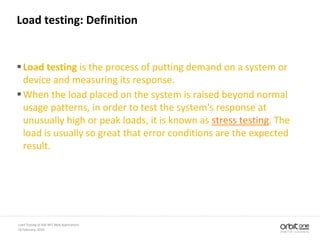
Load testing: Definition
Load testing is the process of putting demand on a system or
device and measuring its response.
When the load placed on the system is raised beyond normal
usage patterns, in order to test the system's response at
unusually high or peak loads, it is known as stress testing. The
load is usually so great that error conditions are the expected
result.
16 February, 2010
Load Testing of ASP.NET Web Applications
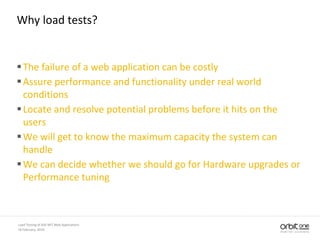
Why load tests?
The failure of a web application can be costly
Assure performance and functionality under real world
conditions
Locate and resolve potential problems before it hits on the
users
We will get to know the maximum capacity the system can
handle
We can decide whether we should go for Hardware upgrades or
Performance tuning
16 February, 2010
Load Testing of ASP.NET Web Applications
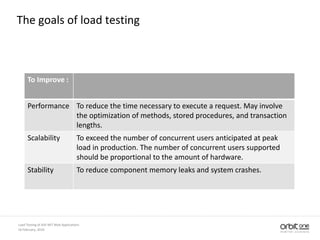
The goals of load testing
To Improve :
Performance To reduce the time necessary to execute a request. May involve
the optimization of methods, stored procedures, and transaction
lengths.
Scalability To exceed the number of concurrent users anticipated at peak
load in production. The number of concurrent users supported
should be proportional to the amount of hardware.
Stability To reduce component memory leaks and system crashes.
16 February, 2010
Load Testing of ASP.NET Web Applications
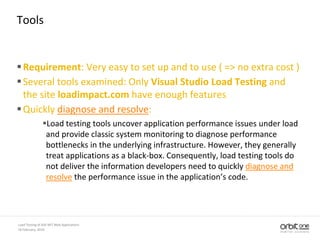
Tools
Requirement: Very easy to set up and to use ( => no extra cost )
Several tools examined: Only Visual Studio Load Testing and
the site loadimpact.com have enough features
Quickly diagnose and resolve:
Load testing tools uncover application performance issues under load
and provide classic system monitoring to diagnose performance
bottlenecks in the underlying infrastructure. However, they generally
treat applications as a black-box. Consequently, load testing tools do
not deliver the information developers need to quickly diagnose and
resolve the performance issue in the application’s code.
16 February, 2010
Load Testing of ASP.NET Web Applications
Loadimpact.com
With this online tool you can (only) measure the load time of a
page with different user loads
Example tests
http://loadimpact.com/result/construction.orbitone.com/VlaamseOp
era2007/default.orb-4b482f3b9b935caedb3484e46b8de714
http://loadimpact.com/result/www.denorbit.com-
6f2d1986218e19900ef3295db398d419
16 February, 2010
Load Testing of ASP.NET Web Applications
Visual Studio: Load Testing
Extensive capabilities, easy to use, no additional tool required
Demo (Umbraco website)
16 February, 2010
Load Testing of ASP.NET Web Applications
About Scenarios
Load tests contain scenarios, which contain Web tests or unit
tests.
A scenario is the container within a load test where you specify load
pattern, test mix, browser mix, and network mix.
Scenarios are important because they provide you with flexibility in
configuring test characteristics that allow for simulation of complex,
realistic work loads.
16 February, 2010
Load Testing of ASP.NET Web Applications
About Load Patterns
The load pattern properties specify how the simulated user
load is adjusted during a load test. Team Edition for Testers
provides three built-in load patterns: constant, step, and goal-
based.
Constant: a user load that does not change during the load test
Step: a user load that increases with time up to a defined maximum
user load
Goal-Based: adjusts the user load based on performance counter
thresholds
16 February, 2010
Load Testing of ASP.NET Web Applications
About Think Times
Think times are used to simulate human behavior that causes
people to wait between interactions
www.orbitone.com
Load Testing of ASP.NET Web Applications
16 February, 2010

Load testing web applications

  • 1.
    www.orbitone.com Raas van Gaverestraat83 B-9000 GENT, BELGIUM E-mail info@orbitone.com Website www.orbitone.com Tel. +32 9 330 15 00 VAT BE 456.457.353 Bank 442-7059001-50 (KBC) Wim Roegiers 16 February, 2010 Load Testing of ASP.NET Web Applications
  • 2.
    16 February, 2010 LoadTesting of ASP.NET Web Applications Load testing: Definition Load testing is the process of putting demand on a system or device and measuring its response. When the load placed on the system is raised beyond normal usage patterns, in order to test the system's response at unusually high or peak loads, it is known as stress testing. The load is usually so great that error conditions are the expected result.
  • 3.
    16 February, 2010 LoadTesting of ASP.NET Web Applications Why load tests? The failure of a web application can be costly Assure performance and functionality under real world conditions Locate and resolve potential problems before it hits on the users We will get to know the maximum capacity the system can handle We can decide whether we should go for Hardware upgrades or Performance tuning
  • 4.
    16 February, 2010 LoadTesting of ASP.NET Web Applications The goals of load testing To Improve : Performance To reduce the time necessary to execute a request. May involve the optimization of methods, stored procedures, and transaction lengths. Scalability To exceed the number of concurrent users anticipated at peak load in production. The number of concurrent users supported should be proportional to the amount of hardware. Stability To reduce component memory leaks and system crashes.
  • 5.
    16 February, 2010 LoadTesting of ASP.NET Web Applications Tools Requirement: Very easy to set up and to use ( => no extra cost ) Several tools examined: Only Visual Studio Load Testing and the site loadimpact.com have enough features Quickly diagnose and resolve: Load testing tools uncover application performance issues under load and provide classic system monitoring to diagnose performance bottlenecks in the underlying infrastructure. However, they generally treat applications as a black-box. Consequently, load testing tools do not deliver the information developers need to quickly diagnose and resolve the performance issue in the application’s code.
  • 6.
    16 February, 2010 LoadTesting of ASP.NET Web Applications Loadimpact.com With this online tool you can (only) measure the load time of a page with different user loads Example tests http://loadimpact.com/result/construction.orbitone.com/VlaamseOp era2007/default.orb-4b482f3b9b935caedb3484e46b8de714 http://loadimpact.com/result/www.denorbit.com- 6f2d1986218e19900ef3295db398d419
  • 7.
    16 February, 2010 LoadTesting of ASP.NET Web Applications Visual Studio: Load Testing Extensive capabilities, easy to use, no additional tool required Demo (Umbraco website)
  • 8.
    16 February, 2010 LoadTesting of ASP.NET Web Applications About Scenarios Load tests contain scenarios, which contain Web tests or unit tests. A scenario is the container within a load test where you specify load pattern, test mix, browser mix, and network mix. Scenarios are important because they provide you with flexibility in configuring test characteristics that allow for simulation of complex, realistic work loads.
  • 9.
    16 February, 2010 LoadTesting of ASP.NET Web Applications About Load Patterns The load pattern properties specify how the simulated user load is adjusted during a load test. Team Edition for Testers provides three built-in load patterns: constant, step, and goal- based. Constant: a user load that does not change during the load test Step: a user load that increases with time up to a defined maximum user load Goal-Based: adjusts the user load based on performance counter thresholds
  • 10.
    16 February, 2010 LoadTesting of ASP.NET Web Applications About Think Times Think times are used to simulate human behavior that causes people to wait between interactions
  • 11.
    www.orbitone.com Load Testing ofASP.NET Web Applications 16 February, 2010