
Load Balancing from the Cloud
Eldad Chai, VP Products
March 2014
Agenda
Introduction
Load Balancing in the Cloud Era
Technology Review
Incapsula’s Load Balancer
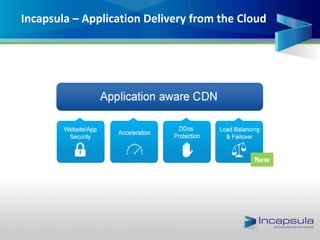
Incapsula – Application Delivery from the Cloud
New
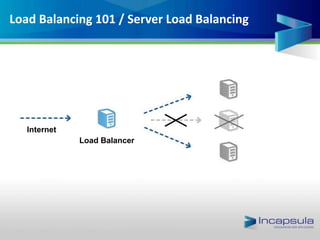
Load Balancing 101 / Server Load Balancing
Internet
Load Balancer
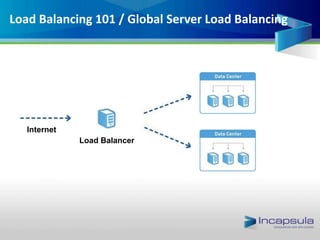
Load Balancing 101 / Global Server Load Balancing
Internet
Load Balancer
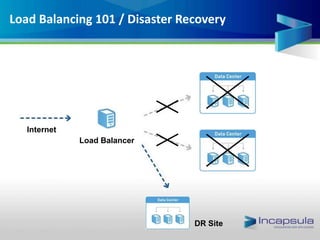
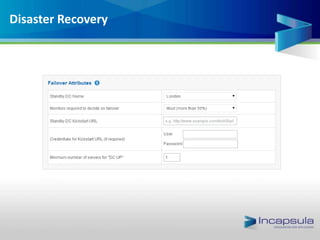
Load Balancing 101 / Disaster Recovery
Internet
Load Balancer
DR Site
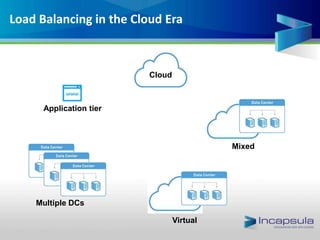
Load Balancing in the Cloud Era
Cloud
Mixed
Virtual
Multiple DCs
Application tier
Load Balancing in the Cloud Era
Internet
Load Balancer
Load Balancing in the Cloud Era
Internet
Load Balancer
Load Balancer
Load Balancing in the Cloud Era
Internet
Load Balancer
Load Balancer
DNS
Layer 3 Layer 7
No visibility
Load Balancing in the Cloud Era
Internet
?
Load Balancer
DNS
Layer 3 Layer 7
No visibility
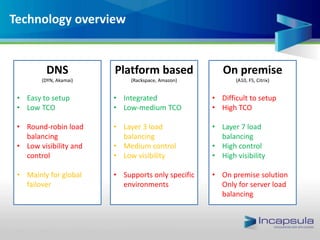
Technology overview
DNS
(DYN, Akamai)
• Easy to setup
• Low TCO
• Round-robin load
balancing
• Low visibility and
control
• Mainly for global
failover
Platform based
(Rackspace, Amazon)
• Integrated
• Low-medium TCO
• Layer 3 load
balancing
• Medium control
• Low visibility
• Supports only specific
environments
On premise
(A10, F5, Citrix)
• Difficult to setup
• High TCO
• Layer 7 load
balancing
• High control
• High visibility
• On premise solution
Only for server load
balancing
Incasula’s Load Balancer
Internet
Incasula’s Load Balancer
Internet
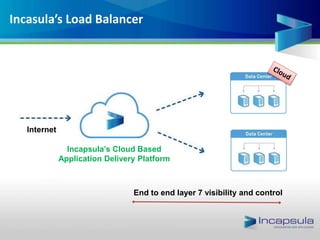
Incapsula’s Cloud Based
Application Delivery Platform
End to end layer 7 visibility and control
Incasula’s Load Balancer
Single platform for server and global load balancing
End to end layer 7 visibility and control and traffic distribution
Supports all environment
Global monitoring
Real time statistics
API
Comprehensive offering including Load Balancing and Failover,
CDN, DDoS Protection and Website Security
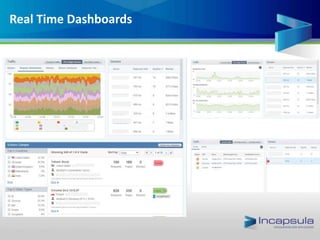
Real Time Dashboards
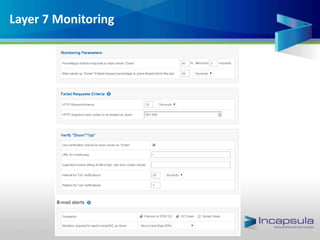
Layer 7 Monitoring
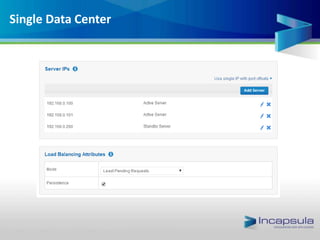
Single Data Center
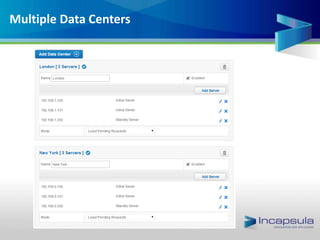
Multiple Data Centers
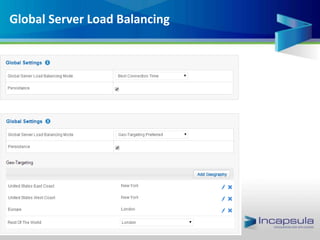
Global Server Load Balancing
Disaster Recovery
Thank you!
Eldad Chai
VP Products, Incapsula
eldad@incapsula.com
Thank You

Load Balancing from the Cloud - Layer 7 Aware Solution

Editor's Notes

  • #2 Thanks Shira Hello everyone and thank you for joining this session introducing our new Load Balancer Im Eldad Chai, VP Products at Incapsula and we are very excited to have launched this solution last week that addressed new challenges in application delivery
  • #3 We will start with a short introduction on load balancing and then move to discuss new load balancing use cases introduced with the adoption of cloud technologies I will review the existing technologies and how they address the different use cases and finally introduce Incapsula’s solution for load balancing from the cloud
  • #4 So a short introduction to Incapsula… Incapsula is a cloud application delivery solution Incapsula has built an application aware CDN and using this platform delivers high end application delivery solutions Website security, website acceleration, DDoS protection and now load balancing and failover
  • #5 Now a short introduction on load balancing There are several main use cases for load balancing The first is simple server load balancing, for example if your web application has three front end servers and incoming web traffic needs to be distributed among these servers A load balancer deployed in front of the web servers would be responsible for managing the incoming traffic and distributing it evenly to the web servers The load balancer is also responsible for detecting server failure and taking it out of the resource pool when it goes down
  • #6 Another common use case is multi data center deployment This could be performance reasons, regulation or geographical requirements In this case the load balancer will be responsible of distributing traffic on a global scale to the data centers based on a varying set of criteria. Whether the driver is performance, regulation or geo targeting the load balancing algorithm might be different Any data center might also include a number of servers and thus to implement a local load balancing algorithm
  • #7 Finally many deployment and SaaS in particular maintain high availability and disaster recovery data centers In these scenarios the load balancer is responsible to monitor the data center availability and detect outages Once an outage is detected the load balancer would shift traffic to the disaster recovery site
  • #8 Now lets look at the trends and changes in application hosting over the recent years and how they are affecting the load balancing solutions The first driver that is influencing load balancing needs is of course the cloud. In a world where on premise load balancers dominate, the fact that you cannot take your load balancer with you to the cloud is driving the development of new load balancing solutions Next are mixed deployments including both on premise and cloud servers. IT managers today are forced to use more than one and sometimes even three different solutions to load balance traffic in these scenarios Third driver is the virtual world that can be either on premise or cloud but in many cases tries to replace physical appliances in the data center (?) Finally in the era of SaaS more and more companies are maintain more than a single data center and there is much more focus on the application tier dictating layer 7 (?)
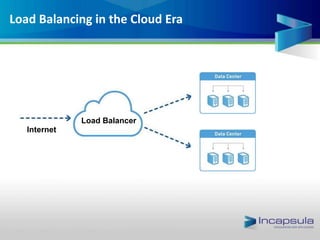
  • #9 Lets go back to the basic load balancing diagram In this simple use case the load balancer is responsible to route traffic to the appropriate data center based on the selected criteria and locally with in each data center
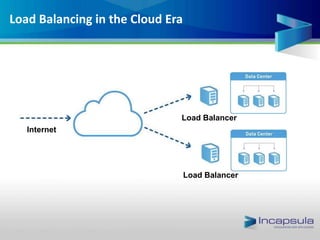
  • #10 Well, obviously with todays technology it is not that simple and once internal load balancing is a requirement an internal load balancer is involved. In this use case, two are required to handle traffic distribution for each DC
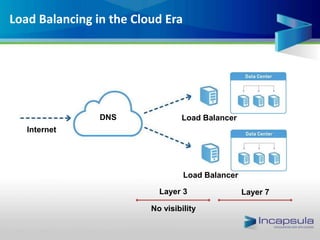
  • #11 Now what about distributing the traffic between data centers? Here another component is required usually based on DNS. Which when you think of it is somewhat a workaround because DNS is not designed for load balancing so what you get is layer 3 load balancing at best and practically almost no visibility or control over traffic at the global scale
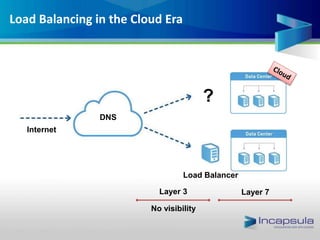
  • #12 When you add to this cloud scenarios it gets even more complicated because again, you cannot take your load balancer with you to the cloud There tailored solutions for cloud environment but as you can see every solution is tailored for a specific use case with various limitations when trying to support more advanced scenarios
  • #13 Here are the solutions available today for the presented use cases DNS solutions like DYN or Akamai Platform based solutions like Rackspace or Amazon And on premise solutions like A10, F15 or Citrix DNS solutions are pretty straightforward to setup and have low TCO However the load balancing capabilities are very limited and this solution is mainly used for simple round robin and global failover Platform based solutions have the obvious advantage of being highly integrated with the platform but they support only one specific environment and limit flexibility. Also these solutions are usually less advanced then on premise solutions and offer a narrow feature set for visibility and control On premise solution provide the best feature set and capabilities but are difficult to setup and usually expensive. These solutions do not support well global scenarios for global server load balancing and failover and do not support cloud environment
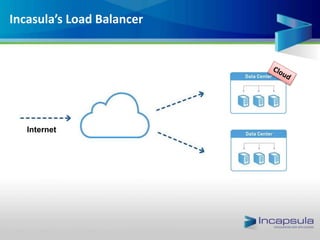
  • #14 Going back to this simple diagram What if you could manage any use case global or local, physical or virtual, on premise or cloud using the same platform? What if you could maintain layer 7 visibility and control along the entire path? This need is exactly what drove us to develop the Incapsula load balancing solution
  • #15 Using the Incapsula application delivery platform we can offer a load balancing solution that support any load balancing scenario while maintain end to end layer 7 visibility and control A load balancing solution with no compromise Lets see what it includes
  • #16 It’s a single platform for all load balancing and failover needs Again, its layer 7 end to end It includes global monitoring from 18 locations world wide It provides real time dashboards from monitoring and control as well as an API for automation And last but not least it is part of a comprehensive application delivery solution delivered as a service
  • #17 Lets dive a bit deeper into the capabilities First is a great informative real time dashboard with essentially everything you need to monitor and control your application delivery solution Incapsula’s dashboards provide realtime global and granular statistics as request or bandwidth distribution, response time and even live samples of traffic Each origin server can be also monitored for number of connections, pending requests and response time as well as availability
  • #18 Monitoring is available at the network, server and application level with various settings allowing you to control the way monitoring is performed and the criteria for detecting issues Of course, every even can generate notifications for a pre defined set of recipients
  • #19 Its pretty simple to maintain a clear picture of your entire deployment and the load balancing strategy From a small deployment of two servers with one standby server
  • #20 Up to a more complex scenario with multiple data centers
  • #21 Global load balancing whether it is performance, regulation or geo targeting based is defined in a simple manner using the same console
  • #22 As well as data center failover