Bit mesra ranchi,kolkata extn.
Under The Guidance of:

Ajanta De Sarkar
Soumya Ray
Presented By: Group No-24
Udita Chakarborty (MCA/3508/10)
Ashutosh Kumar (MCA/3539/10)
Puja Kumari (MCA/3543/10)
Shashi Ranjan (MCA/3545/10)
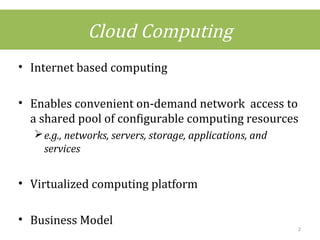
• Internet based computing
• Enables convenient on-demand network access to
a shared pool of configurable computing resources
e.g., networks, servers, storage, applications, and
services
• Virtualized computing platform
• Business Model
Cloud Computing
2
Cloud Computing(cont..)
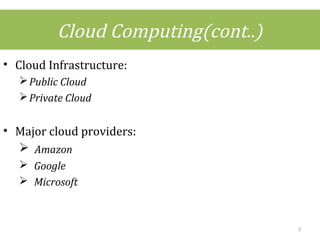
• Cloud Infrastructure:
Public Cloud
Private Cloud
• Major cloud providers:
 Amazon
 Google
 Microsoft
3
Some key aspects of cloud computing
• on-demand network
• Scalable use of computing resources
• Pay-per-use concept
4
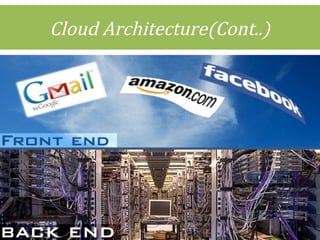
Cloud Architecture
• Consists of two component:
Front-end(or user-end)
Back-end
5
Cloud Architecture(Cont..)
6
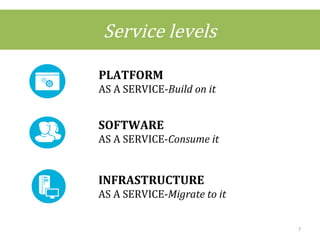
Service levels
PLATFORM
AS A SERVICE-Build on it
SOFTWARE
AS A SERVICE-Consume it
INFRASTRUCTURE
AS A SERVICE-Migrate to it
7
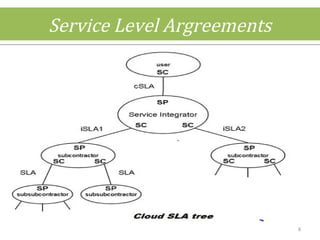
Service Level Argreements
8
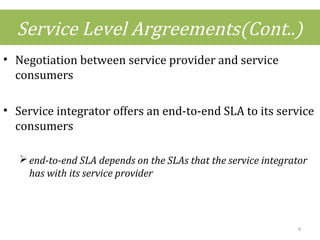
Service Level Argreements(Cont..)
• Negotiation between service provider and service
consumers
• Service integrator offers an end-to-end SLA to its service
consumers
end-to-end SLA depends on the SLAs that the service integrator
has with its service provider
9
10
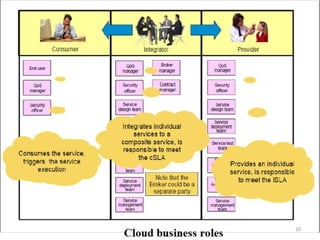
Users and their Roles
• Four types of business roles:
A Cloud Service Consumer (CSC)
A Cloud Service Provider (CSP)
A Cloud Service Integrator (CSI)
A Cloud Service Broker (CSB)
11
Advantages
• Easy to maintain
• Easy access
• Ideal for small business
• Location independence
• Provides flexibility 12
Advantages (Cont..)
• Scalable
• Cost-effective
• Energy-efficient
• Reliable
13
Drawbacks
• Possible downtime
• Security issues
• Other issues:
 Load Balancing
14
Why we need load balancing??
• The steady growth of the Internet
low response times
network congestion and
disruption of services
• For achieving Green computing in clouds
Limited Energy Consumption
Reducing Carbon Emission 15
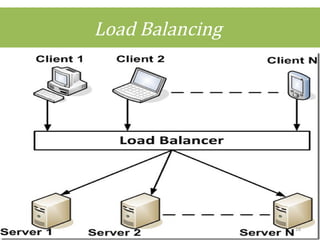
Load Balancing
16
Some key aspects of load balancing
• Network Load Balancing or Server Load Balancing
• Reassigning load to each individual node
• Provided by dedicated software or hardware
 e.g. multilayer switch ,DNS server etc.
17
Some key aspects of load balancing
(Cont..)
• Make resource utilization effective
• Improve the response time
• Dynamic in nature
• Load of resources considered can be:
 CPU load,
 amount of memory used,
 delay or Network load
18
Goals of load balancing
• Availability
• To improve the performance substantially
• To maintain the system stability
• To accommodate future modification in the
system
• Build a fault tolerant system by Creating backups 19
Types of load balancing algorithms
• Depending on who initiated the process:
sender Initiated
receiver Initiated
Symmetric
• Depending on the current state of the system:
static
dynamic
20
Usefulness of study of simulation
• Creating and experimenting model of a physical system
• To test scenarios that might be particularly difficult or
expensive
• Provide graphical applications
21
Need of Simulators
• Difficult to access exact cloud computing environment
• Easily mimicking cloud testbeds with different VMs
• To easily include modifications for complex scenario
22
Types of Simulators
GreenCloud
» Why?
» Scenarios
» Performance Measurement
iCanCloud
» Why?
» Scenarios
» Performance Measurement
CloudSim
» Why?
» Scenarios
» Performance Measurement
Comparison 23
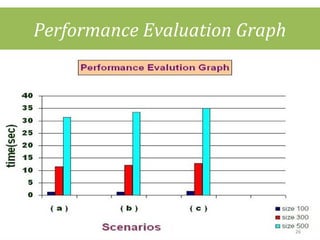
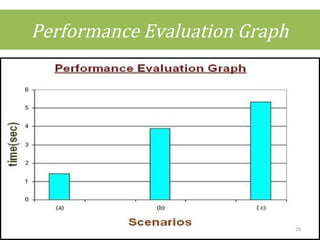
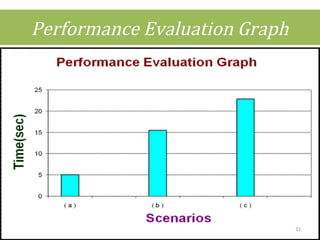
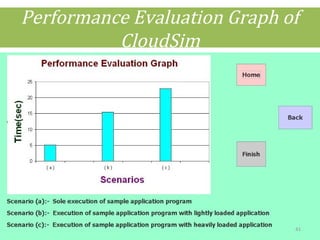
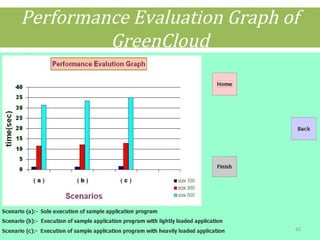
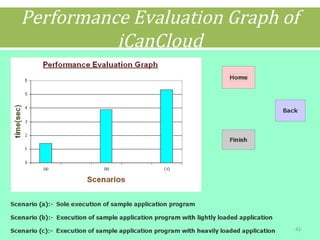
Scenarios
Scenario a: sole execution of sample application program
Scenario b: execution of sample application program
with lightly loaded application
Scenario c: execution of sample program with heavily
loaded application
24
Why Green Cloud?
1. A simulation environment
2. No provisioning for observing clouds for their energy efficiency
3. Offers a thorough investigation of workload distributions
4. Minimise energy consumption
5. Packet-level simulations of communications in the data center infrastructure
Performance Evaluation Graph
26
Why iCanCloud?
• Used to simulate and model systems
•Optimizes the trade-off between cost and performance
• Lets the users to take an easy decision for paying
corresponding budget of machines
• Provides flexibility, scalability, performance and
usability
27
Why iCanCloud?(Cont..)
• Customizable VMs can be used to quickly simulate uni-
core/multi-core systems
• Provides a user-friendly GUI
• Conducts large experiment
• provides a flexible global hypervisor for integrating any cloud
brokering policy
• reproduces the instance types provided by a given cloud
infrastructure 28
Performance Evaluation Graph
29
Why CloudSim?
• An extensible simulation toolkit that enables modelling
and simulation of Cloud computing systems and
application provisioning environments.
• Can test the performance of a newly developed
application service in a controlled and easy to set-up
environment.
• Requires very less effort and time to implement Cloud-
based application provisioning test environment
30
Cont..
• Used for modelling and simulation of large scale computing
environments
• Facilitates simulation of federated cloud environment
• Supports simulation of network connections among the simulated
system elements
• Support for modelling and simulation of energy-aware
computational resources are also available
Performance Evaluation Graph
32
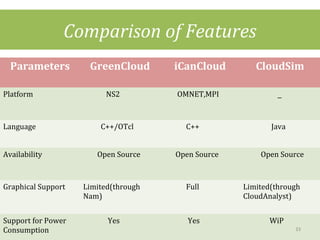
Comparison of Features
Parameters GreenCloud iCanCloud CloudSim
Platform NS2 OMNET,MPI _
Language C++/OTcl C++ Java
Availability Open Source Open Source Open Source
Graphical Support Limited(through
Nam)
Full Limited(through
CloudAnalyst)
Support for Power
Consumption
Yes Yes WiP
33
Implementation of Proposed
Load Balancing
Approach through Interface
34
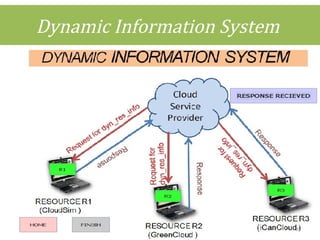
Dynamic Information System
35
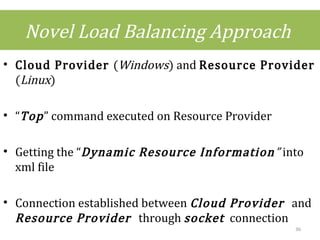
Novel Load Balancing Approach
• Cloud Provider (Windows) and Resource Provider
(Linux)
• “Top” command executed on Resource Provider
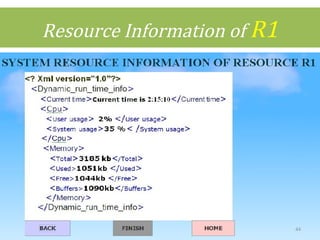
• Getting the “Dynamic Resource Information” into
xml file
• Connection established between Cloud Provider and
Resource Provider through socket connection
36
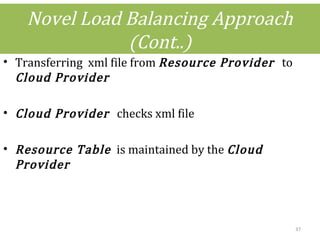
Novel Load Balancing Approach
(Cont..)
• Transferring xml file from Resource Provider to
Cloud Provider
• Cloud Provider checks xml file
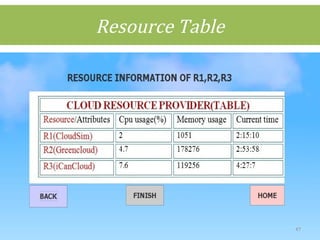
• Resource Table is maintained by the Cloud
Provider
37
Welcome Page
38
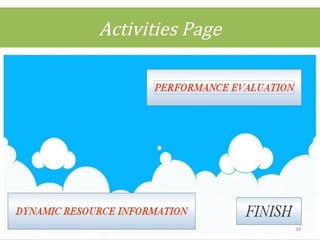
Activities Page
39
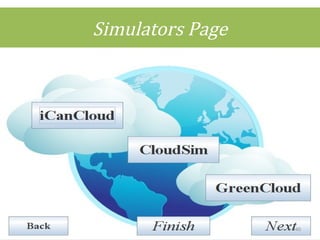
Simulators Page
40
Performance Evaluation Graph of
CloudSim
41
Performance Evaluation Graph of
GreenCloud
42
Performance Evaluation Graph of
iCanCloud
43
Resource Information of R1
44
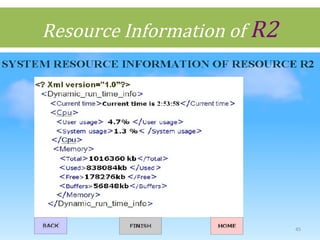
Resource Information of R2
45
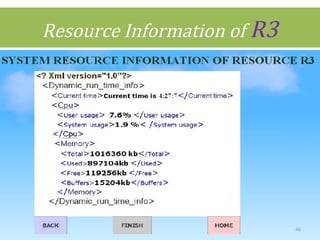
Resource Information of R3
46
Resource Table
47
Conclusion
• Concludes features, architectures and performance evaluation
graph of different existing cloud simulators
• Predict the outcome of each simulator under different
scenarios
• Compares the different simulators
48
Conclusion(Cont..)
• Future Work:
Improvement from the cloud consumer sides
Service level agreements between cloud provider and cloud
consumer
• Limitations:
Message passing overhead
A part of the Approach
49
Reference
1. Aarti Khetan, Vie Bhushan and Subhash Chand Gupta “A novel Survey
on Load Balancing in Cloud Computing” International Journal of
Engineering Research & Technology (IJERT) Vol. 2 Issue 2,February-
2013.
2. Anthony T.Velte, Toby J.Velte, Robert Elsenpeter, “Cloud Computing:A
Practical Approach”, TATA McGRAW-HILL Edition 2010.
50
Reference(Cont..)
4. Kliazovich, D., Bouvry, P., Khan, S.U.: “iCanCloud: A Flexible and
Scalable Cloud Infrastructure Simulator.” J Grid Computing (2012)
10:185–209 DOI 10.1007/s10723-012-9208-5.
5. Mell, P.; and Grance, T. (2009, 7 10). The NIST Definition of Cloud
Computing, from NIST Information Technology Laboratory,
http://www.nist.gov/itl/cloud/upload/cloud-def-v15.pdf,retrieved
onApril 2011.
51
YOU…..
THANK
52

Cloud computing(bit mesra kolkata extn.)

  • 1.
    Bit mesra ranchi,kolkataextn. Under The Guidance of: Ajanta De Sarkar Soumya Ray Presented By: Group No-24 Udita Chakarborty (MCA/3508/10) Ashutosh Kumar (MCA/3539/10) Puja Kumari (MCA/3543/10) Shashi Ranjan (MCA/3545/10)
  • 2.
    • Internet basedcomputing • Enables convenient on-demand network access to a shared pool of configurable computing resources e.g., networks, servers, storage, applications, and services • Virtualized computing platform • Business Model Cloud Computing 2
  • 3.
    Cloud Computing(cont..) • CloudInfrastructure: Public Cloud Private Cloud • Major cloud providers:  Amazon  Google  Microsoft 3
  • 4.
    Some key aspectsof cloud computing • on-demand network • Scalable use of computing resources • Pay-per-use concept 4
  • 5.
    Cloud Architecture • Consistsof two component: Front-end(or user-end) Back-end 5
  • 6.
  • 7.
    Service levels PLATFORM AS ASERVICE-Build on it SOFTWARE AS A SERVICE-Consume it INFRASTRUCTURE AS A SERVICE-Migrate to it 7
  • 8.
  • 9.
    Service Level Argreements(Cont..) •Negotiation between service provider and service consumers • Service integrator offers an end-to-end SLA to its service consumers end-to-end SLA depends on the SLAs that the service integrator has with its service provider 9
  • 10.
  • 11.
    Users and theirRoles • Four types of business roles: A Cloud Service Consumer (CSC) A Cloud Service Provider (CSP) A Cloud Service Integrator (CSI) A Cloud Service Broker (CSB) 11
  • 12.
    Advantages • Easy tomaintain • Easy access • Ideal for small business • Location independence • Provides flexibility 12
  • 13.
    Advantages (Cont..) • Scalable •Cost-effective • Energy-efficient • Reliable 13
  • 14.
    Drawbacks • Possible downtime •Security issues • Other issues:  Load Balancing 14
  • 15.
    Why we needload balancing?? • The steady growth of the Internet low response times network congestion and disruption of services • For achieving Green computing in clouds Limited Energy Consumption Reducing Carbon Emission 15
  • 16.
  • 17.
    Some key aspectsof load balancing • Network Load Balancing or Server Load Balancing • Reassigning load to each individual node • Provided by dedicated software or hardware  e.g. multilayer switch ,DNS server etc. 17
  • 18.
    Some key aspectsof load balancing (Cont..) • Make resource utilization effective • Improve the response time • Dynamic in nature • Load of resources considered can be:  CPU load,  amount of memory used,  delay or Network load 18
  • 19.
    Goals of loadbalancing • Availability • To improve the performance substantially • To maintain the system stability • To accommodate future modification in the system • Build a fault tolerant system by Creating backups 19
  • 20.
    Types of loadbalancing algorithms • Depending on who initiated the process: sender Initiated receiver Initiated Symmetric • Depending on the current state of the system: static dynamic 20
  • 21.
    Usefulness of studyof simulation • Creating and experimenting model of a physical system • To test scenarios that might be particularly difficult or expensive • Provide graphical applications 21
  • 22.
    Need of Simulators •Difficult to access exact cloud computing environment • Easily mimicking cloud testbeds with different VMs • To easily include modifications for complex scenario 22
  • 23.
    Types of Simulators GreenCloud »Why? » Scenarios » Performance Measurement iCanCloud » Why? » Scenarios » Performance Measurement CloudSim » Why? » Scenarios » Performance Measurement Comparison 23
  • 24.
    Scenarios Scenario a: soleexecution of sample application program Scenario b: execution of sample application program with lightly loaded application Scenario c: execution of sample program with heavily loaded application 24
  • 25.
    Why Green Cloud? 1.A simulation environment 2. No provisioning for observing clouds for their energy efficiency 3. Offers a thorough investigation of workload distributions 4. Minimise energy consumption 5. Packet-level simulations of communications in the data center infrastructure
  • 26.
  • 27.
    Why iCanCloud? • Usedto simulate and model systems •Optimizes the trade-off between cost and performance • Lets the users to take an easy decision for paying corresponding budget of machines • Provides flexibility, scalability, performance and usability 27
  • 28.
    Why iCanCloud?(Cont..) • CustomizableVMs can be used to quickly simulate uni- core/multi-core systems • Provides a user-friendly GUI • Conducts large experiment • provides a flexible global hypervisor for integrating any cloud brokering policy • reproduces the instance types provided by a given cloud infrastructure 28
  • 29.
  • 30.
    Why CloudSim? • Anextensible simulation toolkit that enables modelling and simulation of Cloud computing systems and application provisioning environments. • Can test the performance of a newly developed application service in a controlled and easy to set-up environment. • Requires very less effort and time to implement Cloud- based application provisioning test environment 30
  • 31.
    Cont.. • Used formodelling and simulation of large scale computing environments • Facilitates simulation of federated cloud environment • Supports simulation of network connections among the simulated system elements • Support for modelling and simulation of energy-aware computational resources are also available
  • 32.
  • 33.
    Comparison of Features ParametersGreenCloud iCanCloud CloudSim Platform NS2 OMNET,MPI _ Language C++/OTcl C++ Java Availability Open Source Open Source Open Source Graphical Support Limited(through Nam) Full Limited(through CloudAnalyst) Support for Power Consumption Yes Yes WiP 33
  • 34.
    Implementation of Proposed LoadBalancing Approach through Interface 34
  • 35.
  • 36.
    Novel Load BalancingApproach • Cloud Provider (Windows) and Resource Provider (Linux) • “Top” command executed on Resource Provider • Getting the “Dynamic Resource Information” into xml file • Connection established between Cloud Provider and Resource Provider through socket connection 36
  • 37.
    Novel Load BalancingApproach (Cont..) • Transferring xml file from Resource Provider to Cloud Provider • Cloud Provider checks xml file • Resource Table is maintained by the Cloud Provider 37
  • 38.
  • 39.
  • 40.
  • 41.
  • 42.
  • 43.
  • 44.
  • 45.
  • 46.
  • 47.
  • 48.
    Conclusion • Concludes features,architectures and performance evaluation graph of different existing cloud simulators • Predict the outcome of each simulator under different scenarios • Compares the different simulators 48
  • 49.
    Conclusion(Cont..) • Future Work: Improvementfrom the cloud consumer sides Service level agreements between cloud provider and cloud consumer • Limitations: Message passing overhead A part of the Approach 49
  • 50.
    Reference 1. Aarti Khetan,Vie Bhushan and Subhash Chand Gupta “A novel Survey on Load Balancing in Cloud Computing” International Journal of Engineering Research & Technology (IJERT) Vol. 2 Issue 2,February- 2013. 2. Anthony T.Velte, Toby J.Velte, Robert Elsenpeter, “Cloud Computing:A Practical Approach”, TATA McGRAW-HILL Edition 2010. 50
  • 51.
    Reference(Cont..) 4. Kliazovich, D.,Bouvry, P., Khan, S.U.: “iCanCloud: A Flexible and Scalable Cloud Infrastructure Simulator.” J Grid Computing (2012) 10:185–209 DOI 10.1007/s10723-012-9208-5. 5. Mell, P.; and Grance, T. (2009, 7 10). The NIST Definition of Cloud Computing, from NIST Information Technology Laboratory, http://www.nist.gov/itl/cloud/upload/cloud-def-v15.pdf,retrieved onApril 2011. 51
  • 52.