WHITEPAPER
www.mazebolt.com
A Simple Guide
to DDoS Mitigation
3 EXECUTIVE SUMMARY
3 COMPONENTS OF A DDoS MITIGATION SYSTEM
4 APPROACHES TO MITIGATION ACTIVITY
4 Cloud-Based Solutions
4 Scrubbing Center
5 Content Delivery Network (CDN)
6 On-Prem. Based Solutions
6 Vendor Appliances (Customer Premises Equipment - CPE)
7 Intrusion Prevention Systems (IPS)
8 Web Application Firewalls (WAFs)
9 Load Balancer
10 Firewall
11 CONCLUSION
12 RESOURCES
3 Figure 1: Illustration of a Typical Hybrid DDoS Mitigation Posture
4 Figure 2: Illustration of a Cloud Scrubbing Service
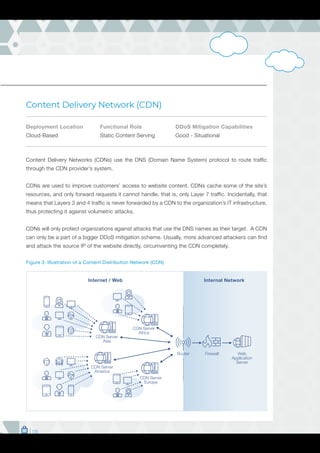
5 Figure 3: Illustration of a Content Distribution Network (CDN)
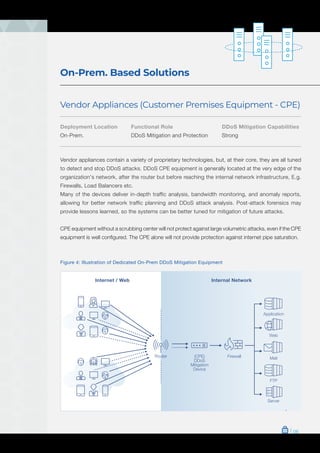
6 Figure 4: Illustration of Dedicated On-Prem DDoS Mitigation Equipment
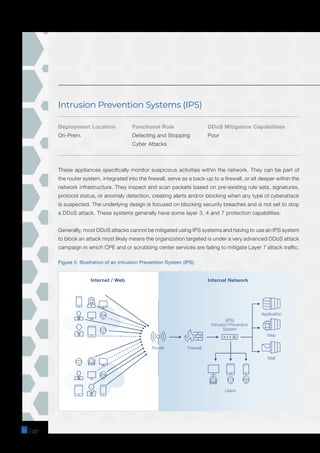
7 Figure 5: Illustration of an Intrusion Prevention System (IPS)
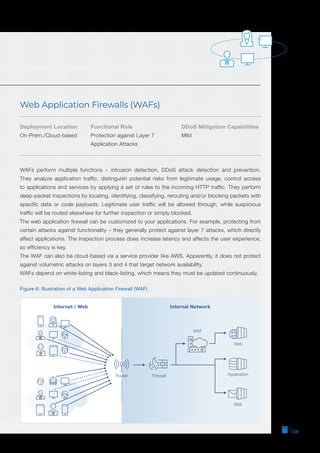
8 Figure 6: Illustration of a Web Application Firewall (WAF)
9 Figure 7: Illustration of a Load Balancer
10 Figure 8: Illustration of a Firewall
TABLE OF CONTENTS
TABLE OF FIGURES
EXECUTIVE SUMMARY
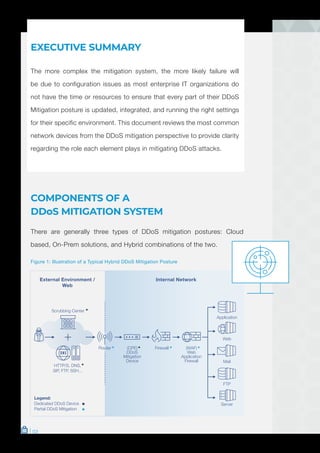
Figure 1: Illustration of a Typical Hybrid DDoS Mitigation Posture
The more complex the mitigation system, the more likely failure will
be due to configuration issues as most enterprise IT organizations do
not have the time or resources to ensure that every part of their DDoS
Mitigation posture is updated, integrated, and running the right settings
for their specific environment. This document reviews the most common
network devices from the DDoS mitigation perspective to provide clarity
regarding the role each element plays in mitigating DDoS attacks.
COMPONENTS OF A
DDoS MITIGATION SYSTEM
There are generally three types of DDoS mitigation postures: Cloud
based, On-Prem solutions, and Hybrid combinations of the two.
| 03
External Environment /
Web
Internal Network
Scrubbing Center
Router
Legend:
Dedicated DDoS Device
Partial DDoS Mitigation
(WAF)
Web
Application
Firewall
Firewall
(CPE)
DDoS
Mitigation
Device
Application
Server
Web
Mail
FTP
DNS
HTTP/S, DNS,
SIP, FTP, SSH...
APPROACHES TO MITIGATION ACTIVITY
Cloud-Based Solutions
Scrubbing Center
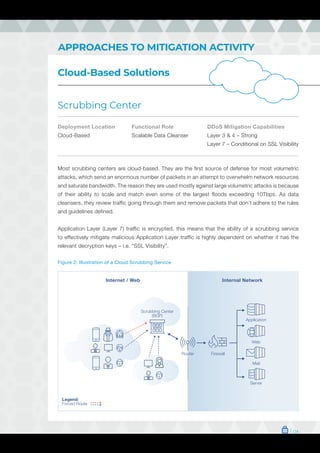
Most scrubbing centers are cloud-based. They are the first source of defense for most volumetric
attacks, which send an enormous number of packets in an attempt to overwhelm network resources
and saturate bandwidth. The reason they are used mostly against large volumetric attacks is because
of their ability to scale and match even some of the largest floods exceeding 10Tbps. As data
cleansers, they review traffic going through them and remove packets that don’t adhere to the rules
and guidelines defined.
Application Layer (Layer 7) traffic is encrypted, this means that the ability of a scrubbing service
to effectively mitigate malicious Application Layer traffic is highly dependent on whether it has the
relevant decryption keys – i.e. “SSL Visibility”.
| 04
Figure 2: Illustration of a Cloud Scrubbing Service
Internet / Web Internal Network
Legend:
Forced Route
Scrubbing Center
(BGP)
Router Firewall
Application
Server
Web
Mail
Deployment Location
Cloud-Based
Functional Role
Scalable Data Cleanser
DDoS Mitigation Capabilities
Layer 3 & 4 – Strong
Layer 7 – Conditional on SSL Visibility
Content Delivery Network (CDN)
Content Delivery Networks (CDNs) use the DNS (Domain Name System) protocol to route traffic
through the CDN provider’s system.
CDNs are used to improve customers’ access to website content. CDNs cache some of the site’s
resources, and only forward requests it cannot handle, that is, only Layer 7 traffic. Incidentally, that
means that Layers 3 and 4 traffic is never forwarded by a CDN to the organization’s IT infrastructure,
thus protecting it against volumetric attacks.
CDNs will only protect organizations against attacks that use the DNS names as their target. A CDN
can only be a part of a bigger DDoS mitigation scheme. Usually, more advanced attackers can find
and attack the source IP of the website directly, circumventing the CDN completely.
Figure 3: Illustration of a Content Distribution Network (CDN)
Internet / Web Internal Network
Router Firewall Web
Application
Server
CDN Server
Africa
CDN Server
Europe
CDN Server
Asia
CDN Server
America
Deployment Location
Cloud-Based
Functional Role
Static Content Serving
DDoS Mitigation Capabilities
Good - Situational
| 05
On-Prem. Based Solutions
Vendor Appliances (Customer Premises Equipment - CPE)
Vendor appliances contain a variety of proprietary technologies, but, at their core, they are all tuned
to detect and stop DDoS attacks. DDoS CPE equipment is generally located at the very edge of the
organization's network, after the router but before reaching the internal network infrastructure, E.g.
Firewalls, Load Balancers etc.
Many of the devices deliver in-depth traffic analysis, bandwidth monitoring, and anomaly reports,
allowing for better network traffic planning and DDoS attack analysis. Post-attack forensics may
provide lessons learned, so the systems can be better tuned for mitigation of future attacks.
CPE equipment without a scrubbing center will not protect against large volumetric attacks, even if the CPE
equipment is well configured. The CPE alone will not provide protection against internet pipe saturation.
Figure 4: Illustration of Dedicated On-Prem DDoS Mitigation Equipment
Internet / Web Internal Network
Router Firewall
(CPE)
DDoS
Mitigation
Device
Application
Server
Web
Mail
FTP
Deployment Location
On-Prem.
Functional Role
DDoS Mitigation and Protection
DDoS Mitigation Capabilities
Strong
| 06
Intrusion Prevention Systems (IPS)
These appliances specifically monitor suspicious activities within the network. They can be part of
the router system, integrated into the firewall, serve as a back-up to a firewall, or sit deeper within the
network infrastructure. They inspect and scan packets based on pre-existing rule sets, signatures,
protocol status, or anomaly detection, creating alerts and/or blocking when any type of cyberattack
is suspected. The underlying design is focused on blocking security breaches and is not set to stop
a DDoS attack. These systems generally have some layer 3, 4 and 7 protection capabilities.
Generally, most DDoS attacks cannot be mitigated using IPS systems and having to use an IPS system
to block an attack most likely means the organization targeted is under a very advanced DDoS attack
campaign in which CPE and or scrubbing center services are failing to mitigate Layer 7 attack traffic.
Figure 5: Illustration of an Intrusion Prevention System (IPS)
Deployment Location
On-Prem.
Functional Role
Detecting and Stopping
Cyber Attacks
DDoS Mitigation Capabilities
Poor
| 07
Internet / Web Internal Network
Router Firewall
Users
(IPS)
Intrusion Prevention
System
Application
Web
Mail
Web Application Firewalls (WAFs)
WAFs perform multiple functions – intrusion detection, DDoS attack detection and prevention.
They analyze application traffic, distinguish potential risks from legitimate usage, control access
to applications and services by applying a set of rules to the incoming HTTP traffic. They perform
deep-packet inspections by locating, identifying, classifying, rerouting and/or blocking packets with
specific data or code payloads. Legitimate user traffic will be allowed through, while suspicious
traffic will be routed elsewhere for further inspection or simply blocked.
The web application firewall can be customized to your applications. For example, protecting from
certain attacks against functionality – they generally protect against layer 7 attacks, which directly
affect applications. The inspection process does increase latency and affects the user experience,
so efficiency is key.
The WAF can also be cloud-based via a service provider like AWS. Apparently, it does not protect
against volumetric attacks on layers 3 and 4 that target network availability.
WAFs depend on white-listing and black-listing, which means they must be updated continuously.
Figure 6: Illustration of a Web Application Firewall (WAF)
Internet / Web Internal Network
Router Firewall
WAF
Application
Web
Mail
Deployment Location
On-Prem./Cloud-based
Functional Role
Protection against Layer 7
Application Attacks
DDoS Mitigation Capabilities
Mild
| 08
Load Balancer
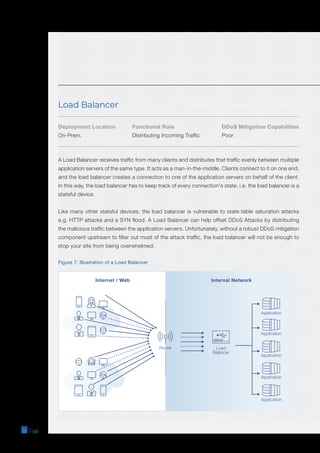
A Load Balancer receives traffic from many clients and distributes that traffic evenly between multiple
application servers of the same type. It acts as a man-in-the-middle. Clients connect to it on one end,
and the load balancer creates a connection to one of the application servers on behalf of the client.
In this way, the load balancer has to keep track of every connection's state, i.e. the load balancer is a
stateful device.
Like many other stateful devices, the load balancer is vulnerable to state-table saturation attacks
e.g. HTTP attacks and a SYN flood. A Load Balancer can help offset DDoS Attacks by distributing
the malicious traffic between the application servers. Unfortunately, without a robust DDoS mitigation
component upstream to filter out most of the attack traffic, the load balancer will not be enough to
stop your site from being overwhelmed.
Figure 7: Illustration of a Load Balancer
Deployment Location
On-Prem.
Functional Role
Distributing Incoming Traffic
DDoS Mitigation Capabilities
Poor
| 09
Internet / Web Internal Network
Router Load
Balancer
Application
Application
Application
Application
Application
Firewall
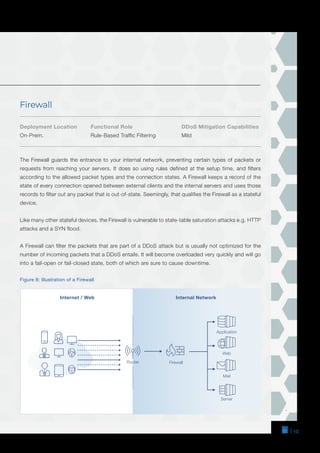
The Firewall guards the entrance to your internal network, preventing certain types of packets or
requests from reaching your servers. It does so using rules defined at the setup time, and filters
according to the allowed packet types and the connection states. A Firewall keeps a record of the
state of every connection opened between external clients and the internal servers and uses those
records to filter out any packet that is out-of-state. Seemingly, that qualifies the Firewall as a stateful
device.
Like many other stateful devices, the Firewall is vulnerable to state-table saturation attacks e.g. HTTP
attacks and a SYN flood.
A Firewall can filter the packets that are part of a DDoS attack but is usually not optimized for the
number of incoming packets that a DDoS entails. It will become overloaded very quickly and will go
into a fail-open or fail-closed state, both of which are sure to cause downtime.
Figure 8: Illustration of a Firewall
Internet / Web Internal Network
Router Firewall
Application
Server
Web
Mail
Deployment Location
On-Prem.
Functional Role
Rule-Based Traffic Filtering
DDoS Mitigation Capabilities
Mild
| 10
CONCLUSION
Choosing the right combination of mitigation devices requires an understanding
of how each devices’ capabilities match your environment's needs together with
an objective look at the corporate requirements – risk, available resources,
budget, personnel, existing network infrastructure.
No matter how the technology is mixed and matched, it needs to be
stress-tested to ensure that it works when DDoS attacks strike.
RADAR™, MazeBolt’s new patented technology solution is part of the MazeBolt
security platform. RADAR™ simulates DDoS attacks continuously and
non-disruptively. Delivering advanced intelligence through straightforward reports
on how to remediate the detected DDoS vulnerabilities found. With RADAR™
organizations can achieve, maintain, and verify the continuous closing of their
DDoS vulnerability gaps. Reducing and maintaining the vulnerability level of a
damaging DDoS attack from an average of 48% to under 2% ongoing.
| 11
| 12
RESOURCES
About MazeBolt
MazeBolt is an innovation leader in cybersecurity and part of
the DDoS mitigation space. Offering full DDoS risk detection
and elimination and working with any mitigation system to
provide end to end full coverage. Supporting organizations in
avoiding downtime and closing DDoS vulnerabilities before an
attack happens.
1. https://en.wikipedia.org/wiki/Application_firewall
2.https://www.techwalla.com/articles/what-are-the-advantages-and-disadvantages
-of-using-a-firewall
3. https://searchnetworking.techtarget.com/definition/deep-packet-inspection-DPI
4. https://arxiv.org/pdf/1710.08628.pdf
5. http://www.ijiss.org/ijiss/index.php/ijiss2/article/view/248/pdf_561
6. https://www.sans.org/reading-room/whitepapers/intrusion/summary-dos-ddos-
prevention-monitoring-mitigation-techniques-service-provider-environment-1212
7. http://www.infosecurityeurope.com/__novadocuments/22581
8. https://en.wikipedia.org/wiki/Data_monitoring_switch

DDoS Mitigation Guide |DDoS Protection Cyber Security | MazeBolt

  • 1.
  • 2.
    3 EXECUTIVE SUMMARY 3COMPONENTS OF A DDoS MITIGATION SYSTEM 4 APPROACHES TO MITIGATION ACTIVITY 4 Cloud-Based Solutions 4 Scrubbing Center 5 Content Delivery Network (CDN) 6 On-Prem. Based Solutions 6 Vendor Appliances (Customer Premises Equipment - CPE) 7 Intrusion Prevention Systems (IPS) 8 Web Application Firewalls (WAFs) 9 Load Balancer 10 Firewall 11 CONCLUSION 12 RESOURCES 3 Figure 1: Illustration of a Typical Hybrid DDoS Mitigation Posture 4 Figure 2: Illustration of a Cloud Scrubbing Service 5 Figure 3: Illustration of a Content Distribution Network (CDN) 6 Figure 4: Illustration of Dedicated On-Prem DDoS Mitigation Equipment 7 Figure 5: Illustration of an Intrusion Prevention System (IPS) 8 Figure 6: Illustration of a Web Application Firewall (WAF) 9 Figure 7: Illustration of a Load Balancer 10 Figure 8: Illustration of a Firewall TABLE OF CONTENTS TABLE OF FIGURES
  • 3.
    EXECUTIVE SUMMARY Figure 1:Illustration of a Typical Hybrid DDoS Mitigation Posture The more complex the mitigation system, the more likely failure will be due to configuration issues as most enterprise IT organizations do not have the time or resources to ensure that every part of their DDoS Mitigation posture is updated, integrated, and running the right settings for their specific environment. This document reviews the most common network devices from the DDoS mitigation perspective to provide clarity regarding the role each element plays in mitigating DDoS attacks. COMPONENTS OF A DDoS MITIGATION SYSTEM There are generally three types of DDoS mitigation postures: Cloud based, On-Prem solutions, and Hybrid combinations of the two. | 03 External Environment / Web Internal Network Scrubbing Center Router Legend: Dedicated DDoS Device Partial DDoS Mitigation (WAF) Web Application Firewall Firewall (CPE) DDoS Mitigation Device Application Server Web Mail FTP DNS HTTP/S, DNS, SIP, FTP, SSH...
  • 4.
    APPROACHES TO MITIGATIONACTIVITY Cloud-Based Solutions Scrubbing Center Most scrubbing centers are cloud-based. They are the first source of defense for most volumetric attacks, which send an enormous number of packets in an attempt to overwhelm network resources and saturate bandwidth. The reason they are used mostly against large volumetric attacks is because of their ability to scale and match even some of the largest floods exceeding 10Tbps. As data cleansers, they review traffic going through them and remove packets that don’t adhere to the rules and guidelines defined. Application Layer (Layer 7) traffic is encrypted, this means that the ability of a scrubbing service to effectively mitigate malicious Application Layer traffic is highly dependent on whether it has the relevant decryption keys – i.e. “SSL Visibility”. | 04 Figure 2: Illustration of a Cloud Scrubbing Service Internet / Web Internal Network Legend: Forced Route Scrubbing Center (BGP) Router Firewall Application Server Web Mail Deployment Location Cloud-Based Functional Role Scalable Data Cleanser DDoS Mitigation Capabilities Layer 3 & 4 – Strong Layer 7 – Conditional on SSL Visibility
  • 5.
    Content Delivery Network(CDN) Content Delivery Networks (CDNs) use the DNS (Domain Name System) protocol to route traffic through the CDN provider’s system. CDNs are used to improve customers’ access to website content. CDNs cache some of the site’s resources, and only forward requests it cannot handle, that is, only Layer 7 traffic. Incidentally, that means that Layers 3 and 4 traffic is never forwarded by a CDN to the organization’s IT infrastructure, thus protecting it against volumetric attacks. CDNs will only protect organizations against attacks that use the DNS names as their target. A CDN can only be a part of a bigger DDoS mitigation scheme. Usually, more advanced attackers can find and attack the source IP of the website directly, circumventing the CDN completely. Figure 3: Illustration of a Content Distribution Network (CDN) Internet / Web Internal Network Router Firewall Web Application Server CDN Server Africa CDN Server Europe CDN Server Asia CDN Server America Deployment Location Cloud-Based Functional Role Static Content Serving DDoS Mitigation Capabilities Good - Situational | 05
  • 6.
    On-Prem. Based Solutions VendorAppliances (Customer Premises Equipment - CPE) Vendor appliances contain a variety of proprietary technologies, but, at their core, they are all tuned to detect and stop DDoS attacks. DDoS CPE equipment is generally located at the very edge of the organization's network, after the router but before reaching the internal network infrastructure, E.g. Firewalls, Load Balancers etc. Many of the devices deliver in-depth traffic analysis, bandwidth monitoring, and anomaly reports, allowing for better network traffic planning and DDoS attack analysis. Post-attack forensics may provide lessons learned, so the systems can be better tuned for mitigation of future attacks. CPE equipment without a scrubbing center will not protect against large volumetric attacks, even if the CPE equipment is well configured. The CPE alone will not provide protection against internet pipe saturation. Figure 4: Illustration of Dedicated On-Prem DDoS Mitigation Equipment Internet / Web Internal Network Router Firewall (CPE) DDoS Mitigation Device Application Server Web Mail FTP Deployment Location On-Prem. Functional Role DDoS Mitigation and Protection DDoS Mitigation Capabilities Strong | 06
  • 7.
    Intrusion Prevention Systems(IPS) These appliances specifically monitor suspicious activities within the network. They can be part of the router system, integrated into the firewall, serve as a back-up to a firewall, or sit deeper within the network infrastructure. They inspect and scan packets based on pre-existing rule sets, signatures, protocol status, or anomaly detection, creating alerts and/or blocking when any type of cyberattack is suspected. The underlying design is focused on blocking security breaches and is not set to stop a DDoS attack. These systems generally have some layer 3, 4 and 7 protection capabilities. Generally, most DDoS attacks cannot be mitigated using IPS systems and having to use an IPS system to block an attack most likely means the organization targeted is under a very advanced DDoS attack campaign in which CPE and or scrubbing center services are failing to mitigate Layer 7 attack traffic. Figure 5: Illustration of an Intrusion Prevention System (IPS) Deployment Location On-Prem. Functional Role Detecting and Stopping Cyber Attacks DDoS Mitigation Capabilities Poor | 07 Internet / Web Internal Network Router Firewall Users (IPS) Intrusion Prevention System Application Web Mail
  • 8.
    Web Application Firewalls(WAFs) WAFs perform multiple functions – intrusion detection, DDoS attack detection and prevention. They analyze application traffic, distinguish potential risks from legitimate usage, control access to applications and services by applying a set of rules to the incoming HTTP traffic. They perform deep-packet inspections by locating, identifying, classifying, rerouting and/or blocking packets with specific data or code payloads. Legitimate user traffic will be allowed through, while suspicious traffic will be routed elsewhere for further inspection or simply blocked. The web application firewall can be customized to your applications. For example, protecting from certain attacks against functionality – they generally protect against layer 7 attacks, which directly affect applications. The inspection process does increase latency and affects the user experience, so efficiency is key. The WAF can also be cloud-based via a service provider like AWS. Apparently, it does not protect against volumetric attacks on layers 3 and 4 that target network availability. WAFs depend on white-listing and black-listing, which means they must be updated continuously. Figure 6: Illustration of a Web Application Firewall (WAF) Internet / Web Internal Network Router Firewall WAF Application Web Mail Deployment Location On-Prem./Cloud-based Functional Role Protection against Layer 7 Application Attacks DDoS Mitigation Capabilities Mild | 08
  • 9.
    Load Balancer A LoadBalancer receives traffic from many clients and distributes that traffic evenly between multiple application servers of the same type. It acts as a man-in-the-middle. Clients connect to it on one end, and the load balancer creates a connection to one of the application servers on behalf of the client. In this way, the load balancer has to keep track of every connection's state, i.e. the load balancer is a stateful device. Like many other stateful devices, the load balancer is vulnerable to state-table saturation attacks e.g. HTTP attacks and a SYN flood. A Load Balancer can help offset DDoS Attacks by distributing the malicious traffic between the application servers. Unfortunately, without a robust DDoS mitigation component upstream to filter out most of the attack traffic, the load balancer will not be enough to stop your site from being overwhelmed. Figure 7: Illustration of a Load Balancer Deployment Location On-Prem. Functional Role Distributing Incoming Traffic DDoS Mitigation Capabilities Poor | 09 Internet / Web Internal Network Router Load Balancer Application Application Application Application Application
  • 10.
    Firewall The Firewall guardsthe entrance to your internal network, preventing certain types of packets or requests from reaching your servers. It does so using rules defined at the setup time, and filters according to the allowed packet types and the connection states. A Firewall keeps a record of the state of every connection opened between external clients and the internal servers and uses those records to filter out any packet that is out-of-state. Seemingly, that qualifies the Firewall as a stateful device. Like many other stateful devices, the Firewall is vulnerable to state-table saturation attacks e.g. HTTP attacks and a SYN flood. A Firewall can filter the packets that are part of a DDoS attack but is usually not optimized for the number of incoming packets that a DDoS entails. It will become overloaded very quickly and will go into a fail-open or fail-closed state, both of which are sure to cause downtime. Figure 8: Illustration of a Firewall Internet / Web Internal Network Router Firewall Application Server Web Mail Deployment Location On-Prem. Functional Role Rule-Based Traffic Filtering DDoS Mitigation Capabilities Mild | 10
  • 11.
    CONCLUSION Choosing the rightcombination of mitigation devices requires an understanding of how each devices’ capabilities match your environment's needs together with an objective look at the corporate requirements – risk, available resources, budget, personnel, existing network infrastructure. No matter how the technology is mixed and matched, it needs to be stress-tested to ensure that it works when DDoS attacks strike. RADAR™, MazeBolt’s new patented technology solution is part of the MazeBolt security platform. RADAR™ simulates DDoS attacks continuously and non-disruptively. Delivering advanced intelligence through straightforward reports on how to remediate the detected DDoS vulnerabilities found. With RADAR™ organizations can achieve, maintain, and verify the continuous closing of their DDoS vulnerability gaps. Reducing and maintaining the vulnerability level of a damaging DDoS attack from an average of 48% to under 2% ongoing. | 11
  • 12.
    | 12 RESOURCES About MazeBolt MazeBoltis an innovation leader in cybersecurity and part of the DDoS mitigation space. Offering full DDoS risk detection and elimination and working with any mitigation system to provide end to end full coverage. Supporting organizations in avoiding downtime and closing DDoS vulnerabilities before an attack happens. 1. https://en.wikipedia.org/wiki/Application_firewall 2.https://www.techwalla.com/articles/what-are-the-advantages-and-disadvantages -of-using-a-firewall 3. https://searchnetworking.techtarget.com/definition/deep-packet-inspection-DPI 4. https://arxiv.org/pdf/1710.08628.pdf 5. http://www.ijiss.org/ijiss/index.php/ijiss2/article/view/248/pdf_561 6. https://www.sans.org/reading-room/whitepapers/intrusion/summary-dos-ddos- prevention-monitoring-mitigation-techniques-service-provider-environment-1212 7. http://www.infosecurityeurope.com/__novadocuments/22581 8. https://en.wikipedia.org/wiki/Data_monitoring_switch