Ryan Dixon 
17607145 
Phys 101 ­ 203 
LH2            ​Physics 101 Learning Object 
          ​Michelson Interferometer 
 
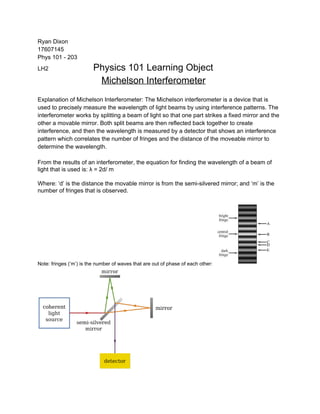
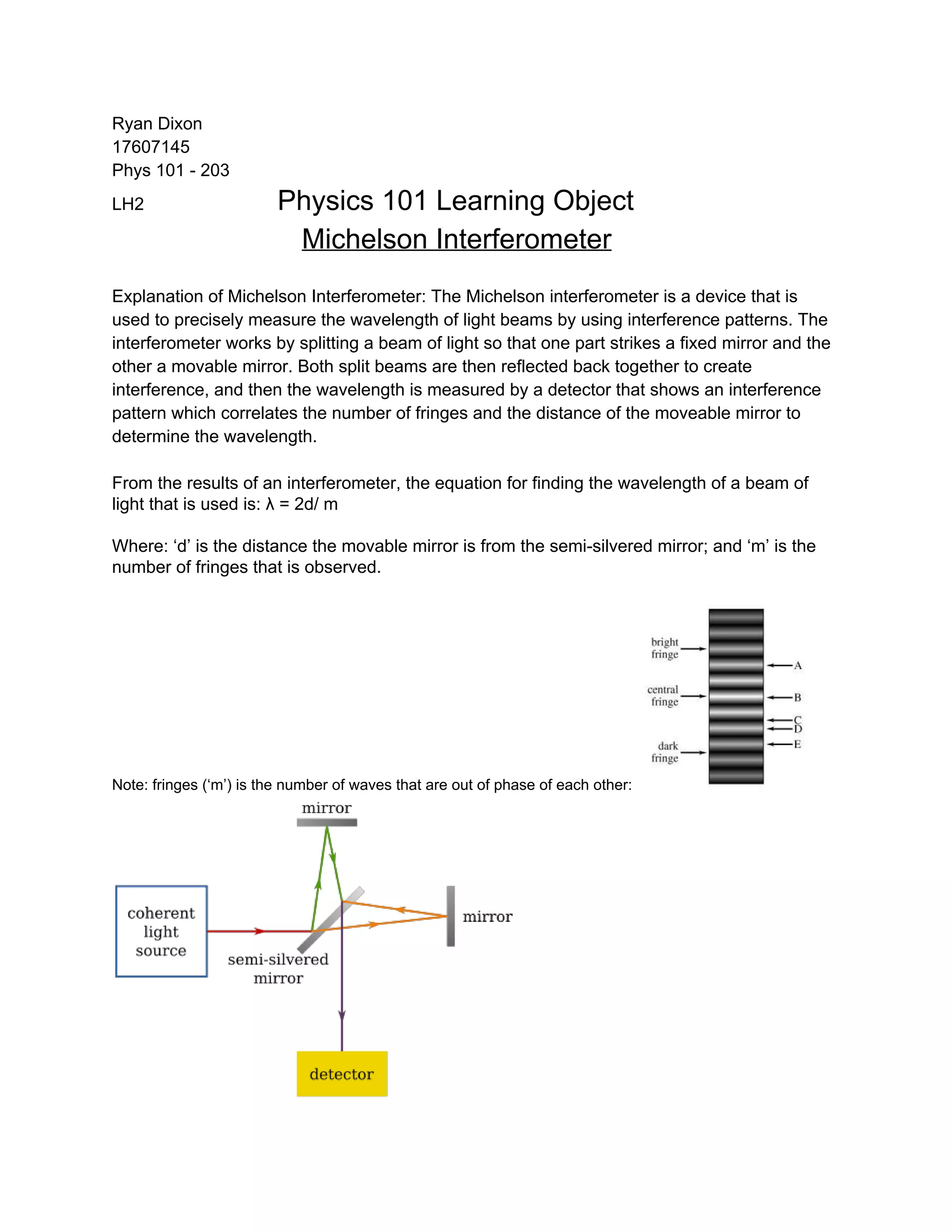
Explanation of Michelson Interferometer: The Michelson interferometer is a device that is 
used to precisely measure the wavelength of light beams by using interference patterns. The 
interferometer works by splitting a beam of light so that one part strikes a fixed mirror and the 
other a movable mirror. Both split beams are then reflected back together to create 
interference, and then the wavelength is measured by a detector that shows an interference 
pattern which correlates the number of fringes and the distance of the moveable mirror to 
determine the wavelength. 
 
From the results of an interferometer, the equation for finding the wavelength of a beam of 
light that is used is: λ = 2d/ m 
 
Where: ‘d’ is the distance the movable mirror is from the semi­silvered mirror; and ‘m’ is the 
number of fringes that is observed. 
 
Note: fringes (‘m’) is the number of waves that are out of phase of each other:  
 
Michelson Interferometer Diagram ( scienceworld.wolfram.com) 
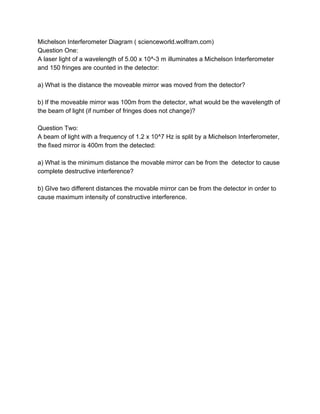
Question One: 
A laser light of a wavelength of 5.00 x 10^­3 m illuminates a Michelson Interferometer 
and 150 fringes are counted in the detector: 
 
a) What is the distance the moveable mirror was moved from the detector? 
 
b) If the moveable mirror was 100m from the detector, what would be the wavelength of 
the beam of light (if number of fringes does not change)? 
 
Question Two: 
A beam of light with a frequency of 1.2 x 10^7 Hz is split by a Michelson Interferometer, 
the fixed mirror is 400m from the detected: 
 
a) What is the minimum distance the movable mirror can be from the  detector to cause 
complete destructive interference? 
 
b) GIve two different distances the movable mirror can be from the detector in order to 
cause maximum intensity of constructive interference. 


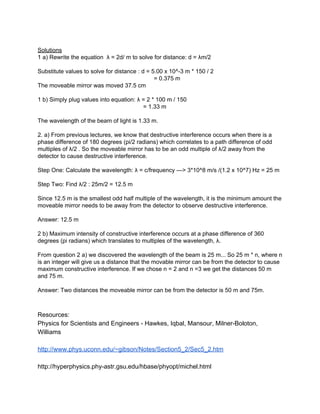
Solutions 
1 a) Rewrite the equation  λ = 2d/ m to solve for distance: d = λm/2 
 
Substitute values to solve for distance : d = 5.00 x 10^­3 m * 150 / 2 
  = 0.375 m 
The moveable mirror was moved 37.5 cm 
 
1 b) Simply plug values into equation: λ = 2 * 100 m / 150 
       = 1.33 m 
 
The wavelength of the beam of light is 1.33 m. 
 
2. a) From previous lectures, we know that destructive interference occurs when there is a 
phase difference of 180 degrees (pi/2 radians) which correlates to a path difference of odd 
multiples of λ/2 . So the moveable mirror has to be an odd multiple of λ/2 away from the 
detector to cause destructive interference. 
 
Step One: Calculate the wavelength: λ = c/frequency ­­­> 3*10^8 m/s /(1.2 x 10^7) Hz = 25 m 
 
Step Two: Find λ/2 : 25m/2 = 12.5 m 
 
Since 12.5 m is the smallest odd half multiple of the wavelength, it is the minimum amount the 
moveable mirror needs to be away from the detector to observe destructive interference. 
 
Answer: 12.5 m  
 
2 b) Maximum intensity of constructive interference occurs at a phase difference of 360 
degrees (pi radians) which translates to multiples of the wavelength, λ. 
 
From question 2 a) we discovered the wavelength of the beam is 25 m... So 25 m * n, where n 
is an integer will give us a distance that the movable mirror can be from the detector to cause 
maximum constructive interference. If we chose n = 2 and n =3 we get the distances 50 m 
and 75 m. 
 
Answer: Two distances the moveable mirror can be from the detector is 50 m and 75m. 
 
 
Resources: 
Physics for Scientists and Engineers ­ Hawkes, Iqbal, Mansour, Milner­Boloton, 
Williams 
 
http://www.phys.uconn.edu/~gibson/Notes/Section5_2/Sec5_2.htm 
 
http://hyperphysics.phy­astr.gsu.edu/hbase/phyopt/michel.html 

Learning object9 ryandixon-lh2-17607145