QUARTER 1
MODULE 5
ELEMENTS AND
PRINCIPLES OF ART





After going through
this module, you are
expected to:
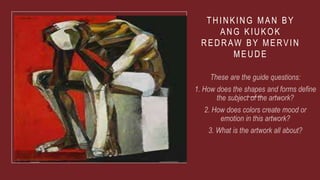
THINKING MAN BY
ANG KIUKOK
REDRAW BY MERVIN
MEUDE
ELEMENTS OF
ARTS

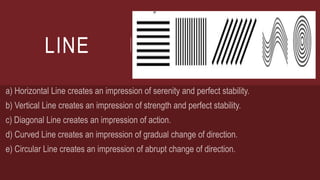
An element of art that is used to define shape,
contours, and outlines, also to suggest mass and
volume. It may be a continuous mark made on a
surface with a pointed tool or implied by the edges of
shapes and forms. Line may come in two
characteristics: form – curved, dotted, or broken lines;
and direction – vertical, horizontal, or diagonal lines.
LINE
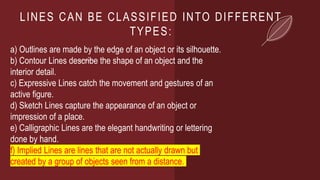
LINES CAN BE CLASSIFIED INTO DIFFERENT
TYPES:
a) Outlines are made by the edge of an object or its silhouette.
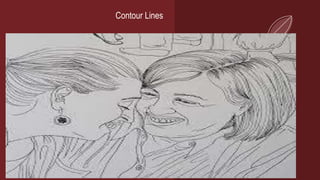
b) Contour Lines describe the shape of an object and the
interior detail.
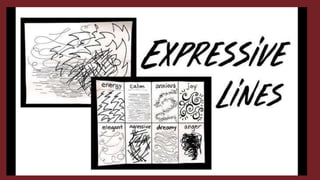
c) Expressive Lines catch the movement and gestures of an
active figure.
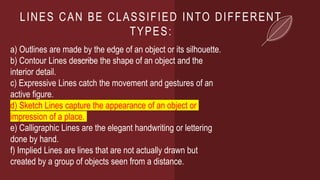
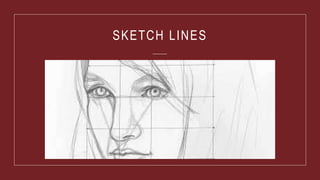
d) Sketch Lines capture the appearance of an object or
impression of a place.
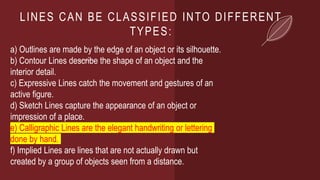
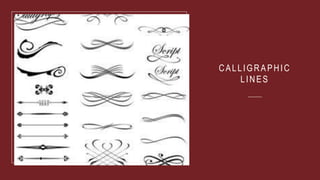
e) Calligraphic Lines are the elegant handwriting or lettering
done by hand.
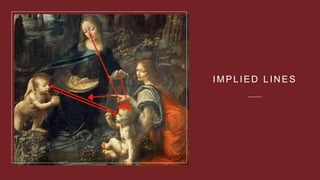
f) Implied Lines are lines that are not actually drawn but
created by a group of objects seen from a distance.
Contour Lines
LINES CAN BE CLASSIFIED INTO DIFFERENT
TYPES:
a) Outlines are made by the edge of an object or its silhouette.
b) Contour Lines describe the shape of an object and the
interior detail.
c) Expressive Lines catch the movement and gestures of an
active figure.
d) Sketch Lines capture the appearance of an object or
impression of a place.
e) Calligraphic Lines are the elegant handwriting or lettering
done by hand.
f) Implied Lines are lines that are not actually drawn but
created by a group of objects seen from a distance.
LINES CAN BE CLASSIFIED INTO DIFFERENT
TYPES:
a) Outlines are made by the edge of an object or its silhouette.
b) Contour Lines describe the shape of an object and the
interior detail.
c) Expressive Lines catch the movement and gestures of an
active figure.
d) Sketch Lines capture the appearance of an object or
impression of a place.
e) Calligraphic Lines are the elegant handwriting or lettering
done by hand.
f) Implied Lines are lines that are not actually drawn but
created by a group of objects seen from a distance.
SKETCH LINES
LINES CAN BE CLASSIFIED INTO DIFFERENT
TYPES:
a) Outlines are made by the edge of an object or its silhouette.
b) Contour Lines describe the shape of an object and the
interior detail.
c) Expressive Lines catch the movement and gestures of an
active figure.
d) Sketch Lines capture the appearance of an object or
impression of a place.
e) Calligraphic Lines are the elegant handwriting or lettering
done by hand.
f) Implied Lines are lines that are not actually drawn but
created by a group of objects seen from a distance.
CALLIGRAPHIC
LINES
LINES CAN BE CLASSIFIED INTO DIFFERENT
TYPES:
a) Outlines are made by the edge of an object or its silhouette.
b) Contour Lines describe the shape of an object and the
interior detail.
c) Expressive Lines catch the movement and gestures of an
active figure.
d) Sketch Lines capture the appearance of an object or
impression of a place.
e) Calligraphic Lines are the elegant handwriting or lettering
done by hand.
f) Implied Lines are lines that are not actually drawn but
created by a group of objects seen from a distance.
IMPLIED LINES
3. COLOR
3. COLOR
3. COLOR
4. SPACE

OVERCOMING
NERVOUSNESS
ENGAGING THE AUDIENCE




SELECTING VISUAL AIDS
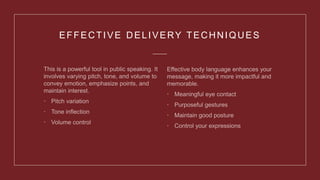
EFFECTIVE DELIVERY TECHNIQUES







NAVIGATING Q&A
SESSIONS
1.
2.
3.




SPEAKING IMPACT
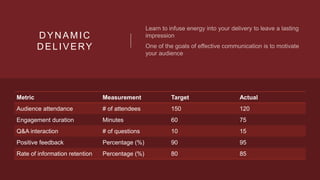
DYNAMIC
DELIVERY
Metric Measurement Target Actual
Audience attendance # of attendees 150 120
Engagement duration Minutes 60 75
Q&A interaction # of questions 10 15
Positive feedback Percentage (%) 90 95
Rate of information retention Percentage (%) 80 85
FINAL TIPS &
TAKEAWAYS




1.
2.
3.
4.
5.
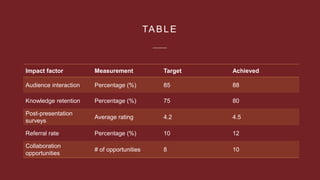
TABLE
Impact factor Measurement Target Achieved
Audience interaction Percentage (%) 85 88
Knowledge retention Percentage (%) 75 80
Post-presentation
surveys
Average rating 4.2 4.5
Referral rate Percentage (%) 10 12
Collaboration
opportunities
# of opportunities 8 10
THANK YOU

Contemporary Arts in the Module Five .pptx

  • 1.
    QUARTER 1 MODULE 5 ELEMENTSAND PRINCIPLES OF ART
  • 2.
  • 3.
    THINKING MAN BY ANGKIUKOK REDRAW BY MERVIN MEUDE
  • 4.
    ELEMENTS OF ARTS  An elementof art that is used to define shape, contours, and outlines, also to suggest mass and volume. It may be a continuous mark made on a surface with a pointed tool or implied by the edges of shapes and forms. Line may come in two characteristics: form – curved, dotted, or broken lines; and direction – vertical, horizontal, or diagonal lines.
  • 5.
  • 6.
    LINES CAN BECLASSIFIED INTO DIFFERENT TYPES: a) Outlines are made by the edge of an object or its silhouette. b) Contour Lines describe the shape of an object and the interior detail. c) Expressive Lines catch the movement and gestures of an active figure. d) Sketch Lines capture the appearance of an object or impression of a place. e) Calligraphic Lines are the elegant handwriting or lettering done by hand. f) Implied Lines are lines that are not actually drawn but created by a group of objects seen from a distance.
  • 7.
  • 8.
    LINES CAN BECLASSIFIED INTO DIFFERENT TYPES: a) Outlines are made by the edge of an object or its silhouette. b) Contour Lines describe the shape of an object and the interior detail. c) Expressive Lines catch the movement and gestures of an active figure. d) Sketch Lines capture the appearance of an object or impression of a place. e) Calligraphic Lines are the elegant handwriting or lettering done by hand. f) Implied Lines are lines that are not actually drawn but created by a group of objects seen from a distance.
  • 10.
    LINES CAN BECLASSIFIED INTO DIFFERENT TYPES: a) Outlines are made by the edge of an object or its silhouette. b) Contour Lines describe the shape of an object and the interior detail. c) Expressive Lines catch the movement and gestures of an active figure. d) Sketch Lines capture the appearance of an object or impression of a place. e) Calligraphic Lines are the elegant handwriting or lettering done by hand. f) Implied Lines are lines that are not actually drawn but created by a group of objects seen from a distance.
  • 11.
  • 12.
    LINES CAN BECLASSIFIED INTO DIFFERENT TYPES: a) Outlines are made by the edge of an object or its silhouette. b) Contour Lines describe the shape of an object and the interior detail. c) Expressive Lines catch the movement and gestures of an active figure. d) Sketch Lines capture the appearance of an object or impression of a place. e) Calligraphic Lines are the elegant handwriting or lettering done by hand. f) Implied Lines are lines that are not actually drawn but created by a group of objects seen from a distance.
  • 13.
  • 14.
    LINES CAN BECLASSIFIED INTO DIFFERENT TYPES: a) Outlines are made by the edge of an object or its silhouette. b) Contour Lines describe the shape of an object and the interior detail. c) Expressive Lines catch the movement and gestures of an active figure. d) Sketch Lines capture the appearance of an object or impression of a place. e) Calligraphic Lines are the elegant handwriting or lettering done by hand. f) Implied Lines are lines that are not actually drawn but created by a group of objects seen from a distance.
  • 15.
  • 18.
  • 19.
  • 20.
  • 23.
  • 25.
  • 26.
  • 27.
  • 28.
  • 29.
  • 30.
  • 31.
    DYNAMIC DELIVERY Metric Measurement TargetActual Audience attendance # of attendees 150 120 Engagement duration Minutes 60 75 Q&A interaction # of questions 10 15 Positive feedback Percentage (%) 90 95 Rate of information retention Percentage (%) 80 85
  • 32.
  • 33.
    TABLE Impact factor MeasurementTarget Achieved Audience interaction Percentage (%) 85 88 Knowledge retention Percentage (%) 75 80 Post-presentation surveys Average rating 4.2 4.5 Referral rate Percentage (%) 10 12 Collaboration opportunities # of opportunities 8 10
  • 34.