Week 6
EL118
STRUCTURALIST
APPROACH
LITERARY CRITICISM MHELLY RAMOS
CONTENT OF THIS TEMPLATE
Here’s what you’ll find in this Slidesgo template:
1. A slide structure based on a newsletter, which you can easily adapt to your needs. For more info on how to
edit the template, please visit Slidesgo School or read our FAQs.
2. An assortment of graphic resources that are suitable for use in the presentation can be found in the
alternative resources slide.
3. A thanks slide, which you must keep so that proper credits for our design are given.
4. A resources slide, where you’ll find links to all the elements used in the template.
5. Instructions for use.
6. Final slides with:
○ The fonts and colors used in the template.
○ A selection of illustrations. You can also customize and animate them as you wish with the online
editor. Visit Storyset to find more.
○ More infographic resources, whose size and color can be edited.
○ Sets of customizable icons of the following themes: general, business, avatar, creative process,
education, help & support, medical, nature, performing arts, SEO & marketing, and teamwork.
You can delete this slide when you’re done editing the presentation.
E L 1 1 8 : Literary Criticism
TABLE OF CONTENTS
WARM UP
Motivation
01
INTRODUCTION
02
ASSESSMENT
w/ examples
05
NOTABLE
PERSON
03
ABOUT
APPROACH
04
STRUCTURALIST 3
STRUCTURALIST
01
WARM UP
MOTIVATION
E L 1 1 8 : Literary Criticism 4
CRITICISM
the act of making judgments;
analysis of qualities and
evaluation
5
GET ½
SHEET OF
PAPER
6
SECRI TIC
SECRETIC7
Warm up
TELL ME SOMETHING
NICE…
● WRITE YOUR NAME
● PASS THE PAPER TO YOUR
RIGHT
● 3 SEC ONLY
● S T A Y A N O N Y M O U S
Motivation 8
Warm up
TELL ME SOMETHING
BAD…
● WRITE YOUR NAME
● PASS THE PAPER TO YOUR
RIGHT
● 3 SEC ONLY
● S T A Y A N O N Y M O U S
Motivation 10
LET’S
REFLEC
T
11
WHAT IS STRUCTURALIST
02
INTRODUCTION
Structuralist criticism
focuses on examining the
underlying structures and
systems that govern
meaning and
communication.
Structuralist criticism
Focuses on the underlying
structures and patterns
within a literary work.
Structuralist criticism
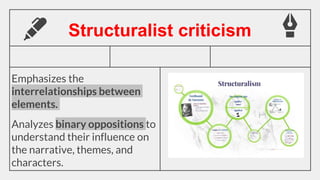
Emphasizes the
interrelationships between
elements.
Analyzes binary oppositions to
understand their influence on
the narrative, themes, and
characters.
Structuralist criticism
Explores the use of symbols and
metaphorical representations
within the text.
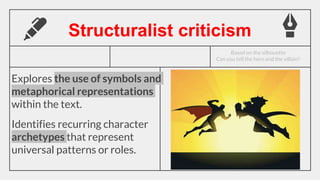
Identifies recurring character
archetypes that represent
universal patterns or roles.
Based on the silhouette
Can you tell the hero and the villain?
Structuralist criticism
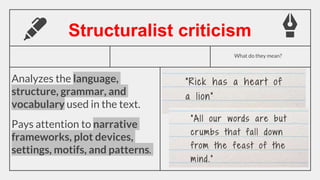
Analyzes the language,
structure, grammar, and
vocabulary used in the text.
Pays attention to narrative
frameworks, plot devices,
settings, motifs, and patterns.
What do they mean?
● The goal of structuralist literary criticism is to
uncover the hidden meanings, structural
coherence, and cultural implications of a text
by examining its underlying structures,
interrelationships between elements, and
symbolic representations.
18
Structuralist criticism
STRUCTURALIST
03
NOTABLE
PERSON
Ferdinand de Saussure
LITERARY
CRITICISM
19
20
What does an open hand
mean?
21
How about a cross inside a
circle?
22
What about this sign?
23
Three cycling arrows
Semiology
the study of signs
: the study of signs.
especially : semiotics.
(Merriam-Webster)
What we just
demonstrated is called
In 1960’s Ferdinand de
Saussre influenced his
theory through
examination of language
as a system of signs
(semiology)
Ferdinand de Saussure
● a Swiss linguist and semiotician
● Born in 1857 in Geneva,
Switzerland.
● Known as the founder of
modern linguistics and
structural linguistics.
kk
Ferdinand de Saussure
● Developed the concept of structuralism,
which analyzes language as a system of signs
and rules.
● Introduced the distinction between langue
(the underlying structure of a language) and
parole (actual instances of language use).
kk
Ferdinand de Saussure
● Emphasized the role of signs and
signifiers in understanding language and
meaning.
● Contributed to the development of
semiotics, the study of signs and
symbols.
kk
Ferdinand de Saussure
● His theories had a significant impact on
fields beyond linguistics, including
literary theory, anthropology, and
philosophy.
● Considered one of the most important
figures in 20th-century linguistics and
structuralist thought.
kk
LETS
EXPAND
Structuralist Approach
04
6 KEY CONCEPTS
AND PRINCIPLES OF
STRUCTURALIST
LITERARY
CRITICISM INCLUDE:
31
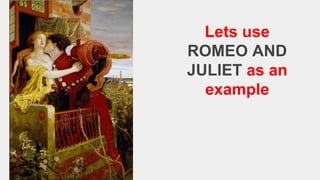
Lets use
ROMEO AND
JULIET as an
example
1. Binary Oppositions:
Structuralists analyze the
presence of binary oppositions, to
understand how these opposing
forces shape the narrative,
themes, and characters in a work.
Ex. such as
good/evil,
male/female,
nature/culture,
etc.
33
1. Binary Oppositions:
• love/hate (the passionate love between Romeo and Juliet and the
ongoing feud between their families),
• fate/free will (the predetermined tragic outcome vs. the characters'
choices).
34
2. Narrative Structure
Structuralists examine the
organization and progression of a
narrative. They analyze how these
structural elements contribute to
the overall meaning and impact of
the work.
Ex. focusing on elements
such as exposition,
rising action, climax,
falling action, and
resolution
35
2. Narrative Structure
• The play follows a five-act structure
• exposition introduces the feud between the Montagues and
Capulets and the initial encounter between Romeo and Juliet.
• The rising action develops as their love blossoms and faces
challenges.
• The climax occurs with the deaths of Mercutio and Tybalt,
• the resolution, Romeo and Juliet tragically take their own lives.
36
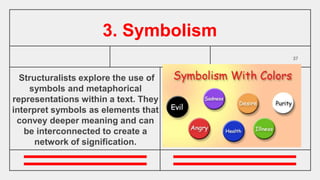
3. Symbolism
Structuralists explore the use of
symbols and metaphorical
representations within a text. They
interpret symbols as elements that
convey deeper meaning and can
be interconnected to create a
network of signification.
37
3. Symbolism
The balcony scene symbolizes
the forbidden and clandestine
nature of Romeo and Juliet's
love.
38
4. Character Archetypes
Structuralists identify recurring
character types or archetypes that
represent universal patterns or
roles. The analysis of character
archetypes helps to reveal broader
cultural and symbolic significance.
Ex. the hero, the villain,
the trickster, the mentor,
etc.
39
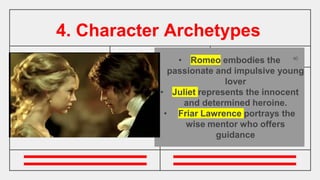
4. Character Archetypes
• Romeo embodies the
passionate and impulsive young
lover
• Juliet represents the innocent
and determined heroine.
• Friar Lawrence portrays the
wise mentor who offers
guidance
40
5. Language and Textual
Analysis
Structuralists closely examine the
language used in a text, analyzing
its structure, grammar, and
vocabulary. They explore linguistic
devices to uncover hidden
meanings and interpret the text
within a broader cultural context.
Ex. metaphors,
repetitions, and allusions
41
5. Language and Textual
Analysis
Shakespeare's use of poetic language, metaphors, and sonnets
enhances the emotional intensity and lyrical beauty of the play.
The dialogue between characters, such as Romeo and Juliet's
famous declarations of love, contribute to the play's enduring
popularity.
42
5. Language and Textual Analysis
43
“Love is a smoke made
with the fume of sighs.
Being purged, a fire
sparkling in lovers’ eyes;
Being vex’d a sea
nourish’d with lovers’
tears.”
5. Language and Textual Analysis
44
BAKIT MALUNGKOT
ANG BESHY KO?
BEH ARAT TANAN!!
6. Structural Elements
Structuralist criticism pays
attention to various structural
elements, The analysis of these
elements helps to understand how
the text is organized and how
meaning is conveyed.
Ex. narrative
frameworks, plot
devices, settings, motifs,
themes, cultural
implications and
patterns.
45
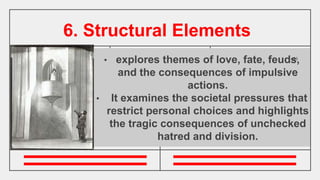
6. Structural Elements
• explores themes of love, fate, feuds,
and the consequences of impulsive
actions.
• It examines the societal pressures that
restrict personal choices and highlights
the tragic consequences of unchecked
hatred and division.
46
Monday, 2021
ASSESSMENT
05
JUPITER 47
Let’s use Cinderella
48
GIVE OPPOSITES
1. Binary
Oppositions
MARS 49
• Cinderella's oppressed state
vs. the world of possibilities
represented by the ball.
• Cinderella's kindness and
goodness vs. the wickedness
of her stepmother and
stepsisters.
• The fairy godmother's magic
and enchantment vs. the
limitations of Cinderella's
ordinary life.
EXPOSITION, RISING ACTION,
CLIMAX, FALLING ACTION,
RESOLUTION
2. Narrative
Structure
MARS 50
• The climax occurs during the
royal ball when Cinderella
captures the attention of the
prince.
• The falling action includes
Cinderella's hasty retreat from
the ball and the search for the
owner of the glass slipper.
• The resolution arrives when
Cinderella's true identity is
revealed, leading to her marriage
to the prince.
• The exposition introduces
Cinderella's unfortunate
circumstances and her
desire for change.
• The rising action follows
Cinderella's encounter with
the fairy godmother and the
transformation of her
appearance.
GLASS SLIPPER
FAIRY GODMOTHER
PUMPKIN TURNED CARRIAGE
3. Symbolic
Elements
MARS 51
• The glass slipper represents the
idealized, unattainable beauty
and the pursuit of true love.
• The fairy godmother symbolizes
the presence of magic and the
catalyst for Cinderella's
transformation.
• The pumpkin-turned-carriage
represents the transformative
power of the supernatural in
overcoming obstacles.
HERO VS VILLAIN
4. Character
Archetypes:
MARS 52
• Cinderella embodies the
archetypal figure of the
oppressed and virtuous
heroine, symbolizing
perseverance and eventual
triumph.
• The stepmother and
stepsisters serve as the
archetypal wicked figures,
representing jealousy,
cruelty, and societal
pressures.
What Genre is it?
5. Language and
Style
MARS 53
• The language in "Cinderella"
often contrasts Cinderella's
humble speech with the more
refined and manipulative
speech of the stepmother
and stepsisters.
• The story employs a
straightforward narrative
style, emphasizing the
cause-and-effect relationship
of events.
What is the theme?
What is the lesson?
What does the story imply to the time?
6. Structural
Elements
MARS 54
• "Cinderella" explores
themes of transformation,
perseverance, and the
power of kindness and
virtue.
• It reflects cultural values
surrounding beauty
standards, social
hierarchies, and the belief
in the possibility of a better
future.
"Have courage and be
kind"
—Cinderella
CREDITS: This presentation template was created by Slidesgo, including
icons by Flaticon, and infographics & images by Freepik
THANKS!
DO YOU HAVE ANY
QUESTIONS?
MHELLY RAMOS
BSED 2A

Literary Criticism: Structuralist Approach

  • 1.
  • 2.
    CONTENT OF THISTEMPLATE Here’s what you’ll find in this Slidesgo template: 1. A slide structure based on a newsletter, which you can easily adapt to your needs. For more info on how to edit the template, please visit Slidesgo School or read our FAQs. 2. An assortment of graphic resources that are suitable for use in the presentation can be found in the alternative resources slide. 3. A thanks slide, which you must keep so that proper credits for our design are given. 4. A resources slide, where you’ll find links to all the elements used in the template. 5. Instructions for use. 6. Final slides with: ○ The fonts and colors used in the template. ○ A selection of illustrations. You can also customize and animate them as you wish with the online editor. Visit Storyset to find more. ○ More infographic resources, whose size and color can be edited. ○ Sets of customizable icons of the following themes: general, business, avatar, creative process, education, help & support, medical, nature, performing arts, SEO & marketing, and teamwork. You can delete this slide when you’re done editing the presentation.
  • 3.
    E L 11 8 : Literary Criticism TABLE OF CONTENTS WARM UP Motivation 01 INTRODUCTION 02 ASSESSMENT w/ examples 05 NOTABLE PERSON 03 ABOUT APPROACH 04 STRUCTURALIST 3
  • 4.
    STRUCTURALIST 01 WARM UP MOTIVATION E L1 1 8 : Literary Criticism 4
  • 5.
    CRITICISM the act ofmaking judgments; analysis of qualities and evaluation 5
  • 6.
  • 7.
  • 8.
    Warm up TELL MESOMETHING NICE… ● WRITE YOUR NAME ● PASS THE PAPER TO YOUR RIGHT ● 3 SEC ONLY ● S T A Y A N O N Y M O U S Motivation 8
  • 10.
    Warm up TELL MESOMETHING BAD… ● WRITE YOUR NAME ● PASS THE PAPER TO YOUR RIGHT ● 3 SEC ONLY ● S T A Y A N O N Y M O U S Motivation 10
  • 11.
  • 12.
  • 13.
    Structuralist criticism focuses onexamining the underlying structures and systems that govern meaning and communication.
  • 14.
    Structuralist criticism Focuses onthe underlying structures and patterns within a literary work.
  • 15.
    Structuralist criticism Emphasizes the interrelationshipsbetween elements. Analyzes binary oppositions to understand their influence on the narrative, themes, and characters.
  • 16.
    Structuralist criticism Explores theuse of symbols and metaphorical representations within the text. Identifies recurring character archetypes that represent universal patterns or roles. Based on the silhouette Can you tell the hero and the villain?
  • 17.
    Structuralist criticism Analyzes thelanguage, structure, grammar, and vocabulary used in the text. Pays attention to narrative frameworks, plot devices, settings, motifs, and patterns. What do they mean?
  • 18.
    ● The goalof structuralist literary criticism is to uncover the hidden meanings, structural coherence, and cultural implications of a text by examining its underlying structures, interrelationships between elements, and symbolic representations. 18 Structuralist criticism
  • 19.
  • 20.
    20 What does anopen hand mean?
  • 21.
    21 How about across inside a circle?
  • 22.
  • 23.
  • 24.
    Semiology the study ofsigns : the study of signs. especially : semiotics. (Merriam-Webster) What we just demonstrated is called
  • 25.
    In 1960’s Ferdinandde Saussre influenced his theory through examination of language as a system of signs (semiology)
  • 26.
    Ferdinand de Saussure ●a Swiss linguist and semiotician ● Born in 1857 in Geneva, Switzerland. ● Known as the founder of modern linguistics and structural linguistics. kk
  • 27.
    Ferdinand de Saussure ●Developed the concept of structuralism, which analyzes language as a system of signs and rules. ● Introduced the distinction between langue (the underlying structure of a language) and parole (actual instances of language use). kk
  • 28.
    Ferdinand de Saussure ●Emphasized the role of signs and signifiers in understanding language and meaning. ● Contributed to the development of semiotics, the study of signs and symbols. kk
  • 29.
    Ferdinand de Saussure ●His theories had a significant impact on fields beyond linguistics, including literary theory, anthropology, and philosophy. ● Considered one of the most important figures in 20th-century linguistics and structuralist thought. kk
  • 30.
  • 31.
    6 KEY CONCEPTS ANDPRINCIPLES OF STRUCTURALIST LITERARY CRITICISM INCLUDE: 31
  • 32.
  • 33.
    1. Binary Oppositions: Structuralistsanalyze the presence of binary oppositions, to understand how these opposing forces shape the narrative, themes, and characters in a work. Ex. such as good/evil, male/female, nature/culture, etc. 33
  • 34.
    1. Binary Oppositions: •love/hate (the passionate love between Romeo and Juliet and the ongoing feud between their families), • fate/free will (the predetermined tragic outcome vs. the characters' choices). 34
  • 35.
    2. Narrative Structure Structuralistsexamine the organization and progression of a narrative. They analyze how these structural elements contribute to the overall meaning and impact of the work. Ex. focusing on elements such as exposition, rising action, climax, falling action, and resolution 35
  • 36.
    2. Narrative Structure •The play follows a five-act structure • exposition introduces the feud between the Montagues and Capulets and the initial encounter between Romeo and Juliet. • The rising action develops as their love blossoms and faces challenges. • The climax occurs with the deaths of Mercutio and Tybalt, • the resolution, Romeo and Juliet tragically take their own lives. 36
  • 37.
    3. Symbolism Structuralists explorethe use of symbols and metaphorical representations within a text. They interpret symbols as elements that convey deeper meaning and can be interconnected to create a network of signification. 37
  • 38.
    3. Symbolism The balconyscene symbolizes the forbidden and clandestine nature of Romeo and Juliet's love. 38
  • 39.
    4. Character Archetypes Structuralistsidentify recurring character types or archetypes that represent universal patterns or roles. The analysis of character archetypes helps to reveal broader cultural and symbolic significance. Ex. the hero, the villain, the trickster, the mentor, etc. 39
  • 40.
    4. Character Archetypes •Romeo embodies the passionate and impulsive young lover • Juliet represents the innocent and determined heroine. • Friar Lawrence portrays the wise mentor who offers guidance 40
  • 41.
    5. Language andTextual Analysis Structuralists closely examine the language used in a text, analyzing its structure, grammar, and vocabulary. They explore linguistic devices to uncover hidden meanings and interpret the text within a broader cultural context. Ex. metaphors, repetitions, and allusions 41
  • 42.
    5. Language andTextual Analysis Shakespeare's use of poetic language, metaphors, and sonnets enhances the emotional intensity and lyrical beauty of the play. The dialogue between characters, such as Romeo and Juliet's famous declarations of love, contribute to the play's enduring popularity. 42
  • 43.
    5. Language andTextual Analysis 43 “Love is a smoke made with the fume of sighs. Being purged, a fire sparkling in lovers’ eyes; Being vex’d a sea nourish’d with lovers’ tears.”
  • 44.
    5. Language andTextual Analysis 44 BAKIT MALUNGKOT ANG BESHY KO? BEH ARAT TANAN!!
  • 45.
    6. Structural Elements Structuralistcriticism pays attention to various structural elements, The analysis of these elements helps to understand how the text is organized and how meaning is conveyed. Ex. narrative frameworks, plot devices, settings, motifs, themes, cultural implications and patterns. 45
  • 46.
    6. Structural Elements •explores themes of love, fate, feuds, and the consequences of impulsive actions. • It examines the societal pressures that restrict personal choices and highlights the tragic consequences of unchecked hatred and division. 46
  • 47.
  • 48.
  • 49.
    GIVE OPPOSITES 1. Binary Oppositions MARS49 • Cinderella's oppressed state vs. the world of possibilities represented by the ball. • Cinderella's kindness and goodness vs. the wickedness of her stepmother and stepsisters. • The fairy godmother's magic and enchantment vs. the limitations of Cinderella's ordinary life.
  • 50.
    EXPOSITION, RISING ACTION, CLIMAX,FALLING ACTION, RESOLUTION 2. Narrative Structure MARS 50 • The climax occurs during the royal ball when Cinderella captures the attention of the prince. • The falling action includes Cinderella's hasty retreat from the ball and the search for the owner of the glass slipper. • The resolution arrives when Cinderella's true identity is revealed, leading to her marriage to the prince. • The exposition introduces Cinderella's unfortunate circumstances and her desire for change. • The rising action follows Cinderella's encounter with the fairy godmother and the transformation of her appearance.
  • 51.
    GLASS SLIPPER FAIRY GODMOTHER PUMPKINTURNED CARRIAGE 3. Symbolic Elements MARS 51 • The glass slipper represents the idealized, unattainable beauty and the pursuit of true love. • The fairy godmother symbolizes the presence of magic and the catalyst for Cinderella's transformation. • The pumpkin-turned-carriage represents the transformative power of the supernatural in overcoming obstacles.
  • 52.
    HERO VS VILLAIN 4.Character Archetypes: MARS 52 • Cinderella embodies the archetypal figure of the oppressed and virtuous heroine, symbolizing perseverance and eventual triumph. • The stepmother and stepsisters serve as the archetypal wicked figures, representing jealousy, cruelty, and societal pressures.
  • 53.
    What Genre isit? 5. Language and Style MARS 53 • The language in "Cinderella" often contrasts Cinderella's humble speech with the more refined and manipulative speech of the stepmother and stepsisters. • The story employs a straightforward narrative style, emphasizing the cause-and-effect relationship of events.
  • 54.
    What is thetheme? What is the lesson? What does the story imply to the time? 6. Structural Elements MARS 54 • "Cinderella" explores themes of transformation, perseverance, and the power of kindness and virtue. • It reflects cultural values surrounding beauty standards, social hierarchies, and the belief in the possibility of a better future.
  • 55.
    "Have courage andbe kind" —Cinderella
  • 56.
    CREDITS: This presentationtemplate was created by Slidesgo, including icons by Flaticon, and infographics & images by Freepik THANKS! DO YOU HAVE ANY QUESTIONS? MHELLY RAMOS BSED 2A