Literary Genres
What is a Literary Genre?
A “genre” is
a particular
style or
type of
writing.
Most Common Genres:
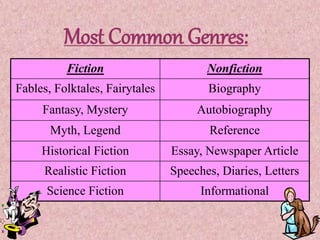
Fiction Nonfiction
Fables, Folktales, Fairytales Biography
Fantasy, Mystery Autobiography
Myth, Legend Reference
Historical Fiction Essay, Newspaper Article
Realistic Fiction Speeches, Diaries, Letters
Science Fiction Informational
Fiction
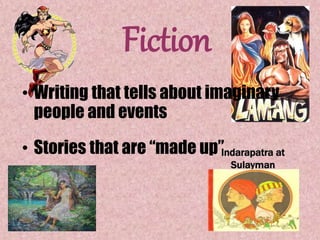
• Writing that tells about imaginary
people and events
• Stories that are “made up”
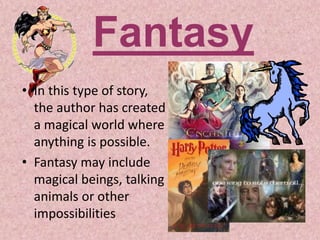
Fantasy
• In this type of story,
the author has created
a magical world where
anything is possible.
• Fantasy may include
magical beings, talking
animals or other
impossibilities
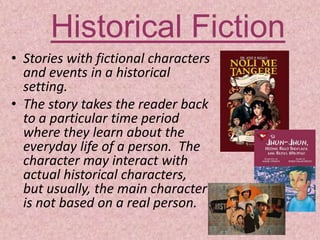
Historical Fiction
• Stories with fictional characters
and events in a historical
setting.
• The story takes the reader back
to a particular time period
where they learn about the
everyday life of a person. The
character may interact with
actual historical characters,
but usually, the main character
is not based on a real person.
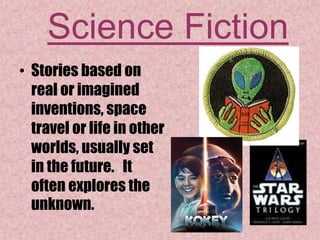
Science Fiction
• Stories based on
real or imagined
inventions, space
travel or life in other
worlds, usually set
in the future. It
often explores the
unknown.
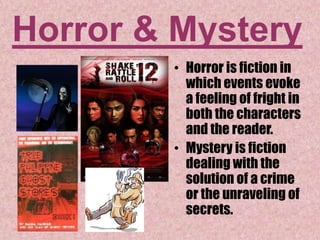
Horror & Mystery
• Horror is fiction in
which events evoke
a feeling of fright in
both the characters
and the reader.
• Mystery is fiction
dealing with the
solution of a crime
or the unraveling of
secrets.
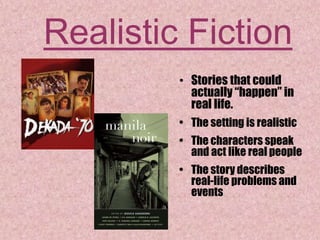
Realistic Fiction
• Stories that could
actually “happen” in
real life.
• The setting is realistic
• The characters speak
and act like real people
• The story describes
real-life problems and
events
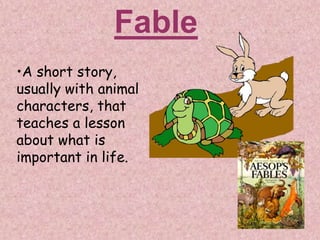
•A short story,
usually with animal
characters, that
teaches a lesson
about what is
important in life.
Fable
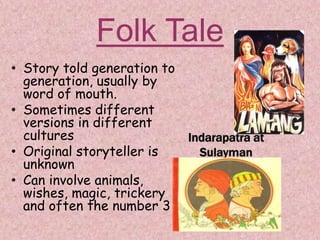
Folk Tale
• Story told generation to
generation, usually by
word of mouth.
• Sometimes different
versions in different
cultures
• Original storyteller is
unknown
• Can involve animals,
wishes, magic, trickery
and often the number 3
Myths
• Myths are early people’s way to
explain the universe.
• Many gods and goddesses are
present in myths
• The gods, goddesses, and heroes
are super human in nature.
• Human emotions are experienced
by the gods.
• Magic is often present in myths.
• Gods sometimes appear in
disguised form
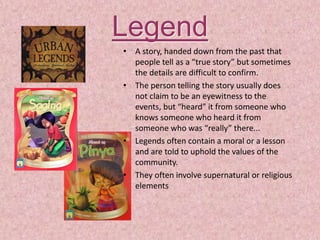
Legend
• A story, handed down from the past that
people tell as a “true story” but sometimes
the details are difficult to confirm.
• The person telling the story usually does
not claim to be an eyewitness to the
events, but “heard” it from someone who
knows someone who heard it from
someone who was “really” there...
• Legends often contain a moral or a lesson
and are told to uphold the values of the
community.
• They often involve supernatural or religious
elements
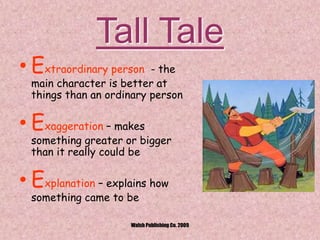
Tall Tale
• Extraordinary person - the
main character is better at
things than an ordinary person
• Exaggeration – makes
something greater or bigger
than it really could be
• Explanation – explains how
something came to be
Walsh Publishing Co. 2009
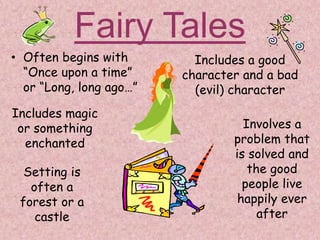
Fairy Tales
• Often begins with
“Once upon a time”
or “Long, long ago…”
Includes a good
character and a bad
(evil) character
Includes magic
or something
enchanted
Involves a
problem that
is solved and
the good
people live
happily ever
after
Setting is
often a
forest or a
castle
Non-Fiction
~ Accounts of real people, places and
events
~ Fact, NOT fiction…
(that’s why it’s called NON-Fiction.
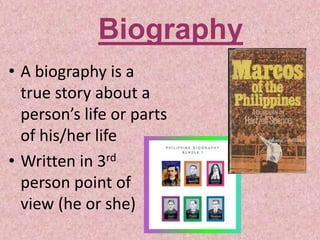
Biography
• A biography is a
true story about a
person’s life or parts
of his/her life
• Written in 3rd
person point of
view (he or she)
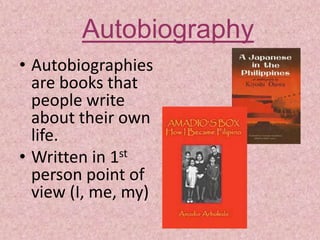
Autobiography
• Autobiographies
are books that
people write
about their own
life.
• Written in 1st
person point of
view (I, me, my)
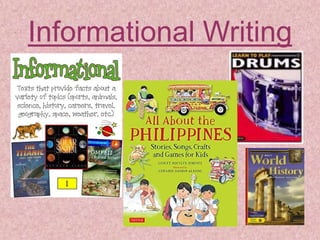
Informational Writing
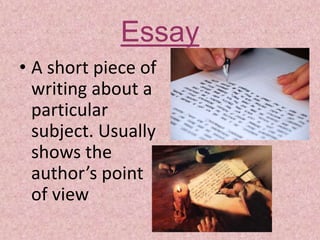
Essay
• A short piece of
writing about a
particular
subject. Usually
shows the
author’s point
of view
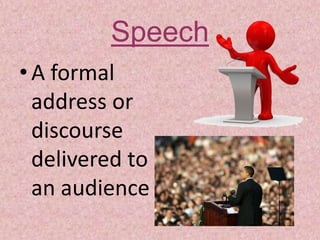
Speech
•A formal
address or
discourse
delivered to
an audience
Textbook
• A short piece of
writing about a
particular
subject. Usually
shows the
author’s point
of view
Diary
• A book in which
one keeps a
daily record of
events and
experiences
Anecdote
• a short amusing
or interesting
story about a
real incident or
person

LITERARY GENRES

  • 1.
  • 2.
    What is aLiterary Genre? A “genre” is a particular style or type of writing.
  • 3.
    Most Common Genres: FictionNonfiction Fables, Folktales, Fairytales Biography Fantasy, Mystery Autobiography Myth, Legend Reference Historical Fiction Essay, Newspaper Article Realistic Fiction Speeches, Diaries, Letters Science Fiction Informational
  • 4.
    Fiction • Writing thattells about imaginary people and events • Stories that are “made up”
  • 5.
    Fantasy • In thistype of story, the author has created a magical world where anything is possible. • Fantasy may include magical beings, talking animals or other impossibilities
  • 6.
    Historical Fiction • Storieswith fictional characters and events in a historical setting. • The story takes the reader back to a particular time period where they learn about the everyday life of a person. The character may interact with actual historical characters, but usually, the main character is not based on a real person.
  • 7.
    Science Fiction • Storiesbased on real or imagined inventions, space travel or life in other worlds, usually set in the future. It often explores the unknown.
  • 8.
    Horror & Mystery •Horror is fiction in which events evoke a feeling of fright in both the characters and the reader. • Mystery is fiction dealing with the solution of a crime or the unraveling of secrets.
  • 9.
    Realistic Fiction • Storiesthat could actually “happen” in real life. • The setting is realistic • The characters speak and act like real people • The story describes real-life problems and events
  • 10.
    •A short story, usuallywith animal characters, that teaches a lesson about what is important in life. Fable
  • 11.
    Folk Tale • Storytold generation to generation, usually by word of mouth. • Sometimes different versions in different cultures • Original storyteller is unknown • Can involve animals, wishes, magic, trickery and often the number 3
  • 12.
    Myths • Myths areearly people’s way to explain the universe. • Many gods and goddesses are present in myths • The gods, goddesses, and heroes are super human in nature. • Human emotions are experienced by the gods. • Magic is often present in myths. • Gods sometimes appear in disguised form
  • 13.
    Legend • A story,handed down from the past that people tell as a “true story” but sometimes the details are difficult to confirm. • The person telling the story usually does not claim to be an eyewitness to the events, but “heard” it from someone who knows someone who heard it from someone who was “really” there... • Legends often contain a moral or a lesson and are told to uphold the values of the community. • They often involve supernatural or religious elements
  • 14.
    Tall Tale • Extraordinaryperson - the main character is better at things than an ordinary person • Exaggeration – makes something greater or bigger than it really could be • Explanation – explains how something came to be Walsh Publishing Co. 2009
  • 15.
    Fairy Tales • Oftenbegins with “Once upon a time” or “Long, long ago…” Includes a good character and a bad (evil) character Includes magic or something enchanted Involves a problem that is solved and the good people live happily ever after Setting is often a forest or a castle
  • 16.
    Non-Fiction ~ Accounts ofreal people, places and events ~ Fact, NOT fiction… (that’s why it’s called NON-Fiction.
  • 17.
    Biography • A biographyis a true story about a person’s life or parts of his/her life • Written in 3rd person point of view (he or she)
  • 18.
    Autobiography • Autobiographies are booksthat people write about their own life. • Written in 1st person point of view (I, me, my)
  • 19.
  • 20.
    Essay • A shortpiece of writing about a particular subject. Usually shows the author’s point of view
  • 21.
  • 22.
    Textbook • A shortpiece of writing about a particular subject. Usually shows the author’s point of view
  • 23.
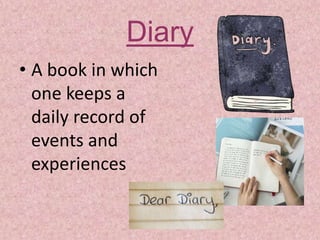
    Diary • A bookin which one keeps a daily record of events and experiences
  • 24.
    Anecdote • a shortamusing or interesting story about a real incident or person