By: Jocelyn Brooke Pruden
Introduction to Literacy-Rich Environments:
A literacy-rich environment is a setting that
stimulates all students to participate in language and
literacy activities in their daily lives thereby giving
them the understandings of the utility and function
of oral and written language (The Access
Center, 2007).
LITERACY-RICH
MATERIALS
A literacy-rich environment has
an abundance of high-quality
literacy materials. Like in the
photo, literacy-rich classrooms
have materials such as a variety
of
books, dictionaries, labels, signs, e
tc. These materials help students
with reading, writing, speaking
and listening because they
provide the resources needed to
educate students effectively.Retrieved from www.dorireads.blogspot.com
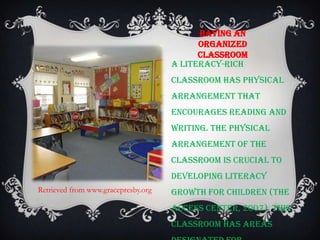
HAVING AN
ORGANIZED
CLASSROOM
A literacy-rich
classroom has physical
arrangement that
encourages reading and
writing. The physical
arrangement of the
classroom is crucial to
developing literacy
growth for children (The
Access Center, 2007). This
classroom has areas
Retrieved from www.gracepresby.org
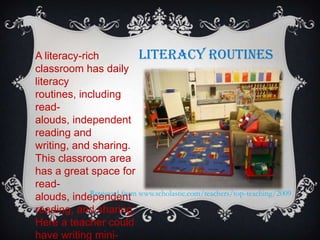
Literacy RoutinesA literacy-rich
classroom has daily
literacy
routines, including
read-
alouds, independent
reading and
writing, and sharing.
This classroom area
has a great space for
read-
alouds, independent
reading, and sharing.
Here a teacher could
have writing mini-
Retrieved from www.scholastic.com/teachers/top-teaching/2009
Classroom
Culture
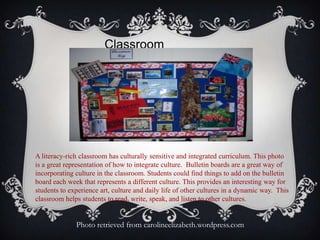
A literacy-rich classroom has culturally sensitive and integrated curriculum. This photo
is a great representation of how to integrate culture. Bulletin boards are a great way of
incorporating culture in the classroom. Students could find things to add on the bulletin
board each week that represents a different culture. This provides an interesting way for
students to experience art, culture and daily life of other cultures in a dynamic way. This
classroom helps students to read, write, speak, and listen to other cultures.
Photo retrieved from carolineelizabeth.wordpress.com
ASSESSMENT IDEAS
A literacy-rich classroom uses
assessment to guide
instruction. This photo
primarily relates to writing. A
teacher could examine the
student’s writing to see what
spelling stage the child is in, as
well as find ways to guide
further instruction for
individual students.
Photo retrieved from www.teachingblogaddict.com
THINK SMART
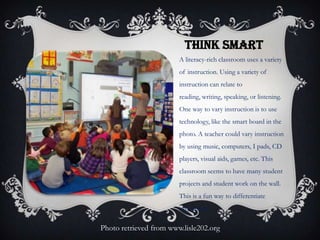
A literacy-rich classroom uses a variety
of instruction. Using a variety of
instruction can relate to
reading, writing, speaking, or listening.
One way to vary instruction is to use
technology, like the smart board in the
photo. A teacher could vary instruction
by using music, computers, I pads, CD
players, visual aids, games, etc. This
classroom seems to have many student
projects and student work on the wall.
This is a fun way to differentiate
instruction.
Photo retrieved from www.lisle202.org
GROUP WORK
A literacy-rich classroom uses
a variety of groups. You could
vary groups in
reading, writing, speaking, as
well as listening. Like in the
photo, a teacher could vary
groups by small group, whole
group, partner
work, independent
work, teacher/student
work, etc. By varying
groups, it helps students to
reflect on their own
opinions, as well as consider
ideas from their peers.
Photo retrieved from debbiediller.wordpress.com
C H AR AC TER ISTIC S OF LITER AC Y- R IC H
C LASSR OOMS
C ON C LU SION :
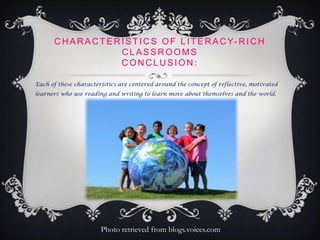
Each of these characteristics are centered around the concept of reflective, motivated
learners who use reading and writing to learn more about themselves and the world.
Photo retrieved from blogs.voices.com
SOURCES
 The Access Center, (2007). Literacy-Rich Environments. Retrieved November
10, 2012, from The Access Center website:
http://www.k8accesscenter.org/training_resources/literacyrichenvironments.asp

Literacy Rich Environments

  • 1.
    By: Jocelyn BrookePruden Introduction to Literacy-Rich Environments: A literacy-rich environment is a setting that stimulates all students to participate in language and literacy activities in their daily lives thereby giving them the understandings of the utility and function of oral and written language (The Access Center, 2007).
  • 2.
    LITERACY-RICH MATERIALS A literacy-rich environmenthas an abundance of high-quality literacy materials. Like in the photo, literacy-rich classrooms have materials such as a variety of books, dictionaries, labels, signs, e tc. These materials help students with reading, writing, speaking and listening because they provide the resources needed to educate students effectively.Retrieved from www.dorireads.blogspot.com
  • 3.
    HAVING AN ORGANIZED CLASSROOM A literacy-rich classroomhas physical arrangement that encourages reading and writing. The physical arrangement of the classroom is crucial to developing literacy growth for children (The Access Center, 2007). This classroom has areas Retrieved from www.gracepresby.org
  • 4.
    Literacy RoutinesA literacy-rich classroomhas daily literacy routines, including read- alouds, independent reading and writing, and sharing. This classroom area has a great space for read- alouds, independent reading, and sharing. Here a teacher could have writing mini- Retrieved from www.scholastic.com/teachers/top-teaching/2009
  • 5.
    Classroom Culture A literacy-rich classroomhas culturally sensitive and integrated curriculum. This photo is a great representation of how to integrate culture. Bulletin boards are a great way of incorporating culture in the classroom. Students could find things to add on the bulletin board each week that represents a different culture. This provides an interesting way for students to experience art, culture and daily life of other cultures in a dynamic way. This classroom helps students to read, write, speak, and listen to other cultures. Photo retrieved from carolineelizabeth.wordpress.com
  • 6.
    ASSESSMENT IDEAS A literacy-richclassroom uses assessment to guide instruction. This photo primarily relates to writing. A teacher could examine the student’s writing to see what spelling stage the child is in, as well as find ways to guide further instruction for individual students. Photo retrieved from www.teachingblogaddict.com
  • 7.
    THINK SMART A literacy-richclassroom uses a variety of instruction. Using a variety of instruction can relate to reading, writing, speaking, or listening. One way to vary instruction is to use technology, like the smart board in the photo. A teacher could vary instruction by using music, computers, I pads, CD players, visual aids, games, etc. This classroom seems to have many student projects and student work on the wall. This is a fun way to differentiate instruction. Photo retrieved from www.lisle202.org
  • 8.
    GROUP WORK A literacy-richclassroom uses a variety of groups. You could vary groups in reading, writing, speaking, as well as listening. Like in the photo, a teacher could vary groups by small group, whole group, partner work, independent work, teacher/student work, etc. By varying groups, it helps students to reflect on their own opinions, as well as consider ideas from their peers. Photo retrieved from debbiediller.wordpress.com
  • 9.
    C H ARAC TER ISTIC S OF LITER AC Y- R IC H C LASSR OOMS C ON C LU SION : Each of these characteristics are centered around the concept of reflective, motivated learners who use reading and writing to learn more about themselves and the world. Photo retrieved from blogs.voices.com
  • 10.
    SOURCES  The AccessCenter, (2007). Literacy-Rich Environments. Retrieved November 10, 2012, from The Access Center website: http://www.k8accesscenter.org/training_resources/literacyrichenvironments.asp