February 20, 2012

LITERACY TEAM REPORT
ASSIGNMENT MANDATED BY OPI
Make recommendations for improving literacy
  at PHS

  Based on research (rather than folklore)
QUESTIONS THE LITERACY TEAM ASKED

   1. What should be done across the
      curriculum in all academic classes?
   2. What should be done in English classes?
   3. What should be done for students
      struggling with literacy?
TWO DOMAINS: ACADEMICS AND ATTITUDES

1.   Academic Achievement: Poor readers
     (little background knowledge, minimal
     vocabulary)
         Questions: Why are some students
         getting to high school without the
         knowledge and skills to succeed?
         (diagnosis) What does research indicate
         works? (prescription)
TWO DOMAINS: ACADEMICS AND ATTITUDES
2.   Attitudes and Dispositions: Unmotivated
     (poor work ethic, poor ability to focus, lack
     of engagement, lack of diligence, unable to
     work through boredom, impatient,
     egocentric, lack of purpose)
       Questions: What habits and dispositions
       should be taught all year long in freshman
       classes?
       How can these habits and dispositions be
       supported throughout the school? MBI?
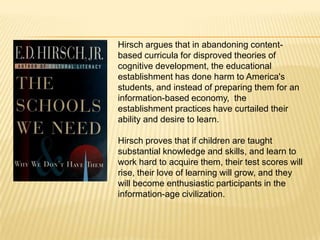
Hirsch argues that in abandoning content-
based curricula for disproved theories of
cognitive development, the educational
establishment has done harm to America's
students, and instead of preparing them for an
information-based economy, the
establishment practices have curtailed their
ability and desire to learn.

Hirsch proves that if children are taught
substantial knowledge and skills, and learn to
work hard to acquire them, their test scores will
rise, their love of learning will grow, and they
will become enthusiastic participants in the
information-age civilization.
HIRSCH’S KEY ASSERTIONS

1.   To stress critical thinking while de-
     emphasizing knowledge reduces a
     student’s capacity to think critically.


     Focus on knowledge rather than formal “skills”
HIRSCH’S KEY ASSERTIONS

2.   Giving a child constant praise to bolster self-
     esteem (or cultural pride) regardless of
     academic achievement breeds
     complacency, or skepticism, or both, and,
     ultimately, a decline in self-esteem.


     Focus on knowledge rather than vague motivations
HIRSCH’S KEY ASSERTIONS

3.   For a teacher to pay significant attention to
     each individual child in a class of twenty or
     more students means individual neglect for
     most children most of the time.


     Emphasize whole class instruction more than
     individual attention
HIRSCH’S KEY ASSERTIONS

4.   Schoolwork that has been called
     “developmentally inappropriate” has proved
     to be highly appropriate to millions of
     students the world over, while the infantile
     pablum now fed to American children is
     developmentally inappropriate (in a
     downward direction) and often bores them.

     Increase the rigor of academic coursework
The reader needs the common knowledge
        that the author of the text
        assumes the reader has.
VIDEO

   What is “cultural literacy”?

   http://www.youtube.com/watch?v=ROIujiY1uZU
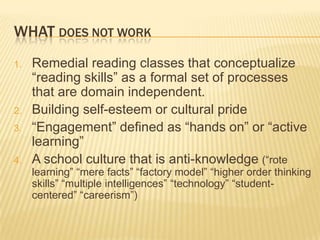
WHAT DOES NOT WORK
1.   Remedial reading classes that conceptualize
     “reading skills” as a formal set of processes
     that are domain independent.
2.   Building self-esteem or cultural pride
3.   “Engagement” defined as “hands on” or “active
     learning”
4.   A school culture that is anti-knowledge (“rote
     learning” “mere facts” “factory model” “higher order thinking
     skills” “multiple intelligences” “technology” “student-
     centered” “careerism”)
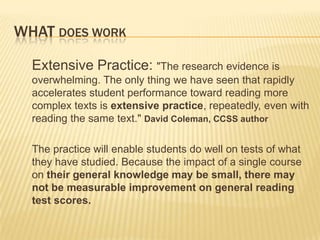
WHAT DOES WORK

  Extensive Practice: "The research evidence is
  overwhelming. The only thing we have seen that rapidly
  accelerates student performance toward reading more
  complex texts is extensive practice, repeatedly, even with
  reading the same text." David Coleman, CCSS author

  The practice will enable students do well on tests of what
  they have studied. Because the impact of a single course
  on their general knowledge may be small, there may
  not be measurable improvement on general reading
  test scores.
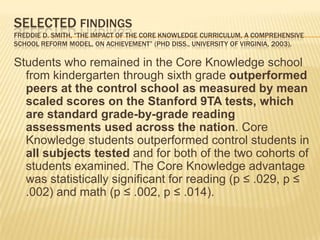
SELECTED FINDINGS
FREDDIE D. SMITH, “THE IMPACT OF THE CORE KNOWLEDGE CURRICULUM, A COMPREHENSIVE
SCHOOL REFORM MODEL, ON ACHIEVEMENT” (PHD DISS., UNIVERSITY OF VIRGINIA, 2003).

Students who remained in the Core Knowledge school
  from kindergarten through sixth grade outperformed
  peers at the control school as measured by mean
  scaled scores on the Stanford 9TA tests, which
  are standard grade-by-grade reading
  assessments used across the nation. Core
  Knowledge students outperformed control students in
  all subjects tested and for both of the two cohorts of
  students examined. The Core Knowledge advantage
  was statistically significant for reading (p ≤ .029, p ≤
  .002) and math (p ≤ .002, p ≤ .014).
Both advantaged and disadvantaged (free
 lunch) students in the Core Knowledge
 school outperformed students in the
 control school on the Stanford 9TA tests.
 Again, this was true for all three subjects and
 for both cohorts examined. The
 disadvantaged students in the Core
 Knowledge school showed statistically
 significant advantages in reading (p ≤ .017 for
 one cohort and p ≤ .030 for the other). Core
 Knowledge thus promoted fairness in
 schooling by providing educational
 opportunity to disadvantaged as well as
 advantaged students.
Core Knowledge helped narrow the
 achievement gap on the Stanford 9TA test
 between advantaged and disadvantaged
 students. The achievement gap, as
 measured by the Stanford 9TA
 tests, was narrowed for one Core
 Knowledge cohort and eliminated for
 the other. The achievement gap between
 advantaged and disadvantaged students
 remained large for both cohorts at the
 control school.
Core Knowledge helped students achieve
 much larger gains on the Stanford 9TA tests
 over two-year periods, from fourth to sixth
 grades. Both advantaged and disadvantaged
 students made larger gains than their peers
 in the control school in all of the twelve cases
 evaluated. Among disadvantaged
 students, the edge to Core Knowledge
 was deemed highly significant in all three
 subjects (p ≤ .001, p ≤ .001 for reading; p ≤
 .001, p ≤ .001 for math; p ≤ .001, p ≤ .002 for
 language).
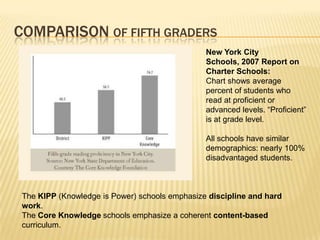
COMPARISON OF FIFTH GRADERS
                                                New York City
                                                Schools, 2007 Report on
                                                Charter Schools:
                                                Chart shows average
                                                percent of students who
                                                read at proficient or
                                                advanced levels. “Proficient”
                                                is at grade level.

                                                All schools have similar
                                                demographics: nearly 100%
                                                disadvantaged students.


 The KIPP (Knowledge is Power) schools emphasize discipline and hard
 work.
 The Core Knowledge schools emphasize a coherent content-based
 curriculum.
VIDEO

   Nathan Glazer interviewed by Education
    Next

   http://www.youtube.com/watch?v=-GdjTIVIgh4
THE “MATTHEW EFFECT”

   “For whosoever hath, to him shall he given,
    and he shall have more abundance: but
    whosoever hath not, from him shall he taken
    away even that he hath.”
MATTHEW EFFECT: VOCABULARY

1.   Need to know 90% of words in text to make
     sense of it
2.   Kids who know the 90% are able to figure
     out the other 10%
3.   Kids who don’t, don’t. They fall even further
     behind
4.   The verbal gap gets wider as they move
     through school
THIRD GRADE READING PASSAGE
 Farmers in ancient Egypt thought of the year as
 having three seasons: flood time, seeding, and
 harvest. Each year the Nile River would flood. This
 was good news for farmers because Egypt is mostly
 desert, and not enough rain falls to grow crops. The
 annual flood would last for a few weeks, and then the
 water level would drop, leaving a layer of fertile, black
 mud. This mud fertilized tle soil, and the flood water
 was stored in a series of canals. A special
 government department was in charge of making
 sure the canals were kept in good repair.
NEEDED BACKGROUND KNOWLEDGE

1.   Egypt was a country in ancient times
2.   The year has seasons
3.   Farming depends on planting seeds in moist
     soil
4.   Plants need nutrients and water to grow
5.   “desert” “Nile” “basic farming”
THE PROBLEM IS NOT ETHNICITY OR POVERTY

 The problem is diversity of preparation.
 The problem is background knowledge.
VERBAL SKILL INVOLVES KNOWLEDGE OF THINGS

 Improving reading proficiency often fails
 because of the mistaken assumption
 that reading is a skill like typing
 and that when you learn the technique
 you can read any text
MANY LANGUAGE PROGRAMS

 Practice abstract strategies on an incoherent
  array of uninformative fictions.
 The opportunity costs have been
  enormous.
 Schools waste hours practicing drills,
  depriving students of knowledge that
  could enhance reading comprehension.
NEW YORK STATE: FOURTH GRADE READING TEST

There is a path that starts in Maine and ends in
  Georgia, 2,167 miles later. This path is called
  the Appalachian Trail. If you want, you can walk
  the whole way, although only some people who
  try to do this actually make it, because it is so
  far, and they get tired. The idea for the trail
  came from a man named Benton Mac-Kaye. In
  1921 he wrote an article about how people
  needed a nearby place where they could enjoy
  nature and take a break from work. He thought
  the Appalachian Mountains would be perfect
  for this.
FIRST QUESTION, DEALS WITH MAIN IDEA:

This article is mostly about
1. how the Appalachian Trail came to exist.

2. when people can visit the Appalachian Trail.

3. who hikes the most on the Appalachian
   Trail.
4. why people work together on the
   Appalachian Trail.
WHAT IF YOU ARE A FOURTH GRADER

 Who knows nothing about hiking?
 Doesn’t know the Appalachians from the
  Himalayans?
 Doesn’t know where Maine and Georgia are?

 Can’t grasp what “to enjoy nature” means?
RESEARCH FOUNDATIONS ARE WEAK

•   For claims that scores on such tasks are
    improved by practicing strategies such as
    questioning the author or finding the main
    idea
•   Subject matter knowledge decisively trumps
    formal skill in reading
•   Proficiency at one reading comprehension
    task does not predict success in another
READING COMPREHENSION IS DOMAIN SPECIFIC

 Teaching students to read Shakespeare
 will be unlikely to make them better at
 reading geography texts or science texts

 CCSS assigns responsibility for teaching literacy
 to all academic teachers. Students are to
 improve reading and writing science in science
 class and reading and writing history in history
 class.
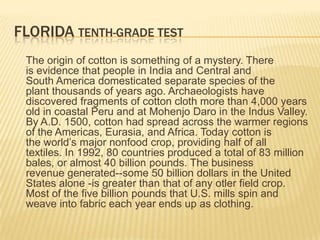
FLORIDA TENTH-GRADE TEST
 The origin of cotton is something of a mystery. There
 is evidence that people in India and Central and
 South America domesticated separate species of the
 plant thousands of years ago. Archaeologists have
 discovered fragments of cotton cloth more than 4,000 years
 old in coastal Peru and at Mohenjo Daro in the Indus Valley.
 By A.D. 1500, cotton had spread across the warmer regions
 of the Americas, Eurasia, and Africa. Today cotton is
 the world’s major nonfood crop, providing half of all
 textiles. In 1992, 80 countries produced a total of 83 million
 bales, or almost 40 billion pounds. The business
 revenue generated--some 50 billion dollars in the United
 States alone -is greater than that of any otler field crop.
 Most of the five billion pounds that U.S. mills spin and
 weave into fabric each year ends up as clothing.
A READING TEST IS A KNOWLEDGE TEST

1.   Apart from “what is cotton?” or “what is a
     bale?” it helps to understand the
     domestication of plant species.
2.   Success requires familiarity with the subject
     the test covers.
3.   The fundamental “gap” between kids is a
     knowledge gap
A manifold, contained in an intuition which I call
  mine, is represented, by means of the
  synthesis of understanding, as belonging to
  the necessary unity of self-
  consciousness, and this is effected by means
  of the category. This requirement of a
  category therefore shows that the empirical
  consciousness of a given manifold in a single
  intuition is subject to a pure self-
  consciousness a priori, just as is empirical
  intuition to a pure sensible intuition, which
  likewise takes place a priori.
            From Immanuel Kant (Critique of Pure Reason)
The main idea of this passage is
1.   Without a manifold, one cannot call an intuition
     “mine.”
2.   Intuition must precede understanding
3.   Intuition must occur through a category
4.   Self-consciousness is necessary to
     understanding
      Typical “reading strategies” struggling readers are
      compelled to practice:
      1. Try to find the main idea
      2. Try to summarize the main idea
      3. Try to clarify the main idea
      4. Try to “question the author”—What is Kant trying
         to get at here?
LITERACY TEAM RECOMMENDATIONS (DRAFT)
1.   Establish district-wide conversation regarding
     curriculum
2.   Recognize that student time and professional staff
     time are the limiting resources
3.   Do not assume literacy teaching can be done
     effectively without adequate prep time
4.   Eliminate remedial reading classes
5.   Use professional staff to teach core content
     classes
6.   Provide literacy labs (with their English teacher) at
     school for students who do not succeed with
     homework
CCSS (ADOPTED BY MONTANA)
(COMMON CORE STATE STANDARDS)

1.   Literacy Standards included in Social
     Studies and in Science
2.   70% of student reading is to be done in
     informational texts
3.   English teachers will still teach
     fiction, drama, poetry, and other literature.
     Most of the informational reading is to be
     done in other classes. More frequent
     tests (online) in more subject areas
VIDEO 24 MINUTES

   Davd Coleman Literacy Discussion

   http://neric.welearntube.org/?q=node/147

Polson High School Literacy Project Report

  • 1.
  • 2.
    ASSIGNMENT MANDATED BYOPI Make recommendations for improving literacy at PHS Based on research (rather than folklore)
  • 3.
    QUESTIONS THE LITERACYTEAM ASKED 1. What should be done across the curriculum in all academic classes? 2. What should be done in English classes? 3. What should be done for students struggling with literacy?
  • 4.
    TWO DOMAINS: ACADEMICSAND ATTITUDES 1. Academic Achievement: Poor readers (little background knowledge, minimal vocabulary) Questions: Why are some students getting to high school without the knowledge and skills to succeed? (diagnosis) What does research indicate works? (prescription)
  • 5.
    TWO DOMAINS: ACADEMICSAND ATTITUDES 2. Attitudes and Dispositions: Unmotivated (poor work ethic, poor ability to focus, lack of engagement, lack of diligence, unable to work through boredom, impatient, egocentric, lack of purpose) Questions: What habits and dispositions should be taught all year long in freshman classes? How can these habits and dispositions be supported throughout the school? MBI?
  • 6.
    Hirsch argues thatin abandoning content- based curricula for disproved theories of cognitive development, the educational establishment has done harm to America's students, and instead of preparing them for an information-based economy, the establishment practices have curtailed their ability and desire to learn. Hirsch proves that if children are taught substantial knowledge and skills, and learn to work hard to acquire them, their test scores will rise, their love of learning will grow, and they will become enthusiastic participants in the information-age civilization.
  • 7.
    HIRSCH’S KEY ASSERTIONS 1. To stress critical thinking while de- emphasizing knowledge reduces a student’s capacity to think critically. Focus on knowledge rather than formal “skills”
  • 8.
    HIRSCH’S KEY ASSERTIONS 2. Giving a child constant praise to bolster self- esteem (or cultural pride) regardless of academic achievement breeds complacency, or skepticism, or both, and, ultimately, a decline in self-esteem. Focus on knowledge rather than vague motivations
  • 9.
    HIRSCH’S KEY ASSERTIONS 3. For a teacher to pay significant attention to each individual child in a class of twenty or more students means individual neglect for most children most of the time. Emphasize whole class instruction more than individual attention
  • 10.
    HIRSCH’S KEY ASSERTIONS 4. Schoolwork that has been called “developmentally inappropriate” has proved to be highly appropriate to millions of students the world over, while the infantile pablum now fed to American children is developmentally inappropriate (in a downward direction) and often bores them. Increase the rigor of academic coursework
  • 12.
    The reader needsthe common knowledge that the author of the text assumes the reader has.
  • 13.
    VIDEO  What is “cultural literacy”?  http://www.youtube.com/watch?v=ROIujiY1uZU
  • 14.
    WHAT DOES NOTWORK 1. Remedial reading classes that conceptualize “reading skills” as a formal set of processes that are domain independent. 2. Building self-esteem or cultural pride 3. “Engagement” defined as “hands on” or “active learning” 4. A school culture that is anti-knowledge (“rote learning” “mere facts” “factory model” “higher order thinking skills” “multiple intelligences” “technology” “student- centered” “careerism”)
  • 15.
    WHAT DOES WORK Extensive Practice: "The research evidence is overwhelming. The only thing we have seen that rapidly accelerates student performance toward reading more complex texts is extensive practice, repeatedly, even with reading the same text." David Coleman, CCSS author The practice will enable students do well on tests of what they have studied. Because the impact of a single course on their general knowledge may be small, there may not be measurable improvement on general reading test scores.
  • 16.
    SELECTED FINDINGS FREDDIE D.SMITH, “THE IMPACT OF THE CORE KNOWLEDGE CURRICULUM, A COMPREHENSIVE SCHOOL REFORM MODEL, ON ACHIEVEMENT” (PHD DISS., UNIVERSITY OF VIRGINIA, 2003). Students who remained in the Core Knowledge school from kindergarten through sixth grade outperformed peers at the control school as measured by mean scaled scores on the Stanford 9TA tests, which are standard grade-by-grade reading assessments used across the nation. Core Knowledge students outperformed control students in all subjects tested and for both of the two cohorts of students examined. The Core Knowledge advantage was statistically significant for reading (p ≤ .029, p ≤ .002) and math (p ≤ .002, p ≤ .014).
  • 17.
    Both advantaged anddisadvantaged (free lunch) students in the Core Knowledge school outperformed students in the control school on the Stanford 9TA tests. Again, this was true for all three subjects and for both cohorts examined. The disadvantaged students in the Core Knowledge school showed statistically significant advantages in reading (p ≤ .017 for one cohort and p ≤ .030 for the other). Core Knowledge thus promoted fairness in schooling by providing educational opportunity to disadvantaged as well as advantaged students.
  • 18.
    Core Knowledge helpednarrow the achievement gap on the Stanford 9TA test between advantaged and disadvantaged students. The achievement gap, as measured by the Stanford 9TA tests, was narrowed for one Core Knowledge cohort and eliminated for the other. The achievement gap between advantaged and disadvantaged students remained large for both cohorts at the control school.
  • 19.
    Core Knowledge helpedstudents achieve much larger gains on the Stanford 9TA tests over two-year periods, from fourth to sixth grades. Both advantaged and disadvantaged students made larger gains than their peers in the control school in all of the twelve cases evaluated. Among disadvantaged students, the edge to Core Knowledge was deemed highly significant in all three subjects (p ≤ .001, p ≤ .001 for reading; p ≤ .001, p ≤ .001 for math; p ≤ .001, p ≤ .002 for language).
  • 20.
    COMPARISON OF FIFTHGRADERS New York City Schools, 2007 Report on Charter Schools: Chart shows average percent of students who read at proficient or advanced levels. “Proficient” is at grade level. All schools have similar demographics: nearly 100% disadvantaged students. The KIPP (Knowledge is Power) schools emphasize discipline and hard work. The Core Knowledge schools emphasize a coherent content-based curriculum.
  • 21.
    VIDEO  Nathan Glazer interviewed by Education Next  http://www.youtube.com/watch?v=-GdjTIVIgh4
  • 22.
    THE “MATTHEW EFFECT”  “For whosoever hath, to him shall he given, and he shall have more abundance: but whosoever hath not, from him shall he taken away even that he hath.”
  • 23.
    MATTHEW EFFECT: VOCABULARY 1. Need to know 90% of words in text to make sense of it 2. Kids who know the 90% are able to figure out the other 10% 3. Kids who don’t, don’t. They fall even further behind 4. The verbal gap gets wider as they move through school
  • 24.
    THIRD GRADE READINGPASSAGE Farmers in ancient Egypt thought of the year as having three seasons: flood time, seeding, and harvest. Each year the Nile River would flood. This was good news for farmers because Egypt is mostly desert, and not enough rain falls to grow crops. The annual flood would last for a few weeks, and then the water level would drop, leaving a layer of fertile, black mud. This mud fertilized tle soil, and the flood water was stored in a series of canals. A special government department was in charge of making sure the canals were kept in good repair.
  • 25.
    NEEDED BACKGROUND KNOWLEDGE 1. Egypt was a country in ancient times 2. The year has seasons 3. Farming depends on planting seeds in moist soil 4. Plants need nutrients and water to grow 5. “desert” “Nile” “basic farming”
  • 26.
    THE PROBLEM ISNOT ETHNICITY OR POVERTY  The problem is diversity of preparation.  The problem is background knowledge.
  • 27.
    VERBAL SKILL INVOLVESKNOWLEDGE OF THINGS Improving reading proficiency often fails because of the mistaken assumption that reading is a skill like typing and that when you learn the technique you can read any text
  • 28.
    MANY LANGUAGE PROGRAMS Practice abstract strategies on an incoherent array of uninformative fictions.  The opportunity costs have been enormous.  Schools waste hours practicing drills, depriving students of knowledge that could enhance reading comprehension.
  • 29.
    NEW YORK STATE:FOURTH GRADE READING TEST There is a path that starts in Maine and ends in Georgia, 2,167 miles later. This path is called the Appalachian Trail. If you want, you can walk the whole way, although only some people who try to do this actually make it, because it is so far, and they get tired. The idea for the trail came from a man named Benton Mac-Kaye. In 1921 he wrote an article about how people needed a nearby place where they could enjoy nature and take a break from work. He thought the Appalachian Mountains would be perfect for this.
  • 30.
    FIRST QUESTION, DEALSWITH MAIN IDEA: This article is mostly about 1. how the Appalachian Trail came to exist. 2. when people can visit the Appalachian Trail. 3. who hikes the most on the Appalachian Trail. 4. why people work together on the Appalachian Trail.
  • 31.
    WHAT IF YOUARE A FOURTH GRADER  Who knows nothing about hiking?  Doesn’t know the Appalachians from the Himalayans?  Doesn’t know where Maine and Georgia are?  Can’t grasp what “to enjoy nature” means?
  • 32.
    RESEARCH FOUNDATIONS AREWEAK • For claims that scores on such tasks are improved by practicing strategies such as questioning the author or finding the main idea • Subject matter knowledge decisively trumps formal skill in reading • Proficiency at one reading comprehension task does not predict success in another
  • 33.
    READING COMPREHENSION ISDOMAIN SPECIFIC Teaching students to read Shakespeare will be unlikely to make them better at reading geography texts or science texts CCSS assigns responsibility for teaching literacy to all academic teachers. Students are to improve reading and writing science in science class and reading and writing history in history class.
  • 34.
    FLORIDA TENTH-GRADE TEST The origin of cotton is something of a mystery. There is evidence that people in India and Central and South America domesticated separate species of the plant thousands of years ago. Archaeologists have discovered fragments of cotton cloth more than 4,000 years old in coastal Peru and at Mohenjo Daro in the Indus Valley. By A.D. 1500, cotton had spread across the warmer regions of the Americas, Eurasia, and Africa. Today cotton is the world’s major nonfood crop, providing half of all textiles. In 1992, 80 countries produced a total of 83 million bales, or almost 40 billion pounds. The business revenue generated--some 50 billion dollars in the United States alone -is greater than that of any otler field crop. Most of the five billion pounds that U.S. mills spin and weave into fabric each year ends up as clothing.
  • 35.
    A READING TESTIS A KNOWLEDGE TEST 1. Apart from “what is cotton?” or “what is a bale?” it helps to understand the domestication of plant species. 2. Success requires familiarity with the subject the test covers. 3. The fundamental “gap” between kids is a knowledge gap
  • 36.
    A manifold, containedin an intuition which I call mine, is represented, by means of the synthesis of understanding, as belonging to the necessary unity of self- consciousness, and this is effected by means of the category. This requirement of a category therefore shows that the empirical consciousness of a given manifold in a single intuition is subject to a pure self- consciousness a priori, just as is empirical intuition to a pure sensible intuition, which likewise takes place a priori. From Immanuel Kant (Critique of Pure Reason)
  • 37.
    The main ideaof this passage is 1. Without a manifold, one cannot call an intuition “mine.” 2. Intuition must precede understanding 3. Intuition must occur through a category 4. Self-consciousness is necessary to understanding Typical “reading strategies” struggling readers are compelled to practice: 1. Try to find the main idea 2. Try to summarize the main idea 3. Try to clarify the main idea 4. Try to “question the author”—What is Kant trying to get at here?
  • 38.
    LITERACY TEAM RECOMMENDATIONS(DRAFT) 1. Establish district-wide conversation regarding curriculum 2. Recognize that student time and professional staff time are the limiting resources 3. Do not assume literacy teaching can be done effectively without adequate prep time 4. Eliminate remedial reading classes 5. Use professional staff to teach core content classes 6. Provide literacy labs (with their English teacher) at school for students who do not succeed with homework
  • 39.
    CCSS (ADOPTED BYMONTANA) (COMMON CORE STATE STANDARDS) 1. Literacy Standards included in Social Studies and in Science 2. 70% of student reading is to be done in informational texts 3. English teachers will still teach fiction, drama, poetry, and other literature. Most of the informational reading is to be done in other classes. More frequent tests (online) in more subject areas
  • 40.
    VIDEO 24 MINUTES  Davd Coleman Literacy Discussion  http://neric.welearntube.org/?q=node/147