GETTING STARTED
World History, 9
St. Anne’s-Belfield
2013-2014

Thursday, October 17, 13
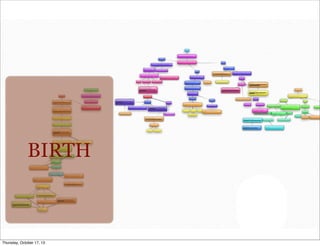
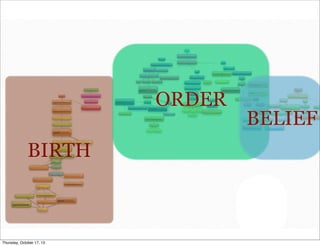
BIRTH

Thursday, October 17, 13
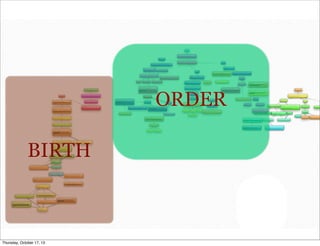
ORDER
BIRTH

Thursday, October 17, 13
ORDER
BIRTH

Thursday, October 17, 13

BELIEF
Thursday, October 17, 13
TAKING NOTES FROM A
TEXTBOOK
World History 9
St. Anne’s-Belfield

Thursday, October 17, 13
NO MAGIC FORMULA

Thursday, October 17, 13
NO MAGIC FORMULA
• Note-taking from a text is the art of recording ALL OF THE
ESSENTIAL information as QUICKLY and
ORGANIZED as possible

Thursday, October 17, 13
NO MAGIC FORMULA
• Note-taking from a text is the art of recording ALL OF THE
ESSENTIAL information as QUICKLY and
ORGANIZED as possible
1. You must also learn what the instructor is going to
ask about

Thursday, October 17, 13
NO MAGIC FORMULA
• Note-taking from a text is the art of recording ALL OF THE
ESSENTIAL information as QUICKLY and
ORGANIZED as possible
1. You must also learn what the instructor is going to
ask about
2. You must learn to discriminate between what is important
and what is not

Thursday, October 17, 13
NO MAGIC FORMULA
• Note-taking from a text is the art of recording ALL OF THE
ESSENTIAL information as QUICKLY and
ORGANIZED as possible
1. You must also learn what the instructor is going to
ask about
2. You must learn to discriminate between what is important
and what is not
3. You must learn how to record information in an
efficient, organized manner

Thursday, October 17, 13
NO MAGIC FORMULA
These skills come with time and PRACTICE, and
there is no magic formula

• Note-taking from a text is the art of recording ALL OF THE
ESSENTIAL information as QUICKLY and
ORGANIZED as possible
1. You must also learn what the instructor is going to
ask about
2. You must learn to discriminate between what is important
and what is not
3. You must learn how to record information in an
efficient, organized manner

Thursday, October 17, 13
STEP 1. FOCUS

Thursday, October 17, 13
STEP 1. FOCUS
•

Note-taking is an active, NOT passive activity
• The key to effective note-taking is reading carefully so that
you may...

Thursday, October 17, 13
STEP 1. FOCUS
•

Note-taking is an active, NOT passive activity
• The key to effective note-taking is reading carefully so that
you may...
1. filter OUT irrelevant information and
2. paraphrase- this requires concentration.
3. utilize short hand

Thursday, October 17, 13
STEP 1. FOCUS
QUIET THE VOICES IN YOUR HEAD!!!!
•

Note-taking is an active, NOT passive activity
• The key to effective note-taking is reading carefully so that
you may...
1. filter OUT irrelevant information and
2. paraphrase- this requires concentration.
3. utilize short hand

Thursday, October 17, 13
STEP 1. FOCUS
QUIET THE VOICES IN YOUR HEAD!!!!
•

Note-taking is an active, NOT passive activity
• The key to effective note-taking is reading carefully so that
you may...
1. filter OUT irrelevant information and
2. paraphrase- this requires concentration.
3. utilize short hand

Find a comfortable (NOT YOUR BED), quiet place to take
your notes where phones, TV’s, computers, stereos,
radios, iPods, Skype, friends, parents etc. won’t put voices
in your head
Thursday, October 17, 13
STEP 2. FILTER CRAP!

Thursday, October 17, 13
STEP 2. FILTER CRAP!
1. Voluminous notes are NOT NECESSARILY good notes

Thursday, October 17, 13
STEP 2. FILTER CRAP!
1. Voluminous notes are NOT NECESSARILY good notes
– What’s important?

Thursday, October 17, 13
STEP 2. FILTER CRAP!
1. Voluminous notes are NOT NECESSARILY good notes
– What’s important?
• Vocabulary (see bold and highlighted terms!)

Thursday, October 17, 13
STEP 2. FILTER CRAP!
1. Voluminous notes are NOT NECESSARILY good notes
– What’s important?
• Vocabulary (see bold and highlighted terms!)
• Rulers, how they rose/fell, chief achievements, and dates

Thursday, October 17, 13
STEP 2. FILTER CRAP!
1. Voluminous notes are NOT NECESSARILY good notes
– What’s important?
• Vocabulary (see bold and highlighted terms!)
• Rulers, how they rose/fell, chief achievements, and dates
• Significant places (nations, regions, geographic features, cities)

Thursday, October 17, 13
STEP 2. FILTER CRAP!
1. Voluminous notes are NOT NECESSARILY good notes
– What’s important?
• Vocabulary (see bold and highlighted terms!)
• Rulers, how they rose/fell, chief achievements, and dates
• Significant places (nations, regions, geographic features, cities)
• Religions, religious beliefs, and religious leaders

Thursday, October 17, 13
STEP 2. FILTER CRAP!
1. Voluminous notes are NOT NECESSARILY good notes
– What’s important?
• Vocabulary (see bold and highlighted terms!)
• Rulers, how they rose/fell, chief achievements, and dates
• Significant places (nations, regions, geographic features, cities)
• Religions, religious beliefs, and religious leaders
• Changes and innovations (FIRSTS!)

Thursday, October 17, 13
STEP 2. FILTER CRAP!
1. Voluminous notes are NOT NECESSARILY good notes
– What’s important?
• Vocabulary (see bold and highlighted terms!)
• Rulers, how they rose/fell, chief achievements, and dates
• Significant places (nations, regions, geographic features, cities)
• Religions, religious beliefs, and religious leaders
• Changes and innovations (FIRSTS!)
2. READ THE SECTION BEFORE YOU WRITE!

Thursday, October 17, 13
STEP 2. FILTER CRAP!
1. Voluminous notes are NOT NECESSARILY good notes
– What’s important?
• Vocabulary (see bold and highlighted terms!)
• Rulers, how they rose/fell, chief achievements, and dates
• Significant places (nations, regions, geographic features, cities)
• Religions, religious beliefs, and religious leaders
• Changes and innovations (FIRSTS!)
2. READ THE SECTION BEFORE YOU WRITE!
• Weed out what is unimportant so that you don’t have to
waste your time writing EVERYTHING down.

Thursday, October 17, 13
STEP 2. FILTER CRAP!
1. Voluminous notes are NOT NECESSARILY good notes
– What’s important?
• Vocabulary (see bold and highlighted terms!)
• Rulers, how they rose/fell, chief achievements, and dates
• Significant places (nations, regions, geographic features, cities)
• Religions, religious beliefs, and religious leaders
• Changes and innovations (FIRSTS!)
2. READ THE SECTION BEFORE YOU WRITE!
• Weed out what is unimportant so that you don’t have to
waste your time writing EVERYTHING down.
• MAKE THIS AN ACTIVE EXERCISE!!!

Thursday, October 17, 13
STEP 3. USE SHORTHAND!

Thursday, October 17, 13
STEP 3. USE SHORTHAND!
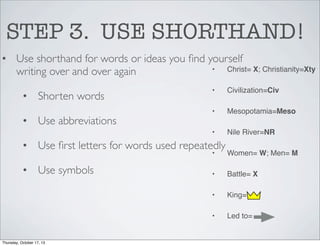
• Use shorthand for words or ideas you find yourself
writing over and over again
• Shorten words
• Use abbreviations
• Use first letters for words used repeatedly
• Use symbols

Thursday, October 17, 13
STEP 3. USE SHORTHAND!
• Use shorthand for words or ideas you find yourself
•
Christ= X; Christianity=Xty
writing over and over again

• Use abbreviations

Civilization=Civ

•

Mesopotamia=Meso

•

• Shorten words

•

Nile River=NR

• Use first letters for words used repeatedly
•

Battle= X
King=

•

Thursday, October 17, 13

•
•

• Use symbols

Women= W; Men= M

Led to=
STEP 3. USE SHORTHAND!
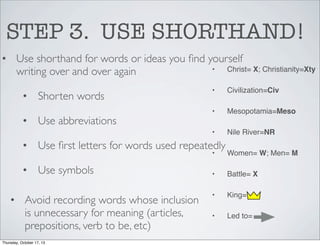
• Use shorthand for words or ideas you find yourself
•
Christ= X; Christianity=Xty
writing over and over again

• Use abbreviations

Civilization=Civ

•

Mesopotamia=Meso

•

• Shorten words

•

Nile River=NR

• Use first letters for words used repeatedly
•

• Use symbols
• Avoid recording words whose inclusion
is unnecessary for meaning (articles,
prepositions, verb to be, etc)
Thursday, October 17, 13

Women= W; Men= M

•

Battle= X

•

King=

•

Led to=
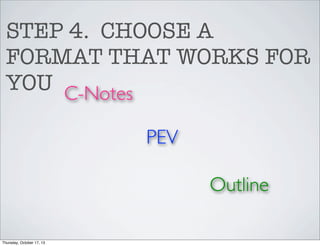
STEP 4. CHOOSE A
FORMAT THAT WORKS FOR
YOU C-Notes
PEV
Outline
Thursday, October 17, 13
CORNELL NOTES-

Thursday, October 17, 13
CORNELL NOTES• Try the Cornell Note-taking System.

Thursday, October 17, 13
CORNELL NOTES• Try the Cornell Note-taking System.
• Briefly, this method makes it easier to
highlight and recall major ideas from a
textbook.

Thursday, October 17, 13
CORNELL NOTES• Try the Cornell Note-taking System.
• Briefly, this method makes it easier to
highlight and recall major ideas from a
textbook.
It’s ideal to study from for a test and
HIGHLY recommended!!

Thursday, October 17, 13
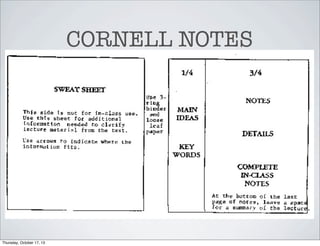
CORNELL NOTES

Thursday, October 17, 13
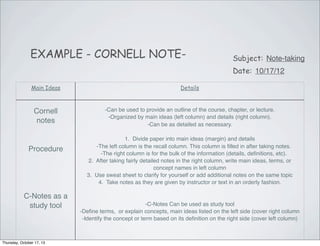
EXAMPLE - CORNELL NOTE-

Subject: Note-taking
Date: 10/17/12

Main Ideas

Details

Cornell
notes

-Can be used to provide an outline of the course, chapter, or lecture.
-Organized by main ideas (left column) and details (right column).
-Can be as detailed as necessary.

Procedure

C-Notes as a
study tool

Thursday, October 17, 13

1. Divide paper into main ideas (margin) and details
-The left column is the recall column. This column is filled in after taking notes.
-The right column is for the bulk of the information (details, definitions, etc).
2. After taking fairly detailed notes in the right column, write main ideas, terms, or
concept names in left column
3. Use sweat sheet to clarify for yourself or add additional notes on the same topic
4. Take notes as they are given by instructor or text in an orderly fashion.

-C-Notes Can be used as study tool
-Define terms, or explain concepts, main ideas listed on the left side (cover right column
-Identify the concept or term based on its definition on the right side (cover left column)
INDEPENDENT PRACTICE

• Take

out your textbook. Please read and take
notes on pages 6-7 for discussion tomorrow.

Thursday, October 17, 13
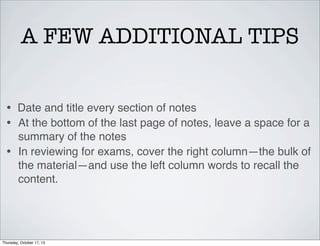
A FEW ADDITIONAL TIPS
• Date and title every section of notes
• At the bottom of the last page of notes, leave a space for a
summary of the notes
• In reviewing for exams, cover the right column—the bulk of
the material—and use the left column words to recall the
content.
Thursday, October 17, 13
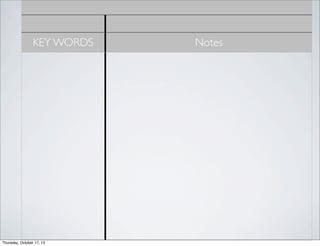
KEY WORDS

Thursday, October 17, 13

Notes
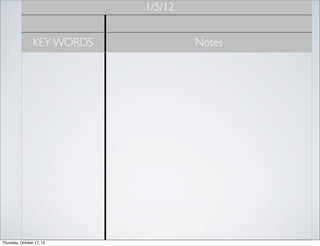
1/5/12
KEY WORDS

Thursday, October 17, 13

Notes
1/5/12
pgs 66-69
KEY WORDS

Thursday, October 17, 13

Notes
1/5/12
pgs 66-69

Ancient India

KEY WORDS

Notes

Thursday, October 17, 13
1/5/12
pgs 66-69

Ancient India

KEY WORDS

Notes
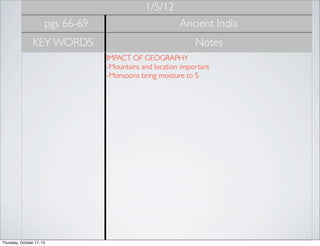
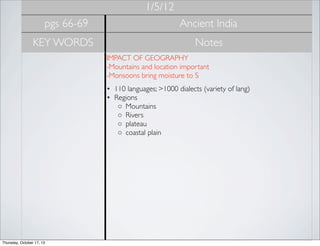
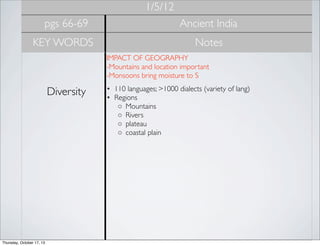
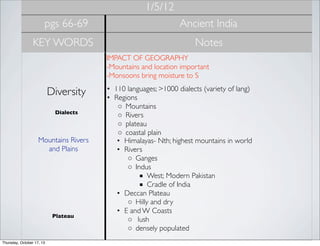
IMPACT OF GEOGRAPHY
-Mountains and location important
-Monsoons bring moisture to S

Thursday, October 17, 13
1/5/12
pgs 66-69

Ancient India

KEY WORDS

Notes
IMPACT OF GEOGRAPHY
-Mountains and location important
-Monsoons bring moisture to S
• 110 languages; >1000 dialects (variety of lang)
• Regions
◦ Mountains
◦ Rivers
◦ plateau
◦ coastal plain

Thursday, October 17, 13
1/5/12
pgs 66-69

Ancient India

KEY WORDS

Notes
IMPACT OF GEOGRAPHY
-Mountains and location important
-Monsoons bring moisture to S

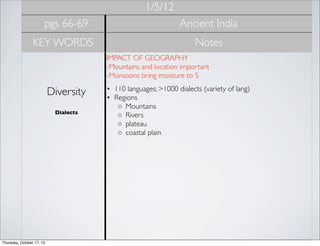
Diversity

Thursday, October 17, 13

• 110 languages; >1000 dialects (variety of lang)
• Regions
◦ Mountains
◦ Rivers
◦ plateau
◦ coastal plain
1/5/12
pgs 66-69

Ancient India

KEY WORDS

Notes
IMPACT OF GEOGRAPHY
-Mountains and location important
-Monsoons bring moisture to S

Diversity
Dialects

Thursday, October 17, 13

• 110 languages; >1000 dialects (variety of lang)
• Regions
◦ Mountains
◦ Rivers
◦ plateau
◦ coastal plain
1/5/12
pgs 66-69

Ancient India

KEY WORDS

Notes
IMPACT OF GEOGRAPHY
-Mountains and location important
-Monsoons bring moisture to S

Diversity
Dialects

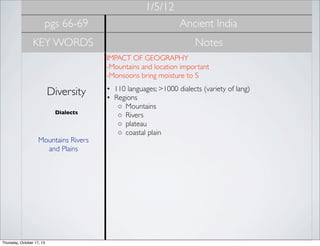
Mountains Rivers
and Plains

Thursday, October 17, 13

• 110 languages; >1000 dialects (variety of lang)
• Regions
◦ Mountains
◦ Rivers
◦ plateau
◦ coastal plain
1/5/12
pgs 66-69

Ancient India

KEY WORDS

Notes
IMPACT OF GEOGRAPHY
-Mountains and location important
-Monsoons bring moisture to S

Diversity
Dialects

Mountains Rivers
and Plains

Thursday, October 17, 13

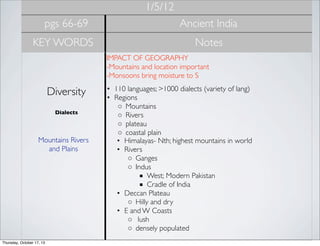
• 110 languages; >1000 dialects (variety of lang)
• Regions
◦ Mountains
◦ Rivers
◦ plateau
◦ coastal plain
• Himalayas- Nth; highest mountains in world
• Rivers
◦ Ganges
◦ Indus
■ West; Modern Pakistan
■ Cradle of India
• Deccan Plateau
◦ Hilly and dry
• E and W Coasts
◦  lush
◦ densely populated
1/5/12
pgs 66-69

Ancient India

KEY WORDS

Notes
IMPACT OF GEOGRAPHY
-Mountains and location important
-Monsoons bring moisture to S

Diversity
Dialects

Mountains Rivers
and Plains

Plateau

Thursday, October 17, 13

• 110 languages; >1000 dialects (variety of lang)
• Regions
◦ Mountains
◦ Rivers
◦ plateau
◦ coastal plain
• Himalayas- Nth; highest mountains in world
• Rivers
◦ Ganges
◦ Indus
■ West; Modern Pakistan
■ Cradle of India
• Deccan Plateau
◦ Hilly and dry
• E and W Coasts
◦  lush
◦ densely populated
1/5/12
pgs 66-69

Ancient India

KEY WORDS

Notes

Thursday, October 17, 13
1/5/12
pgs 66-69

Ancient India

KEY WORDS

Notes
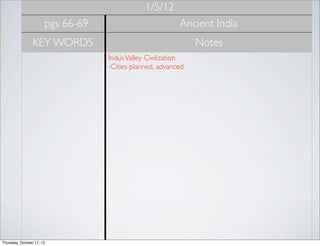
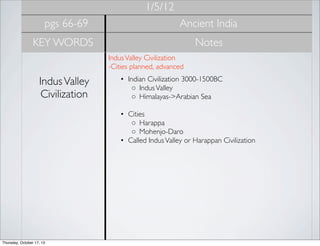
Indus Valley Civilization
-Cities planned, advanced 

Thursday, October 17, 13
1/5/12
pgs 66-69

Ancient India

KEY WORDS

Notes
Indus Valley Civilization
-Cities planned, advanced 
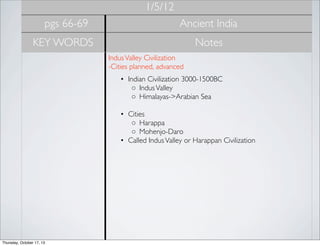
• Indian Civilization 3000-1500BC
◦ Indus Valley
◦ Himalayas->Arabian Sea
• Cities
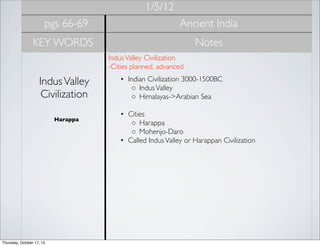
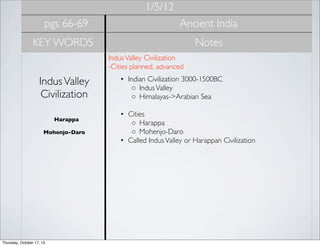
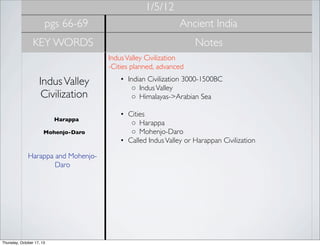
◦ Harappa
◦ Mohenjo-Daro
• Called Indus Valley or Harappan Civilization

Thursday, October 17, 13
1/5/12
pgs 66-69

Ancient India

KEY WORDS

Notes
Indus Valley Civilization
-Cities planned, advanced 

Indus Valley
Civilization

• Indian Civilization 3000-1500BC
◦ Indus Valley
◦ Himalayas->Arabian Sea
• Cities
◦ Harappa
◦ Mohenjo-Daro
• Called Indus Valley or Harappan Civilization

Thursday, October 17, 13
1/5/12
pgs 66-69

Ancient India

KEY WORDS

Notes
Indus Valley Civilization
-Cities planned, advanced 

Indus Valley
Civilization
Harappa

Thursday, October 17, 13

• Indian Civilization 3000-1500BC
◦ Indus Valley
◦ Himalayas->Arabian Sea
• Cities
◦ Harappa
◦ Mohenjo-Daro
• Called Indus Valley or Harappan Civilization
1/5/12
pgs 66-69

Ancient India

KEY WORDS

Notes
Indus Valley Civilization
-Cities planned, advanced 

Indus Valley
Civilization
Harappa
Mohenjo-Daro

Thursday, October 17, 13

• Indian Civilization 3000-1500BC
◦ Indus Valley
◦ Himalayas->Arabian Sea
• Cities
◦ Harappa
◦ Mohenjo-Daro
• Called Indus Valley or Harappan Civilization
1/5/12
pgs 66-69

Ancient India

KEY WORDS

Notes
Indus Valley Civilization
-Cities planned, advanced 

Indus Valley
Civilization
Harappa
Mohenjo-Daro

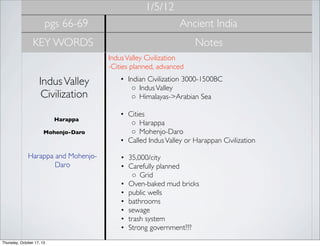
Harappa and MohenjoDaro

Thursday, October 17, 13

• Indian Civilization 3000-1500BC
◦ Indus Valley
◦ Himalayas->Arabian Sea
• Cities
◦ Harappa
◦ Mohenjo-Daro
• Called Indus Valley or Harappan Civilization
1/5/12
pgs 66-69

Ancient India

KEY WORDS

Notes
Indus Valley Civilization
-Cities planned, advanced 

Indus Valley
Civilization
Harappa
Mohenjo-Daro

Harappa and MohenjoDaro

Thursday, October 17, 13

• Indian Civilization 3000-1500BC
◦ Indus Valley
◦ Himalayas->Arabian Sea
• Cities
◦ Harappa
◦ Mohenjo-Daro
• Called Indus Valley or Harappan Civilization
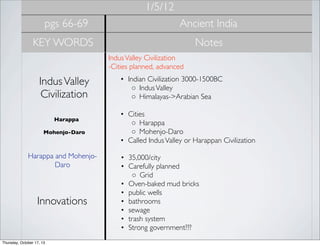
• 35,000/city
• Carefully planned
◦ Grid
• Oven-baked mud bricks
• public wells
• bathrooms
• sewage
• trash system
• Strong government???
1/5/12
pgs 66-69

Ancient India

KEY WORDS

Notes
Indus Valley Civilization
-Cities planned, advanced 

Indus Valley
Civilization
Harappa
Mohenjo-Daro

Harappa and MohenjoDaro

Innovations

Thursday, October 17, 13

• Indian Civilization 3000-1500BC
◦ Indus Valley
◦ Himalayas->Arabian Sea
• Cities
◦ Harappa
◦ Mohenjo-Daro
• Called Indus Valley or Harappan Civilization
• 35,000/city
• Carefully planned
◦ Grid
• Oven-baked mud bricks
• public wells
• bathrooms
• sewage
• trash system
• Strong government???

Note taking and practice reading quiz 1314

  • 1.
    GETTING STARTED World History,9 St. Anne’s-Belfield 2013-2014 Thursday, October 17, 13
  • 2.
  • 3.
  • 4.
  • 5.
  • 6.
  • 7.
  • 8.
    TAKING NOTES FROMA TEXTBOOK World History 9 St. Anne’s-Belfield Thursday, October 17, 13
  • 9.
  • 10.
    NO MAGIC FORMULA •Note-taking from a text is the art of recording ALL OF THE ESSENTIAL information as QUICKLY and ORGANIZED as possible Thursday, October 17, 13
  • 11.
    NO MAGIC FORMULA •Note-taking from a text is the art of recording ALL OF THE ESSENTIAL information as QUICKLY and ORGANIZED as possible 1. You must also learn what the instructor is going to ask about Thursday, October 17, 13
  • 12.
    NO MAGIC FORMULA •Note-taking from a text is the art of recording ALL OF THE ESSENTIAL information as QUICKLY and ORGANIZED as possible 1. You must also learn what the instructor is going to ask about 2. You must learn to discriminate between what is important and what is not Thursday, October 17, 13
  • 13.
    NO MAGIC FORMULA •Note-taking from a text is the art of recording ALL OF THE ESSENTIAL information as QUICKLY and ORGANIZED as possible 1. You must also learn what the instructor is going to ask about 2. You must learn to discriminate between what is important and what is not 3. You must learn how to record information in an efficient, organized manner Thursday, October 17, 13
  • 14.
    NO MAGIC FORMULA Theseskills come with time and PRACTICE, and there is no magic formula • Note-taking from a text is the art of recording ALL OF THE ESSENTIAL information as QUICKLY and ORGANIZED as possible 1. You must also learn what the instructor is going to ask about 2. You must learn to discriminate between what is important and what is not 3. You must learn how to record information in an efficient, organized manner Thursday, October 17, 13
  • 15.
  • 16.
    STEP 1. FOCUS • Note-takingis an active, NOT passive activity • The key to effective note-taking is reading carefully so that you may... Thursday, October 17, 13
  • 17.
    STEP 1. FOCUS • Note-takingis an active, NOT passive activity • The key to effective note-taking is reading carefully so that you may... 1. filter OUT irrelevant information and 2. paraphrase- this requires concentration. 3. utilize short hand Thursday, October 17, 13
  • 18.
    STEP 1. FOCUS QUIETTHE VOICES IN YOUR HEAD!!!! • Note-taking is an active, NOT passive activity • The key to effective note-taking is reading carefully so that you may... 1. filter OUT irrelevant information and 2. paraphrase- this requires concentration. 3. utilize short hand Thursday, October 17, 13
  • 19.
    STEP 1. FOCUS QUIETTHE VOICES IN YOUR HEAD!!!! • Note-taking is an active, NOT passive activity • The key to effective note-taking is reading carefully so that you may... 1. filter OUT irrelevant information and 2. paraphrase- this requires concentration. 3. utilize short hand Find a comfortable (NOT YOUR BED), quiet place to take your notes where phones, TV’s, computers, stereos, radios, iPods, Skype, friends, parents etc. won’t put voices in your head Thursday, October 17, 13
  • 20.
    STEP 2. FILTERCRAP! Thursday, October 17, 13
  • 21.
    STEP 2. FILTERCRAP! 1. Voluminous notes are NOT NECESSARILY good notes Thursday, October 17, 13
  • 22.
    STEP 2. FILTERCRAP! 1. Voluminous notes are NOT NECESSARILY good notes – What’s important? Thursday, October 17, 13
  • 23.
    STEP 2. FILTERCRAP! 1. Voluminous notes are NOT NECESSARILY good notes – What’s important? • Vocabulary (see bold and highlighted terms!) Thursday, October 17, 13
  • 24.
    STEP 2. FILTERCRAP! 1. Voluminous notes are NOT NECESSARILY good notes – What’s important? • Vocabulary (see bold and highlighted terms!) • Rulers, how they rose/fell, chief achievements, and dates Thursday, October 17, 13
  • 25.
    STEP 2. FILTERCRAP! 1. Voluminous notes are NOT NECESSARILY good notes – What’s important? • Vocabulary (see bold and highlighted terms!) • Rulers, how they rose/fell, chief achievements, and dates • Significant places (nations, regions, geographic features, cities) Thursday, October 17, 13
  • 26.
    STEP 2. FILTERCRAP! 1. Voluminous notes are NOT NECESSARILY good notes – What’s important? • Vocabulary (see bold and highlighted terms!) • Rulers, how they rose/fell, chief achievements, and dates • Significant places (nations, regions, geographic features, cities) • Religions, religious beliefs, and religious leaders Thursday, October 17, 13
  • 27.
    STEP 2. FILTERCRAP! 1. Voluminous notes are NOT NECESSARILY good notes – What’s important? • Vocabulary (see bold and highlighted terms!) • Rulers, how they rose/fell, chief achievements, and dates • Significant places (nations, regions, geographic features, cities) • Religions, religious beliefs, and religious leaders • Changes and innovations (FIRSTS!) Thursday, October 17, 13
  • 28.
    STEP 2. FILTERCRAP! 1. Voluminous notes are NOT NECESSARILY good notes – What’s important? • Vocabulary (see bold and highlighted terms!) • Rulers, how they rose/fell, chief achievements, and dates • Significant places (nations, regions, geographic features, cities) • Religions, religious beliefs, and religious leaders • Changes and innovations (FIRSTS!) 2. READ THE SECTION BEFORE YOU WRITE! Thursday, October 17, 13
  • 29.
    STEP 2. FILTERCRAP! 1. Voluminous notes are NOT NECESSARILY good notes – What’s important? • Vocabulary (see bold and highlighted terms!) • Rulers, how they rose/fell, chief achievements, and dates • Significant places (nations, regions, geographic features, cities) • Religions, religious beliefs, and religious leaders • Changes and innovations (FIRSTS!) 2. READ THE SECTION BEFORE YOU WRITE! • Weed out what is unimportant so that you don’t have to waste your time writing EVERYTHING down. Thursday, October 17, 13
  • 30.
    STEP 2. FILTERCRAP! 1. Voluminous notes are NOT NECESSARILY good notes – What’s important? • Vocabulary (see bold and highlighted terms!) • Rulers, how they rose/fell, chief achievements, and dates • Significant places (nations, regions, geographic features, cities) • Religions, religious beliefs, and religious leaders • Changes and innovations (FIRSTS!) 2. READ THE SECTION BEFORE YOU WRITE! • Weed out what is unimportant so that you don’t have to waste your time writing EVERYTHING down. • MAKE THIS AN ACTIVE EXERCISE!!! Thursday, October 17, 13
  • 31.
    STEP 3. USESHORTHAND! Thursday, October 17, 13
  • 32.
    STEP 3. USESHORTHAND! • Use shorthand for words or ideas you find yourself writing over and over again • Shorten words • Use abbreviations • Use first letters for words used repeatedly • Use symbols Thursday, October 17, 13
  • 33.
    STEP 3. USESHORTHAND! • Use shorthand for words or ideas you find yourself • Christ= X; Christianity=Xty writing over and over again • Use abbreviations Civilization=Civ • Mesopotamia=Meso • • Shorten words • Nile River=NR • Use first letters for words used repeatedly • Battle= X King= • Thursday, October 17, 13 • • • Use symbols Women= W; Men= M Led to=
  • 34.
    STEP 3. USESHORTHAND! • Use shorthand for words or ideas you find yourself • Christ= X; Christianity=Xty writing over and over again • Use abbreviations Civilization=Civ • Mesopotamia=Meso • • Shorten words • Nile River=NR • Use first letters for words used repeatedly • • Use symbols • Avoid recording words whose inclusion is unnecessary for meaning (articles, prepositions, verb to be, etc) Thursday, October 17, 13 Women= W; Men= M • Battle= X • King= • Led to=
  • 35.
    STEP 4. CHOOSEA FORMAT THAT WORKS FOR YOU C-Notes PEV Outline Thursday, October 17, 13
  • 36.
  • 37.
    CORNELL NOTES• Trythe Cornell Note-taking System. Thursday, October 17, 13
  • 38.
    CORNELL NOTES• Trythe Cornell Note-taking System. • Briefly, this method makes it easier to highlight and recall major ideas from a textbook. Thursday, October 17, 13
  • 39.
    CORNELL NOTES• Trythe Cornell Note-taking System. • Briefly, this method makes it easier to highlight and recall major ideas from a textbook. It’s ideal to study from for a test and HIGHLY recommended!! Thursday, October 17, 13
  • 40.
  • 41.
    EXAMPLE - CORNELLNOTE- Subject: Note-taking Date: 10/17/12 Main Ideas Details Cornell notes -Can be used to provide an outline of the course, chapter, or lecture. -Organized by main ideas (left column) and details (right column). -Can be as detailed as necessary. Procedure C-Notes as a study tool Thursday, October 17, 13 1. Divide paper into main ideas (margin) and details -The left column is the recall column. This column is filled in after taking notes. -The right column is for the bulk of the information (details, definitions, etc). 2. After taking fairly detailed notes in the right column, write main ideas, terms, or concept names in left column 3. Use sweat sheet to clarify for yourself or add additional notes on the same topic 4. Take notes as they are given by instructor or text in an orderly fashion. -C-Notes Can be used as study tool -Define terms, or explain concepts, main ideas listed on the left side (cover right column -Identify the concept or term based on its definition on the right side (cover left column)
  • 42.
    INDEPENDENT PRACTICE • Take outyour textbook. Please read and take notes on pages 6-7 for discussion tomorrow. Thursday, October 17, 13
  • 43.
    A FEW ADDITIONALTIPS • Date and title every section of notes • At the bottom of the last page of notes, leave a space for a summary of the notes • In reviewing for exams, cover the right column—the bulk of the material—and use the left column words to recall the content. Thursday, October 17, 13
  • 44.

  • 45.
  • 46.
  • 47.
  • 48.
    1/5/12 pgs 66-69 Ancient India KEYWORDS Notes Thursday, October 17, 13
  • 49.
    1/5/12 pgs 66-69 Ancient India KEYWORDS Notes IMPACT OF GEOGRAPHY -Mountains and location important -Monsoons bring moisture to S Thursday, October 17, 13
  • 50.
    1/5/12 pgs 66-69 Ancient India KEYWORDS Notes IMPACT OF GEOGRAPHY -Mountains and location important -Monsoons bring moisture to S • 110 languages; >1000 dialects (variety of lang) • Regions ◦ Mountains ◦ Rivers ◦ plateau ◦ coastal plain Thursday, October 17, 13
  • 51.
    1/5/12 pgs 66-69 Ancient India KEYWORDS Notes IMPACT OF GEOGRAPHY -Mountains and location important -Monsoons bring moisture to S Diversity Thursday, October 17, 13 • 110 languages; >1000 dialects (variety of lang) • Regions ◦ Mountains ◦ Rivers ◦ plateau ◦ coastal plain
  • 52.
    1/5/12 pgs 66-69 Ancient India KEYWORDS Notes IMPACT OF GEOGRAPHY -Mountains and location important -Monsoons bring moisture to S Diversity Dialects Thursday, October 17, 13 • 110 languages; >1000 dialects (variety of lang) • Regions ◦ Mountains ◦ Rivers ◦ plateau ◦ coastal plain
  • 53.
    1/5/12 pgs 66-69 Ancient India KEYWORDS Notes IMPACT OF GEOGRAPHY -Mountains and location important -Monsoons bring moisture to S Diversity Dialects Mountains Rivers and Plains Thursday, October 17, 13 • 110 languages; >1000 dialects (variety of lang) • Regions ◦ Mountains ◦ Rivers ◦ plateau ◦ coastal plain
  • 54.
    1/5/12 pgs 66-69 Ancient India KEYWORDS Notes IMPACT OF GEOGRAPHY -Mountains and location important -Monsoons bring moisture to S Diversity Dialects Mountains Rivers and Plains Thursday, October 17, 13 • 110 languages; >1000 dialects (variety of lang) • Regions ◦ Mountains ◦ Rivers ◦ plateau ◦ coastal plain • Himalayas- Nth; highest mountains in world • Rivers ◦ Ganges ◦ Indus ■ West; Modern Pakistan ■ Cradle of India • Deccan Plateau ◦ Hilly and dry • E and W Coasts ◦  lush ◦ densely populated
  • 55.
    1/5/12 pgs 66-69 Ancient India KEYWORDS Notes IMPACT OF GEOGRAPHY -Mountains and location important -Monsoons bring moisture to S Diversity Dialects Mountains Rivers and Plains Plateau Thursday, October 17, 13 • 110 languages; >1000 dialects (variety of lang) • Regions ◦ Mountains ◦ Rivers ◦ plateau ◦ coastal plain • Himalayas- Nth; highest mountains in world • Rivers ◦ Ganges ◦ Indus ■ West; Modern Pakistan ■ Cradle of India • Deccan Plateau ◦ Hilly and dry • E and W Coasts ◦  lush ◦ densely populated
  • 56.
    1/5/12 pgs 66-69 Ancient India KEYWORDS Notes Thursday, October 17, 13
  • 57.
    1/5/12 pgs 66-69 Ancient India KEYWORDS Notes Indus Valley Civilization -Cities planned, advanced  Thursday, October 17, 13
  • 58.
    1/5/12 pgs 66-69 Ancient India KEYWORDS Notes Indus Valley Civilization -Cities planned, advanced  • Indian Civilization 3000-1500BC ◦ Indus Valley ◦ Himalayas->Arabian Sea • Cities ◦ Harappa ◦ Mohenjo-Daro • Called Indus Valley or Harappan Civilization Thursday, October 17, 13
  • 59.
    1/5/12 pgs 66-69 Ancient India KEYWORDS Notes Indus Valley Civilization -Cities planned, advanced  Indus Valley Civilization • Indian Civilization 3000-1500BC ◦ Indus Valley ◦ Himalayas->Arabian Sea • Cities ◦ Harappa ◦ Mohenjo-Daro • Called Indus Valley or Harappan Civilization Thursday, October 17, 13
  • 60.
    1/5/12 pgs 66-69 Ancient India KEYWORDS Notes Indus Valley Civilization -Cities planned, advanced  Indus Valley Civilization Harappa Thursday, October 17, 13 • Indian Civilization 3000-1500BC ◦ Indus Valley ◦ Himalayas->Arabian Sea • Cities ◦ Harappa ◦ Mohenjo-Daro • Called Indus Valley or Harappan Civilization
  • 61.
    1/5/12 pgs 66-69 Ancient India KEYWORDS Notes Indus Valley Civilization -Cities planned, advanced  Indus Valley Civilization Harappa Mohenjo-Daro Thursday, October 17, 13 • Indian Civilization 3000-1500BC ◦ Indus Valley ◦ Himalayas->Arabian Sea • Cities ◦ Harappa ◦ Mohenjo-Daro • Called Indus Valley or Harappan Civilization
  • 62.
    1/5/12 pgs 66-69 Ancient India KEYWORDS Notes Indus Valley Civilization -Cities planned, advanced  Indus Valley Civilization Harappa Mohenjo-Daro Harappa and MohenjoDaro Thursday, October 17, 13 • Indian Civilization 3000-1500BC ◦ Indus Valley ◦ Himalayas->Arabian Sea • Cities ◦ Harappa ◦ Mohenjo-Daro • Called Indus Valley or Harappan Civilization
  • 63.
    1/5/12 pgs 66-69 Ancient India KEYWORDS Notes Indus Valley Civilization -Cities planned, advanced  Indus Valley Civilization Harappa Mohenjo-Daro Harappa and MohenjoDaro Thursday, October 17, 13 • Indian Civilization 3000-1500BC ◦ Indus Valley ◦ Himalayas->Arabian Sea • Cities ◦ Harappa ◦ Mohenjo-Daro • Called Indus Valley or Harappan Civilization • 35,000/city • Carefully planned ◦ Grid • Oven-baked mud bricks • public wells • bathrooms • sewage • trash system • Strong government???
  • 64.
    1/5/12 pgs 66-69 Ancient India KEYWORDS Notes Indus Valley Civilization -Cities planned, advanced  Indus Valley Civilization Harappa Mohenjo-Daro Harappa and MohenjoDaro Innovations Thursday, October 17, 13 • Indian Civilization 3000-1500BC ◦ Indus Valley ◦ Himalayas->Arabian Sea • Cities ◦ Harappa ◦ Mohenjo-Daro • Called Indus Valley or Harappan Civilization • 35,000/city • Carefully planned ◦ Grid • Oven-baked mud bricks • public wells • bathrooms • sewage • trash system • Strong government???