Multi-Sensory Learning
Week 6 Discussion by Alyssa Conner
What is Multi-Sensory Learning
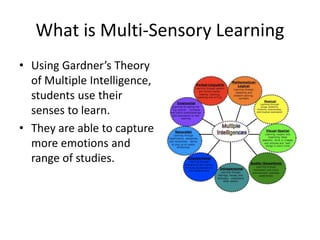
• Using Gardner’s Theory
of Multiple Intelligence,
students use their
senses to learn.
• They are able to capture
more emotions and
range of studies.
Using Multi-Sensory Learning
How does multisensory instruction
work?
• Learning often relies on a child’s sight to look at text and pictures and to
read information. It also relies on a child’s hearing to listen to what the
teacher is saying.
• Multisensory teaching isn’t just limited to reading and listening. Instead, it
tries to use all of the senses. Every lesson won’t use all of a child’s senses
(taste, smell, touch, sight, hearing and movement). But in most
multisensory lessons, students engage with the material in more than one
way.
• For example, let’s say your child’s class is studying apples. Your child might
have the chance to visually examine, touch, smell and taste apples—
instead of just reading and listening to his teacher speak about how they
grow. Then he might hold a halved apple and count the number of seeds
inside, one by one.
• That’s multisensory teaching. It conveys information through things like
touch and movement—called tactile and kinesthetic elements—as well as
sight and hearing.
https://www.understood.org/en/school-learning/partnering-with-childs-
school/instructional-strategies/multisensory-instruction-what-you-need-to-know
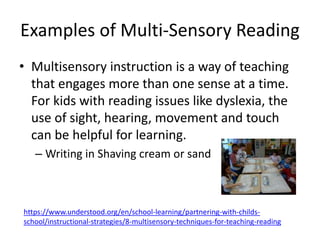
Examples of Multi-Sensory Reading
• Multisensory instruction is a way of teaching
that engages more than one sense at a time.
For kids with reading issues like dyslexia, the
use of sight, hearing, movement and touch
can be helpful for learning.
– Writing in Shaving cream or sand
https://www.understood.org/en/school-learning/partnering-with-childs-
school/instructional-strategies/8-multisensory-techniques-for-teaching-reading
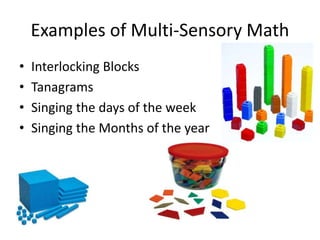
Examples of Multi-Sensory Math
• Interlocking Blocks
• Tanagrams
• Singing the days of the week
• Singing the Months of the year
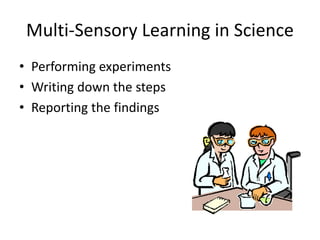
Multi-Sensory Learning in Science
• Performing experiments
• Writing down the steps
• Reporting the findings
How does this approach help students
achieve more out of school
• Kids with learning and attention issues can
have trouble learning through just reading or
listening.
• Multisensory instruction can help kids learn
information more effectively.
• All kids can benefit from multisensory
instruction.
https://www.understood.org/en/school-
learning/partnering-with-childs-school/instructional-
strategies/multisensory-instruction-what-you-need-
to-know
How can you incorporate this in your
classroom?
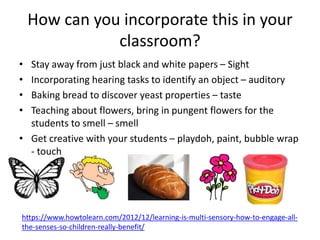
• Stay away from just black and white papers – Sight
• Incorporating hearing tasks to identify an object – auditory
• Baking bread to discover yeast properties – taste
• Teaching about flowers, bring in pungent flowers for the
students to smell – smell
• Get creative with your students – playdoh, paint, bubble wrap
- touch
https://www.howtolearn.com/2012/12/learning-is-multi-sensory-how-to-engage-all-
the-senses-so-children-really-benefit/
Multisensory Learning
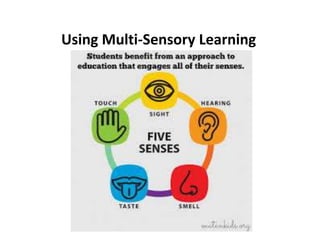
• This is a system that I back up I think that it is
a great visual of how learning should be
happening. It gives all students the chance to
succeed.
Citations
• Morin, A. 8 Multisensory Techniques for
Teaching Reading. Understood: for Learning
and Attention Issues.
• Morin, A., & Wilson M.Ed., B. A. Multisesory
Instruction: What you Need to Know.
Understood: for Learning and Attention Isses.
• Pitts, A. (2012). Learning Is Multi-Sensory:
How To Engage All The Senses So Children
Really Benefi. Howtolearn.com.

Multi-Sensory Learning

  • 1.
    Multi-Sensory Learning Week 6Discussion by Alyssa Conner
  • 2.
    What is Multi-SensoryLearning • Using Gardner’s Theory of Multiple Intelligence, students use their senses to learn. • They are able to capture more emotions and range of studies.
  • 3.
  • 4.
    How does multisensoryinstruction work? • Learning often relies on a child’s sight to look at text and pictures and to read information. It also relies on a child’s hearing to listen to what the teacher is saying. • Multisensory teaching isn’t just limited to reading and listening. Instead, it tries to use all of the senses. Every lesson won’t use all of a child’s senses (taste, smell, touch, sight, hearing and movement). But in most multisensory lessons, students engage with the material in more than one way. • For example, let’s say your child’s class is studying apples. Your child might have the chance to visually examine, touch, smell and taste apples— instead of just reading and listening to his teacher speak about how they grow. Then he might hold a halved apple and count the number of seeds inside, one by one. • That’s multisensory teaching. It conveys information through things like touch and movement—called tactile and kinesthetic elements—as well as sight and hearing. https://www.understood.org/en/school-learning/partnering-with-childs- school/instructional-strategies/multisensory-instruction-what-you-need-to-know
  • 5.
    Examples of Multi-SensoryReading • Multisensory instruction is a way of teaching that engages more than one sense at a time. For kids with reading issues like dyslexia, the use of sight, hearing, movement and touch can be helpful for learning. – Writing in Shaving cream or sand https://www.understood.org/en/school-learning/partnering-with-childs- school/instructional-strategies/8-multisensory-techniques-for-teaching-reading
  • 6.
    Examples of Multi-SensoryMath • Interlocking Blocks • Tanagrams • Singing the days of the week • Singing the Months of the year
  • 7.
    Multi-Sensory Learning inScience • Performing experiments • Writing down the steps • Reporting the findings
  • 8.
    How does thisapproach help students achieve more out of school • Kids with learning and attention issues can have trouble learning through just reading or listening. • Multisensory instruction can help kids learn information more effectively. • All kids can benefit from multisensory instruction. https://www.understood.org/en/school- learning/partnering-with-childs-school/instructional- strategies/multisensory-instruction-what-you-need- to-know
  • 9.
    How can youincorporate this in your classroom? • Stay away from just black and white papers – Sight • Incorporating hearing tasks to identify an object – auditory • Baking bread to discover yeast properties – taste • Teaching about flowers, bring in pungent flowers for the students to smell – smell • Get creative with your students – playdoh, paint, bubble wrap - touch https://www.howtolearn.com/2012/12/learning-is-multi-sensory-how-to-engage-all- the-senses-so-children-really-benefit/
  • 10.
    Multisensory Learning • Thisis a system that I back up I think that it is a great visual of how learning should be happening. It gives all students the chance to succeed.
  • 11.
    Citations • Morin, A.8 Multisensory Techniques for Teaching Reading. Understood: for Learning and Attention Issues. • Morin, A., & Wilson M.Ed., B. A. Multisesory Instruction: What you Need to Know. Understood: for Learning and Attention Isses. • Pitts, A. (2012). Learning Is Multi-Sensory: How To Engage All The Senses So Children Really Benefi. Howtolearn.com.