Presentation by: 
Chr isoula 
Koutoulas 
Walden 
Universi ty 
EDUC 6706: The 
Beginning 
Reader, PreK-3 
CREATING A LITERATE 
ENVIRONMENT
 Getting to know literacy learners 
 Assessing students’ cognitive and noncognitive abilities 
 Selecting engaging and appropriate texts to motivate 
students 
 Integrating the three literacy perspectives 
 Interactive 
 Critical 
 Response 
COMPONENTS OF A 
LITERATE ENVIRONMENT
GETTING TO KNOW LITERACY LEARNERS 
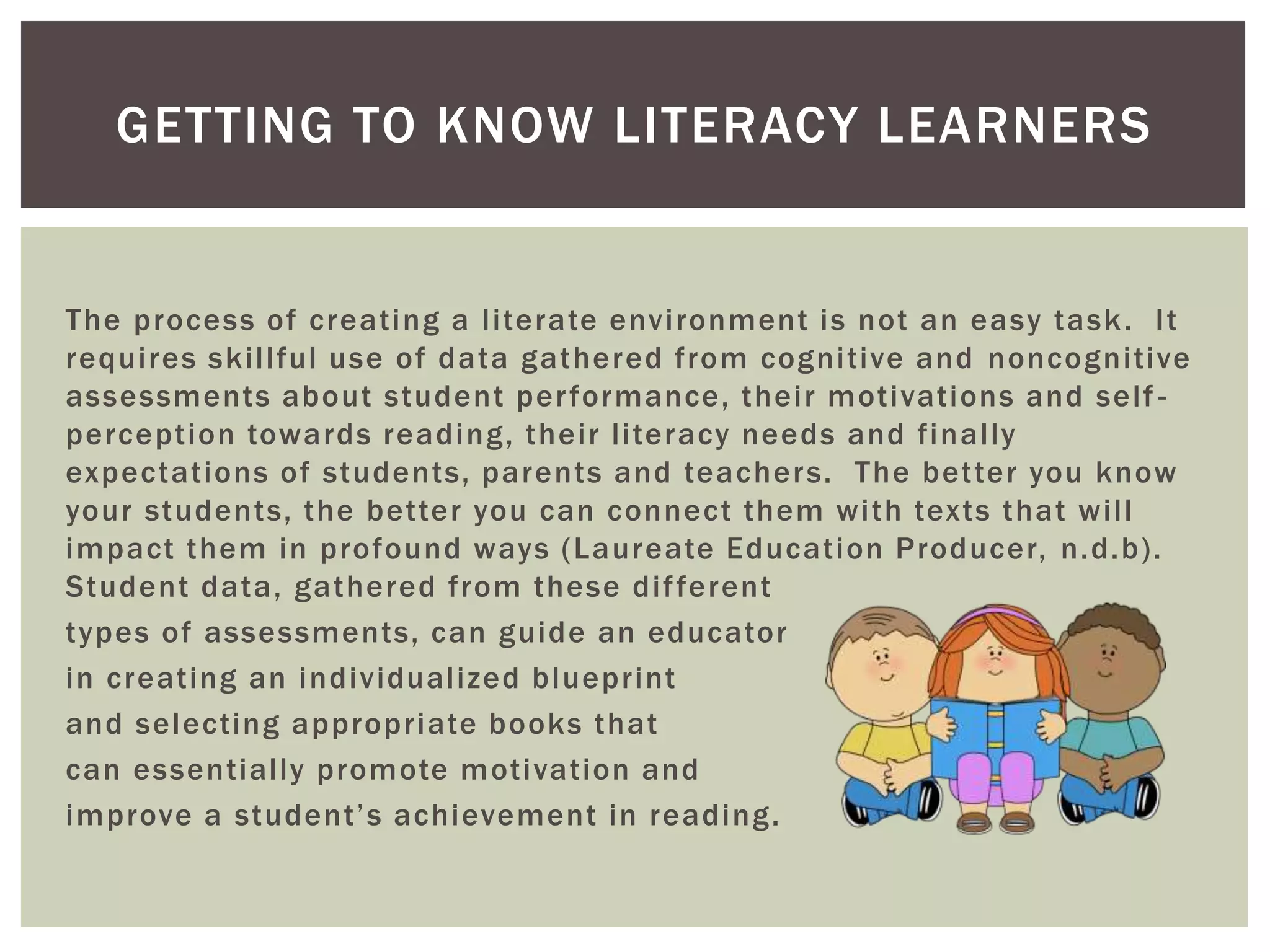
The process of creat ing a l i terate envi ronment is not an easy task. I t 
requi res ski l l ful use of data gathered from cogni tive and noncogni tive 
assessments about student per formance, thei r mot ivat ions and sel f - 
percept ion towards reading, thei r l i teracy needs and final ly 
expectat ions of students, parents and teachers. The bet ter you know 
your students, the bet ter you can connect them wi th texts that wi l l 
impact them in profound ways (Laureate Educat ion Producer, n.d.b) . 
Student data, gathered from these di f ferent 
types of assessments, can guide an educator 
in creat ing an individual ized bluepr int 
and selecting appropr iate books that 
can essent ial ly promote mot ivat ion and 
imp r ov e a s t u d e n t ’ s a c h i e v eme n t i n r e a d i n g .
GETTING TO KNOW LITERACY LEARNERS 
Assessment is ongoing and provides immediate feedback to improve 
teaching and learning for al l students (Tompkins, 2010, p. 75) . 
 Cogni t ive Assessment : The Fountas & Pinnel l (2010) formal reading 
a s s e s sme n t p r o v i d e d i n f o rma t i o n a b o u t e a c h s t u d e n t ’ s p h o n emi c a w a r e n e s s 
ski l ls; blending and segment ing ski l ls; sight word recogni t ion; reading accuracy 
and f luency; comprehension ski l ls; any use of reading st rategies and 
inst ruct ional reading level . 
 Noncogni t ive Assessment : The Elementar y Reading At t i tude Sur vey (McKenna 
& Kear, 1990) provided informat ion that did not per tain to thei r reading 
per formance, but was equal ly as impor tant . I t is impor tant to assess factor s 
such as mot ivat ion and sel f-esteem because these are both possible outcomes 
of becoming a bet ter reader (Af f lerbach, 2012, p. 174) . This assessment gave 
me v a l u a b l e i n s i g h t i n t o my s t u d e n t s ’ s e l f-percept ions and at t i tudes regarding 
reading in order to view the chi ld as a whole. This informat ion assisted me in 
select ing books that would interest and mot ivate them.
SELECTING TEXTS 
Select ing engaging and appropriate texts for students is a crucial par t of 
inst ruct ion in the classroom yet , the process of matching them to the 
needs and interests of students can be qui te chal lenging due to the 
overwhelming amount of resources there are. In to d a y ’ s l i t e r a c y 
classroom, you wi l l f ind many di f ferent forms of text f rom pr inted books 
to digi tal media (Laureate Educat ion Producer, n.d.a) . Each has an 
imp o r t a n t p l a c e i n to d a y ’ s c l a s s r o om a n d c a n b e e q u a l l y b e n e f i c i a l i f t h e 
r ight one is matched wi th the r ight student . 
Once the reading level , l i teracy needs and 
mot ivat ions are determined teachers can 
star t choosing appropriate texts for thei r 
l i teracy inst ruct ion wi th the assistance of 
the Li teracy Mat r ix that is discussed by 
Dr. Douglas Har tman and Dr. Janice Almasi 
(Laureate Educat ion Producer, n.d.a) .
SELECTING TEXTS 
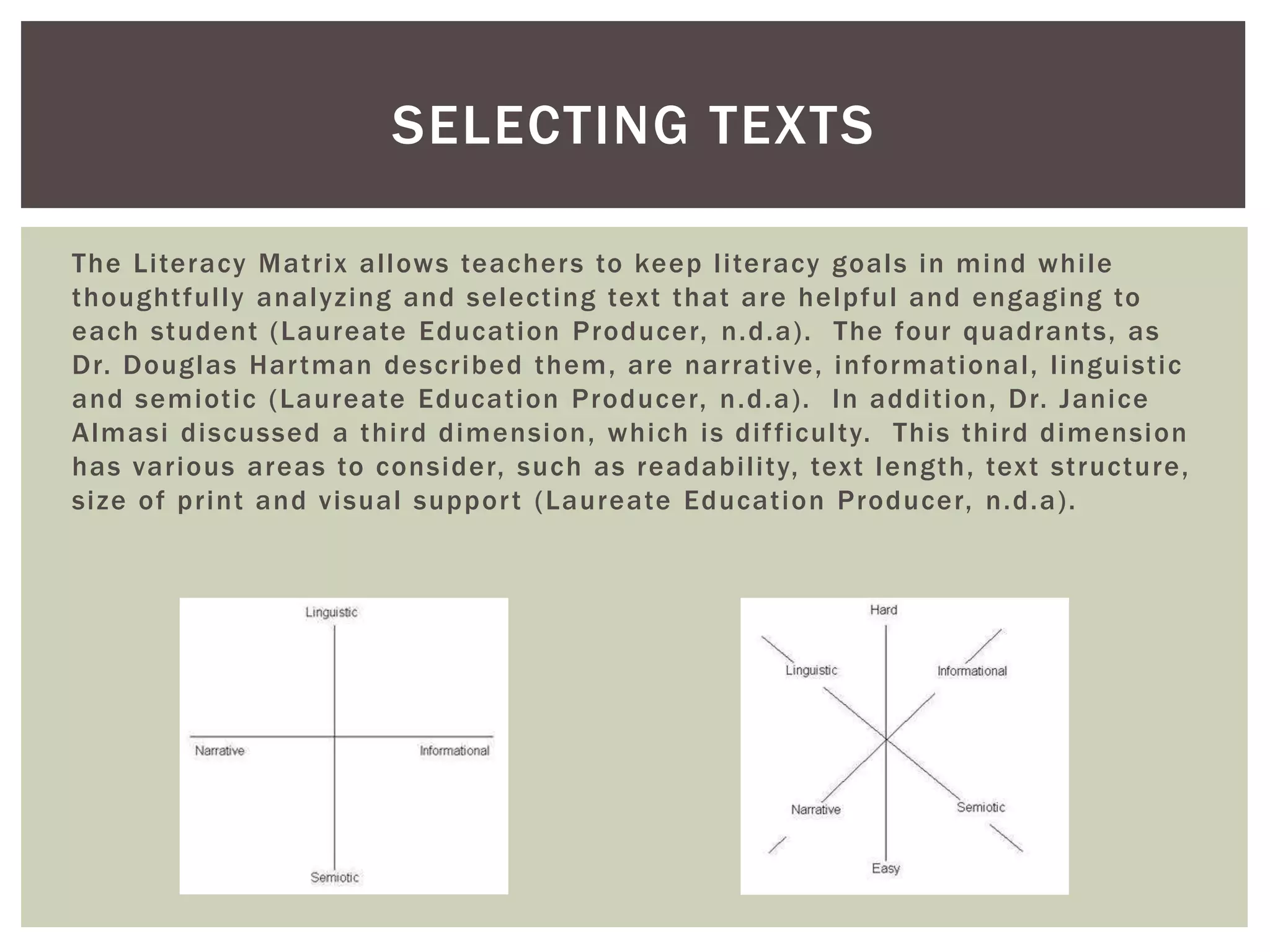
The Li teracy Mat r ix al lows teachers to keep l i teracy goals in mind whi le 
thought ful ly analyzing and select ing text that are helpful and engaging to 
each student (Laureate Educat ion Producer, n.d.a) . The four quadrants, as 
Dr. Douglas Har tman descr ibed them, are nar rat ive, informat ional , l inguist ic 
and semiot ic (Laureate Educat ion Producer, n.d.a) . In addi t ion, Dr. Janice 
Almasi discussed a thi rd dimension, which is di f f icul ty. This thi rd dimension 
has var ious areas to consider, such as readabi l i ty, text length, text st ructure, 
size of pr int and visual suppor t (Laureate Educat ion Producer, n.d.a) .
SELECTING TEXTS 
Using the cogni tive and noncogni tive assessment resul ts as wel l as 
the Li teracy Matrix, I was able to choose appropriate and engaging 
texts for my students that were at the beginning stages of l i teracy 
development . 
 Narrat ive texts: 
Growing Vegetable Soup by Lois Ehler t (1990) 
What I See by Hol ly Kel ler (2003) 
 Informat ional texts: 
Beans by Gai l Saunders-Smi th (1998) 
A Garde n e r ’s Al ph abet by Mar y Azarian (2000) 
 Onl ine texts: 
It Is Spring by Cheryl Ryan (2014) 
Vegetables by Cheryl Ryan (2014)
LITERACY LEARNING PERSPECTIVES 
In order to have a balanced l i teracy program and create wel l - rounded 
readers that not only can read, but who choose to read, who are 
mot ivated to read and can think cr i t ical ly, educators must consider al l 
three l i teracy perspect ives, interact ive, cr i t ical and response. The 
f ramework for l i teracy inst ruct ion highl ights these three perspect ives 
(Laureate Educat ion Producer, n.d.c) . 
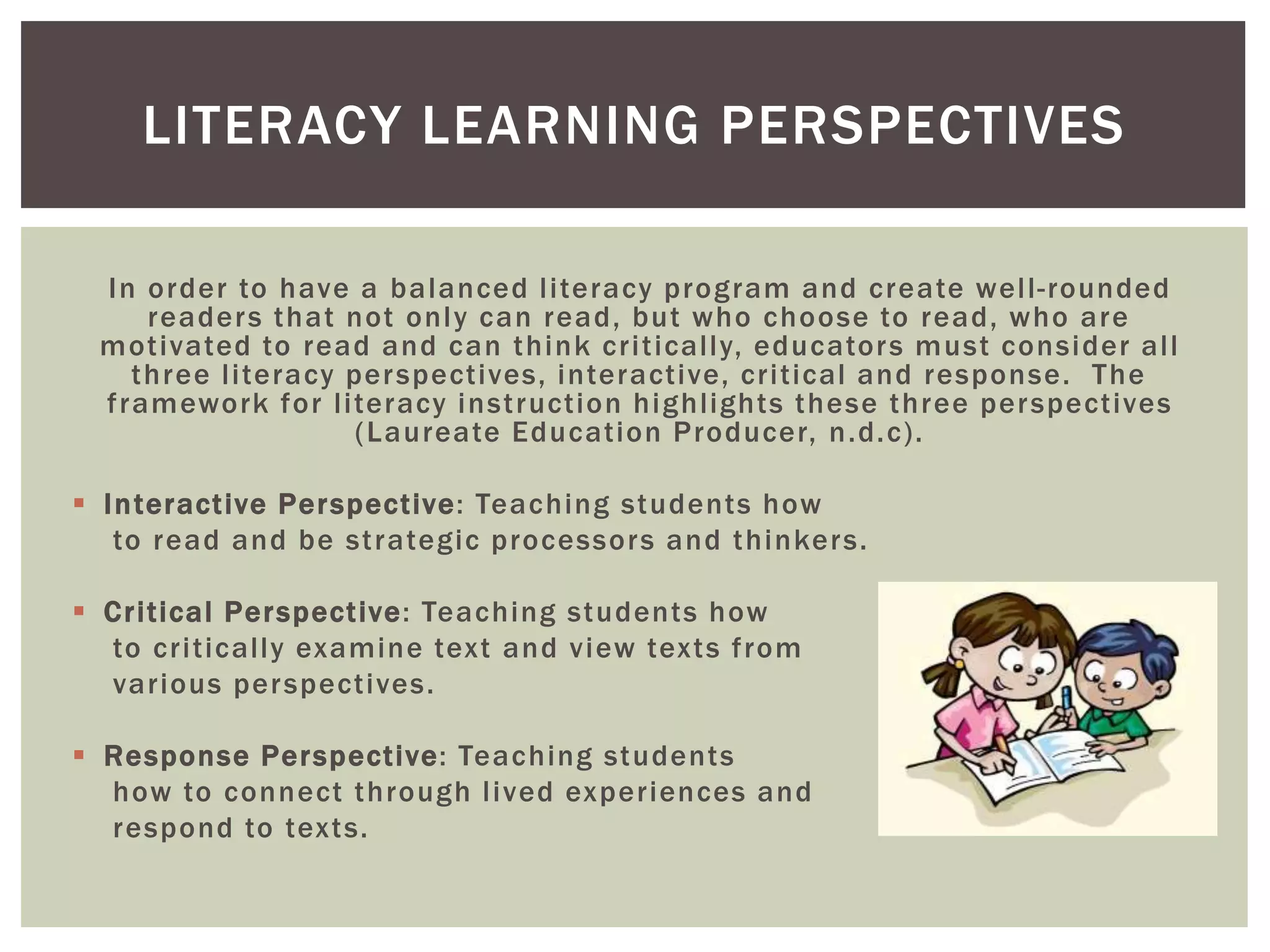
 Interact ive Perspect ive: Teaching students how 
to read and be st rategic processors and thinkers. 
 Cr i t ical Perspect ive: Teaching students how 
to cr i t ical ly examine text and view texts f rom 
var ious perspect ives. 
 Response Perspect ive: Teaching students 
how to connect through l ived exper iences and 
respond to texts.
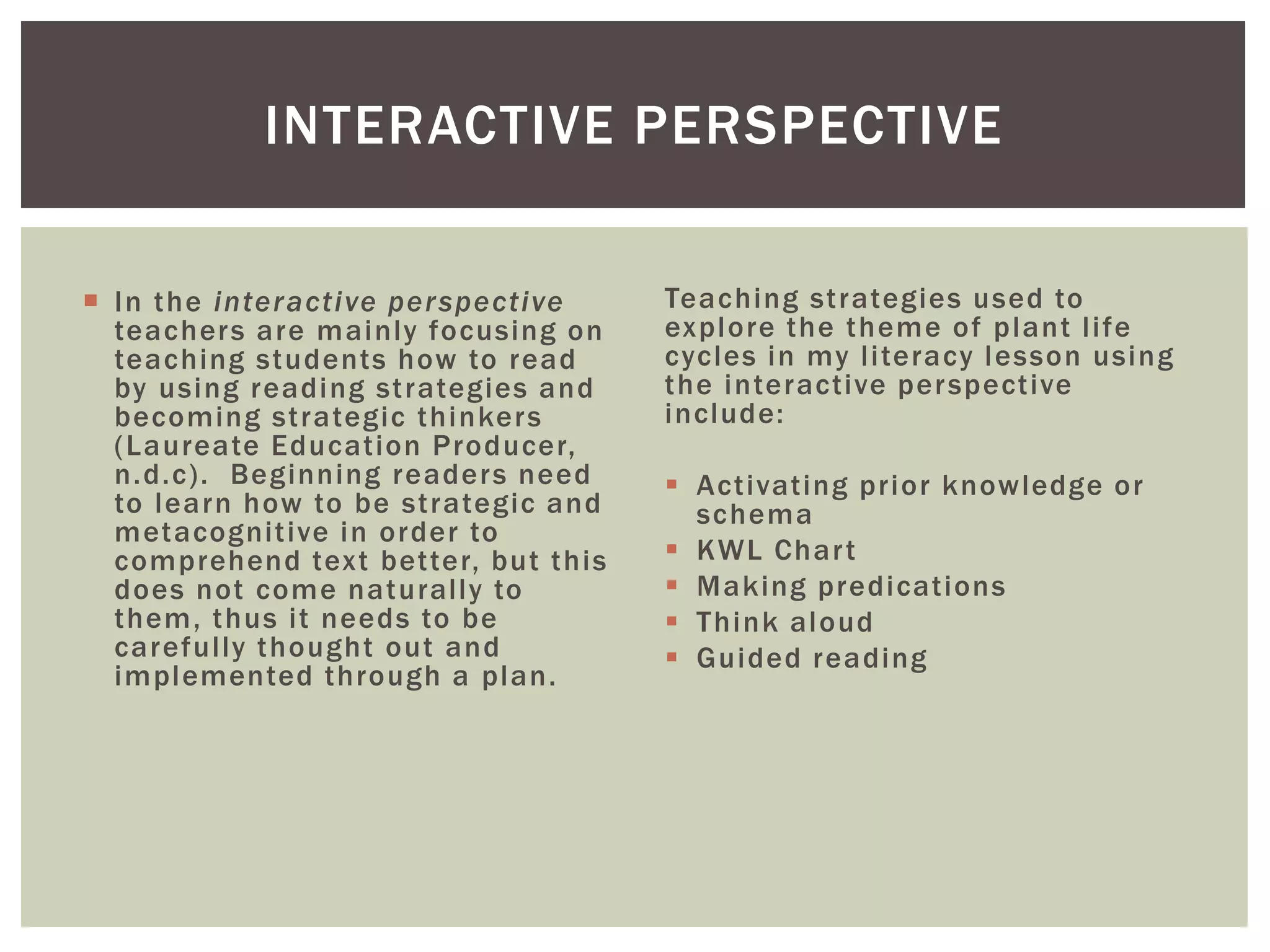
INTERACTIVE PERSPECTIVE 
 In the interact ive perspect ive 
teachers are mainly focusing on 
teaching students how to read 
by using reading st rategies and 
becoming st rategic thinkers 
(Laureate Educat ion Producer, 
n.d.c) . Beginning readers need 
to learn how to be st rategic and 
metacogni t ive in order to 
comprehend text bet ter, but this 
does not come natural ly to 
them, thus i t needs to be 
careful ly thought out and 
implemented through a plan. 
Teaching st rategies used to 
explore the theme of plant l i fe 
cycles in my l i teracy lesson using 
the interact ive perspect ive 
include: 
 Act ivat ing pr ior knowledge or 
schema 
 KWL Char t 
 Making predicat ions 
 Think aloud 
 Guided reading
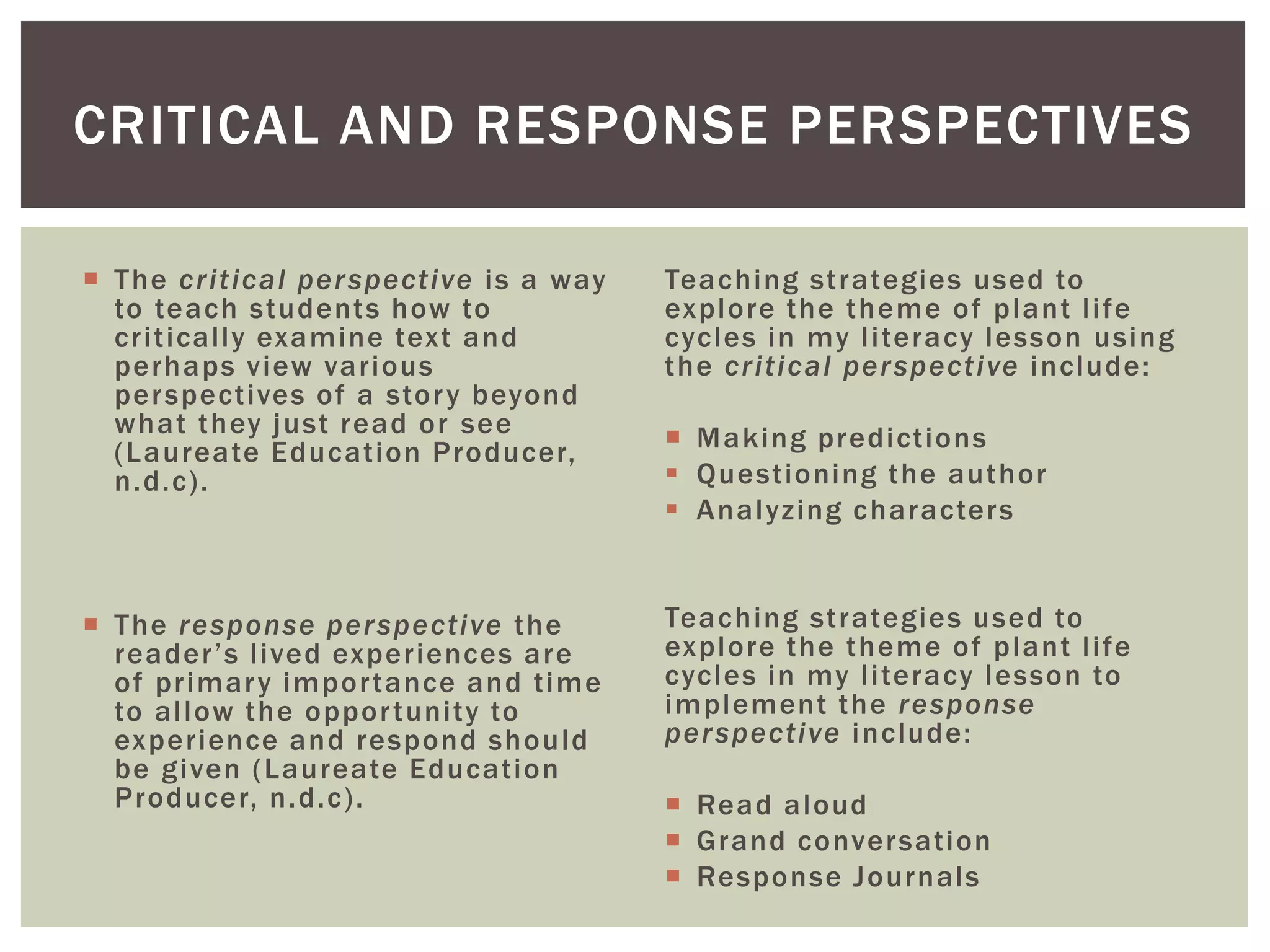
CRITICAL AND RESPONSE PERSPECTIVES 
 The cr i t ical perspect ive is a way 
to teach students how to 
cr i t ical ly examine text and 
perhaps view var ious 
perspect ives of a stor y beyond 
what they just read or see 
(Laureate Educat ion Producer, 
n.d.c) . 
 The response perspect ive the 
r e a d e r ’ s l i v e d ex p e r i e n c e s a r e 
of pr imary impor tance and t ime 
to al low the oppor tuni ty to 
exper ience and respond should 
be given (Laureate Educat ion 
Producer, n.d.c) . 
Teaching st rategies used to 
explore the theme of plant l i fe 
cycles in my l i teracy lesson using 
the cr i t ical perspect ive include: 
 Making predict ions 
 Quest ioning the author 
 Analyzing characters 
Teaching st rategies used to 
explore the theme of plant l i fe 
cycles in my l i teracy lesson to 
implement the response 
perspect ive include: 
 Read aloud 
 Grand conversat ion 
 Response Journals
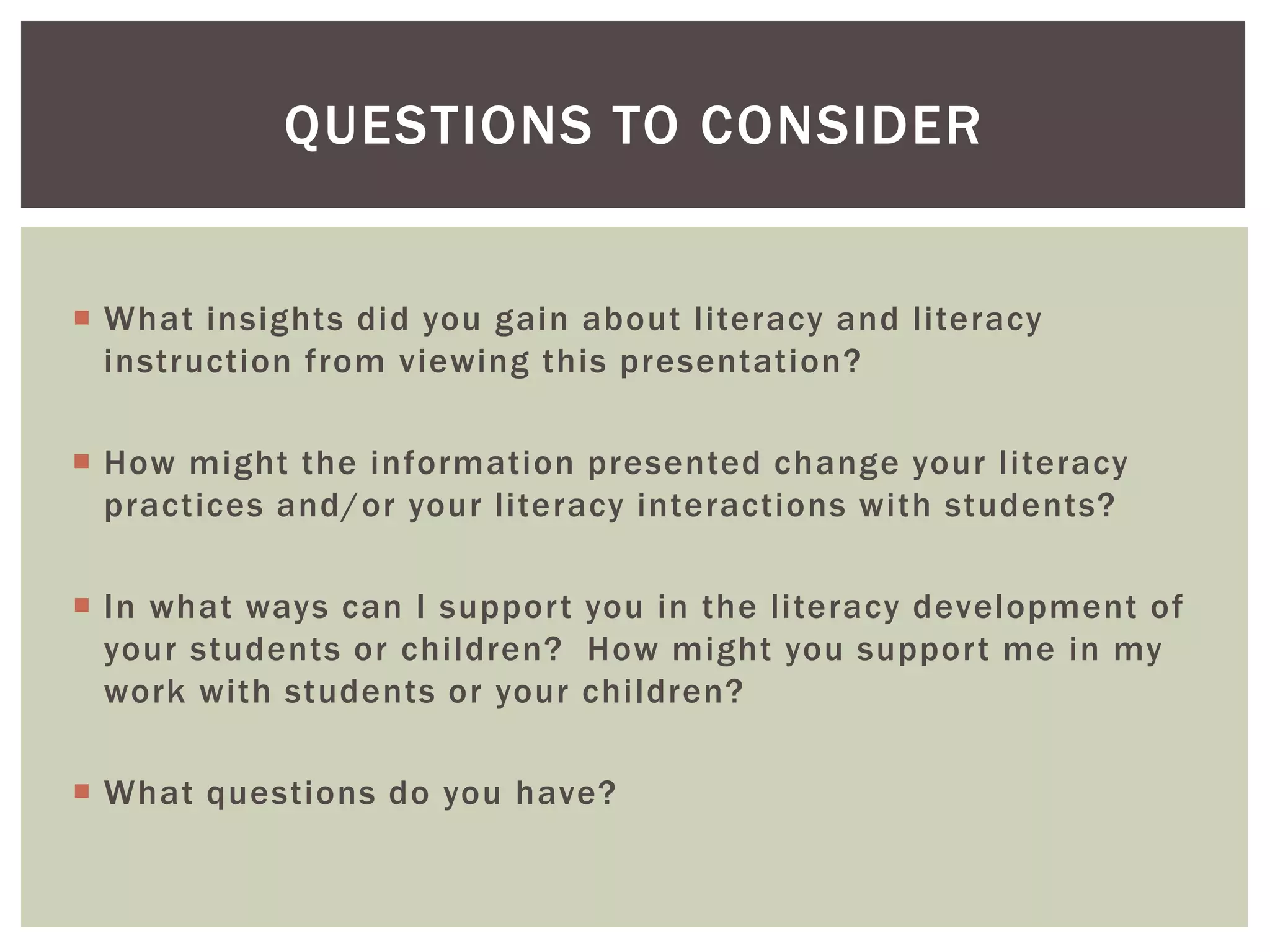
QUESTIONS TO CONSIDER 
 What insights did you gain about l iteracy and l iteracy 
instruction from viewing this presentation? 
 How might the information presented change your l iteracy 
practices and/or your l iteracy interactions with students? 
 In what ways can I suppor t you in the l iteracy development of 
your students or chi ldren? How might you suppor t me in my 
work with students or your chi ldren? 
 What questions do you have?
REFERENCES 
Af f lerbach, P. (2012) . Under standing and using reading assessment K–12 
(2nd ed. ) . Newark, DE: Internat ional Reading Associat ion . 
Azar ian, M. (2000) . A G a r d e n e r ’ s A l p h a b e t . Boston: Houghton Mi f f l in 
Ehler t , L. (1990) . Growing Vegetable Soup. Boston: Houghton Mi f f l in Harcour t 
Fountas, I .C. , & Pinnel l , G.S. (2010) . Fountas & Pinnel l 
benchmark as sessment s ys tem 1, 
Grades K-2, levels A-N. Por tsmouth, NH: Heinemann . 
Kel ler, H. (2003) . What I See. Or land: Green Light Reader s/Harcour t 
Laureate Educat ion (Producer ) . ( n.d.a) . Analyz ing and select ing text 
[Video f i le] . Ret r ieved f rom ht tps://class.waldenu.edu 
Laureate Educat ion (Producer ) . ( n.d.b) . Get t ing to know your 
s tudents. [Video f i le] . 
Ret r ieved f rom ht tps://class.waldenu.edu
REFERENCES 
Laureate Educat ion (Producer ) . (n.d.c) .Per spect ives on l i teracy learning . 
[Video f i le] . Ret r ieved f rom ht tps://class.waldenu.edu 
McKenna, M. C. , & Kear , D. J . (1990) . Measur ing at t i tude toward 
reading: A new tool for teacher s. The Reading Teacher, 
43(9) , 626-639. Ret r ieved f rom the Educat ion Research 
Complete database. 
Ryan, C. (2014) . I t Is Spr ing. 
Ret r ieved f rom 
ht tp://www. readinga-z .com/books/leveledbooks/book /?id=23 
Ryan, C. (2014) . Vegetables . 
Ret r ieved f rom 
ht tp://www. readinga-z .com/books/leveled-books/book/?id=653 
Saunder s-Smi th, G. (1998) . Beans. Mankato, Minnesota: Pebble Books 
Tompkins , G. E. (2010) . Li teracy for the 21st centur y: A 
balanced approach (5th ed. ) . Boston: Al lyn & Bacon.

Literate environment analysis presentation

  • 1.
    Presentation by: Chrisoula Koutoulas Walden Universi ty EDUC 6706: The Beginning Reader, PreK-3 CREATING A LITERATE ENVIRONMENT
  • 2.
     Getting toknow literacy learners  Assessing students’ cognitive and noncognitive abilities  Selecting engaging and appropriate texts to motivate students  Integrating the three literacy perspectives  Interactive  Critical  Response COMPONENTS OF A LITERATE ENVIRONMENT
  • 3.
    GETTING TO KNOWLITERACY LEARNERS The process of creat ing a l i terate envi ronment is not an easy task. I t requi res ski l l ful use of data gathered from cogni tive and noncogni tive assessments about student per formance, thei r mot ivat ions and sel f - percept ion towards reading, thei r l i teracy needs and final ly expectat ions of students, parents and teachers. The bet ter you know your students, the bet ter you can connect them wi th texts that wi l l impact them in profound ways (Laureate Educat ion Producer, n.d.b) . Student data, gathered from these di f ferent types of assessments, can guide an educator in creat ing an individual ized bluepr int and selecting appropr iate books that can essent ial ly promote mot ivat ion and imp r ov e a s t u d e n t ’ s a c h i e v eme n t i n r e a d i n g .
  • 4.
    GETTING TO KNOWLITERACY LEARNERS Assessment is ongoing and provides immediate feedback to improve teaching and learning for al l students (Tompkins, 2010, p. 75) .  Cogni t ive Assessment : The Fountas & Pinnel l (2010) formal reading a s s e s sme n t p r o v i d e d i n f o rma t i o n a b o u t e a c h s t u d e n t ’ s p h o n emi c a w a r e n e s s ski l ls; blending and segment ing ski l ls; sight word recogni t ion; reading accuracy and f luency; comprehension ski l ls; any use of reading st rategies and inst ruct ional reading level .  Noncogni t ive Assessment : The Elementar y Reading At t i tude Sur vey (McKenna & Kear, 1990) provided informat ion that did not per tain to thei r reading per formance, but was equal ly as impor tant . I t is impor tant to assess factor s such as mot ivat ion and sel f-esteem because these are both possible outcomes of becoming a bet ter reader (Af f lerbach, 2012, p. 174) . This assessment gave me v a l u a b l e i n s i g h t i n t o my s t u d e n t s ’ s e l f-percept ions and at t i tudes regarding reading in order to view the chi ld as a whole. This informat ion assisted me in select ing books that would interest and mot ivate them.
  • 5.
    SELECTING TEXTS Selecting engaging and appropriate texts for students is a crucial par t of inst ruct ion in the classroom yet , the process of matching them to the needs and interests of students can be qui te chal lenging due to the overwhelming amount of resources there are. In to d a y ’ s l i t e r a c y classroom, you wi l l f ind many di f ferent forms of text f rom pr inted books to digi tal media (Laureate Educat ion Producer, n.d.a) . Each has an imp o r t a n t p l a c e i n to d a y ’ s c l a s s r o om a n d c a n b e e q u a l l y b e n e f i c i a l i f t h e r ight one is matched wi th the r ight student . Once the reading level , l i teracy needs and mot ivat ions are determined teachers can star t choosing appropriate texts for thei r l i teracy inst ruct ion wi th the assistance of the Li teracy Mat r ix that is discussed by Dr. Douglas Har tman and Dr. Janice Almasi (Laureate Educat ion Producer, n.d.a) .
  • 6.
    SELECTING TEXTS TheLi teracy Mat r ix al lows teachers to keep l i teracy goals in mind whi le thought ful ly analyzing and select ing text that are helpful and engaging to each student (Laureate Educat ion Producer, n.d.a) . The four quadrants, as Dr. Douglas Har tman descr ibed them, are nar rat ive, informat ional , l inguist ic and semiot ic (Laureate Educat ion Producer, n.d.a) . In addi t ion, Dr. Janice Almasi discussed a thi rd dimension, which is di f f icul ty. This thi rd dimension has var ious areas to consider, such as readabi l i ty, text length, text st ructure, size of pr int and visual suppor t (Laureate Educat ion Producer, n.d.a) .
  • 7.
    SELECTING TEXTS Usingthe cogni tive and noncogni tive assessment resul ts as wel l as the Li teracy Matrix, I was able to choose appropriate and engaging texts for my students that were at the beginning stages of l i teracy development .  Narrat ive texts: Growing Vegetable Soup by Lois Ehler t (1990) What I See by Hol ly Kel ler (2003)  Informat ional texts: Beans by Gai l Saunders-Smi th (1998) A Garde n e r ’s Al ph abet by Mar y Azarian (2000)  Onl ine texts: It Is Spring by Cheryl Ryan (2014) Vegetables by Cheryl Ryan (2014)
  • 8.
    LITERACY LEARNING PERSPECTIVES In order to have a balanced l i teracy program and create wel l - rounded readers that not only can read, but who choose to read, who are mot ivated to read and can think cr i t ical ly, educators must consider al l three l i teracy perspect ives, interact ive, cr i t ical and response. The f ramework for l i teracy inst ruct ion highl ights these three perspect ives (Laureate Educat ion Producer, n.d.c) .  Interact ive Perspect ive: Teaching students how to read and be st rategic processors and thinkers.  Cr i t ical Perspect ive: Teaching students how to cr i t ical ly examine text and view texts f rom var ious perspect ives.  Response Perspect ive: Teaching students how to connect through l ived exper iences and respond to texts.
  • 9.
    INTERACTIVE PERSPECTIVE In the interact ive perspect ive teachers are mainly focusing on teaching students how to read by using reading st rategies and becoming st rategic thinkers (Laureate Educat ion Producer, n.d.c) . Beginning readers need to learn how to be st rategic and metacogni t ive in order to comprehend text bet ter, but this does not come natural ly to them, thus i t needs to be careful ly thought out and implemented through a plan. Teaching st rategies used to explore the theme of plant l i fe cycles in my l i teracy lesson using the interact ive perspect ive include:  Act ivat ing pr ior knowledge or schema  KWL Char t  Making predicat ions  Think aloud  Guided reading
  • 10.
    CRITICAL AND RESPONSEPERSPECTIVES  The cr i t ical perspect ive is a way to teach students how to cr i t ical ly examine text and perhaps view var ious perspect ives of a stor y beyond what they just read or see (Laureate Educat ion Producer, n.d.c) .  The response perspect ive the r e a d e r ’ s l i v e d ex p e r i e n c e s a r e of pr imary impor tance and t ime to al low the oppor tuni ty to exper ience and respond should be given (Laureate Educat ion Producer, n.d.c) . Teaching st rategies used to explore the theme of plant l i fe cycles in my l i teracy lesson using the cr i t ical perspect ive include:  Making predict ions  Quest ioning the author  Analyzing characters Teaching st rategies used to explore the theme of plant l i fe cycles in my l i teracy lesson to implement the response perspect ive include:  Read aloud  Grand conversat ion  Response Journals
  • 11.
    QUESTIONS TO CONSIDER  What insights did you gain about l iteracy and l iteracy instruction from viewing this presentation?  How might the information presented change your l iteracy practices and/or your l iteracy interactions with students?  In what ways can I suppor t you in the l iteracy development of your students or chi ldren? How might you suppor t me in my work with students or your chi ldren?  What questions do you have?
  • 12.
    REFERENCES Af flerbach, P. (2012) . Under standing and using reading assessment K–12 (2nd ed. ) . Newark, DE: Internat ional Reading Associat ion . Azar ian, M. (2000) . A G a r d e n e r ’ s A l p h a b e t . Boston: Houghton Mi f f l in Ehler t , L. (1990) . Growing Vegetable Soup. Boston: Houghton Mi f f l in Harcour t Fountas, I .C. , & Pinnel l , G.S. (2010) . Fountas & Pinnel l benchmark as sessment s ys tem 1, Grades K-2, levels A-N. Por tsmouth, NH: Heinemann . Kel ler, H. (2003) . What I See. Or land: Green Light Reader s/Harcour t Laureate Educat ion (Producer ) . ( n.d.a) . Analyz ing and select ing text [Video f i le] . Ret r ieved f rom ht tps://class.waldenu.edu Laureate Educat ion (Producer ) . ( n.d.b) . Get t ing to know your s tudents. [Video f i le] . Ret r ieved f rom ht tps://class.waldenu.edu
  • 13.
    REFERENCES Laureate Education (Producer ) . (n.d.c) .Per spect ives on l i teracy learning . [Video f i le] . Ret r ieved f rom ht tps://class.waldenu.edu McKenna, M. C. , & Kear , D. J . (1990) . Measur ing at t i tude toward reading: A new tool for teacher s. The Reading Teacher, 43(9) , 626-639. Ret r ieved f rom the Educat ion Research Complete database. Ryan, C. (2014) . I t Is Spr ing. Ret r ieved f rom ht tp://www. readinga-z .com/books/leveledbooks/book /?id=23 Ryan, C. (2014) . Vegetables . Ret r ieved f rom ht tp://www. readinga-z .com/books/leveled-books/book/?id=653 Saunder s-Smi th, G. (1998) . Beans. Mankato, Minnesota: Pebble Books Tompkins , G. E. (2010) . Li teracy for the 21st centur y: A balanced approach (5th ed. ) . Boston: Al lyn & Bacon.