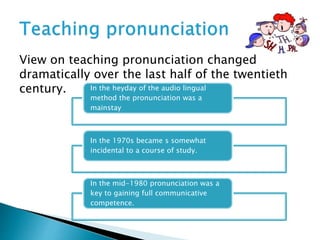
View on teaching pronunciation changed
dramatically over the last half of the twentieth
century. In the heyday of the audio lingual
method the pronunciation was a
mainstay
In the 1970s became s somewhat
incidental to a course of study.
In the mid-1980 pronunciation was a
key to gaining full communicative
competence.
Current approaches to pronunciation contrast with
the early approaches.
Not only bottom up approach build a learner’s
articulatory competence but also top down
approach of pronunciation- stress, rhythm ,and
intonation is important.
Our goal as a teachers of English
Pronunciation should be more
Realistically focused on clear ,
Comprehensible pronunciation.
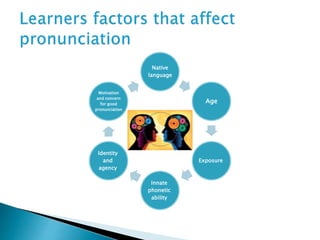
Native
language
Age
Exposure
Innate
phonetic
ability
Identity
and
agency
Motivation
and concern
for good
pronunciation
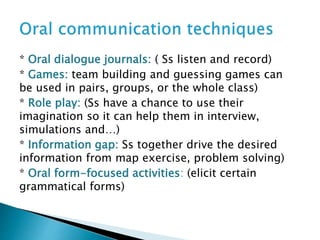
* Oral dialogue journals: ( Ss listen and record)
* Games: team building and guessing games can
be used in pairs, groups, or the whole class)
* Role play: (Ss have a chance to use their
imagination so it can help them in interview,
simulations and…)
* Information gap: Ss together drive the desired
information from map exercise, problem solving)
* Oral form-focused activities: (elicit certain
grammatical forms)
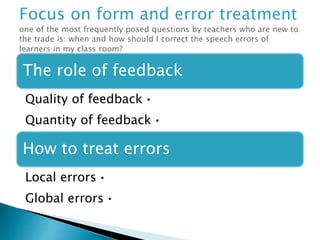
The role of feedback
•Quality of feedback
•Quantity of feedback
How to treat errors
•Local errors
•Global errors
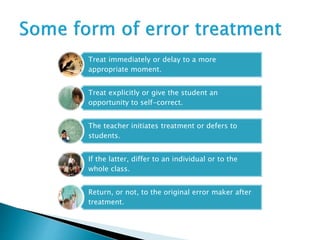
Treat immediately or delay to a more
appropriate moment.
Treat explicitly or give the student an
opportunity to self-correct.
The teacher initiates treatment or defers to
students.
If the latter, differ to an individual or to the
whole class.
Return, or not, to the original error maker after
treatment.
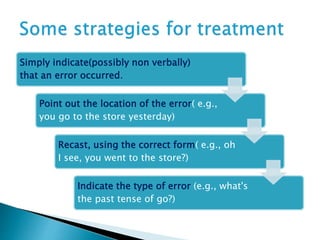
Simply indicate(possibly non verbally)
that an error occurred.
Point out the location of the error( e.g.,
you go to the store yesterday)
Recast, using the correct form( e.g., oh
I see, you went to the store?)
Indicate the type of error (e.g., what's
the past tense of go?)
The teacher do not always
have to be the person who
provides the treatment.
Manner of treatment varies
according to the input to the
student, the directness of the
treatment, the students
output, and your follow up.
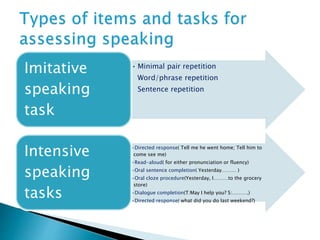
• Minimal pair repetition
Word/phrase repetition
Sentence repetition
Imitative
speaking
task
•Directed response( Tell me he went home; Tell him to
come see me)
•Read-aloud( for either pronunciation or fluency)
•Oral sentence completion( Yesterday……… )
•Oral cloze procedure(Yesterday, I………to the grocery
store)
•Dialogue completion(T:May I help you? S:……….)
•Directed response( what did you do last weekend?)
Intensive
speaking
tasks
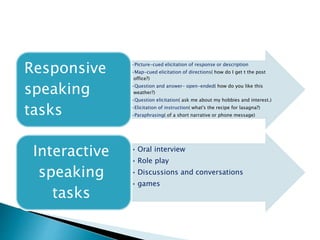
•Picture-cued elicitation of response or description
•Map-cued elicitation of directions( how do I get t the post
office?)
•Question and answer- open-ended( how do you like this
weather?)
•Question elicitation( ask me about my hobbies and interest.)
•Elicitation of instruction( what's the recipe for lasagna?)
•Paraphrasing( of a short narrative or phone message)
Responsive
speaking
tasks
• Oral interview
• Role play
• Discussions and conversations
• games
Interactive
speaking
tasks
• Oral presentations
• Picture-cued
• Retelling story
• translation[into the l2] of an
extended text(short story,
news article.
Extensive
speaking
tasks
Dr. H. Douglas Brown(Teaching Pronunciation)

Dr. H. Douglas Brown(Teaching Pronunciation)

  • 2.
    View on teachingpronunciation changed dramatically over the last half of the twentieth century. In the heyday of the audio lingual method the pronunciation was a mainstay In the 1970s became s somewhat incidental to a course of study. In the mid-1980 pronunciation was a key to gaining full communicative competence.
  • 3.
    Current approaches topronunciation contrast with the early approaches. Not only bottom up approach build a learner’s articulatory competence but also top down approach of pronunciation- stress, rhythm ,and intonation is important. Our goal as a teachers of English Pronunciation should be more Realistically focused on clear , Comprehensible pronunciation.
  • 4.
  • 5.
    * Oral dialoguejournals: ( Ss listen and record) * Games: team building and guessing games can be used in pairs, groups, or the whole class) * Role play: (Ss have a chance to use their imagination so it can help them in interview, simulations and…) * Information gap: Ss together drive the desired information from map exercise, problem solving) * Oral form-focused activities: (elicit certain grammatical forms)
  • 6.
    The role offeedback •Quality of feedback •Quantity of feedback How to treat errors •Local errors •Global errors
  • 7.
    Treat immediately ordelay to a more appropriate moment. Treat explicitly or give the student an opportunity to self-correct. The teacher initiates treatment or defers to students. If the latter, differ to an individual or to the whole class. Return, or not, to the original error maker after treatment.
  • 8.
    Simply indicate(possibly nonverbally) that an error occurred. Point out the location of the error( e.g., you go to the store yesterday) Recast, using the correct form( e.g., oh I see, you went to the store?) Indicate the type of error (e.g., what's the past tense of go?)
  • 9.
    The teacher donot always have to be the person who provides the treatment. Manner of treatment varies according to the input to the student, the directness of the treatment, the students output, and your follow up.
  • 10.
    • Minimal pairrepetition Word/phrase repetition Sentence repetition Imitative speaking task •Directed response( Tell me he went home; Tell him to come see me) •Read-aloud( for either pronunciation or fluency) •Oral sentence completion( Yesterday……… ) •Oral cloze procedure(Yesterday, I………to the grocery store) •Dialogue completion(T:May I help you? S:……….) •Directed response( what did you do last weekend?) Intensive speaking tasks
  • 11.
    •Picture-cued elicitation ofresponse or description •Map-cued elicitation of directions( how do I get t the post office?) •Question and answer- open-ended( how do you like this weather?) •Question elicitation( ask me about my hobbies and interest.) •Elicitation of instruction( what's the recipe for lasagna?) •Paraphrasing( of a short narrative or phone message) Responsive speaking tasks • Oral interview • Role play • Discussions and conversations • games Interactive speaking tasks
  • 12.
    • Oral presentations •Picture-cued • Retelling story • translation[into the l2] of an extended text(short story, news article. Extensive speaking tasks