THE LISTENING PROCESS
(HURIER MODEL)

PRIMALEE P. ENCARNACION
BSED III
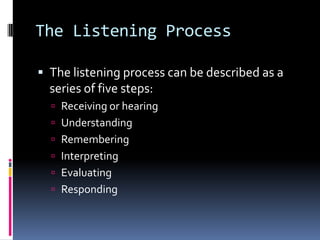
The Listening Process

 The listening process can be described as a
  series of five steps:
   Receiving or hearing
   Understanding
   Remembering
   Interpreting
   Evaluating
   Responding
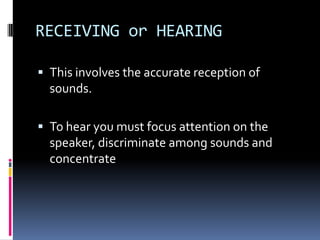
RECEIVING or HEARING

 This involves the accurate reception of
  sounds.

 To hear you must focus attention on the
  speaker, discriminate among sounds and
  concentrate
UNDERSTANDING

 This takes into consideration the thoughts
  that are expressed as well as the emotional
  tone that accompanies these thoughts.

 It likewise includes establishing links
  between what the listener know about the
  topic and the new information given by the
  speaker.
REMEMBERING

 This is retaining messages for at least some
  period of time.

 What you remember is actually not what was
  said but what you think was said.
INTERPRETING
 When you interpret messages you do two
  things.
   First, you take into account the total communication
    context so that you are better able to understand the
    meaning of what is said from the speaker’s point of
    view. Your ability to see a situation from the other
    person’s perspective, requires that you pay attention
    to emotional meaning and to the communication
    context.
 Second, effective listeners let their partners
  know that they have been understood.
EVALUATING

 You listen from a unique point of view and are
  influenced by your perceptual filters – your
  past experience, attitudes, personal values
  and predispositions.
 It is therefore impossible not to evaluate to
  some extent, everything you hear.
 Effective listeners should deliberately reduce
  the influence of their own viewpoint until
  they have first understood the speaker’s
  ideas.
RESPONDING

 This is when you send signals while the
  speaker is talking to let him know that he is
  understood and responding after the speaker
  has stopped talking.
 This stage marks the start of a new cycle
  where the listener takes his turn as a speaker.

The listening process

  • 1.
    THE LISTENING PROCESS (HURIERMODEL) PRIMALEE P. ENCARNACION BSED III
  • 2.
    The Listening Process The listening process can be described as a series of five steps:  Receiving or hearing  Understanding  Remembering  Interpreting  Evaluating  Responding
  • 3.
    RECEIVING or HEARING This involves the accurate reception of sounds.  To hear you must focus attention on the speaker, discriminate among sounds and concentrate
  • 4.
    UNDERSTANDING  This takesinto consideration the thoughts that are expressed as well as the emotional tone that accompanies these thoughts.  It likewise includes establishing links between what the listener know about the topic and the new information given by the speaker.
  • 5.
    REMEMBERING  This isretaining messages for at least some period of time.  What you remember is actually not what was said but what you think was said.
  • 6.
    INTERPRETING  When youinterpret messages you do two things.  First, you take into account the total communication context so that you are better able to understand the meaning of what is said from the speaker’s point of view. Your ability to see a situation from the other person’s perspective, requires that you pay attention to emotional meaning and to the communication context.
  • 7.
     Second, effectivelisteners let their partners know that they have been understood.
  • 8.
    EVALUATING  You listenfrom a unique point of view and are influenced by your perceptual filters – your past experience, attitudes, personal values and predispositions.  It is therefore impossible not to evaluate to some extent, everything you hear.  Effective listeners should deliberately reduce the influence of their own viewpoint until they have first understood the speaker’s ideas.
  • 9.
    RESPONDING  This iswhen you send signals while the speaker is talking to let him know that he is understood and responding after the speaker has stopped talking.  This stage marks the start of a new cycle where the listener takes his turn as a speaker.