Technologies

Technology & Strategy – Week 10

Monday 3/12/12
Agenda

   Administrative Stuff
   IT News
   Technology & Strategy
Administrivia

   Check course outline!
   Academic technologies 4/2/12
   Group Assignment #2 due today at 10AM
    from every group member
   Assignment #7A (security & jobs.html)
    due at 10AM on Thursday 3/15/12
   Monday 3/19/12 – Career Fair
IT News

   What's going on in Austin, TX?
    – SXSW & "social discovery" tools
       • Highlight
       • Sonar
   Kony & Slacktivism
   New iPad
   March 12, 1923
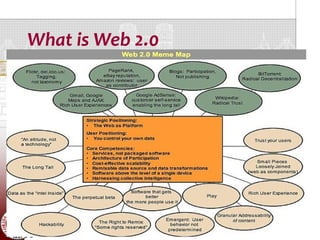
What is Web 2.0
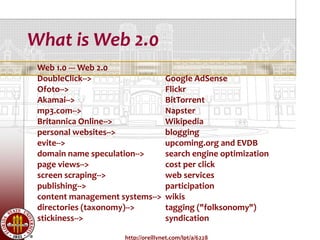
 Web 1.0 --- Web 2.0
 DoubleClick-->                     Google AdSense
 Ofoto-->                           Flickr
 Akamai-->                          BitTorrent
 mp3.com-->                         Napster
 Britannica Online-->               Wikipedia
 personal websites-->               blogging
 evite-->                           upcoming.org and EVDB
 domain name speculation-->         search engine optimization
 page views-->                      cost per click
 screen scraping-->                 web services
 publishing-->                      participation
 content management systems-->      wikis
 directories (taxonomy)-->          tagging ("folksonomy")
 stickiness-->                      syndication

                     http://oreillynet.com/lpt/a/6228
What is Web 2.0
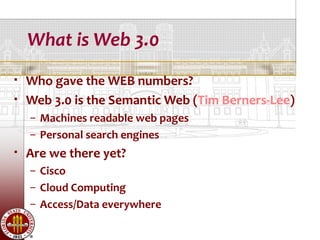
What is Web 3.0
   Who gave the WEB numbers?
   Web 3.0 is the Semantic Web (Tim Berners-Lee)
    – Machines readable web pages
    – Personal search engines
   Are we there yet?
    – Cisco
    – Cloud Computing
    – Access/Data everywhere
Critical Questions

   Given the large number of choices and the
    rate of new innovations in IT:
    – How are you using information technology (IT)
      today in your firms and businesses?

    – How successful has this been for your firm?

    – Do you have problems that are still unresolved
      with Information Technology?
Critical Questions
   Given the large number of choices and the
    rate of new innovations in IT:
    – What is Competitive Advantage?

    – Can IT give competitive advantage, anyway?

    – How can one identify which technologies will
      best give strategic advantage?

    – Does TECHNOLOGY give you a competitive
      advantage?
Critical Questions
     What is the role of IT in the business?

     Is IT a tool, a strategic investment, a
      technology option, a competitive
      advantage?

     Who makes technology decisions?

     What is the time frame?
IT SYSTEMS

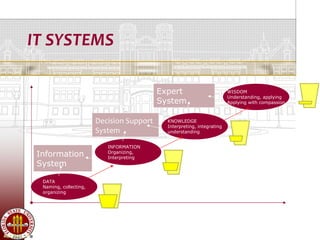
                                                       Expert                        WISDOM
                                                                                     Understanding, applying
                                                       System                        Applying with compassion


                                    Decision Support     KNOWLEDGE
                                                         Interpreting, integrating
                                    System               understanding


                                       INFORMATION
             Information               Organizing,
                                       Interpreting
             System

              DATA
              Naming, collecting,
              organizing


Randeree ©
Types of IT Systems

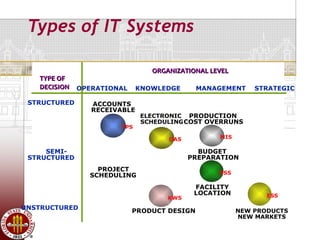
                               ORGANIZATIONAL LEVEL
   TYPE OF
   DECISION OPERATIONAL     KNOWLEDGE      MANAGEMENT     STRATEGIC

 STRUCTURED    ACCOUNTS
               RECEIVABLE
                            ELECTRONIC PRODUCTION
                            SCHEDULING COST OVERRUNS
                     TPS

                                   OAS          MIS

     SEMI-                                 BUDGET
 STRUCTURED                              PREPARATION
                 PROJECT
                                                DSS
               SCHEDULING
                                          FACILITY
                                          LOCATION           ESS
                                   KWS
UNSTRUCTURED
                          PRODUCT DESIGN              NEW PRODUCTS
                                                      NEW MARKETS
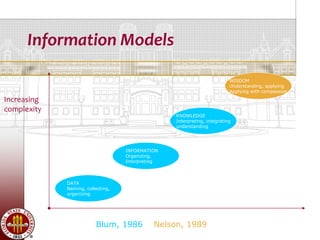
Information Models

                                                                          WISDOM
                                                                          Understanding, applying
                                                                          Applying with compassion

Increasing
complexity
                                                  KNOWLEDGE
                                                  Interpreting, integrating
                                                  understanding


                                   INFORMATION
                                   Organizing,
                                   Interpreting


             DATA
             Naming, collecting,
             organizing


                         Blum, 1986          Nelson, 1989
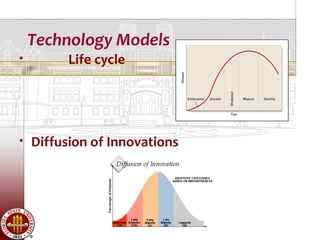
Technology Models
         Life cycle


   Diffusion of Innovations
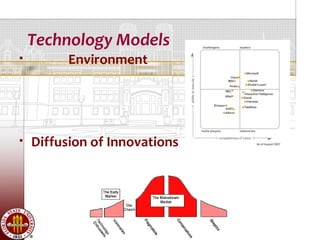
Technology Models
         Environment


   Diffusion of Innovations
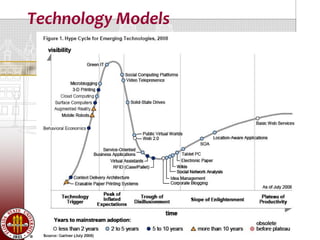
Technology Models
Systems Development Life Cycle (SDLC)


• Systems development life cycle (SDLC)
   • a structured step-by-step approach for developing
     information systems
• Typical activities include:
      •   Determining budgets
      •   Gathering business requirements and user needs
      •   Designing models
      •   Writing user documentation
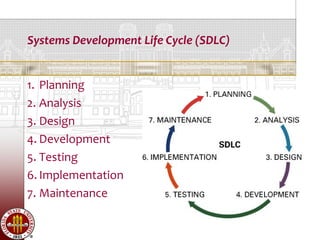
Systems Development Life Cycle (SDLC)


1. Planning
2. Analysis
3. Design
4. Development
5. Testing
6. Implementation
7. Maintenance
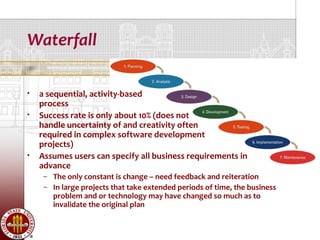
Waterfall

   a sequential, activity-based
    process
   Success rate is only about 10% (does not
    handle uncertainty of and creativity often
    required in complex software development
    projects)
   Assumes users can specify all business requirements in
    advance
     – The only constant is change – need feedback and reiteration
     – In large projects that take extended periods of time, the business
       problem and or technology may have changed so much as to
       invalidate the original plan
Rapid Application
Development (RAD)
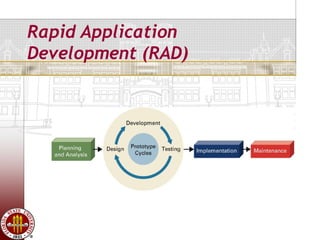
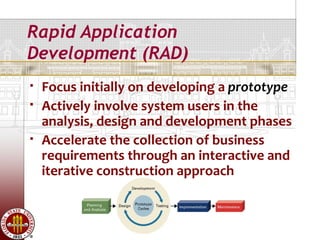
Rapid Application
Development (RAD)
   Focus initially on developing a prototype
   Actively involve system users in the
    analysis, design and development phases
   Accelerate the collection of business
    requirements through an interactive and
    iterative construction approach
Extreme Programming (XP)

   breaks a project into tiny phases and developers
    cannot continue on to the next phase until the first
    phase is complete
     – Individually, the pieces make no sense until they
       are combined together- much like a jigsaw
       puzzle
     – Difference with the waterfall is that XP divides
       its phases into iterations
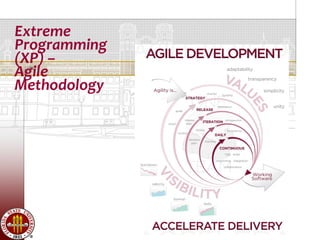
   Agile methodology is a form of XP; break project
    into smaller projects and deliver on each
    separately
Extreme
Programming
(XP) –
Agile
Methodology
Other Choices?

   Outsourcing
   Prototyping
   ASPs –
   XSPs?
Business Drivers

   Business changes are faster
   Role of globalization
   IT = innovation and competitive advantage
   A survey of CEOs say “IT enables & transforms” – 84%
     – “Management recognizes technology as central to
        innovation and competitive advantage... more CIOs
        are gaining a prominent seat at the table in their
        executive teams and are playing an active role in
        strategic business decisions."
     – CIOs have end-to-end view of business
Problems

   Enrollment in IT college programs declining
   Perception that IT jobs are decreasing


   Desired skills in entry level candidates:
       Programming
       Support/help desk

   Roles most likely to be outsourced/offshore:
       Programming
       Support/help desk
Problems

   Result
    – “That’s HR... And not meeting my needs”
    – “IT people leave in 2-3 years”
    – “Where is the ROI”

   “Young workers pose a confounding
    problem... Lofty expectations and a near
    total lack of loyalty have conspired to make
    young workers entirely unpredictable”
    (CIO Insight)
It's not just about hiring

   Engagement
   Leadership Development
   Succession Planning
   Learning & Development
   Coaching & Mentoring
   Sourcing Strategy
   Building Business Acumen
   Skills Inventory
   Resource Management
   Integrated process & data
week 14


It's not just about hiring

   Relationship Management
   Leadership
   Business Acumen
   Global Perspective
   Strategy  Execution
   Collaborative and Partnering
    If people are your greatest asset….
        •Know your talent needs
        •Define your pipeline
        •Invest in your people
Questions?

LIS3353 SP12 Week 10

  • 1.
    Technologies Technology & Strategy– Week 10 Monday 3/12/12
  • 2.
    Agenda  Administrative Stuff  IT News  Technology & Strategy
  • 3.
    Administrivia  Check course outline!  Academic technologies 4/2/12  Group Assignment #2 due today at 10AM from every group member  Assignment #7A (security & jobs.html) due at 10AM on Thursday 3/15/12  Monday 3/19/12 – Career Fair
  • 4.
    IT News  What's going on in Austin, TX? – SXSW & "social discovery" tools • Highlight • Sonar  Kony & Slacktivism  New iPad  March 12, 1923
  • 5.
    What is Web2.0 Web 1.0 --- Web 2.0 DoubleClick--> Google AdSense Ofoto--> Flickr Akamai--> BitTorrent mp3.com--> Napster Britannica Online--> Wikipedia personal websites--> blogging evite--> upcoming.org and EVDB domain name speculation--> search engine optimization page views--> cost per click screen scraping--> web services publishing--> participation content management systems--> wikis directories (taxonomy)--> tagging ("folksonomy") stickiness--> syndication http://oreillynet.com/lpt/a/6228
  • 6.
  • 7.
    What is Web3.0  Who gave the WEB numbers?  Web 3.0 is the Semantic Web (Tim Berners-Lee) – Machines readable web pages – Personal search engines  Are we there yet? – Cisco – Cloud Computing – Access/Data everywhere
  • 8.
    Critical Questions  Given the large number of choices and the rate of new innovations in IT: – How are you using information technology (IT) today in your firms and businesses? – How successful has this been for your firm? – Do you have problems that are still unresolved with Information Technology?
  • 9.
    Critical Questions  Given the large number of choices and the rate of new innovations in IT: – What is Competitive Advantage? – Can IT give competitive advantage, anyway? – How can one identify which technologies will best give strategic advantage? – Does TECHNOLOGY give you a competitive advantage?
  • 10.
    Critical Questions  What is the role of IT in the business?  Is IT a tool, a strategic investment, a technology option, a competitive advantage?  Who makes technology decisions?  What is the time frame?
  • 11.
    IT SYSTEMS Expert WISDOM Understanding, applying System Applying with compassion Decision Support KNOWLEDGE Interpreting, integrating System understanding INFORMATION Information Organizing, Interpreting System DATA Naming, collecting, organizing Randeree ©
  • 12.
    Types of ITSystems ORGANIZATIONAL LEVEL TYPE OF DECISION OPERATIONAL KNOWLEDGE MANAGEMENT STRATEGIC STRUCTURED ACCOUNTS RECEIVABLE ELECTRONIC PRODUCTION SCHEDULING COST OVERRUNS TPS OAS MIS SEMI- BUDGET STRUCTURED PREPARATION PROJECT DSS SCHEDULING FACILITY LOCATION ESS KWS UNSTRUCTURED PRODUCT DESIGN NEW PRODUCTS NEW MARKETS
  • 13.
    Information Models WISDOM Understanding, applying Applying with compassion Increasing complexity KNOWLEDGE Interpreting, integrating understanding INFORMATION Organizing, Interpreting DATA Naming, collecting, organizing Blum, 1986 Nelson, 1989
  • 14.
    Technology Models  Life cycle  Diffusion of Innovations
  • 15.
    Technology Models  Environment  Diffusion of Innovations
  • 16.
  • 17.
    Systems Development LifeCycle (SDLC) • Systems development life cycle (SDLC) • a structured step-by-step approach for developing information systems • Typical activities include: • Determining budgets • Gathering business requirements and user needs • Designing models • Writing user documentation
  • 18.
    Systems Development LifeCycle (SDLC) 1. Planning 2. Analysis 3. Design 4. Development 5. Testing 6. Implementation 7. Maintenance
  • 19.
    Waterfall  a sequential, activity-based process  Success rate is only about 10% (does not handle uncertainty of and creativity often required in complex software development projects)  Assumes users can specify all business requirements in advance – The only constant is change – need feedback and reiteration – In large projects that take extended periods of time, the business problem and or technology may have changed so much as to invalidate the original plan
  • 20.
  • 21.
    Rapid Application Development (RAD)  Focus initially on developing a prototype  Actively involve system users in the analysis, design and development phases  Accelerate the collection of business requirements through an interactive and iterative construction approach
  • 22.
    Extreme Programming (XP)  breaks a project into tiny phases and developers cannot continue on to the next phase until the first phase is complete – Individually, the pieces make no sense until they are combined together- much like a jigsaw puzzle – Difference with the waterfall is that XP divides its phases into iterations  Agile methodology is a form of XP; break project into smaller projects and deliver on each separately
  • 23.
  • 24.
    Other Choices?  Outsourcing  Prototyping  ASPs –  XSPs?
  • 25.
    Business Drivers  Business changes are faster  Role of globalization  IT = innovation and competitive advantage  A survey of CEOs say “IT enables & transforms” – 84% – “Management recognizes technology as central to innovation and competitive advantage... more CIOs are gaining a prominent seat at the table in their executive teams and are playing an active role in strategic business decisions." – CIOs have end-to-end view of business
  • 26.
    Problems  Enrollment in IT college programs declining  Perception that IT jobs are decreasing  Desired skills in entry level candidates:  Programming  Support/help desk  Roles most likely to be outsourced/offshore:  Programming  Support/help desk
  • 27.
    Problems  Result – “That’s HR... And not meeting my needs” – “IT people leave in 2-3 years” – “Where is the ROI”  “Young workers pose a confounding problem... Lofty expectations and a near total lack of loyalty have conspired to make young workers entirely unpredictable” (CIO Insight)
  • 28.
    It's not justabout hiring  Engagement  Leadership Development  Succession Planning  Learning & Development  Coaching & Mentoring  Sourcing Strategy  Building Business Acumen  Skills Inventory  Resource Management  Integrated process & data
  • 29.
    week 14 It's notjust about hiring  Relationship Management  Leadership  Business Acumen  Global Perspective  Strategy  Execution  Collaborative and Partnering If people are your greatest asset…. •Know your talent needs •Define your pipeline •Invest in your people
  • 30.

Editor's Notes

  • #5 Kony & Slactivism – what is Slacktivism? http://mashable.com/2012/03/09/kony-slacktivism/ The film aims to make Joseph Kony, the leader of Uganda’s Lord’s Resistance Army (LRA), famous for his crimes against humanity, particularly kidnapping and abducting children, and turning them into child soldiers and sex slaves. As of Friday morning, the film has been viewed 70 million times on YouTube and Vimeo and received almost half a million comments. Uganda, LRA, Invisible Children and #stopkony, among other topics related to the film, have trended throughout the week on Twitter. Slacktivism (sometimes slactivism or slackervism) is a term formed out of the words slacker and activism. The word is usually considered a pejorative term that describes "feel-good" measures, in support of an issue or social cause, that have little or no practical effect other than to make the person doing it feel satisfaction. The acts tend to require minimal personal effort from the slacktivist. The underlying assumption being promoted by the term is that these low cost efforts substitute for more substantive actions rather than supplementing them, although this assumption has not been borne out by research. [1] Slacktivist activities include signing Internet petitions,[2] joining a community organization without contributing to the organization's efforts, copying and pasting of Social Network statuses or messages or altering one's personal data or avatar on social network services. New iPad http://www.wired.com/thisdayintech/2012/03/march-12-1923-talkies-talk-on-their-own/
  • #7 What is a meme A meme ( /ˈmiːm/; meem)[1]) is "an idea, behavior or style that spreads from person to person within a culture."[2] A meme acts as a unit for carrying cultural ideas, symbols or practices, which can be transmitted from one mind to another through writing, speech, gestures, rituals or other imitable phenomena. Supporters of the concept regard memes as cultural analogues to genes in that they self-replicate, mutate and respond to selective pressures.[3] The word meme is a shortening (modeled on gene) of mimeme (from Ancient Greek μίμημα Greek pronunciation: [míːmɛːma] mīmēma, "something imitated", from μιμεῖσθαι mimeisthai, "to imitate", from μῖμος mimos "mime")[4] and it was coined by the British evolutionary biologist Richard Dawkins in The Selfish Gene (1976)[1][5] as a concept for discussion of evolutionary principles in explaining the spread of ideas and cultural phenomena. Examples of memes given in the book included melodies, catch-phrases, fashion and the technology of building arches.[6] Proponents theorize that memes may evolve by natural selection in a manner analogous to that of biological evolution. Memes do this through the processes of variation, mutation, competition and inheritance, each of which influence a meme's reproductive success. Memes spread through the behaviors that they generate in their hosts. Memes that propagate less prolifically may become extinct, while others may survive, spread and (for better or for worse) mutate. Memes that replicate most effectively enjoy more success, and some may replicate effectively even when they prove to be detrimental to the welfare of their hosts.[7] A field of study called memetics[8] arose in the 1990s to explore the concepts and transmission of memes in terms of an evolutionary model. Criticism from a variety of fronts has challenged the notion that academic study can examine memes empirically. However, developments in neuroimaging may make empirical study possible.[9] Some commentators[who?] question the idea that one can meaningfully categorize culture in terms of discrete units. Others, including Dawkins himself, have argued that this usage of the term is the result of a misunderstanding of the original proposal.[10]
  • #8 Who gave web numbers? Dale Dougherty dreamed up something called Web 2.0, and the idea soon took on a life of its own. In the beginning, it was little more than a rallying cry, a belief that the Internet would rise again. But as Dougherty's O'Reilly Media put together the first Web 2.0 Conference in late 2005, the term seemed to trumpet a particular kind of online revolution, a World Wide Web of the people. Web 2.0 came to describe almost any site, service, or technology that promoted sharing and collaboration right down to the Net's grass roots. That includes blogs and wikis, tags and RSS feeds, del.icio.us and Flickr, MySpace and YouTube. Because the concept blankets so many disparate ideas, some have questioned how meaningful—and how useful—it really is, but there's little doubt it owns a spot in our collective consciousness. Whether or not it makes sense, we now break the history of the Web into two distinct stages: Today we have Web 2.0, and before that there was Web 1.0. The Semantic Web is a collaborative movement led by the World Wide Web Consortium (W3C) [1] that promotes common formats for data on the World Wide Web. By encouraging the inclusion of semantic content in web pages, the Semantic Web aims at converting the current web of unstructured documents into a "web of data". It builds on the W3C's Resource Description Framework (RDF).[2] According to the W3C, "The Semantic Web provides a common framework that allows data to be shared and reused across application, enterprise, and community boundaries."[2] The term was coined by Tim Berners-Lee,[3] the inventor of the World Wide Web and director of the World Wide Web Consortium ("W3C"), which oversees the development of proposed Semantic Web standards. He defines the Semantic Web as "a web of data that can be processed directly and indirectly by machines." While its critics have questioned its feasibility, proponents argue that applications in industry, biology and human sciences research have already proven the validity of the original concept.[4] [ not in citation given ]
  • #19 Planning – defning the system to be developed, set the project scope, develop the project plan Analysis – gather business requirements Design – design the technical architecture, design system models Development - build technical architecture, databases, programs Testing – write test conditions, perform testing Implementation – write user documentation, provide training Maintenance – build a help desk, support system changes
  • #21 emphasizes extensive user involvement in the rapid and evolutionary construction of working prototypes of a system to accelerate the systems development process
  • #22 Prototype: a smaller-scale, representation, or working model of the user's requirements or a proposed design for an information system Iteration means the act of repeating a process usually with the aim of approaching a desired goal or target or result. Each repetition of the process is also called an "iteration," and the results of one iteration are used as the starting point for the next iteration.
  • #25 Outsourcing: the delegation of specific work to a third party for a specified length of time, at a specified cost, and at a specified level of service Prototyping: w/pilot studies ASP Application Services Providers (for software and services) XSPs