Introduction


    Managing Information
         Systems

        Lee SCHLENKER – EMLYON


The EMLYON Business School
Lyon – March 04, 2013
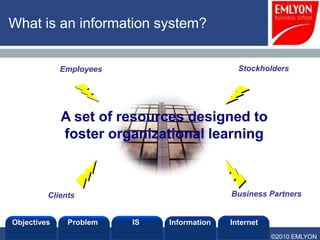
What is an information system?


             Employees                        Stockholders


             A set of resources designed to
             foster organizational learning


         Clients                            Business Partners


Objectives    Problem    IS   Information   Internet
                                                       ©2010 EMLYON
Faciltators


              Dr. Thomas HESS
              thess@bwl.lmu.de


              Dr. John EDWARDS
              j.s.edwards@aston.ac.uk


              Dr. Lee SCHLENKER
              schlenker@em-lyon.com
What role does IT play in innovation?


Objectives   Problem   IS   Information   Internet
                                                     ©2010 EMLYON
©2010 LHST sarl


The objectives


      EMM MIS
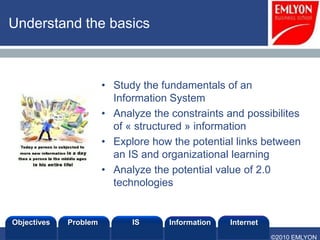
Understand the basics


                       • Study the fundamentals of an
                         Information System
                       • Analyze the constraints and possibilites
                         of « structured » information
                       • Explore how the potential links between
                         an IS and organizational learning
                       • Analyze the potential value of 2.0
                         technologies


Objectives   Problem         IS      Information   Internet
                                                              ©2010 EMLYON
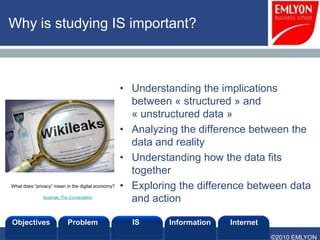
Why is studying IS important?


                                                   • Understanding the implications
                                                     between « structured » and
                                                     « unstructured data »
                                                   • Analyzing the difference between the
                                                     data and reality
                                                   • Understanding how the data fits
                                                     together
What does “privacy” mean in the digital economy?   • Exploring the difference between data
              Assange, The Conversation
                                                     and action

Objectives                Problem                    IS      Information   Internet
                                                                                      ©2010 EMLYON
Evaluation


             • An open book exam 25/03/2013
             • Based on a case study
             • Focus points indentifying :
               – the value proposition,
               – IT/Business alignment,
               – use of IT concepts/methodologies
©2010 LHST sarl


The Problem


    EMM MIS
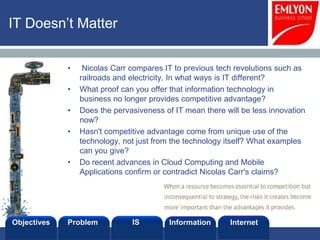
IT Doesn’t Matter


             •    Nicolas Carr compares IT to previous tech revolutions such as
                 railroads and electricity. In what ways is IT different?
             •   What proof can you offer that information technology in
                 business no longer provides competitive advantage?
             •   Does the pervasiveness of IT mean there will be less innovation
                 now?
             •   Hasn't competitive advantage come from unique use of the
                 technology, not just from the technology itself? What examples
                 can you give?
             •   Do recent advances in Cloud Computing and Mobile
                 Applications confirm or contradict Nicolas Carr's claims?


Objectives   Problem           IS         Information      Internet
Commoditisation


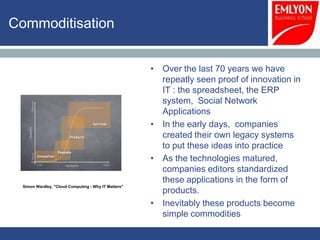
                                                      • Over the last 70 years we have
                                                        repeatly seen proof of innovation in
                                                        IT : the spreadsheet, the ERP
                                                        system, Social Network
                                                        Applications
                                                      • In the early days, companies
                                                        created their own legacy systems
                                                        to put these ideas into practice
                                                      • As the technologies matured,
                                                        companies editors standardized
                                                        these applications in the form of
  Simon Wardley, "Cloud Computing - Why IT Matters"
                                                        products.
                                                      • Inevitably these products become
                                                        simple commodities
Technology and Innovation


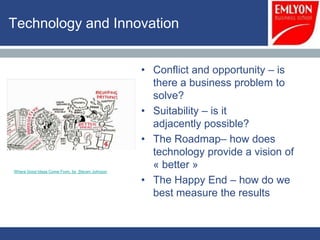
                                                • Conflict and opportunity – is
                                                  there a business problem to
                                                  solve?
                                                • Suitability – is it
                                                  adjacently possible?
                                                • The Roadmap– how does
                                                  technology provide a vision of
Where Good Ideas Come From, by Steven Johnson
                                                  « better »
                                                • The Happy End – how do we
                                                  best measure the results
©2010 LHST sarl


Information


   EMM MIS
The definition of information

                       • From an objective point of view,
                         information refers to date in context that
                         conveys meaning to an individual.
                       • From a subjective point of view, we
                         could suggest that it’s the individual’s
                         perspective of the data that implies
                         meaning.
                       • Given these definitions what meaning
                         do Wikileaks, Twitter, or Facebook
                         have?


Objectives   Problem      IS      Information   Internet
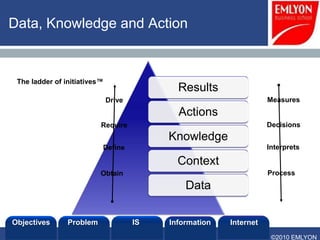
Data, Knowledge and Action


 The ladder of initiatives™
                                             Results
                              Drive                                 Measures
                                             Actions
                          Require                                   Decisions
                                           Knowledge
                          Define                                    Interprets
                                             Context
                          Obtain                                    Process
                                               Data

Objectives      Problem               IS   Information   Internet
                                                                     ©2010 EMLYON
Structured data


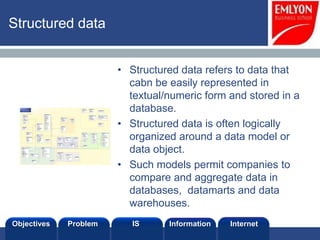
                       • Structured data refers to data that
                         cabn be easily represented in
                         textual/numeric form and stored in a
                         database.
                       • Structured data is often logically
                         organized around a data model or
                         data object.
                       • Such models permit companies to
                         compare and aggregate data in
                         databases, datamarts and data
                         warehouses.
Objectives   Problem      IS     Information   Internet
Non-structured data


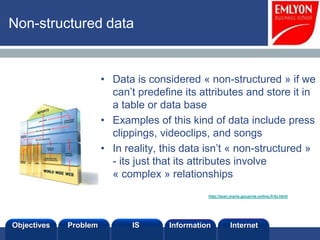
                       • Data is considered « non-structured » if we
                         can’t predefine its attributes and store it in

                         a table or data base
                       • Examples of this kind of data include press
                         clippings, videoclips, and songs
                       • In reality, this data isn’t « non-structured »
                         - its just that its attributes involve
                         « complex » relationships
                                                http://jean.marie.gouarne.online.fr/bi.html


Objectives   Problem          IS      Information          Internet
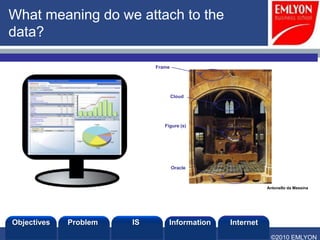
What meaning do we attach to the
data?

                            Frame


                                    Cloud


                               Figure (s)


                                    Oracle


                                                          Antonello da Messina


Objectives   Problem   IS        Information   Internet
                                                           ©2010 EMLYON
©2010 LHST sarl


Information
   Systems


   EMM MIS
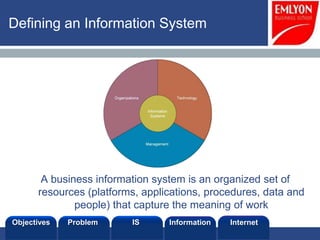
Defining an Information System


       A business information system is an organized set of
      resources (platforms, applications, procedures, data and
              people) that capture the meaning of work
Objectives   Problem     IS      Information   Internet
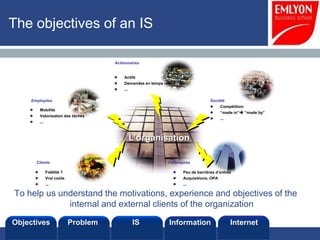
The objectives of an IS

                                         Actionnaires


                                            Actifs
                                            Demandes en temps réel
                                            ...

     Employées                                                                          Société
                                                                                            Compétition
           Mobilité
                                                                                            “made in” “made by”
           Valorisation des tâches
                                                                                            ...
           ...


                                                   L’organisation

        Clients                                                  Partenaires

                 Fidélité ?                                             Peu de barrières d’entrée
                 Vrai coûts                                             Acquisitions, OPA
                 ...                                                    ...

To help us understand the motivations, experience and objectives of the
             internal and external clients of the organization

Objectives                     Problem             IS             Information                      Internet
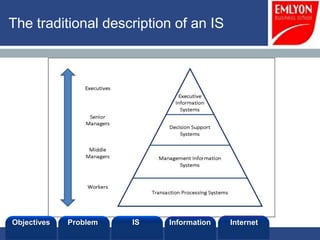
The traditional description of an IS


Objectives   Problem   IS   Information   Internet
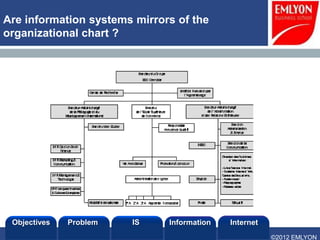
Are information systems mirrors of the
organizational chart ?


 Objectives   Problem   IS    Information   Internet
                                                       ©2012 EMLYON
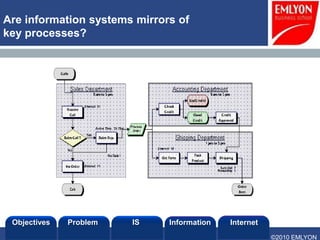
Are information systems mirrors of
key processes?


 Objectives   Problem   IS    Information   Internet
                                                       ©2010 EMLYON
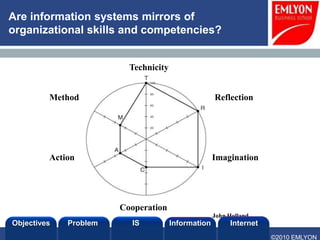
Are information systems mirrors of
organizational skills and competencies?


                         Technicity


         Method                                     Reflection


         Action                                     Imagination


                       Cooperation
                                                    John Holland
Objectives   Problem     IS           Information        Internet
                                                                    ©2010 EMLYON
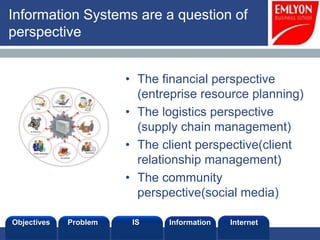
Information Systems are a question of
perspective


                       • The financial perspective
                         (entreprise resource planning)
                       • The logistics perspective
                         (supply chain management)
                       • The client perspective(client
                         relationship management)
                       • The community
                         perspective(social media)

Objectives   Problem    IS    Information   Internet
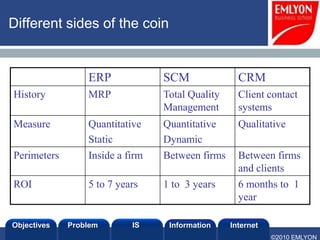
Different sides of the coin


                 ERP             SCM               CRM
History          MRP             Total Quality     Client contact
                                 Management        systems
Measure          Quantitative    Quantitative      Qualitative
                 Static          Dynamic
Perimeters       Inside a firm   Between firms     Between firms
                                                   and clients
ROI              5 to 7 years    1 to 3 years      6 months to 1
                                                   year

Objectives   Problem       IS     Information    Internet
                                                            ©2010 EMLYON
©2010 LHST sarl


The Internet


    EMM MIS
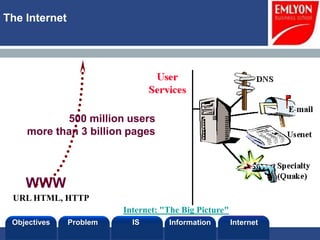
The Internet


           500 million users
    more than 3 billion pages


    WWW
 URL HTML, HTTP
                         Internet: "The Big Picture"
 Objectives    Problem     IS       Information        Internet
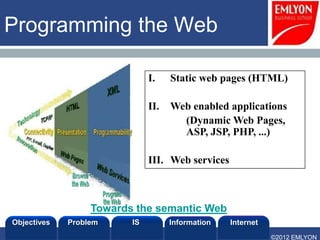
Programming the Web

                              I.    Static web pages (HTML)

                              II.   Web enabled applications
                                      (Dynamic Web Pages,
                                      ASP, JSP, PHP, ...)

                              III. Web services


                  Towards the semantic Web
Objectives   Problem     IS         Information   Internet
                                                             ©2012 EMLYON
The Web as a set of information flows


                       • The Internet is only one
                         component of the Web
                       • Web sites and portals are
                         only isolated endpoints of
                         information flows
                       • We capture the information
                         flows on Twitter, Deezer,
                         Facebook and Netvibes
Objectives   Problem    IS   Information   Internet
Digital footprints and clickstreams


                            • Before the Web we assumed that our
                              digital footprint was as ephemeral as a
                              phone
                            • Clickstreams can provide a level of
                              intelligence about how people use the
                              Web
                            • Innovative companies have figured out
                              how to deliver great Web-based services
                              by divining clickstream patterns
                            • We have yet to aggregate the critical mass
                              of clickstreams in a database of intentions
Objectives            Problem       IS     Information   Internet
Prof. Lee SCHLENKER
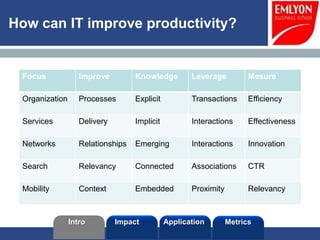
How can IT improve productivity?


 Focus             Improve         Knowledge         Leverage          Mesure

 Organization      Processes       Explicit          Transactions      Efficiency

 Services          Delivery        Implicit          Interactions      Effectiveness

 Networks          Relationships   Emerging          Interactions      Innovation

 Search            Relevancy       Connected         Associations      CTR

 Mobility          Context         Embedded          Proximity         Relevancy


                Intro         Impact          Application        Metrics
©2010 LHST sarl


      Mobile
Applications


    EMM MIS
Zaarly


                          • Zaarly is a buyer-powered
                            market - focus on what people
                            want than what they have
                          • Creates a broad, transparent,
                            and social marketplace
                          • 43 percent of the items are
                            requests for "stuff, 40 percent for
                            services, and 17 percent for
                            "access to experiences“
                          • Business model based on
                            transactional sales

         Intro   Impact   Application     Metrics
Context over Process


                       • Context : The setting
                         (circumstances) in which an event
                         occurs
                       • Process : A structure of activities
                         and tasks in response to customer
                         demands
                       • Processes are models whereas
                         context reflects patterns of
                         interaction
         Saavedra      • Context has geographical and
                         social dimensions
        Intro       Impact    Application   Metrics
Changing IS skills


                     • Analyse the user experience and
                       the context in which they « work »
                     • Design applications essentially
                       from web services
                     • Understand how the various
                       mobile platforms are built
                     • Develop mobile strategies that
                       match the underlying business
                       models

         Intro   Impact    Application   Metrics
Giving « an application » new meaning


                      • Aesthetic, convenient user
                        interface
                      • Asynchronous
                        Communication
                      • Always-on network
                        connectivity
                      • Critical personal data
                      • Built-in interactivity
         Intro   Impact    Application   Metrics
Revenue Models


                 •   Advertising revenue
                 •   Brand Takeovers
                 •   Download fees (and upgrades)
                 •   In-app purchases
                 •   Subscriptions
                 •   Two-sided model (the app as a
                     platform)
                                            Paulina Delgado Soots


       Intro   Impact    Application   Metrics
©2010 LHST sarl


Workshop


  EMM MIS
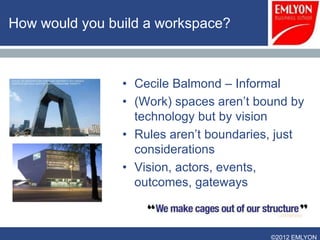
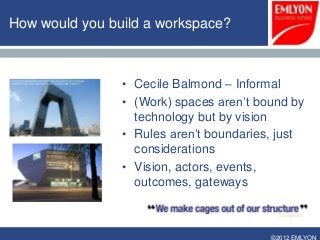
How would you build a workspace?


                • Cecile Balmond – Informal
                • (Work) spaces aren’t bound by
                  technology but by vision
                • Rules aren’t boundaries, just
                  considerations
                • Vision, actors, events,
                  outcomes, gateways


                                         ©2012 EMLYON
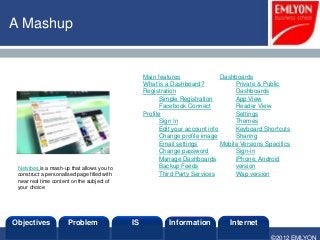
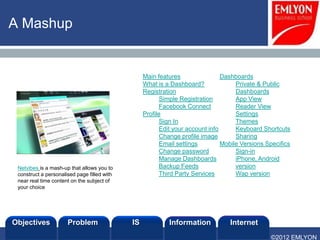
A Mashup


                                                  Main features                 Dashboards
                                                  What is a Dashboard?               Private & Public
                                                  Registration                       Dashboards
                                                         Simple Registration         App View
                                                         Facebook Connect            Reader View
                                                  Profile                            Settings
                                                         Sign In                     Themes
                                                         Edit your account info      Keyboard Shortcuts
                                                         Change profile image        Sharing
                                                         Email settings         Mobile Versions Specifics
                                                         Change password             Sign-in
                                                         Manage Dashboards           iPhone, Android
 Netvibes is a mash-up that allows you to                Backup Feeds                version
 construct a personalised page filled with               Third Party Services        Wap version
 near real time content on the subject of
 your choice


Objectives            Problem                IS            Information            Internet
                                                                                                 ©2012 EMLYON
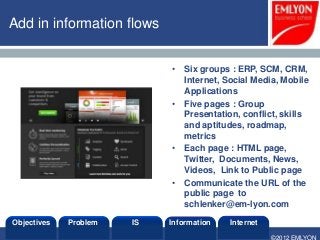
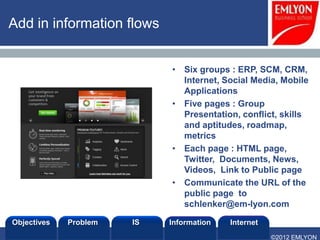
Add in information flows


                            • Six groups : ERP, SCM, CRM,
                              Internet, Social Media, Mobile
                              Applications
                            • Five pages : Group
                              Presentation, conflict, skills
                              and aptitudes, roadmap,
                              metrics
                            • Each page : HTML page,
                              Twitter, Documents, News,
                              Videos, Link to Public page
                            • Communicate the URL of the
                              public page to
                              schlenker@em-lyon.com

Objectives   Problem   IS   Information   Internet
                                                     ©2012 EMLYON
Resources


  EMM MIS
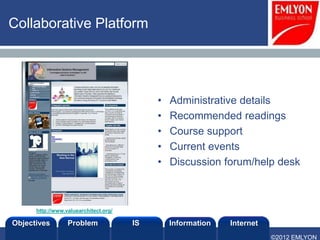
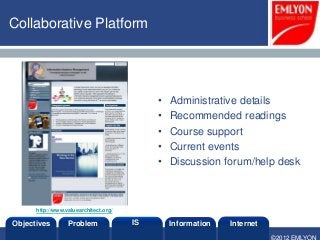
Collaborative Platform


                                            •   Administrative details
                                            •   Recommended readings
                                            •   Course support
                                            •   Current events
                                            •   Discussion forum/help desk


      http://www.valuearchitect.org/

Objectives        Problem              IS       Information   Internet
                                                                         ©2012 EMLYON

Emm Introduction 2013

  • 1.
    Introduction Managing Information Systems Lee SCHLENKER – EMLYON The EMLYON Business School Lyon – March 04, 2013
  • 2.
    What is aninformation system? Employees Stockholders A set of resources designed to foster organizational learning Clients Business Partners Objectives Problem IS Information Internet ©2010 EMLYON
  • 3.
    Faciltators Dr. Thomas HESS thess@bwl.lmu.de Dr. John EDWARDS j.s.edwards@aston.ac.uk Dr. Lee SCHLENKER schlenker@em-lyon.com
  • 4.
    What role doesIT play in innovation? Objectives Problem IS Information Internet ©2010 EMLYON
  • 5.
    ©2010 LHST sarl Theobjectives EMM MIS
  • 6.
    Understand the basics • Study the fundamentals of an Information System • Analyze the constraints and possibilites of « structured » information • Explore how the potential links between an IS and organizational learning • Analyze the potential value of 2.0 technologies Objectives Problem IS Information Internet ©2010 EMLYON
  • 7.
    Why is studyingIS important? • Understanding the implications between « structured » and « unstructured data » • Analyzing the difference between the data and reality • Understanding how the data fits together What does “privacy” mean in the digital economy? • Exploring the difference between data Assange, The Conversation and action Objectives Problem IS Information Internet ©2010 EMLYON
  • 8.
    Evaluation • An open book exam 25/03/2013 • Based on a case study • Focus points indentifying : – the value proposition, – IT/Business alignment, – use of IT concepts/methodologies
  • 9.
    ©2010 LHST sarl TheProblem EMM MIS
  • 10.
    IT Doesn’t Matter • Nicolas Carr compares IT to previous tech revolutions such as railroads and electricity. In what ways is IT different? • What proof can you offer that information technology in business no longer provides competitive advantage? • Does the pervasiveness of IT mean there will be less innovation now? • Hasn't competitive advantage come from unique use of the technology, not just from the technology itself? What examples can you give? • Do recent advances in Cloud Computing and Mobile Applications confirm or contradict Nicolas Carr's claims? Objectives Problem IS Information Internet
  • 11.
    Commoditisation • Over the last 70 years we have repeatly seen proof of innovation in IT : the spreadsheet, the ERP system, Social Network Applications • In the early days, companies created their own legacy systems to put these ideas into practice • As the technologies matured, companies editors standardized these applications in the form of Simon Wardley, "Cloud Computing - Why IT Matters" products. • Inevitably these products become simple commodities
  • 12.
    Technology and Innovation • Conflict and opportunity – is there a business problem to solve? • Suitability – is it adjacently possible? • The Roadmap– how does technology provide a vision of Where Good Ideas Come From, by Steven Johnson « better » • The Happy End – how do we best measure the results
  • 13.
  • 14.
    The definition ofinformation • From an objective point of view, information refers to date in context that conveys meaning to an individual. • From a subjective point of view, we could suggest that it’s the individual’s perspective of the data that implies meaning. • Given these definitions what meaning do Wikileaks, Twitter, or Facebook have? Objectives Problem IS Information Internet
  • 15.
    Data, Knowledge andAction The ladder of initiatives™ Results Drive Measures Actions Require Decisions Knowledge Define Interprets Context Obtain Process Data Objectives Problem IS Information Internet ©2010 EMLYON
  • 16.
    Structured data • Structured data refers to data that cabn be easily represented in textual/numeric form and stored in a database. • Structured data is often logically organized around a data model or data object. • Such models permit companies to compare and aggregate data in databases, datamarts and data warehouses. Objectives Problem IS Information Internet
  • 17.
    Non-structured data • Data is considered « non-structured » if we can’t predefine its attributes and store it in a table or data base • Examples of this kind of data include press clippings, videoclips, and songs • In reality, this data isn’t « non-structured » - its just that its attributes involve « complex » relationships http://jean.marie.gouarne.online.fr/bi.html Objectives Problem IS Information Internet
  • 18.
    What meaning dowe attach to the data? Frame Cloud Figure (s) Oracle Antonello da Messina Objectives Problem IS Information Internet ©2010 EMLYON
  • 19.
  • 20.
    Defining an InformationSystem A business information system is an organized set of resources (platforms, applications, procedures, data and people) that capture the meaning of work Objectives Problem IS Information Internet
  • 21.
    The objectives ofan IS Actionnaires  Actifs  Demandes en temps réel  ... Employées Société  Compétition  Mobilité  “made in” “made by”  Valorisation des tâches  ...  ... L’organisation Clients Partenaires  Fidélité ?  Peu de barrières d’entrée  Vrai coûts  Acquisitions, OPA  ...  ... To help us understand the motivations, experience and objectives of the internal and external clients of the organization Objectives Problem IS Information Internet
  • 22.
    The traditional descriptionof an IS Objectives Problem IS Information Internet
  • 23.
    Are information systemsmirrors of the organizational chart ? Objectives Problem IS Information Internet ©2012 EMLYON
  • 24.
    Are information systemsmirrors of key processes? Objectives Problem IS Information Internet ©2010 EMLYON
  • 25.
    Are information systemsmirrors of organizational skills and competencies? Technicity Method Reflection Action Imagination Cooperation John Holland Objectives Problem IS Information Internet ©2010 EMLYON
  • 26.
    Information Systems area question of perspective • The financial perspective (entreprise resource planning) • The logistics perspective (supply chain management) • The client perspective(client relationship management) • The community perspective(social media) Objectives Problem IS Information Internet
  • 27.
    Different sides ofthe coin ERP SCM CRM History MRP Total Quality Client contact Management systems Measure Quantitative Quantitative Qualitative Static Dynamic Perimeters Inside a firm Between firms Between firms and clients ROI 5 to 7 years 1 to 3 years 6 months to 1 year Objectives Problem IS Information Internet ©2010 EMLYON
  • 28.
    ©2010 LHST sarl TheInternet EMM MIS
  • 29.
    The Internet 500 million users more than 3 billion pages WWW URL HTML, HTTP Internet: "The Big Picture" Objectives Problem IS Information Internet
  • 30.
    Programming the Web I. Static web pages (HTML) II. Web enabled applications (Dynamic Web Pages, ASP, JSP, PHP, ...) III. Web services Towards the semantic Web Objectives Problem IS Information Internet ©2012 EMLYON
  • 31.
    The Web asa set of information flows • The Internet is only one component of the Web • Web sites and portals are only isolated endpoints of information flows • We capture the information flows on Twitter, Deezer, Facebook and Netvibes Objectives Problem IS Information Internet
  • 32.
    Digital footprints andclickstreams • Before the Web we assumed that our digital footprint was as ephemeral as a phone • Clickstreams can provide a level of intelligence about how people use the Web • Innovative companies have figured out how to deliver great Web-based services by divining clickstream patterns • We have yet to aggregate the critical mass of clickstreams in a database of intentions Objectives Problem IS Information Internet Prof. Lee SCHLENKER
  • 33.
    How can ITimprove productivity? Focus Improve Knowledge Leverage Mesure Organization Processes Explicit Transactions Efficiency Services Delivery Implicit Interactions Effectiveness Networks Relationships Emerging Interactions Innovation Search Relevancy Connected Associations CTR Mobility Context Embedded Proximity Relevancy Intro Impact Application Metrics
  • 34.
    ©2010 LHST sarl Mobile Applications EMM MIS
  • 35.
    Zaarly • Zaarly is a buyer-powered market - focus on what people want than what they have • Creates a broad, transparent, and social marketplace • 43 percent of the items are requests for "stuff, 40 percent for services, and 17 percent for "access to experiences“ • Business model based on transactional sales Intro Impact Application Metrics
  • 36.
    Context over Process • Context : The setting (circumstances) in which an event occurs • Process : A structure of activities and tasks in response to customer demands • Processes are models whereas context reflects patterns of interaction Saavedra • Context has geographical and social dimensions Intro Impact Application Metrics
  • 37.
    Changing IS skills • Analyse the user experience and the context in which they « work » • Design applications essentially from web services • Understand how the various mobile platforms are built • Develop mobile strategies that match the underlying business models Intro Impact Application Metrics
  • 38.
    Giving « anapplication » new meaning • Aesthetic, convenient user interface • Asynchronous Communication • Always-on network connectivity • Critical personal data • Built-in interactivity Intro Impact Application Metrics
  • 39.
    Revenue Models • Advertising revenue • Brand Takeovers • Download fees (and upgrades) • In-app purchases • Subscriptions • Two-sided model (the app as a platform) Paulina Delgado Soots Intro Impact Application Metrics
  • 40.
  • 41.
    How would youbuild a workspace? • Cecile Balmond – Informal • (Work) spaces aren’t bound by technology but by vision • Rules aren’t boundaries, just considerations • Vision, actors, events, outcomes, gateways ©2012 EMLYON
  • 42.
    A Mashup Main features Dashboards What is a Dashboard? Private & Public Registration Dashboards Simple Registration App View Facebook Connect Reader View Profile Settings Sign In Themes Edit your account info Keyboard Shortcuts Change profile image Sharing Email settings Mobile Versions Specifics Change password Sign-in Manage Dashboards iPhone, Android Netvibes is a mash-up that allows you to Backup Feeds version construct a personalised page filled with Third Party Services Wap version near real time content on the subject of your choice Objectives Problem IS Information Internet ©2012 EMLYON
  • 43.
    Add in informationflows • Six groups : ERP, SCM, CRM, Internet, Social Media, Mobile Applications • Five pages : Group Presentation, conflict, skills and aptitudes, roadmap, metrics • Each page : HTML page, Twitter, Documents, News, Videos, Link to Public page • Communicate the URL of the public page to schlenker@em-lyon.com Objectives Problem IS Information Internet ©2012 EMLYON
  • 44.
  • 45.
    Collaborative Platform • Administrative details • Recommended readings • Course support • Current events • Discussion forum/help desk http://www.valuearchitect.org/ Objectives Problem IS Information Internet ©2012 EMLYON

Editor's Notes

  • #36 ProgrammabilityPotential for creating more responsive applications (combats bad perception left by WAP)Critical personal dataEvery application will access personal user profile in some formCustomizations, preferences, authentication information, personal information (contacts, tasks, appointments, etc.)Mobile payments (credit cards, account information, e-tickets)Asynchronous CommunicationMost applications are best described as event-based―core of the application logic is to react to some external events.Aesthetic, convenient user interfaceApplications need pleasing, simple and responsive user interfacesAlways-on network connectivityAlmost all applications heavily rely on network connectivity. Integration of data from the desktop (office, enterprise, school) to mobile device. Access anytime, anywhere is what increases utility of the mobile applications.