PRESENTS
DISASTER RECOVERY & BUSINESS
 CONTINUITY IT BEST PRACTICES
       DECEMBER 8TH, 2009
House Keeping

•   Rest rooms
•   Food
•   NDA
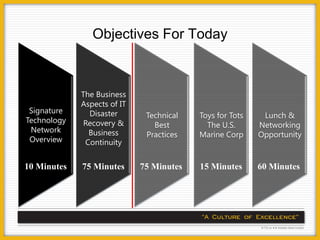
Objectives For Today


             The Business
             Aspects of IT
 Signature     Disaster       Technical   Toys for Tots    Lunch &
Technology    Recovery &        Best        The U.S.      Networking
 Network       Business       Practices   Marine Corp     Opportunity
 Overview     Continuity


10 Minutes   75 Minutes      75 Minutes   15 Minutes      60 Minutes
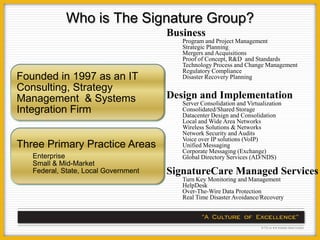
Who is The Signature Group?
                                      Business
                                         Program and Project Management
                                         Strategic Planning
                                         Mergers and Acquisitions
                                         Proof of Concept, R&D and Standards
                                         Technology Process and Change Management
                                         Regulatory Compliance
Founded in 1997 as an IT                 Disaster Recovery Planning
Consulting, Strategy
Management & Systems                  Design and Implementation
                                         Server Consolidation and Virtualization
Integration Firm                         Consolidated/Shared Storage
                                         Datacenter Design and Consolidation
                                         Local and Wide Area Networks
                                         Wireless Solutions & Networks
                                         Network Security and Audits
                                         Voice over IP solutions (VoIP)
Three Primary Practice Areas             Unified Messaging
                                         Corporate Messaging (Exchange)
   Enterprise                            Global Directory Services (AD/NDS)
   Small & Mid-Market
   Federal, State, Local Government   SignatureCare Managed Services
                                         Turn Key Monitoring and Management
                                         HelpDesk
                                         Over-The-Wire Data Protection
                                         Real Time Disaster Avoidance/Recovery
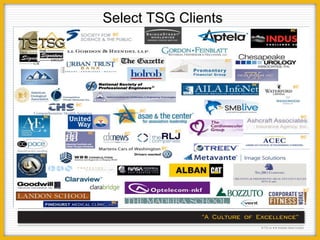
Select TSG Clients
What is STN?
   Signature Technology Network (STN) is a free membership based group* of Senior IT
   Executives in the DC Metro Area from a broad array of industries.

Purpose:                                                Benefits:
• Social and Peer Networking                            • Learn from Success and Failures of Peers
• Sharing of Best Practices                             • Understand Do’s, Don’ts and Best Practices
• Discuss Technology & Business Solutions               • Learn the Solutions that Your Peers are Using to
• Access to Independent Industry Experts                   Improve the Performance of Their Business
• Forum for Ongoing Education                           • Hear What Independent Experts Say About
       Dedicated Learning Sessions                         Various Technologies and Business Solutions
       Panel Discussions                                • Gain Direct Access to Manufacturers and
       Roundtable Events                                   Vendors to Understand their Long Term Road
       Manufacturer and Vendor Presentations               Maps and How These Will Help You Plan And
       Looking to the Future of IT                         Invest Wisely For The Future
                             •NDA’s are required for all participating members

               Signature Technology Network
STN 2010 Events Calendar
•   Tuesday, January 12, 2010
       Windows 7/Server 2008/Active Directory
                 8:00 am – Noon
                 The Tower Club
•   February 10-12, 2010
      Collaboration Technologies & Managed Services Exhibition
      Virtualization Business and Technology Best Practices – Educational Track
                  ASAE Technology Conference
                  Walter E. Washington Convention Center
•   Tuesday, March 9, 2010
       Microsoft Exchange 2010 and Collaboration Solutions
                   8:00 am – Noon
                   The Tower Club
For Small and Medium Enterprises
Michael Perdue, Chief Executive Officer
      The Signature Group, Inc.
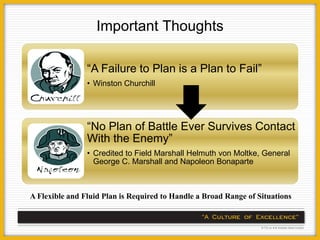
Important Thoughts

                “A Failure to Plan is a Plan to Fail”
                • Winston Churchill


                “No Plan of Battle Ever Survives Contact
                With the Enemy”
                • Credited to Field Marshall Helmuth von Moltke, General
                  George C. Marshall and Napoleon Bonaparte


A Flexible and Fluid Plan is Required to Handle a Broad Range of Situations
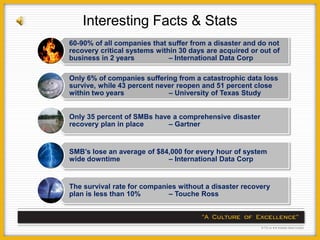
Interesting Facts & Stats
60-90% of all companies that suffer from a disaster and do not
recovery critical systems within 30 days are acquired or out of
business in 2 years           – International Data Corp

Only 6% of companies suffering from a catastrophic data loss
survive, while 43 percent never reopen and 51 percent close
within two years             – University of Texas Study


Only 35 percent of SMBs have a comprehensive disaster
recovery plan in place     – Gartner


SMB’s lose an average of $84,000 for every hour of system
wide downtime               – International Data Corp


The survival rate for companies without a disaster recovery
plan is less than 10%        – Touche Ross
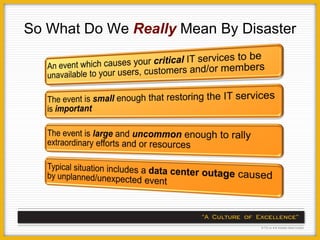
So What Do We Really Mean By Disaster
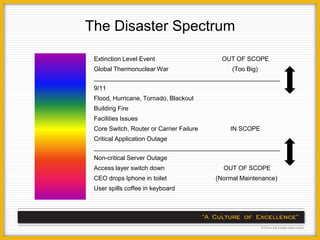
The Disaster Spectrum

 Extinction Level Event                     OUT OF SCOPE
 Global Thermonuclear War                (Too Big)
 ______________________________________________________
 9/11
 Flood, Hurricane, Tornado, Blackout
 Building Fire
 Facilities Issues
 Core Switch, Router or Carrier Failure       IN SCOPE
 Critical Application Outage
 ______________________________________________________
 Non-critical Server Outage
 Access layer switch down                   OUT OF SCOPE
 CEO drops Iphone in toilet               (Normal Maintenance)
 User spills coffee in keyboard
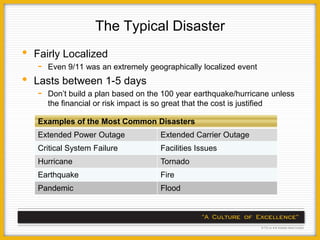
The Typical Disaster
•   Fairly Localized
    -   Even 9/11 was an extremely geographically localized event
•   Lasts between 1-5 days
    -   Don’t build a plan based on the 100 year earthquake/hurricane unless
        the financial or risk impact is so great that the cost is justified

    Examples of the Most Common Disasters
    Extended Power Outage              Extended Carrier Outage
    Critical System Failure            Facilities Issues
    Hurricane                          Tornado
    Earthquake                         Fire
    Pandemic                           Flood
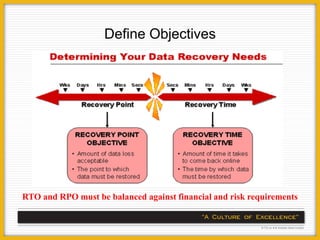
Define Objectives


RTO and RPO must be balanced against financial and risk requirements
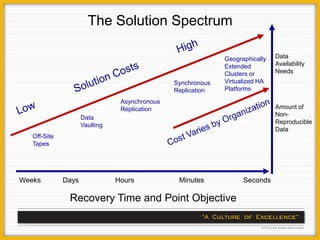
The Solution Spectrum

                                                              Geographically   Data
                                                              Extended         Availability
                                                              Clusters or      Needs
                                                Synchronous   Virtualized HA
                                                Replication   Platforms

                                 Asynchronous
                                 Replication                                   Amount of
                                                                               Non-
                     Data
                                                                               Reproducible
                     Vaulting
                                                                               Data
   Off-Site
   Tapes


Weeks         Days              Hours            Minutes            Seconds

               Recovery Time and Point Objective
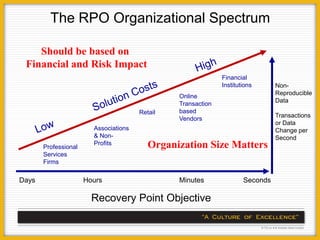
The RPO Organizational Spectrum

    Should be based on
 Financial and Risk Impact
                                                              Financial
                                                              Institutions      Non-
                                                                                Reproducible
                                                Online
                                                                                Data
                                                Transaction
                                       Retail   based
                                                                                Transactions
                                                Vendors
                                                                                or Data
                        Associations                                            Change per
                        & Non-                                                  Second
       Professional
                        Profits           Organization Size Matters
       Services
       Firms

Days                  Hours                     Minutes               Seconds

                        Recovery Point Objective
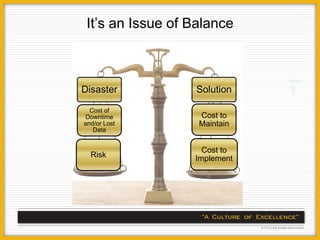
It’s an Issue of Balance


Disaster          Solution

  Cost of
 Downtime          Cost to
and/or Lost        Maintain
   Data


                    Cost to
  Risk            Implement
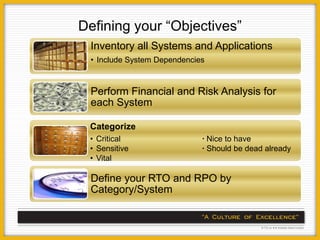
Defining your “Objectives”
 Inventory all Systems and Applications
 • Include System Dependencies


 Perform Financial and Risk Analysis for
 each System

 Categorize
 • Critical                  ∙ Nice to have
 • Sensitive                 ∙ Should be dead already
 • Vital

 Define your RTO and RPO by
 Category/System
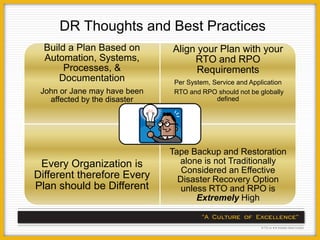
DR Thoughts and Best Practices
  Build a Plan Based on           Align your Plan with your
  Automation, Systems,                 RTO and RPO
       Processes, &                     Requirements
     Documentation                 Per System, Service and Application
 John or Jane may have been        RTO and RPO should not be globally
   affected by the disaster                     defined


                              .
                                  Tape Backup and Restoration
 Every Organization is              alone is not Traditionally
                                     Considered an Effective
Different therefore Every           Disaster Recovery Option
Plan should be Different             unless RTO and RPO is
                                         Extremely High
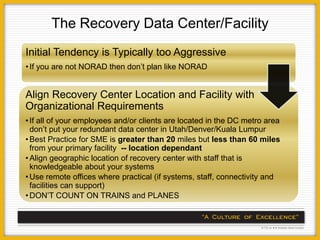
The Recovery Data Center/Facility
Initial Tendency is Typically too Aggressive
• If you are not NORAD then don’t plan like NORAD


Align Recovery Center Location and Facility with
Organizational Requirements
• If all of your employees and/or clients are located in the DC metro area
  don’t put your redundant data center in Utah/Denver/Kuala Lumpur
• Best Practice for SME is greater than 20 miles but less than 60 miles
  from your primary facility -- location dependant
• Align geographic location of recovery center with staff that is
  knowledgeable about your systems
• Use remote offices where practical (if systems, staff, connectivity and
  facilities can support)
• DON’T COUNT ON TRAINS and PLANES
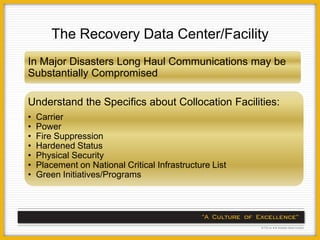
The Recovery Data Center/Facility
In Major Disasters Long Haul Communications may be
Substantially Compromised

Understand the Specifics about Collocation Facilities:
•   Carrier
•   Power
•   Fire Suppression
•   Hardened Status
•   Physical Security
•   Placement on National Critical Infrastructure List
•   Green Initiatives/Programs
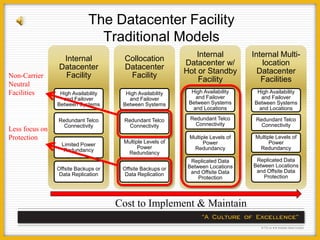
The Datacenter Facility
                               Traditional Models
                                                              Internal           Internal Multi-
                 Internal              Collocation
                                                           Datacenter w/            location
                Datacenter             Datacenter
                                                           Hot or Standby          Datacenter
Non-Carrier      Facility               Facility
                                                               Facility             Facilities
Neutral
Facilities       High Availability     High Availability     High Availability    High Availability
                  and Failover          and Failover          and Failover         and Failover
                Between Systems       Between Systems       Between Systems      Between Systems
                                                             and Locations        and Locations

                Redundant Telco       Redundant Telco       Redundant Telco       Redundant Telco
                  Connectivity          Connectivity          Connectivity          Connectivity
Less focus on
Protection                                                  Multiple Levels of    Multiple Levels of
                                      Multiple Levels of          Power                 Power
                  Limited Power
                                            Power            Redundancy            Redundancy
                   Redundancy
                                       Redundancy
                                                             Replicated Data      Replicated Data
                                                            Between Locations    Between Locations
                Offsite Backups or    Offsite Backups or                          and Offsite Data
                 Data Replication      Data Replication      and Offsite Data
                                                                Protection           Protection


                                     Cost to Implement & Maintain
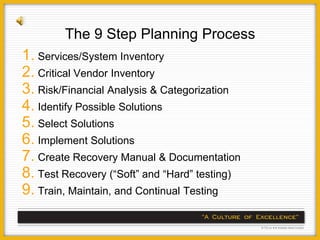
The 9 Step Planning Process
1. Services/System Inventory
2. Critical Vendor Inventory
3. Risk/Financial Analysis & Categorization
4. Identify Possible Solutions
5. Select Solutions
6. Implement Solutions
7. Create Recovery Manual & Documentation
8. Test Recovery (“Soft” and “Hard” testing)
9. Train, Maintain, and Continual Testing
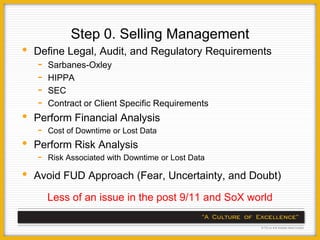
Step 0. Selling Management
•   Define Legal, Audit, and Regulatory Requirements
    -   Sarbanes-Oxley
    -   HIPPA
    -   SEC
    -   Contract or Client Specific Requirements
•   Perform Financial Analysis
    -   Cost of Downtime or Lost Data
•   Perform Risk Analysis
    -   Risk Associated with Downtime or Lost Data

•   Avoid FUD Approach (Fear, Uncertainty, and Doubt)

        Less of an issue in the post 9/11 and SoX world
Questions & Answers

12.08.09 Event Mike Perdue Presentation

  • 1.
    PRESENTS DISASTER RECOVERY &BUSINESS CONTINUITY IT BEST PRACTICES DECEMBER 8TH, 2009
  • 2.
    House Keeping • Rest rooms • Food • NDA
  • 3.
    Objectives For Today The Business Aspects of IT Signature Disaster Technical Toys for Tots Lunch & Technology Recovery & Best The U.S. Networking Network Business Practices Marine Corp Opportunity Overview Continuity 10 Minutes 75 Minutes 75 Minutes 15 Minutes 60 Minutes
  • 4.
    Who is TheSignature Group? Business Program and Project Management Strategic Planning Mergers and Acquisitions Proof of Concept, R&D and Standards Technology Process and Change Management Regulatory Compliance Founded in 1997 as an IT Disaster Recovery Planning Consulting, Strategy Management & Systems Design and Implementation Server Consolidation and Virtualization Integration Firm Consolidated/Shared Storage Datacenter Design and Consolidation Local and Wide Area Networks Wireless Solutions & Networks Network Security and Audits Voice over IP solutions (VoIP) Three Primary Practice Areas Unified Messaging Corporate Messaging (Exchange) Enterprise Global Directory Services (AD/NDS) Small & Mid-Market Federal, State, Local Government SignatureCare Managed Services Turn Key Monitoring and Management HelpDesk Over-The-Wire Data Protection Real Time Disaster Avoidance/Recovery
  • 5.
  • 6.
    What is STN? Signature Technology Network (STN) is a free membership based group* of Senior IT Executives in the DC Metro Area from a broad array of industries. Purpose: Benefits: • Social and Peer Networking • Learn from Success and Failures of Peers • Sharing of Best Practices • Understand Do’s, Don’ts and Best Practices • Discuss Technology & Business Solutions • Learn the Solutions that Your Peers are Using to • Access to Independent Industry Experts Improve the Performance of Their Business • Forum for Ongoing Education • Hear What Independent Experts Say About Dedicated Learning Sessions Various Technologies and Business Solutions Panel Discussions • Gain Direct Access to Manufacturers and Roundtable Events Vendors to Understand their Long Term Road Manufacturer and Vendor Presentations Maps and How These Will Help You Plan And Looking to the Future of IT Invest Wisely For The Future •NDA’s are required for all participating members Signature Technology Network
  • 7.
    STN 2010 EventsCalendar • Tuesday, January 12, 2010 Windows 7/Server 2008/Active Directory 8:00 am – Noon The Tower Club • February 10-12, 2010 Collaboration Technologies & Managed Services Exhibition Virtualization Business and Technology Best Practices – Educational Track ASAE Technology Conference Walter E. Washington Convention Center • Tuesday, March 9, 2010 Microsoft Exchange 2010 and Collaboration Solutions 8:00 am – Noon The Tower Club
  • 8.
    For Small andMedium Enterprises Michael Perdue, Chief Executive Officer The Signature Group, Inc.
  • 10.
    Important Thoughts “A Failure to Plan is a Plan to Fail” • Winston Churchill “No Plan of Battle Ever Survives Contact With the Enemy” • Credited to Field Marshall Helmuth von Moltke, General George C. Marshall and Napoleon Bonaparte A Flexible and Fluid Plan is Required to Handle a Broad Range of Situations
  • 11.
    Interesting Facts &Stats 60-90% of all companies that suffer from a disaster and do not recovery critical systems within 30 days are acquired or out of business in 2 years – International Data Corp Only 6% of companies suffering from a catastrophic data loss survive, while 43 percent never reopen and 51 percent close within two years – University of Texas Study Only 35 percent of SMBs have a comprehensive disaster recovery plan in place – Gartner SMB’s lose an average of $84,000 for every hour of system wide downtime – International Data Corp The survival rate for companies without a disaster recovery plan is less than 10% – Touche Ross
  • 12.
    So What DoWe Really Mean By Disaster
  • 13.
    The Disaster Spectrum Extinction Level Event OUT OF SCOPE Global Thermonuclear War (Too Big) ______________________________________________________ 9/11 Flood, Hurricane, Tornado, Blackout Building Fire Facilities Issues Core Switch, Router or Carrier Failure IN SCOPE Critical Application Outage ______________________________________________________ Non-critical Server Outage Access layer switch down OUT OF SCOPE CEO drops Iphone in toilet (Normal Maintenance) User spills coffee in keyboard
  • 14.
    The Typical Disaster • Fairly Localized - Even 9/11 was an extremely geographically localized event • Lasts between 1-5 days - Don’t build a plan based on the 100 year earthquake/hurricane unless the financial or risk impact is so great that the cost is justified Examples of the Most Common Disasters Extended Power Outage Extended Carrier Outage Critical System Failure Facilities Issues Hurricane Tornado Earthquake Fire Pandemic Flood
  • 15.
    Define Objectives RTO andRPO must be balanced against financial and risk requirements
  • 16.
    The Solution Spectrum Geographically Data Extended Availability Clusters or Needs Synchronous Virtualized HA Replication Platforms Asynchronous Replication Amount of Non- Data Reproducible Vaulting Data Off-Site Tapes Weeks Days Hours Minutes Seconds Recovery Time and Point Objective
  • 17.
    The RPO OrganizationalSpectrum Should be based on Financial and Risk Impact Financial Institutions Non- Reproducible Online Data Transaction Retail based Transactions Vendors or Data Associations Change per & Non- Second Professional Profits Organization Size Matters Services Firms Days Hours Minutes Seconds Recovery Point Objective
  • 18.
    It’s an Issueof Balance Disaster Solution Cost of Downtime Cost to and/or Lost Maintain Data Cost to Risk Implement
  • 19.
    Defining your “Objectives” Inventory all Systems and Applications • Include System Dependencies Perform Financial and Risk Analysis for each System Categorize • Critical ∙ Nice to have • Sensitive ∙ Should be dead already • Vital Define your RTO and RPO by Category/System
  • 20.
    DR Thoughts andBest Practices Build a Plan Based on Align your Plan with your Automation, Systems, RTO and RPO Processes, & Requirements Documentation Per System, Service and Application John or Jane may have been RTO and RPO should not be globally affected by the disaster defined . Tape Backup and Restoration Every Organization is alone is not Traditionally Considered an Effective Different therefore Every Disaster Recovery Option Plan should be Different unless RTO and RPO is Extremely High
  • 21.
    The Recovery DataCenter/Facility Initial Tendency is Typically too Aggressive • If you are not NORAD then don’t plan like NORAD Align Recovery Center Location and Facility with Organizational Requirements • If all of your employees and/or clients are located in the DC metro area don’t put your redundant data center in Utah/Denver/Kuala Lumpur • Best Practice for SME is greater than 20 miles but less than 60 miles from your primary facility -- location dependant • Align geographic location of recovery center with staff that is knowledgeable about your systems • Use remote offices where practical (if systems, staff, connectivity and facilities can support) • DON’T COUNT ON TRAINS and PLANES
  • 22.
    The Recovery DataCenter/Facility In Major Disasters Long Haul Communications may be Substantially Compromised Understand the Specifics about Collocation Facilities: • Carrier • Power • Fire Suppression • Hardened Status • Physical Security • Placement on National Critical Infrastructure List • Green Initiatives/Programs
  • 23.
    The Datacenter Facility Traditional Models Internal Internal Multi- Internal Collocation Datacenter w/ location Datacenter Datacenter Hot or Standby Datacenter Non-Carrier Facility Facility Facility Facilities Neutral Facilities High Availability High Availability High Availability High Availability and Failover and Failover and Failover and Failover Between Systems Between Systems Between Systems Between Systems and Locations and Locations Redundant Telco Redundant Telco Redundant Telco Redundant Telco Connectivity Connectivity Connectivity Connectivity Less focus on Protection Multiple Levels of Multiple Levels of Multiple Levels of Power Power Limited Power Power Redundancy Redundancy Redundancy Redundancy Replicated Data Replicated Data Between Locations Between Locations Offsite Backups or Offsite Backups or and Offsite Data Data Replication Data Replication and Offsite Data Protection Protection Cost to Implement & Maintain
  • 24.
    The 9 StepPlanning Process 1. Services/System Inventory 2. Critical Vendor Inventory 3. Risk/Financial Analysis & Categorization 4. Identify Possible Solutions 5. Select Solutions 6. Implement Solutions 7. Create Recovery Manual & Documentation 8. Test Recovery (“Soft” and “Hard” testing) 9. Train, Maintain, and Continual Testing
  • 25.
    Step 0. SellingManagement • Define Legal, Audit, and Regulatory Requirements - Sarbanes-Oxley - HIPPA - SEC - Contract or Client Specific Requirements • Perform Financial Analysis - Cost of Downtime or Lost Data • Perform Risk Analysis - Risk Associated with Downtime or Lost Data • Avoid FUD Approach (Fear, Uncertainty, and Doubt) Less of an issue in the post 9/11 and SoX world
  • 26.