MANUFACTURING OF LIQUIDS
Presented by-
SUPRIYA SUMAN
PharmD 4th year
Roll no.-15
INTRODUCTION:-
 Liquid dosage forms are prepared any of the following:-
• by dissolving active ingredients in an aqueous or non-
aqueous solvent,
• by suspending the drug or
• by incorporating the drug into one of the two phases of
an oil and water systems.
ADVANTAGE:-
• Easy to sawllow.
• Faster therapeutic response.
• Palatable.
• Acceptable for pediatric and geriatric use.
• Solution are more acceptable for local action.
DISADVANTAGE:-
• Shorter life than other dosage form
I. Less stable
II. Easily affected by microorganisms
• Harder to measure accuracy measuring dose is
required
• Need special storage condition
• Not potable
• High risk of loss by the breakage of the container
CLASSIFICATION:-
LIQUID
MONOPHASIC
INTERNAL
SYRUPELIXIRLINCTUS
EXTERNAL
APPLICATION
ON THE SKIN
LINIMENTLOTION
USED IN
MOUTH
GARGLES
MOUTH
WASH
THROAT
PAINT
INSTILLED
INTO BODY
CAVITIES
EAR DROPNASAL DROPNASAL SPRAY
BIPHASIC
SUSPENSIONEMULSION
Formulation /Manufacturing procedure
COMPONENTS
• API
• Vehicle
Aqueous vehicles: Water, Aromatic Water,
Alcohol, glycerine, Propylene Glycol.
Oily vehicles: Vegetable oils, mineral oils,
organic oily bases or emulsified bases.
COMPONENTS
• Surfactant
 Solubilising agents – eg- Polysorbate 80.
 Flocculating agent – eg- gum acacia,wool fat,methylcellulose,
 Wetting agent – eg- Tweens 80, spans ,SLS.
 Emulsifying agents
 Antifoaming agents –eg- Castor oil, fatty acids.
CONTINUE.....
• Colouring agent – example- coal tar dyes such as amaranth
(red),caramel(brown),indigo(blue), napthol(black).
• Flavouring agents -
 Tinctures- tincture lemon, and tincture ginger .
 Fruit juices- raspberry juice , wild cherry.
 Essence- vanilla, orange.
• Preservative –example-methyl paraben , sodium benzoate,
benzoic acid.
• Antioxidant agent-example- BHA,BHT
PROCEDURE
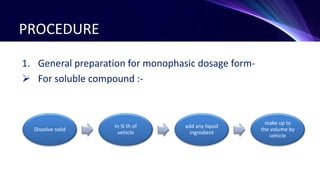
1. General preparation for monophasic dosage form-
 For soluble compound :-
Dissolve solid
In ¾ th of
vehicle
add any liquid
ingredient
make up to
the volume by
vehicle
CONTINUE....
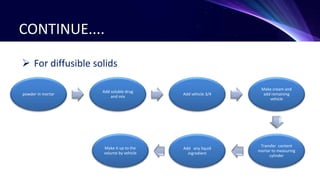
 For diffusible solids
powder in mortar
Add soluble drug
and mix
Add vehicle 3/4
Make cream and
add remaining
vehicle
Transfer content
mortar to measuring
cylinder
Add any liquid
ingredient
Make it up to the
volume by vehicle
CONTINUE...
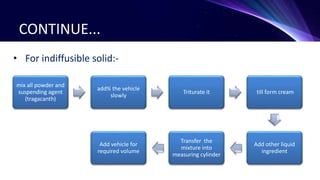
• For indiffusible solid:-
mix all powder and
suspending agent
(tragacanth)
add¾ the vehicle
slowly
Triturate it till form cream
Add other liquid
ingredient
Transfer the
mixture into
measuring cylinder
Add vehicle for
required volume
CONTINUE ...
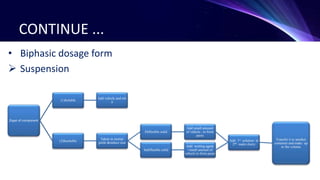
• Biphasic dosage form
 Suspension
2type of component
(1)Soluble
Add vehicle and stir
it
(2)Insoluble
Taken in mortar
pistle &reduce size
Diffusible solid
Add small amount
of vehicle , to form
paste
Add 1st solution in
2nd make slurry
Transfer it to another
container and make up
to the volume
Indiffusible solid
Add wetting agent
+small amount of
vehicle to form paste
CONTINUE ...
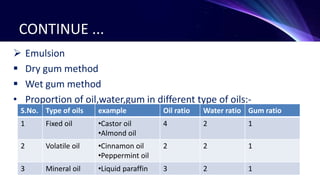
 Emulsion
 Dry gum method
 Wet gum method
• Proportion of oil,water,gum in different type of oils:-
S.No. Type of oils example Oil ratio Water ratio Gum ratio
1 Fixed oil •Castor oil
•Almond oil
4 2 1
2 Volatile oil •Cinnamon oil
•Peppermint oil
2 2 1
3 Mineral oil •Liquid paraffin 3 2 1
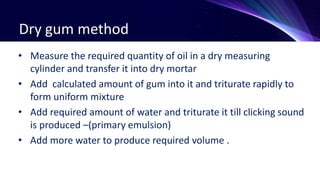
Dry gum method
• Measure the required quantity of oil in a dry measuring
cylinder and transfer it into dry mortar
• Add calculated amount of gum into it and triturate rapidly to
form uniform mixture
• Add required amount of water and triturate it till clicking sound
is produced –(primary emulsion)
• Add more water to produce required volume .
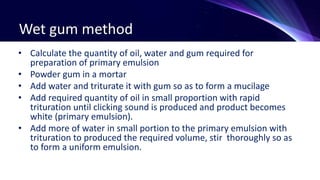
Wet gum method
• Calculate the quantity of oil, water and gum required for
preparation of primary emulsion
• Powder gum in a mortar
• Add water and triturate it with gum so as to form a mucilage
• Add required quantity of oil in small proportion with rapid
trituration until clicking sound is produced and product becomes
white (primary emulsion).
• Add more of water in small portion to the primary emulsion with
trituration to produced the required volume, stir thoroughly so as
to form a uniform emulsion.
THANK YOU

Liquid manufacturing

  • 1.
    MANUFACTURING OF LIQUIDS Presentedby- SUPRIYA SUMAN PharmD 4th year Roll no.-15
  • 2.
    INTRODUCTION:-  Liquid dosageforms are prepared any of the following:- • by dissolving active ingredients in an aqueous or non- aqueous solvent, • by suspending the drug or • by incorporating the drug into one of the two phases of an oil and water systems.
  • 3.
    ADVANTAGE:- • Easy tosawllow. • Faster therapeutic response. • Palatable. • Acceptable for pediatric and geriatric use. • Solution are more acceptable for local action.
  • 4.
    DISADVANTAGE:- • Shorter lifethan other dosage form I. Less stable II. Easily affected by microorganisms • Harder to measure accuracy measuring dose is required • Need special storage condition • Not potable • High risk of loss by the breakage of the container
  • 5.
    CLASSIFICATION:- LIQUID MONOPHASIC INTERNAL SYRUPELIXIRLINCTUS EXTERNAL APPLICATION ON THE SKIN LINIMENTLOTION USEDIN MOUTH GARGLES MOUTH WASH THROAT PAINT INSTILLED INTO BODY CAVITIES EAR DROPNASAL DROPNASAL SPRAY BIPHASIC SUSPENSIONEMULSION
  • 6.
  • 7.
    COMPONENTS • API • Vehicle Aqueousvehicles: Water, Aromatic Water, Alcohol, glycerine, Propylene Glycol. Oily vehicles: Vegetable oils, mineral oils, organic oily bases or emulsified bases.
  • 8.
    COMPONENTS • Surfactant  Solubilisingagents – eg- Polysorbate 80.  Flocculating agent – eg- gum acacia,wool fat,methylcellulose,  Wetting agent – eg- Tweens 80, spans ,SLS.  Emulsifying agents  Antifoaming agents –eg- Castor oil, fatty acids.
  • 9.
    CONTINUE..... • Colouring agent– example- coal tar dyes such as amaranth (red),caramel(brown),indigo(blue), napthol(black). • Flavouring agents -  Tinctures- tincture lemon, and tincture ginger .  Fruit juices- raspberry juice , wild cherry.  Essence- vanilla, orange. • Preservative –example-methyl paraben , sodium benzoate, benzoic acid. • Antioxidant agent-example- BHA,BHT
  • 10.
    PROCEDURE 1. General preparationfor monophasic dosage form-  For soluble compound :- Dissolve solid In ¾ th of vehicle add any liquid ingredient make up to the volume by vehicle
  • 11.
    CONTINUE....  For diffusiblesolids powder in mortar Add soluble drug and mix Add vehicle 3/4 Make cream and add remaining vehicle Transfer content mortar to measuring cylinder Add any liquid ingredient Make it up to the volume by vehicle
  • 12.
    CONTINUE... • For indiffusiblesolid:- mix all powder and suspending agent (tragacanth) add¾ the vehicle slowly Triturate it till form cream Add other liquid ingredient Transfer the mixture into measuring cylinder Add vehicle for required volume
  • 13.
    CONTINUE ... • Biphasicdosage form  Suspension 2type of component (1)Soluble Add vehicle and stir it (2)Insoluble Taken in mortar pistle &reduce size Diffusible solid Add small amount of vehicle , to form paste Add 1st solution in 2nd make slurry Transfer it to another container and make up to the volume Indiffusible solid Add wetting agent +small amount of vehicle to form paste
  • 14.
    CONTINUE ...  Emulsion Dry gum method  Wet gum method • Proportion of oil,water,gum in different type of oils:- S.No. Type of oils example Oil ratio Water ratio Gum ratio 1 Fixed oil •Castor oil •Almond oil 4 2 1 2 Volatile oil •Cinnamon oil •Peppermint oil 2 2 1 3 Mineral oil •Liquid paraffin 3 2 1
  • 15.
    Dry gum method •Measure the required quantity of oil in a dry measuring cylinder and transfer it into dry mortar • Add calculated amount of gum into it and triturate rapidly to form uniform mixture • Add required amount of water and triturate it till clicking sound is produced –(primary emulsion) • Add more water to produce required volume .
  • 16.
    Wet gum method •Calculate the quantity of oil, water and gum required for preparation of primary emulsion • Powder gum in a mortar • Add water and triturate it with gum so as to form a mucilage • Add required quantity of oil in small proportion with rapid trituration until clicking sound is produced and product becomes white (primary emulsion). • Add more of water in small portion to the primary emulsion with trituration to produced the required volume, stir thoroughly so as to form a uniform emulsion.
  • 17.