Definition of lipid
• Lipids are
Heterogenous group of organic substances
Water insoluble
But soluble in fat solvents (non-polar organic solvents) like eather,
benzene, chloroform, alcohol etc
And actually or potentially related to fatty acids.
• Together with carbohydrates and proteins, lipids are the main constituents
of plant and animal cells.
• Lipids are not polymeric substance like protein, polysaccharide and nucleic
acid.
Why called
heterogenous
• They are different in
chemical structure but
more related t0 same
physical properties like
insoluble in water.
Bloor’s criteria
• Relatively insoluble in water.
• Soluble in organic solvents like
eather, benzene, alcohol etc.
• Actually or potentially related to
fatty acid.
• Utilized by living organism.
Properties of lipid
Physical:
1. Fats and fatty acids are soluble in organic solvents, such as petroleum
ether, benzene and chloroform. They are insoluble in water.
2. Tasteless, odorless, colorless.
3. Specific gravity less than 1.0.
4. Melting point-low (human fat), around 50 degree Celsius
5. Spreading and surface tension: they spread uniformly over the surface
and reduce the surface tension.
Chemical properties:
• Hydrolysis: Fats undergo hydrolysis when treated with mineral acids, the
alkalis or fat splitting enzyme lipase or hydrolases to yield glycerol and the
constituent fatty acids.
Triacylglycerol FA + Glycerol
• Saponification: Hydrolysis of triacyl glycerol by alkali to produce glycerol
and soap.
Triacyl glycerol + 3NaOH Glycerol + 3R COONa (soap)
Lipase
• Hydrogenation: Oils containing unsaturated fatty acids can be
hydrogenated into fully saturated solid fat by addition of H+ across
the double bond by fatty acid in presence of high temperature,
pressure and catalyst nickel.
This reaction forms the basis of the industrial production of
hydrogenated oil (vegetable ghee).
• Rancidity: It is a chemical change resulting in unpleasant odor and
taste on storage when fats and oils are exposed to light, heat, air &
bacteria. It occurs mostly in unsaturated fatty acid.
• Lipid peroxidation: in living cells, Fat undergoes oxidation (auto oxidation)
in Vivo to produce lipid peroxides and free radicals that cause tissue
damage, malignancy, aging, atherosclerosis.
• Emulsification: The process of breaking of large-sized fat molecules into
smaller ones is called emulsification. In animals, this process is brought
about by bile juice liberated from liver. Other emulsifying agents are water,
soaps, proteins and gums.
Sources of lipid
• They are widely distributed in nature, both in plants and animals.
Animal: meat, fish, liver, egg yolk, milk and milk products like
butter, ghee, cheese etc.
Plant: oils like soyabean oil, sunflower oil, olive oil etc.
Dietary lipids areTriacylglycerol (85%), cholesterol ester,
phospholipid and glycolipid.
Classification of lipids
• Simple lipid: Ester of fatty acid with alcohol, do not contain non
lipid substance.(fatty acid+ alcohol).
Eg: neutral fat, wax.
• Complex lipid/Compound lipid: esters of fatty acid with alcohol
with other non lipid substance.(fatty acid + alcohol +non lipid
substance).
Eg: phospholipid, glycolipids, lipoprotein.
• Derived lipid: obtained by hydrolysis of simple and complex lipid.
Eg: fatty acid, alcohol, glycerol, steroid, cholesterol,
prostaglandin, fat soluble vitamins( vit-A, D, E, K), ketone
body.
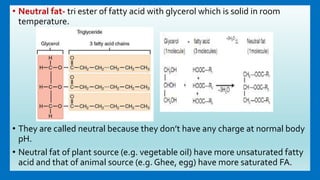
• Neutral fat- tri ester of fatty acid with glycerol which is solid in room
temperature.
• They are called neutral because they don’t have any charge at normal body
pH.
• Neutral fat of plant source (e.g. vegetable oil) have more unsaturated fatty
acid and that of animal source (e.g. Ghee, egg) have more saturated FA.
• Wax-Ester of fatty acid with long chain monohydric alcohol. It is
formed as secretions which are mostly protective in function by many
animals.They resemble like fats and are usually solid.These
compounds have no importance as far as human metabolism
concerned.
Use: they are widely used in pharmaceutical, cosmetic and other
industries in the manufacture of lotions, ointments etc.
• Fat-solid at room temperature, contain saturated fatty acid.
• Oil-liquid at room temperature, contain unsaturated fatty acid.
contain contain
Function of lipid
• Source of energy.
• Important storage form of energy.
• Important constituent of biological membrane.
• Provides essential fatty acid and helps in absorption of fat soluble
vitamins (vit- A, D, E, K).
• Act as subcutaneous thermal insulator and perineural electrical
insulator.
• Acts as a mechanical cushion around the internal organs to
protect them from mechanical injury.
• Add taste and palatability to food.
Complex / Compound lipid
• Esters of FA+ alcohol + additional group (phosphate, nitrogenous
base, CHO, protein)
Phospholipid: FA+ alcohol + phosphoric acid ± nitrogenous base
Glycolipid: FA+ sphingol (alcohol) + CHO
Lipoprotein: Lipid + protein
Phospholipid
Phospholipid (classification)
Phospholipid
Glycerophospholipid
FA+ Glycerol +H3PO4 ± N2 base
e.g.:
Phosphatidylcholine (lecithin)
Phosphatidyl ethanol amine
(cephalin)
Phosphatidylserine
Phosphatidylinositol
Lysophospholipid
Cardiolipin
Plasmalogen
Sphingophospholipid
FA+ sphingol+H3PO4+
choline
e.g.:
Sphingomyelin
Function of phospholipid
• Major constituents of cell membrane.
• Essential component of bile where they act as detergent & help to
keep cholesterol in solution.
• Dipalmitoyl lecithin acts as surfactant in lung, which lowers surface
tension and can help in lung expansion.
• Cephalin helps in blood clotting (thromboplastin).
• Increase the rate of Fatty acid oxidation.
• Acts as lipotropic factor prevents fatty liver ( accumulation of fat in
the liver).
• Phosphatidyl inositol act as 2nd messenger for different hormones.
• Constituent of myelin sheath (sphingomyelin) in nerve tissue.
Lipoprotein***
• Lipoproteins are dynamic
spherical macromolecular
complexes of lipids and
specific proteins that
transport insoluble lipids
through the blood between
different organs and tissues.
Structure of Lipoprotein
• TAG & cholesterol esters are core structure of lipoprotein. They are
more hydrophobic.
• Phospholipids & free cholesterols are located on surface as a single
monolayer.
• Apolipoproteins are located outside.
Important lipoproteins (LP) are:
• Chylomicron (lowest density & TG rich)
• VLDL (Very low density LP & TG rich)
• LDL (Low density LP & cholesterol rich)
• HDL (High density LP & phospholipid rich)
Importance of LP:
Keep lipids soluble as they transport them in plasma.
They provide an efficient mechanism for delivering their lipids.
Synthesis & function of LP
Lipoprotein Site of synthesis Function
Chylomicron Intestine Transport of dietary lipids from
intestine to peripheral tissue.
VLDL Liver Transport ofTAG from Liver to
peripheral tissue.
LDL PlasmaVLDL Transport of cholesterol from
liver to peripheral tissue.
HDL Liver and intestine Transport of free cholesterol
from peripheral tissue to liver by
reverse cholesterol transport.
LDL is harmful but HDL is beneficial
• LDL is Harmful cause it deposits cholesterols in smooth muscle
cells of artery & occurs atherosclerosis which increase risk of
cardiac disease (Myocardial infarction).
• HDL is beneficial cause it transports free cholesterol from
peripheral tissue to liver by reverse cholesterol transport for biliary
excretion. So, HDL keeps cholesterol concentration low in blood.
It also has antiatherogenic property.
Derived Lipid: Fatty acid ***
• Fatty acids are aliphatic monocarboxylic acid.
• General structure: CH3-(CH2)n-CH2-CH2-COOH
• Fatty acids are not found in a free state in nature; commonly they exist
in combination with glycerol (an alcohol) in the form of triglyceride.
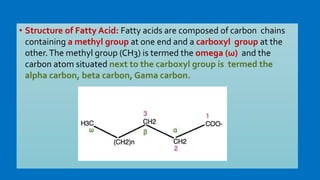
• Structure of Fatty Acid: Fatty acids are composed of carbon chains
containing a methyl group at one end and a carboxyl group at the
other.The methyl group (CH3) is termed the omega (ω) and the
carbon atom situated next to the carboxyl group is termed the
alpha carbon, beta carbon, Gama carbon.
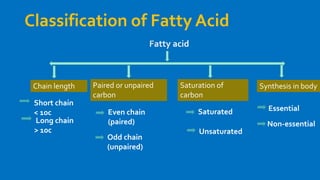
Classification of Fatty Acid
Chain length Paired or unpaired
carbon
Saturation of
carbon
Synthesis in body
Short chain
< 10c
Long chain
> 10c
Even chain
(paired)
Odd chain
(unpaired)
Saturated
Unsaturated
Essential
Non-essential
1. According to hydrocarbon chain length
• Short chain FA: carbon number 2-10.
e.g. acetic acid (2c), propionic acid (3c) etc. Mostly found in
milk.
• Long chain FA: carbon number > 10.
e.g. Palmitic acid (16 c), stearic acid (18 c) etc.
2. Based on paired or unpaired number of
carbons
• Even chain FA: > 90% of FA in human body contains even number
of carbon atoms. E.g. Palmitic acid (16c), stearic acid (18c).
• Odd chain FA: only < 5% FA in human body contains odd number
of carbon atoms. E.g. Propionic acid (3c), valeric acid (5c).
3.Based on saturation of carbons
• Saturated FA: No double bond in their hydrocarbon chain (found in human
body).
eg: Palmitic acid , stearic acid .
• Unsaturated FA: Presence of double bond in their hydrocarbon chain.
Monounsaturated FA (MUFA): Presence of single double bond.
E.g. Oleic Acid. Found in olive oil.
Polyunsaturated FA (PUFA): Presence of more than one double bond.
E.g. Linoleic Acid, linolenic Acid & arachidonic acid. Found in fish oil
and vegetable oil( except coconut oil & palm oil).
***
***
4.Based on nutritional value
• Non-essential FA: Human body can synthesize these FAs.
E.g. Palmitic acid , stearic acid .
• Essential FA: these fatty acids can’t be synthesized in human body due to lack of enzymes, so
must be supplied in die
• t.They are dietary essential in humans for growth.
E.g.
i. Linoleic acid (ω₆ - FA),
ii. Linolenic FA (ω₃ - FA) and
iii. Arachidonic Acid (ω₆ - FA).
Sources of fatty acid
• Endogenous source: synthesis of non-essential fatty acids within
the body.
• Exogenous source:
Saturated F.A: animal fat, milk, butter, ghee, dalda, coconut oil, palm oil,
vanaspati.
Unsaturated F.A(good for health): vegetable oil, fish oil, codliver oil, egg
yolk.
Sources of Essential FA
• All vegetable oils (except coconut
& palm oil)
Nuts, avocado, olive oil, soyabean oil,
corn oil etc.
Fish oil, cod liver oil, egg yolk.
***Importance of Essential FA
• Acts as precursors of eicosanoids (20 carbon PUFA).
• Components of all biological membrane.
• Prevents atherosclerosis by increasing cholesterol excretion via
bile.
• Essential for skin integrity, normal growth and reproduction.
• Helps in vision.
• Prevent fatty liver.
• Oxidized for energy production.
Numbering and designation of carbon in fatty acid
7 6 5 4 3 2 1
CH3 - CH2 - CH2 - CH2 - CH2 - CH2 - COOH
β α
CH3 - CH2 - CH2 - CH2 - CH2 - CH2 - COOH
ω1 ω2 ω3 ω4 ω5 ω6
• Linoleic acid (C: 18 : 2:∆9,12) in ∆ (Delta) system.
18 13 12 10 9 1
CH3-(CH2)4- CH=CH - CH2- CH=CH-(CH2)7- COOH
• Linoleic acid (C: 18 : 2: ω6) in ω system.
CH3 - (CH2)4 - CH=CH - CH2- CH= CH - (CH2)7- COOH
ω1 ω6 ω7 ω8 ω9 ω10 ω18
18 means total number of carbon
2 means number of double bond in structure
9 & 12 indicates location of double bond
Eicosanoids
• Prostaglandin (PG) and their related compounds-
Prostacycline (PGI2), thromboxane (TX), leukotrienes (LT) &
Lipoxin (LX) are collectively known as eicosanoids.
All are derived from 20 carbon (Greek: eikosi=twenty) PUFA.
Synthesis of Eicosanoids
Membrane Phospholipid
Arachidonic Acid
Phospholipase A2
Lipooxygenase
Cyclooxygenase
ThromboxaneA2 (TX A2)
Prostacyclin (PG I2)
Prostaglandin (PG)
Lipoxin (LX)
Leukotrine (LT)
Synthesis of eicosanoids
Prostaglandin
Thromboxane A2
Steroid and sterol
• Steroids are the compounds containing a cyclic steroid nucleus
namely cyclopentanoperhydrophenanthrene (CPPP).
• All the steroids have similar cyclic nucleus resembling
phenanthrene (ring A, B, C) to which a cyclopentane ring (ring D) is
attached. It is designated as cyclopentane per hydro phenanthrene
nucleus.
Steroids found in human body
• Cholesterol
• Bile acids
• Vitamin D
• Sex hormone: testosterone, estrogen & progesterone.
• Adrenocortical hormone
Sterol
• When a steroid contains one or
more hydroxyl (OH) groups, then
that compound is known as sterols.
• Cholesterol is the major sterol in
animal tissue.
Cholesterol (27 carbon compound)
•It consists of steroid nucleus
namely phenanthrene containing
19 carbon atoms.
•All animal cells contain cholesterol,
a lipid that plays a role in the
membrane’s fluidity and
permeability.
Structure of cholesterol (C27H46O)
• Cholesterol is a component of steroid
containing 27 carbon compounds.
• It has a cyclopentanoperhydrophenanthrene
nucleus (19 C).
• 8 hydrocarbon side chains are attached to
D ring at 17 carbon.
• A hydroxyl group is attached to carbon 3 at
A ring. (if carbon 3 is replaced by FA it is
called cholesterol ester).
• One double bond is present between carbon
atoms 5 and 6 chain.
Dietary sources : cheese, eggs, beef, mutton, prawn, pork, liver,
chicken, brain.
Function:
• Constituents of biological membrane.
• Helps in digestion.
• Helps in synthesis of steroid hormones, bile acid, vitamin D.
• High cholesterol increase the risk of atherosclerosis disorders.
• Act as building Blocks.
Dietary lipid, blood lipid, lipoprotein
• Dietary lipid:
Triacylglycerol (85%),
Cholesterol ester
Phospholipid
Glycolipid
• Blood Lipid:
Triglyceride < 150 mg%
Total cholesterol <200 mg%
Free FA 6-16 mg%
Phospholipid 150-200 mg%
• Lipoprotein:
Chylomicron
VLDL
LDL
HDL
• Serum lipid profile
 Total cholesterol < 200 mg%
 TAG <150 mg%
 LDL-C <130 mg %
 HDL-C >40 mg %
•Fat cell: adipocyte
Brown fat White fat
1.Present during fetal life but
diminishes gradually in adult.
1. Predominantly found in
adult.
2.Numerous small fat droplets. 2.Large fat droplet.
3. Mitochondria are numerous
with enormous blood vessels
and enzymes.
3.Few mitochondria are
present.
4.By heat production it
maintains thermogenesis in
newborn.
4. Provides energy during
fasting & cell size reduces.
*****
*****
****Too much white fat builds up in obesity.
Brown fat is healthy fat:
• Brown fat maintains body temperature.
• Brown fat burns calories.
• Brown fat breaks down glucose, thus may help control blood sugar &
improve insulin level.
• It helps by removing fats from the blood & thus reduces the risk of
hyperlipidemia.
• Brown fat is highly regarded as a treatment of obesity.
LIPID

LIPID

  • 2.
    Definition of lipid •Lipids are Heterogenous group of organic substances Water insoluble But soluble in fat solvents (non-polar organic solvents) like eather, benzene, chloroform, alcohol etc And actually or potentially related to fatty acids. • Together with carbohydrates and proteins, lipids are the main constituents of plant and animal cells. • Lipids are not polymeric substance like protein, polysaccharide and nucleic acid.
  • 3.
    Why called heterogenous • Theyare different in chemical structure but more related t0 same physical properties like insoluble in water.
  • 5.
    Bloor’s criteria • Relativelyinsoluble in water. • Soluble in organic solvents like eather, benzene, alcohol etc. • Actually or potentially related to fatty acid. • Utilized by living organism.
  • 6.
    Properties of lipid Physical: 1.Fats and fatty acids are soluble in organic solvents, such as petroleum ether, benzene and chloroform. They are insoluble in water. 2. Tasteless, odorless, colorless. 3. Specific gravity less than 1.0. 4. Melting point-low (human fat), around 50 degree Celsius 5. Spreading and surface tension: they spread uniformly over the surface and reduce the surface tension.
  • 7.
    Chemical properties: • Hydrolysis:Fats undergo hydrolysis when treated with mineral acids, the alkalis or fat splitting enzyme lipase or hydrolases to yield glycerol and the constituent fatty acids. Triacylglycerol FA + Glycerol • Saponification: Hydrolysis of triacyl glycerol by alkali to produce glycerol and soap. Triacyl glycerol + 3NaOH Glycerol + 3R COONa (soap) Lipase
  • 8.
    • Hydrogenation: Oilscontaining unsaturated fatty acids can be hydrogenated into fully saturated solid fat by addition of H+ across the double bond by fatty acid in presence of high temperature, pressure and catalyst nickel. This reaction forms the basis of the industrial production of hydrogenated oil (vegetable ghee). • Rancidity: It is a chemical change resulting in unpleasant odor and taste on storage when fats and oils are exposed to light, heat, air & bacteria. It occurs mostly in unsaturated fatty acid.
  • 9.
    • Lipid peroxidation:in living cells, Fat undergoes oxidation (auto oxidation) in Vivo to produce lipid peroxides and free radicals that cause tissue damage, malignancy, aging, atherosclerosis. • Emulsification: The process of breaking of large-sized fat molecules into smaller ones is called emulsification. In animals, this process is brought about by bile juice liberated from liver. Other emulsifying agents are water, soaps, proteins and gums.
  • 10.
    Sources of lipid •They are widely distributed in nature, both in plants and animals. Animal: meat, fish, liver, egg yolk, milk and milk products like butter, ghee, cheese etc. Plant: oils like soyabean oil, sunflower oil, olive oil etc. Dietary lipids areTriacylglycerol (85%), cholesterol ester, phospholipid and glycolipid.
  • 11.
  • 12.
    • Simple lipid:Ester of fatty acid with alcohol, do not contain non lipid substance.(fatty acid+ alcohol). Eg: neutral fat, wax. • Complex lipid/Compound lipid: esters of fatty acid with alcohol with other non lipid substance.(fatty acid + alcohol +non lipid substance). Eg: phospholipid, glycolipids, lipoprotein. • Derived lipid: obtained by hydrolysis of simple and complex lipid. Eg: fatty acid, alcohol, glycerol, steroid, cholesterol, prostaglandin, fat soluble vitamins( vit-A, D, E, K), ketone body.
  • 13.
    • Neutral fat-tri ester of fatty acid with glycerol which is solid in room temperature. • They are called neutral because they don’t have any charge at normal body pH. • Neutral fat of plant source (e.g. vegetable oil) have more unsaturated fatty acid and that of animal source (e.g. Ghee, egg) have more saturated FA.
  • 14.
    • Wax-Ester offatty acid with long chain monohydric alcohol. It is formed as secretions which are mostly protective in function by many animals.They resemble like fats and are usually solid.These compounds have no importance as far as human metabolism concerned. Use: they are widely used in pharmaceutical, cosmetic and other industries in the manufacture of lotions, ointments etc. • Fat-solid at room temperature, contain saturated fatty acid. • Oil-liquid at room temperature, contain unsaturated fatty acid.
  • 15.
  • 16.
    Function of lipid •Source of energy. • Important storage form of energy. • Important constituent of biological membrane. • Provides essential fatty acid and helps in absorption of fat soluble vitamins (vit- A, D, E, K). • Act as subcutaneous thermal insulator and perineural electrical insulator. • Acts as a mechanical cushion around the internal organs to protect them from mechanical injury. • Add taste and palatability to food.
  • 18.
    Complex / Compoundlipid • Esters of FA+ alcohol + additional group (phosphate, nitrogenous base, CHO, protein) Phospholipid: FA+ alcohol + phosphoric acid ± nitrogenous base Glycolipid: FA+ sphingol (alcohol) + CHO Lipoprotein: Lipid + protein
  • 19.
  • 21.
    Phospholipid (classification) Phospholipid Glycerophospholipid FA+ Glycerol+H3PO4 ± N2 base e.g.: Phosphatidylcholine (lecithin) Phosphatidyl ethanol amine (cephalin) Phosphatidylserine Phosphatidylinositol Lysophospholipid Cardiolipin Plasmalogen Sphingophospholipid FA+ sphingol+H3PO4+ choline e.g.: Sphingomyelin
  • 22.
    Function of phospholipid •Major constituents of cell membrane. • Essential component of bile where they act as detergent & help to keep cholesterol in solution. • Dipalmitoyl lecithin acts as surfactant in lung, which lowers surface tension and can help in lung expansion. • Cephalin helps in blood clotting (thromboplastin). • Increase the rate of Fatty acid oxidation. • Acts as lipotropic factor prevents fatty liver ( accumulation of fat in the liver). • Phosphatidyl inositol act as 2nd messenger for different hormones. • Constituent of myelin sheath (sphingomyelin) in nerve tissue.
  • 24.
    Lipoprotein*** • Lipoproteins aredynamic spherical macromolecular complexes of lipids and specific proteins that transport insoluble lipids through the blood between different organs and tissues.
  • 26.
    Structure of Lipoprotein •TAG & cholesterol esters are core structure of lipoprotein. They are more hydrophobic. • Phospholipids & free cholesterols are located on surface as a single monolayer. • Apolipoproteins are located outside.
  • 27.
    Important lipoproteins (LP)are: • Chylomicron (lowest density & TG rich) • VLDL (Very low density LP & TG rich) • LDL (Low density LP & cholesterol rich) • HDL (High density LP & phospholipid rich) Importance of LP: Keep lipids soluble as they transport them in plasma. They provide an efficient mechanism for delivering their lipids.
  • 28.
    Synthesis & functionof LP Lipoprotein Site of synthesis Function Chylomicron Intestine Transport of dietary lipids from intestine to peripheral tissue. VLDL Liver Transport ofTAG from Liver to peripheral tissue. LDL PlasmaVLDL Transport of cholesterol from liver to peripheral tissue. HDL Liver and intestine Transport of free cholesterol from peripheral tissue to liver by reverse cholesterol transport.
  • 29.
    LDL is harmfulbut HDL is beneficial • LDL is Harmful cause it deposits cholesterols in smooth muscle cells of artery & occurs atherosclerosis which increase risk of cardiac disease (Myocardial infarction). • HDL is beneficial cause it transports free cholesterol from peripheral tissue to liver by reverse cholesterol transport for biliary excretion. So, HDL keeps cholesterol concentration low in blood. It also has antiatherogenic property.
  • 30.
    Derived Lipid: Fattyacid *** • Fatty acids are aliphatic monocarboxylic acid. • General structure: CH3-(CH2)n-CH2-CH2-COOH • Fatty acids are not found in a free state in nature; commonly they exist in combination with glycerol (an alcohol) in the form of triglyceride.
  • 31.
    • Structure ofFatty Acid: Fatty acids are composed of carbon chains containing a methyl group at one end and a carboxyl group at the other.The methyl group (CH3) is termed the omega (ω) and the carbon atom situated next to the carboxyl group is termed the alpha carbon, beta carbon, Gama carbon.
  • 32.
    Classification of FattyAcid Chain length Paired or unpaired carbon Saturation of carbon Synthesis in body Short chain < 10c Long chain > 10c Even chain (paired) Odd chain (unpaired) Saturated Unsaturated Essential Non-essential
  • 33.
    1. According tohydrocarbon chain length • Short chain FA: carbon number 2-10. e.g. acetic acid (2c), propionic acid (3c) etc. Mostly found in milk. • Long chain FA: carbon number > 10. e.g. Palmitic acid (16 c), stearic acid (18 c) etc.
  • 34.
    2. Based onpaired or unpaired number of carbons • Even chain FA: > 90% of FA in human body contains even number of carbon atoms. E.g. Palmitic acid (16c), stearic acid (18c). • Odd chain FA: only < 5% FA in human body contains odd number of carbon atoms. E.g. Propionic acid (3c), valeric acid (5c).
  • 35.
    3.Based on saturationof carbons • Saturated FA: No double bond in their hydrocarbon chain (found in human body). eg: Palmitic acid , stearic acid . • Unsaturated FA: Presence of double bond in their hydrocarbon chain. Monounsaturated FA (MUFA): Presence of single double bond. E.g. Oleic Acid. Found in olive oil. Polyunsaturated FA (PUFA): Presence of more than one double bond. E.g. Linoleic Acid, linolenic Acid & arachidonic acid. Found in fish oil and vegetable oil( except coconut oil & palm oil).
  • 37.
  • 38.
    4.Based on nutritionalvalue • Non-essential FA: Human body can synthesize these FAs. E.g. Palmitic acid , stearic acid . • Essential FA: these fatty acids can’t be synthesized in human body due to lack of enzymes, so must be supplied in die • t.They are dietary essential in humans for growth. E.g. i. Linoleic acid (ω₆ - FA), ii. Linolenic FA (ω₃ - FA) and iii. Arachidonic Acid (ω₆ - FA).
  • 39.
    Sources of fattyacid • Endogenous source: synthesis of non-essential fatty acids within the body. • Exogenous source: Saturated F.A: animal fat, milk, butter, ghee, dalda, coconut oil, palm oil, vanaspati. Unsaturated F.A(good for health): vegetable oil, fish oil, codliver oil, egg yolk.
  • 40.
    Sources of EssentialFA • All vegetable oils (except coconut & palm oil) Nuts, avocado, olive oil, soyabean oil, corn oil etc. Fish oil, cod liver oil, egg yolk.
  • 41.
    ***Importance of EssentialFA • Acts as precursors of eicosanoids (20 carbon PUFA). • Components of all biological membrane. • Prevents atherosclerosis by increasing cholesterol excretion via bile. • Essential for skin integrity, normal growth and reproduction. • Helps in vision. • Prevent fatty liver. • Oxidized for energy production.
  • 42.
    Numbering and designationof carbon in fatty acid 7 6 5 4 3 2 1 CH3 - CH2 - CH2 - CH2 - CH2 - CH2 - COOH β α CH3 - CH2 - CH2 - CH2 - CH2 - CH2 - COOH ω1 ω2 ω3 ω4 ω5 ω6
  • 43.
    • Linoleic acid(C: 18 : 2:∆9,12) in ∆ (Delta) system. 18 13 12 10 9 1 CH3-(CH2)4- CH=CH - CH2- CH=CH-(CH2)7- COOH • Linoleic acid (C: 18 : 2: ω6) in ω system. CH3 - (CH2)4 - CH=CH - CH2- CH= CH - (CH2)7- COOH ω1 ω6 ω7 ω8 ω9 ω10 ω18 18 means total number of carbon 2 means number of double bond in structure 9 & 12 indicates location of double bond
  • 44.
    Eicosanoids • Prostaglandin (PG)and their related compounds- Prostacycline (PGI2), thromboxane (TX), leukotrienes (LT) & Lipoxin (LX) are collectively known as eicosanoids. All are derived from 20 carbon (Greek: eikosi=twenty) PUFA.
  • 45.
    Synthesis of Eicosanoids MembranePhospholipid Arachidonic Acid Phospholipase A2 Lipooxygenase Cyclooxygenase ThromboxaneA2 (TX A2) Prostacyclin (PG I2) Prostaglandin (PG) Lipoxin (LX) Leukotrine (LT)
  • 46.
  • 47.
    Steroid and sterol •Steroids are the compounds containing a cyclic steroid nucleus namely cyclopentanoperhydrophenanthrene (CPPP). • All the steroids have similar cyclic nucleus resembling phenanthrene (ring A, B, C) to which a cyclopentane ring (ring D) is attached. It is designated as cyclopentane per hydro phenanthrene nucleus.
  • 48.
    Steroids found inhuman body • Cholesterol • Bile acids • Vitamin D • Sex hormone: testosterone, estrogen & progesterone. • Adrenocortical hormone
  • 49.
    Sterol • When asteroid contains one or more hydroxyl (OH) groups, then that compound is known as sterols. • Cholesterol is the major sterol in animal tissue.
  • 50.
    Cholesterol (27 carboncompound) •It consists of steroid nucleus namely phenanthrene containing 19 carbon atoms. •All animal cells contain cholesterol, a lipid that plays a role in the membrane’s fluidity and permeability.
  • 51.
    Structure of cholesterol(C27H46O) • Cholesterol is a component of steroid containing 27 carbon compounds. • It has a cyclopentanoperhydrophenanthrene nucleus (19 C). • 8 hydrocarbon side chains are attached to D ring at 17 carbon. • A hydroxyl group is attached to carbon 3 at A ring. (if carbon 3 is replaced by FA it is called cholesterol ester). • One double bond is present between carbon atoms 5 and 6 chain.
  • 52.
    Dietary sources :cheese, eggs, beef, mutton, prawn, pork, liver, chicken, brain. Function: • Constituents of biological membrane. • Helps in digestion. • Helps in synthesis of steroid hormones, bile acid, vitamin D. • High cholesterol increase the risk of atherosclerosis disorders. • Act as building Blocks.
  • 53.
    Dietary lipid, bloodlipid, lipoprotein • Dietary lipid: Triacylglycerol (85%), Cholesterol ester Phospholipid Glycolipid • Blood Lipid: Triglyceride < 150 mg% Total cholesterol <200 mg% Free FA 6-16 mg% Phospholipid 150-200 mg% • Lipoprotein: Chylomicron VLDL LDL HDL • Serum lipid profile  Total cholesterol < 200 mg%  TAG <150 mg%  LDL-C <130 mg %  HDL-C >40 mg %
  • 54.
    •Fat cell: adipocyte Brownfat White fat 1.Present during fetal life but diminishes gradually in adult. 1. Predominantly found in adult. 2.Numerous small fat droplets. 2.Large fat droplet. 3. Mitochondria are numerous with enormous blood vessels and enzymes. 3.Few mitochondria are present. 4.By heat production it maintains thermogenesis in newborn. 4. Provides energy during fasting & cell size reduces. ***** *****
  • 55.
    ****Too much whitefat builds up in obesity. Brown fat is healthy fat: • Brown fat maintains body temperature. • Brown fat burns calories. • Brown fat breaks down glucose, thus may help control blood sugar & improve insulin level. • It helps by removing fats from the blood & thus reduces the risk of hyperlipidemia. • Brown fat is highly regarded as a treatment of obesity.