I. Introduction to new guidelines on lipid management
II. Comparison with atp III guidelines
III. Current statin treatment recommendations
IV. Current statin safety recommendations
 Goal: treatment of blood cholesterol to reduce atherosclerotic
cardiovascular risk in adults, currently the leading cause of
death and disability in America
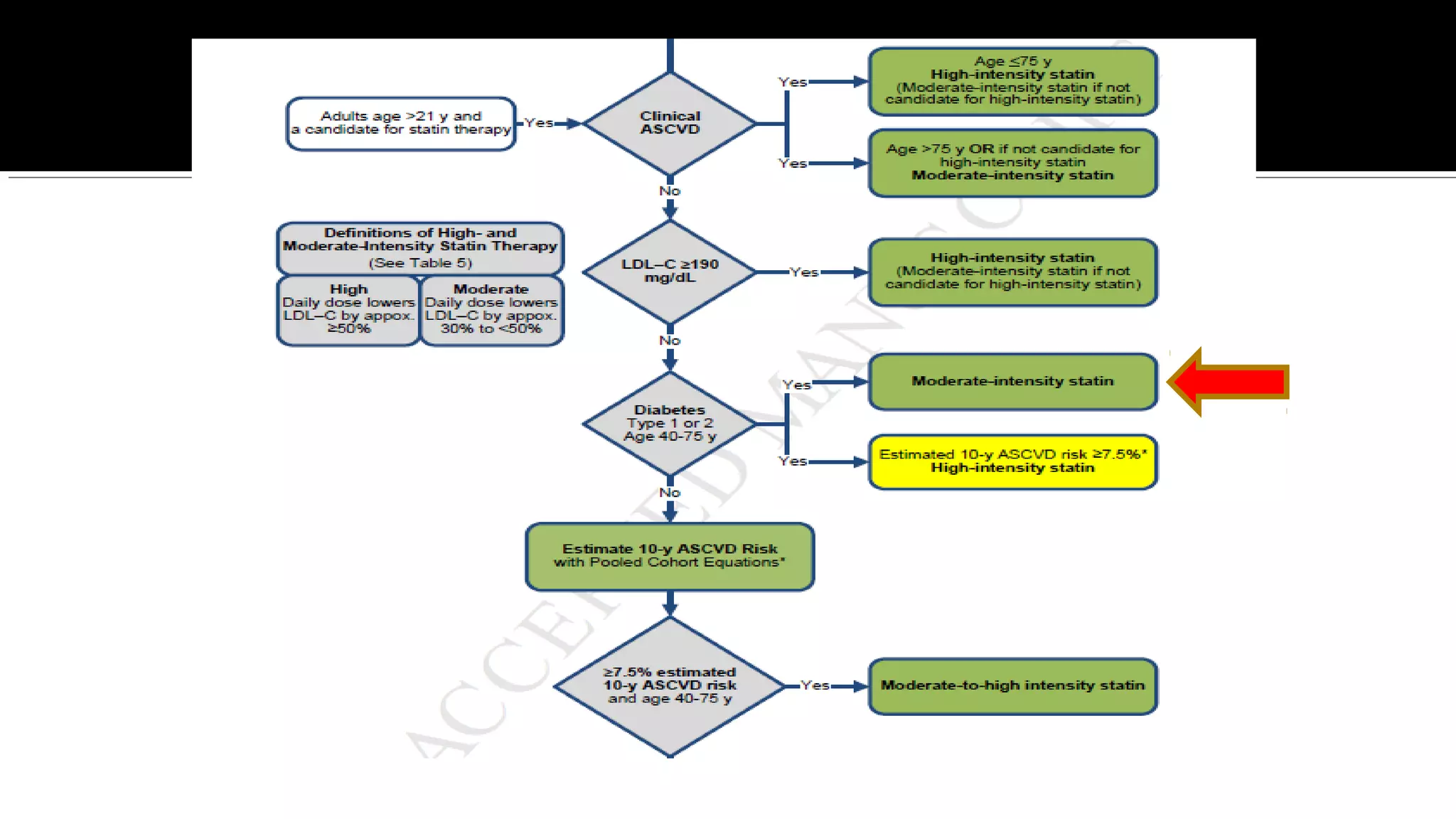
 initiate either moderate-intensity or high-intensity statin therapy for patients who fall into the four
categories
 Unlike atp-iii, Do not titrate to a specific LDL cholesterol target
 Measure lipids during follow-ups to assess adherence to treatment, not to achieve a specific LDL target
1) Individuals with clinical ASCVD
2) Individuals with LDL >190
3) Individuals with dm, 40-75 yo with LDL 70-189 and without
clinical ASCVD
4) Individuals without clinical ASCVD or dm with LDL 70-189 and
estimated 10-year ASCVD risk >7.5%
http://clincalc.com/Cardiology/ASCVD/PooledCohort.aspx
NO RECOMMENDATIONS ON STATIN THERAPY FOR PTS WITH NYHA CLASS II-
IV OR ESRD ON DIALYSIS (GRADE N RECOOMENDATIONS)
 Select the appropriate dose
 Keep potential Side effects and drug-drug interaction In mind
(grade A)
 If high or moderate intensity statin not tolerated, use the
maximum tolerated dose instead
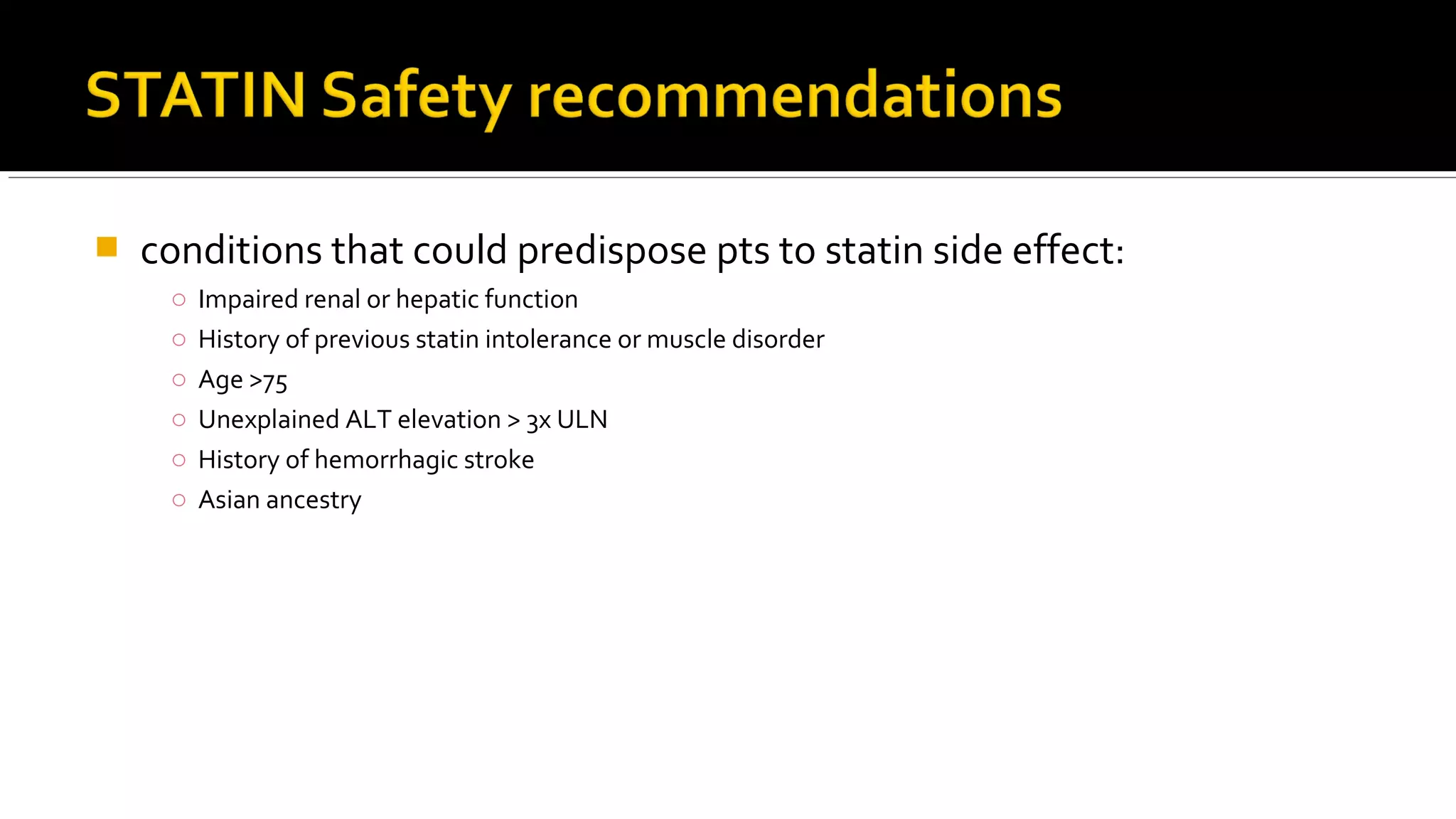
 conditions that could predispose pts to statin side effect:
o Impaired renal or hepatic function
o History of previous statin intolerance or muscle disorder
o Age >75
o Unexplained ALT elevation > 3x ULN
o History of hemorrhagic stroke
o Asian ancestry
 Check baseline ALT prior initiating the statin (Grade B)
 Check LFTs if patient develops Symptoms of hepatic dysfunction (Grade E)
 If 2 consecutive LDL <40, Consider decreasing the statin dose (Grade C, weak recommendation)
 It may be harmful to initiate simvastatin 80mg, or increase the dose of simvastatin to 80mg (Grade B)
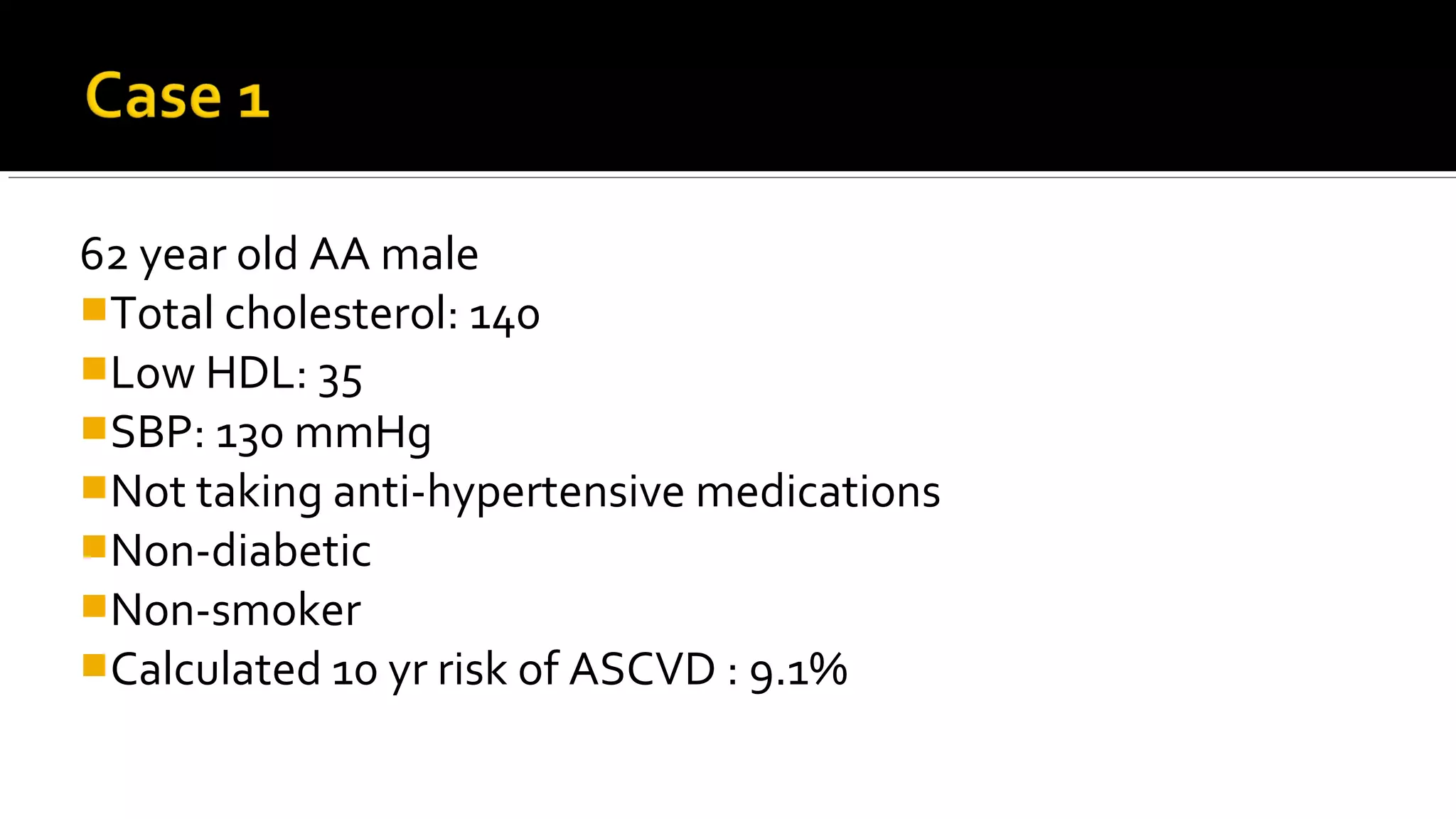
62 year old AA male
Total cholesterol: 140
Low HDL: 35
SBP: 130 mmHg
Not taking anti-hypertensive medications
Non-diabetic
Non-smoker
Calculated 10 yr risk of ASCVD : 9.1%
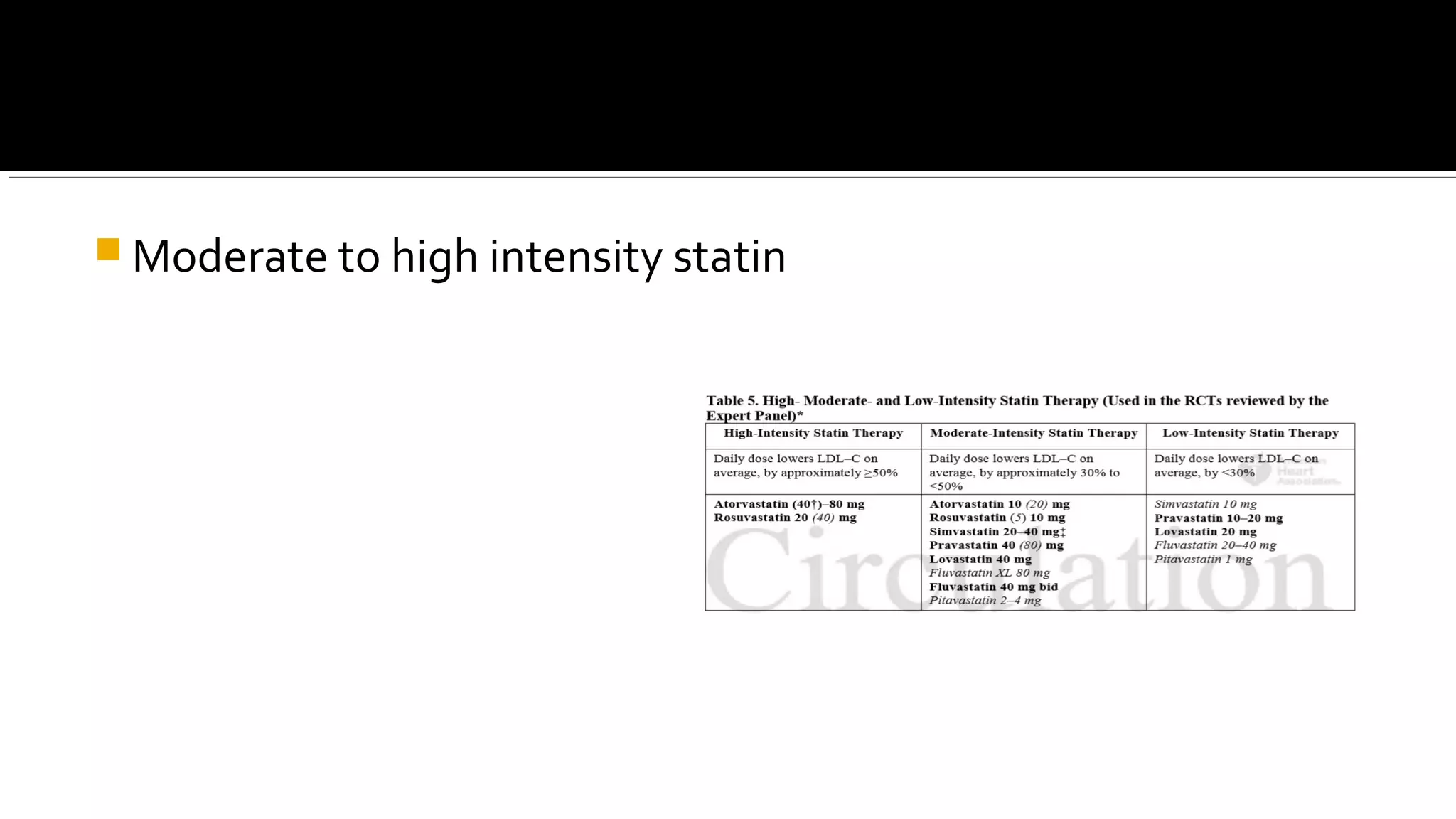
 Moderate to high intensity statin
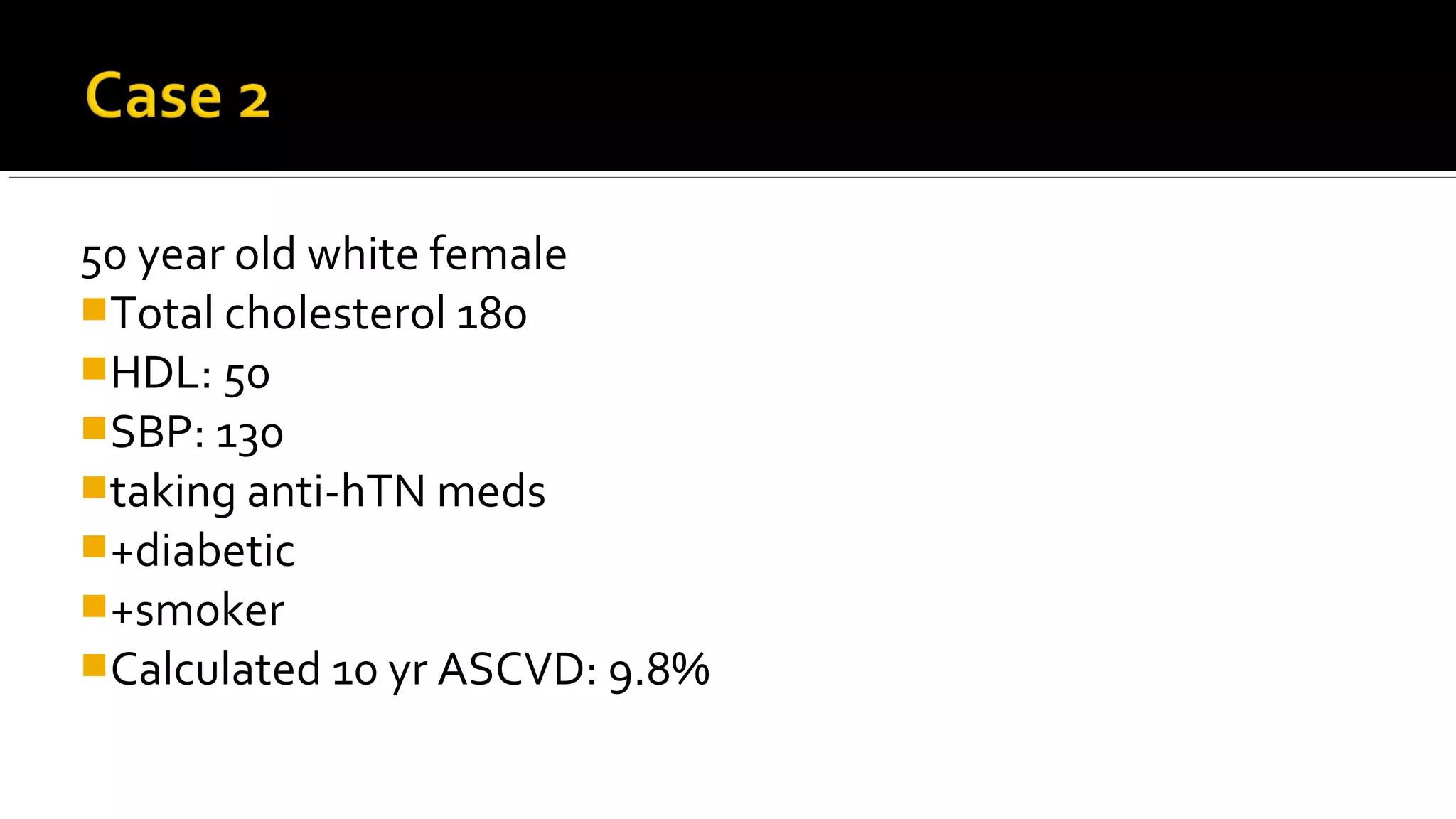
50 year old white female
Total cholesterol 180
HDL: 50
SBP: 130
taking anti-hTN meds
+diabetic
+smoker
Calculated 10 yr ASCVD: 9.8%
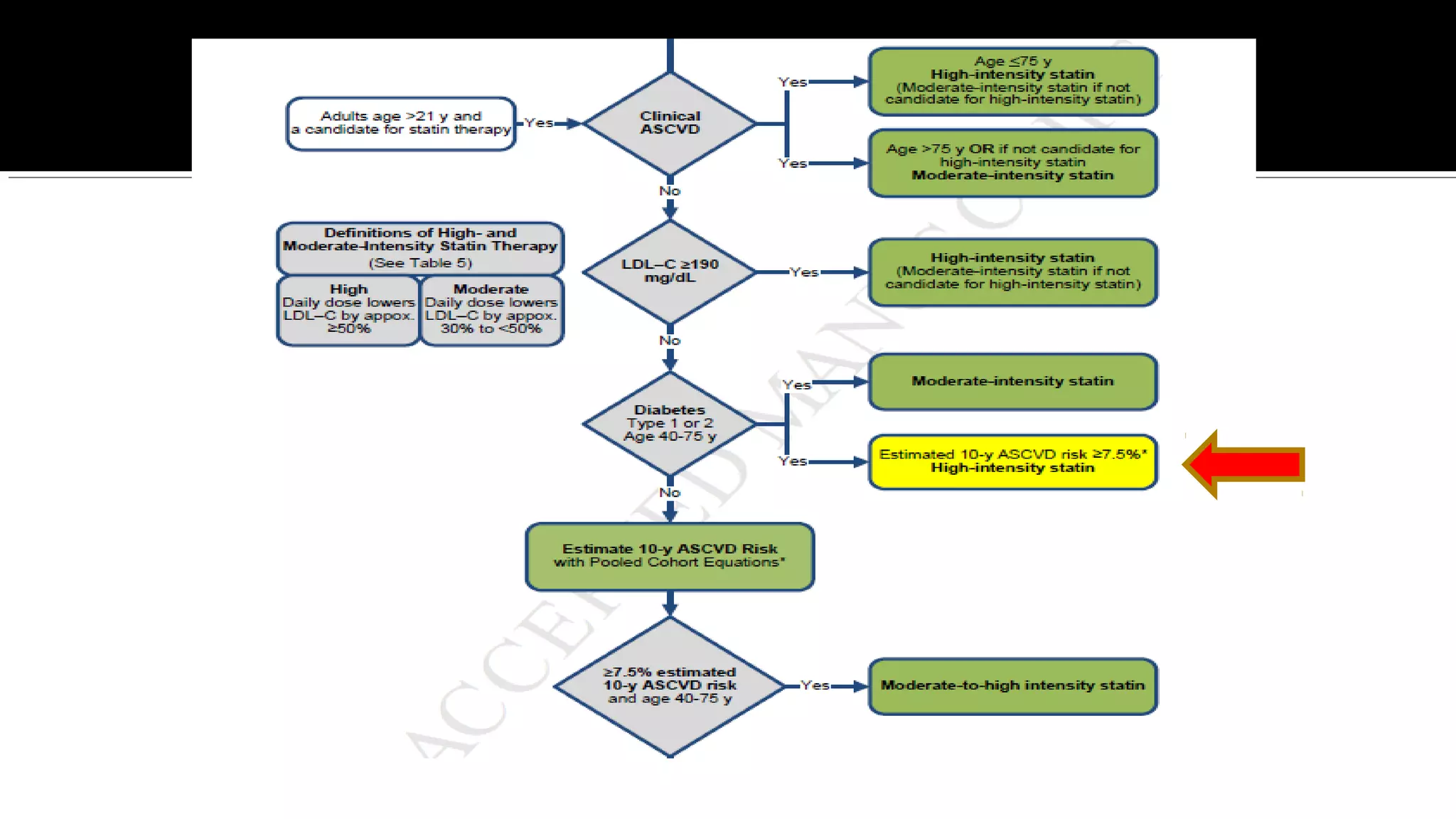
 high intensity statin
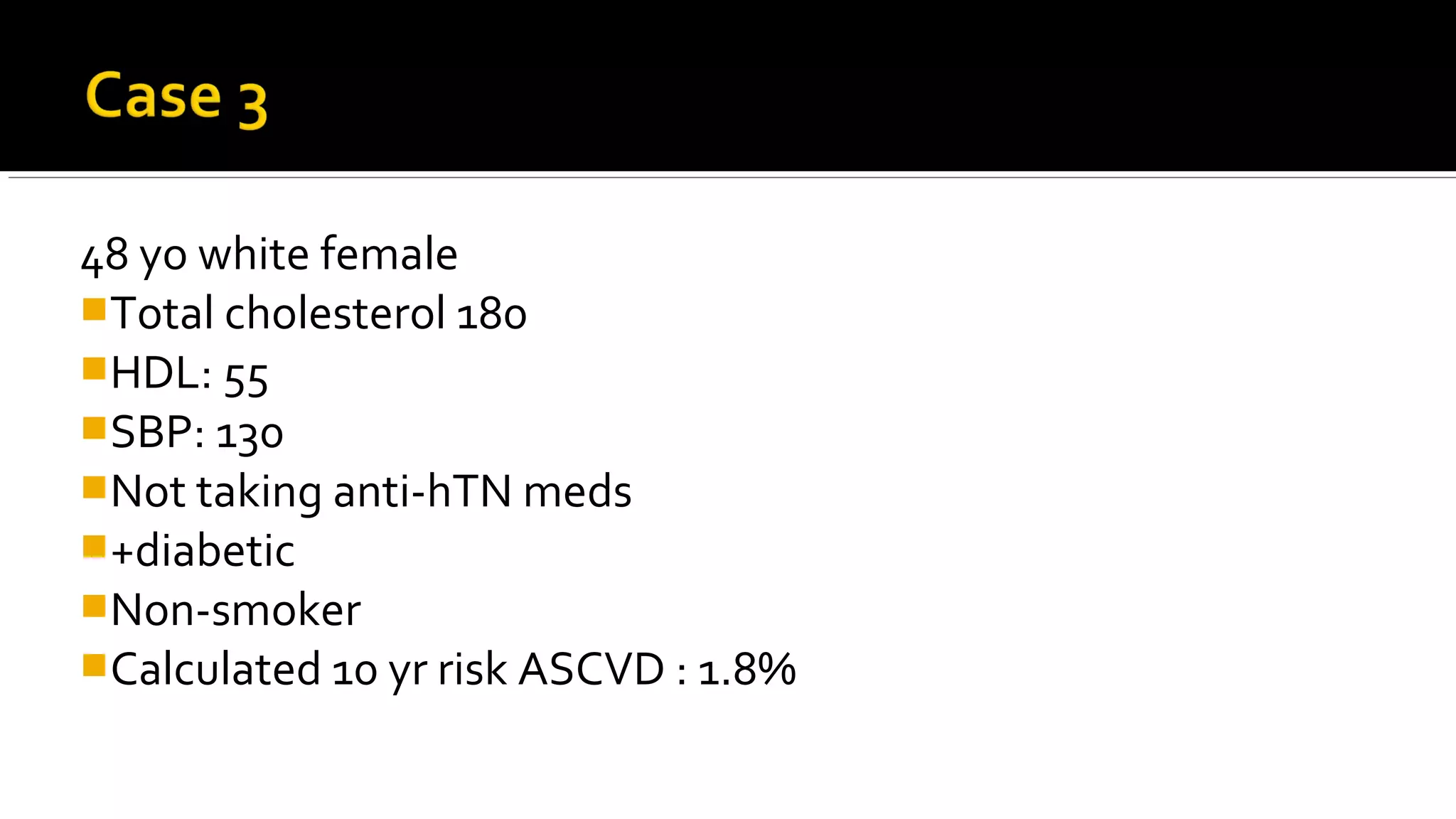
48 yo white female
Total cholesterol 180
HDL: 55
SBP: 130
Not taking anti-hTN meds
+diabetic
Non-smoker
Calculated 10 yr risk ASCVD : 1.8%
 Moderate intensity statin
22 yo white male
LDL: 195
SBP: 120
Not taking anti-hTN meds
Non-diabetic
Non-smoker
 High intensity statin
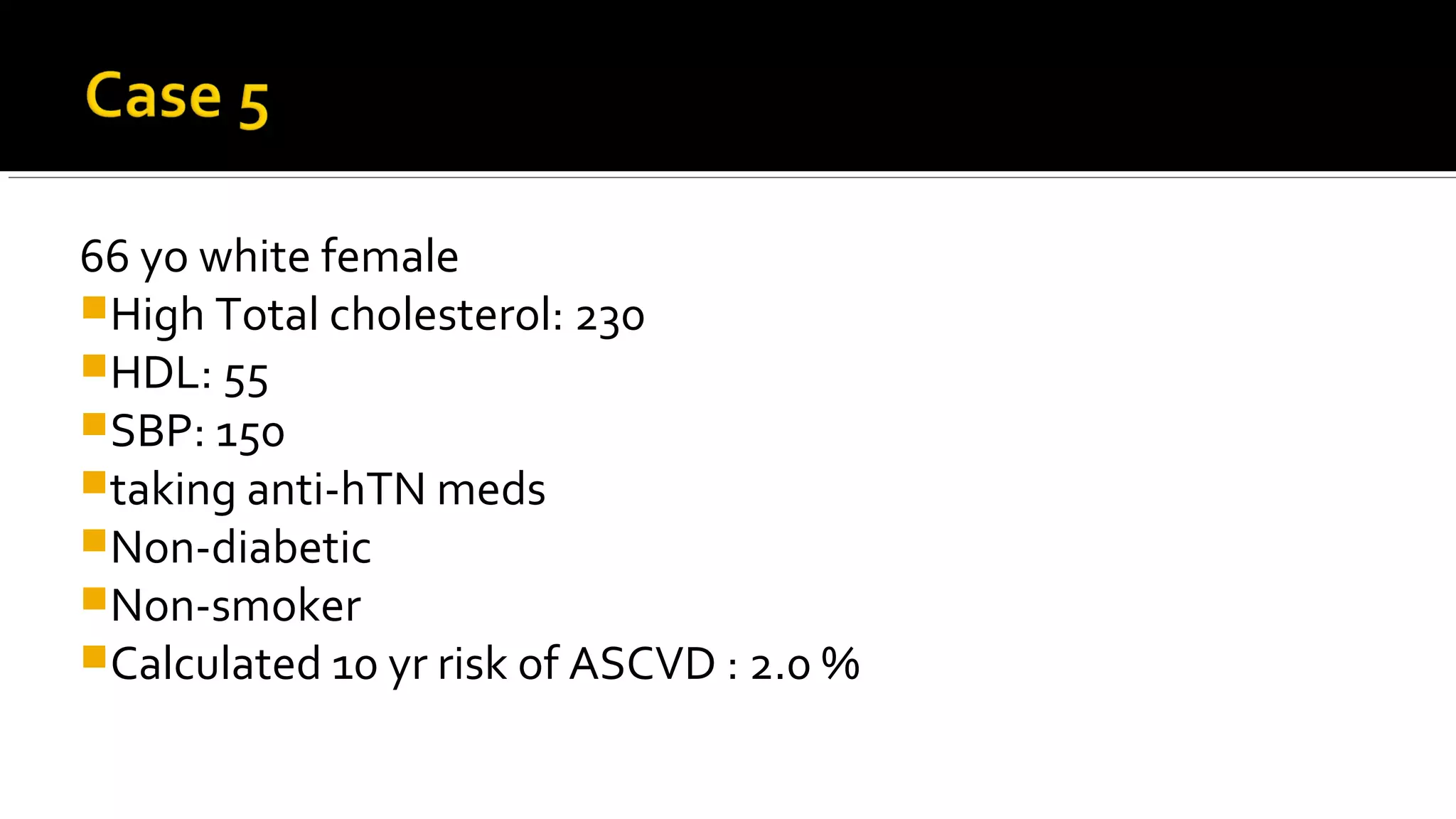
66 yo white female
High Total cholesterol: 230
HDL: 55
SBP: 150
taking anti-hTN meds
Non-diabetic
Non-smoker
Calculated 10 yr risk of ASCVD : 2.0 %
 Statin therapy NOT recommended
1. Rather than LDL–C or non-HDL– C targets, new guideline
uses the intensity of statin therapy as the goal of treatment.
2. Know the 4 Statin Benefit Groups:
1. Individuals with clinical ASCVD
2. Individuals with primary elevations of LDL–C ≥190 mg/dL
3. Individuals 40 to 75 years of age with diabetes and LDL–C 70 to189 mg/dL
without clinical ASCVD
4. Individuals without clinical ASCVD or diabetes who are 40 to 75 years of
age with LDL–C 70 to 189 mg/dL and have an estimated 10-year ASCVD
risk of 7.5% or higher. (using the Pooled Cohort Equations for ASCVD
risk prediction)
http://clincalc.com/Cardiology/ASCVD/PooledCohort.aspx

Lipid management 2013 acc-aha guidelines

  • 2.
    I. Introduction tonew guidelines on lipid management II. Comparison with atp III guidelines III. Current statin treatment recommendations IV. Current statin safety recommendations
  • 3.
     Goal: treatmentof blood cholesterol to reduce atherosclerotic cardiovascular risk in adults, currently the leading cause of death and disability in America
  • 4.
     initiate eithermoderate-intensity or high-intensity statin therapy for patients who fall into the four categories  Unlike atp-iii, Do not titrate to a specific LDL cholesterol target  Measure lipids during follow-ups to assess adherence to treatment, not to achieve a specific LDL target
  • 5.
    1) Individuals withclinical ASCVD 2) Individuals with LDL >190 3) Individuals with dm, 40-75 yo with LDL 70-189 and without clinical ASCVD 4) Individuals without clinical ASCVD or dm with LDL 70-189 and estimated 10-year ASCVD risk >7.5%
  • 7.
  • 8.
    NO RECOMMENDATIONS ONSTATIN THERAPY FOR PTS WITH NYHA CLASS II- IV OR ESRD ON DIALYSIS (GRADE N RECOOMENDATIONS)
  • 10.
     Select theappropriate dose  Keep potential Side effects and drug-drug interaction In mind (grade A)  If high or moderate intensity statin not tolerated, use the maximum tolerated dose instead
  • 11.
     conditions thatcould predispose pts to statin side effect: o Impaired renal or hepatic function o History of previous statin intolerance or muscle disorder o Age >75 o Unexplained ALT elevation > 3x ULN o History of hemorrhagic stroke o Asian ancestry
  • 12.
     Check baselineALT prior initiating the statin (Grade B)  Check LFTs if patient develops Symptoms of hepatic dysfunction (Grade E)  If 2 consecutive LDL <40, Consider decreasing the statin dose (Grade C, weak recommendation)  It may be harmful to initiate simvastatin 80mg, or increase the dose of simvastatin to 80mg (Grade B)
  • 13.
    62 year oldAA male Total cholesterol: 140 Low HDL: 35 SBP: 130 mmHg Not taking anti-hypertensive medications Non-diabetic Non-smoker Calculated 10 yr risk of ASCVD : 9.1%
  • 15.
     Moderate tohigh intensity statin
  • 16.
    50 year oldwhite female Total cholesterol 180 HDL: 50 SBP: 130 taking anti-hTN meds +diabetic +smoker Calculated 10 yr ASCVD: 9.8%
  • 18.
  • 19.
    48 yo whitefemale Total cholesterol 180 HDL: 55 SBP: 130 Not taking anti-hTN meds +diabetic Non-smoker Calculated 10 yr risk ASCVD : 1.8%
  • 21.
  • 22.
    22 yo whitemale LDL: 195 SBP: 120 Not taking anti-hTN meds Non-diabetic Non-smoker
  • 24.
  • 25.
    66 yo whitefemale High Total cholesterol: 230 HDL: 55 SBP: 150 taking anti-hTN meds Non-diabetic Non-smoker Calculated 10 yr risk of ASCVD : 2.0 %
  • 27.
     Statin therapyNOT recommended
  • 28.
    1. Rather thanLDL–C or non-HDL– C targets, new guideline uses the intensity of statin therapy as the goal of treatment. 2. Know the 4 Statin Benefit Groups: 1. Individuals with clinical ASCVD 2. Individuals with primary elevations of LDL–C ≥190 mg/dL 3. Individuals 40 to 75 years of age with diabetes and LDL–C 70 to189 mg/dL without clinical ASCVD 4. Individuals without clinical ASCVD or diabetes who are 40 to 75 years of age with LDL–C 70 to 189 mg/dL and have an estimated 10-year ASCVD risk of 7.5% or higher. (using the Pooled Cohort Equations for ASCVD risk prediction)
  • 29.

Editor's Notes

  • #3 -I am gonna also talk to you about what has changed compared to ATP III guidelines which we have been using in our practice in the past few years -I am gonna also teach you about the current statin treatment and safety that are both mentioned in the new guidelines
  • #4 The goal was To guide clinicians in treatment of blood cholesterol to reduce atherosclerotic cardiovascular risk in adults, currently the leading cause of death and disability in America The RCTs identified, demonstrated consistent reduction in ASCVD events from statins therapy in secondary and primary prevention populations (with the exception of those with NYHA class II-IV heart failure or receiving maintenance hemodialysis)
  • #5 current guidelines direct clinicians to initiate either moderate-intensity or high-intensity statin therapy for patients who fall into the four categories, without titration to a specific LDL cholesterol target Measuring lipids during follow-ups is done to assess adherence to treatment and not to see whether a specific LDL cholesterol target has been achieved Rather than use a &amp;quot;lowest is best&amp;quot; approach that combines a low dose of a statin drug along with several other cholesterol-lowering drugs, new guidelines focuses on a healthy lifestyle along with a higher dose of statins, eliminating the need for additional medications.
  • #6 -Based on extensive review of the evidence, the expert panel identified 4 groups that would benefit from statin therapy: Individuals with clinical ASCVD Individuals with LDL &amp;gt;190 Individuals with dm, 40-75 yo with LDL 70-189 and without clinical ASCVD Individuals without clinical ASCVD or dm with LDL 70-189 and estimated 10-year ASCVD risk &amp;gt;7.5% Note that Clinical ASCVD is defined by the inclusion criteria for the secondary prevention statin RCTs (acute coronary syndromes, or a history of MI, stable or unstable angina, coronary or other arterial revascularization, stroke, TIA, or peripheral arterial disease presumed to be of atherosclerotic origin).
  • #7 This algorithim summarizes the major guidelines in one page You see the 4 statin benefit groups in the middle: on top, you see the patient’s group with clinical ASCVD, below that you see the group with LDL &amp;gt;190, below that you see the patient’s with history of DM 40-75 years old, and in the bottom, you see patients who don’t have the characteristics of the first 3 groups but their 10 year ASCD risk is greater than 7.5% For the first group: based on the guidline, if you have clinical ASCD, are younger than 75 and don’t have any history of intolerance to statin, you should be started on high intensity statin. On the other hand, if you are older than 75, or not a candidate for high intensity statin due to lets say intolerance to statins, you are a candidate for moderate-intensity statin For the second group, if your LDL is greater than 190, you need to be started on high-intensity statin, unless you have contra-indication to high dose start on moderate dose For the third group, individuals with diabetes with above mentioned group age, you need to calculate the 10 year ASCVD risk using a new equation/calculater called “pooled Cohort Equations” if the 10 year risk is greater than 7.5%, start them on high-intensity, otherwise, you can start them on moderate-intensity statin For the last group, you need to calculate patient’s risk factor and start them on moderate-to-high intensity statin if their estimated 10-y ASCVD risk is greater than 7.5% Keep that in mind that what we mean by “high intensity” statin, is the daily dose of statin that lowers the LDL by appox greater than 50%, and what we mean by moderate intensity statin, is the daily dose of statin that lowers the LDL by appox 30-50%.
  • #8 This is the new equation, the pooled cohort risk assessment equation As you can see, there are different parameters that you need to plug in to the equation to calculate the risk: gender, age, race, total cholesterol, HDL, systolic BP, whether or not you are on any anti-HTN meds, any history of DM or being a smoker
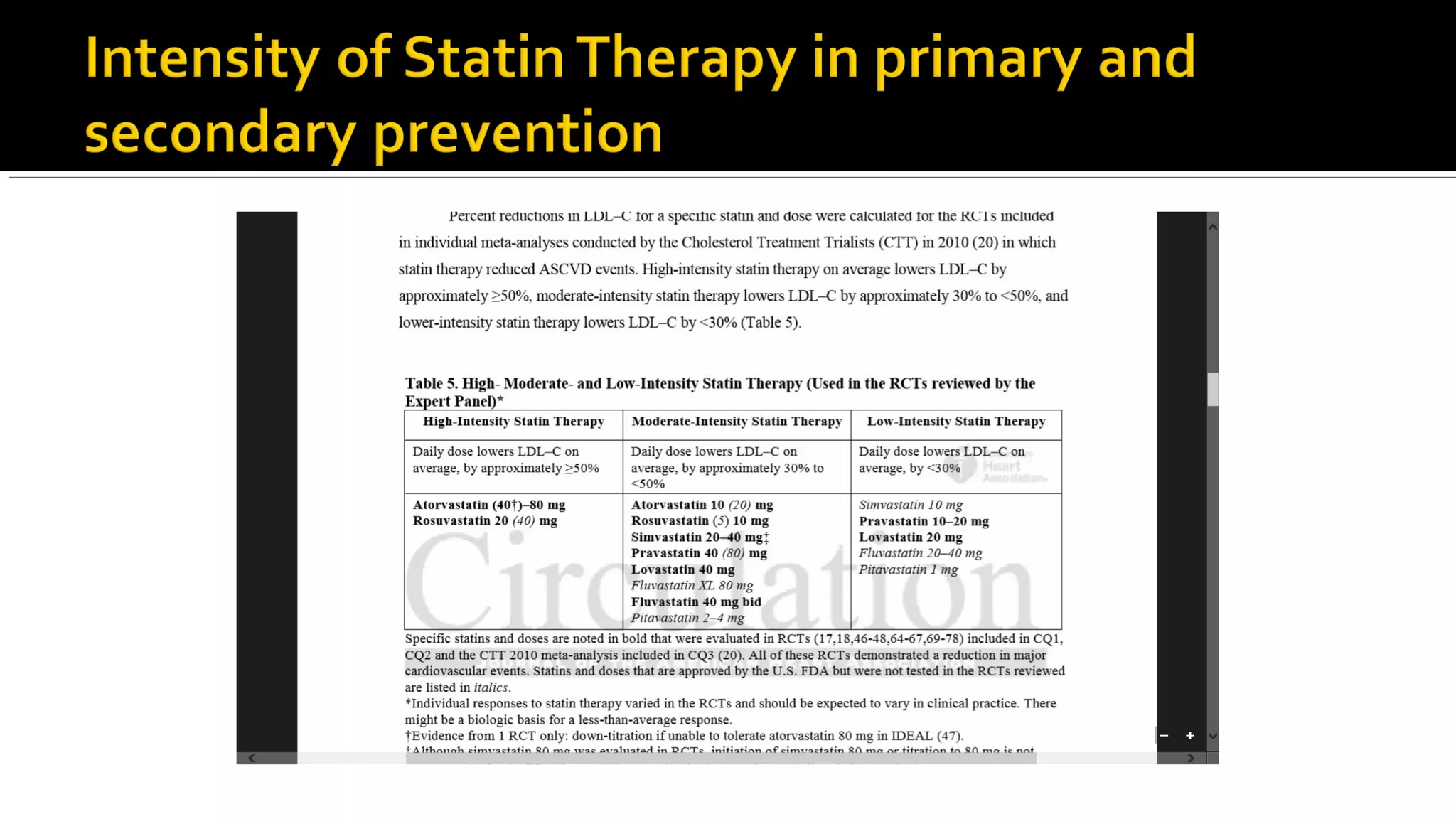
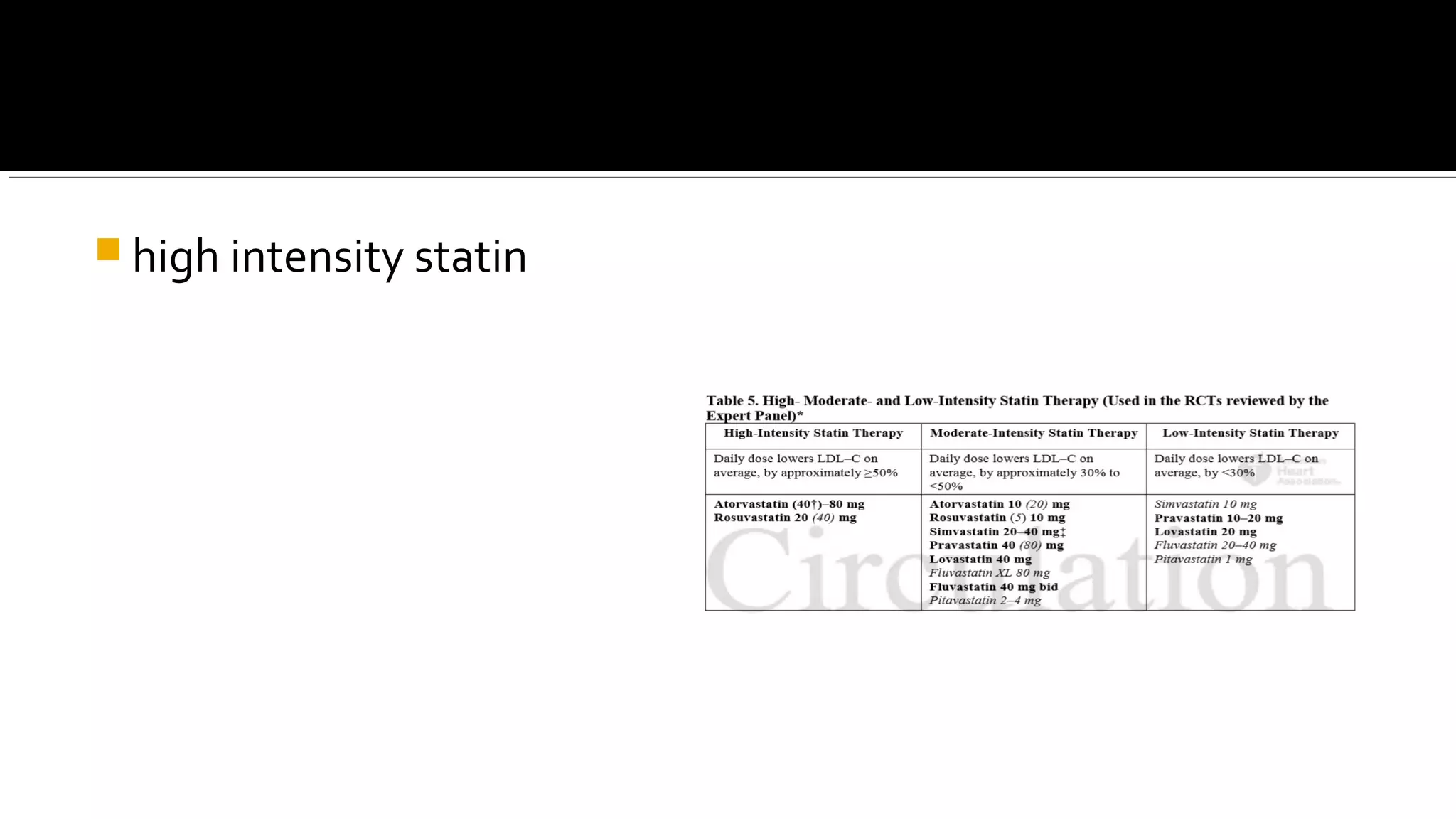
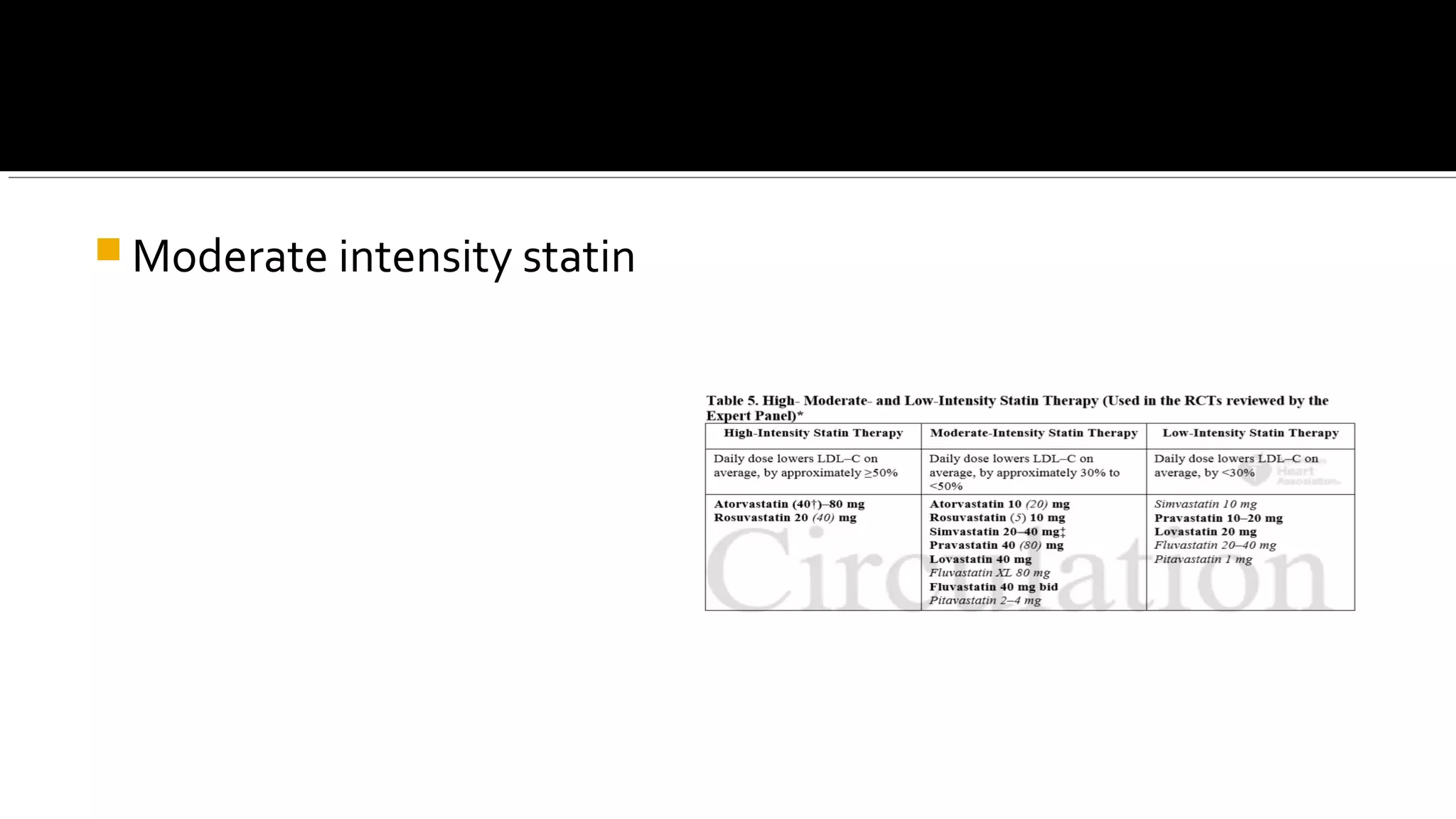
  • #10 This is just a chart you can use as a reference to choose the specific statin and its dose that is recommended to be used as high, moderate or low intensity statin
  • #11 The next few slides tells you the new guidelines on the safety recommendations for statins
  • #13 Symptoms of hepatic dysfunction: unusual fatigue or weakness, loss of appetite, abdominal pain, dark colored urine, Jaundice
  • #15 Mention that patient belongs to the fourth group meeting the criteria for moderate to high intensity statin given the 10 year risk of ASCVD is greater than 7.5%
  • #18 Mention that patient is a diabetic with 10 yr risk is greater than 7.5% so he or she is candidate for high intensity statin
  • #21 Mention that patient is a diabetic but since his or her ASCVD is less than 7.5%, he or she is a candidate for moderate intensity statin
  • #23 Ask the learner whether or not you need to calculate the 10 yr risk for developing the ASCVD in a patient with LDL&amp;gt;195. The answer is NO. This patient belongs to the second statin benefit group and is a candidate for high intesntity Statin regardless of 10 year risk
  • #27 Mention that despite the fact that the total cholesterol is high, since the LDL is less than 195, and patient doesn’t meet any other statin benefit group, there is no indication for statin therapy
  • #30 Re-emphasize the importance of learning how to use the new pooled cohort equation in daily practice